Search Blog Posts

Showing posts with label Social Security. Show all posts

Saturday, February 14, 2015

Will Uncle Sam get your IRA?

Posted on February 13, 2015 by Pat Heller

I have written a number of times that I expect the U.S. government will eventually take or somehow get control of all assets in private retirement accounts, including precious metals individual retirement accounts. The basic reason for this expectation is that the U.S. government is running up tens of trillions of dollars of debts and unfunded liabilities. The trillions of dollars of private retirement account assets are just too big a target for the politicians and bureaucrats to leave alone.
Will Uncle Sam get your IRA?

An early attempt by the government to take control of such assets came soon after President Clinton took office. As now structured, income taxes are not paid on most retirement accounts until the assets are withdrawn. This event to collect income taxes usually occurs years down the road.

In the early 1990s, that concept was turned around. The proposal was to impose a 15 percent tax on all existing private retirement accounts, then tax new contributions also at the 15 percent rate.  The payoff for taxpayers was that any future withdrawals would be tax free.

A new plan was presented to the House Committee on Education and Labor in hearings on Oct. 7, 2008, by Professor Teresa Ghilarducci. This proposal was for the U.S. government to seize all private retirement assets and replace them with Guaranteed Retirement Accounts (GRAs) managed by the Social Security Administration. The only assets that would be allowed into these new Accounts would be U.S. Treasury bonds paying 3 percent interest (indexed for subsequent Consumer Price Index changes).

Further, the plan called for 5 percent of payrolls to be withheld, on top of existing Social Security and Medicare tax withholdings, for deposit into these GRAs.  The last feature of this proposal is that upon the death of the account holder, part of the remaining assets would be forfeited to the U.S. government. That was a huge change where all private retirement account assets, up to now, go to the heirs.

The one bonus to bribe Americans to go along with the nationalization of private retirement accounts was that the assets would be converted to government bonds as of their value at a designated earlier date when most paper assets such as stocks, bonds and currencies were mostly at a higher value than they were in October 2008. Given the opportunity to recoup some of the losses that retirement accounts had suffered in 2007 and 2008, this was a definite enticement.

In September 2010, the Departments of Labor and Treasury held joint hearings to advocate that, upon retirement, the assets in private retirement accounts would be converted into annuities, where the residual assets upon death would ultimately all be retained by the U.S. government.

In January 2014, during his State of the Union address, President Obama proposed the establishment of the MyRA. This is initially a voluntary program for lower-income Americans to set aside some after-tax dollars to earn income that can later be withdrawn tax-free. However, there are several limitations. First, these accounts can only own U.S. Treasury debt that pays the same interest rate as the Thrift Savings Plan’s Government Securities Investment Fund. This fund was paying less than 2 percent at the time of the President’s proposal. A second major limitation is that accounts could not exceed $15,000 in total value. Further, these accounts cannot exist longer than 30 years.

Starting two months ago, a small number of these MyRA accounts have been established.
 
Investment writer Doug Fabian has described an all-too-plausible scenario that he expects to happen before the end of President Obama’s term. He anticipates that there will be some major financial crisis in the United States, greater than the Great Recession of last decade, where investors will see the values of their stocks, bonds and other assets mostly plummet.

This could be triggered by any number of incidents. As some examples, Greece could leave the European Monetary Union, which would force many major American and foreign banks to write down tens of billions of dollars of bonds that they are now carrying at face value.  The developing fall in demand for upper-end U.S. housing could expand to all housing nationwide, leaving U.S. banks with massive bad debts that risk their survival. Or local, school district, regional, and state governments all across America could be forced into bankruptcy after the Governmental Accounting Standards Board issues their pronouncements in June requiring these entities to more fully report the extent of their tens of trillions of dollars of unfunded liabilities for employee pensions and retiree health care benefits. There are many other possible crises, but this gives you an idea of how massive a financial crisis could occur.

At the time when such a financial crisis hits, private retirement account assets will almost all drop in value – by a lot.  If, or when, this occurs, there will be a huge groundswell from people who no longer have enough wealth to retire. Mr. Fabian theorizes that this will be the perfect time for the federal government to modify MyRA accounts to accept unlimited asset transfers from existing private retirement accounts. By the federal government offering people the opportunity to get credit for the value of their assets before the financial crisis was triggered, Fabian expects that a high percentage of Americans would voluntarily be eager to turn their retirement assets into loans to the U.S. Treasury.

Such a scenario would be a power-grabbing politician’s dream. Instead of being thought of as a President who stole people’s retirement assets, the person in charge in such circumstances were be hailed as a savior. Unfortunately, I think the risk of such events coming to pass by the end of 2016 are high enough that Americans need to prepare their finances sooner rather than later.

Should any huge financial crisis come to pass, expect to see a surge in demand for precious metals, especially gold and silver. Other portable tangible assets such as rare coins and paper money will also likely experience stronger demand.  However, the increased demand for such assets will not be for placement in retirement accounts.  Instead, look for the surge in demand to be for assets that can be owned and possessed directly.

Patrick A. Heller was the American Numismatic Association 2012 Harry Forman Numismatic Dealer of the Year Award winner. He is the owner emeritus and communications officer of Liberty Coin Service in Lansing, Mich., and writes “Liberty’s Outlook,” a monthly newsletter on rare coins and precious metals subjects. Past newsletter issues can be viewed at http://www.libertycoinservice.com. Other commentaries are available at Coin Week (http://www.coinweek.com and http://www.coininfo.com). He also writes a bi-monthly column on collectibles for “The Greater Lansing Business Monthly” (http://www.lansingbusinessmonthly.com/articles/department-columns). His Numismatic Literary Guild award-winning radio show “Things You ‘Know’ That Just Aren’t So, And Important News You Need To Know” can be heard at 8:45 a.m. Wednesday and Friday mornings on 1320-AM WILS in Lansing (which streams live and becomes part of the audio and text archives posted at http://www.1320wils.com).  

via numismaticnews

Monday, January 26, 2015

U.S. nursing homes' new tactic to collect debts: Seizing power of attorney from patients' relatives

If you haven't already cleared your remaining savings and other assets off the table, you probably should not rule it out until checking out this new government/corporatist fraud. Government is but the collection enforcement agent for the Corporatists.
 ~~~~~~~~~~~~~~~~~~~~~~~~~~~~~~~~~~~~~~~~~~
The New York Times | January 26, 2015 | Last Updated: Jan 26 11:16 AM ET
Piotr Redlinski/The New York Times: Dino and Lillian Palermo at the Mary Manning Walsh Nursing Home, which filed a guardianship petition asking the court to give a stranger full legal power over Lillian Palermo and complete control of her money, in New York, Oct. 31, 2014. 

NEW YORK — Lillian Palermo tried to prepare for the worst possibilities of aging. An insurance executive with a Ph.D. in psychology and a love of ballroom dancing, she arranged for her power of attorney and health care proxy to go to her husband, Dino, eight years her junior, if she became incapacitated. And in her 80s, she did.

Dino Palermo, who was the lead singer in a Midtown nightclub in the 1960s when Lillian’s elegant tango first caught his eye, now regularly rolls his wife’s wheelchair to the piano at the Catholic nursing home in Manhattan where she ended up in 2010 as dementia, falls and surgical complications took their toll. He sings her favourite songs, feeds her home-cooked Italian food, and pays a private aide to be there when he cannot.

It’s a strategic move to intimidate. Nursing homes do it just to bring money.

But one day last summer, after he disputed nursing home bills that had suddenly doubled Lillian Palermo’s copays, and complained about inexperienced employees who dropped his wife on the floor, Dino Palermo was shocked to find a six-page legal document waiting on her bed.

It was a guardianship petition filed by the nursing home, Mary Manning Walsh, asking the court to give a stranger full legal power over Lillian Palermo, now 90, and complete control of her money.

Few people are aware that a nursing home can take such a step. Guardianship cases are difficult to gain access to and poorly tracked by New York state courts; cases are often closed from public view for confidentiality.
Piotr Redlinski/The New York Times: Nursing homes are using a New York State statute created to protect the infirm as a way to get paid.

It’s so cruel. Mr. Palermo loves his wife, he’s there every single day, and they just threw him to the courts.

But the Palermo case is no aberration. Interviews with veterans of the system and a review of guardianship court data conducted by researchers at Hunter College at the request of The New York Times show the practice has become routine, underscoring the growing power nursing homes wield over residents and families amid changes in the financing of long-term care.

In a random, anonymized sample of 700 guardianship cases filed in Manhattan over a decade, Hunter College researchers found more than 12 percent were brought by nursing homes. Some of these may have been prompted by family feuds, suspected embezzlement or just the absence of relatives to help secure Medicaid coverage.

But lawyers and others versed in the guardianship process agree that nursing homes primarily use such petitions as a means of bill collection – a purpose never intended by the Legislature when it enacted the guardianship statute in 1993.

At least one judge has ruled that the tactic by nursing homes is an abuse of the law, but the petitions, even if they are ultimately unsuccessful, force families into costly legal ordeals.

The Palermo case is no different than any other nursing home bill that they had difficulty collecting. When you have families that do not co-operate and an incapacitated person, guardianship is a legitimate means to get the nursing home paid.

“It’s a strategic move to intimidate,” said Ginalisa Monterroso, who handled patient Medicaid accounts at the Mary Manning Walsh Nursing Home until 2012, and is now chief executive officer of Medicaid Advisory Group, an elder care counselling business that was representing Dino Palermo in his billing dispute. “Nursing homes do it just to bring money.”

“It’s so cruel,” she added. “Mr. Palermo loves his wife, he’s there every single day, and they just threw him to the courts.”

Brett D. Nussbaum, a lawyer who represents Mary Manning Walsh and many other nursing homes, said Dino Palermo’s devotion to his wife was irrelevant to the decision to seek a court-appointed guardian in July, when the billing dispute over his wife’s care reached a stalemate, with an outstanding balance approaching $68,000.
Nina Bernstein/The New York Times Dino and Lillian Palermo

“The Palermo case is no different than any other nursing home bill that they had difficulty collecting,” Nussbaum said, estimating that he had brought 5,000 guardianship cases himself in 21 years of practice. “When you have families that do not co-operate and an incapacitated person, guardianship is a legitimate means to get the nursing home paid.”
READ MORE

Sunday, December 7, 2014

Social Security has become the de facto retirement plan for millions of Americans.

...Social Security helps keep half of elderly Americans from poverty

Posted by mybudget360


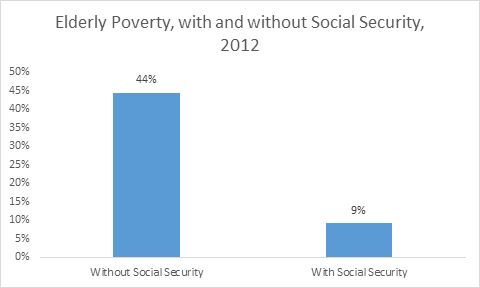
Social Security was never designed as a long-term retirement plan for millions of Americans.  Yet Social Security has become the default retirement plan for many elderly Americans.  In fact, if it were not for Social Security roughly 44 percent of elderly Americans would be in poverty.
 

This is calculated by how many Americans receive Social Security and the standard poverty income cutoff created by Census figures.  The middle class continues to struggle and falls further behind the curve

Since Social Security is adjusted via the CPI, it is problematic when the CPI fails to account for bigger changes in prices.  As we’ve highlighted before, inflation is here in big ways.
 

For older Americans healthcare costs are soaring and this eats deep
into their monthly budgets.  Social Security in various forms is now
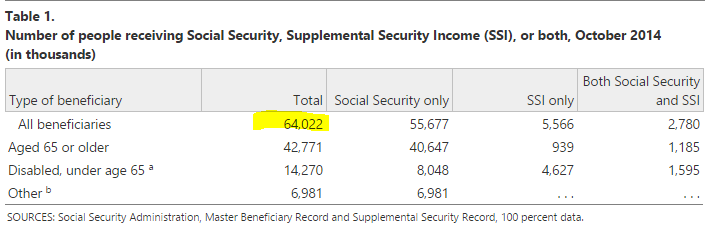
being received by 64million Americans.  This is a big deal especially with so many Americans hitting retirement age in the years to come.


Social Security the last barrier from poverty for millions

It was interesting to read a report highlight that without Social
Security, roughly 44 percent of elderly Americans would be in poverty:

“[Figures show]
that were it not for Social Security benefits, over 44 percent of the elderly would be poor. With it, that share falls to 9 percent.”

While some might see this in a positive light I see this as more of a
precautionary tale.  Many Americans are too close to the financial edge and are winging it in retirement.  The data is troubling:


elderly social security


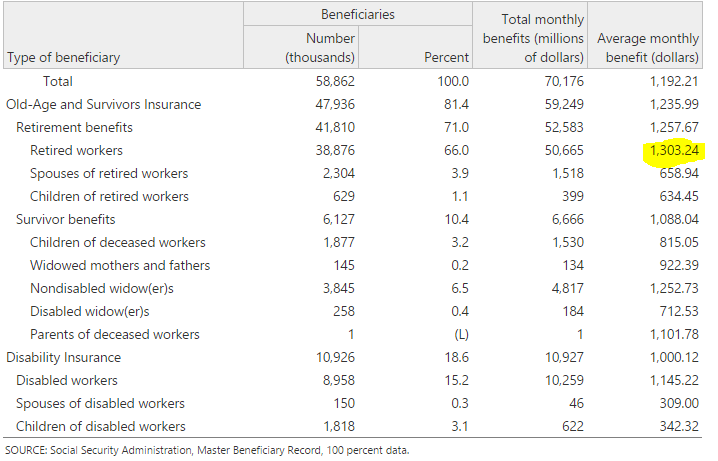
For more than one-third of retirees Social Security makes up 90 percent of their income.  And how much is the typical benefit?

social security average payment


For your typical retiree the typical monthly benefit is $1,300.  Keep
in mind that Social Security isn’t some kind of charity fund.  You pay into it when you work.  We all do.  However, with fewer younger workers and many making lower incomes combined with many older Americans retiring, the math is getting tougher to sustain here.  $1,300 a month does not go far especially when this is your primary source of retirement income.


Many Americans are now drawing on a system that was largely setup to help families for a few years to keep them from poverty.  But this now appears to be a long-term retirement system for older Americans.  Take a look at the raw numbers:

social security

64 million Americans receive some form of funds from the Social
Security Administration.  During the last decade, those claiming
disability has gone straight through the roof.  This figure requires
deeper analysis like the “not in the labor force” category of our employment.  The jump in those claiming disability simply does not go in line with population growth.  The figure held steady for a long period of time but the 2000s saw a steady increase:


[disability]

The bigger issue here is the structural changes to our economy and
many simply not finding work in the current economy.  There are some permanent changes to our economy here and many are depending on these monthly payments to stay out of poverty.  This is scary and doesn’t really speak to the quality of this recovery.  We still have 46 million Americans receiving food stamps.


It should be clear that Social Security has become the default retirement plan for millions of older Americans.  But with inflation
hitting in areas that are hard to measure via the CPI, COLA adjustments to Social Security benefits are simply not going to keep up.  


 Unfortunately many older Americans are going to fall into poverty as the years go by.


Source:
Social Security helps keep half of elderly Americans from poverty: Social Security has become the de facto retirement plan for millions of Americans.

Thursday, June 26, 2014

The Happy Story of Boomers Retiring on Their Generational Wealth Is Wrong

Wednesday, June 25, 2014
Charles Hugh Smith
This happy story is wrong on multiple counts.

The conventional view of the Baby Boomers' retirement is a happy story:
 since we're living longer and remaining productive longer, Boomers will not be as much of a burden on Gen-X and Gen-Y as doom-and-gloomers assume.

Not only are Boomers staying productive longer, they will draw upon their vast generational wealth as they age, limiting the financial burden on younger generations.


This happy story is nicely summarized in this lengthy piece The Fear Factor: Long-held predictions of economic chaos as baby boomers grow old are based on formulas that are just plain wrong.


In this view, the only thing needed to prop up Social Security for the rest of the 21st century is a higher tax on high-income earners, in effect moving the limit on earned income exposed to Social Security taxes from about $114,000 to $217,000.


This happy story is wrong on multiple counts. Let's start with the most egregious errors:


1. It ignores the End of Work and the decline of full-time jobs


2. It ignores the Elephants in the Room, Medicare and Medicaid


3. It ignores the inconvenient reality that there is nobody to buy the Boomers' overpriced stocks, bonds and homes when they start to unload them


Put another way:
 the happy story ignores the changing nature of work and jobs, the unsustainable cost trajectory of Sickcare (a.k.a. healthcare) and the inability of Gen-X and Gen-Y to buy Boomer assets at bubble valuations. Take these factors into minimal consideration and the claim that 76 million people (out of 316 million) can retire with no negative repercussions falls completely apart.

1. The end of work and changing nature of jobs: I have covered this for many years, most recently in a program with Gordon Long: The New Nature of Work: Jobs, Occupations & Careers (25 minutes, YouTube).


Insert end of work in the custom search box on this site and you'll get 10 pages of articles published here on that topic. For example:


Global Reality: Surplus of Labor, Scarcity of Paid Work (May 7, 2012)


The reality is sobering: 57 million people draw Social Security benefits, tens of millions more draw Medicaid, Section 8 housing credits, etc., and full-time jobs number 118 million:


The Good And The Not- So-Good News About US Jobs In One Chart (Zero Hedge)


That's a ratio of roughly two workers for every retiree and considerably less than that for workers to the total number of government dependents. As the Baby Boom retires en masse, if full-time jobs don't rise as dramatically as the number of retirees, the system fails.


The happy story repeats the usual falsehood that Social Security has a Trust Fund it can draw down. This is a falsehood because the Trust Fund is fiction: when Social Security runs a deficit, the Treasury funds it by selling Treasury bonds, the same way it funds any other deficit spending. If the Treasury can't sell bonds, the phantom nature of the Trust Fund will be revealed.


2. Everyone who looks at numbers rather than fictional claims knows the intractable problem is Medicare and Medicaid. In Sickcare, there are no real limits on cost, and so every attempt to impose cost discipline fails or triggers blowback. Read more

Thursday, June 19, 2014

Dallas Hospital Uses Executive Bonus Fund to Give Employees a Raise

(Incidentally, it was this Parkland Hospital to which the slain
President JFK was taken for treatment upon his assassination. Furthermore, we could find no evidence the employees had any need for a labor union.)


Thursday, June 19, 2014
Dr. Jim Dunn (photo: LinkedIn)
Raising the wages of low-paid workers normally doesn’t make headlines. But in an era of soaring corporate profits and stratospheric CEO salaries, a hospital in Dallas made news when its executives decided to spend money ticketed for their own benefit so employees at the lowest rung could receive a raise.

The hospital, Parkland Health & Hospital System in Dallas, announced recently that it would elevate its own minimum wage from $8.78 to $10.25 an hour starting in July. Texas’ state minimum wage is currently $7.25.

The decision will affect about 230 workers, including those who wash sheets and towels, who make food for patients, and who keep the hospital clean.

But it was how Parkland decided to finance the raise that got people’s attention. The extra $350,000 needed to fund the minimum wage increase will come out of a pool of money reserved for executives’ bonuses.

Dr. Jim Dunn, the hospital’s executive vice president and chief talent officer, told Modern Healthcare that the decision was “the right thing to do.”

“We really want, in any way possible, to break down any gaps or anything between the top leaders and those who are closest to our patients.”

Parkland’s effort comes at a time when the difference nationwide between CEO pay and the salaries of ordinary workers has gone from a ratio of 87-to-1 two decades ago to 296-to-1 today, according to Think Progress, a liberal advocacy group.


To Learn More:


Friday, May 30, 2014

New federal database will track Americans' credit ratings, Social Security #'s, other financial information

...and the Republicans are "deeply concerned"? Oh yeah, we'll take a Jeffersonian Democrat to preserve our liberties over a Republican any day!

By Richard Pollock | May 30, 2014
As many as 227 million Americans may be compelled to disclose intimate details of their families...

As many as 227 million Americans may be compelled to disclose intimate details of their families and financial lives -- including their Social Security numbers -- in a new national database being assembled by two federal agencies.

The Federal Housing Finance Agency and the Consumer Financial Protection Bureau posted an April 16 Federal Register notice of an expansion of their joint National Mortgage Database Program to include personally identifiable information that reveals actual users, a reversal of previously stated policy.

FHFA will manage the database and share it with CFPB. A CFPB internal planning document for 2013-17 describes the bureau as monitoring 95 percent of all mortgage transactions.

FHFA officials claim the database is essential to conducting a monthly mortgage survey required by the Housing and Economic Recovery Act of 2008 and to help it prepare an annual report for Congress.

Critics, however, question the need for such a “vast database” for simple reporting purposes.

In a May 15 letter to FHFA Director Mel Watt and CFPB Director Richard Cordray, Rep. Jeb Hensarling, R-Texas, and Sen. Mike Crapo, R-Idaho, charged, "this expansion represents an unwarranted intrusion into the private lives of ordinary Americans."

Crapo is the ranking Republican on the Senate Banking, Housing and Urban Affairs Committee. Hensarling is chairman of the House Financial Services Committee.

Critics also warn the new database will be vulnerable to cyber attacks that could put private information about millions of consumers at risk. They also question the agency’s authority to collect such information.

Earlier this year, Cordray tried to assuage concerned lawmakers during a Jan. 28 hearing of Hensarling's panel, saying repeatedly the database will only contain “aggregate” information with no personal identifiers.

But under the April register notice, the database expansion means it will include a host of data points, including a mortgage owner’s name, address, Social Security number, all credit card and other loan information and account balances.

The database will also encompass a mortgage holder’s entire credit history, including delinquent payments, late payments, minimum payments, high account balances and credit scores, according to the notice.

The two agencies will also assemble “household demographic data,” including racial and ethnic data, gender, marital status, religion, education, employment history, military status, household composition, the number of wage earners and a family’s total wealth and assets.

Only 12 public comments were submitted during the 30-day comment period following the notice's April 16 publication.

The mortgage database is unprecedented and would collect personal mortgage information on every single-family residential first lien loan issued since 1998. Federal officials will continue updating the database into the indefinite future.

The database held information on at least 10.1 million mortgage owners, according to a July 31, 2013, FHFA and CFPB presentation at an international conference on collateral risk.

FHFA has two contracts with CoreLogic, which boasts that it has “access to industry’s largest most comprehensive active and historical mortgage databases of over 227 million loans.”

Cordray confirmed in his January testimony that CoreLogic had been retained for the national mortgage database.

The credit giant Experian is also involved in the mortgage database project, according to an FHFA official who requested anonymity.
Read more…

Sunday, December 15, 2013

Friday, November 22, 2013

Why Your Pension Fund Is Doomed In Five Easy Charts


Source Pension Pulse

Submitted by Tyler Durden on 11/22/2013 19:50 -0500
A few days ago, when GMO released its quarterly thoughts, most focused immediately on the claim that the market is 75% overvalued. However perhaps an even more important analysis by author Ben Inker, and one which was largely ignored by most, is what front-loading so much market gains thanks to the Bernanke surge in the S&P means for future returns especially as it pertains to pension funds the bulk of which are already underfunded. GMO's conclusion was not a happy one.

Social Security: The Most Successful Ponzi Scheme in History

Mises Daily: Friday, November 22, 2013 by Gary Galles
 
“We paid our Social Security and Medicare taxes; we earned our benefits.” It is that belief among senior citizens that President Obama was pandering to when, in his second inaugural address, he claimed that those programs “strengthen us. They do not make us a nation of takers.”