Search Blog Posts

Showing posts with label Tyrants. Show all posts

Saturday, April 4, 2015

THE WAR PRAYER - Mark Twain *vid*


Uploaded on Apr 13, 2011 
Featured at Animation Film Screening at OSA Archivum in Budapest, Hungary to commemorate UN Human Rights Day, December 9, 2010. 
From OSA Program: The War Prayer (Markos Kounalakis, USA, 2006, 14 min) Based on Mark Twain's piece "The War Prayer," a short story written in the heat of the Philippine-American war of 1899-1902 offering a poignant reflection on the double-edged moral sword implicit to war. 

Followed by discussion with Markos Kounalakis, a Senior Fellow at the Center for Media and Communication Studies at the Central European University in Budapest, Hungary and President and Publisher Emeritus of the Washington Monthly. Moderator -- Oksana Sarkisova, Film Historian, OSA Archivum. 

From Wikipedia Notes: "The War Prayer," a short story or prose poem by Mark Twain, is a scathing indictment of war, and particularly of blind patriotic and religious fervor as motivations for war. The structure of the work is simple, but effective: an unnamed country goes to war, and patriotic citizens attend a church service for soldiers who have been called up. The people call upon their God to grant them victory and protect their troops. Suddenly, an "aged stranger" appears and announces that he is God's messenger. 

He explains to them that he is there to speak aloud the second part of their prayer for victory, the part which they have implicitly wished for but have not spoken aloud themselves: the prayer for the suffering and destruction of their enemies. What follows is a grisly depiction of hardships inflicted on war-torn nations by their conquerors. 

Friday, April 3, 2015

Resistance to Tyranny is Obedience to God

Should We Obey Authority … No Matter What?

A number of Christian leaders say that Christians must obey the government … no matter what.   For example, Robert Deffinbaugh – pastor at Community Bible Chapel in Richardson, Texas – says:
Whether the government be totalitarian or democratic, the Christian’s obligation to submit to it is the same.
Many ministers tell us we should act like slaves, blindly submitting to the government:
Some even allege that the U.S. government is coordinating with Christian ministers nationwide so that – if the government imposes martial – the ministers will urge their flocks to obey the government. See this and this.

This is not an unrealistic or abstract concept. After all, most churches in Nazi-era Germany supported the Nazis.    The German clergy used the same rationale to support Hitler that many American churches are using today to demand obedience to authority … Romans 13:
The German Christians were strongly nationalistic, and adopted … respect for state authority. This passage in Romans 13 was often cited as proof of a correlation between the Church and State:
Let every person be subject to the governing authorities. For there is no authority except from God, and those that exist have been instituted by God. Therefore he who resists the authorities resists the what God has appointed, and those who resist will incur judgment.
German church leaders even criticized Christians for disobeying their “governing authorities” … by protecting Jewish refugees by hiding them in their homes.

 
  1.  
And Hitler shows how tyrannical rulers view those who obey a demand for obedience … he ridiculed German Christians behind their backs for being so submissive in obeying the Nazis:
The Protestants haven’t the faintest conception of a church. You can do anything you like with them– they will submit. These pastors are used to cares and worries… they learnt them from their squires…. They are insignificant little people, submissive as dogs, and they sweat with embarrassment when you talk to them.

The Bible Urges Us to CHALLENGE – Not Obey – Bad Government

In reality, Christian (and Jewish) leaders throughout history have explained that we must disobey tyrannical governments.

The Book of Maccabees – an ancient Jewish book purporting to document the events which Chanukah celebrates - apparently says:
Resistance to tyranny is obedience to God.
(Thomas Jefferson agreed.)

Gordan Runyan – pastor of Immanuel Baptist Church – points out numerous instances in the Bible of men and women who disobeyed their government rulers, and were rewarded by God and praised as holy.

Indeed, the Bible mentions “justice” more than almost any other topic. The Bible demands that we do justice and to stand up to ANYONE — including the rich or powerful — who do injustice or oppress the people.

Baptist minister Chuck Baldwin writes:
Did John the Baptist violate God’s principle of submission to authority when he publicly scolded King Herod for his infidelity? Did Simon Peter and the other Apostles violate God’s principle of submission to authority when they refused to stop preaching on the streets of Jerusalem? Did Paul violate God’s principle of submission to authority when he refused to obey those authorities who demanded that he abandon his missionary work? In fact, Paul spent almost as much time in jail as he did out of jail.

Remember that every apostle of Christ (except John) was killed by hostile civil authorities opposed to their endeavors. Christians throughout church history were imprisoned, tortured, or killed by civil authorities of all stripes for refusing to submit to their various laws and prohibitions. Did all of these Christian martyrs violate God’s principle of submission to authority?

So, even the great prophets, apostles, and writers of the Bible (including the writer of Romans Chapter 13) understood that human authority – even civil authority – is limited.

Plus, Paul makes it clear that our submission to civil authority must be predicated on more than fear of governmental retaliation. Notice, he said, “Wherefore ye must needs be subject, not only for wrath, but also for conscience sake.” Meaning, our obedience to civil authority is more than just “because they said so.” It is also a matter of conscience. This means we must think and reason for ourselves regarding the justness and rightness of our government’s laws. Obedience is not automatic or robotic. It is a result of both rational deliberation and moral approbation.
***
Therefore, there are times when civil authority may need to be resisted. Either governmental abuse of power or the violation of conscience (or both) could precipitate civil disobedience.”
(Baldwin also notes that Romans 13 teaches that any government that is a “terror to good works” is acting beyond its authority and must be resisted. Therefore, Romans 13 compels us to resist and remove from power all elements of government which are corrupt.)
Reverend Howard Bess writes:
As modern New Testament scholars have reconstructed the context in which Jesus lived and taught, they have realized that Jesus was not simply a religious figure. He was a severe critic of those who controlled the temple, those who controlled the empire, and those who controlled the economic systems that starved and robbed the poor and left the orphan and the widow to fend for themselves. To Jesus, these issues were all tied together.
***
He advocated overthrow of a corrupt system. He believed the days of the oppressors were numbered. But he believed the overthrow could be accomplished by love, mercy and kindness.
Family Guardian Ministry notes:
The entire basis of the Reformation was that of disobedience to the “governing authorities” of Rome– the Pope and the Emperor, who both demanded submission to the Roman Catholic church as the religious and political establishment of God’s Kingdom on earth. When it was demanded of Martin Luther at the Diet of Worms to recant of his opposition to papal authority, his only response was as follows:
Unless I am refuted and convicted by testimonies of the Scriptures or by clear arguments… I am conquered by the Holy Scriptures quoted by me, and my conscience is bound in the word of God: I can not and will not recant any thing, since it is unsafe and dangerous to do any thing against the conscience. Here I stand. God help me! Amen.  [See Philip Schaff, History of the Christian Church]
Luther’s courageous stand against tyranny literally set off the spark which would eventually ignite the Protestant Reformation. As stated by Church historian, Philip Schaff:
Luther’s testimony before the Diet is an event of world-historical importance and far-reaching effect. It opened an intellectual conflict which is still going on in the civilized world. He stood there as the fearless champion of the supremacy of the word of God over the traditions of men, and of the liberty of conscience over the tyranny of authority….
When tradition becomes a wall against freedom, when authority degenerates into tyranny, the very blessing is turned into a curse, and history is threatened with stagnation and death. At such rare junctures, Providence raises those pioneers of progress, who have the intellectual and moral courage to break through the restraints at the risk of their lives, and to open new paths for the onward march of history…. Conscience is the voice of God in man.
***
This principle of the primacy of the Scripture-bound conscience over human tradition, whether it be magisterial or ecclesiastical, resounds throughout the writings of the most prominent Protestant leaders whom God raised up to defend the faith after Luther. Not one of these great men interpreted Romans 13:1-7 in the way it is so often interpreted today, and that should be sufficient reason to at least reconsider what is so commonly taught from the modern pulpit on the subject of civil obedience and disobedience. Without succumbing to the error of traditionalism, we are nevertheless to look upon the views of godly men of times past with respect.

John Calvin, known even by many of his theological opponents as the “prince of exegetes,” advocated the same position with regards to civil disobedience previously set forth by Luther.
*** Finish reading

Jesus died in a police state

If Jesus had been killed twenty years ago, Catholic school children would be wearing little electric chairs around their necks instead of crosses.”―Lenny Bruce
If you buy into the version of Christianity Lite peddled by evangelical leaders such as Franklin Graham, who recently advised Americans to do as the Bible says and “submit to your leaders and those in authority,” then staying alive in the American police state depends largely on your ability to comply, submit, obey orders, respect authority and generally do whatever a cop tells you to do.

If, however, you’re one of those who prefers to model yourself after Jesus Christ himself—a radical nonconformist who challenged authority at every turn—rather than subscribe to the watered-down, corporatized, simplified, gentrified, sissified vision of a meek creature holding a lamb that most modern churches peddle, then you will understand better than most how relevant Jesus’ life and death are to those attempting to navigate the American police state.

Indeed, it is fitting, at a time when the nation is grappling with moral questions about how best to execute death row prisoners (by electric chair, lethal injection or shooting squad), whether police should be held responsible for shooting unarmed citizens (who posed no threat and complied with every order), and to what extent we allow the government to dictate, monitor and control every aspect of our lives (using Stingray devices, license plate readers, and all manner of surveillance technology), that we remember that Jesus Christ—the religious figure worshipped by Christians for his death on the cross and subsequent resurrection—died at the hands of a police state.

Those living through this present age of militarized police, SWAT team raids, police shootings of unarmed citizens, roadside strip searches, and invasive surveillance might feel as if these events are unprecedented. Yet while we in the United States may be experiencing a steady slide into a police state, we are neither the first nor the last nation to do so.

Although technology, politics and superpowers have changed over time, the characteristics of a police state and its reasons for being have remained the same: control, power and money. Indeed, as I point out in my book Battlefield America: The War on the American People, a police state extends far beyond the actions of law enforcement. In fact, a police state “is characterized by bureaucracy, secrecy, perpetual wars, a nation of suspects, militarization, surveillance, widespread police presence, and a citizenry with little recourse against police actions.”

Just as police states have arisen throughout history, there have also been individuals or groups of individuals who have risen up to challenge the injustices of their age. Nazi Germany had its Dietrich Bonhoeffer. The gulags of the Soviet Union were challenged by Aleksandr Solzhenitsyn. America had its color-coded system of racial segregation and warmongering called out for what it was, blatant discrimination and profiteering, by Martin Luther King Jr.

And then there was Jesus Christ, an itinerant preacher and revolutionary activist, who not only died challenging the police state of his day—namely, the Roman Empire—but provided a blueprint for civil disobedience that would be followed by those, religious and otherwise, who came after him. Yet for all the accolades poured out upon Jesus, little is said about the harsh realities of the police state in which he lived and its similarities to modern-day America, and yet they are striking.

Secrecy, surveillance and rule by the elite. As the chasm between the wealthy and poor grew wider in the Roman Empire, the ruling class and the wealthy class became synonymous, while the lower classes, increasingly deprived of their political freedoms, grew disinterested in the government and easily distracted by “bread and circuses.” Much like America today, with its lack of government transparency, overt domestic surveillance, and rule by the rich, the inner workings of the Roman Empire were shrouded in secrecy, while its leaders were constantly on the watch for any potential threats to its power. The resulting state-wide surveillance was primarily carried out by the military, which acted as investigators, enforcers, torturers, policemen, executioners and jailers. Today that role is fulfilled by increasingly militarized police forces across the country. Finish reading

Tuesday, March 31, 2015

Leak of Secret Trade Document Reveals Sovereignty-Destroying Courts

Tuesday, 31 March 2015

Written by 

Why has the Obama administration kept the Trans-Pacific Partnership agreement text secret from Congress and the American people? 

A newly leaked TPP chapter reveals at least one huge reason: The TPP text proposes creating tribunals (courts) that could overrule the decisions of our state and federal courts, as well as our local, state and federal laws — and our state and national constitutions.

The tribunals would be presided over by arbitrators (judges) appointed by the Secretary-General of the International Centre for Settlement of Investment Disputes (ICSID), an institution of the World Bank Group. The ICSID is housed at the World Bank’s headquarters complex in Washington, D.C. The ICSID receives its funding from the World Bank and the ICSID’s governing Council is chaired by the President of the World Bank. So the proposed TPP tribunals are, in essence, a means for transferring judicial authority over vast areas of domestic law to “arbitrators” picked by the World Bank — and the central bankers and the giant commercial/investment bankers that run the World Bank.

On March 25, the international organization WikiLeaks released the “Investment Chapter” of the still-classified Trans-Pacific Partnership agreement that the Obama administration has been secretly negotiating for the past several years. Despite repeated calls from members of the United States Senate and House of Representatives, as well as legal scholars and law professors for the administration to make good on its pledges of transparency, the TPP negotiations have remained a closed, secret  process — except for the representatives of major corporations and Wall Street banks, along with other privileged “stakeholders,” who are not only given access to the TPP documents, but even allowed to participate in negotiations.

The WikiLeaks release of the TPP’s Chapter 2 on investment should assist patriots who are trying to build opposition to this dangerous agreement that represents a giant step toward regional and global government. It also confirms what The New American has reported over the past several years: that TPP was following in the footsteps of NAFTA, the WTO and other “free trade” arrangements that are rapidly eroding U.S. national sovereignty and independence.

Among the significant articles included in Chapter 2 is “Article II.21: Selection of Arbitrators.” This section tells us, among other things: “The Secretary-General [of ICSID] shall serve as appointing authority for an arbitration under this Section.” It states further: “if a tribunal has not been constituted within 75 days from the date that a claim is submitted to arbitration under this Section, the Secretary-General, on the request of a disputing party, shall appoint, in his or her discretion, the arbitrators not yet appointed.”

As we have noted in previous articles, Secretary of State John Kerry has been a key operative in overseeing the TPP negotiations. While he was a U.S. Senator, Kerry supported and voted for NAFTA. Years later, when NAFTA tribunals began overruling U.S. law and U.S. court decisions, Kerry used the innocence-through-ignorance defense, claiming to have been completely blindsided by the Chapter 11 tribunals that were in the agreement he voted for. 

"When we debated NAFTA," Kerry told the New York Times, "not a single word was uttered in discussing Chapter 11. Why? Because we didn't know how this provision would play out. No one really knew just how high the stakes would get." But it is not true that “no one really knew” of the danger from the tribunals; this publication, along with others warned of this very danger. But Senator Kerry and other NAFTA supporters chose to ignore, or scoff at, those warnings. Moreover, it was his duty to know what was in the agreement before voting for it; the claim of ignorance is a self-incriminating excuse.

In its unauthorized release of the purported TPP text on March 25, Wikileaks provides this description:
This is an advanced January 2015 version of the confidential draft treaty chapter from the Investment groups of the Trans Pacific Partnership (TPP) talks between the United States, Mexico, Canada, Australia, Malaysia, Singapore, Peru, Vietnam, New Zealand and Brunei Darussalam. The treaty is being negotiated in secret by delegations from each of these 12 countries, who together account for 40% of global GDP. The chapter covers agreements on investments from one TPP nation to another, including empowering foreign firms to “sue” other states’ governments, as well as regulations around investor-state dispute settlements and tribunals. This document was prepared by TPP investment chapter negotiators in advance of the informal round of negotiations held in New York City 26th January to 1st February, 2015.
The WikiLeaks release also highlights another audacious feature of the TPP that we have reported previously: not only are the negotiations being conducted in secrecy, and not only are the TPP text documents being withheld from the public and the public’s elected representatives, but even more outrageous is the effort by the TPP negotiators to keep the agreement (or at least certain portions of the agreement and the negotiating process) secret for four years after it goes into effect! At the beginning of the newly released Chapter 2 is this classification notice: Finish reading

Sunday, March 29, 2015

Will America's Revolution be another French Terror? - *7min. vid*

Let's hope not. For one thing France is today, and in a shorter time, more socialist than we are. Our Constitution for individuals' liberties is superior, yet "we the people" send people to represent us who denigrate it, and tolerate its decay and abuse. Second, while violence may be thought of as an alternative, today we have the UN which could summon world troops to our soil expeditiously to crush us. Ron Paul has pointed us in the right direction, but will we snore on, and look to the problem of Government for the solution?

Would you deny that America is well on its way to creating her very own "committee of public safety"?


              Oh ye of the Third Estate, take heed!

What About the French Revolution?

Friday, November 18, 2011 – by Staff Report
from The Daily Bell

We are increasingly believers in "directed history" – history that's coordinated by a power elite intent on creating one-world government. We've written a good deal about the directed history we're seeing as regards Occupy Wall Street. We think that the movement has been set up to be divisive and ultimately to reinforce the power of the state. Out of chaos ... order.


That's probably the reason the movement has no agenda. The people at the top who are manipulating the movement know what they want to achieve and are doing so in order to trigger increased social discord. The ultimate aim, perhaps, is to enhance world government. We've explained the parallelism here: VIDEO: Parallels Between Early 20th Century and Present Are Scary.

But there are even more parallels. The Tea Party movement in America was organic to begin with. It was a bit like the American Revolution. But having observed the American Revolution, the power elite of the day (from what we can tell) fomented the French Revolution.

That's how long the modern conspiracy to set up world government has been going on, in our view – about 300 years, maybe since the founding of the Illuminati. The American Revolution, manipulated as it may have been, ultimately was in a sense anti-government and focused on individual freedom.
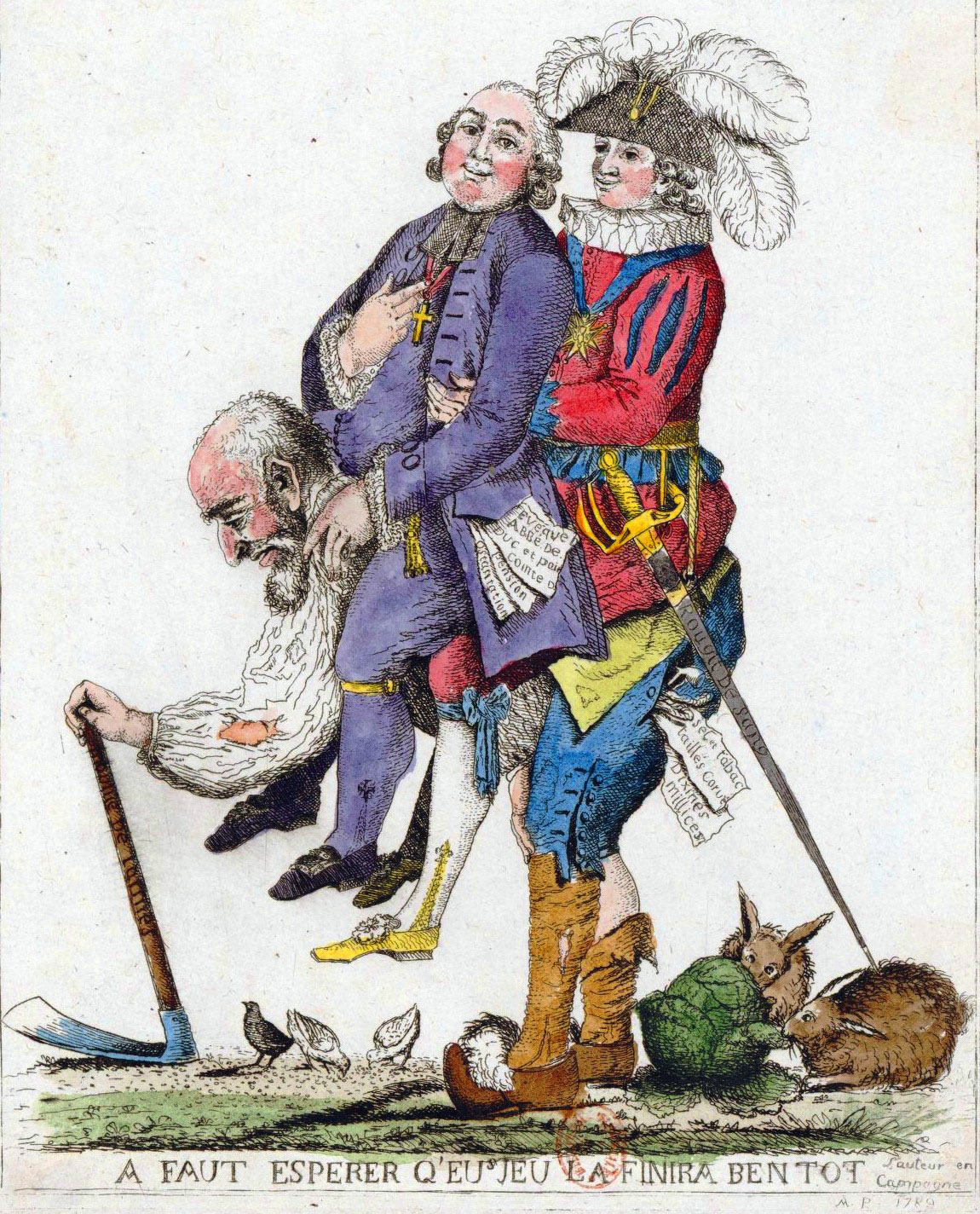
English: The Third Estate carrying the
Clergy and the Nobility on its back
Français : Le Tiers-État portant le
Clergé et la Noblesse sur son dos.

The French Revolution was set up deliberately to be "pro-government" – or pro-force at any rate. It was designed to defuse classical liberalism and freedom by proposing that government in the hands of an expert technocracy could "perfect" society and humankind.

Post revolution, between 1789 and September 1791, the French National Assembly reformed the ancient regime. They accomplished this with six basic statements, according to the website Modern European Intellectual History. Here are three of six. We've substituted the word "bankster" for "clergy" and "monarch" ...

•the abolition of special privileges of BANKSTERS through the legalization of equality (August 4, 1789)

•they subordinated BANKSTERS to the State. In November 1789, the National Assembly confiscated all BANKSTER property. And in early 1790, they passed the civil constitution, which reduced the power of the BANKSTERS who were now selected and paid by the State

•in September 1791, the National Assembly drew up a constitution, something it had been trying to do since June 1789. The constitution of 1791 specified such liberal ideas as limited BANKSTERS and full equality before the law

"Populist" movements like the French Revolution rarely end well because they are expressions mostly of anger and envy. They are not rational. They eat their own. That's what happened then as the movement began with the idea of overthrowing the regime and ended up by trying to "perfect" society using the power of the state.

Here is a Wikipedia summary:

http://en.wikipedia.org/wiki/French_revolution

The French Revolution (1789–1799), sometimes distinguished as the 'Great French Revolution' (La Grande Révolution), was a period of radical social and political upheaval in France and Europe. The absolute monarchy that had ruled France for centuries collapsed in three years. French society underwent an epic transformation as feudal, aristocratic and religious privileges evaporated under a sustained assault from radical left-wing political groups, masses on the streets, and peasants in the countryside. Old ideas about tradition and hierarchy - of monarchy, aristocracy and religious authority - were abruptly overthrown by new Enlightenment principles of equality,citizenship and inalienable rights.

The French Revolution began in 1789 with the convocation of the Estates-General in May. The first year of the Revolution saw members of the Third Estate proclaiming the Tennis Court Oath in June, the assault on the Bastille in July, the passage of the Declaration of the Rights of Man and of the Citizen in August, and an epic march on Versailles that forced the royal court back to Paris in October. The next few years were dominated by tensions between various liberal assemblies and a right-wing monarchy intent on thwarting major reforms.

A republic was proclaimed in September 1792 and King Louis XVI was executed the next year. External threats also played a dominant role in the development of the Revolution. The French Revolutionary Wars started in 1792 and ultimately featured spectacular French victories that facilitated the conquest of the Italian Peninsula, the Low Countries and most territories west of the Rhine – achievements that had defied previous French governments for centuries.

Internally, popular sentiments radicalized the Revolution significantly, culminating in the rise of Maximilien Robespierre and the Jacobins and virtual dictatorship by the Committee of Public Safety during the Reign of Terror from 1793 until 1794 during which between 16,000 and 40,000 people were killed. After the fall of the Jacobins and the execution of Robespierre, the Directory assumed control of the French state in 1795 and held power until 1799, when it was replaced by the Consulate under Napoleon Bonaparte.

After the Napoleonic Wars and ensuing rise and fall of Napoleon's First French Empire, a restoration of absolutist monarchy was followed by two further successful smaller revolutions (1830 and 1848). This meant the 19th century and process of modern France taking shape saw France again successively governed by a similar cycle of constitutional monarchy (1830-48), fragile republic (Second Republic) (1848-1852), and empire (Second Empire) (1852-1870). The modern era has unfolded in the shadow of the French Revolution. The growth of republics and liberal democracies, the spread of secularism, the development of modern ideologies and the invention of total war all mark their birth during the Revolution.

Below is a short video narrative of the French Revolution. It is simple and direct and written apparently by a high school student. We recommend it for the blunt arc of its narrative, even if it contains some factual flaws. Young people, not being so sophisticated their elders, sometimes see more clearly ...

(Video from byustudent2012's YouTube user channel.)

source: TheDailyBell

Saturday, March 28, 2015

Bipartisan House Bill would Repeal Patriot Act and Ban Mass Surveillance of Americans

Anyone taking odds on this congress has neither the guts or moral fiber to go against the oligarchy that owns them...and us?

Friday, March 27, 2015
Reps. Mark Pocan
and Thomas Massie
 
An ambitious bipartisan bill that would seriously roll back the federal government’s ability to conduct surveillance operations has been introduced in the U.S. House of Representatives.
HR 1466 (pdf) (the Surveillance State Repeal Act) would do away with the Patriot Act (pdf) and ban large-scale spying programs, such as the National Security Agency’s telephone metadata collection that has generated so much controversy. It is the most far-reaching anti-surveillance legislation drafted to date.

“This isn’t just tinkering around the edges, it’s a meaningful overhaul that makes sure the meaningless surveillance of emails and cell phones are done away with,” Representative Mark Pocan (D-Wisconsin), one of the bill’s authors, told a briefing for congressional staffers, according to ThinkProgress. The coauthor of HR 1466 is Representative Thomas Massie (R-Kentucky).

The bill’s original co-sponsors are Democrats Alan Grayson of Florida, James McGovern of Massachusetts and Lloyd Doggett of Texas. Other supporters include libertarian organizations opposed to widespread government spying.

Patrick Eddington, national security and civil liberties policy analyst for the libertarian think tank CATO Institute, said: “All mass surveillance does is violate the rights and put a chilling effect on the American people.”

The legislation also would eliminate numerous surveillance permissions granted under the Foreign Intelligence Surveillance Act (pdf) amendments approved by Congress during the George W. Bush administration.

The Hill reported that the proposal is “likely to be a nonstarter for leaders in Congress, who have been worried that even much milder reforms to the nation’s spying laws would tragically handicap the nation’s ability to fight terrorists. A similar bill was introduced in 2013 but failed to gain any movement in the House.”

Congress has until June 1 to reauthorize portions of the Patriot Act that support the government’s surveillance operation. Without re-authorization of the law’s Section 215, the telephone metadata program will expire.
-Noel Brinkerhoff
To Learn More:
HR 1466 (Congress.gov) (pdf)
NSA Phone Data Collection Made No Difference to National Security (by Noel Brinkerhoff and Danny Biederman, AllGov)

Thursday, March 26, 2015

▶ ARMY and MSM Launch DisInfo Psyop Against American People – YouTube


Published on Mar 23, 2015


Alex Jones covers the current disinfo psyop being launched by the federal government in conjunction with Army Special Forces, mainstream media outlets who are afraid that the public is waking up to the fact that programs and training exercises are being launched to condition the public that troops will be placed on the streets in the event of a national emergency.
 
Related:
FEDS PREPARING TO INVADE TEXAS, LIST STATE AS ‘HOSTILE’ – http://www.infowars.com/feds-preparin…

SOCOM PLAN TO INVADE ‘HOSTILE’ TEXAS REVEALED – http://www.infowars.com/socom-plan-to…

 Image result for ARMY and MSM Launch DisInfo Psyop Against

Friday, March 6, 2015

A Lone Wolf President & His Executive Orders

Can the president rewrite federal laws? Can he alter their meaning? Can he change their effect? These are legitimate questions in an era in which we have an unpopular progressive Democratic president who has boasted that he can govern without Congress by using his phone and his pen, and a mostly newly elected largely conservative Republican Congress with its own ideas about big government.

These are not hypothetical questions. In 2012, President Obama signed executive orders that essentially said to about 1.7 million unlawfully present immigrants who arrived in the U.S. before their 16th birthdays and who are not yet 31 years of age that if they complied with certain conditions that he made up out of thin air they will not be deported.

In 2014, the president signed additional executive orders that essentially made the same offer to about 4.7 million unlawfully present immigrants, without the age limits that he had made up out of thin air. A federal court enjoined enforcement of the 2014 orders last month.

Last week, the Federal Communications Commission — the bureaucrats appointed by the president who regulate broadcast radio and television — decreed that it has the authority to regulate the Internet, even though federal courts have twice ruled that it does not.

Also last week, the federal Bureau of Alcohol, Tobacco, Firearms and Explosives, whose director is appointed by the president, proposed regulations that would outlaw the only mass-produced bullets that can be fired from an AR-15 rifle. This rifle has been the target of the left for many years because it looks like a military weapon; yet it is a lawful and safe civilian rifle commonly owned by many Americans.

This week, the president’s press secretary told reporters that the president is seriously thinking of signing executive orders intended to raise taxes on corporations by directing the IRS to redefine tax terminology so as to increase corporate tax burdens. He must have forgotten that those additional taxes would be paid by either the shareholders or the customers of those corporations, and those shareholders and customers elected a Congress they had every right to expect would be writing the tax laws. He has eviscerated that right.

What’s going on here?

What’s going on is the exercise of authoritarian impulses by a desperate president terrified of powerlessness and irrelevance, the Constitution be damned. I say “damned” because when the president writes laws, whether under the guise of administrative regulations or executive orders, he is effectively damning the Constitution by usurping the powers of Congress.

The Constitution could not be clearer.

Article I, section 1 begins, “All legislative Powers herein granted shall be vested in a Congress of the United States.” Obama actually asked Congress to write the laws he is now purporting to write, and Congress declined, and so he does so at his peril.

In 1952, President Truman seized America’s closed steel mills because steel workers went on strike and the military needed hardware to fight the Korean War. He initially asked Congress for authorization to do this, and Congress declined to give it to him; so he seized the mills anyway. His seizure was challenged by Youngstown Sheet & Tube Co., then a huge operator of steel mills. In a famous Supreme Court decision, the court enjoined the president from operating the mills.

Youngstown is not a novel or arcane case. The concurring opinion by Justice Robert Jackson articulating the truism that when the president acts in defiance of Congress he operates at his lowest ebb of constitutional power and can be enjoined by the courts unless he is in an area uniquely immune from congressional authority is among the most highly regarded and frequently cited concurring opinions in modern court history. It reminds the president and the lawyers who advise him that the Constitution imposes limits on executive power.

The president’s oath of office underscores those limits. It requires that he enforce the laws faithfully. The reason James Madison insisted on using the word “faithfully” in the presidential oath and putting the oath itself into the Constitution was to instill in presidents the realization that they may need to enforce laws with which they disagree — even laws they hate.

But Obama rejects the Youngstown decision and the Madisonian logic. Here is a president who claims he can kill Americans without due process, spy on Americans without individualized probable cause, start wars on his own, borrow money on his own, regulate the Internet, ban lawful guns, tell illegal immigrants how to avoid the consequences of federal law, and now raise taxes on his own.

One of the safeguards built into the Constitution is the separation of powers: Congress writes the laws, the president enforces the laws, and the courts interpret them. The purpose of this separation is to prevent the accumulation of too much power in the hands of too few — a valid fear when the Constitution was written and a valid fear today.

When the president effectively writes the laws, Congress is effectively neutered. 

Yet, the reason we have the separation of powers is not to protect Congress, but to protect all individuals from the loss of personal liberty. Under Obama, that loss has been vast. Will Congress and the courts do anything about it?

COPYRIGHT 2015 ANDREW P. NAPOLITANO
source 10thACtr

Wednesday, March 4, 2015

The Myth of the Voluntary Military

July 29, 2011 Jeffrey A. Tucker

Ludwig von Mises summed up the essence of government in words that are particularly vivid in wartime:
Government interference always means either violent action or the threat of such action.… Government is in the last resort the employment of armed men, of policemen, gendarmes, soldiers, prison guards, and hangmen. The essential feature of government is the enforcement of its decrees by beating, killing, and imprisoning. Those who are asking for more government interference are asking ultimately for more compulsion and less freedom.

What about those who are called upon to enforce state edicts, whether just or unjust? Every society includes people who are willing to act as the coercive arm of the state, those who are willing to use violence and freely risk their lives as they administer the law. The state has no great trouble recruiting policemen and prison guards. Are there enough such people to amass a huge army of hundreds of thousands of people who are willing to risk their lives carrying out destructive foreign wars of dubious merit?

When you see the pictures of American troops fighting their way through sand storms, in a strange land with strange people, seeking to overturn a government and transform a society that posed no credible threat to the United States, being shot at by average Iraqis who are clearly motivated only by the desire to expel the invader, it is not hard to imagine that US troops are wondering how it all came to this.

The British defense secretary, Geoff Hoon, claims that the coalition armed forces are made up of "men and women who made a free choice to serve their country," whereas Iraqi forces "are motivated either by fear or by hatred." It's hard to say what motivates Iraqi forces (perhaps the desire to repel invasion?), but what he says about coalition troops is simply not true.


The men and women now fighting initially agreed to be in the employ of the military. The United States is not yet conscripting people. And yet how many of these would leave Iraq if they could? What if Donald Rumsfeld announced that anyone now fighting in Iraq is free to leave without penalty? What would become of the US armed forces now attempting to bring about unconditional surrender in Iraq?

It's an interesting question, as a pure mental experiment, because it highlights the essentially forced nature of all modern military service. To leave once the war begins would amount to what the government calls desertion. This word sounds ominous, but in fact it merely describes what everyone in a civilized society takes for granted: the right to quit.

Deuteronomy's exhortation to encourage the Israelites into battle includes an invitation to freely leave: "What man is there that is fearful and fainthearted? Let him go and return unto his house." (20:8) But there is no such right in the modern US military. If you try to leave, you face coercion, particularly if you try to leave in wartime. In this way, the military differs from the police and the ranks of prison guards, jobs from which people are free to walk away without penalty.

Punishing people for attempting to leave the military — to avoid killing and/or being killed — is not a new practice. Mises speaks of the "barbarous" practices used in the 18th century to keep soldiers from deserting their units. The more undesirable wartime conditions become, the more necessary it is for the state to force people to continue to endure them.

The scene that shocked me most in the movie Gods and Generals — and it was clearly not intended to be shocking — occurs when an assistant to Stonewall Jackson informs the general that some soldiers have been discovered in an attempt to desert the army under his command. The general orders them to be tried in a military court, and, if found guilty of attempted desertion, to be shot. They were indeed tried and shot. Thus did these men die for exercising their God-given right to walk away.

One of those shot in the film was a young man recruited by Jackson himself, the son of a friend who decided to return to the North. The scene was included to demonstrate Jackson's impartiality. This general is no respecter of persons — or (more plausibly) personhood. To me, the scene demonstrated the immorality of all modern notions of military discipline.

As the movie shows, the South believed it was fighting for the right of self-government, which required that the states be able to exercise their right to leave an increasingly despotic Union. But the military command would not allow their soldiers to secede. The Confederate generals believed that the Union must be voluntary, but the army itself must be kept together through coercion.
"The legalization of desertion might provide the very key to bringing about a more humane world."

Of course, Northern armies employed the same practice. Many Union troops believed they were fighting against slavery, which amounts to nothing more than forbidding people from exercising their right to flee their alleged owners. But the imposition of the death penalty for soldiers choosing not to fight, that is, to flee their military owners, was assumed to be a normal part of military discipline.

Both North and South claimed they were fighting in order to abolish a form of captivity — the right to self-government in one case, and the right to not be employed against one's will in the other — but the ability of the military to imprison and kill fleeing soldiers was never questioned. It is not often questioned tod

The scene parallels the opening sequence in the movie Enemy at the Gates, when Russian troops in boats are being bombed from the air by German planes. Russian troops begin to jump in the water to get away. Their Russian commander starts to unload his pistol as they leap. The viewer is rightly shocked by this incredible display of totalitarian brutality. Yet, in essence, what we are seeing is nothing more than a fast-forwarded version of the court-martial, death-penalty scene in Gods and Generals.

Both scenes underscore a reality hardly ever discussed: all modern armies are essentially totalitarian enterprises. Once you sign up for them, or are drafted, you are a slave. The penalty for becoming a fugitive is death. Even now, the enforcements against mutiny, desertion, going AWOL, or what have you, are never questioned.

This is remarkable, if you think about it. Imagine that you work for Walmart but find the job too dangerous, and try to quit. You are told that you may not, so you run away. The management catches up to you, and jails you. You refuse to go and resist. Finally, you are shot. We would all recognize that this is exploitation, an atrocity, a crime, a clear example of the disregard that this company has for human life. The public outrage would be palpable. The management, not the fleeing employees, would be jailed or possibly executed.

Murray Rothbard frames the question nicely: "In what other occupation in the country are there severe penalties, including prison and in some cases execution, for 'desertion,' i.e., for quitting the particular employment? If someone quits General Motors, is he shot at sunrise?"

The military has done a study1  of what causes people to go AWOL, concluding that the practice "tends to increase in magnitude during wartime" and when "the Army is attempting to restrict the ways that soldiers can exit service through administrative channels."

The same study profiles the deserters, as compared with nondeserters, as less educated, having a lower aptitude, more likely to be from broken homes, etc. — all the usual reasons why a person is so dishonorably disinclined to want to be killed. Finally, this study examined the effects of desertion on the individual, concluding that choosing to be disemployed from the ranks of the armed and dangerous causes "loss of self-esteem and confidence" as well as "embarrassment and even shame." Well, what else would you expect from someone who has "chosen a certain path and failed to meet the necessary requirements and/or sustain the fortitude to meet those requirements"?

Now comes the report from Diwaniya, Iraq, heavily cited by a US military spokesman, that many Iraqi soldiers were fighting at gunpoint, threatened with death by tough loyalists of President Saddam Hussein.… "The officers threatened to shoot us unless we fought," said a wounded Iraqi from his bed in the American field hospital here. "They took out their guns and pointed them and told us to fight."

It could be that the captured soldiers are only trying to win sympathy. But it would hardly be surprising if it were true. To force people to fight when they would rather not is the very essence of modern military organization. In modern practice, there is no such thing as a voluntary military. Whether you are forced into the machine or not (via conscription or via payments in tax dollars), once you are a cog, you must stay in no matter how much grinding you do or how much you are ground.

The slave-like nature of the military commitment has no expiration date. Yes, there are contracts, but the military can void them whenever it so desires. Predictably, it desires to void these contracts (through so-called stop-loss regulations) when the enlisted most want to leave: when they must kill and risk being killed. All branches of the military have implemented these stop-loss regulations because of the war on terror. This amounts to the nationalization of human beings.
 
Still, one wonders how much the ranks of the militarily employed would shrink in absence of antidesertion enforcement. If modern presidents had to recruit the way barons and lords recruited, and if they constantly faced the prospect of mass desertions, they might be more careful about getting involved in unnecessary, unjust, unwinnable wars, or going to war at all. Peace would take on new value out of necessity. When going to war, they might be more careful to curb their war aims, and match war strategies with those more limited aims.

In fact, we might discover through the study of the history of antidesertion statutes the key to the transition from the limited war and decentralized military of the medieval world to the mass murder of the modern total war. The legalization of desertion might provide the very key to bringing about a more humane world.

In the meantime, US officials would do well to stop complaining that Iraqi soldiers are being forced to serve and forced to kill. A press release from the Air Force announcing its new stop-loss rule says, "We understand the individual sacrifices that our airmen and their families will be making.… We appreciate their unwavering support and dedication to our nation."

One might even have a greater appreciation for their sacrifice (even if not their mission) if one knew that it were undertaken willingly.

This article is excerpted from It's a Jetsons World, "The Myth of the Voluntary Military" (2011).

source: Mises.org