Search Blog Posts

Showing posts with label Collapse. Show all posts

Tuesday, March 31, 2015

Putin Is About To Nationalise Rothschild Central Bank

A big stretch maybe, but a fascinating prospect...we'll see. Whose side will you be on?

His effort to stabilise the declining Ruble.

Posted by: Neon Nettle  |@Neon Nettle
 on 18th March 2015 @ 10.26am


putin is to nationalise the rothschild controlled central bank of russia in an effort to stabilise the declining ruble  © press
Putin is to nationalise the Rothschild controlled Central Bank of Russia in an effort to stabilise the declining Ruble.
Putin is to nationalise the Rothschild controlled Central Bank of Russia in an effort to stabilise the declining Ruble. 
Euro-med.dk reports:
Under the Constitution, the CBR belongs to a foreign State – the City of London – and is taking orders from London and Washington. This bank can only print money corresponding to its cash in foreign currency, which is not sufficient for Putin´s purposes. The CBR even has to buy (worthless) US bonds for the dollars paid for Russian oil – whereby the dollars return to the FED!
Moreover, Putin is under pressure from the West, which wants to overthrow and replace him with Western-minded oligarchs. Thus, the US ambassador to Moscow, Tefft, is said to have made it very clear: “We will displace Putin from office and install our people as leader of the government (he even mentioned the person by name) and appoint ministers”. -

Therefore, Putin now needs a strong army to prevent Russia’s submission to the US.

Fyodorov said in an interview: A split in the Russian elite took place two months ago, as part of the elite decided to stay with Putin.

Putin then made his decision, which defines the events to follow. Furthermore, the logic of 1) a state of emergency or 2) geopolitical war entered into force, while we are under pressure.


What this means is, a. Americans now cannot diminish their pressure, while b. we just enjoy the pressure, because it forces us technologically into national liberation: For many years, we could not obtain de-offshoring, but American pressure has performed this in one day.

Putin must now mercilessly clean the 5th column – in “Our Central Bank, the Ministry of Finance, the Ministry of Economy.
 

But above all, Putin sees the West as the big speculator against the ruble.

To put the plan straightforward: 1. A split in the government, 2. Identification of the fifth column in government, in business, in the media, 3. purge 4. a parallel active position on the Ukraine, because Ukraine and Russia is the same – like Putin said. With these words he defined his position and strategy for Russia.

Nationalization of the Central Bank of Russia would be the first signal and mean the final breach with Rothschild´s City of London / the British Empire / the “British (banksters) Crown” and its tool, the United States. Their Relationship has been tense since Putin´s seizure of the Rothschild/Chodorkowsky’s Yukos shares. 

Therefore, Putin hesitates with the nationalization. He also still needs authorization to enforce his plan as a strong man. For this he needs a “great necessity” which is supposedly imminent because of US aggression.
via NeonNettle
 

Friday, March 27, 2015

Brazil: at Cusp of Monetary Apocalypse

Brazil: Victim of Vulgar Keynesianism

  • brazil and empty pockets

March 27, 2015

All Keynesian roads lead to stagflation. That was the case in Europe and in the United States in the 1970s when both stagnation and inflation hit the economies at the same time. Currently, this is the case in Brazil.

Since coming into power in 2003, the Brazilian labor government has religiously implemented the economic policy doctrine of growth by spending. Now, the country has fallen into stagnation with a recession looming while inflation is on the rise. All economic indicators flash red lights: from economic growth to inflation and the exchange rate, from productivity to investment and industrial production.

Booms and Bubbles, Brazilian Style

Once again, Keynesian policies have led to stagflation. Reality has finally set in. The illusion of easy wealth is shattered. The Keynesian wonder weapon has become impotent. The economic policy teams at the Ministry of Finance and the Central Bank have no notion what to do now. After all, they know of no other economic policy doctrine than to stimulate the economy by spending ever more. Yet with the government’s coffers empty and inflation high and rising, the policy tools of deficit spending and monetary expansion have run out of fuel. Favorable external conditions such as the China boom and high demand for commodities had benefited the Brazilian economy during the presidency of Luiz InĂ¡cio “Lula” da Silva. These external factors together with massive internal stimuli accelerated economic growth. With the end of the commodities boom and the slowing of economic growth in China, the external environment factors no longer helped when at the same time internal consumption hit the wall, as consumers had to scale back along with the government as the debt burden approaches its limit.

In early 2015, it became obvious that the country has lived in an illusionary world under the Labor Party over the past twelve years. Now it seems like a joke that President Lula once announced that Brazil’s economy was about to overtake that of the United Kingdom and from then on move upward on the ladder of the large economies. Yet when it was announced in 2007 that Brazil was to host the Soccer World Championship in 2014 and when in 2009 the Olympic Committee selected Rio de Janeiro for the Olympic Games in 2016, it seemed that the much-wanted international recognition of the president’s achievements had arrived. The jubilation at home was fully matched by the exuberance abroad about how Lula would lead Brazil into the twenty-first century.

Just as much as many Brazilians did not want to recognize, foreign observers, too, shut their eyes to the fact that the Brazilian Labor Party has been practicing one of the crudest forms of Keynesianism. The Brazilian kind of Keynesianism is deeply mixed with the Marxism of Michal Kalecki. In Europe and the United States remnants of sound economics survived at the onset of the “new economics,” and later on partially recovered classical and neoclassical principles. In Brazil there has been an almost complete victory of “Kaleckian Keynesianism” with most other types of macroeconomics cast aside.

Can the Government Turn Stones into Bread?

Even today, the Polish economist Kalecki is still held in high esteem at some of the most prominent Brazilian universities. The version of “Keynesianism” that he developed in the 1930s has become the leading paradigm for economic policymaking albeit this type of macroeconomics lacks any micro-foundation and is largely void of realistic content. The Kaleckian version of Keynesianism takes the macroeconomic symbols for real and by moving them around according to the basic rules of algebra, the model finally is brought to the conclusion that “workers spend what they earn,” while “capitalists earn what they spend” (as this theory was once summarized by Kaldor).

Kalecki and his Marxist followers consequently decided that when the state assumes the capitalist function, government could spend the country to wealth while workers would get their fair share as consumers. Even more so than Keynes, Kalecki’s gospel preached that its believers could turn stones into bread. Government spending for whatever purpose combined with mass consumption promised a most pleasurable way to prosperity. This promise has been the economic policy principle of the Brazilian Labor Party government over the past twelve years.

During much of the two presidential periods of da Silva from the beginning of 2003 to the end of 2010, the Kaleckian-Keynesian recipe seemed to work. The Brazilian government under the former trade union leader spent, the consumers consumed, and the economy grew. All the while, price inflation remained subdued and the unemployment rate fell. No wonder that President Lula enjoyed immense popularity during his two terms and that Lula’s Labor Party would remain in power when his handpicked successor won the elections for presidency in 2010 and in 2014.

Dilma Rousseff, however, a politician by trade and former urban guerilla fighter, had a hard time winning the elections. When running for her second mandate, dark clouds began to overshadow the still blatant optimism of the ruling party. In 2011, the economic growth rate began to fall. The government first brushed it away as a temporary dip, yet when the rate continued to decline even more in 2012, the government began to panic. With the election coming up in 2014, the government did what the Kaleckian-Keynesian recipe prescribes and accelerated even more its expansive policies. This may have won the election for her, but the price to pay came in high later on.

Disillusion Sets In

Now, in early 2015, disillusion has fully set in. People feel cheated by the false optimism of the government. The corruption scandal of the Brazilian oil company Petrobras together with the rapidly deteriorating economic conditions drove over a million of Brazilians to the streets on March 15 in protest against the government.

What many of the protesters fail to see, however, is that Brazil needs more than just a change of government. The country needs a change of mind. In order to get on to the path of prosperity, Brazil has to discard its prevalent economic ideology. Brazil has to get rid of its tradition of profligate government spending and easy money, Marxist-inspired state involvement in the economy, and the protectionism that had come with the adoption of Cepalism (the economic policy concept of the Economic Commission of Latin America). Not special circumstances lie at the heart of the current malaise, but wrong ideas about economic policy.

Brazil needs a huge dosage of economic liberalization to find its way out of the current crisis. Less state intervention and much more freedom of doing business must be the first steps. For this to happen a change of mind is needed. Brazilians must open up to an alternative beyond state capitalism. Brazil must embrace laissez-faire in order to prosper.

This task is tremendous and not much different from earlier elections, almost all parties currently represented in the Brazilian Congress belong to the left and the extreme left. There is neither a truly conservative nor an authentic pro-market political party. This situation is more than peculiar because, as surveys consistently show, most of the Brazilians locate their political orientation at the center-right and in favor of free markets.

Marxism Still Dominates the Universities

The reason for this discrepancy lies in the fact that the left dominates higher education, particularly in the social sciences, economics, and law. It is from this group that most political activists come. When the military dictatorship ended in 1984, the university system fell under almost complete control by leftists of all kinds. This way, academic life is ideologically very different from the rest of the Brazilian society where common sense still has prevailed.

Fortunately, intellectual evolution is no longer largely dependent on academia. While the Kaleckian brand of Keynesianism and Marxism still dominates the universities, a strong libertarian movement is on the rise spearheaded by the Brazilian Mises Institute. Young people in particular flock to this site like the proverbial wanderer in the desert in the search for water. In the past, changes of mentality took decades and even centuries in order to unfold.

Nowadays, with the internet, ideas have a market place of their own with free access for all. It should be easy for the Brazilians to learn that it is not enough to be fed up with the present government, but it is high time to transform the country’s state capitalism into a free market system in order to prosper.

Note: The views expressed on Mises.org are not necessarily those of the Mises Institute.

Thursday, March 26, 2015

The Great Fear and the Great Faith

1st pub by CV 10.29.12


By Rev. R.J. Rushdoony

Otto J. Scott, in Robespierre, The Voice of Virtue, calls attention to all important phenomenon of the French Revolution, The Great Fear.

Tuesday, January 27, 2015

▶ SHOCKING Report Reveals Government STEALING Pension Funds! - YouTube


Sources:
"Is Your Pension Courting Catastrophe? - Bloomberg View"
http://www.bloombergview.com/articles...
"Detroit attorney says pension cuts actually close to 50 percent - World Socialist Web Site"
http://www.wsws.org/en/articles/2014/...
"Public service unions not entitled to $28B pension surplus, says Supreme Court | Toronto Star"
http://www.thestar.com/news/canada/20...
"Portugal raids pension funds to meet deficit targets - Telegraph"
http://www.telegraph.co.uk/finance/fi...
"Hungarian savers say government is stealing their pensions | Reuters"
http://www.reuters.com/article/2014/1...
"Russia Seized Citizens Pension Funds. Could That Happen in the U.S.? - Businessweek"
http://www.businessweek.com/articles/...
"UPDATE 2-Poland reduces public debt through pension funds overhaul | Reuters"
http://www.reuters.com/article/2013/0...
"Argentina seizes pension funds to pay debts. Who's next? – Telegraph Blogs"
http://blogs.telegraph.co.uk/finance/...
"How the West Was Lost: Fifty Years of Economic Folly - And the Stark Choices ... - Dambisa Moyo - Google Books"
https://books.google.ca/books?id=ivXM...


Thursday, January 1, 2015

Death Penalty for Debasing Currency: US Coinage Act of 1792

Don't kid yourself that it couldn't happen again in this century. The serfs are waking up, and they're MAD as Hell and won't take it anymore. If bankers' heads and those of their government defenders begin appearing on the ends of pikes, you'll know why!

As most of you know much of our current law was based on English case law. Hence, this was the Royal Mint's disposition of counterfeiters and forgers. The methods employed for carrying out the death penalty are appropriate even today.:


SOLOMON IDSWELL, Deception > forgery, 20th May 1795.


Reference Number: t17950520-26
Offence: Deception & forgery
Verdict: Guilty
Punishment: Death


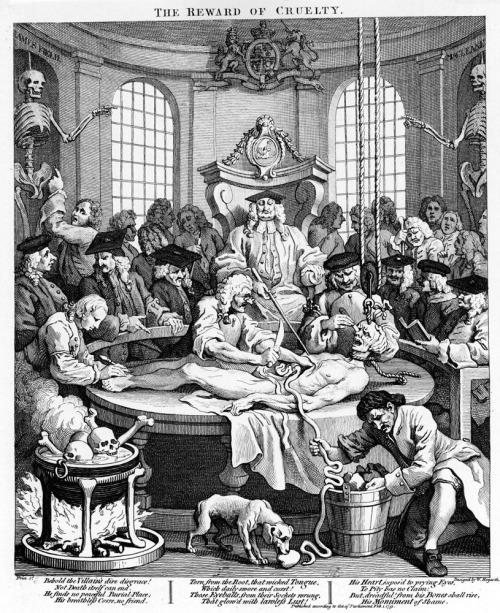
Our preferred method of punishment would be by "dissected and anatomised". Rehabilitation is not up for reconsideration. That's already been shown to be a failed remedy.Plate IV: The Reward of Cruelty by William Hogarth


Section 19 of coinage act of 1792: death penalty for debasing currency

And be it further enacted, That if any of the gold or silver coins which shall be struck or coined at the said mint shall be debased or made worse as to the proportion of the fine gold or fine silver therein contained, or shall be of less weight or value than the same out to be pursuant to the directions of this act, through the default or with the connivance of any of the officers or persons who shall be employed at the said mint, for the purpose of profit or gain, or otherwise with a fraudulent intent, and if any of the said officers or persons shall embezzle any of the metals which shall at any time be committed to their charge for the purpose of being coined, or any of the coins which shall be struck or coined at the said mint, every such officer or person who shall commit any or either of the said offenses, shall be deemed guilty of felony, and shall suffer death. section 19 of coinage act of 1792


The Federal Reserve debased our currency. Take a look at your coinage. See any gold or silver there?

The founders of this nation knew that banks left to themselves, would substitute cheap metal tokens for real money. They had seen it happen in England, and they saw the results; massive unemployment and poverty for the people.

So the Founders created a monetary system based on government-issued currency of fixed real value, for the use of the people without interest. And the United States flourished.

Then the bankers wormed their way back into the system, bought the Congress and a President, replaced the government issued public currency with currency borrowed from their banks at interest... and debased the gold and silver coinage.

By that last act, every member of the Federal Reserve system (and their enablers in Congress and the Treasury) is in violation of Section 19 of the coinage act of 1792.

Source:  section 19 of coinage act of 1792: death penalty for debasing currency

Wednesday, November 12, 2014

Which Cities/States Will Be the First to Default When the Economy Rolls Over?


Tuesday, November 11, 2014


What happens to local governments when the economy rolls over?

Though we're constantly reassured the "recovery" that's stumbled for five years has years of strong growth ahead, history suggests the "recovery" is due to roll over.
 Few recoveries last longer than 5 or 6 years, and the business cycle is graying fast: subprime auto loans are not exactly the foundation of "strong growth."
So what might push the economy over the cliff? The strong U.S. dollar is crimping overseas sales and profits, the global economy is already recessionary, mortgage applications have dried up, auto sales are being driven by subprime loans, and the valuation bubbles in stocks and real estate are due for a breather, if not an outright reversal. Retail sales are flat, and with all these headwinds, growing profits by 10% to 20% a year becomes impossible for the vast majority of enterprises.

So what happens to local governments when the economy rolls over? Tax revenues decline.

The consensus is that local governments are sitting pretty: sales and property values have risen smartly, pushing tax revenues higher, and the cost of borrowing money via tax-free municipal bonds has fallen. Nice, but these are all functions of expansion and rising tax rates.

The uneven nature of the "recovery" has left some cities and states more vulnerable to a downturn than others.Let's catalog the various risk factors that might become consequential as the global and U.S. economies weaken.

1. Those dependent on foreign tourism. The weak dollar made America a bargain destination for the past decade. As the dollar strengthens and other currencies lose purchasing power, America is no longer a bargain--especially as job cuts decimate the number of people who can blow a few thousand dollars on overseas vacations to the U.S.

2. Auto manufacturing-dependent locales. Vehicle sales have been strong, and the cheerleaders claim sales will keep rising for years to come. Really? With what money? As soon as layoffs hit the marginal workforce and the subprime auto loan bubble implodes, vehicle sales will follow suit.

3. Cities and states that depend heavily on capital gains taxes. Once the current housing and stock bubbles deflate--or simply stop expanding--tax revenues from the enormous capital gains reaped in the past five years will wither.

4. Locales dependent on high income taxes. Given that most of the job growth of the past five years has occurred in low-wage sectors, adding jobs hasn't boosted income taxes much. High income-tax states have jacked up rates on high-income earners, but there is no law of nature that says high-income jobs will survive a global downturn.

Rather, enterprises desperate to tighten operating costs will want to jettison high-cost employees first.

5. Local governments with enormous debt burdens. With interest rates low, municipalities and states went to the bond market over the past few years for "free money." Once tax revenues plummet, the interest on all that "free money" will take a larger percentage of tax revenues, heightening the cost of new bond debt as buyers start adding in the risk of eventual default.

6. Locales with high fixed costs. These include high healthcare costs for homeless, elderly, government employees, etc., interest on all those bonds, government employee pensions, etc. The fixed costs only increase every year, regardless of tax revenues. Every local government with high fixed costs is in a tightening fiscal vice once tax revenues plummet.

7. Local governments with generous employee benefits and pensions. Once the stock market rolls over, the big capital gains that have funded public pension plans dry up, and the annual contribution has to be paid out of declining tax revenues.

Should interest rates actually rise, pension fund bond portfolios would plummet in value, too.

8. Local governments dominated by self-serving entrenched interests. That is, all of them: sclerotic, self-serving, entrenched interests resolutely refuse to accept any cuts in their swag. As tax revenues fall off a cliff, government managers will face a dilemma: they can't cut costs because the self-serving interests have made that politically impossible, and they can't borrow money for operating expenses.

That leaves defaulting on debt as the only choice left. And since that's the only choice left, that's what they'll do.

The vice will close on some cities and states sooner than others, but it will eventually squeeze every city and state with declining revenues and rising fixed costs into default.


New video program with Gordon T. Long:


watch on YouTube

via oftwominds

Tuesday, November 4, 2014

What Does Societal Collapse and Martial Law Look Like?

Nov, 2014 by

preppers
According to a survey conducted by the Adelphi University Center for Health Innovation, 55 percent of Americans believe that the government will come to their rescue when the proverbial poop hits the fan because your big brother really cares. Literally, every alternative media outlet could show conclusive proof that an EMP was going to wipe out the power grid. We could conclusively prove that nuclear bombs were going off in 39 American cities in the most horrific false flag attack in world history and it would not make any difference to 55% of all Americans because of their cognitive dissonance.

The United States is staring at an economic collapse in the face with its $17 trillion dollar deficit, $238 trillion dollars of unfunded mandates (e.g. social security, Medicare, etc.) and a one quadrillion dollar derivatives debt in which the governments of the world are being forced to assume in the form of the “bailouts”. Even if Obama and his bankster puppet masters never had any intention of executing a false flag event in order to put this country into martial law in order to fully complete the coup d’Ă©tat that is already underway, a crash is coming. The banks are going to collapse, the people will riot, there will be food shortages, whether they be planned or unplanned. I do, however, believe that food will undoubtedly be used to control the unruly masses, despite the DHS and their new found friends in the Chinese and Russian personnel which are on our soil.

Are you prepared? At the bottom of this article, I will visually demonstrate to the reader with real time examples of human behavior in groups, how each of us are going to be in very grave danger when the collapse comes. But first, let’s analyze America’s present level of individual and collective preparedness.

How Prepared Is America?

The Adelphi University research center tells us that 53% of all Americans do not have a three day supply of nonperishable food and water in their homes. FEMA and DHS are not about serving the needs of the American people; These agencies are about preserving the status quo of the powers that be. But don’t try and tell that to 55% of the citizens of this country.

Most Likely Causes of a Societal Breakdown

As the TV show by the same name, there are literally a 1,000 ways to die. The following six events represent some of the most likely events which would mortally wound our society.

1. False flag attack as a result of a chemical and biological attack
2. False flag attack as a result of a series of nuclear explosions
3. World War III
4. EMP attack
5. Economic collapse
6. Military coup resulting in civil war

America’s Level of Preparedness

A brief summation of the Adelphi study reveals the following:
  • 44 percent don’t have first-aid kits
  • 48 percent lack emergency supplies
  • 53 percent do not have a minimum three-day supply of nonperishable food and water at home
  • 55 percent believe local authorities will come to their rescue if disaster strikes
This means that 56% of those with first-aid kits, 52% of those with emergency supplies, and 47% of those who have more than three days worth of water, will be victimized by those who have not properly planned. Please allow me to put this into a real number for you. Over 130 million teenagers and adults will be in the streets seeking to obtain life-sustaining resources in a very short time following the disaster event. 

This is a train wreck starting to happen.

Time Frame for Societal Breakdown

Finish reading

Friday, October 24, 2014

Pope: “Corruption Is a Greater Evil than Sin”

Thursday, October 23, 2014

Cicero's Prognosis


THE HONORABLE MILLARD F. CALDWELL
Justice - Supreme Court
Tallahassee, Florida


Presented at the 22nd Annual Meeting of the Association of American Physicians and Surgeons, Inc.

October 7-9, 1965, Columbus, Ohio
Reprinted March, 1996

The Roman Republic, the foremost power of its day, had reached its zenith. Its leadership had attained unbounded wealth and unstinted power. The rulers were intolerant of restraint, indifferent to the demands of the middle class, and contemptuous of the Constitution which was designed to curb their ambitions. The time was some 70 years before the birth of Christ.

Young Marcus Tullius Cicero, then a student of law under old Scaevola, the eminent lawyer of his day, was just about to suffer his first great disillusionment with grasping government. Rome, by force of arms, guile and trickery, dominated the world. Its citizens had grown slick and fat, careless of their rights, and had fallen prey to the ruthless politicians who craved more and ever more power and riches.

Young Cicero's first client was a substantial man of business - a man of integrity who trusted his government and his fellow man. But he was a rich man and, because powerful men of government coveted his wealth, he was the victim of bureaucratic chicanery. Young Cicero, retained to plead his cause, submitted documentary proof of his client's innocence to the Judges, confident that justice would prevail.

But for some reason, his case was not going well. He consulted with his great friend and mentor, Scaevola, telling him what course he had followed, and asked why he had failed. Scaevola was disgusted - he slammed the table and, leaning toward Cicero, shouted, "Imbecile! Of what use are records presented to tribunes, consuls, or senators if the government is determined to rob and destroy a man who had displeased them, or who possesses what they want? Have I truly wasted all these years on such an idiot as this Marcus Tullius Cicero!"

Does that have the familiar ring of 1965 and the current raids of government on your substance and your rights?

Nevertheless, Cicero, before the august Senate, pleaded his client's defense against confiscatory taxation, saying "we are taxed in our bread and our wine, in our incomes and our investments, on our land and on our property, not only for base creatures who do not deserve the name of man, but for foreign nations, for complacent nations who will bow to us and accept our largesse and promise us to assist in the keeping of the peace - these mendicant nations who will destroy us when we show a moment of weakness or our treasury is bare. We are taxed to maintain legions on their soil, in the name of law and order and the Pax Romana, a document which will fall into dust when it pleases our allies and our vassals. We keep them in precarious balance only with our gold. Is the heart-blood of our nation worth these? Shall one Italian be sacrificed for Britain, for Gaul, for Egypt, for India, even for Greece, and a score of other nations? Were they bound to us with ties of love, they would not ask our gold. They would ask only our laws. They take our very flesh, and they hate and despise us. And who shall say we are worthy of more?"

Does that sound like 1965 and the billions we are pouring out to such as Nasser and Tito and their ilk?

Cicero did not save his client. But he did live to argue the cause of honest government and to talk with Sulla, the Dictator, about integrity and fair dealing. Sulla had little faith in the people. He believed them too deeply interested in their own welfare to concern themselves, too timid to stand up for their rights. He told Cicero the middle class, the lawyers, the physicians, the bankers, and the merchants would make no sacrifices. He said none of your lawyers will challenge the lawmakers and cry to them, "This is unconstitutional, an affront to a free people, and it must not pass!" 

He asked "Will one of these, your own, lift his eyes from his ledgers long enough to scan the Twelve Tables of Roman Law, and then expose those who violate them and help to remove them from power, even if it costs their lives? These fat men. Will six of them in this city, disregarding personal safety, rise up from their offices and stand in the Forum, and tell the people the inevitable fate of Rome unless they return to virtue and thrift and drive from the Senate the evil men who have corrupted them for the power they have to bestow?"
Does that sound like 1965 and our indifference to government? Does it remind you of our preoccupation with our personal affairs and our unwillingness to "rock the boat?"

Rome continued to decay. The ambitious were fattening upon its bones. The liberties of the people were lifted one by one in the name of emergencies or traded in on benefits. Catiline, brilliant, uninhibited, and evil, was pressing his suit for leadership and, in his course, curtailing the rights of all those who disagreed.

Cicero, in his Second Oration before the Senate, had this to say: "Too long have we said to ourselves 'intolerance of another's politics is barbarous and not to be countenanced in a civilized country. Are we not free? Shall a man be denied his right to speak under the law which established that right?' I tell you that freedom does not mean the freedom to exploit law in order to destroy it! It is not freedom which permits the Trojan Horse to be wheeled within the gates * * *. 
He who is not for Rome and Roman Law and Roman liberty is against Rome. He who espouses tyranny and oppression and the old dead despotisms is against Rome. He who plots against established authority and incites the populace to violence is against Rome. He cannot ride two horses at the same time. We cannot be for lawful ordinances and for an alien conspiracy at one and the same moment."

Does that sound like 1965 and its government-sponsored demonstrations?

Cicero continued: "Though liberty is established by law, we must be vigilant, for liberty to enslave us is always present under that very liberty. Our Constitution speaks of the 'general welfare of the people.' Under that phrase all sorts of excesses can be employed by lusting tyrants to make us bondsmen."

Does that sound like 1965 and usurpation by the Supreme Court in the name of "the general welfare?"

As the years went by Cicero continued his struggle, he became Consul and, for a time, stopped waste and thievery. But the people again grew careless, weary of well doing, and the avaricious and the corrupt politicians moved in and sought to banish Cicero. Once again he appeared before the Senate, but this time to plead his own cause. 

He said "The Senate, in truth, has no right to censure me for anything, for I did but my duty and exposed traitors and treason against the State. If that is a crime, then I am indeed a criminal."

Crassus, Caesar and Pompey were present. He turned and looked at them, but their faces were shut against him. His smile was sad as he said to them, "You have succeeded against me. Be it as you will. I will depart * * *." He then told the Senate: "For this day's work, lords, you have encouraged treason and opened the prison doors to free the traitors. A nation can survive its fools, and even the ambitious. But it cannot survive treason from within. An enemy at the gates is less formidable, for he is known and he carries his banners openly against the city. But the traitor moves among those within the gates freely, his sly whispers rustling through all the alleys, heard in the very halls of government itself. For the traitor appears no traitor; he speaks in the accents familiar to his victims, and he wears their face and their garments, and he appeals to the baseness that lies deep in the hearts of all men. He rots the soul of a nation; he works secretly and unknown in the night to undermine the pillars of a city; he infects the body politic so that it can no longer resist. A murderer is less to be feared. The traitor is the carrier of the plague. You have unbarred the gates of Rome to him."

Does that sound like 1965 and the subversives in high places who have been exposed and those who are not yet exposed?

Cicero was exiled from Rome but not from his conscience. He continued to plead the cause of honest government. But the people he pleaded for were not concerned. His friends, the lawyers, the doctors, and the businessmen told him: "We do not meddle in politics. 

Rome is prosperous and at peace. We have our villas in Caprae, our racing vessels, our houses, our servants, our pretty mistresses, and our comfort and treasures. We implore you, Cicero, do not disturb us with your lamentations of disaster. Rome is on the march to the mighty society, for all Romans."

Does that sound like 1965 and some of the people you know and meet in your day-to-day walks of life?

Cicero was in despair. He began to write his book De Legibus but Atticus, his publisher, asked, "But who will read it? Romans care nothing for law any longer, their bellies are too full."

And then, later, Brutus, the long-time sycophant of the ambitious Caesar, came to his senses and went to Cicero with his plea that something be done to save the nation. He confessed his error, he said he had believed in Caesar, he had believed he would restore the public, but that he has betrayed his trust.

Cicero's bitter reply was "Do not blame Caesar, blame the people of Rome who have so enthusiastically acclaimed and adored him and rejoiced in their loss of freedom and danced in his path and gave him triumphal processions and laughed delightedly at his licentiousness and thought it very superior of him to acquire vast amounts of gold illicitly. Blame the people who hail him when he speaks in the Forum of the 'new, wonderful good society' which shall now be Rome's, interpreted to mean 'more money, more ease, more security, more living fatly at the expense of the industrious.' Julius was always an ambitious villain, but he is only one man."

Does that talk of a "wonderful good society" remind you of 1965 and its "Great Society"?

I am not sure just where this country is going nor what life in America will be like five, ten, or fifty years from now. But it's clear that the old ideas of obedience to law, public thrift and common honesty, the old laws of supply and demand, and the old concepts of local self-government and individual responsibility have been discarded.

And it staggers the imagination to contemplate the changes which have occurred in the last thirty years. Our manner of government and our way of life are, for the United States, new and novel, with little in common with what has gone before. Our forefathers would be astounded by the insidious encroachments of centralized government in our everyday life.

Government is in the business of housing the people, in prescribing the hours we can work, with whom we must work, the salaries we are paid and the tax to be withheld from that salary, the schools our children can go to and with whom they must sit and play, the highways we can drive on, how and where our food is grown and processed. The government concerns itself with the products you buy, the conditions under which they are manufactured, the manner in which they are advertised; the kind, the shape, and the size of the package in which they are offered; and how they are labeled. It Is meddling with your health, your general welfare, your old age and your retirement, your security after retirement, your savings and the banks in which you place your savings; the conduct of your city, its police department and its department of health; the conduct of the affairs of your state, its law enforcement, its elections, the composition of its legislature; and every other facet of your life, private and public.

But the people of this country may like all this - to say the least, they have asked for it. They have elected the public officials who brought it about and they sit around with their tin cups waiting for more. If that's what a majority of the people of this nation want, those of us who disagree can't complain. The majority has the right to change our form of government if it wishes.

But one unfortunate aspect is that, once the die is finally cast, it will be too late to change our minds; it's altogether unlikely we could then ever reestablish the kind of government, the kind of independence and individuality our forefathers conceived and anticipated for posterity. We will have come too far and given up too much.

For that reason it is important that we give some thought to what is happening and reach some conclusions about what we'd like our future to be. We must count the cost of all the politically inspired humanitarian claptrap and be sure we're willing to pay the price in freedom, liberty, and independence.

The cause of sound government is not without a feeble hope. There is an overriding suspicion and uneasiness. The taxpayers complain of the complexities and the inequities fostered by internal revenue; the farmers complain of regimentation; the lawyers complain of the federal judiciary and its whimsical construction of the Constitution; the police deplore the judicial pampering of the criminals; citizens gener- ally are alarmed by the government stirring up of the caldrons of racial hate; students of government seeking the truth are handicapped by managed news and the dominance of news media by the extreme liberals; many are apprehensive of the coddling of communists in high office and their people generally resent America's subordination to the United Nations and the waste of multiple billions on red satellites.

Well, we ask, in the light of the precarious situation what can we do? The first thing to decide is whether we want to live in a constitutional Republic or under a socialistic despotism. Theoretically, I suppose the vast majority would say they prefer constitutional government, but, as a matter of truth, that same majority is unwilling to jeopardize the spurious but temporary prosperity linked to current socialistic practice. Indeed, it may be we are irrevocably committed - too many of us have sold the future for the hope of free medical care, free college education, social equality, and security against poverty.

But, if you are concerned, I suggest you assess the responsibility for what's happening in government. If you are honest with yourselves you will admit we cannot blame the weak Congress or the bureaucrats, the tax gatherers or the judges or the communists - the responsibility must rest upon our own shoulders.

And while it's obvious that our conduct of public affairs under both political parties has long been lacking in the forthrightness and courage so essential to our independence, we cannot take the easy way out and charge the nation's ills to the ADA, the Bobby Bakers, or the Supreme Court. To put it simply, you and I and the people generally have been negligent in attention to our public business.

In good conscience, we cannot say the federal encroachments upon our rights and the rights of the states have come with any surprise. 

We have been warned and warned again. Two thousand years ago Cicero told us what to expect, when our ancestors were considering the adoption of the Federal Constitution for the new Republic. Patrick Henry, distrusting a central government, with true and unerring foresight, told the people to "be extremely cautious, watchful, jealous of your liberty. Instead of securing your rights, you may lose them forever." He said, "there will be no checks, no real balances in this government," and looking ahead to 1965, he said "this government will * * * destroy the state governments and swallow the liberties of the people."

George Mason was fearful of centralization and thought there was a very real danger of losing all the Revolution had gained. He said that a consolidated government "is totally subversive of every principle which has hitherto governed us."

William Grayson was suspicious of the proposed Supreme Court. He said, "this court has more power than any court under heaven..." George Mason said the creation of the court would result in the destruction of state governments because, in the absence of restraint, the court "will be the judges of how far their law will operate."

Benjamin Franklin, after the Constitution was adopted, anticipating a people negligent in safeguarding their rights, said he thought our government would be well administered for a few years but that it "can only end in despotism."

At the conclusion of his two terms as President and in the light of his experience, George Washington thought the people of the future should be warned of the dangers inherent in an unrestrained Supreme Court - he said; "If * * * the distribution * * * of the constitutional powers be in any particular wrong, let it be corrected by an amendment in the way which the Constitution designates. But let there be no change by usurpation: for though this, in one instance, may be the instrument of good, it is the customary weapon by which free governments are destroyed."

Thomas Jefferson foresaw the evils of judicial encroachment when, in effect, he said the Court, under its philosophy, made the Constitution a mere thing of wax to be twisted into any form they pleased; that to consider the Judges the ultimate arbiter of the Constitution would place us under the despotism of an oligarchy.

Some years later Lord Macauley, the English historian, after a careful study of our government and our Constitution warned the American people "Your Constitution is all sail and no anchor. Either Caesar or Napoleon will seize the reins of government with a strong hand, or your Republic will be as fearfully plundered and laid waste by the barbarians in the twentieth century as the Roman Empire was in the fifth - with this difference, that the Huns and Vandals who ravaged the Roman Empire came from without, and your Huns and Vandals will have been engendered within your own country by your own institutions." It is reasonable to assume he thought the Supreme Court was one of the institutions which would destroy us from within.

Abraham Lincoln thought it necessary to tell the people: "If the policy of the government upon vital questions affecting the whole people is to be irrevocably fixed by the decisions of the Supreme Court, the people will have ceased to be their own rulers, having...practically resigned their government into the hands of that eminent tribunal."
Robert Moses had this to say the other day: "We are living in a second American Revolution, as critical as the first one which established our nation * * * the Supreme Court now legislates and executes * * * It now by-passes the state courts and delegates to lower federal courts authority to tell the states what to do and how to do it * * * the states are reduced to peonage * * * until we change our Constitution, any five judges out of nine - distinguished men no doubt but political accidents not chosen by the people - are ruling the country and determining its future."

No, we cannot have been surprised by what has happened because, from our earliest days, we have been on notice it would happen. We, very simply, have refused to heed the warnings or to acknowledge that our freedoms can be preserved by vigilant action and not otherwise. We have refused to acknowledge that bad government and bad public officials are but the reflection of ourselves as we have cast our votes - that the elected official is nothing more nor less than the instrumentality through which we express our will.

The whole trouble is that, in our civic stupor, we have forgotten that major policies, whether the gift of our substance to the communists or the regimentation of industry, agriculture, business, and the professions, require either the approval or acquiescence of the citizens of this country. What has been done, both that which has contributed to our stability and that which has endangered our future, has been with our consent. But I should tell you that the time is growing short. We must make a choice between the form of government conceived by those who captured our freedoms from Great Britain in the Revolution and this new form of government, a centralization, advocated and practiced by the left-dealers. Whether this nation is to be governed by the rule of law, under the Constitution, or the rule of man, unfettered by any restraint, constitutes the most vital problem of our time.

It is no longer of first importance whether we collectivize the professions or bankrupt the nation in abolishing poverty or in supporting our enemies abroad - the vital question, the question, in the face of which all others fade to insignificance, is whether we save the Constitution of the United States and the Republican form of government established by it.

If we can succeed in that respect and retain the right to elect the Congress and the President, all of us, the timid and the brave, the generous and the greedy, the conservatives, the liberals, and the middle gender moderates, can live with wisdom and folly, frugality and waste, the ADA socialists, and the crafty politicians. But, and never forget it, we cannot exist as a free people nor our nation as a Republic without a Constitution, observed in fact and not in the breach.

Whether the nation moves even further to the left as a socialistic despotism or is re-established as a Republic depends entirely upon the will of the majority. The answer does not hang upon whether you are liberal or conservative, a Democrat or a Republican - the answer, the sole answer, is whether you believe in and are resolute in trying to save the Constitution - as it was written and intended - upon whether you are determined to elect public officials who believe in that Constitution and are willing to boot them out of office without ceremony if they falter in their conviction.

You must face the fact that we have spent thirty years setting up the machinery to destroy that Constitution, and it will take dogged determination and constant, unwavering purpose to save it. You will have to reckon with the human inclination to avoid unpleasant facts. We are reluctant to admit our conversion to socialism or that the Supreme Court has usurped the rights of the Congress to legislate.

But we must admit that many people, many splinter groups, approve one or the other of the encroachments by the Supreme Court upon the rights of the majority. The Negroes are happy in the belief that the Brown decision established superior rights for them over the majority; the criminals are happy with the Mallory and Escobedo decisions because of the great advantage gained over the law enforcement officers and society in general; the communists thoroughly approve the Schware, Konigsberg and the Slochower cases which insure their right to infiltrate the legal profession and the schools. The labor unions like the decisions which gave to them enormous advantages. The urban politicians like the reapportionment decisions which insure their control of the state houses and the Congress.

Some of the changes made in the Constitution by judicial fiat were useful. Some, I would actively support In the political arena, but, as George Washington advised us, they should come in the manner prescribed by the Constitution and not through the unconstitutional usurpation by a court not subject to the vote of the people.

But you must remember that, by coddling particular self-interest groups, one after the other, the "rule by man" forces have built a strong following - a following which is active, vocal and organized.
The devotees of the "rule by man" theory include the moderates, the ADAers, most of labor, practically all of the minorities, many ministers, and many of the business and professional world. But I do not believe the tin-cup crowd constitutes a majority of the people of this country.

The simple majority, and I emphasize the word simple, composed of decent, ordinary businessmen, doctors, farmers, mechanics, preachers, and just people, does not realize how it has been duped. The honest fellow has always been an easy mark - the easiest to rob.

The simple majority is slow to anger. They are not given to sit-downs and sit-ins, to placards and to violence and to hate. But neither is that majority watchful of its own rights and the freedoms it inherited from brave ancestors. The majority is slow to express its opinion - slow to write the Congressmen or the President or the Supreme Court or the newspaper; it is, because of its supinely acquiescent attitude, slow to stand up and be counted.

If you, per chance, are among those who would rather be governed by constitutional law than by the whims of men unfettered by restraint, I suggest that the war will have to be fought on a wide front. You can't win with brush fights in special area. You must join and coordinate your efforts with the professions, with business and industry, with agriculture and all facets of American society concerned with the preser- vation of personal liberty. The centralizers can lick the isolated groups, but they could not defeat a sustained drive by the consolidated believers in constitutional government.
As a conservative, you should scrutinize every political candidate, at whatever level, and support the man who believes in our traditional form of government. You should examine every major governmental proposal and express your convictions at the ballot box and by letter, telegram, and in person. You should devote the same degree of thought and attention to your public business as you give to your personal affairs.

If you are a liberal, you should insist upon a Republican form of government. You should oppose every invalid executive order and shout from the housetops against the Supreme Court of the United States every time it arrogates to itself the power to write new law and to rewrite the Federal Constitution. You should remember that the historic method of stamping out liberalism is to undermine constitutional government and substitute the rule of man. You should remember that in Russia and Germany, in Italy and Red China, the liberals were promised more liberality and more freedoms - that the promisors promised fast action by fiat. They said, as our Supreme Court now says, let's do these good things now - let's not wait for the slow processes of the law.

If you are an ADA left-winger, you should insist upon utopia under the law, not by executive order. You should insist upon the right to live in Mr. Gotrock's house on the beach, the right to a free college education for your children, your right as a Protestant to join the Knights of Columbus - but you should never give Big Brother the power to confer those rights by ukase. Why? Because when the President or the Supreme Court usurps the power to give you something to which, under the law, you are not entitled, the President or the Court can, with equal ease, usurp the power to take from you that to which you are entitled.

If you are one of the American minorities and unhappy with your race, you should exert every effort to improve your position; you can aspire to the social organizations of the other races and endeavor to pull down distinction and level off all differences. But, being knowledgeable in history, you should do all these things under constitutional law. You ought never urge the illegal use of the army in your behalf because, when you have lost your popularity as a cause and are no longer needed at the ballot box, the President can use that same army illegally against you. You should remember vividly, how, in other countries, where constitutional government was abolished, minorities were cooked in the gas ovens or deep frozen in Siberia.

And if I were a left-wing newspaperman wedded to socialism, hating wealth and the wealthy, I would do my writing behind America's constitutional guaranty of free speech. I would emulate the feist dog and bark mightily, but from behind the strong fence of constitutional protection. I would remember only too well how freedom of the press and freedom of those who write for the press have been curtailed in those countries where man has risen above the law. Each morning I would remind myself to remind all my left-wing doctor, preacher, teacher, and racist friends that only under a constitutional form of government, where the rights of the individuals are protected, can we live and breathe and preach and write our thoughts; that under centralized power our only free choice will be to write and preach and teach as Big Brother tells us or to go dig salt in the mines.

But what would you do if your aim is for a dictatorship or a communistic takeover? How would you go about weakening the fiber of the country? You would know that, given a fair choice between a representative Republic and a dictatorship, the vast majority of the people in this country would vote against centralization.

No, your road to successful takeover would involve beguiling the people with handouts, creating false sense of security and, step by step, the dishing out of benefits with one hand and the lifting of liberties with the other. You would encourage the issuance of invalid executive orders, all in the name of humanity to please large segments of the voters. You would persuade the judiciary to ignore constitutional restraint and, in the beginning at least, issue invalid decisions in favor of the so-called downtrodden of our population and, of course, contemporarily, you would have the do-gooders demonstrate and create strife and, in every way possible, debunk and belittle the principles upon which the country grew and prospered and became the first nation of the earth. This prescription, faithfully followed, is likely of success under all conditions and, absent intelligent opposition, can be guaranteed.

These are not just theoretical abstractions - that's the way it's been done throughout history, beginning with Greece and Rome, on down through Russia, Hitler's Germany, Mussolini's Italy, and Peron's Argentina.

But there's a great difference in the composition of nationalities. 

Three or four hundred years ago the English, pushed to the wall by the power-spawned rule of the Star Chamber courts, pushed back and recaptured their rights. The Russian people, in sheep-like docility, have submitted. The melting pot of America seems content and complacent. Its sycophantic Congress, reflecting public acquiescence, is grovelling at the feet of the President. Its Democratic party has been captured, and its Republican party is without policy or guidance. 

We appear to be drunk on benefits and slogans, rushing lightheartedly along to self-destruction.

But perhaps all this is in keeping with natural law. The children of Hamlin followed the Pied Piper to ruin, the people of Germany and Italy followed Hitler and Mussolini, the lemmings of Norway rush to the sea to drown, and the grunions of the West Coast rush from the sea to flop on the beach and die. The Roman Republic was destroyed when the urban leaders pampered its populace with free handouts...Perhaps Benjamin Franklin knew what he was talking about when he told the young nation, after it had adopted its Constitution, in substance, that they had gained a free and independent nation but did not have the common sense to keep it. 


Pamphlet No. 1047, March 1996
via aapsonline