Search Blog Posts

Showing posts with label War Conflict. Show all posts

Wednesday, May 6, 2015

DEATH STALKS US SAILORS JUST BENEATH THEIR UNWARY CREWS


Despite Numbers, Experts Question Combat Effectiveness

WASHINGTON — The Russian Navy's submarine force is on a roll.
Four different kinds of submarines are under construction and more are coming. The country expects to lay down five new nuclear submarines in 2015.

The Navy is accepting Borey-class nuclear-powered ballistic missile submarines, Yasen-class nuclear attack submarines, and Kilo- and Lada-class diesel electric attack submarines. Six Kilos are being built for Vietnam and more are offered for export.
This rate of construction is beginning to look more like Cold War days rather than the lethargic shipbuilding rates prevalent since the 1990s.

By comparison, the US only recently returned to building two nuclear attack submarines per year, and industry is gearing up to begin construction of a new class of ballistic submarines in 2021 — a three-subs-per-year construction rate not seen since the Reagan era.

Combine the revived Russian submarine construction rate with President Vladimir Putin's aggressive stances of the past year, along with the steady drumbeat of Chinese naval expansion, and the question might be asked — is a submarine race going on?

"I know a lot of folks like the term arms race, but I think it's more complicated than that," said Thomas Mahnken, a former US defense official and now a professor at the Naval War College. "There's definitely competition going on — with the US, other NATO navies, China — but there's also modernization going on. An increasing portion of what Russia is doing is replacing aging systems or systems that already have been retired."

"I would be skeptical," cautioned Norman Friedman, a longtime naval analyst and author. "There's a history in that country of laying down things that don't get finished for a long time. No question they'll lay down the subs, but actually building them after that is a more interesting question."

The Russians frequently issue proclamations that they intend to increase naval construction, including statements about building a fleet of aircraft carriers. But ship construction remains modest, and the Navy remains largely a collection of Cold War relics. Yet Russia has a long tradition of building tough and innovative submarines.

"The Russians have put their money where their mouth is with regard to submarine construction and development," said Bryan Clark, a former US Navy submariner and strategist, now an analyst with the Center for Strategic and Budgetary Assessments. "They see that as a way to generate an asymmetric advantage over US forces. If they can develop a really high-end submarine force like they did in the Cold War, it would create a problem for US naval planners and strategists thinking through how to deal with a potential Russian threat — one that could emerge without a lot of warning."

Construction Delays

The most lethal new subs are those of the Yuri Dolgoruky class, also known as the Project 955 Borey class. Construction of the Dolgoruky has been a protracted affair — the ship was laid down at the Sevmash military shipyard in Severodvinsk in 1996 but not launched until 2007. Sea trials began in 2009, but development of the ship's primary weapon, the Bulava intercontinental ballistic missile (ICBM), itself has been fraught with problems. It was only in 2014 that the submarine submerged with a full load of 16 ICBMs, according to Russian media.

A second Borey, the Alexander Nevsky, was laid down in March 2004 and began sea trials in 2011. Like the Dolgoruky, the ship and its missiles have experienced numerous problems, and trials continued at least through 2013. Vladimir Monomakh, the third Borey, was commissioned last December after eight years of construction and trials.

Three more Boreys are under construction, and Russian Navy chief Adm. Viktor Chirkov said in December two more would be laid down in 2015, for a total of eight, all expected to be in service by 2020.

The design of the Dolgorukys uses many features of earlier submarines. In fact, the first units used pieces and components built for earlier submarines that were either scrapped or never finished. Russian media reports indicate the Vladimir Monomakh used significant hull components of the decommissioned Akula-class attack submarine Ak Bars.

"I get the feeling for all the big talk from the Russians about building a new fleet, they're probably having trouble getting stuff," Friedman said. "For the first subs, they used pieces from earlier subs."

The Dolgoruky carried out an operational test firing of a Bulava in October, the Itar-Tass news agency reported — the third successful test launch since a September 2013 failure — and two more will take place in 2015.

Meanwhile, construction of Yasen-class Project 885M nuclear attack submarines is picking up. The first unit, Severodvinsk, was commissioned at the end of 2013 after a 20-year construction period, during which the submarine underwent significant re-design. A second unit, laid down in 2009 at Sevmash, could be delivered this year.

Two more Yasens were laid down in 2014. Itar-Tass reported on Dec. 26 that Mikhail Budnichenko, head of Sevmash, said three Project 885 Yasen-class subs would be laid down this year along with two Boreys.

Non-nuclear submarine construction also continues. Along with several Kilo-class subs being built for the Russian Navy and export, at least one more Lada-class diesel-electric submarine is to begin construction this year.

Numbers vs. Effectiveness

But can Russia sustain this prodigious submarine construction effort?

"The naval production we're likely to see this year is an artifact of decisions made some time ago when oil prices were fairly high and before a number of Western countries imposed sanctions on Russia," Mahnken said. "Whatever the Russians do this year, I think it'll be very hard for them to sustain naval production going forward."

Added Friedman: "Putin doesn't have that much money. And with the drop in oil prices, they have very bad problems."

With the post-1990 decline in shipbuilding, Friedman said, the shipyards have lost much of their submarine-building expertise.
"A lot of people quit the yards" when construction all but ended, he said. "If they lost a lot of their smarter people, there's a difficulty in recreating what they had. Coming back 15 years later and trying to recreate it is kind of dubious."

Clark agreed.

"Their industrial base is weakened from two decades of not being used," he said. "You've got a significant reduction in the number of skilled engineers, the aging out of people who otherwise would be part of the Russian design base.

"While Russian engineering and technology development is top-notch, they don't necessarily have the people to be able to do all the legwork necessary to take an idea into a reality. That's why you see things like submarines taking 10 or more years to construct, because they just don't have the design and construction base to support high-rate production."

But are the new submarines cause for worry?

The Yasen attack subs "are probably what you could get in 1989, plus improved combat systems," Friedman said. "They got access to microprocessors and things like that. But they're not going to the insertion of new technology, because they're not that flexible. But I would guess the combat systems have improved substantially."

Clark sees no cause for alarm in the pace of Russian submarine construction.

"They don't have very many submarines today, and they certainly don't have very many frontline submarines that would be anywhere close to US submarines," he said. "The best submarines the Russians are producing are perhaps equivalent to some of the older US submarines currently in use. It would take a while for the Russians to build up enough of those to where they create a potential problem for the US.

"The main concern," Clark added, "is that even a small number of very good submarines can be problematic from an intelligence-gathering and surprise strike kind of perspective. But they're not able to cause a debilitating effect to a fleet."
E-mail ccavas@defensenews.com

Chinese Warships Enter the Black Sea = backing the Deadly Russian Subs!


“The geopolitical significance of China exercising alongside Russia will not be lost on the U.S. and NATO”

12 hours ago | 1,280 16
June 15, 2010. Russian President Dmitry Medvedev (center) at the Sevmash shipyard, before the ceremonial launching of the Severodvinsk multi-purpose submarine. Source: Vladimir Rodionov / RIA Novosti
- http://rbth.com/defence/2014/06/17/russias_top-secret_nuclear_submarine_comes_into_service_37483.html)
 

This article originally appeared at Zero Hedge

On Friday we reported that for the first time in history, Chinese and Russian navies will begin a significant joint naval exercise in The Mediterranean Sea in mid-May.

Citied by RT, Chinese Defense Ministry spokesman Geng Yansheng said that “The aim is to deepen both countries’ friendly and practical cooperation, and increase our navies’ ability to jointly deal with maritime security threats,” but diplomatically added “these exercises are not aimed at any third party and have nothing to do with the regional situation.”

Against a background of this week’s “upgraded Japan-American military relationship” following Abe’s visit to Obama, as one analyst notes, “the geopolitical significance of its exercising alongside Russia will not be lost on the U.S. and NATO.”

While it was unclear if directly related to the upcoming “historic” drill, the Bosphorus Navy Blog reports that in what is a comparable “first” yesterday two warships from Peoples Republic of China were seen passing through the Bosphorus, and entering the Black Sea.

More:
Two Jiangkai II (type 054A) class frigates 550 Weifang and 547 Linyi from PLAN North Sea Fleet made a northbound passage through the Turkish Straits. The destination of these Chinese ships were not disclosed.
The frigates shown below, as they were seen crossing the naval barrier between Europe and Asia:
Chinese frigate 547 Linyi passing through Bosphorus | Photo: Nurderen Özbek
Chinese frigate 550 Weifang passing through Bosphorus | Photo: Yörük Işık
 
NATO promptly responded and hours ago AP reported that a top NATO commander said the alliance will briefly move its allied joint force command from Italy to Romania - which has a historic Black Sea port in the town of Constanta - as NATO continues to react to Russia’s moves in Ukraine.

Admiral Mark Ferguson, Commander of Allied Joint Force Command based in Naples, Italy, said the command will be based in Cincu, central Romania, for 12 days in June, to support a NATO exercise involving 1,000 troops from 21 NATO states.

Cincu is Romania’s largest military shooting range, some 180 kilometers (112 miles) northwest of Bucharest.
“This deployment will be the first time a NATO Joint Force Command Headquarters has deployed to Romania,” Ferguson said Tuesday.
At the same time, NATO will conduct exercises in Poland, the Baltics and the Baltic Sea.

As a reminder, in the summer of 2013 when the Syria war tensions saw a build of US, Russian and even Chinese ships in the Mediterranean ahead of what could be the first global Middle East war. The war was avoided in the last minute. This time the naval build up is taking place even closer to both Europe and Russia, and now even China is present.

Saturday, April 4, 2015

Do Heroes Go to Heaven?


Over the past decade or so I have witnessed some disturbing trends at church. One would have thought that our Lord Jesus Christ had, himself, worn a government-issued uniform, given how much reverence, gratitude, and appreciation we are led to collectively express for these folks during Mass. At first, it was a weekly prayer “for the troops,” which is fine. There is no human being, alive or dead, who doesn’t need prayers.

However, we never prayed for the innocent civilians in the countries Americans had invaded, who were killed, maimed, and tortured in far greater numbers than Americans.

We never prayed for the loved ones they left behind, the widows, the orphans.

We never prayed for the refugees.

We never prayed for our enemies.

The secular state holidays have become occasion for military remembrance and honorary tribute. On Memorial Day and Veterans Day, the church bulletin includes a message of thanks to veterans for protecting Americans’ freedom, which sends the message to churchgoers that American “wars” abroad have something to do with the Bill of Rights here at home, and the wars are therefore necessary and just (a dubious notion at best). At some point, militarism began to invade Christmas with camouflaged Christmas ornaments and patriotic displays upstaging the Eucharist.

In the last year, the Catholic Church has expanded its prayers to allow more folks in uniforms to get in on the prayer action. In addition to (or in lieu of) praying for military servicemen and women, Catholic Churches are now offering weekly prayers on Sundays for all “first responders.” One wonders how this became a national “thing.” (I have heard it in several states). It seems to mesh nicely with the overall message in the mass media that we are all on the brink of ruin all the time, threatened by an inexhaustible number of enemies and looming crises, and should live in fear and trembling awaiting the next crash, attack, disaster, or pandemic; thus we owe an infinite debt of gratitude to those who offer us safety, order, and protection in such a precarious and nefarious world. (Hm. Who benefits when we have a nation of nervous Nellie’s?)

Things seem to have reached a new threshold with American Sniper. We now have American priests coming right out and saying things in the media like: “Chris Kyle was an American hero.”

The primary concern of the Church is the salvation of souls. 

Christians are concerned with holiness, not heroism. Whether Chris Kyle was an American hero is a secular idea and a moot point, and a strange pronouncement for a priest to make, unless that priest is willing to ask the questions that naturally follow: Does heroism lead to holiness? Do heroes go to heaven? Before you write me an email vilifying me as a “liberal” who “hates” soldiers for asking these questions, let me say: I do not know if “heroes” go to heaven. Nobody knows. Only God can judge the human heart. What I’m saying is: it is dangerous to pretend that they automatically do. It’s also dangerous to pretend that the question I am asking is, itself, a moot point.

When churches and religious leaders constantly adore, praise and worship those who wear uniforms, carry guns, and embody secular ideas of heroism, it leads to misunderstanding and moral confusion among the faithful. People begin to equate this image of heroism with holiness, especially children. If you don’t believe me, all you have to do is take a look at www.nogreaterloveart.com, where uniformed government agents are depicted with angels’ wings, angels of course being spiritual beings who are known for their ability to guard and protect. All you have to do is look at the “Soldier’s Stairway to Heaven,” very popular on Pinterest, or license plates and t-shirts that quote John 15:13 and hold up the service of the soldier as being second only to the “service” of Jesus. 

There is an idea that if you have fought in a war, you have “served your time in hell”; soldiers therefore go straight to heaven. But is such an idea spiritually and theologically acceptable? Does God offer bypasses?

Heroism and holiness have many things in common: They both require strength, courage, devotion, fortitude, self-sacrifice. But all of those qualities could be attributed to people fighting for ISIS just as well, even faith. According to the Catechism of the Catholic Church: “The way of perfection passes by way of the Cross. There is no holiness without renunciation and spiritual battle.”  There is no holiness without renunciation; that does not mean that every act of renunciation leads to holiness. The way of perfection requires hardship; not all hardship helps us on our way to perfection. In short, not all suffering is redemptive. Finish reading article

THE WAR PRAYER - Mark Twain *vid*


Uploaded on Apr 13, 2011 
Featured at Animation Film Screening at OSA Archivum in Budapest, Hungary to commemorate UN Human Rights Day, December 9, 2010. 
From OSA Program: The War Prayer (Markos Kounalakis, USA, 2006, 14 min) Based on Mark Twain's piece "The War Prayer," a short story written in the heat of the Philippine-American war of 1899-1902 offering a poignant reflection on the double-edged moral sword implicit to war. 

Followed by discussion with Markos Kounalakis, a Senior Fellow at the Center for Media and Communication Studies at the Central European University in Budapest, Hungary and President and Publisher Emeritus of the Washington Monthly. Moderator -- Oksana Sarkisova, Film Historian, OSA Archivum. 

From Wikipedia Notes: "The War Prayer," a short story or prose poem by Mark Twain, is a scathing indictment of war, and particularly of blind patriotic and religious fervor as motivations for war. The structure of the work is simple, but effective: an unnamed country goes to war, and patriotic citizens attend a church service for soldiers who have been called up. The people call upon their God to grant them victory and protect their troops. Suddenly, an "aged stranger" appears and announces that he is God's messenger. 

He explains to them that he is there to speak aloud the second part of their prayer for victory, the part which they have implicitly wished for but have not spoken aloud themselves: the prayer for the suffering and destruction of their enemies. What follows is a grisly depiction of hardships inflicted on war-torn nations by their conquerors. 

Friday, April 3, 2015

US Militarism Far Bigger Threat to American Liberty Than Russia


(Jacob G. Hornberger)  George Washington pointed out, “Overgrown military establishments, which under any form of government, are inauspicious to liberty, and which are to be regarded as particularly hostile to Republican Liberty.

Wise words by the father of our country, but ones, unfortunately, rejected by modern-day Americans, who love and idolize the enormously overgrown military establishment that now characterizes our federal governmental system.

Eastern Europeans are getting a gander at America’s overgrown military establishment. Yesterday, the New York Times reported that a huge contingent of U.S. military forces is winding its way through Eastern Europe as some sort of good-will tour and also to serve as a message to Russia that the United States is ready to go to war to protect Eastern Europe from Russia’s aggressive designs.

Never mind that it is America’s overgrown military establishment that gave rise to Russia’s so-called aggressive designs. Ever since the end of the Cold War, NATO has been absorbing Eastern European countries with the ultimate aim of absorbing Ukraine, which would enable the U.S. military to place bases and missiles on Russia’s borders.

There was never a possibility that Russia was going to let that happen, any more than the U.S. national-security establishment would permit North Korea to place military bases and missiles on Mexico’s side of the Rio Grande. In the eyes of those who believe that America’s overgrown military establishment can do no wrong, that makes Russia the aggressor in the crisis.

But let’s face it: These people are ingenious at producing crises and then playing the innocent. The fact is that NATO should have been dissolved at the end of the Cold War. It wasn’t dissolved for one big reason: in order to produce endless crises with Russia so that Americans would feel the need to keep their overgrown, Cold War-era, military establishment in existence.

Moreover, under what authority is America’s overgrown military establishment telling Eastern Europeans that the United States will come to their defense in a war against Russia? I thought that under the U.S. Constitution it is the responsibility of Congress to decide when America goes to war. The U.S. military march through Eastern Europe is just another sign of how the national-security branch of the federal government — the most powerful branch — calls its own shots when it comes to foreign policy.

Moreover, it’s a sign of the times when America’s overgrown military establishment is our country’s good-will ambassador. It used to be that the American private sector served that purpose. Not so anymore. Now, it’s U.S. generals and other military personnel who serve that purpose, as they parade through Eastern Europe showing off their tanks and other military equipment, just like the Soviets did in their May Day parades. Continue reading
 

Obama Told This Admiral Not To Give Out Bibles, His Response Is Glorious


Obama’s agenda to keep the Bible out of the hands of our Military is in full swing. If there is only one speech you have to see that takes him down, THIS IS IT!!!

The Government is telling soldiers that if a person is in need, or even contemplating suicide to send them to a Chaplain and do nothing else.

But what if the opportunity to save a life is here and now, in the moment?

This Rear Admiral says that no matter what he is told by the Government he will share the Bible when and where it is needed.

This man of true Faith is what we need right now in this country to lead us back to greatness. He took a stand against those who wish that the Bible didn’t exist and not back down from a fight!

Wednesday, April 1, 2015

How Long Would the US Navy Survive in a Shooting War?

US Navy is a huge force but largely based around aircraft carrier groups that modern weaponry may have made obsolete
Military 7 hours ago | 2200 32
 
Carriers today may be sunk from air, land or sea America sees itself as a ruler of the world’s oceans. After all, the country — which spends 10 times more on its military forces than the following nine countries — has by far the biggest naval force. And as since the Vietnam War they have dealt only with militarily inferior opponents, they are extremely self-confident in their belief that they can defeat everything and everyone. It is not surprising that some young Americans even wear T-shirts with the logo: “United States Navy: The Sea is Ours.”

Perhaps we need to meet this pride and arrogance with some understanding in view of the numerical superiority of the U.S. Navy. In total, it currently has 10 operational aircraft carriers (two in reserve), while Russia and China have only one each.

Aircraft carriers are the great pride of the U.S. Navy and are also perfect to underline visually the claim of the ruler of the seas. They are therefore well liked by U.S. presidents as stages for delivering speeches when the time comes to tell the people that this unique nation has once again won a heroic victory.

What thrilling moments these were (at least for Americans) when George W. Bush landed in a fighter jet on the USS Abraham Lincoln (no, not as a pilot) and then, with the words “mission accomplished” and “a job well done,” proclaimed the end of the Iraq war to the people. As we know, the destruction of Iraq was carried out by the Americans under the label of Operation Iraqi Freedom. We may still ask ourselves what it had to do with freedom, but that’s a different story.

In addition to their suitability as impressive orator stages, the aircraft carriers also fulfill, of course, a military purpose. They can be considered as small floating airports, which ship up to 100 fighter jets to the scene of the action. Since they are equipped with the best weapons, radar, and defense systems, until now they have experienced almost no threat, especially since in the past the U.S. Navy parked them preferably off the coasts of defenseless desert states.

But what would it look like if the power of the U.S. Navy met its peer? The title of this article already implies the answer: not so good, and it could be that the patriotic U.S. Navy fans would hide their T-shirts quickly in the closet.

Back in the 70s, Admiral Rickover, the “father of nuclear navy,” had to answer the question before the U.S. Senate: “How long would our aircraft carriers survive in a battle against the Russian Navy?” His response caused disillusionment: “Two or three days before they sink, maybe a week if they stay in the harbor.”

The reason for the greatly reduced lifetime of the aircraft carrier in a battle against the Russians is a deadly danger below the water: modern submarines — especially Russian ones — are so powerful and difficult to locate that they can send large battleships and aircraft carriers to the bottom of the sea in the blink of an eye. The weakness of the U.S. Navy, therefore, is their vulnerability when they compete with an enemy that — using the language of the Americans — dominates the seas below the water surface. Of course, the U.S. military analysts are aware of this weakness, so one wonders why the U.S. Navy still adheres to the doctrine “the bigger the better” and continues to rely on an armada of aircraft carriers and large battleships.

Colonel Douglas McGregor, a decorated combat veteran, author of four books, a PhD and military analyst, gives the answer: “Strategically, it makes no sense, but the construction of large ships, of course, creates a lot of jobs.”

So the threat of Russian submarines, torpedoes and anti-ship missiles is well known by the Americans — a fact which Roger Thompson’s book, Lessons Not Learned: The U.S. Navy’s Status Quo Culture, also points out. A brief excerpt:
As Howard Bloom and Dianne Star Petryk-Bloom advised in 2003, both the Russians and Chinese now have the deadly SS-N-22 Sunburn missile at their disposal. This massive long-range missile, equipped with nuclear or conventional warheads, is extremely difficult to detect or destroy. According to Jane’s Information Group, it is more than capable of destroying any U.S. aircraft carrier. More to the point, Timperlake (a Naval Academy graduate) and Triplett warned that the Sunburn missile is designed to do one thing: kill American aircraft carriers and Aegis-class cruisers.

The SS-N-22 missile skims the surface of the water at two-and-a-half times the speed of sound until just before impact, when it lifts up and then heads straight down into the target’s deck. Its two-hundred-kiloton nuclear warhead has almost twenty times the explosive power of the atomic bombs dropped on Hiroshima. The U.S. Navy has no defence against this missile system. As retired Admiral Eric McVadon put it: “It’s enough to make the U.S. 7th (Pacific) Fleet sink twice.”
In addition to this concept-related, almost inevitable weakness of large warships, there is another reason for the vulnerability of the U.S. Navy and the U.S. armed forces in general: their arrogance and the associated underestimation of their opponents. Anyone who underestimates his enemy grows imprudent and holds bad cards in the event of a surprise attack. This happened in 2000, when the American aircraft carrier USS Kitty Hawk was caught by the Russians on the wrong foot.

Here are some excerpts from Jon Dougherty’s article, “Russian Navy takes Flyover by Surprise” (World Net Daily):
A pair of Russian warplanes that made at least three high-speed passes over a U.S. aircraft carrier stationed in the Sea of Japan in October constituted a much more serious threat than the Pentagon has admitted and were easily in a position to destroy the ship if the planes had had hostile intentions, say Navy personnel.
According to reports, a Russian air force Su-24 “Fencer” accompanied by a Su-27 “Flanker” made unopposed passes over the USS Kitty Hawk on Oct. 9, as the carrier was being refueled.
Russian fighters and reconnaissance planes made a second attempt to get close to the carrier on Nov. 9 — a repeat performance for which the Pentagon, as well as eyewitnesses aboard ship, said the carrier was prepared. But it was the first incident in October that caused alarm.
Pentagon spokesman Kenneth Bacon said during a regularly scheduled press briefing Nov. 30 that the Russian fighters were detected on radar well in advance of their high-speed passes. Naval officers aboard ship who spoke of the incident on the condition of anonymity agreed.
However, at the time the carrier’s combat information center alerted the ship’s commander, Capt. Allen G. Myers, that the Russian fighters were inbound, none of the carrier’s fighters were airborne. The ship carries 85 aircraft, according to Navy figures, and has a crew of over 5,500. 
Witnesses said Myers immediately ordered the launch of alert fighters, but the ship’s scheduled fighter squadron was on “Alert-30” status — a minimum launch time of 30 minutes where pilots are “in the ready room” but are not sitting in cockpits waiting to be launched.
Bacon told reporters only that there “may have been a slight delay” in getting the interceptors in the air, explaining that because the Kitty Hawk was taking on fuel, it was not sailing fast enough to launch its aircraft.
One naval officer onboard the ship said, “40 minutes after the CO [commanding officer] called away the alerts,” the Russian planes “made a 500-knot, 200-foot pass directly over the tower” of the carrier.
Before the Kitty Hawk could get a single plane airborne, the Russian fighters made two more passes. Worse, witnesses said, the first plane off the deck was an EA-6B Prowler — a plane used primarily for electronic jamming of an enemy’s radar and air defenses, not a fighter capable of intercepting another warplane.
The EA-6B “ended up in a one-versus-one with a Flanker just in front of the ship,” one witness said. “The Flanker was all over his a.... He was screaming for help when finally an F/A-18 Hornet from our sister squadron got off the deck and made the intercept. It was too late.”
Naval personnel noted that “the entire crew watched overhead as the Russians made a mockery of our feeble attempt of intercepting them.”
The Clinton administration downplayed the incident .... The BBC, however, said that it was evident by the photographs taken by the Russian jets that there was “panic aboard” when the planes made their over-flights.
Our American readers will now perhaps argue that this humiliating incident happened 15 years ago and such a thing is no longer possible nowadays. But most readers of Russia Insider remember the events of April 2014 when the ultra-modern destroyer USS Donald Cook was paralyzed by a single SU-24.

For those readers who unfortunately missed the story, here it is: At the beginning of April last year the Americans sent the USS Donald Cook into the Black Sea, with the permission of Turkey, to protest against the Russian annexation of Crimea and to demonstrate their military strength. The destroyer was equipped with the most advanced Aegis Combat System, a naval weapons systems which ensures the detection, tracking and destruction of multiple targets at the same time. In addition, the USS Donald Cook is equipped with four large radars, whose power is comparable to that of several stations. For protection, it carries more than 50 anti-aircraft missiles of various types.

According to the “Montreux Convention,” non-Black Sea state warships are permitted to stay in the Black Sea for no longer than 21 days. The Americans, of course, ignored this rule, and Russia responded by sending an SU-24. The Sukhoi was unarmed but equipped with the latest electronic warfare device, called Khibiny.

When the SU-24 approached the destroyer, all radar and control systems, information transfers, etc., of the USS Donald Cook were suddenly paralyzed by Khibiny. In other words, the seemingly superior Aegis system was completely off — like when you turn off your TV with the remote control.

Subsequently, the Sukhoi simulated 12 missile attacks at low altitude on the virtually blind and deaf USS Donald Cook, and we can imagine that the two SU-24 aircraft pilots had a lot of fun. 

Unfortunately, at this time there was neither John McCain nor NATO Commander Phillip Breedlove on board the ship — they would certainly have received some long-lasting impressions from this demonstration.

After this incident, the USS Donald Cook chose to immediately and at full speed move towards a port in Romania, where 27 shocked crew members asked for dismissal from the service.

This story shows us that Americans still overestimate the capabilities of their armed forces and do not realize (or do not want to admit) that Russia’s military technology is in many areas superior and has an advantage that cannot be offset quickly.

So, as long as a single Russian fighter jet can turn off a complete U.S. warship with the latest warning and fire control systems by just pushing a button, the answer to the question “How long would the U.S. Navy survive?” today is the same as in the old Cold War days. Source

Sunday, March 29, 2015

Americans Supported and Inspired the Nazis

Unless We Learn Our History, We’re Doomed to Repeat It

Preface:  I am a patriotic American who loves  my country. I was born here, and lived here my entire life.

So why do I frequently point out America’s warts?  Because – as the Founding Fathers and Supreme Court judges have explained – we can only make America better if we honestly examine her shortcomings.  After all:
“Dissent is the highest form of patriotism.”
Only when Americans can honestly look at our weaknesses can we become stronger. If we fail to do so, history will repeat …


While Americans rightly condemn the Nazis as monstrous people, we don’t know that America played both sides … both fighting and supporting the Nazis.

Americans also aren’t aware that the Nazis were – in part – inspired by anti-Semites in America.

Backing Nazis

Large American banks – and George W. Bush’s grandfather – financed the Nazis.

American manufacturing companies were big supporters of the Nazis.   here are 6 historical examples …
(1) IBM.  CNET reports:
IBM has responded to questions about its relationship with the Nazis largely by characterizing the information as old news.

“The fact that Hollerith equipment manufactured by (IBM’s German unit) Dehomag was used by the Nazi administration has long been known and is not new information,” IBM representative Carol Makovich wrote in an e-mail interview. “This information was published in 1997 in the IEEE Annals of the History of Computing and in 1998 in Washington Jewish Week.”
***

IBM also defended Chairman Thomas Watson for his dealings with Hitler and his regime.
***

On September 13, 1939, The New York Times reports on
Page 1 that 3 million Jews are going to be “immediately removed” from Poland, and they appear to be candidates for “physical extermination.” On September 9, the German managers of IBM Berlin send a letter to Thomas Watson with copy to staff in Geneva via phone that, due to the “situation,” they need high-speed alphabetizing equipment. IBM wanted no paper trail, so an oral agreement was made, passed from New York to Geneva to Berlin, and those alphabetizers were approved by Watson, personally, before the end of the month.

That month he also approved the opening of a new Europe-wide school for Hollerith technicians in Berlin.

And at the same time he authorized a new German-based subsidiary in occupied Poland, with a printing plant across the street from the Warsaw Ghetto at 6 Rymarska Street. It produced some 15 million punch cards at that location, the major client of which was the railroad.

We have a similar example involving Romania in 1941, and The Sunday Times has actually placed the IBM documents up on their Web site…. When Nazi Germany went into France, IBM built two new factories to supply the Nazi war machine. This is the 1941-’42 era, in Vichy, France, which was technically neutral. When Germany invaded Holland in May 1940, IBM rushed a brand-new subsidiary into occupied Holland. And it even sent 132 million punch cards in 1941, mainly from New York, to support the Nazi activity there. Holland had the highest rate of Jewish extermination in all of Europe; 72 percent of Jews were killed in Holland, compared to 24 percent in France, where the machines did not operate successfully.
***

When Hitler came to power in 1933, his desire to destroy European Jewry was so ambitious an enterprise, it required the resources of a computer. But in 1933 no computer existed. What did exist was the Hollerith punch-card system. It was invented by a German-American in Buffalo, New York, for the Census Bureau. This punch-card system could store all the information about individuals, places, products, inventories, schedules, in the holes that were punched or not punched in columns and rows.

The Hollerith system reduced everything to number code.

Over time, the IBM alphabetizers could convert this code to alphabetical information. IBM made constant improvements for their Nazi clients.
***

Our entry was of course precipitated by the bombing of Pearl Harbor on December 7. Shortly before that, with sudden new trading-with-the-enemy regulations in force–this is October 1941–Watson issued a cable to all IBM’s European subsidiaries, saying in effect: “Don’t tell us what you’re doing and don’t ask us any questions.” He didn’t say, “Don’t send machines into concentration camps.” He didn’t say, “Stop organizing the military forces of Nazi Germany.” He didn’t say, “Don’t undertake anything to harm innocent civilians.”
***
He then bifurcated the management of IBM Europe–one manager in Geneva, named Werner Lier, and the other one in New York, in his office, named J.L. Schotte. So all communications went from Switzerland to New York. Ultimately there was a Hollerith Department called Hollerith Abteilung–German for department–in almost every concentration camp. Remember, the original Auschwitz tattoo was an IBM number.
***

IBM put the blitz in blitzkrieg. The whole war effort was organized on Hollerith machines from 1933 to 1945. This is when information technology comes to warfare. At the same time, IBM was supporting the entire German war machine directly from New York until the fall of 1941 ….

***
IBM did more than just sell equipment. Watson and IBM controlled the unique technical magic of Hollerith machines. They controlled the monopoly on the cards and the technology. And they were the ones that had to custom-design even the paper forms and punch cards–they were custom-designed for each specific purpose. That included everything form counting Jews to confiscating bank accounts, to coordinating trains going into death camps, to the extermination by labor campaign.

That’s why even the paper forms in the prisoner camps had Hollerith notations and numbered fields checked. They were all punched in. For example, IBM had to agree with their Nazi counterparts that Code 6 in the concentration camps was extermination. Code 1 was released, Code 2 was transferred, Code 3 was natural death, Code 4 was formal execution, Code 5 was suicide. Code 7 was escape. Code 6 was extermination.

All of the money and all the machines from all these operations was claimed by IBM as legitimate business after the war. The company used its connections with the State Department and the Pentagon to recover all the machines and all the bank accounts. They never said, “We do not want this blood money.” They wanted it all.
(2) Standard Oil.   The Nazi air force – the Luftwaffe – needed tetraethyl lead gas in order to get their planes off the ground. Standard Oil sold tetraethyl to the Nazis.

After WWII began, the English became angry about U.S. shipments of strategic materials to Nazi Germany. So Standard changed the registration of their entire fleet to Panamanian to avoid British search or seizure. These ships continued to carry oil to the Nazis. Continued

Wednesday, March 25, 2015

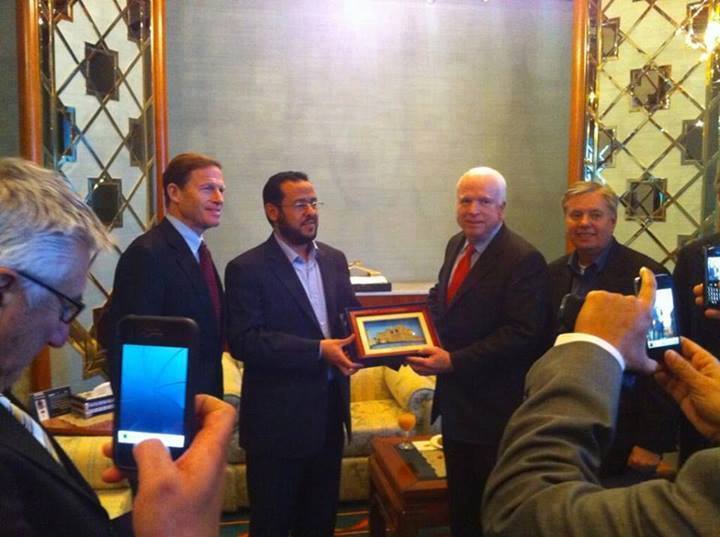
Washington's Al Qaeda Ally Now Leading ISIS in Libya

 Republican senators McCain & Graham heroes to some, traitors to most. While they will not be punished by congress which acts unlawfully itself, this pair must be removed by the voters of those respective states. 

Additionally, state governors for years have condoned the respective national guard regiments to be deployed in the undeclared overseas wars upon many nations - and lives. Those unlawful acts should be nullified by governors immediately.

March 9, 2015 (Eric Draitser - NEO) - The revelations that US ally Abdelhakim Belhadj is now leading ISIS in Libya should come as no surprise to those who have followed US policy in that country, and throughout the region. It illustrates for the umpteenth time that Washington has provided aid and comfort to precisely those forces it claims to be fighting around the world.

According to recent reports, Abdelhakim Belhadj has now firmly ensconced himself as the organizational commander of the ISIS presence inside Libya. The information comes from an unnamed US intelligence official who has confirmed that Belhadj is supporting and coordinating the efforts of the ISIS training centers in eastern Libya around the city of Derna, an area long known as a hotbed of jihadi militancy.

While it may not seem to be a major story – Al Qaeda terrorist turns ISIS commander – the reality is that since 2011 the US and its NATO allies have held up Belhadj as a “freedom fighter.” They portrayed him as a man who courageously led his fellow freedom-lovers against the “tyrannical despot” Gaddafi whose security forces at one time captured and imprisoned many members of the Libyan Islamic Fighting Group (LIFG), including Belhadj.

Belhadj served the US cause in Libya so well that he can be seen receiving accolades from Sen. John McCain who referred to Belhadj and his followers as heroes. He was initially rewarded after the fall of Gaddafi with the post of military commander of Tripoli, though he was forced to give way to a more politically palatable “transitional government” which has since evaporated in that chaotic, war-ravaged country.

Belhadj’s history of terrorist activity includes such “achievements” as collaboration with Al Qaeda in Afghanistan and Iraq, and of course his convenient servitude to the US-NATO sponsored rampage across Libya that, among other things, caused mass killings of black Libyans and anyone suspected of being part of the Green Resistance (those loyal to the Libyan Arab Jamahiriya led by Gaddafi). Although the corporate media tried to make a martyr of Belhadj for his alleged torture via the CIA rendition program, the inescapable fact is that wherever he goes he leaves a violent and bloody wake.

While much of this information is known, what is of paramount importance is placing this news in a proper political context, one that illustrates clearly the fact that the US has been, and continues to be, the major patron of extremist militants from Libya to Syria and beyond, and that all talk of “moderate rebels” is merely rhetoric designed to fool an unthinking public.

The Enemy of My Enemy is My Friend…Until He Isn’t

There is ample documented evidence of Belhadj’s association with Al Qaeda and his terrorist exploits the world over. Variousreports have highlighted his experiences fighting in Afghanistan and elsewhere, and he himself has boasted of killing US troops in Iraq. However, it was in Libya in 2011 where Belhadj became the face of the “rebels” seeking to topple Gaddafi and the legal government of Libya.

As the New York Times reported:
The Libyan Islamic Fighting Group was formed in 1995 with the goal of ousting Colonel Qaddafi. Driven into the mountains or exile by Libyan security forces, the group’s members were among the first to join the fight against Qaddafi security forces… Officially the fighting group does not exist any longer, but the former members are fighting largely under the leadership of Abu Abdullah Sadik [aka Abdelhakim Belhadj].
So, not only was Belhadj a participant in the US-NATO war on Libya, he was one of its most powerful leaders, heading a battle-hardened jihadist faction that constituted the leading edge of the war against Gaddafi. Nowhere was this more clearly demonstrated than when the Libyan Islamic Fighting Group (LIFG) took the lead in the attack on Gaddafi’s compound at Bab al-Aziziya. In this regard, LIFG was provided intelligence, and likely also tactical support, from US intelligence and the US military.

This new information about Belhadj’s association with the suddenly globally relevant ISIS certainly bolsters the argument that this writer, among many others, has made since 2011 – that the US-NATO war on Libya was waged by terrorist groups overtly and tacitly supported by US intelligence and the US military. Moreover, it dovetails with other information that has surfaced in recent years, information that shines a light on how the US exploited for its own geopolitical purposes one of the most active terrorist hotbeds anywhere in the world.

According to the recent reports, Belhadj is directly involved with supporting the ISIS training centers in Derna. Of course Derna should be well known to anyone who has followed Libya since 2011, because that city, along with Tobruk and Benghazi, were the centers of anti-Gaddafi terrorist recruitment in the early days of the “uprising” all through the fateful year of 2011. But Derna was known long before that as a locus of militant extremism. FINISH READING

Sunday, March 8, 2015

John McCain's Terrorist Friends

1st pub. CV on 05.29.13
My Catbird Seat May 29, 2013 
"The Israel lobby’s involvement in all this is somewhat obscure, but WINEP has been on the scene providing quotes and rationales for US intervention, and now with the Israeli air strikes and all this talk of Hezbollah propping up a supposedly faltering Assad, it’s clear why: the Israelis want to use this opportunity to take out another of their enemies.

They lured us into attacking Iraq, and now they are insisting we go after Iran – but as an appetizer, so to speak, they’re inviting us to first gobble up Syria before partaking of the main course."

Friday, March 6, 2015

Neocon Nuland Lies about Ukraine before Congress

It starts with her claim the US-backed violent overthrow of the Ukrainian government last year was the work of "peaceful protesters"

Daniel McAdams
03.06.2015 
Neocons espouse the concept
of 'the noble lie'

This article originally appeared at RT


Victoria Nuland’s anti-Russian rhetoric comes from the neocon camp of US politics, seeking to stir the Ukraine crisis, thrilled by the prospect of defense industry expansion and more arms sales, Daniel McAdams of the Ron Paul Peace Institute told RT.

RT: World leaders and international monitors agree the situation in Ukraine is generally improving. Why are we still witnessing aggressive rhetoric from some US officials?

Daniel McAdams: Because the US does not want peace to break out. The US is determined to see its project through. But unfortunately like all of its regime change projects this one is failing miserably. Victoria Nuland completely disregards the role of the US in starting the conflict in Ukraine. She completely glosses over the fact that the army supported by Kiev has been bombarding Eastern Ukraine, as if these independent fighters in the east are killing themselves and their own people. Victoria Nuland was an aid to Dick Cheney; she is firmly ensconced in the neocon camp. The neocons believe very strongly in lying, the noble lie… They lied us into the war in Iraq; they are lying now about Ukraine. Lying is what the neocons do.

RT: Nuland listed a lot of hostile actions by Russia without providing any reliable proof. Do you think she can she be challenged on these topics?

DM: Maybe she is right but the US hasn't provided one piece of proof, except for Ambassador Geoffrey Pyatt’s Rorschach tests he passes off as a satellite photo. Maybe they are true but we have to present some evidence because we’ve seen now the neocons have lied us into the war. This is much more serious than the attack on small Iraq. This has the potential for a global nuclear war. So I think they should be held to a higher level of scrutiny. Thus far they have not provided any. We do know however that the US is providing military aid. As the matter of fact this week hundreds of American troops are arriving in Ukraine. Why is that not an escalation? Why is it only an escalation when the opponents of the US government are involved?

RT: How probable is that the Western nations ship lethal aid to Ukraine?

DM: It is interesting because Victoria Nuland this week spent some time with Andriy Parubiy, one of the founders of the fascist party in Ukraine and I believe one of the founders of the Joseph Goebbels Institute. She met with him this week and had a photo taken with him. He came back to Ukraine and assured his comrades that the US will provide additional, non-lethal weapons - whatever that means - and felt pretty strongly that they would provide lethal weapons. The Chairman of the Joint Chiefs of Staff, General Martin Dempsey has been urging the US government to provide lethal weapons as has the new US defense secretary [Ashton Carter], both of whom come from the military industrial complex which is thrilled by prospect of a lot more arms to be sold.

RT: Nuland has said the State Department is in talks with EU leaders for another round of sanctions on Russia. Do you think the EU will agree?

DM: I think they will be pressured into agreeing. It is interesting that Nuland said that the new Rada, the new Ukrainian parliament, in this first four months has been a hive of activity. I was just watching some videos from the fights in the Ukrainian parliament. So that was one bit of unintentional humor probably in her speech. It looks like a fight club over there.


via Russia-insider

Wednesday, March 4, 2015

The Myth of the Voluntary Military

July 29, 2011 Jeffrey A. Tucker

Ludwig von Mises summed up the essence of government in words that are particularly vivid in wartime:
Government interference always means either violent action or the threat of such action.… Government is in the last resort the employment of armed men, of policemen, gendarmes, soldiers, prison guards, and hangmen. The essential feature of government is the enforcement of its decrees by beating, killing, and imprisoning. Those who are asking for more government interference are asking ultimately for more compulsion and less freedom.

What about those who are called upon to enforce state edicts, whether just or unjust? Every society includes people who are willing to act as the coercive arm of the state, those who are willing to use violence and freely risk their lives as they administer the law. The state has no great trouble recruiting policemen and prison guards. Are there enough such people to amass a huge army of hundreds of thousands of people who are willing to risk their lives carrying out destructive foreign wars of dubious merit?

When you see the pictures of American troops fighting their way through sand storms, in a strange land with strange people, seeking to overturn a government and transform a society that posed no credible threat to the United States, being shot at by average Iraqis who are clearly motivated only by the desire to expel the invader, it is not hard to imagine that US troops are wondering how it all came to this.

The British defense secretary, Geoff Hoon, claims that the coalition armed forces are made up of "men and women who made a free choice to serve their country," whereas Iraqi forces "are motivated either by fear or by hatred." It's hard to say what motivates Iraqi forces (perhaps the desire to repel invasion?), but what he says about coalition troops is simply not true.


The men and women now fighting initially agreed to be in the employ of the military. The United States is not yet conscripting people. And yet how many of these would leave Iraq if they could? What if Donald Rumsfeld announced that anyone now fighting in Iraq is free to leave without penalty? What would become of the US armed forces now attempting to bring about unconditional surrender in Iraq?

It's an interesting question, as a pure mental experiment, because it highlights the essentially forced nature of all modern military service. To leave once the war begins would amount to what the government calls desertion. This word sounds ominous, but in fact it merely describes what everyone in a civilized society takes for granted: the right to quit.

Deuteronomy's exhortation to encourage the Israelites into battle includes an invitation to freely leave: "What man is there that is fearful and fainthearted? Let him go and return unto his house." (20:8) But there is no such right in the modern US military. If you try to leave, you face coercion, particularly if you try to leave in wartime. In this way, the military differs from the police and the ranks of prison guards, jobs from which people are free to walk away without penalty.

Punishing people for attempting to leave the military — to avoid killing and/or being killed — is not a new practice. Mises speaks of the "barbarous" practices used in the 18th century to keep soldiers from deserting their units. The more undesirable wartime conditions become, the more necessary it is for the state to force people to continue to endure them.

The scene that shocked me most in the movie Gods and Generals — and it was clearly not intended to be shocking — occurs when an assistant to Stonewall Jackson informs the general that some soldiers have been discovered in an attempt to desert the army under his command. The general orders them to be tried in a military court, and, if found guilty of attempted desertion, to be shot. They were indeed tried and shot. Thus did these men die for exercising their God-given right to walk away.

One of those shot in the film was a young man recruited by Jackson himself, the son of a friend who decided to return to the North. The scene was included to demonstrate Jackson's impartiality. This general is no respecter of persons — or (more plausibly) personhood. To me, the scene demonstrated the immorality of all modern notions of military discipline.

As the movie shows, the South believed it was fighting for the right of self-government, which required that the states be able to exercise their right to leave an increasingly despotic Union. But the military command would not allow their soldiers to secede. The Confederate generals believed that the Union must be voluntary, but the army itself must be kept together through coercion.
"The legalization of desertion might provide the very key to bringing about a more humane world."

Of course, Northern armies employed the same practice. Many Union troops believed they were fighting against slavery, which amounts to nothing more than forbidding people from exercising their right to flee their alleged owners. But the imposition of the death penalty for soldiers choosing not to fight, that is, to flee their military owners, was assumed to be a normal part of military discipline.

Both North and South claimed they were fighting in order to abolish a form of captivity — the right to self-government in one case, and the right to not be employed against one's will in the other — but the ability of the military to imprison and kill fleeing soldiers was never questioned. It is not often questioned tod

The scene parallels the opening sequence in the movie Enemy at the Gates, when Russian troops in boats are being bombed from the air by German planes. Russian troops begin to jump in the water to get away. Their Russian commander starts to unload his pistol as they leap. The viewer is rightly shocked by this incredible display of totalitarian brutality. Yet, in essence, what we are seeing is nothing more than a fast-forwarded version of the court-martial, death-penalty scene in Gods and Generals.

Both scenes underscore a reality hardly ever discussed: all modern armies are essentially totalitarian enterprises. Once you sign up for them, or are drafted, you are a slave. The penalty for becoming a fugitive is death. Even now, the enforcements against mutiny, desertion, going AWOL, or what have you, are never questioned.

This is remarkable, if you think about it. Imagine that you work for Walmart but find the job too dangerous, and try to quit. You are told that you may not, so you run away. The management catches up to you, and jails you. You refuse to go and resist. Finally, you are shot. We would all recognize that this is exploitation, an atrocity, a crime, a clear example of the disregard that this company has for human life. The public outrage would be palpable. The management, not the fleeing employees, would be jailed or possibly executed.

Murray Rothbard frames the question nicely: "In what other occupation in the country are there severe penalties, including prison and in some cases execution, for 'desertion,' i.e., for quitting the particular employment? If someone quits General Motors, is he shot at sunrise?"

The military has done a study1  of what causes people to go AWOL, concluding that the practice "tends to increase in magnitude during wartime" and when "the Army is attempting to restrict the ways that soldiers can exit service through administrative channels."

The same study profiles the deserters, as compared with nondeserters, as less educated, having a lower aptitude, more likely to be from broken homes, etc. — all the usual reasons why a person is so dishonorably disinclined to want to be killed. Finally, this study examined the effects of desertion on the individual, concluding that choosing to be disemployed from the ranks of the armed and dangerous causes "loss of self-esteem and confidence" as well as "embarrassment and even shame." Well, what else would you expect from someone who has "chosen a certain path and failed to meet the necessary requirements and/or sustain the fortitude to meet those requirements"?

Now comes the report from Diwaniya, Iraq, heavily cited by a US military spokesman, that many Iraqi soldiers were fighting at gunpoint, threatened with death by tough loyalists of President Saddam Hussein.… "The officers threatened to shoot us unless we fought," said a wounded Iraqi from his bed in the American field hospital here. "They took out their guns and pointed them and told us to fight."

It could be that the captured soldiers are only trying to win sympathy. But it would hardly be surprising if it were true. To force people to fight when they would rather not is the very essence of modern military organization. In modern practice, there is no such thing as a voluntary military. Whether you are forced into the machine or not (via conscription or via payments in tax dollars), once you are a cog, you must stay in no matter how much grinding you do or how much you are ground.

The slave-like nature of the military commitment has no expiration date. Yes, there are contracts, but the military can void them whenever it so desires. Predictably, it desires to void these contracts (through so-called stop-loss regulations) when the enlisted most want to leave: when they must kill and risk being killed. All branches of the military have implemented these stop-loss regulations because of the war on terror. This amounts to the nationalization of human beings.
 
Still, one wonders how much the ranks of the militarily employed would shrink in absence of antidesertion enforcement. If modern presidents had to recruit the way barons and lords recruited, and if they constantly faced the prospect of mass desertions, they might be more careful about getting involved in unnecessary, unjust, unwinnable wars, or going to war at all. Peace would take on new value out of necessity. When going to war, they might be more careful to curb their war aims, and match war strategies with those more limited aims.

In fact, we might discover through the study of the history of antidesertion statutes the key to the transition from the limited war and decentralized military of the medieval world to the mass murder of the modern total war. The legalization of desertion might provide the very key to bringing about a more humane world.

In the meantime, US officials would do well to stop complaining that Iraqi soldiers are being forced to serve and forced to kill. A press release from the Air Force announcing its new stop-loss rule says, "We understand the individual sacrifices that our airmen and their families will be making.… We appreciate their unwavering support and dedication to our nation."

One might even have a greater appreciation for their sacrifice (even if not their mission) if one knew that it were undertaken willingly.

This article is excerpted from It's a Jetsons World, "The Myth of the Voluntary Military" (2011).

source: Mises.org