Search Blog Posts

Showing posts with label Silver Manipulation. Show all posts

Tuesday, April 28, 2015

Why in the world has JP Morgan accumulated more than 55 million ounces of physical silver?

The Real Bunker Hunt Story - What IF Today JP Morgan was Actually BUYING Physical Silver? *video*

We 1st pub. this in March of 2012

Now, what would happen today if the Hunt family were replaced by the banksters, namely JPM? The CFTC, SEC & COMEX were crooked in 1980, and aren't they even more so today?

Why couldn't the crooks actually be strategically on the long side for physical. They have the corrupted regulators in their pockets, so why not execute a similar strategy from the long side? Couldn't their large short positions be implemented to suppress the price for themselves, and acquiring it from miners directly or middle agents? Just another element that our silver gurus have been neglecting...in my view.

In fact, having driven the mining stocks down to absurd levels the conspirators could buy all the controlling equity in every gold/silver mine in the world for a few billion dollars of their taxpayer-supplied money!!

So, then, without the general public joining in the physical buying frenzy, why the repeated delivery delays of modest amounts. You might want to Google:  "physical silver bullion delivery delays"

In relation to this postulate, watch: Silver Fakewardation - *video*


Is JP Morgan Shorting Paper Metals While Acquiring Massive Physical Stockpiles?

*Updated

Manipulation explained, or pure disinformation orchestrated  to pre-emptively manage the fallout of the coming JP Morgan silver manipulation scandal?

Tuesday, March 31, 2015

What’s Wrong With Silver?

Which silver?  Paper silver or real silver?


Silver prices are largely set on the COMEX futures – paper silver.  

A company can post the margin and sell short thousands of contracts with no actual metal available thereby creating artificial supply.  The reverse occurs when some company buys thousands of contracts.  It is a paper game, but unfortunately it has tremendous influence on the price of real silver.

What’s wrong with paper silver?  Paper silver has been aggressively sold and that pushes prices down – just the opposite of what occurred between 2009 and April 2011.  What is wrong with paper silver is … probably nothing.  Buyers and sellers do their thing, sometimes in fractions of a second, and they define a price for paper.

What’s wrong with physical silver?  The usual – the paper markets set the price for the physical markets and drive prices to unsustainable highs and lows.  We are currently at the low end of the cycle.

How do we know the price is low and due to turn up?  Of course we have no guarantee (my crystal ball is being repaired) but we can look at the demand and charts.  Steve St. Angelo publishes excellent analysis on physical supply and demand for silver.  Read his many articles, but a summary is:  silver supply is weak and global investment demand is strong, especially at these prices.

The silver to gold ratio shows a clear pattern for the past 44 years.  When silver prices are low so is the ratio, and when the ratio is high, look out below.  Silver moves higher faster than gold and crashes more quickly, hence the volatility in the ratio.  Examine the (smoothed) chart for the past 10 years as an example.  The ratio is now quite low and so is the price of silver.  History shows that exponentially increasing debt creates exponential increases in consumer prices, currency in circulation, and gold prices.  Debt will increase – this is as certain as tomorrow’s sunrise – and gold prices will also increase, albeit erratically.

Silver to Gold Ratio
Other analysts suggest gold and silver have not reached their final lows.  They may be correct in the short-term (not my take), but in the long-term, prices for both metals will go substantially higher.  

Examine the monthly log scale chart of silver.
Silver Monthly
Note the massive correction in prices, and the deeply oversold (monthly) condition of the RSI (Relative Strength Indicator) and the TDI.  Prices have been ready to turn up for several months.  Prices may not rally this week but they will soon.  Stacking silver is good insurance.

What could go wrong with our political and financial systems that might assist silver prices?

The US recently sent 3,000 troops and 750 tanks and other military vehicles to Latvia on the Russian border.

“Russia Starts Nationwide Show of Force:”  45,000 Russian troops plus war planes and submarines are performing military drills.

Over 20 central banks have reduced interest rates in the past few months.  They are not reducing interest rates because their economies are strong.  Hint:  more QE.

Great Britain joined the Chinese backed Asian Infrastructure Investment Bank, clearly in opposition to US interests.  Germany, France and Italy did the same.  US influence is declining and Chinese and Russian military and economic influence is rising.  

How long will the dollar be the ONLY reserve currency in the world?  When those excess dollars flood back to the US, after they are no longer needed elsewhere, how much inflation will that create for the U.S.?

Economic wars and hot military wars increase debt and commodity prices.  Gold and silver will see another rally, probably one that surprises almost everyone.

Gary Christenson
The Deviant Investor

Saturday, January 17, 2015

Rothschild may have already become the Custodian for China's Gold

We 1st published this post about a year ago, again more recently 05.11.14 - but still no mainstream financial "journalists" have dared touch it. No surprise here. Had you forgotten Hank Paulson's more 70+ trips to China when he was with Goldman Sachs setting himself to be the US Treasury Secretary?

Read December 2014 post:
ICBC: A New Global Currency & Gold Setup Is Being Conceived

Perhaps we were too quick to pass over the world gold fixing stories and manipulations recently.  Reading this banking article from the 1990s is a good lead-in for our strong suspicions that manipulations will go on as usual business in China. Then, at the appropriate time we the serfs will come to realize that Rothschild's syndicated ICBC bank is the controlling factor (custodian, central bank?) for Red China's gold.

Saturday, December 6, 2014

Gold Price Manipulation Goes Mainstream On German TV

1st posted by CV on May 21, 2014
 
Public TV channel 3sat, which is a cooperation between Germany, Austria and Switzerland, broadcasted a short documentary on gold price manipulation on May 9, 2014. More and more mainstream news outlets are covering the allegedly gold price manipulation, after evidence is piling up and many other market manipulations, like LIBOR, are coming out. From the Financial Times February 23, 2014:

Global gold prices may have been manipulated on 50 per cent of occasions between January 2010 and December 2013, according to analysis by Fideres, a consultancy.

The findings come amid a probe by German and UK regulators into alleged manipulation of the gold price, which is set twice a day by Deutsche Bank, HSBC, Barclays, Bank of Nova Scotia and Société Générale in a process known as the “London gold fixing”.

Fideres’ research found the gold price frequently climbs (or falls) once a twice-daily conference call between the five banks begins, peaks (or troughs) almost exactly as the call ends and then experiences a sharp reversal, a pattern it alleged may be evidence of “collusive behaviour”.

“The behaviour of the gold price is very suspicious in 50 per cent of the cases. This is not something you would expect to see if you take into account normal market factors,“ said Alberto Thomas, a partner at Fideres.

Oddly enough this article from the Financial Times was removed from their website two days after publication.

One of the most extensive researches that has been done on gold price manipulation is by Dimitri Speck in his book “The Gold Cartel”. On his website there is a chart that illustrates what Fideres’ found about the London gold fix. Dimitri Speck was, amongst others, interviewed by 3sat for the documentary.


I do not agree with everything that’s being said in the video, for example they state Chinese gold demand was 1066 tonnes in 2013, which is based upon numbers from the World Gold Council I happen to disagree with, or that it’s not necessary to invest in physical gold stored outside the banking system, though I thought it was worth sharing this clip with subtitles for the English speaking world. Germany is one of the few Western countries where there is a broad consensus about the importance of gold and sound money.

Press the captions button (lower right corner, a double "cc", white) and choose English. Translated by Behfar Bastani.


Transcript:

Presenter: Good evening and welcome to the business magazine Makro. For many people, the purchase of gold represents a safe reserve for bad times. No wonder that, at the height of the financial crisis savers were queuing up at gold dealers. Throughout history, gold has served as a promise of reliability and stability. But today there are considerable doubts as to whether that promise remains valid, because an examination of gold prices reveals machinations fit for a financial thriller.

Narrator: London, the most important gold market in the world. Whether the price of gold rises or falls is determined here. Twice a day, a handful of bankers confer on the phone to fix the daily price of the precious metal. Thus arises the most important reference value for physical gold, used by businesses ranging from jewellers to gold mines. There is no public oversight for the “Fixing”. Apparently, this lack of restraint has led to serious manipulations of the gold price, as pointed out by a current investigation which has detected strange price movements spanning a number of years.

Rosa Abrantes-Metz: The setting of the gold fixing is, in my view, problematic. It opens the door for abuse and manipulation. There is absolutely no transparency in the arrangements made during the private phone conversations of this small group of participants as they decide what the price of gold should be. 

Narrator: Experts have long complained that this system is particularly susceptible to manipulation. Only five banks participate in the London gold fix, thus far including the Deutsche Bank. In the more extreme futures markets, where bets are made on gold price developments in future months, the quantities that exchange hands are of quite different magnitudes.

Folker Hellmeyer: We have a situation where this market is dominated by three essential players, three banks, in the USA. These banks have a market share on the order of 80 percent. In other words, we are talking about an almost monopolistic structure which of course also provides the power to manipulate the market.

Narrator: And which power is apparently being abundantly used. The futures market, intended to provide predictability and stability for future prices, is controlled by the following three banks: HSBC, Citibank, and JP Morgan. Their tool: paper gold securities.

Thorsten Schulte: It is possible to simply sell scraps of paper, thereby creating fear, especially fear among those who possess gold in its physical form, and who may then arrange to sell their metal, eventually resulting in such a a wave of fear …

Narrator: The gold price has been attacked in this fashion time and again, often with massive price declines within a matter of a few minutes. Yet, there is quite a bit more to the story.

Dimitri Speck: Gold is the opponent of debt based moneys, i.e. currencies, and in particular the US Dollar. Therefore, the US Federal Reserve has an interest in a weak gold price, and the US government protects the manipulation of the gold price by the private banks.

Narrator: For years, the US Federal Reserve has served as the lender of last resort. Gold must be weak if a loss of confidence in the US Dollar is to be averted. It has been difficult to prove that this is a rigged game with a stacked deck, but if the gold market manipulations are indeed encouraged in addition to being condoned, that would explain why oversight bodies have thus far turned a blind eye to it, despite years of massive conspicuous activities in the futures markets, as with the gold fixing in London.

Presenter: Incidentally, the Deutsche Bank intends to withdraw from the gold fix. As of now, no other bank has expressed an interest
in filling that spot. Too many banks are scared to damage their good reputation in London. Gold is a speculation commodity with a high symbolic power. Its price is therefore strongly influenced by many fears and hopes. Here are a few facts about that from our Makroskop.

Narrator: 31.1 grams, the weight of one ounce of refined gold. The precious metal is regarded foremost as protection in times of crisis. Gold climbed rapidly during the financial and economic crisis. Currently gold trades for about USD $1300 per ounce. Yet the more hopes grow for an end to the international economic slowdown, the more the price of gold declines. The US government continues to hold the largest governmental gold reserves at 261.6 million ounces, over 8100 metric tonnes. The US is followed by Germany, Italy, France, and China. But the largest demand comes from the Middle Kingdom. From gold coins to gold bars, the Chinese are accumulating large quantities. In 2013 the Chinese acquired 1065.8 tonnes, moving for the first time ahead of the Indians who purchased 974.8 tonnes in 2013. Jewellery accounts for the highest portion of the demand. In China, jewellery sales have tripled since 2004. They represent about 30 percent of worldwide demand. About 400 tonnes was purchased by businesses. In particular, China’s electronic manufacturers need industrial gold for production. Meanwhile, in the mining sector, China has risen from being a small player to become the number one gold producing country. In the past tens years, Chinese gold production has more than doubled from 217 to 437 tonnes.

Presenter: Today, the course of the gold market is being set by China. What are the worldwide consequences of this? Let’s talk about that with the chief editor of the Frankfurter Börsenbrief.

Presenter: A very good evening to you, Mr. Bernhard Klinzing. These days the flow of gold seems to be from the west to the east, as we have just seen. There are considerably more buyers in Asia than in the developed western countries. What do you attribute this to?

Klinzing: The reason is that India and China, which together make up half the gold market, do not have state provided elder care, which is valued differently there. Inflation fears are another factor. “The Chinese are the Germans of Asia”, it is said, and so they sit on gold.

Presenter: We have seen that the price of gold is heavily manipulated. There are manipulators that are apparently backed
from the highest places. Do you believe that, or do you regard it as a conspiracy theory?

Klinzing: I don’t believe that based on the Deutsche Bank and the London fix, but based on what we just saw from the Americans I absolutely do see that danger, because there is a quasi “Edward Snowden”. His name is Paul Roberts and he worked at the US treasury department and he has confirmed that the Fed, together with a number of banks, are preventing gold from rising above $1400 per ounce by continually providing gold bids which put downward pressure on the price.

Presenter: Given the unsound loans that came to light in the Libor scandal or the forex markets, do you believe that this is only the tip of the iceberg in the gold trade?

Klinzing: I would say that we are only seeing a snow ball from the iceberg while a lot more is hidden at the bottom. The banks earn a hefty sum whenever they fix the gold price by as little as 1/10th of a US Dollar upwards or downwards. You can see that with Goldman Sachs who published studies predicting gold’s decline to $950 per ounce while at the same time increasing their own gold positions by 20%. That does not match up. Presenter: What are some consequences for other market participants? You stated that the banks are lining their pockets, but what are some of the consequences?

Klinzing: Yes, there is a hedge fund manager by the name of William Kaye who has said that the German gold is no longer stored in the vaults of the Fed in New York, but has already found its way to China because the Fed needed the gold in order to carry out its market manipulations. This is as yet only a suspicion, and it may even be a conspiracy theory, but the Germans were denied an opportunity to touch or take samples of their own gold in New York.

Presenter: One could hardly think up a better plot for an economic thriller. I would like to talk about investors again. Is gold a good investment for the, let’s say, small investor?

Klinzing: One should not construct a portfolio with only gold, that much should be clear. But of course gold is a very attractive portfolio addition, whereby investors can insure the value of their portfolio against currency risks. Because if the Euro rises, the value of gold falls, so you can participate only less than possible, therefore invest always in a currency protected fashion.

Presenter: How can I do that as an investor?

Klinzing: There are certificates for doing this, there is no need for an investor to store gold in their own vault or under their pillow. For that there are very good solutions on the financial markets.

Presenter: Before we wrap up, what are your thoughts on how the gold price develops further from here?

Klinzing: We can see that in China the standard of living is rising, the middle class will grow from 300 million people to 500 million by 2020, and urbanization is accelerating. This means that there will be much more demand for gold from China, as well as from India. I don’t believe that gold will break $1400 per ounce this year, but we will see a new gold rally in the next few years.

Presenter: An overview of the gold price from Bernhard Klinzing of the Frankfurter Börsenbrief. Thank you for being on the show with us tonight. Dear viewers, if you have any questions for our studio guest, please visit the Makro blog where Mr. Klinzing will be available for a little while longer after the show. On our homepage you will also find additional background material on the topic of gold. 

Thursday, December 4, 2014

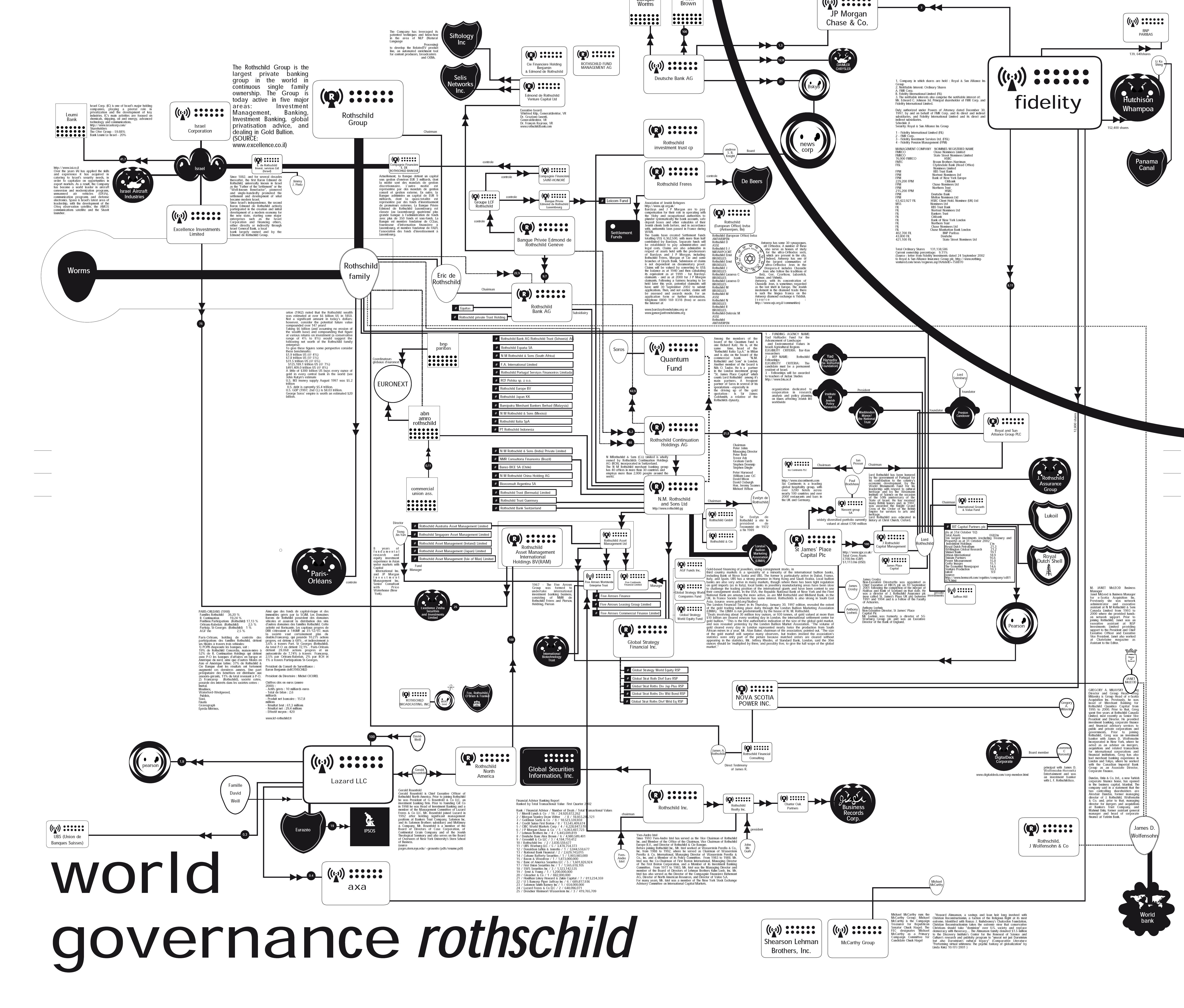
Rothschild Governance Graphic Chart - Who They Own, Who They Control

Rothschild banks are firmly embedded in the Shanghai Foreign Exchange (SHFE) which includes SILVER futures. Nate Rothschild is a board member of BUMI, his London-formed Asian financial predator.  More Rothschild-related posts on this blog

Click image to expand to a MUCH larger view!

Wednesday, November 5, 2014

1974 Enders To Kissinger: "We Should Look Hard At Substantial Sales & Raid The Gold Market Once And For All"

Submitted by Tyler Durden on 11/30/2013 14:57 -0500
Four years ago we exposed what appeared to be a 'smoking gun' of the Fed's willingness to manipulate the price of gold. Then Fed-chair Burns noted the equivalency of gold and money, and furthermore pointed out that if the Fed does not control this core relationship, it would "easily frustrate our efforts to control world liquidity." 

Through a "secret understanding in writing with the Bundesbank that Germany will not buy gold," the cloak-and-dagger CB negotiations were exposed as far back as 1975. 

Monday, September 8, 2014

Silver Price Ready to Reverse its Tumble? - - a Coin Dealer's Perspective

physical silver perspective from a leading coin dealer...

Silver fall ready to reverse?


From July 29 to Sept. 2, managed money traders (which include large hedge funds, commodity pool operators, commodity trading advisors and similar companies) decreased their net long position in COMEX silver contracts from 14,063 to 6,542. Since each contract represents 5,000 ounces of silver, that means they decreased their net long position by about 37.6 million ounces in just five weeks. 

This change was accomplished by increasing their gross short positions by over 135 million ounces while the increase in gross long contracts by less than 98 million ounces.

This shift represents roughly 4 percent of global worldwide silver mining production. Had this shift occurred among "strong hands" traders, the decline in the price of silver would almost certainly have been greater than the $1.42 (6.9 percent) drop from $20.57 on July 29 to $19.15 on Sept. 2.

However, traders in this category are traditionally "weak hands." They typically buy and sell positions for short-term results. The offset to their reduction in their net position (remember that there is always a short and a long position for each COMEX contract) has been bought largely by "strong hands" investors, those who will hold on to their position for much longer than the managed money traders.

Indeed, from July 29 to Sept.  2, the net COMEX silver long position held by companies listed in the "Other Reportables" category increased from 8,461 to 12,034 contracts (just under 18 million ounces).  This category includes very large traders who are trading for their own accounts rather than executing orders for clients.

It seems obvious to me that if short- term traders have been decreasing their net long position, they have a high likelihood of soon turning around to aggressively add to their net holdings. This also seems to be the expectation of large traders placing trades on their own behalf.

Do these two trends indicate that silver prices will end September higher than at the beginning? We will find out in three weeks.

In the meantime, recent lower silver prices have brought a minor flurry of buying of bullion-priced physical silver coins and bars. The U.S. Mint reported higher sales of silver Eagles in August than in July.  While there are no shortages of physical silver on the market yet, those purchasing large quantities will probably have to wait a few more days for delivery than they did in late July.


S​ource ​

Wednesday, August 27, 2014

Silver Price: When is the big comeback?

Wednesday, August 27, 2014, 13:40 clock


After the dramatic rally three years ago, it's been pretty quiet around the silver. Even in the recent geopolitical turmoil, the precious metal could hardly score. When is the big silver comeback?
Silbermix
While the price of gold in the environment of rising political tensions in the crisis areas last grew again, the silver price fell short of the expectations of many precious metal investors.

In this case, both metals are bought by investors as insurance against inflation. That silver is stronger than gold, also used in industry, is one of the main differences between the metals. And this is certainly one of the factors that currently dampens the demand for silver. Since the beginning of silver has now again a drop of approximately 0.5 percent   recorded, for a fat discount of more than 37 percent last year. Gold was down almost 7 percent, however so far after all. In euro terms, the impact is down even slightly larger.

The price of silver is much more volatile compared to other metals.  
That is, the prices more volatile than about in gold. The value of relationship to each other is changing so continuously. To close on a negative or positive evaluation of one metal over the other, one examines the so-called gold-silver ratio. It is a simple ratio: gold price divided by silver price. The gold-silver ratio indicates with how many ounces of silver can buy one ounce of gold. Currently, we obtain for one unit of gold about 65 units of silver (gold-silver ratio = 65). Is silver to gold has to be classed as rather expensive or cheap?
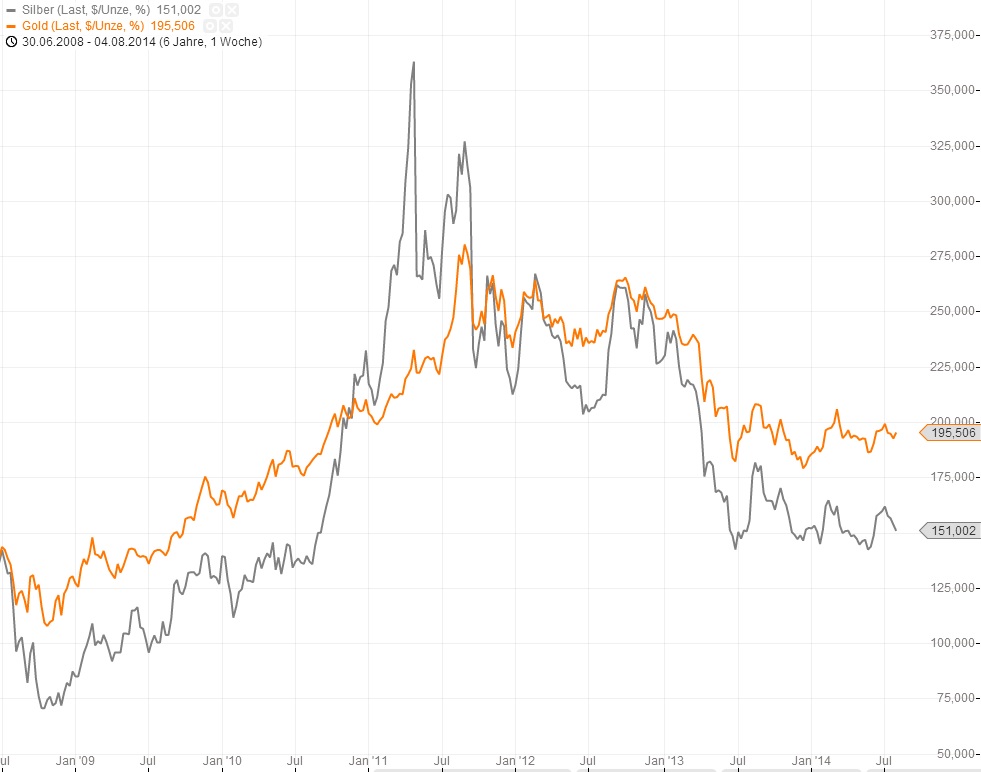
Gold-silver since 2009
Gold and silver price performance since 2009 in comparison (weekly closing prices, index)

For this one must seek the story and compare the geological conditions. According to scientific estimates, more silver is about 17 times stored as gold in the earth's crust. That alone already points to a mismatch between the current precious metal prices. It should however be borne in mind that silver is used industrially.  

The quantities of ore once funded take so continuously. In contrast, all gold ever mined is still as good as being completely present.

More meaningful is the historical comparison. The gold-silver ratio was about 10 to 20 centuries peak periods experienced the quotient end of the 20s and beginning of the nineties, with values ​​of about 100 The sharp rise in the 20th century is due to the fact that silver completely its cash function was robbed and it is now primarily viewed as an industrial metal. The central banks have large holdings of precious metals, but silver is not among them!

The silver market is also regarded as even more strongly influenced by speculative interests, than the gold market. In the spring of 2010 for the first time media attention manipulation allegations were against large U.S. banks (JP Morgan, HSBC) pronounced and later prosecuted, put the price of silver in the episode a dramatic rally on the dance floor.

Within just one year, the price of silver rose from $ 18 to $ 48. Since then, the silver chart is again in decline. So when is the big comeback? U.S. analysts such as Ted Butler and James Turk expect it for a long time. They assume that the current price represents the true scarcity of the precious metal is not nearly. Sooner or later become a new price jump coming - also in relation to gold. It seems as if only someone would take their foot off the gas. And perhaps, have to force a U.S. bank to again before the price of the white precious metal really picks up speed again.


​source: Gold Reporter

Tuesday, August 26, 2014

How The Coming Silver Price Bubble Will Develop - Ted Butler

On the other hand, with or absent manipulation, silver will always be money. It has been a millennial refuge for those seeking a safe harbor for their dying fiat currencies. A panic along that plain, IMO, would ignite silver's price and reach a magnitude far greater than just a "shortage."

We reported this yesterday, but didn't see any mention by Mr. Butler: Gold and Silver Futures Margins Lowered by CME
In the "past" the lowering of margin requirements has given an immediate bullish blip to prices, but not yet it seems.


Commodities / Gold and Silver 2014 Aug 26, 2014 - 06:07 PM GMT
Ted Butler writes: What is an asset bubble? An asset bubble occurs when a large number of buyers, normally not usually prone to speculate in an asset, bid the price of that asset much higher than underlying valuations would support, most often fueled by leverage or borrowed money. 

Typically, towards the terminal phase of the bubble the most compelling reason for continuing to buy the asset is due to the rising price itself, as all caution is thrown to the wind amid the collective belief that prices can only move higher still. Then, when the last possible speculator has purchased the asset, the inevitable occurs and the price of the asset collapses as previous buyers turn into sellers and attempt to get out. Since the formation of the bubble and its inevitable collapse are driven by the collective emotions of greed and fear, it is generally impossible to predict how long an asset bubble will persist and how high the price can climb, as well as the timing and extent of the subsequent collapse.


How do asset bubbles develop? Most often, an asset bubble develops when an undervalued asset which has a compelling investment story and there exists an overall financial environment of sufficient buying power, catches the collective interest of the crowd. For example, by the mid-2000's and after years of steady appreciation, residential real estate developed into an asset bubble amid the self-fulfilling cycle of continued gains and the availability of easy credit.

As far as great stories go, silver has the best potential story to develop into a bubble. First, there is little argument that it is among the most, if not the most undervalued asset of all by objective relative historical price comparison. In addition, it is at or below its primary cost of production, as evidenced in recent quarterly earnings reports. Remember, most bubbles start out with an asset that is undervalued – on this score silver more than qualifies as being undervalued.

Aside from extreme undervaluation, the silver story is multi-faceted. Silver is both an industrial metal and a primary investment asset, the net effect being that very little newly-produced silver is available for investment, perhaps only 10% of the one billion oz produced yearly (mine plus recycling), or 100 million oz annually. In dollar terms, at current prices that comes to less than $2 billion per year. There are two ways to look at that; the observation that there are countless individuals and investment funds capable of ponying up that entire amount on their own and the fact that $2 billion amounts to less than 30 cents on a per capita basis for the world's 7 billion inhabitants. Simply put, there is no other asset class which would require less buying to develop into a bubble than silver.

Apart from newly-produced silver available for investment, the amount of previously produced metal available for investment, or world inventories, is also shockingly low. As a result of a 65 year deficit consumption pattern that ended in 2005, world silver inventories have been depleted by 90% from the levels existing at the start of World War II. Today, only a little over one billion oz of metal in accepted bullion industrial form exists with perhaps another billion oz existing in coins and bars. In dollar terms, that comes to $20 to $40 billion, where most other asset classes (stocks, bonds, real estate and even gold) are measured in the many trillions of dollars. And please, never confuse what exists with what's available for purchase – only the owners of the small amount of silver that exists will determine at what price it is available.

The conclusion is simple – the asset requiring the least amount of buying to create a bubble is, automatically, the best candidate for developing into the biggest bubble. The fuel for any bubble is total (world) buying power versus the actual amount of an asset available for purchase. Previous, as well as prospective, bubbles in stocks, bonds and real estate grew to many trillions of dollars of total valuation. At $200 an ounce, all the silver in the world (bullion plus coins) would "only" amount to $400 billion, not even a rounding error to the total valuation of stocks, bonds, real estate and, even, gold. In other words, due to silver's current undervaluation and its shockingly small amount in existence, it has more room to the upside than any other asset class.

But I'm not done. Silver's unique dual role as a vital industrial material and primary investment asset creates a setup for something happening that has never occurred in any previous bubble. As and when sufficient physical investment buying develops in silver to drive prices significantly higher, the industrial consumers of silver, in everything from electrical and solar applications to medical and chemical applications, will likely be subject to delays in the customary delivery timelines of the metal. As is almost always the case, whenever industrial consumers of a commodity are deprived of timely deliveries, they resort to stockpiling that commodity as a remedy, further exacerbating delivery delays to other users.

Thus, the stage is set for something the world has never experienced previously – an asset bubble accompanied with an industrial shortage. The two greatest upward price forces known to man, an asset bubble and a genuine commodity shortage, appear set to combine in silver. Either one, alone, would have a profound impact on the price, but the combination seems both inevitable and almost impossible to contemplate in terms of how high the price of silver could be driven. And it's hard to see how intense investment buying wouldn't trip off industrial user attempted inventory stockpiling or vice versa; it doesn't matter which comes first.

Tying everything together, there is one and only one explanation for why silver is so undervalued and the asset bubble/industrial shortage hasn't occurred yet – the ongoing price manipulation on the COMEX. Massive amounts of paper contracts traded between two groups of large speculators (technical funds and commercials), measuring in the hundreds of millions of ounces and completely unrelated to the supply/demand fundamentals have set the price of silver. This COMEX price control is both the curse and the promise in that it not only explains the undervaluation, it will explain why it seems inevitable for an asset bubble/user shortage to develop.

Think of it this way – the asset with the greatest potential for becoming the biggest bubble ever had better have the greatest story ever as well.  And that is what the COMEX silver manipulation is – the key ingredient in the greatest investment potential score ever.  If silver wasn't manipulated how good would the story be? Absent manipulation, I wouldn't buy or hold silver because that would mean that free market forces were setting the price all along. In other words, if silver wasn't manipulated there would be scant reason to buy it in my eyes. If I wasn't convinced silver was manipulated, I can't see how I would have ever written this or anything about it in the past or could have become interested in it in the first place.

As painful as recent prices have been to existing holders because of the manipulation, without it there would be little chance for a price explosion at some point. The easiest major potential change in the silver price equation is for the manipulation to end, one way or another. And if history and logic win out, the silver manipulation must end, not the least because of the coming clash between paper and physical silver. Some call it the disconnect between paper derivatives contract on the COMEX and actual physical silver, but in reality the story is that COMEX futures contracts are very much connected to each other via the delivery mechanism.

The connection between paper and physical has been forged because the main COMEX futures speculators are only interested in trading paper futures contracts and not in trading physical metal. Technical funds have no desire to buy and sell real metal for full cash payment when they can deal in paper contracts for only 10% cash down because they are trading, not investing. The problem is that the trading between the technical funds and the commercials has become so large that it dwarfs real world silver supply/demand fundamentals and ends up setting the price of silver in violation of commodity law. I know that this perversion of the price-discovery process has existed for a long time, but it would be wrong to confuse longevity with permanence.

The fact is that while the COMEX paper market dominance has lorded over the real supply and demand fundamentals, the stage has been set for a physical asset bubble/industrial user panic event. I've become convinced that any prospective bubble in silver won't be driven by the aggressive buying of COMEX futures contracts, but only by physical buying. For one thing, the crooked CME and CFTC would never allow any group of traders to drive silver prices sharply higher by buying unlimited amounts of COMEX futures contracts. If the technical funds do buy big amounts of COMEX silver futures contracts (as was the case from June to mid-July), you can almost be certain that the CME and CFTC knew that those funds would be soon forced to sell on lower prices.

As a result, any bubble in silver must and will develop from physical investment buying. Surely, any industrial user inventory buying panic must involve immediate physical delivery and not a paper futures contract in a time of delivery delays and uncertainty. In fact, it is hard to imagine, as a silver bubble begins to develop, a greater urgency for holding only physical metal to intensify, due to a growing recognition that the COMEX manipulation was responsible for the former low price.

Since I am speaking in terms of a potential historic asset bubble in silver, I am implying that the price of silver will far exceed its true value at some point before correcting sharply. It is before that collapse point, that God-willing, I intend to sell. I am not deluding myself that I will come close except hoping not to be terribly early or late. While I respect anyone's reasons for buying and holding silver, my mission has always been to help end the manipulation and be done with silver after that was accomplished and reflected in the price.

This article is based on a commentary of Ted Butler's premium service at www.butlerresearch.com which contains the highest quality of gold and silver market analysis. Ted Butler is specialized in precious metals market analysis for over four decades.

Source - http://goldsilverworlds.com/physical-market/how-the-coming-silver-bubble-will-develop/

© 2014 Copyright goldsilverworlds - All Rights Reserved Disclaimer: The above is a matter of opinion provided for general information purposes only and is not intended as investment advice. Information and analysis above are derived from sources and utilising methods believed to be reliable, but we cannot accept responsibility for any losses you may incur as a result of this analysis. Individuals should consult with their personal financial advisors.


Monday, August 25, 2014

Gold and Silver Futures Margins Lowered by CME

Monday, August 25, 2014, 8:44 clock | Posted by Gold Reporter

Gold and silver futures speculators must deposit less money

Gold und Silber (Orlando-Florin-Rosu-Fotolia.com)
The speculation in gold and silver for re-appointment cheaper for traders.

 
The CME Group has reduced the margin requirements when trading gold and silver futures for the fourth time this year.

The operator of the US-commodity futures exchange Comex, the CME Group, has lowered the gold margins by the start of trading on Monday again by almost 15 percent. However, this applies only to the trade group of speculators.

When trading statements must now per 100-ounce contract only $ 5,060 deposited in the account of the respective distributors be (formerly $ 5,940). The Maintenance Margin (if a contract is held longer than one day) is reduced to $ 4,600 (formerly $ 5,400). The amounts secured for hedgers / members remain unchanged, so that the maintenance margin is now equal in both groups of traders.

The Silver margins for the 5,000-ounce contract fall by around 13 percent. Again, only speculators affected by the reduction and also the Maintenance Margins are now both dealer groups with $ 6,500 at the same height. As initial margin $ 7,150 (speculators) or $ 6,500 (Hedger / members) are now required.

The margins for smaller contract sizes have been adjusted downward. It is the fourth margin reduction this year in gold and silver.
Gold Reporter


Wednesday, August 13, 2014

Shanghai Silver In Backwardation

​Koos Jansen of BullionStar​
Published: 12-08-2014 22:54

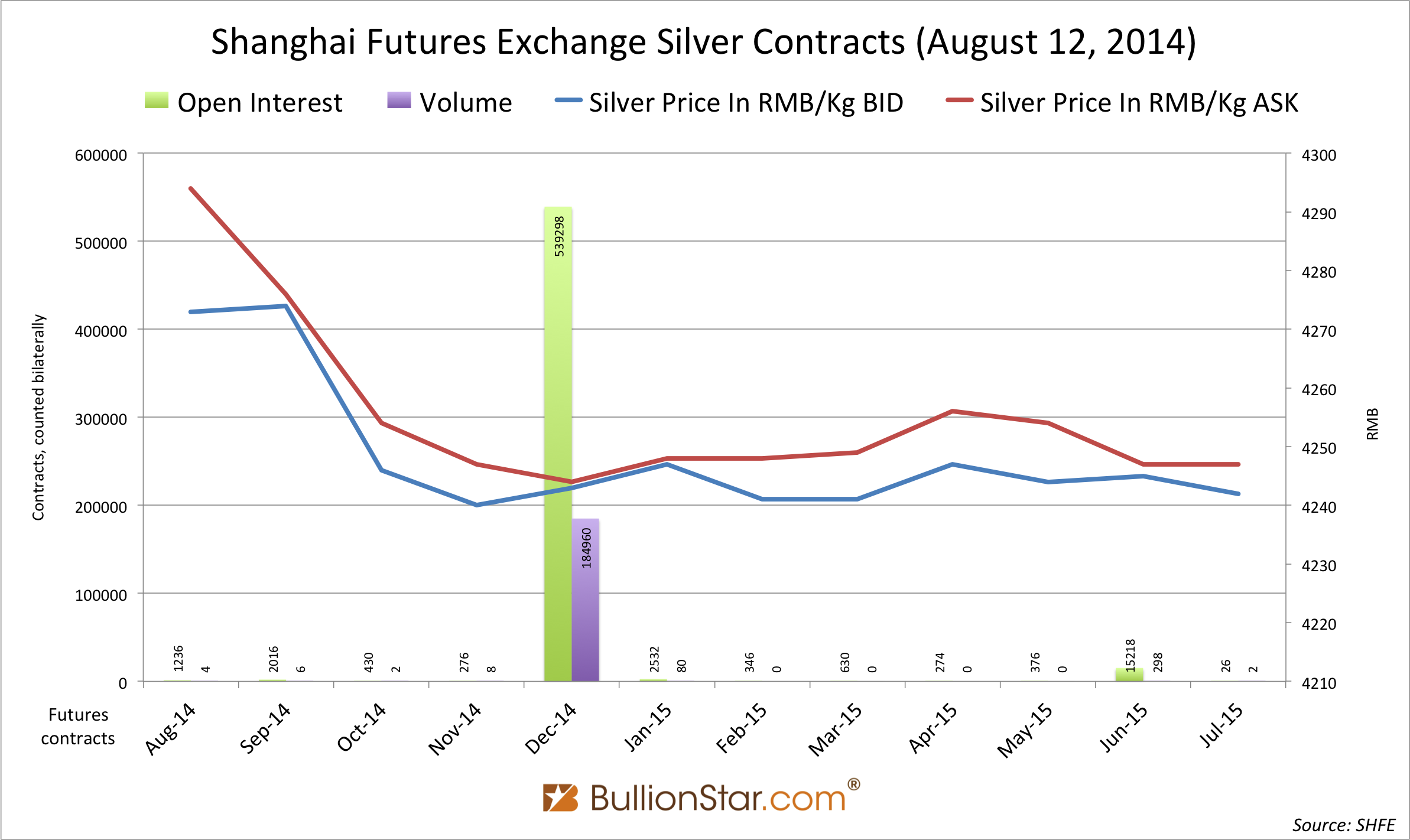
Today the front month silver contract on the Shanghai Futures Exchange (SHFE) closed at an 8 % premium over London spot. Therewithal the futures curve of silver is in backwardation; silver is scarce in Shanghai. 


Backwardation means the future price is lower than the present spot price. Normally the futures curve of precious metals is in contango, meaning the future price is higher than the spot price. 

If we look at the Ag1412 contract (silver 2014 December), the ask price closed at 4244 RMB/Kg, while the bid price of Ag1408 (silver 2014 August) was 4273 RMB/Kg. Consequentially one could, for example, sell 900 Kg of silver in August for 3,845,700 RMB (900 Kg times 4273 RMB) and buy back the same amount of silver delivered in December for 3,819,600 RMB (900 Kg times 4244 RMB). This trade would make a profit of 26,100 RMB in 4 months on 900 Kg.    

The open interest (OI) for Ag1408 is 1246 contracts. On the Shanghai Futures Exchange the OI is calculated bilaterally, so currently there are 623 long and 623 short contracts open. The contract size is 15 Kg/lot. The Last Trading Day of Ag1408 is friday August 15. If the 623 shorts/longs aren't closed before friday, these contracts will be settled and the longs take delivery of 9.345 metric tonnes (623 contracts times 15 Kg). When silver is delivered this doesn't necessarily mean the metal is taken out of the warehouse. What happens is that a warrant, a claim of ownership on silver in the warehouse, is transferred from short to long. If the long redeems the warrant and takes the silver out of the warehouse or chooses to hold the warrant and from that moment pay storage costs is up to him. Additionally, anyone can deposit silver in the warehouse and create a warrant.

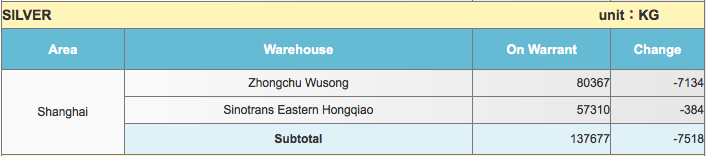
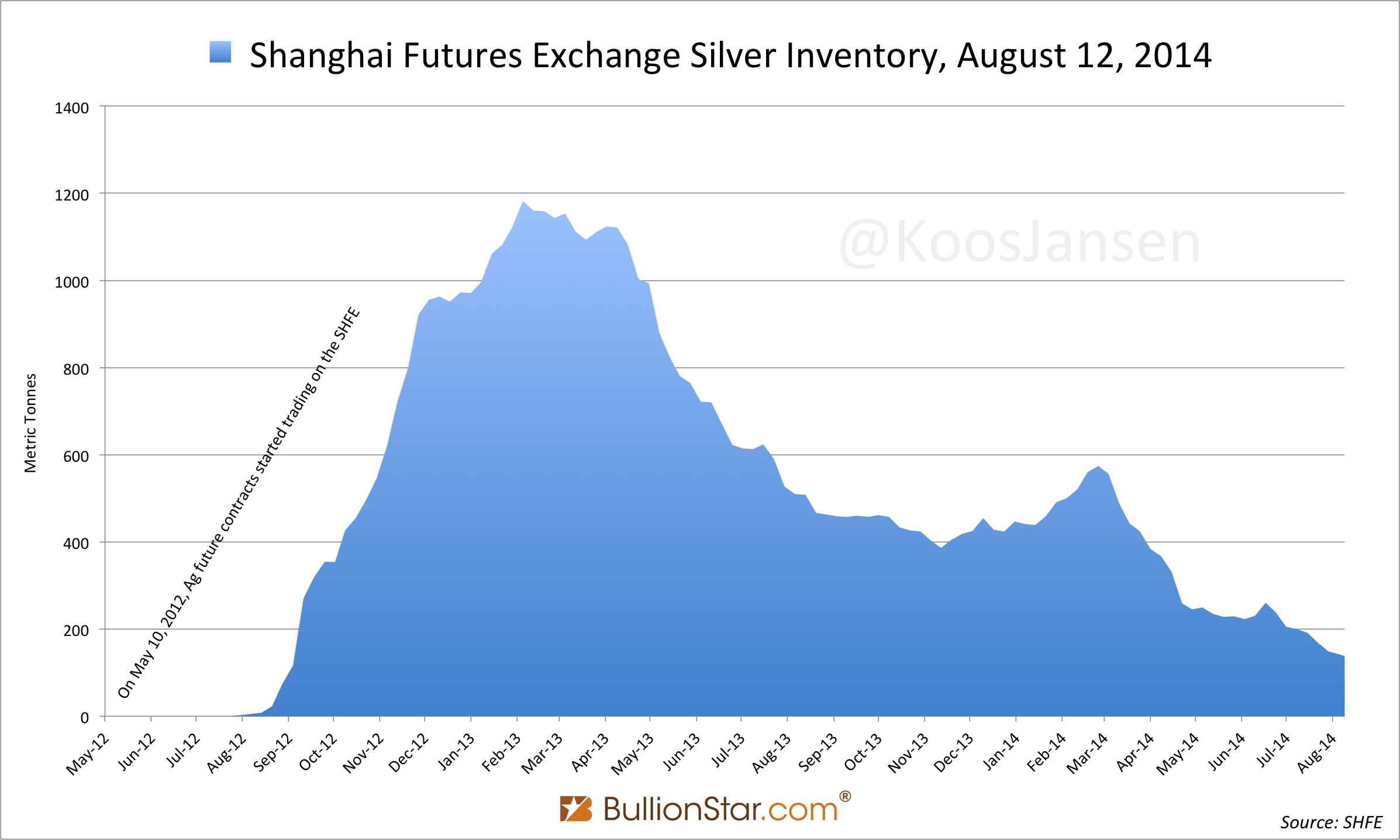
The owner of a warrant can redeem his silver any time he prefers. The SHFE today reported silver inventory (on warrant) was 137.677 tonnes, 


down 7.518 tonnes from yesterday. 


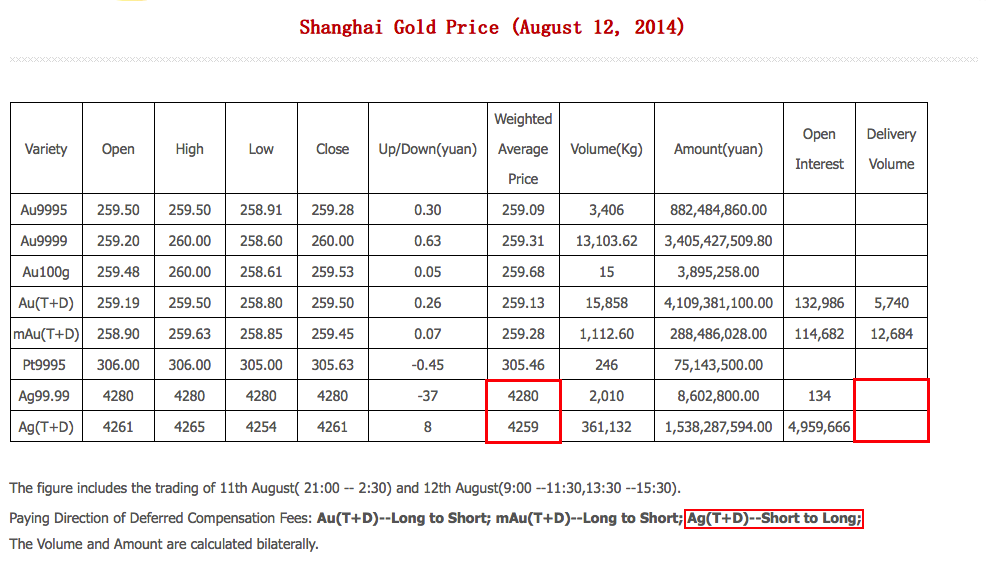
On the Shanghai Gold Exchange (SGE) we could see spot silver Ag99.99 trading at a premium over spot deferred silver Ag(T+D). The Ag(T+D) shorts chose not to deliver any metal, but instead pay the deferred compensation fee. Today Ag99.99 closed at a 7.8 % premium over London spot, Ag(T+D) at 7.3%. Note, the SGE does not close at the same time as the SHFE.  


In May and June silver also traded in backwardation on the SHFE. The trading opportunity then attracted supply that pushed the futures curve in contango and the premiums lower. The next chart lags a couple of days. 


Koos Jansen