|
Showing posts with label Savings. Show all posts
Showing posts with label Savings. Show all posts
Thursday, February 26, 2015
Take Your Money And Run!! Global Central Bank Conspiracy Exposed - Next Step: Confiscating Your Bank Deposits


Wednesday, February 25, 2015
What is junk silver?
The idea is to first get started. Save four silver quarters a month dated before 1964.
Feb202015
 Do you have a coin jug at home? Perhaps it isn’t a jug, per se, but a coffee can, glass jar, or maybe even an old fashioned piggy bank? It might be holding far more money than you realize!
If you spend much time surfing various survival/prepper message boards and other forums, you’ll no doubt run across the term “junk silver.” People want to know, “What is junk silver? And, should I buy it?”
The term refers to coins containing a high amount of actual silver, unlike most common coins minted today.
Here’s the cool part. If you have a coin jug at home, odds are you probably have at least a few junk silver coins in there. While you won’t see them every day, they do still crop up regularly.
What is junk silver?
Here in the United States, junk silver coins are basically any coin (except pennies and nickels) minted in 1964 or earlier.
Given that half-dollars and other larger coins are somewhat rare in most of our daily lives, we’re basically talking about dimes and quarters. If a coin is categorized as junk silver, it does not have any numismatic value to collectors.
The value in junk silver is the silver itself, not the coin’s appearance.
The only silver nickels in recent history are the “wartime” ones produced in 1942-1945. Even then, they only contain about 30% silver, whereas most junk silver coins contain 90% silver.
If after looking at the mint date you still aren’t sure if the coin is silver, a silver coin sounds very different from a non-silver one when dropped on a table. The sound is hard to describe but once you’ve heard it, you’ll recognize it pretty quickly going forward.
Why do preppers focus on junk silver?
Why is it important to know about junk silver? Well, for starters, junk silver is a very easy way to get started with collecting precious metals for possible use as alternative currency, should there come some sort of economic collapse. It takes just a few seconds at the end of the day to examine the coins in your pocket before you dump them into your coin jug.
On top of that, junk silver coins are worth far more than their face value. Generally speaking, if you have $1.40 in face value of junk silver coins, you have one troy ounce of actual silver. As of this writing, an ounce of silver is going for about $18.00 or so. I use Kitco to check prices when I’m getting ready to buy.
Now, honestly, that’s not a completely true comparison as junk silver coins aren’t actually worth the full silver spot price. But, those dimes and quarters are worth a ton more than what you’d get from a candy vending machine.
At my house, we have two separate jars, one for pennies and one for all other coins. I’ll usually glance through my spare change, checking mint dates, before tossing the coins into the appropriate jar. But, because I’m human and might miss seeing a junk silver coin, we’ll have one of our children dump out the jar and check each coin before we cash in the change. Often, they’ll find one or two coins we missed. The junk silver coins are stored away under lock and key, just in case we need them someday. If nothing else, they’ll be nice for the kids to have someday.
Resources for junk silver
Survival Mom: How to Prepare Your Family for Everyday Disasters and Worst Case Scenarios (I include an interview with a precious metals dealer and information about buying junk silver.)
via survivalmom Lowest Interest Rates in History - EVER
We truly live at a momentous time. Play your cards right (whatever those cards may be) and you'll provide for your foreseeable generations to come.
by on February 24, 2015
Business Insider’s Myles Udland just posted a chart,
drawn from research by the Bank of England, showing interest rates for
the past 3,000 years. And for all those who’ve been feeling like today’s
“new normal” is actually profoundly abnormal, here’s your proof. It
turns out that interest rates, both long and short-term, are lower than
they’ve ever been. Not lower than in this cycle, or post-war or in the
past century, but ever, going back to the earliest days of markets.
~~~~~~~~~~~~~~~~~~~~~~~~~~~~~~~~~~~~~~~

And they’re still falling in most of the world.
Central banks are cutting rates on a daily basis (Turkey was today’s announcement), in some cases to less than zero. Something like $2 trillion of sovereign and corporate debt now trades with negative yields.
Virtually the only major entity considering raising rates is the US, and the incongruity of this threat has traders balking. See Bloomberg’s Traders still don’t believe the Fed is ready to raise rates .
If this is indeed uncharted territory and we’re going further in before we’re done, what are the implications for markets and, well, everything? A couple of thoughts:
The insurance industry, pension funds and money market funds all depend on positive yields to operate. A life insurance company, for instance, can keep premiums low because it can invest that cash for years before having to pay out on the policy. What happens if the bonds it buys start yielding nothing (or less than nothing)? What about a money market fund that can no longer find investment grade corporate paper yielding much more than zero? Pension funds, meanwhile, have generally promised 7%-8% returns to their members, but now have to get all of those profits from the equity and real estate sides of their portfolios.
For any of these entities to stay in business they now have to act like hedge funds, taking on extra risk, rolling the dice and hoping that the good years outweigh the bad ones. In other words, these formerly safest-of-the-safe investment vehicles become just as risky as the typical eTrade account.
Then there’s the impact of negative rates on the market’s price signaling mechanism for the rest of us. Interest rates are the price of money, and as such they tell investors, entrepreneurs and consumers what to do. Low interest rates generally say “buy, build, consume, take risks” while high rates say “save, sell, conserve, wait.”
But zero or negative rates? Are they just an extreme version of low rates or is there a qualitative difference? Everyone has a theory about this but in the absence of historical precedent, we’ll have to wait and see.
Anyhow, the coming negative interest rate world will provide plenty of thrills, chills and blog post material. For now it’s enough to note that we’ve never, through depressions, world wars, bubbles and famines, seen anything like today’s economy.
via dollarcollapse
Monday, February 23, 2015
A New Way to Hold Gold (2015 Update)

What if you could carry and exchange gold in the exact same manner as you do with the dollar bills in your wallet?
Last year, we introduced the precious metals community to a company called Valaurum, which has developed a technology that’s making this possible.
Here’s the write-up from last year:
Democratizing GoldIn short, a fractional gram’s worth of gold is affixed to layers of polyester, creating a note – called an “Aurum” – similar in dimension and thickness to a U.S. dollar bill. This gold (usually 1/10th or 1/20th of a gram) is commercially recoverable. So an Aurum offers similar potential as a coin or bar, in terms of providing a vehicle for storing and exchanging known, dependable increments of precious metals – just in much smaller (and more affordable) amounts than commercially available to date.The big idea here? In a world where a 1oz coin of gold costs over $1,200, an Aurum will let you hold a few dollars’ worth of gold in a single note. If you’ve got pocket change, you can be a precious metals owner.And you don’t have to change your behavior. You can store and transport an Aurum in your billfold along with your dollars.Understanding the AurumAs the saying goes, a picture’s worth a thousand words. Here’s a picture of an Aurum designed for Peak Prosperity that the Valaurum team produced for us:
You’ll see that with even just 1/20th of a gram of gold involved, it’s enough to make the Aurum appear to be “made of” gold.The characteristic luster, color, and shine of the 24-karat gold used is immediately apparent.The Aurum is designed to be handled in the same manner as we do with our “paper” money. And, despite having a more ‘plastic’ feel to it (resulting from the polyester backing), it’s as flexible, lightweight, and familiar-feeling as paper currency.The big difference, of course, is that instead of being a claim on something else, it simply is what it is: a fractional gram of gold. It can be stored, traded, or melted down – just like a coin or bar.Here’s a brief video that gives an overview of the production process:ImplicationsBeing able to hold gold in this form is significant for several reasons.First, it makes gold ownership available to all budgets. Many of the world’s households have been priced out of gold to date. This changes that completely.Second, it enables the potential for everyday transactions should we ever return to a precious metal-backed monetary standard. It answers the challenge: How will you pay for your groceries with gold? With an Aurum, it’s now easy.Whether Valaurum’s product emerges as the winning horse or not, the world definitely needs this type of solution (i.e., convenient fractional physical metal) to go mainstream.I’m very excited by this new innovation in the bullion industry, and I explore the matter in depth in this podcast [14]. If you’re similarly intrigued, it’s worth the listen.
The response to last year’s podcast was tremendous. It quickly became one of the most popular in Peak Prosperity’s history. If the description above interests you, and you haven’t listened to it already, you can do so by clicking here [14].
Big News
So, what’s happened with the aurum over the past year? Has the concept caught on with precious metals investors?
We’ve invited Adam Trexler back to the program to find out. In this week’s podcast, he shares with us a number of positive updates about adoption of the aurum, demand by the bullion dealer community, and product enhancement to the gold note itself.
But most exciting is this: a (small) sovereign central bank is deep in negotiations with Valaurum to replace its existing national currency with aurum notes, creating a true precious-metals backed monetary system. As best we know, this would make it the only one in existence in the world today.
If this indeed occurs, it could be a game-changer. Changes in trust and perception always begin with a non-conformist having the courage to depart from the herd’s consensus. Even a small country rejecting fiat money in favor of a gold standard will catch the attention of others. And as the current currency wars exacerbate, as they inevitably will, more countries will increasingly look to adopt monetary regimes that work better.
Perhaps that will be a return to gold, in this new form.
More Big News
The Peak Prosperity aurum notes we printed up last year quickly sold out. Demand was much higher than we had expected.
For those who did not have the chance to purchase any — or for those who did, and are interested in collecting each new series that gets produced — we have good news: the new 2015 Peak Prosperity aurum (1/10th gram) is now available for purchase [15]. Those interested in doing so can learn more by clicking here [15].
And for those interested in the latest on Valaurum, click the play button below to listen to my latest interview with Adam Trexler (31m:20s)
via washingtonsblog
Saturday, February 14, 2015
Will Uncle Sam get your IRA?
Posted on February 13, 2015 by Pat Heller
I have written a number of times that I expect the U.S. government will eventually take or somehow get control of all assets in private retirement accounts, including precious metals individual retirement accounts. The basic reason for this expectation is that the U.S. government is running up tens of trillions of dollars of debts and unfunded liabilities. The trillions of dollars of private retirement account assets are just too big a target for the politicians and bureaucrats to leave alone.
 |
| Will Uncle Sam get your IRA? |
Will Uncle Sam get your IRA?
An early attempt by the government to take control of such assets came soon after President Clinton took office. As now structured, income taxes are not paid on most retirement accounts until the assets are withdrawn. This event to collect income taxes usually occurs years down the road.
In the early 1990s, that concept was turned around. The proposal was to impose a 15 percent tax on all existing private retirement accounts, then tax new contributions also at the 15 percent rate. The payoff for taxpayers was that any future withdrawals would be tax free.
A new plan was presented to the House Committee on Education and Labor in hearings on Oct. 7, 2008, by Professor Teresa Ghilarducci. This proposal was for the U.S. government to seize all private retirement assets and replace them with Guaranteed Retirement Accounts (GRAs) managed by the Social Security Administration. The only assets that would be allowed into these new Accounts would be U.S. Treasury bonds paying 3 percent interest (indexed for subsequent Consumer Price Index changes).
Further, the plan called for 5 percent of payrolls to be withheld, on top of existing Social Security and Medicare tax withholdings, for deposit into these GRAs. The last feature of this proposal is that upon the death of the account holder, part of the remaining assets would be forfeited to the U.S. government. That was a huge change where all private retirement account assets, up to now, go to the heirs.
The one bonus to bribe Americans to go along with the nationalization of private retirement accounts was that the assets would be converted to government bonds as of their value at a designated earlier date when most paper assets such as stocks, bonds and currencies were mostly at a higher value than they were in October 2008. Given the opportunity to recoup some of the losses that retirement accounts had suffered in 2007 and 2008, this was a definite enticement.
In September 2010, the Departments of Labor and Treasury held joint hearings to advocate that, upon retirement, the assets in private retirement accounts would be converted into annuities, where the residual assets upon death would ultimately all be retained by the U.S. government.
In January 2014, during his State of the Union address, President Obama proposed the establishment of the MyRA. This is initially a voluntary program for lower-income Americans to set aside some after-tax dollars to earn income that can later be withdrawn tax-free. However, there are several limitations. First, these accounts can only own U.S. Treasury debt that pays the same interest rate as the Thrift Savings Plan’s Government Securities Investment Fund. This fund was paying less than 2 percent at the time of the President’s proposal. A second major limitation is that accounts could not exceed $15,000 in total value. Further, these accounts cannot exist longer than 30 years.
Starting two months ago, a small number of these MyRA accounts have been established.
Investment writer Doug Fabian has described an all-too-plausible scenario that he expects to happen before the end of President Obama’s term. He anticipates that there will be some major financial crisis in the United States, greater than the Great Recession of last decade, where investors will see the values of their stocks, bonds and other assets mostly plummet.
This could be triggered by any number of incidents. As some examples, Greece could leave the European Monetary Union, which would force many major American and foreign banks to write down tens of billions of dollars of bonds that they are now carrying at face value. The developing fall in demand for upper-end U.S. housing could expand to all housing nationwide, leaving U.S. banks with massive bad debts that risk their survival. Or local, school district, regional, and state governments all across America could be forced into bankruptcy after the Governmental Accounting Standards Board issues their pronouncements in June requiring these entities to more fully report the extent of their tens of trillions of dollars of unfunded liabilities for employee pensions and retiree health care benefits. There are many other possible crises, but this gives you an idea of how massive a financial crisis could occur.
At the time when such a financial crisis hits, private retirement account assets will almost all drop in value – by a lot. If, or when, this occurs, there will be a huge groundswell from people who no longer have enough wealth to retire. Mr. Fabian theorizes that this will be the perfect time for the federal government to modify MyRA accounts to accept unlimited asset transfers from existing private retirement accounts. By the federal government offering people the opportunity to get credit for the value of their assets before the financial crisis was triggered, Fabian expects that a high percentage of Americans would voluntarily be eager to turn their retirement assets into loans to the U.S. Treasury.


Such a scenario would be a power-grabbing politician’s dream. Instead of being thought of as a President who stole people’s retirement assets, the person in charge in such circumstances were be hailed as a savior. Unfortunately, I think the risk of such events coming to pass by the end of 2016 are high enough that Americans need to prepare their finances sooner rather than later.
Should any huge financial crisis come to pass, expect to see a surge in demand for precious metals, especially gold and silver. Other portable tangible assets such as rare coins and paper money will also likely experience stronger demand. However, the increased demand for such assets will not be for placement in retirement accounts. Instead, look for the surge in demand to be for assets that can be owned and possessed directly.
Patrick A. Heller was the American Numismatic Association 2012 Harry Forman Numismatic Dealer of the Year Award winner. He is the owner emeritus and communications officer of Liberty Coin Service in Lansing, Mich., and writes “Liberty’s Outlook,” a monthly newsletter on rare coins and precious metals subjects. Past newsletter issues can be viewed at http://www.libertycoinservice.com. Other commentaries are available at Coin Week (http://www.coinweek.com and http://www.coininfo.com). He also writes a bi-monthly column on collectibles for “The Greater Lansing Business Monthly” (http://www.lansingbusinessmonthly.com/articles/department-columns). His Numismatic Literary Guild award-winning radio show “Things You ‘Know’ That Just Aren’t So, And Important News You Need To Know” can be heard at 8:45 a.m. Wednesday and Friday mornings on 1320-AM WILS in Lansing (which streams live and becomes part of the audio and text archives posted at http://www.1320wils.com).
Labels:
Coins
,
Debt Budget Morass
,
Gold and Silver
,
Medicare
,
Retirement
,
Savings
,
Social Security
,
Taxes


Thursday, February 12, 2015
You Can't Create More Savings by Printing More Money
February 12, 2015 Frank Shostak
 Savings has nothing to do with money. For instance, if a baker produces ten loaves of bread and consumes one loaf, his savings is nine loaves of bread. In other words, the “savings” in this case is the baker’s real income (his production of bread) minus the amount of bread that the baker consumed. The baker’s savings now permits him to secure other goods and services.
For instance, the baker can now exchange his saved bread for a pair of shoes with a shoemaker. Observe that the baker’s savings is his real means of payments — he pays for the shoes with the saved bread. Likewise, the shoemaker pays for the nine loaves of bread with the shoes that are his real savings.
What Is Savings?
The introduction of money doesn’t alter what we have so far said. When a baker sells his bread for money to a shoemaker, he has supplied the shoemaker with his saved, unconsumed bread. The supplied bread sustains the shoemaker and allows him to continue making shoes. Note that the money received by the baker is fully backed by his unconsumed production of bread.
Yet without the medium of exchange, i.e., money, no market economy, and hence, the division of labor, could take place. Money enables the goods of one specialist to be exchanged for the goods of another specialist. In short, by means of money, people can channel real savings, which in turn permits the widening of the process of real wealth generation.
Also, in a world without money it would be impossible to save various final goods like perishable goods for a long period of time. So the introduction of money solves this problem. Instead of storing his bread, the baker can now exchange his bread for money.
In other words, his unconsumed production of bread is now “stored,” so to speak, in money. There is, however, one proviso in all of this: that the flow of the production of goods and services continues unabated. This means that whenever a holder of money decides to exchange some money for goods, these goods are there for him.
Having Money Is Not the Same as Having Savings
Money can be seen as a receipt, as it were, given to producers of final goods and services that are ready for human consumption. Thus when a baker exchanges his money for apples, the baker has already paid for them with the bread produced and saved prior to this exchange. Money therefore is the baker’s claim on real savings. It is not, however, savings.
Now what about the case where money is used to buy unprocessed material — is the unprocessed material real savings? The answer is no. The raw material must be processed and then converted into a piece of equipment, which in turn can be employed in the production of final goods and services that are ready for human consumption. In this sense, the buyer of unprocessed material transfers his claims on real savings to the seller of material in return for the prospect that the transformed material, some time in the future, will generate benefits far in excess of the cost incurred.
Furthermore, the buyer of the material also buys time (i.e., by having the material readily available, he can proceed immediately with the stages of making the final tool). If the material weren’t available he would have to extract it himself, which of course would delay the making of the final tool.
Once real savings are exchanged for money, the recipient of the money can exercise his demand for money in a variety of ways. This, however, will not have any effect on the existent pool of real savings.
An individual can exercise his demand for money either by holding it in his pocket, or in his house, or by placing it in the custody of a bank in a demand deposit, or even in a safe deposit box.
Also, whether he uses it immediately in exchange for other goods, or lends it out, or puts it under the mattress, it does not alter the given pool of real savings. Thus by putting the money under the mattress, an individual doesn’t engage in the act of saving. He is just exercising a demand for money. What individuals do with money cannot alter the fact that real savings are already funding a particular activity. Whether individuals decide to hold onto the money, or lend it out alters their demand for money, but this has nothing to do with savings.
Whenever an individual lends some of his money he in fact transfers his claims on real goods to a borrower. By lending money, the individual has in fact lowered the demand for it. Note that the act of lending money (i.e., the transferring of the claim) doesn’t alter the existent pool of real savings. Likewise, if the owner of money decides to buy a financial asset like a bond or a stock he simply transfers his claims on real savings to the seller of financial assets. No present real savings are affected as a result of these transactions.
How Does Money-Supply Expansion Affect Savings?
Now let us examine the effect of monetary expansion on the pool of real savings. Since the expanded money supply was never earned, goods and services therefore do not back it up, so to speak. When such money is exchanged for goods it, in fact, amounts to consumption that is not supported by production. Consequently a holder of honest money (i.e., an individual who has produced real wealth), that wants to exercise his claim over goods discovers that he cannot get back all the goods he previously produced and exchanged for money.
In short, he discovers that the purchasing power of his money has fallen — he has in fact been robbed by means of loose monetary policy. The printing of money therefore cannot result in more savings as suggested by mainstream economists, but rather to its redistribution.
This, in the process, undermines wealth generators, thereby weakening over time the pool of real savings. So any so-called economic growth, in the framework of a loose monetary policy, can only be on account of a private sector that manages to grow the pool of real savings despite the negative effects of the loose money policy.
We can thus conclude that savings is not about money as such, but about final goods and services that support various individuals that are engaged in various stages of production. It is not money that funds economic activity but the flow of final consumer goods and services. The existence of money only facilitates the flow of the real stuff.
via mises.org
For instance, the baker can now exchange his saved bread for a pair of shoes with a shoemaker. Observe that the baker’s savings is his real means of payments — he pays for the shoes with the saved bread. Likewise, the shoemaker pays for the nine loaves of bread with the shoes that are his real savings.
What Is Savings?
The introduction of money doesn’t alter what we have so far said. When a baker sells his bread for money to a shoemaker, he has supplied the shoemaker with his saved, unconsumed bread. The supplied bread sustains the shoemaker and allows him to continue making shoes. Note that the money received by the baker is fully backed by his unconsumed production of bread.
Yet without the medium of exchange, i.e., money, no market economy, and hence, the division of labor, could take place. Money enables the goods of one specialist to be exchanged for the goods of another specialist. In short, by means of money, people can channel real savings, which in turn permits the widening of the process of real wealth generation.
Also, in a world without money it would be impossible to save various final goods like perishable goods for a long period of time. So the introduction of money solves this problem. Instead of storing his bread, the baker can now exchange his bread for money.
In other words, his unconsumed production of bread is now “stored,” so to speak, in money. There is, however, one proviso in all of this: that the flow of the production of goods and services continues unabated. This means that whenever a holder of money decides to exchange some money for goods, these goods are there for him.
Having Money Is Not the Same as Having Savings
Money can be seen as a receipt, as it were, given to producers of final goods and services that are ready for human consumption. Thus when a baker exchanges his money for apples, the baker has already paid for them with the bread produced and saved prior to this exchange. Money therefore is the baker’s claim on real savings. It is not, however, savings.
Now what about the case where money is used to buy unprocessed material — is the unprocessed material real savings? The answer is no. The raw material must be processed and then converted into a piece of equipment, which in turn can be employed in the production of final goods and services that are ready for human consumption. In this sense, the buyer of unprocessed material transfers his claims on real savings to the seller of material in return for the prospect that the transformed material, some time in the future, will generate benefits far in excess of the cost incurred.
Furthermore, the buyer of the material also buys time (i.e., by having the material readily available, he can proceed immediately with the stages of making the final tool). If the material weren’t available he would have to extract it himself, which of course would delay the making of the final tool.
Once real savings are exchanged for money, the recipient of the money can exercise his demand for money in a variety of ways. This, however, will not have any effect on the existent pool of real savings.
An individual can exercise his demand for money either by holding it in his pocket, or in his house, or by placing it in the custody of a bank in a demand deposit, or even in a safe deposit box.
Also, whether he uses it immediately in exchange for other goods, or lends it out, or puts it under the mattress, it does not alter the given pool of real savings. Thus by putting the money under the mattress, an individual doesn’t engage in the act of saving. He is just exercising a demand for money. What individuals do with money cannot alter the fact that real savings are already funding a particular activity. Whether individuals decide to hold onto the money, or lend it out alters their demand for money, but this has nothing to do with savings.
Whenever an individual lends some of his money he in fact transfers his claims on real goods to a borrower. By lending money, the individual has in fact lowered the demand for it. Note that the act of lending money (i.e., the transferring of the claim) doesn’t alter the existent pool of real savings. Likewise, if the owner of money decides to buy a financial asset like a bond or a stock he simply transfers his claims on real savings to the seller of financial assets. No present real savings are affected as a result of these transactions.
How Does Money-Supply Expansion Affect Savings?
Now let us examine the effect of monetary expansion on the pool of real savings. Since the expanded money supply was never earned, goods and services therefore do not back it up, so to speak. When such money is exchanged for goods it, in fact, amounts to consumption that is not supported by production. Consequently a holder of honest money (i.e., an individual who has produced real wealth), that wants to exercise his claim over goods discovers that he cannot get back all the goods he previously produced and exchanged for money.
In short, he discovers that the purchasing power of his money has fallen — he has in fact been robbed by means of loose monetary policy. The printing of money therefore cannot result in more savings as suggested by mainstream economists, but rather to its redistribution.
This, in the process, undermines wealth generators, thereby weakening over time the pool of real savings. So any so-called economic growth, in the framework of a loose monetary policy, can only be on account of a private sector that manages to grow the pool of real savings despite the negative effects of the loose money policy.
We can thus conclude that savings is not about money as such, but about final goods and services that support various individuals that are engaged in various stages of production. It is not money that funds economic activity but the flow of final consumer goods and services. The existence of money only facilitates the flow of the real stuff.
via mises.org
Labels:
Austrian Economics
,
Banking
,
banksters
,
Currencies
,
Federal Reserve
,
Mises
,
Savings
,
TradeBarter
Tuesday, February 10, 2015
The Morality of Capitalism: Liberty, Honesty and Humility

By Richard Ebeling - February 10, 2015
In American culture there is one
persistent villain portrayed as the enemy of humanity, the perpetrator
of deception, and the agent for social corruption and human harm: the
businessman.
Whether in news commentaries or on the movie screen, the businessman is presented as a heartless, greedy manipulator so concerned with squeezing the last possible dollar out of anything he does, that he is willing to destroy the planet, kill his competitors, poison little children, and sell his own mother "down the river" if it will serve his material and financial purposes.
The only thing that saves us from the end of the world at the hands of these criminal private enterprisers is either some righteous individual who refuses to "take it any more" or the virtuous hand of a government agent dedicated to protecting mankind from those who, clearly, care nothing for the common good of humanity.
Critics of Capitalism Want to Abolish or Regulate It
This imagery of the businessman's way of gaining profits has been extended by many intellectuals, academics, and public policy pundits into a general criticism and, indeed, condemnation of capitalism.
What can be praiseworthy, ethical or just in a social and economic system that fosters people to focus only on their self-centered personal interest in the pursuit of material gain with little or no thought to the betterment and improvement of mankind?
The conclusion that many of these critics have reached over the years and decades is that the entire capitalist system must be done away with and replaced with an alternative social and economic system such as socialism; or, at a minimum, business enterprise has to be placed under the detailed supervision and regulatory hand of government bureaucrats presumed to be concerned with and devoted to the general welfare of the country as a whole instead of individual private interest.
I beg to differ from this interpretation of businessmen and the free enterprise system in general. Instead, I would argue that a truly free enterprise, competitive capitalism is the most moral and humanely beneficial way for people to live together that has ever been stumbled upon by mankind.
Capitalism's Premise: Individual Rights and Liberty
There are basically two way human beings can interact and associate with each other: through the threat or use of force or by mutual agreement and voluntary consent.
When have you ever walked into a shoe store looked around and, maybe, tried on a pair of shoes, but when you decided to leave without buying anything a gruff and intimidating character with a club or a gun said, "The boss says you ain't leaving without buying something"? I doubt it any of us have had any such experience.
Why? Because the philosophical and moral premise underlying transactions in the marketplace is that each participant has the right to say, "Yes" or "No" to an offer and an exchange.
Why does every person have this implied right to "Yes" or "No" without attempted physical intimidation or use of force to make him act against his will? This is due to the fact that the foundational American principle is that every one of us has an inviolable individual right to their life, liberty, and honestly acquired property.
Virtually every other philosophical and political system throughout human history has been based on some version of the opposite. That is, that you do not own yourself; your life and property are at the disposal of the primitive tribe or the medieval king, or the social, national, or racial group or "democratic" community to which you've been designated as belonging.
That is the premise of all forms of political and economic collectivism. You work for the group, you obey the group, and you live and die for the group. The political authority claiming to speak and act for the group presumes to have the right to compel your acquiescence and obedience to the asserted needs and desires of that collective group.
Only liberal, free market capitalism as it developed in parts of the Western world, and especially in the United States, broke free of this age-old collectivist conception of the relationship between the individual and others in society.
The modern ideas of individual liberty and free enterprise that began to develop and be argued for about 350 years ago transformed the way men lived and earned a living, and the ethical premises underlying human association in society.
A new morality emerged under which human relationships became based on mutual consent and voluntary agreement. Men could attempt to persuade each other to associate and trade, but they could not be compelled and plundered so one person could get what he wanted from another without their consent.
For Americans, it is heralded as the fundamental principle under which our country was based: It is held to be a self-evident truth that all men are created equal and endowed with certain unalienable rights among which are their individual rights to life, liberty and the pursuit of happiness.
Capitalism Fosters Honesty and Good Manners
As a consequence of this principle of liberty, in the marketplace of the free society individuals learn and practice the etiquette and manners of respect, politeness, honesty and tolerance. This naturally follows from the fact that if violence is ethically and legally abolished, or at least minimized, in all human relationships, then the only way any of us can get others to do things we would like them to do for us is through reason, argument, and persuasion.
The reason why the shoe salesman is motivated to act with courtesy and deference toward us when we are in his store is precisely because he cannot force on us to buy a pair of the shoes he wants to sell. We can walk down the mall corridor and buy those shoes from another seller interested in winning our business, or we can just go home without buying anything that day.
The clichés of "serve with a smile," or "the customer is always right," in fact are inescapable resulting manifestations of the voluntarist principle at the basis of all market transactions.
No businessman is likely to keep his market share or even stay in business in the long run if he earns a reputation for rudeness, deception and dishonesty in his dealings with either other businesses or his consumer customers.
The famous Scottish economist of the 18th century, Adam Smith, long ago explained that the motivation for respectful, polite, honest and deferential behavior on the part of any businessman is his own self-interest. If he doe not, he may not long remain in business, as every private enterpriser knows who had learned to appreciate the importance of gaining and maintaining his brand-name and personal reputation in the eyes of all those with whom he has dealings.
Such polite, courteous, honest and deferential behavior may start out as the self-interested conscious and intentional attempt to merely succeed in the market pursuit of profits, when voluntary and free market dealings and transactions become the common and everyday way in which people associate.
But, over time, such rules of "good behavior" become habituated, a part of the routine of regular day-in and day-out interactions, until, finally, they are transformed into the customs and traditions expected in any and all human encounters, whether in the marketplace or not.
Thus, the practice of self-interested good manners and respectful tolerance fostered first in commercial buying and selling become embedded and reinforced as the general societal rules and ways of civilized and "polite society." And, thus, capitalist conduct makes its contribution to a more cultured and humane civilization.
Capitalism Creates a Spirit of Humility, Not Political Arrogance
Whether in news commentaries or on the movie screen, the businessman is presented as a heartless, greedy manipulator so concerned with squeezing the last possible dollar out of anything he does, that he is willing to destroy the planet, kill his competitors, poison little children, and sell his own mother "down the river" if it will serve his material and financial purposes.
The only thing that saves us from the end of the world at the hands of these criminal private enterprisers is either some righteous individual who refuses to "take it any more" or the virtuous hand of a government agent dedicated to protecting mankind from those who, clearly, care nothing for the common good of humanity.
Critics of Capitalism Want to Abolish or Regulate It
This imagery of the businessman's way of gaining profits has been extended by many intellectuals, academics, and public policy pundits into a general criticism and, indeed, condemnation of capitalism.
What can be praiseworthy, ethical or just in a social and economic system that fosters people to focus only on their self-centered personal interest in the pursuit of material gain with little or no thought to the betterment and improvement of mankind?
The conclusion that many of these critics have reached over the years and decades is that the entire capitalist system must be done away with and replaced with an alternative social and economic system such as socialism; or, at a minimum, business enterprise has to be placed under the detailed supervision and regulatory hand of government bureaucrats presumed to be concerned with and devoted to the general welfare of the country as a whole instead of individual private interest.
I beg to differ from this interpretation of businessmen and the free enterprise system in general. Instead, I would argue that a truly free enterprise, competitive capitalism is the most moral and humanely beneficial way for people to live together that has ever been stumbled upon by mankind.
Capitalism's Premise: Individual Rights and Liberty
There are basically two way human beings can interact and associate with each other: through the threat or use of force or by mutual agreement and voluntary consent.
When have you ever walked into a shoe store looked around and, maybe, tried on a pair of shoes, but when you decided to leave without buying anything a gruff and intimidating character with a club or a gun said, "The boss says you ain't leaving without buying something"? I doubt it any of us have had any such experience.
Why? Because the philosophical and moral premise underlying transactions in the marketplace is that each participant has the right to say, "Yes" or "No" to an offer and an exchange.
Why does every person have this implied right to "Yes" or "No" without attempted physical intimidation or use of force to make him act against his will? This is due to the fact that the foundational American principle is that every one of us has an inviolable individual right to their life, liberty, and honestly acquired property.
Virtually every other philosophical and political system throughout human history has been based on some version of the opposite. That is, that you do not own yourself; your life and property are at the disposal of the primitive tribe or the medieval king, or the social, national, or racial group or "democratic" community to which you've been designated as belonging.
That is the premise of all forms of political and economic collectivism. You work for the group, you obey the group, and you live and die for the group. The political authority claiming to speak and act for the group presumes to have the right to compel your acquiescence and obedience to the asserted needs and desires of that collective group.
Only liberal, free market capitalism as it developed in parts of the Western world, and especially in the United States, broke free of this age-old collectivist conception of the relationship between the individual and others in society.
The modern ideas of individual liberty and free enterprise that began to develop and be argued for about 350 years ago transformed the way men lived and earned a living, and the ethical premises underlying human association in society.
A new morality emerged under which human relationships became based on mutual consent and voluntary agreement. Men could attempt to persuade each other to associate and trade, but they could not be compelled and plundered so one person could get what he wanted from another without their consent.
For Americans, it is heralded as the fundamental principle under which our country was based: It is held to be a self-evident truth that all men are created equal and endowed with certain unalienable rights among which are their individual rights to life, liberty and the pursuit of happiness.
Capitalism Fosters Honesty and Good Manners
As a consequence of this principle of liberty, in the marketplace of the free society individuals learn and practice the etiquette and manners of respect, politeness, honesty and tolerance. This naturally follows from the fact that if violence is ethically and legally abolished, or at least minimized, in all human relationships, then the only way any of us can get others to do things we would like them to do for us is through reason, argument, and persuasion.
The reason why the shoe salesman is motivated to act with courtesy and deference toward us when we are in his store is precisely because he cannot force on us to buy a pair of the shoes he wants to sell. We can walk down the mall corridor and buy those shoes from another seller interested in winning our business, or we can just go home without buying anything that day.
The clichés of "serve with a smile," or "the customer is always right," in fact are inescapable resulting manifestations of the voluntarist principle at the basis of all market transactions.
No businessman is likely to keep his market share or even stay in business in the long run if he earns a reputation for rudeness, deception and dishonesty in his dealings with either other businesses or his consumer customers.
The famous Scottish economist of the 18th century, Adam Smith, long ago explained that the motivation for respectful, polite, honest and deferential behavior on the part of any businessman is his own self-interest. If he doe not, he may not long remain in business, as every private enterpriser knows who had learned to appreciate the importance of gaining and maintaining his brand-name and personal reputation in the eyes of all those with whom he has dealings.
Such polite, courteous, honest and deferential behavior may start out as the self-interested conscious and intentional attempt to merely succeed in the market pursuit of profits, when voluntary and free market dealings and transactions become the common and everyday way in which people associate.
But, over time, such rules of "good behavior" become habituated, a part of the routine of regular day-in and day-out interactions, until, finally, they are transformed into the customs and traditions expected in any and all human encounters, whether in the marketplace or not.
Thus, the practice of self-interested good manners and respectful tolerance fostered first in commercial buying and selling become embedded and reinforced as the general societal rules and ways of civilized and "polite society." And, thus, capitalist conduct makes its contribution to a more cultured and humane civilization.
Capitalism Creates a Spirit of Humility, Not Political Arrogance
Labels:
Americanism
,
Christianity
,
Culture
,
Ethics
,
Government Fraud
,
libertarian
,
Morality
,
Personal Defense
,
Privacy
,
Retail
,
Savings
,
Survival
,
Taxes
,
Tyrants
,
un-Constitutional
,
Voting
Thursday, January 29, 2015
Comparing the inflated cost of living today from 1938 to 2015: US Dollar losing an enormous amount of purchasing power since 1938
Posted by mybudget360
People have a hard time understanding how inflation erodes their purchasing power. Little by little the cost of everything goes up and people simply assume this is normal in an economy. The $2 movie ticket becomes a $8 movie ticket. That can of tuna just got smaller but the price remains the same. The cost of going to college went from manageable to needing large student debt merely to complete a four year degree. Inflation is argued to be a purely monetary outcome. You have too much money, in the form of cash or credit in today’s case, chasing fewer goods. In our current economy, debt is the fuel accelerating inflation. You can see this in items like housing, cars, and college where debt is the primary fuel driving prices higher. The big problem today is that incomes are simply not rising fast enough to keep up with the rise in other expenses. Over time, inflation has a big destructive power. I thought it would be useful to look at the cost of typical items in 1938 and compare them to where things stand in 2015.
Comparing 1938 to 2015
Over a year ago, we looked at some old data and found this to be useful to readers. I thought it would be helpful to update the data and see where things stand today in 2015. Someone sent this snapshot of the cost of living in 1938. It really is fascinating looking at inflation over a very long period of time. In this case, we are looking at spending pre-World War II. Most Americans probably have no sense as to what the cost of living was back then since they are mired in the fight of living paycheck to paycheck.
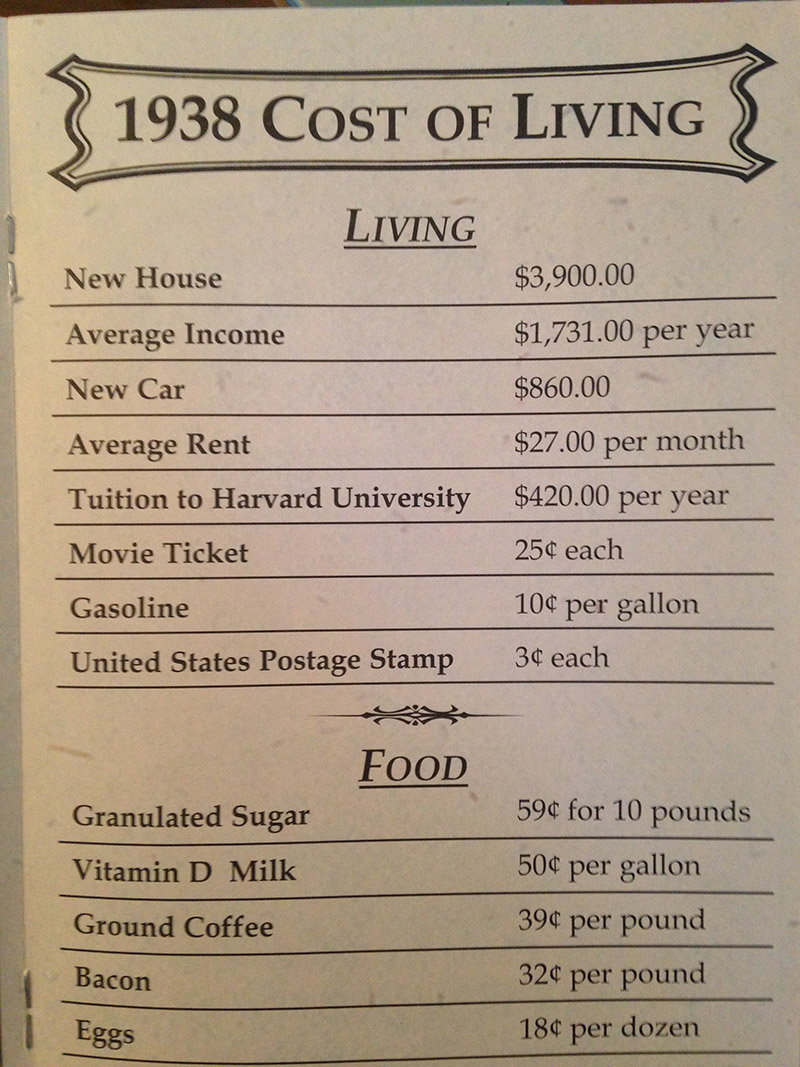
Take a look at the cost of living in 1938:
Source: Reddit
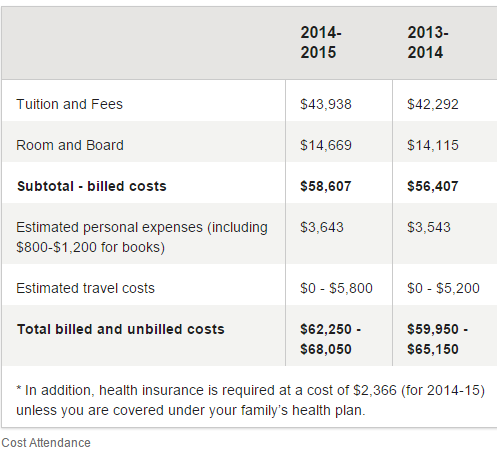
What is important is to look at income in relation to the cost of living. A new home was about twice the annual average income. Today, with the median household income being $50,000 and your typical new home costing $298,000 we are definitely on the more expensive side (6 times annual income versus 2 back in 1938). Look at the new car costs. A new car cost about $860 or half of annual income. Today, a regular car can cost $32,000 and most will need to finance it. Tuition to Harvard was $420 per year and today Harvard tuition is nearly $62,000 with room and board:
Source: Harvard website
In other words, the typical family of today would need to use all their annual income to send their kid to Harvard plus go in debt while in 1938, your average family had income to send 4 kids to Harvard per year. The most inflated of all categories is college tuition.
Looking at various costs adjusting for inflation
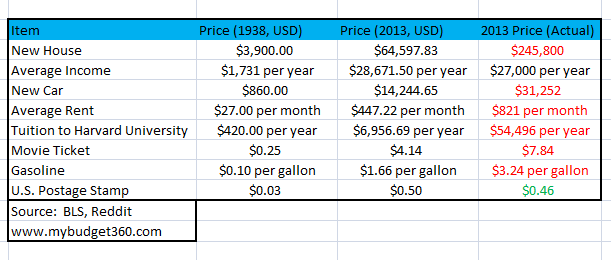
I put this table together and adjusted for inflation to give you a better perspective:
I wanted to update some of this data for 2015 as well:
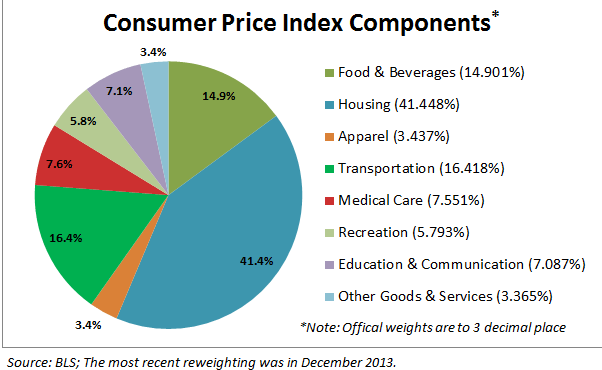
Housing, food, medical care, transportation, and education make up the biggest expenses. Housing by far consumes the biggest portion. And look at how fast prices have gone up since 2000:
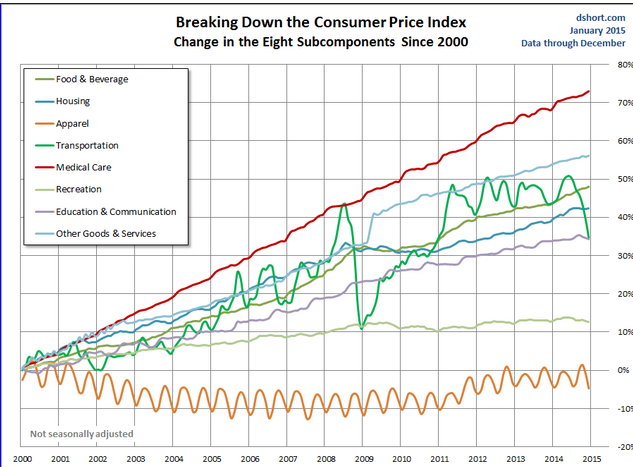
Medical care is up over 70 percent. Housing is up over 40 percent even with the crash in the housing market. Basically the only items that held steady were apparel and recreation. But look at how incomes are doing:
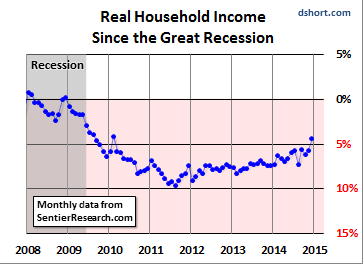
You wonder why you feel like you have less purchasing power? You feel poorer because you are thanks to the slow eroding power of inflation. The Fed would like to argue that there is no inflation but just look at housing costs, medical care, college tuition, and grocery bills and tell the regular working American family that there is no inflation.
Source
People have a hard time understanding how inflation erodes their purchasing power. Little by little the cost of everything goes up and people simply assume this is normal in an economy. The $2 movie ticket becomes a $8 movie ticket. That can of tuna just got smaller but the price remains the same. The cost of going to college went from manageable to needing large student debt merely to complete a four year degree. Inflation is argued to be a purely monetary outcome. You have too much money, in the form of cash or credit in today’s case, chasing fewer goods. In our current economy, debt is the fuel accelerating inflation. You can see this in items like housing, cars, and college where debt is the primary fuel driving prices higher. The big problem today is that incomes are simply not rising fast enough to keep up with the rise in other expenses. Over time, inflation has a big destructive power. I thought it would be useful to look at the cost of typical items in 1938 and compare them to where things stand in 2015.
Comparing 1938 to 2015
Over a year ago, we looked at some old data and found this to be useful to readers. I thought it would be helpful to update the data and see where things stand today in 2015. Someone sent this snapshot of the cost of living in 1938. It really is fascinating looking at inflation over a very long period of time. In this case, we are looking at spending pre-World War II. Most Americans probably have no sense as to what the cost of living was back then since they are mired in the fight of living paycheck to paycheck.
Take a look at the cost of living in 1938:
Source: Reddit
What is important is to look at income in relation to the cost of living. A new home was about twice the annual average income. Today, with the median household income being $50,000 and your typical new home costing $298,000 we are definitely on the more expensive side (6 times annual income versus 2 back in 1938). Look at the new car costs. A new car cost about $860 or half of annual income. Today, a regular car can cost $32,000 and most will need to finance it. Tuition to Harvard was $420 per year and today Harvard tuition is nearly $62,000 with room and board:
Source: Harvard website
In other words, the typical family of today would need to use all their annual income to send their kid to Harvard plus go in debt while in 1938, your average family had income to send 4 kids to Harvard per year. The most inflated of all categories is college tuition.
Looking at various costs adjusting for inflation
I put this table together and adjusted for inflation to give you a better perspective:
I wanted to update some of this data for 2015 as well:
New house: $298,000 (Source: Census)So basically every single category is up besides gasoline given the crash in oil prices in 2014. But this is a small drop in the bucket given what consumes the biggest portion of your budget:
Average income: $28,000 (Social Security)
New Car: $32,000 (Bankrate)
Average Rent: $950
Tuition to Harvard: See above
Movie ticket: $8
Gasoline: $1.99
US Postage Stamp: $0.49
Housing, food, medical care, transportation, and education make up the biggest expenses. Housing by far consumes the biggest portion. And look at how fast prices have gone up since 2000:
Medical care is up over 70 percent. Housing is up over 40 percent even with the crash in the housing market. Basically the only items that held steady were apparel and recreation. But look at how incomes are doing:
You wonder why you feel like you have less purchasing power? You feel poorer because you are thanks to the slow eroding power of inflation. The Fed would like to argue that there is no inflation but just look at housing costs, medical care, college tuition, and grocery bills and tell the regular working American family that there is no inflation.
Source
Labels:
Federal Reserve
,
Health Care
,
Inflation
,
Pensions
,
Retirement
,
Savings
,
US Dollar Crisis
Tuesday, January 27, 2015
▶ SHOCKING Report Reveals Government STEALING Pension Funds! - YouTube

Sources:
"Is Your Pension Courting Catastrophe? - Bloomberg View"
http://www.bloombergview.com/articles...
"Detroit attorney says pension cuts actually close to 50 percent - World Socialist Web Site"
http://www.wsws.org/en/articles/2014/...
"Public service unions not entitled to $28B pension surplus, says Supreme Court | Toronto Star"
http://www.thestar.com/news/canada/20...
"Portugal raids pension funds to meet deficit targets - Telegraph"
http://www.telegraph.co.uk/finance/fi...
"Hungarian savers say government is stealing their pensions | Reuters"
http://www.reuters.com/article/2014/1...
"Russia Seized Citizens Pension Funds. Could That Happen in the U.S.? - Businessweek"
http://www.businessweek.com/articles/...
"UPDATE 2-Poland reduces public debt through pension funds overhaul | Reuters"
http://www.reuters.com/article/2013/0...
"Argentina seizes pension funds to pay debts. Who's next? – Telegraph Blogs"
http://blogs.telegraph.co.uk/finance/...
"How the West Was Lost: Fifty Years of Economic Folly - And the Stark Choices ... - Dambisa Moyo - Google Books"
https://books.google.ca/books?id=ivXM...

Labels:
Collapse
,
Crime
,
Debt Budget Morass
,
Government Fraud
,
Payments
,
Pensions
,
Retirement
,
Savings
,
Taxes
,
Unemployment
Monday, January 26, 2015
U.S. nursing homes' new tactic to collect debts: Seizing power of attorney from patients' relatives
If you haven't already cleared your remaining savings and other assets off the table, you probably should not rule it out until checking out this new government/corporatist fraud. Government is but the collection enforcement agent for the Corporatists.
~~~~~~~~~~~~~~~~~~~~~~~~~~~~~~~~~~~~~~~~~~
The New York Times | January 26, 2015 | Last Updated: Jan 26 11:16 AM ET


Piotr Redlinski/The New York Times: Dino and Lillian Palermo at the Mary Manning Walsh Nursing Home, which filed a guardianship petition asking the court to give a stranger full legal power over Lillian Palermo and complete control of her money, in New York, Oct. 31, 2014.
NEW YORK — Lillian Palermo tried to prepare for the worst possibilities of aging. An insurance executive with a Ph.D. in psychology and a love of ballroom dancing, she arranged for her power of attorney and health care proxy to go to her husband, Dino, eight years her junior, if she became incapacitated. And in her 80s, she did.
Dino Palermo, who was the lead singer in a Midtown nightclub in the 1960s when Lillian’s elegant tango first caught his eye, now regularly rolls his wife’s wheelchair to the piano at the Catholic nursing home in Manhattan where she ended up in 2010 as dementia, falls and surgical complications took their toll. He sings her favourite songs, feeds her home-cooked Italian food, and pays a private aide to be there when he cannot.
It’s a strategic move to intimidate. Nursing homes do it just to bring money.
But one day last summer, after he disputed nursing home bills that had suddenly doubled Lillian Palermo’s copays, and complained about inexperienced employees who dropped his wife on the floor, Dino Palermo was shocked to find a six-page legal document waiting on her bed.
It was a guardianship petition filed by the nursing home, Mary Manning Walsh, asking the court to give a stranger full legal power over Lillian Palermo, now 90, and complete control of her money.
Few people are aware that a nursing home can take such a step. Guardianship cases are difficult to gain access to and poorly tracked by New York state courts; cases are often closed from public view for confidentiality.

Piotr Redlinski/The New York Times: Nursing homes are using a New York State statute created to protect the infirm as a way to get paid.
It’s so cruel. Mr. Palermo loves his wife, he’s there every single day, and they just threw him to the courts.
But the Palermo case is no aberration. Interviews with veterans of the system and a review of guardianship court data conducted by researchers at Hunter College at the request of The New York Times show the practice has become routine, underscoring the growing power nursing homes wield over residents and families amid changes in the financing of long-term care.
In a random, anonymized sample of 700 guardianship cases filed in Manhattan over a decade, Hunter College researchers found more than 12 percent were brought by nursing homes. Some of these may have been prompted by family feuds, suspected embezzlement or just the absence of relatives to help secure Medicaid coverage.
But lawyers and others versed in the guardianship process agree that nursing homes primarily use such petitions as a means of bill collection – a purpose never intended by the Legislature when it enacted the guardianship statute in 1993.
At least one judge has ruled that the tactic by nursing homes is an abuse of the law, but the petitions, even if they are ultimately unsuccessful, force families into costly legal ordeals.
The Palermo case is no different than any other nursing home bill that they had difficulty collecting. When you have families that do not co-operate and an incapacitated person, guardianship is a legitimate means to get the nursing home paid.
“It’s a strategic move to intimidate,” said Ginalisa Monterroso, who handled patient Medicaid accounts at the Mary Manning Walsh Nursing Home until 2012, and is now chief executive officer of Medicaid Advisory Group, an elder care counselling business that was representing Dino Palermo in his billing dispute. “Nursing homes do it just to bring money.”
“It’s so cruel,” she added. “Mr. Palermo loves his wife, he’s there every single day, and they just threw him to the courts.”
Brett D. Nussbaum, a lawyer who represents Mary Manning Walsh and many other nursing homes, said Dino Palermo’s devotion to his wife was irrelevant to the decision to seek a court-appointed guardian in July, when the billing dispute over his wife’s care reached a stalemate, with an outstanding balance approaching $68,000.

Nina Bernstein/The New York Times Dino and Lillian Palermo
“The Palermo case is no different than any other nursing home bill that they had difficulty collecting,” Nussbaum said, estimating that he had brought 5,000 guardianship cases himself in 21 years of practice. “When you have families that do not co-operate and an incapacitated person, guardianship is a legitimate means to get the nursing home paid.”
READ MORE
Labels:
CorporatistCabals
,
Health Care
,
Pensions
,
Privacy
,
Retirement
,
Savings
,
Social Security
,
Tyrants
,
VA
,
Veterans
Subscribe to:
Posts
(
Atom
)