Search Blog Posts

Showing posts with label Rule of Law. Show all posts

Sunday, April 5, 2015

This Simple Mistake Got A Veteran’s Guns Confiscated – And It Could Happen To You


Image source: HuffingtonPost
 
A judge has stripped a disabled veteran of his Second Amendment rights because of unsubstantiated allegations made by a neighbor.
Even though he has not been convicted of a crime, Rick Bailey, 56, had all 28 of his guns confiscated by police and has lost his right to buy firearms.

“I was totally devastated,” Bailey said of the day officers came to take his guns. “I couldn’t believe something like this could happen. I had a 3-hour anxiety-slash-panic attack while officers were there and after they left. They wanted to call an ambulance.”

Officers came to Bailey’s home March 17 in Glendale, Arizona — a Phoenix suburb – to enforce a court order called an “injunction against harassment.” On the order an unidentified city court judge wrote, “Def (defendant) shall not have/buy firearms, surrender any to Glendale PD,” The Blaze reported.

The order was issued after a neighbor told police that Bailey had threatened to shoot him. Bailey has not been charged with any crime and was not given a chance to appeal or contest the order before police came to his home.

Feud with Neighbor Led to Gun Confiscation

Bailey told The Blaze that he had been feuding with the unidentified neighbor for months. He was apparently upset because the neighbor parked dump trucks in his driveway.

Ultimate Tactical Self-Defense And Hunting Weapon That Doesn’t Require A Firearms License!
Bailey eventually filed a complaint with the city of Glendale that prompted authorities to remove the trucks and other equipment. He contends that the neighbor ignored the order and kept storing vehicles and equipment used in a landscaping business on Bailey’s property.
police confiscated guns
Image source: www.wbez.org

On March 16, the day before the injunction was issued, Bailey had called police because he thought he smelled toxic chemicals coming from the neighbor’s home.

“The smell got so bad, I had to come back to my patio and use my inhaler — so I called the police to see if anything could be done,” Bailey told The Blaze. The neighbor apparently told the police about the alleged death threats when officers approached him about the chemicals.

Bailey denies making any threats. The Blaze reported that court documents say that Bailey had threatened to stuff the neighbor in his dump truck. The neighbor also says Bailey threatened to shoot him – an allegation Bailey denies. Bailey says he is disabled and physically incapable of harming anyone.

The court order will be in force for one year, Glendale Police spokesman Sergeant David Vidaure told The Blaze. During that period, Bailey cannot own, use or buy firearms. When the order expires, Bailey’s guns could be returned.

Bailey said he is disabled because of an accident that occurred while he was serving in the Navy. He is a retired software engineer.
Bailey plans to hire an attorney and challenge the court order. A Go Fund Me account was set up to raise $5,000 for Bailey’s legal defense.

Restraining Orders Threaten Second Amendment 

Arizona is not the only state where judges can order gun confiscations and restrict Second Amendment rights with a court order. On Sept. 30, California Governor Jerry Brown signed Assembly Bill 1014, as Off The Grid News previously reported.

That law gives judges the power to issue restraining orders that would prevent people from possessing guns for 21 days at the recommendation of a doctor or psychologist. The law also allows for the confiscation of weapons from individuals at the recommendation of a psychologist.

The lesson? Depending on where you live, be careful what you say to neighbors.

Do you believe judges should be able to order gun confiscations, minus a crime? Share your thoughts in the section below:
Most Shotguns In Homes Are NOT Suitable For Defense. Read More Here.

Interview: John Birch Society’s Art Thompson Speaks on the Dangers of Con Con

 By: Joshua Cook Apr 5, 2015


There is a growing movement among limited-government activists who believe that a Constitutional Convention could solve a lot of America’s balanced budget problems.

Many writers for BenSwann.com have been critical of a Constitutional Convention (Con Con) in the past (see here and here), but the movement has evolved from theory into a growing movement. Many bills for a Con Con are being debated in state houses throughout America.

BenSwann.com’s Joshua Cook spoke to  Art Thompson, CEO of John Birch Society, about the problems with the Con Con, pro-Constitutional Convention, movement.

Cook said that he had friends on both sides of the debate who all want the government to be fiscally responsible, so what’s wrong with those calling for a balanced budget amendment?

“The purpose of it is to rein in the government. So, I would ask the question, does the Constitution now rein in the government? And the answer, of course, is no. The problem is that it wouldn’t matter if you have some change in the Constitution for the better. Would they pay any attention to that anymore than they do to the Constitution today?” asked Thompson.

“The problem is not the Constitution and having to make additions to the Constitution. The problem is adhering to the Constitution we have,” he explained.

Thompson explained that he is all for a balanced budget, but he said standing between the government and a balanced budget are roadblocks.

“We say this unless you repeal two amendments to the Constitution, it will be next to impossible to have a balanced budget,” he said.

“Because what we used to have in this country  was a system of checks and balances between the House and the Senate and the Executive, but once we got the 16th Amendment, the income tax, and once we got the 17th Amendment, the direct election of senators, that threw the whole system to a tailspin. And we’ve never recovered from it,” he added.

“Most people do not understand the implications of those two amendments and how they have destroyed checks and balances between the states and the federal government,” he said. “All you need to do is repeal them, and you’d have a balanced budget if we went back to the old system.”

Thompson said that America’s problems need fixing, but a Constitutional Convention movement is not the answer.

One of his issues with organizations, like Call A Convention, is the bipartisan nature of the group and the questionable sources of its funding.

“There has been 10s of millions of dollars contributed to this campaign, and we don’t know where it’s coming from. In fact, when you take a look at the people involved and the organizations involved, there is more of a case that this is a leftist movement than a conservative movement,” he said.

Call A Convention’s backers, according to their website include conservative Mark Levin and Wolf PAC, an organization that has roots in the Occupy Wall Street movement.

Thompson said that there is no room for bipartisanship, because liberals’ and conservatives’ philosophies are different.

“Bipartisanship has gotten us into the problem. Bipartisanship is another word for compromise in my book. You either stand for the Constitution or you don’t,” he explained. “The problem has been is that the conservatives always compromise with the left. And that compromise with the left has gotten us where we are today.”

These bipartisan groups contain people with radically different viewpoints.

“Some of these people want to get rid of the 2nd Amendment, or if they can’t get rid of it, to add a couple extra words that make it impossible for a citizen in the United States to have the right to keep and bear arms unless they belong to a state militia,” he added.
Are those the type of people we want gathering to amend, or rewrite, our Constitution?

“Conservatives professing that all they want is a balanced budget, but they’re in bed with some leftists who have a completely different agenda. That doesn’t compute logically in my brain,” he said.

Another issue is that the balanced budget amendment would be written during the convention.

“Now I’ve seen a number of balance budget proposals, not one of them would balance the budget,” he explained.

One of the problems with the proposal is the Federal Reserve.
“You cannot balance the budget of the United States unless you take into account the Federal Reserve,” he said. The Federal Reserve allows the government to spend money it doesn’t actually have.

“And yet the Federal Reserve can keep the presses rolling and they might do it in a way of currency exchanges, which is how they’re bailing out Europe right now. They are sending palettes of $100 bills to Europe, and they’re sending us back palettes of Euros. Now we don’t spend the Euros. They’re put in a basement someplace. But Europe spends the dollars,” he explained.

“That to me, is not a balance. It’s a whole unethical means of bailing out Europe,” he said.

And we know the government has emergencies like this all of the time.

Another problem with the balanced budget proposals they don’t account for how much money the federal government gives the states, many of which don’t have their owned balanced budgets.
Thompson also suggests repealing departments and services that aren’t Constitutionally backed. Those include things like Obamacare and departments of education and energy.
“All of those things are off budget, and yet those things are bankrupting this whole country,” he said.
To pay for those unconstitutional agencies, taxes could be raised.
“If we don’t repeal the 16th and 17th Amendments, a balanced budget will tax our economy to its knees.”
To learn more about the John Birch Society, visit their website.

Friday, April 3, 2015

Obama Told This Admiral Not To Give Out Bibles, His Response Is Glorious


Obama’s agenda to keep the Bible out of the hands of our Military is in full swing. If there is only one speech you have to see that takes him down, THIS IS IT!!!

The Government is telling soldiers that if a person is in need, or even contemplating suicide to send them to a Chaplain and do nothing else.

But what if the opportunity to save a life is here and now, in the moment?

This Rear Admiral says that no matter what he is told by the Government he will share the Bible when and where it is needed.

This man of true Faith is what we need right now in this country to lead us back to greatness. He took a stand against those who wish that the Bible didn’t exist and not back down from a fight!

Monday, March 30, 2015

States tell Feds to pound sand

The Internal Revenue Service gives subsidies when it wants. The Bureau of Alcohol, Tobacco, Firearms and Explosives and the Environmental Protection Agency redefine words on a whim in an effort to give themselves more power and more control over your life. “Legislating from the bench” has been superseded by this even more dangerous “lawmaking” by unelected, unaccountable federal agencies.


As Chapman law professor Ronald Rotunda noted recently, we “have come a long way towards governance by bureaucrats.” Some states, however, are taking positive steps in 2015 to thwart the effects of these unilateral — and wildly unconstitutional — acts.
The following is an overview of state legislation to thwart federal overreach that’s moving forward right now.

Federal gun control

Even though the ATF has, at least temporarily, backed down on a proposed M855 ammo ban, gun rights advocates should be alarmed. More of this should be expected moving forward, that is, more gun control no matter whom you elect to Congress.

In Arizona, however, a bill that would effectively block in practice any additional restrictions on the natural right to keep and bear arms has already passed the state Senate by a 17-12 vote and is due for further consideration in the state House in the near future. A similar bill passed the Montana Legislature and is going to Gov. Steve Bullock’s desk, and another in Tennessee is up for a do-or-die vote in committee this week.

Other states like Ohio and Pennsylvania have seen legislation introduced, but not yet considered. Should any of the bills pass into law, they’d join Idaho, which in 2014 was the first in the country to pass legislation specifically designed to thwart any new federal gun control measures.

Broader bills have been introduced in other states, with the goal of addressing not just new federal gun control measures, but nearly all of them. Missouri HB1341 would make any federal gun control measure — past, present or future — invalid and unenforceable in the state. And two Texas bills, HB413 and HB422, would work together to do almost the same. Should either pass, they’d join Alaska, which passed a similar law in 2013.

Self-ownership

The Food and Drug Administration has a lengthy process for approving new treatments for people. In some situations, however, that long process can actually kill people.

Take, for example, the case of Mikaela Knapp, who was diagnosed with kidney cancer. She and her husband, Keith, launched a social media campaign to lobby drug firms and the FDA to give her access to a new gene therapy. Their efforts gained national attention and generated 200,000 signatures on a petition, but failed to win access to the treatment. The 25-year-old newlywed died a few months later.

In 2014, Arizona residents approved Prop. 303, a measure that now allows people the “Right to Try” some experimental treatments not yet approved by the FDA. They joined Colorado, Missouri, Louisiana and Michigan in passing such legislation.

In 2015, governors in Wyoming in Arkansas have already signed a Right to Try act into law. Bills in Virginia, Montana, Indiana, Utah and Mississippi have also passed the full legislature and are awaiting a signature from each state’s governor.

“These laws are a no-brainer,” said Mike Maharrey of the Tenth Amendment Center. “When someone is on their deathbed, the fact that FDA regulations would let them die rather than try, has got to be one of the most inhumane policies of the federal government. Every state should nullify the FDA like this.”

Farming

The total retail value of hemp products sold in the U.S. in 2014 was recently said to be at least $620 million. According to the Hemp Industries Association (HIA), a nonprofit trade association consisting of hundreds of hemp businesses, this includes items like nondairy milk, shelled seed, soaps and lotions, along with clothing, auto parts, building materials and various other products.

Federal regulations resulting in a de facto ban on hemp farming has created a situation where the U.S. is the world’s No. 1 importer of hemp, while China and Canada are the top two exporters in the world.

And while the Feds now “allow” hemp farming for “research purposes,” some states and individuals have taken action beyond what is permitted and are now harvesting crops for commercial purposes.

Hemp is already being farmed in both Colorado and Vermont. On Feb. 2, the Oregon hemp industry officially opened for business. 

One week later, the first license went to a small nonprofit group that hopes to plant 25 acres this spring. The Tennessee Agricultural Department recently put out a call for licensing, signaling that hemp farming will start soon there, too. A law by Gov. Nikki Haley in South Carolina in 2014 authorizes the same. Another passed this year in North Dakota is awaiting a signature from Gov. Jack Dalrymple.

Hemp farming bills have also passed the New Hampshire House, the Washington State Senate, and committees in Connecticut and Missouri. Legislation has been introduced and will be up for consideration soon in Texas, Florida, Maine and elsewhere.

Surveillance

Former National Security Agency chief technical director William Binney called the agency’s practice of “parallel construction” the “most threatening situation to our constitutional republic since the Civil War.” This is the process whereby federal spying data is being handed off to local police for use in everyday law enforcement work, not just for investigating “terrorists.”

In 2014, Utah and New Hampshire passed bills to ban each state from participating in this practice. And this year, bills in Texas, Alaska, Tennessee, Missouri, South Carolina and elsewhere have been introduced to ban all “material support or resources” to all federal bulk warrantless spying programs.

Passage would ban participation in parallel construction, but also take things further and withhold other resources like water, electricity or even trash pickup from state or local governments or agencies to any federal agency involved in the wholesale surveillance of anything and everything you do with your phone or Internet service.

Legislation to help block a recently revealed nationwide license plate tracking program has already passed the Virginia Legislature and the Montana House. Similar legislation is up for consideration in New York, Missouri, Vermont, Massachusetts and Oregon.

Obamacare

While the legal world awaits an opinion this summer from the Supreme Court in the King v. Burwell case, some states are considering bills that will help bring down the federal takeover no matter what the court opines.

Bills passed in the Arizona House and introduced in Texas would ban a crucial enforcement mechanism for the federal act, and set the stage for pulling the rug out from under it and bringing it down.

What’s next

Sometimes, however rare, a federal court will stop a federal agency from unilaterally giving itself more power. Sometimes, a federal agency will back down on a newly proposed rule, like the recent M855 ammo ban from the ATF, because of heavy public pressure. And even more rarely, although I can’t remember anything of note, Congress will actually repeal a law it passed, giving up its own power.

The truth of the matter is this: Federal courts cannot be trusted to limit federal power, and federal politicians cannot be trusted to limit their own power. Only the states and the people can do it now.

While these moves by states give liberty-lovers hope, there is no silver bullet to stop the runaway freight train that is the federal government. But instead of waiting years for a lawsuit, or a convention, or any other national-level process, these state nullification efforts chip away at the monster government right now — one state at a time.

What this gets down to is the power of the people. When enough people tell the Feds to pound sand, and enough states pass laws backing them up, there’s not much the Feds can do to force their unconstitutional laws, rules, regulations or mandates down our throats.

–Michael Boldin

Michael Boldin

is the founder and executive director of the Tenth Amendment Center. Michael has a full schedule working as senior editor of the Center's website, writes a regular column, fields media interviews, and travels the country (when invited, of course) to speak to crowds about sticking to the Constitution — every issue, every time, no exceptions, no excuses.[send him email]

Refuting Objections: But Nullification Isn’t In The Constitution!

A common complaint among detractors of nullification is that, as they see it, “James Madison was the author of the Constitution and since he didn’t include nullification in the document, it can’t be done.”

This attitude holds that the feds get to do whatever they want, as long as it’s not specifically prohibited by the Constitution, while the states have to receive their authority from the Constitution or the feds. This argument completely flips the entire structure of the Constitution on its head. It also ignores what Madison later wrote about nullification in the Virginia Resolutions and later in Notes on Nullification.

The federal government is only authorized to exercise those powers delegated to it in the Constitution, not the states. While states are expressly prohibited from doing some things in the Constitution, mostly listed in Article I, Section 10, it’s the federal government that can’t do something if it’s “not included in the document.”

The Constitution was written to define the limited powers of this central government. Meanwhile, the states retained any powers not specifically delegated to the feds. This is exactly what Madison later wrote in Federalist 45:
The powers delegated by the proposed Constitution to the federal government are few and defined. Those which are to remain in the State governments are numerous and indefinite (bold emphasis added).
The Tenth Amendment also confirms this relationship between the states and the feds when it speaks of “delegated” powers to the federal government.
The powers not delegated to the United States by the Constitution, nor prohibited by it to the States, are reserved to the States respectively, or to the people (bold emphasis added).
The argument that nullification is illegal because isn’t in the Constitution falls apart under even the gentlest scrutiny. If the states must specifically receive authority from the U.S. Constitution and not even their own constitutions, then logically it must follow that every law they pass and legal action they take that is not mentioned in the Constitution must be considered illegal. Plain reasoning demonstrates how absurd this is.

The authority to nullify unconstitutional federal laws, on the other hand, is not delegated to the feds, nor is it expressly prohibited to the states. That nullification is not mentioned at all misses the point of the Tenth Amendment, which was to make it clear that the enumerated powers the feds had were the only powers they had. 

Those who point to the Supremacy Clause as proof of this prohibition also forget that the clause refers to actions taken in pursuance of the Constitution, i.e. it does not give the feds carte blanche to assume any power they want. Nullification pertains to federal actions that go beyond the limitations of the Constitution and serves as an important check and balance when the three federal branches fail to restrain each other as intended.

And if nullification detractors are so concerned about what Madison thought, they will find it hard to dismiss what he wrote about it in December 1834 following the Nullification Crisis of 1832.
Thus the right of nullification meant by Mr. Jefferson is the natural right, which all admit to be a remedy against insupportable oppression (bold emphasis added).
His use of the term “natural right” cannot be overlooked. Madison is not calling nullification a mere legal tool, but a natural right along with “life, liberty, and the pursuit of happiness.” It is a right which all people are born with innately and cannot be deprived of them without their consent.

One shouldn’t be surprised about this, because it logically followed from his belief articulated in Federalist 46 that the powers of a government ultimately resided in the people over whom it ruled.
In it he wrote:
The federal and State governments are in fact but different agents and trustees of the people, constituted with different powers, and designed for different purposes. The adversaries of the Constitution seem to have lost sight of the people altogether in their reasonings on this subject; and to have viewed these different establishments, not only as mutual rivals and enemies, but as uncontrolled by any common superior in their efforts to usurp the authorities of each other. These gentlemen must here be reminded of their error. They must be told that the ultimate authority, wherever the derivative may be found, resides in the people alone, and that it will not depend merely on the comparative ambition or address of the different governments, whether either, or which of them, will be able to enlarge its sphere of jurisdiction at the expense of the other (bold emphasis added).
Put differently, the people ultimately get to decide what their government is allowed to do. When they decide that government has gone too far, nullification is a means of exercising their natural right of protecting their liberties without resorting to violent overthrow of that government.

Lastly, it must be pointed out that James Madison was not the author of the Constitution, albeit he helped draft the document along with other convention delegates. He is known today as the “Father of the Constitution,” chiefly due to his Federalist essays promoting its ratification and his work in drafting the Bill of Rights.

When William Cogswell credited him as “the writer of the Constitution of the U. S.” in 1834, Madison replied that Cogswell had given him “a credit to which I have no claim . . . .  This was not, like the fabled Goddess of Wisdom, the offspring of a single brain.  It ought to be regarded as the work of many heads and many hands” (bold emphasis added).

Madison was no doubt being modest in regards to his involvement, but he was still correct in pointing out that no one person had a legitimate claim of authorship of the Constitution, for it was the product of compromise and collaboration by the delegates who attended the Philadelphia Convention in 1787.

Through nullification people are able to exercise their natural right to resist the unjust and illegal actions of their government when it violates the limitations placed upon it by the written Constitution from which it derives its authority. That it is not mentioned anywhere in the Constitution itself is irrelevant because, as we very well know, the Founders believed in the right of revolution, yet there is no clause in the Constitution affirming this right.
Source

Sunday, March 29, 2015

Espionage, Treason, and the Congressional Fifth Column


Congress canoodles with Israeli spies to undermine Iran deal

by , March 25, 2015
The spectacle of virtually the entire Senate GOP caucus mobilizing in support of a foreign power in order to drag us into war with Iran has certainly been instructive. Not since the Federalist party plotted with the British during the War of 1812 has an American fifth column been so open about their treason.

But isn’t the "t"-word a bit hyperbolic? After all, don’t all Americans, even the worst warmongers among us, have the right to free speech? Those members of Congress were merely expressing their opinion – right?

Not so fast:
"Soon after the U.S. and other major powers entered negotiations last year to curtail Iran’s nuclear program, senior White House officials learned Israel was spying on the closed-door talks.

"The spying operation was part of a broader campaign by Israeli Prime Minister Benjamin Netanyahu’s government to penetrate the negotiations and then help build a case against the emerging terms of the deal, current and former U.S. officials said. In addition to eavesdropping, Israel acquired information from confidential U.S. briefings, informants and diplomatic contacts in Europe, the officials said.

"The espionage didn’t upset the White House as much as Israel’s sharing of inside information with U.S. lawmakers and others to drain support from a high-stakes deal intended to limit Iran’s nuclear program, current and former officials said."

To be clear: the Israelis penetrated our communications, and used other means – including "informants" presumably inside the U.S. government – to uncover details about the emerging deal with Iran, and then passed this information on, perhaps indirectly, to their congressional fifth column, including presidential aspirants Ted Cruz, Marco Rubio, and Rand Paul, all of whom then signed on to Sen. Tom Cotton’s "open letter" to Tehran.

If this isn’t treason, then the word has no meaning.

Speaker of the House John Boehner, who plotted with Israeli ambassador Ron Dermer behind the President’s back to invite Netanyahu to address Congress, said he was "shocked" and "baffled" by the news. Not by the news they spied on us – it’s well known that the Jewish state is among the most aggressive foreign adversaries our counterintelligence agencies have to fend off – but "by the fact that there were reports in this press article that information was being passed on from the Israelis to members of Congress. I’m not aware of that at all." What’s baffling, however, is Boehner’s behavior during this Israeli incursion onto American territory: why did he suddenly decide to go full wingnut and canoodle with the Israelis to bring Bibi to American shores? And how is it the Speaker has so little knowledge of what’s going on right under his nose on Capitol Hill?

"The White House discovered the operation," reports Adam Entous of the Wall Street Journal, "when U.S. intelligence agencies spying on Israel intercepted communications among Israeli officials that carried details the U.S. believed could have come only from access to the confidential talks, officials briefed on the matter said." Those telling details then somehow found their way into conversations between the Israelis (and their American agents) and "U.S. lawmakers and others," accord to the Journal.

It’s one thing to spy, said a top U.S. official, but "it’s another thing to steal U.S. secrets and play them back to U.S. legislators to undermine U.S. diplomacy." Read More
 

Saturday, March 28, 2015

Bipartisan House Bill would Repeal Patriot Act and Ban Mass Surveillance of Americans

Anyone taking odds on this congress has neither the guts or moral fiber to go against the oligarchy that owns them...and us?

Friday, March 27, 2015
Reps. Mark Pocan
and Thomas Massie
 
An ambitious bipartisan bill that would seriously roll back the federal government’s ability to conduct surveillance operations has been introduced in the U.S. House of Representatives.
HR 1466 (pdf) (the Surveillance State Repeal Act) would do away with the Patriot Act (pdf) and ban large-scale spying programs, such as the National Security Agency’s telephone metadata collection that has generated so much controversy. It is the most far-reaching anti-surveillance legislation drafted to date.

“This isn’t just tinkering around the edges, it’s a meaningful overhaul that makes sure the meaningless surveillance of emails and cell phones are done away with,” Representative Mark Pocan (D-Wisconsin), one of the bill’s authors, told a briefing for congressional staffers, according to ThinkProgress. The coauthor of HR 1466 is Representative Thomas Massie (R-Kentucky).

The bill’s original co-sponsors are Democrats Alan Grayson of Florida, James McGovern of Massachusetts and Lloyd Doggett of Texas. Other supporters include libertarian organizations opposed to widespread government spying.

Patrick Eddington, national security and civil liberties policy analyst for the libertarian think tank CATO Institute, said: “All mass surveillance does is violate the rights and put a chilling effect on the American people.”

The legislation also would eliminate numerous surveillance permissions granted under the Foreign Intelligence Surveillance Act (pdf) amendments approved by Congress during the George W. Bush administration.

The Hill reported that the proposal is “likely to be a nonstarter for leaders in Congress, who have been worried that even much milder reforms to the nation’s spying laws would tragically handicap the nation’s ability to fight terrorists. A similar bill was introduced in 2013 but failed to gain any movement in the House.”

Congress has until June 1 to reauthorize portions of the Patriot Act that support the government’s surveillance operation. Without re-authorization of the law’s Section 215, the telephone metadata program will expire.
-Noel Brinkerhoff
To Learn More:
HR 1466 (Congress.gov) (pdf)
NSA Phone Data Collection Made No Difference to National Security (by Noel Brinkerhoff and Danny Biederman, AllGov)

Friday, March 27, 2015

US military officers resort to lying and deception at all levels, finds damning official report

  • Shock 52-page report finds dishonesty at all levels in the U.S. Army 
  • Warns officers have become 'ethically numb' and urges quick action 
  • Says leaders 'espouse lofty values' but slog 'through mire of dishonesty' 
  • Finds personnel expect requested information to be 'questionable' 
  • But notes staff are 'happy to go along with the illusion all is well'  
Published: 08:55 EST, 20 February 2015

A damning official report claims dishonesty within the U.S. military is so endemic that everyone assumes they are being lied to at all times.

The shock report calls on officials to 'urgently confront the corrupting influence of dishonesty' within the army, warning officers have become 'ethically numb'.

The situation has become so bad, the executive summary concludes it has 'allowed leaders to espouse lofty professional values while slogging through the mire of dishonesty and deceit'. 
Dishonesty: The report claims dishonesty is endemic in the army on all levels, discovering personnel expect to not be told the truth at certain points, and accusing officers of becoming 'ethically numb' (Stock picture)

The report's executive summary also claims 'much of the deception and dishonesty... is actually encouraged and sanctioned by the military institution'.

Report authors Leonard Wong and Stephen J. Gerras say it is often justified one of three ways: 'mission accomplishment', 'supporting the troops' or that the task or reporting requirement is unreasonable or 'dumb'.

They go onto note lying and 'adjusting the truth' is so common, military personnel who order a report do not trust its content.

The report authors, who interviewed staff at all levels in the army in order to compile the 53-page document, state: 'It appears that a peculiar situation where those requesting the information, and those supplying it know that the information is questionable.'

However, they add, personnel are 'happy to go along with the illusion all is well'.  
Concerns: Former U.S. Defense Secretary Chuck Hagel sent a memo to military leaders before he stepped down from his post asking to deal with 'unethical or morally questionable behaviour'

The report, created for the Strategic Studies Institute and U.S. Army War College Press, say comes just a week after departing Secretary of Defense Chuck Hagel's final words of advice to senior military staff were to sort out 'unethical behaviour'.

According to CNN, Hagel wrote: 'The vast majority of our senior leaders are men and women who have earned the special trust and confidence afforded them by the American people.

'However, when senior leaders forfeit this trust through unprofessional, unethical or morally questionable behavior, their actions have an enormously negative effect on the profession.' 

via dailymail

Tuesday, March 10, 2015

▶ The Problem With Voting for ‘Conservatives’ - YouTube


Published on Mar 9, 2015
JBS CEO Art Thompson's weekly news video update for March 9 - 15, 2015.

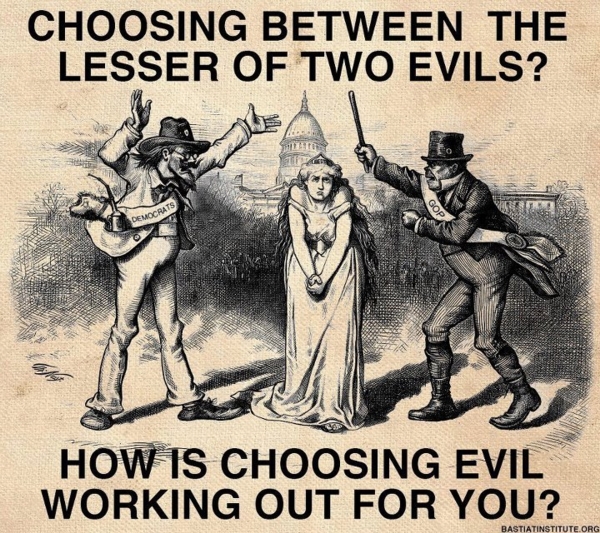
In this week's Analysis Behind the News video, JBS CEO Art Thompson demonstrates the problem with those in Congress who obey the Constitution only 80 percent of the time. He also introduces a new pamphlet focusing on how trade agreements have hurt our military readiness.


 http://www.federalobserver.com/wp-content/uploads/2012/08/Lesser2Evils.jpg

Sunday, March 8, 2015

A Look at the Folly of a Constitutional Convention

This woman has a solid grip on understanding the dangers in foisting a Constitution convention (Con-Con) on us. She is good.
 

Published on Mar 7, 2015
An informative lecture by Publius Huldah, a lawyer and strict constructionist of the Constitution.


Secession Begins at Home

January 30, 2015Jeff Deist
[This article is adapted from a talk presented at the Houston Mises Circle, January 24, 2015.] To listen in audio 22mins.

Presumably everyone in this room, or virtually everyone, is here today because you have some interest in the topic of secession. You may be interested in it as an abstract concept or as a viable possibility for escaping a federal government that Americans now fear and distrust in unprecedented numbers.

As Mises wrote in 1927:
The situation of having to belong to a state to which one does not wish to belong is no less onerous if it is the result of an election than if one must endure it as the consequence of a military conquest.
I’m sure this sentiment is shared by many of you. Mises understood that mass democracy was no substitute for liberal society, but rather the enemy of it. Of course he was right: nearly 100 years later, we have been conquered and occupied by the state and its phony veneer of democratic elections. The federal government is now the putative ruler of nearly every aspect of life in America.

That’s why we’re here today entertaining the audacious idea of secession — an idea Mises elevated to a defining principle of classical liberalism.

It’s tempting, and entirely human, to close our eyes tight and resist radical change — to live in America’s past.

But to borrow a line from the novelist L.P. Hartley, “The past is a foreign country, they do things differently there.” The America we thought we knew is a mirage; a memory, a foreign country.

And that, ladies and gentlemen, is precisely why we should take secession seriously, both conceptually — as consistent with libertarianism — and as a real alternative for the future.

Does anyone really believe that a physically vast, multicultural, social democratic welfare state of 330 million people, with hugely diverse economic, social, and cultural interests, can be commanded from DC indefinitely without intense conflict and economic strife?

Does anyone really believe that we can unite under a state that endlessly divides us? Rich vs. poor, black vs. white, Hispanic vs. Anglo, men vs. women, old vs. young, secularists vs. Christians, gays vs. traditionalists, taxpayers vs. entitlement recipients, urban vs. rural, red state vs. blue state, and the political class vs. everybody?

Frankly it seems clear the federal government is hell-bent on Balkanizing America anyway. So why not seek out ways to split apart rationally and nonviolently? Why dismiss secession, the pragmatic alternative that’s staring us in the face?

Since most of us in the room are Americans, my focus today is on the political and cultural situation here at home. But the same principles of self-ownership, self-determination, and decentralization apply universally — whether we’re considering Texas independence or dozens of active breakaway movements in places like Venice, Catalonia, Scotland, and Belgium.

I truly believe secession movements represent the last best hope for reclaiming our birthright: the great classical liberal tradition and the civilization it made possible. In a world gone mad with state power, secession offers hope that truly liberal societies, organized around civil society and markets rather than central governments, can still exist.

Secession as a “Bottom-Up” Revolution

“But how could this ever really happen?” you’re probably thinking.

Wouldn’t creating a viable secession movement in the US necessarily mean convincing a majority of Americans, or at least a majority of the electorate, to join a mass political campaign much like a presidential election?

I say no. Building a libertarian secession movement need not involve mass political organizing: in fact, national political movements that pander to the Left and Right may well be hopelessly naïve and wasteful of time and resources.

Instead, our focus should be on hyper-localized resistance to the federal government in the form of a “bottom-up” revolution, as Hans-Hermann Hoppe terms it.

Hoppe counsels us to use what little daylight the state affords us defensively: just as force is justified only in self-defense, the use of democratic means is justified only when used to achieve nondemocratic, libertarian, pro-private property ends.

In other words, a bottom-up revolution employs both persuasion and democratic mechanisms to secede at the individual, family, community, and local level — in a million ways that involve turning our backs on the central government rather than attempting to bend its will.

Secession, properly understood, means withdrawing consent and walking away from DC — not trying to capture it politically and “converting the King.”

Secession is Not a Political Movement

Why is the road to secession not political, at least not at the national level? 

Frankly, any notion of a libertarian takeover of the political apparatus in DC is fantasy, and even if a political sea change did occur the army of 4.3 million federal employees is not simply going to disappear.

Convincing Americans to adopt a libertarian political system — even if such an oxymoron were possible — is a hopeless endeavor in our current culture.

Politics is a trailing indicator. Culture leads, politics follows. There cannot be a political sea change in America unless and until there is a philosophical, educational, and cultural sea change. Over the last 100 years progressives have overtaken education, media, fine arts, literature, and pop culture — and thus as a result they have overtaken politics. Not the other way around.

This is why our movement, the libertarian movement, must be a battle for hearts and minds. It must be an intellectual revolution of ideas, because right now bad ideas run the world. We can’t expect a libertarian political miracle to occur in an illibertarian society.

Now please don’t get me wrong. The philosophy of liberty is growing around the world, and I believe we are winning hearts and minds. This is a time for boldness, not pessimism.

Yet libertarianism will never be a mass —which is to say majority — political movement.

Some people will always support the state, and we shouldn’t kid ourselves about this. It may be due to genetic traits, environmental factors, family influences, bad schools, media influences, or simply an innate human desire to seek the illusion of security.

But we make a fatal mistake when we dilute our message to seek approval from people who seemingly are hardwired to oppose us. And we waste precious time and energy.

What’s important is not convincing those who fundamentally disagree with us, but the degree to which we can extract ourselves from their political control.

This is why secession is a tactically superior approach in my view: it is far less daunting to convince liberty-minded people to walk away from the state than to convince those with a statist mindset to change.

What About the Federales?

Now I know what you’re thinking, and so does the aforementioned Dr. Hoppe:
Wouldn’t the federales simply crush any such attempt (at localized secession)?

They surely would like to, but whether or not they can actually do so is an entirely different question … it is only necessary to recognize that the members of the governmental apparatus always represent, even under conditions of democracy, a (very small) proportion of the total population.

Hoppe envisions a growing number of “implicitly seceded territories” engaging in noncompliance with federal authority:
Without local enforcement, by compliant local authorities, the will of the central government is not much more than hot air.
It would be prudent … to avoid a direct confrontation with the central government and not openly denounce its authority …
Rather, it seems advisable to engage in a policy of passive resistance and noncooperation. One simply stops to help in the enforcement in each and every federal law …
Finally, he concludes as only Hoppe could (remember this is the 1990s):
Waco, a teeny group of freaks, is one thing. But to occupy, or to wipe out a significantly large group of normal, accomplished, upstanding citizens is quite another, and quite a more difficult thing.
Now you may disagree with Dr. Hoppe as to the degree to which the federal government would actively order military violence to tamp down any secessionist hotspots, but his larger point is unassailable: the regime is largely an illusion, and consent to its authority is almost completely due to fear, not respect. Eliminate the illusion of benevolence and omnipotence and consent quickly crumbles.

Imagine what a committed, coordinated libertarian base could achieve in America! 10 percent of the US population, or roughly thirty-two million people, would be an unstoppable force of nonviolent withdrawal from the federal leviathan.

As Hoppe posits, it is no easy matter for the state to arrest or attack large local groups of citizens. And as American history teaches, the majority of people in any conflict are likely to be “fence sitters” rather than antagonists.

Left and Right are Hypocrites Regarding Secession

One of the great ironies of our time is that both the political Left and Right complain bitterly about the other, but steadfastly refuse to consider, once again, the obvious solution staring us in the face.

Now one might think progressives would champion the Tenth Amendment and states’ rights, because it would liberate them from the Neanderthal right wingers who stand in the way of their progressive utopia. Imagine California or Massachusetts having every progressive policy firmly in place, without any preemptive federal legislation or federal courts to get in their way, and without having to share federal tax revenues with the hated red states.

Imagine an experiment where residents of the San Francisco bay area were free to live under a political and social regime of their liking, while residents of Salt Lake City were free to do the same.

Surely both communities would be much happier with this commonsense arrangement than the current one, whereby both have to defer to Washington!

But in fact progressives strongly oppose federalism and states’ rights, much less secession! The reason, of course, is that progressives believe they’re winning and they don’t intend for a minute to let anyone walk away from what they have planned for us.

Democracy is the great political orthodoxy of our times, but its supposed champions on the Left can’t abide true localized democracy — which is in fact the stated aim of secession movements.

They’re interested in democracy only when the vote actually goes their way, and then only at the most attenuated federal level, or preferably for progressives, the international level. The last thing they want is local control over anything! They are the great centralizers and consolidators of state authority.

“Live and let live” is simply not in their DNA.

Our friends on the Right are scarcely better on this issue.

Many conservatives are hopelessly wedded to the Lincoln myth and remain in thrall to the central warfare state, no matter the cost.

As an example, consider the Scottish independence referendum that took place in September of 2014.

Some conservatives, and even a few libertarians claimed that we should oppose the referendum on the grounds that it would create a new government, and thus two states would exist in the place of one. But reducing the size and scope of any single state’s dominion is healthy for liberty, because it leads us closer to the ultimate goal of self-determination at the individual level, to granting each of us sovereignty over our lives.

Again quoting Mises:
If it were in any way possible to grant this right of self-determination to every individual person, it would have to be done. (italics added)
Furthermore, some conservatives argue that we should not support secession movements where the breakaway movement is likely to create a government that is more “liberal” than the one it replaces. This was the case in Scotland, where younger Scots who supported the independence referendum in greater numbers hoped to create strong ties with the EU parliament in Brussels and build a Scandinavian-style welfare state run from Holyrood (never mind that Tories in London were overjoyed at the prospect of jettisoning a huge number of Labour supporters!).

But if support for the principle of self-determination is to have any meaning whatsoever, it must allow for others to make decisions with which we disagree. Political competition can only benefit all of us. What neither progressives nor conservatives understand — or worse, maybe they do understand — is that secession provides a mechanism for real diversity, a world where we are not all yoked together. It provides a way for people with widely divergent views and interests to live peaceably as neighbors instead of suffering under one commanding central government that pits them against each other.

Secession Begins With You

Ultimately, the wisdom of secession starts and ends with the individual. Bad ideas run the world, but must they run your world?

The question we all have to ask ourselves is this: how seriously do we take the right of self-determination, and what are we willing to do in our personal lives to assert it?

Secession really begins at home, with the actions we all take in our everyday lives to distance and remove ourselves from state authority — quietly, nonviolently, inexorably.

The state is crumbling all around us, under the weight of its own contradictions, its own fiscal mess, and its own monetary system. We don’t need to win control of DC.

What we need to do, as people seeking more freedom and a better life for future generations, is to walk away from DC, and make sure we don’t go down with it.

How To Secede Right Now

So in closing, let me make a few humble suggestions for beginning a journey of personal secession. Not all of these may apply to your personal circumstances; no one but you can decide what’s best for you and your family. But all of us can play a role in a bottom-up revolution by doing everything in our power to withdraw our consent from the state:
  • Secede from intellectual isolation. Talk to like-minded friends, family, and neighbors — whether physically or virtually — to spread liberty and cultivate relationships and alliances. The state prefers to have us atomized, without a strong family structure or social network;
  • secede from dependency. Become as self-sufficient as possible with regard to food, water, fuel, cash, firearms, and physical security at home. Resist being reliant on government in the event of a natural disaster, bank crisis, or the like;
  • secede from mainstream media, which promotes the state in a million different ways. Ditch cable, ditch CNN, ditch the major newspapers, and find your own sources of information in this internet age. Take advantage of a luxury previous generations did not enjoy;
  • secede from state control of your children by homeschooling or unschooling them;
  • secede from college by rejecting mainstream academia and its student loan trap. Educate yourself using online learning platforms, obtaining technical credentials, or simply by reading as much as you can;
  • secede from the US dollar by owning physical precious metals, by owning assets denominated in foreign currencies, and by owning assets abroad;
  • secede from the federal tax and regulatory regimes by organizing your business and personal affairs to be as tax efficient and unobtrusive as possible;
  • secede from the legal system, by legally protecting your assets from rapacious lawsuits and probate courts as much as possible;
  • secede from the state healthcare racket by taking control of your health, and questioning medical orthodoxy;
  • secede from your state by moving to another with a better tax and regulatory environment, better homeschooling laws, better gun laws, or just one with more liberty-minded people;
  • secede from political uncertainly in the US by obtaining a second passport; or
  • secede from the US altogether by expatriating.
  • Most of all, secede from the mindset that government is all-powerful or too formidable an opponent to be overcome. The state is nothing more than Bastiat’s great fiction, or Murray’s gang of thieves writ large. Let’s not give it the power to make us unhappy or pessimistic.
All of us, regardless of ideological bent and regardless of whether we know it or not, are married to a very violent, abusive spendthrift. It’s time, ladies and gentlemen, to get a divorce from DC.

via Mises.org