Search Blog Posts

Showing posts with label law enforcement. Show all posts

Thursday, April 2, 2015

Murders by Rulers Series: The Clinton's Body Count *incl. video* plus Pics

Ether Zone  Here is the latest body count that we have. All of these people have been connected with the Clintons in some form or another. We have not included any deaths that could not be verified or connected to the Clinton scandals. All deaths are listed chronologically by date. This list is current and accurate to the best of our knowledge as of January 13, 1999 August 1, 2000.

Tuesday, March 31, 2015

Broward Cty Sheriff Deputies "assist" US Fed Troops in Training for Incarcerating US Citizens


Other states and their local police sure to follow...

Troops Training To Intern Citizens In Fort Lauderdale

Posted by Edmondo Burr


Video: Fort Lauderdale, Florida, Shot last week, shows military and law enforcement practicing  internment during martial-law style training.
Eu Times reports: The clip shows armed troops arresting role players on the street before a column of prisoners are marched towards a mock internment facility. Black Hawk choppers are also seen whizzing between buildings.

The exercise was accompanied by very little media coverage.
A Sun-Sentinel report said that Broward County police would be “assisting members of the U.S. Special Operations Forces who are undergoing urban warfare training.”

The drill, which was held in locations the military refused to disclose beforehand, began on March 17 and ended on Friday. 200 military personnel from all four branches, Air Force, Army, Marines and Navy, took part in the exercise.

“The goal is to prepare participants in realistic, unfamiliar training conditions before they deploy for combat overseas,” states the report. Residents were advised “not to be alarmed by the Black Hawk helicopters in the sky.”

Broward County also saw similar drills back in March 2014, when Navy SEALS practicing storming a university building from a helicopter.

Concerns continue to circulate that such drills are designed for dual purpose and are part of a plan to acclimate Americans to accept martial law in a time of national emergency.

As we have exhaustively documented, the fact that preparations are being made to use the military during domestic unrest is manifestly provable.

Jade Helm, an upcoming military drill that will involve nine states, caused controversy after Texas and Utah were labeled “hostile” territory in documents related to the exercise.


Wednesday, March 25, 2015

Here's How the Media/FBI/Police Apply the SPLC Training Doctrine to Provoke Homefront Terrorism *video*

BUT, says the FBI: "We have no specific threats nor are there any groups we are focusing on." Hellooooo?? Can you spell media Disinformation? It'll bring to mind: Rahm Emanuel: "You never want a serious crisis to go to waste"

Here's video (2 mins.) proof of this police provocateur strategy applied in Canada!


Related to this CNN hype piece is Government Corruption: For Profit "non-profit" Hijacks Justice Department and Homeland Security *vid*
We suspect the disappointing grassroots turnout for Romney will be attributed to a "fear of terrorist" act.  First hype the unlikelihood, then correlate the 'non act' as Cause. How convenient.

Sunday, March 8, 2015

A Look at the Folly of a Constitutional Convention

This woman has a solid grip on understanding the dangers in foisting a Constitution convention (Con-Con) on us. She is good.
 

Published on Mar 7, 2015
An informative lecture by Publius Huldah, a lawyer and strict constructionist of the Constitution.


Wednesday, March 4, 2015

The Myth of the Voluntary Military

July 29, 2011 Jeffrey A. Tucker

Ludwig von Mises summed up the essence of government in words that are particularly vivid in wartime:
Government interference always means either violent action or the threat of such action.… Government is in the last resort the employment of armed men, of policemen, gendarmes, soldiers, prison guards, and hangmen. The essential feature of government is the enforcement of its decrees by beating, killing, and imprisoning. Those who are asking for more government interference are asking ultimately for more compulsion and less freedom.

What about those who are called upon to enforce state edicts, whether just or unjust? Every society includes people who are willing to act as the coercive arm of the state, those who are willing to use violence and freely risk their lives as they administer the law. The state has no great trouble recruiting policemen and prison guards. Are there enough such people to amass a huge army of hundreds of thousands of people who are willing to risk their lives carrying out destructive foreign wars of dubious merit?

When you see the pictures of American troops fighting their way through sand storms, in a strange land with strange people, seeking to overturn a government and transform a society that posed no credible threat to the United States, being shot at by average Iraqis who are clearly motivated only by the desire to expel the invader, it is not hard to imagine that US troops are wondering how it all came to this.

The British defense secretary, Geoff Hoon, claims that the coalition armed forces are made up of "men and women who made a free choice to serve their country," whereas Iraqi forces "are motivated either by fear or by hatred." It's hard to say what motivates Iraqi forces (perhaps the desire to repel invasion?), but what he says about coalition troops is simply not true.


The men and women now fighting initially agreed to be in the employ of the military. The United States is not yet conscripting people. And yet how many of these would leave Iraq if they could? What if Donald Rumsfeld announced that anyone now fighting in Iraq is free to leave without penalty? What would become of the US armed forces now attempting to bring about unconditional surrender in Iraq?

It's an interesting question, as a pure mental experiment, because it highlights the essentially forced nature of all modern military service. To leave once the war begins would amount to what the government calls desertion. This word sounds ominous, but in fact it merely describes what everyone in a civilized society takes for granted: the right to quit.

Deuteronomy's exhortation to encourage the Israelites into battle includes an invitation to freely leave: "What man is there that is fearful and fainthearted? Let him go and return unto his house." (20:8) But there is no such right in the modern US military. If you try to leave, you face coercion, particularly if you try to leave in wartime. In this way, the military differs from the police and the ranks of prison guards, jobs from which people are free to walk away without penalty.

Punishing people for attempting to leave the military — to avoid killing and/or being killed — is not a new practice. Mises speaks of the "barbarous" practices used in the 18th century to keep soldiers from deserting their units. The more undesirable wartime conditions become, the more necessary it is for the state to force people to continue to endure them.

The scene that shocked me most in the movie Gods and Generals — and it was clearly not intended to be shocking — occurs when an assistant to Stonewall Jackson informs the general that some soldiers have been discovered in an attempt to desert the army under his command. The general orders them to be tried in a military court, and, if found guilty of attempted desertion, to be shot. They were indeed tried and shot. Thus did these men die for exercising their God-given right to walk away.

One of those shot in the film was a young man recruited by Jackson himself, the son of a friend who decided to return to the North. The scene was included to demonstrate Jackson's impartiality. This general is no respecter of persons — or (more plausibly) personhood. To me, the scene demonstrated the immorality of all modern notions of military discipline.

As the movie shows, the South believed it was fighting for the right of self-government, which required that the states be able to exercise their right to leave an increasingly despotic Union. But the military command would not allow their soldiers to secede. The Confederate generals believed that the Union must be voluntary, but the army itself must be kept together through coercion.
"The legalization of desertion might provide the very key to bringing about a more humane world."

Of course, Northern armies employed the same practice. Many Union troops believed they were fighting against slavery, which amounts to nothing more than forbidding people from exercising their right to flee their alleged owners. But the imposition of the death penalty for soldiers choosing not to fight, that is, to flee their military owners, was assumed to be a normal part of military discipline.

Both North and South claimed they were fighting in order to abolish a form of captivity — the right to self-government in one case, and the right to not be employed against one's will in the other — but the ability of the military to imprison and kill fleeing soldiers was never questioned. It is not often questioned tod

The scene parallels the opening sequence in the movie Enemy at the Gates, when Russian troops in boats are being bombed from the air by German planes. Russian troops begin to jump in the water to get away. Their Russian commander starts to unload his pistol as they leap. The viewer is rightly shocked by this incredible display of totalitarian brutality. Yet, in essence, what we are seeing is nothing more than a fast-forwarded version of the court-martial, death-penalty scene in Gods and Generals.

Both scenes underscore a reality hardly ever discussed: all modern armies are essentially totalitarian enterprises. Once you sign up for them, or are drafted, you are a slave. The penalty for becoming a fugitive is death. Even now, the enforcements against mutiny, desertion, going AWOL, or what have you, are never questioned.

This is remarkable, if you think about it. Imagine that you work for Walmart but find the job too dangerous, and try to quit. You are told that you may not, so you run away. The management catches up to you, and jails you. You refuse to go and resist. Finally, you are shot. We would all recognize that this is exploitation, an atrocity, a crime, a clear example of the disregard that this company has for human life. The public outrage would be palpable. The management, not the fleeing employees, would be jailed or possibly executed.

Murray Rothbard frames the question nicely: "In what other occupation in the country are there severe penalties, including prison and in some cases execution, for 'desertion,' i.e., for quitting the particular employment? If someone quits General Motors, is he shot at sunrise?"

The military has done a study1  of what causes people to go AWOL, concluding that the practice "tends to increase in magnitude during wartime" and when "the Army is attempting to restrict the ways that soldiers can exit service through administrative channels."

The same study profiles the deserters, as compared with nondeserters, as less educated, having a lower aptitude, more likely to be from broken homes, etc. — all the usual reasons why a person is so dishonorably disinclined to want to be killed. Finally, this study examined the effects of desertion on the individual, concluding that choosing to be disemployed from the ranks of the armed and dangerous causes "loss of self-esteem and confidence" as well as "embarrassment and even shame." Well, what else would you expect from someone who has "chosen a certain path and failed to meet the necessary requirements and/or sustain the fortitude to meet those requirements"?

Now comes the report from Diwaniya, Iraq, heavily cited by a US military spokesman, that many Iraqi soldiers were fighting at gunpoint, threatened with death by tough loyalists of President Saddam Hussein.… "The officers threatened to shoot us unless we fought," said a wounded Iraqi from his bed in the American field hospital here. "They took out their guns and pointed them and told us to fight."

It could be that the captured soldiers are only trying to win sympathy. But it would hardly be surprising if it were true. To force people to fight when they would rather not is the very essence of modern military organization. In modern practice, there is no such thing as a voluntary military. Whether you are forced into the machine or not (via conscription or via payments in tax dollars), once you are a cog, you must stay in no matter how much grinding you do or how much you are ground.

The slave-like nature of the military commitment has no expiration date. Yes, there are contracts, but the military can void them whenever it so desires. Predictably, it desires to void these contracts (through so-called stop-loss regulations) when the enlisted most want to leave: when they must kill and risk being killed. All branches of the military have implemented these stop-loss regulations because of the war on terror. This amounts to the nationalization of human beings.
 
Still, one wonders how much the ranks of the militarily employed would shrink in absence of antidesertion enforcement. If modern presidents had to recruit the way barons and lords recruited, and if they constantly faced the prospect of mass desertions, they might be more careful about getting involved in unnecessary, unjust, unwinnable wars, or going to war at all. Peace would take on new value out of necessity. When going to war, they might be more careful to curb their war aims, and match war strategies with those more limited aims.

In fact, we might discover through the study of the history of antidesertion statutes the key to the transition from the limited war and decentralized military of the medieval world to the mass murder of the modern total war. The legalization of desertion might provide the very key to bringing about a more humane world.

In the meantime, US officials would do well to stop complaining that Iraqi soldiers are being forced to serve and forced to kill. A press release from the Air Force announcing its new stop-loss rule says, "We understand the individual sacrifices that our airmen and their families will be making.… We appreciate their unwavering support and dedication to our nation."

One might even have a greater appreciation for their sacrifice (even if not their mission) if one knew that it were undertaken willingly.

This article is excerpted from It's a Jetsons World, "The Myth of the Voluntary Military" (2011).

source: Mises.org  

Private Police: Mercenaries for the American Police State

From this quarter we find it frightening that our fedgov is making a move on our local police. We'd been expecting this for many years, and now it's clearly imminent. 

Privatizing those duties authorized by charter to government is unlawful, and not permitted to be sub-contracted out to private or quasi-government entities. Aren't we seeing it applied already to national incarceration with quasi-govt private prisons? Those are giant steps to walling the people within an oligarchy.

Of particular concern is the expectation that returning states' national guardsmen will be 'invited' to 'participate' within local law enforcement agencies. Hey, loyalty and duty follow the paycheck, no? As an enticement to state governments federal taxpayer 'aid' (bribes) will be offered to state governments.

Right now as you read, our fedgov is employing this strategy with our states permitting the fedgov to deploy our guardsmen in unlawful and - deadly - wars overseas.

Clean out the media-fed propaganda from your own skull and come back to America's roots. We know we're a better people than what we've become.
EDITORIAL

By John Whitehead - March 04, 2015

"Corporate America is using police forces as their mercenaries."—Ray Lewis, Retired Philadelphia Police Captain

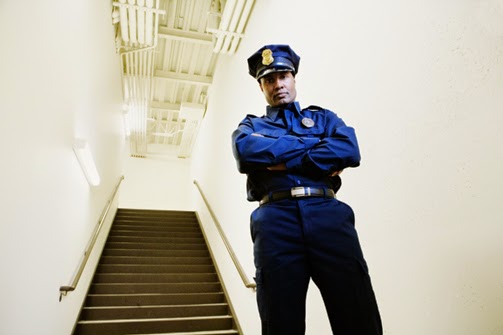
It's one thing to know and exercise your rights when a police officer pulls you over, but what rights do you have when a private cop—entrusted with all of the powers of a government cop but not held to the same legal standards—pulls you over and subjects you to a stop-and-frisk or, worse, causes you to "disappear" into a Gitmo-esque detention center not unlike the one employed by Chicago police at Homan Square?

For that matter, how do you even begin to know who you're dealing with, given that these private cops often wear police uniforms, carry police-grade weapons, and perform many of the same duties as public cops, including carrying out SWAT team raids, issuing tickets and firing their weapons.

This is the growing dilemma we now face as private police officers outnumber public officers (more than two to one), and the corporate elite transforms the face of policing in America into a privatized affair that operates beyond the reach of the Fourth Amendment.

Mind you, it's not as if we had many rights to speak of, anyhow.
Owing to the general complacency of the courts and legislatures, the Fourth Amendment has already been so watered down, battered and bruised as to provide little practical protection against police abuses. 

Indeed, as I make clear in my book A Government of Wolves: The Emerging American Police State, we're already operating in a police state in which police have carte blanche authority to probe, poke, pinch, taser, search, seize, strip and generally manhandle anyone they see fit in almost any circumstance. Expanding on these police powers, the U.S. Supreme Court recently gave law enforcement officials tacit approval to collect DNA from any person, at any time.

However, whatever scant protection the weakened Fourth Amendment provides us dissipates in the face of privatized police, who are paid by corporations working in partnership with the government. Talk about a diabolical end run around the Constitution.

We've been so busy worrying about militarized police, police who shoot citizens first and ask questions later, police who shoot unarmed people, etc., that we failed to take notice of the corporate army that was being assembled under our very noses. Looks like we've been outfoxed, outmaneuvered and we're about to be out of luck.

Indeed, if militarized police have become the government's standing army, privatized police are its private army—guns for hire, if you will. 

This phenomenon can be seen from California to New York, and in almost every state in between. According to the Bureau of Labor Statistics, the private security industry is undergoing a boom right now, with most of the growth coming about due to private police doing the jobs once held by public police. For instance, Foley, Minnesota, population 2600, replaced its police force with private guards.

Technically, a private police force is one that is owned or controlled by a non-governmental body such as a corporation. Those who advocate for privatized services and limited government hail the shift towards private police as a step in the right direction by getting the government out of the business of policing and allow market principles to dictate an officer's success, i.e., if an officer abuses his authority, he can easily be fired.

Read the fine print, however, and you'll find that these private police aka guns-for-hire a.k.a. private armies a.k.a. company police officers a.k.a. secret police a.k.a. conservators of the police a.k.a. rent-a-cops don't exactly remove the government from the equation. Instead, they merely allow them to work behind the scenes, conveniently insulated from any accusations of wrongdoing or demands for transparency. Indeed, most private police officers are either working for private security firms that are contracted by the government or are government workers moonlighting on their time off.

What began as a job detail for wealthy communities and businesses looking to discourage burglaries has snowballed into a lucrative enterprise for private corporations. Today these private police can be found wherever extra security is "needed": at hospitals, universities, banks, shopping malls, gated communities, you name it.

As historian Heather Ann Thompson notes, "private security firms have come substantially to supplement, if not completely to replace, the publicly-funded public safety presence of troubled inner cities ranging from Oakland, to New Orleans, to small towns in states such Minnesota, to entire neighborhoods—sometimes extremely rich, sometimes desperately poor—in urban centers such as Atlanta and Baltimore."

For example, in New Orleans, a 50-person private police squad funded by a "voluntary" hotel tax is being charged with enforcing traffic, zoning and other non-emergency laws in the French Quarter.

In Seattle, off-duty Seattle Police officers moonlighting as a private security force patrol wealthy neighborhoods "approximately six nights/days a week for five hours each shift. Officers are in uniform, carry police radios and their police firearms and drive unmarked personal vehicles."

In California, private mercenaries—many of them ex-U.S. Special Forces, Army Rangers and other combat veterans—equipped with AR-15 rifles use unmarked helicopters to police cannabis farms and cut down private gardens without a warrant.

Yet while these private police firms enjoy the trappings of government agencies—the weaponry, the arrest and shoot authority, even the ability to ticket and frisk— they're often poorly trained, inadequately screened, poorly regulated and heavily armed. Now if that sounds a lot like public police officers, you wouldn't be far wrong.

First off, the label of "private" is dubious at best. Mind you, this is a far cry from a privatization of police. These are guns for hire, answerable to corporations who are already in bed with the government. They are extensions of the government without even the pretense of public accountability. One security consultant likened the relationship between public and private police to public healthcare: "It's basically, the government provides a certain base level. If you want more than that, you pay for it yourself."

The University of Chicago's police department (UCPD) is a prime example of how private security firms are being entrusted with the legal status of private police forces (which sets them beyond the reach of the rule of law) and the powers of public ones. With a jurisdiction that covers a six-square-mile area and is home to 65,000 individuals, the majority of whom are not students, UCPD is one of the largest private security forces in America.

The private police agency, modeled after the tactics of NYPD chief William Bratton, criminalizes nonviolent activities such as loitering, vandalism, smoking marijuana, and ?dancing "reck?l?essly" and punishes minor infractions severely in order to "discourage" violent crime. To this end, the UCPD can search, ticket, arrest, and detain anyone they choose without being required to disclose to the public its reasons for doing so. Not surprisingly, the UCPD has been accused of using racial profiling to target individuals for stop-and-frisks.

Second, these private contractors are operating beyond the reach of the law. For example, although private police in Ohio are "authorized by the state to carry handguns, use deadly force and detain, search and arrest people," they are permitted to keep their arrest and incident reports under wraps. Moreover, the public is not permitted to "check the officers' background or conduct records, including their use-of-force and discipline histories." As attorney Fred Gittes remarked, "There is no accountability. They have the greatest power that society can invest in people — the power to use deadly force and make arrests. Yet, the public and public entities have no practical access to information about their behavior, eluding the ability to hold anyone accountable."

So what happens when the government hires out its dirty deeds to contractors who aren't quite so discriminating about abiding by constitutional safeguards, especially as they relate to searches and heavy-handed tactics? If you think police abuses are worrisome, security expert Bruce Schneier warns that "abuses of power, brutality, and illegal behavior are much more common among private security guards than real police."

As Schneier points out, "Many of the laws that protect us from police abuse do not apply to the private sector. Constitutional safeguards that regulate police conduct, interrogation and evidence collection do not apply to private individuals. Information that is illegal for the government to collect about you can be collected by commercial data brokers, then purchased by the police. We've all seen policemen 'reading people their rights' on television cop shows. If you're detained by a private security guard, you don't have nearly as many rights."

Third, more often than not, the same individuals are serving in both capacities, first on the government payroll, then moonlighting for the corporations. Not surprisingly, given the demand for private police, you'll find that police in most cities work privately while they are off-duty. Some private officers started off as public officers, then made the switch once they saw how lucrative the field could be.

This gives rise to another interesting phenomenon, a schism, if you will, between what is permissible in the private sector versus and what is allowed in the public sector, and how it affects those who travel between both worlds. We saw this played out in St. Louis, Missouri, when an off-duty police officer, working a secondary shift for a private security firm, shot and killed a teenager.

Fourth, what few realize is that these private police agencies are actually given their police powers by state courts and legislatures, which do not require them to act in accordance with the Constitution's strictures or be accountable to "we the people." As legal analyst Timothy Geigner observes, "They're hiding from public scrutiny behind the veil of incorporation, which may rank right up there among the most cynical things a government organization has ever done. It's a move one might find in the corporate republic of some dystopian novel. I say that because it's truly not as though the police departments in question are attempting to claim some kind of exemption within public records law. They're just putting up a stone wall."

It's not as if we have much in the way of local, publicly accountable police forces now; they all answer to the militarized agencies that provide their equipment and training. These private cops simply swell the government's ranks and serve as the private arm of the law.

In fact, the Department of Justice has been one of the most vocal advocates for the benefits that private security—which has twice the budget and manpower as their government counterparts—can provide in partnership with public police. These so-called "benefits" are outlined in the DOJ's guidebook entitled "Operation Partnership: Practices and Trends in Law Enforcement and Private Security Collaborations," which focuses on how both sectors can share cutting-edge technology, information, and personnel resources. Sounds cozy, doesn't it?

As history shows, we're not forging a new path with these private police agencies, either. In fact, we're simply following a model established long ago, not only by Hitler and Mussolini, who relied on private guards to do their bidding, but also by the likes of Andrew Carnegie and John D. Rockefeller, who relied on their own private police force, the Pinkertons, who had broad authority to "harass or hurt anyone their employers deemed a threat—be they a worker trying to get a fair wage or a poor person begging near the doorstep of a mansion."

Nevertheless as historian Heather Ann Thompson points out, "despite countless historical accounts of why private policing of public spaces is a bad idea in a democracy, ordinary Americans have raised little ruckus today when, once again, only those Americans with money are assured access to security and protection." 

Thompson continues:
Worse, astonishing faith has been expressed in the much-touted proposition that private police forces, in fact, act in the best interests of the public. Where is the concern, if not the outrage, that there is virtually no regulation when it comes to private policing in America's inner cities? Not only can individuals with little if any training police public spaces, but in various locales they are even authorized to make arrests and wield firearms. What is more, unlike public police, private security officers are not required by law to read a suspect his or her Miranda Rights and, more incredibly, they are allowed to use force, in some circumstances even deadly force, if they deem it necessary to do so.

What we're finding ourselves faced with is a government of mercenaries, bought and paid for with our tax dollars, all the while claiming to be beyond the reach of the Constitution's dictates.

When all is said and done, privatization in the American police state amounts to little more than the corporate elite providing cover for government wrong-doing.

Either way, the American citizen loses.

This article contributed courtesy of The Rutherford Institute. Click this link to read commentary with full links. 

Monday, February 16, 2015

Hundreds of South Carolina Inmates Sent to Solitary Confinement Over Facebook

February 12, 2015 | By Dave Maass
 
In the South Carolina prison system, accessing Facebook is an offense on par with murder, rape, rioting, escape and hostage-taking.

Back in 2012, the South Carolina Department of Corrections (SCDC) made “Creating and/or Assisting With A Social Networking Site” a Level 1 offense [PDF], a category reserved for the most violent violations of prison conduct policies. It’s one of the most common Level 1 offense charges brought against inmates, many of whom, like most social network users, want to remain in contact with friends and family in the outside world and keep up on current events. Some inmates ask their families to access their online accounts for them, while many access the Internet themselves through a contraband cell phone (possession of which is yet another Level 1 offense).

Through a request under South Carolina’s Freedom of Information Act, EFF found that, over the last three years, prison officials have brought more than 400 disciplinary cases for “social networking”—almost always for using Facebook. The offenses come with heavy penalties, such as years in solitary confinement and deprivation of virtually all privileges, including visitation and telephone access. In 16 cases, inmates were sentenced to more than a decade in what’s called disciplinary detention, with at least one inmate receiving more than 37 years in isolation.

The sentences are so long because SCDC issues a separate Level 1 violation for each day that an inmate accesses a social network. An inmate who posts five status updates over five days, would receive five separate Level 1 violations, while an inmate who posted 100 updates in one day would receive only one.

In other words, if a South Carolina inmate caused a riot, took three hostages, murdered them, stole their clothes, and then escaped, he could still wind up with fewer Level 1 offenses than an inmate who updated Facebook every day for two weeks.

So extreme is the application of this policy that SCDC is forced to regularly suspend solitary confinement sentences because of a lack of space in disciplinary segregation. In many cases, the punishments associated with using social media are so unnecessarily long that inmates will never actually serve them since they exceed their underlying prison sentences.

Prison systems have a legitimate interest in keeping contraband devices out of their facilities and preventing inmates from engaging in illegal activities through the Internet. But South Carolina’s policy goes too far, and not only because of the shockingly disproportionate punishments. The policy is also incredibly broad; it can be applied to any reason an inmate may ask someone outside to access the Internet for them, such as having a family member manage their online financial affairs, working with activists to organize an online legal defense campaign, sending letters to online news sites, or just staying in touch with family and friends to create the type of community support crucial to reintegrating into society.

There is also a censorship component.

Facebook has processed hundreds of requests from SCDC officers who want inmates’ profiles taken down. Facebook’s stated policy is to suspend these pages under the auspices of Terms of Service (ToS) violations—specifically, purported violations of terms banning users from using aliases or sharing passwords with third parties—effectively allowing SCDC to censor inmates’ online speech. Yet, as described below, Facebook goes beyond its stated policy and agrees to SCDC requests to censor inmate pages even when no ToS violation has been alleged. In addition, Facebook seems to have taken no action against SCDC investigators who regularly violate these same terms in uncovering inmate profiles.

What’s more, this process is veiled in secrecy, with both Facebook and SCDC failing to create a public record paper trail documenting the takedown of inmate pages.

It’s time for South Carolinians to demand a review of this policy and for Facebook to reevaluate its role in helping prison systems censor and excessively punish inmates.

Social Media in South Carolina Lockups

Prisons and jails across the country have been looking for new ways to keep inmates off the Internet, not only by investing in controversial new cell-tracking technologies such as Stingrays and DRTboxes, but also using social networks as avenue to find and punish inmates.

South Carolina adopted a Level 1 social media offense [PDF] to punish “Creating and/or Assisting With A Social Networking Site,” defined as: “The facilitation, conspiracy, aiding, abetting in the creation or updating of an Internet web site or social networking site.”

SCDC defines “social networking” very broadly, covering everything from YouTube and Twitter to blogs and email, although all of the cases EFF reviewed [PDF] involved Facebook. Investigations are conducted by corrections officers and inmates are convicted during disciplinary hearings that often last mere minutes.

Since the policy was implemented, SCDC has brought 432 disciplinary cases against 397 inmates, with more than 40 inmates receiving more than two years in solitary confinement [PDF].

Here are some of the most severe social media punishments we’ve seen:
finish reading article

Wednesday, February 11, 2015

FedGov Agents Violate US & State Constitutions, again - by Snooping, Harassing Residents of Three States

We are certainly not one to be tolerant of anti-American radicals agitating violence or terrorist acts regardless of their political philosophies.

But, the threat we see here is the unlawful trampling of our Constitution by federal law enforcement of a state's sovereignty. The elected state representatives of these three-named states, Washington, Idaho, or Oregon with their inaction violate their own sworn oaths of office. In fact, why also have the duty-obligated county sheriffs not expelled or arrested these trespassing federal agents?

To us, it is a greater threat to our rule of law whereby our law enforcement entities respond as commanded by their corporate sponsors, and not to their voters' rights to protection of rights and property. Let them tell us. We need to know.
~~~~~~~~~~~~~~~~~~~~~~~~~~~~~~~~~~~~~~~
Anti-oil sands activists in the U.S. are getting visits from the FBI


Unexpected visitors have been dropping in on anti-oil activists in the United States — knocking on doors, calling, texting, contacting family members.

The visitors are federal agents.

Opponents of Canadian oil say they’ve been contacted by FBI investigators in several states following their involvement in protests that delayed northbound shipments of equipment to Canada’s oilsands.


A lawyer working with the protesters says he’s personally aware of a dozen people having been contacted in the northwestern U.S. and says the actual number is probably higher.

Larry Hildes says it’s been happening the last few months in Washington State, Oregon and Idaho. He says one person got a visit at work, after having already refused to answer questions.

“They appear to be interested in actions around the tarsands and the Keystone XL pipeline,” Hildes said in an interview.

“It’s always the same line: ‘We’re not doing criminal investigations, you’re not accused of any crime. But we’re trying to learn more about the movement.“’

He’s advised activists not to talk — and they mostly haven’t. That lack of communication has made it a little complicated to figure out what, exactly, the FBI is looking for.

The bureau hasn’t offered too many clues.

One agent left his name, number, and the following message in a voicemail for Helen Yost of the group Wild Idaho Rising Tide: “I work with the FBI. Could you give me a call back — I would appreciate it.”

Is anti-oilsands activity an actual focus of the FBI investigation, or is it merely incidental? The bureau won’t say.

What it will say is that it only investigates potential crimes, not political movements.

“The FBI has the authority to conduct an investigation when it has reasonable grounds to believe that an individual has engaged in criminal activity or is planning to do so,” said FBI spokeswoman Ayn Dietrich.

“This authority is based on the illegal activity, not on the individual’s political views.”

But activists say oil sands opposition appears to be the common thread among people being contacted. Police have been in touch with people from different groups, who in some cases don’t agree on much, but one thing they share is mutual participation in the so-called megaload protests.

Those are the intermittent highway blockades set up the last few years to complicate the enormous, football-field-sized shipments of processing equipment up to the oilsands.

Yost said only two people from her group participated in that anti-oil sands action — and those are the people who’ve been contacted by the FBI. She has refused to co-operate.

The other person, Herb Goodwin, was visited at home by an FBI agent and a veteran detective from the local police force in Bellingham, Wash. He said the federal agent told him: “We’re here to ask whether you’ll answer some questions for us about Deep Green Resistance.”

That group, DGR, calls itself a radical environmental movement that believes the biggest problem with the planet is human civilization itself. It proposes a shift back from agriculture to a hunter-gatherer horticultural lifestyle.

It also proposes a four-step program called decisive ecological warfare, a long-term plan calling for the sabotage and dismantling of planet-harming infrastructure.

The group has repeatedly stated that it wouldn’t participate itself in any such actions. But Lierre Keith, one of its founders, laid out the plan in a speech last year at an environmental conference at the University of Oregon.
“I would vastly prefer to wage this struggle non-violently,” Keith said. “But my blogging will not bring forth the necessary numbers. So given a realistic assessment of what we actually have, the only viable strategy left that I can see is direct attacks against infrastructure. In the plainest terms, we need to stop them.”

There was some controversy about inviting her to the conference. Other groups wanted her event cancelled because of her views on transgender people — Keith dismisses the notion that a sex change can undo someone’s gender perspective.

Hildes said the FBI tried asking people about that Oregon speech. Since Yost’s group was among those voicing opposition to DGR, she believes the FBI might be trying to sow division in the movement.

The Canadian government said it wasn’t involved in any U.S. law-enforcement effort. A spokesman said it was aware of the megaload protests, but hadn’t discussed them with any American agency.

Goodwin said he won’t stop protesting. He’s among the nearly 100,000 people who have signed a pledge to engage in civil disobedience, should the Obama administration approve the Keystone XL pipeline.

He called it a life mission to help thwart the development of the oilsands in Canada and the Bakken fields in the U.S. “If we don’t stop that stuff we’re never going to convert to alternative energies that don’t pollute the atmosphere,” he said.

via theglobeandmail

Tuesday, January 13, 2015

How A Police SWAT Team Becomes a Charitable Corporation

Tuesday, 13 January 2015
Written by 


Government agencies have developed very clever ways to hide their acts and paperwork from their bosses, the public. Some of them do it by staying deep in the shadows, such as the CIA or the National Security Agency (NSA). 

However, a group of regional police agencies in New England, which operate Special Weapons and Tactics (SWAT) teams and are armed with machine guns, armored BearCat vehicles, and other military equipment, have done it by styling themselves as non-profit “religious, charitable, scientific, literary or educational” corporations in order to avoid disclosure of their records.
 
These agencies are called “Law Enforcement Councils” (LECs), which evoke images of fraternal cooperation between police departments. In most of the country, that is what they are: regional groups of police departments who band together — and often incorporate — for legislative lobbying, getting funding grants, sharing information, and coordinating between jurisdictions. Some of them share equipment such as traffic speed machines.
 
Only in Massachusetts have these LECs subsumed their police SWAT and other militarized operations, such as locking down the City of Boston after a bomb explosion during its marathon, under the shield of non-profit corporations in order to avoid public scrutiny.


When the American Civil Liberties Union (ACLU) tried to get the documents of one such group, the North Eastern Massachusetts Law Enforcement council (NEMLEC), which is made up of 58 police departments in northeastern Massachusetts, NEMLEC used the excuse that they were just a small non-profit charitable, religious, or educational organization and not a pubic entity, and thus were not subject to freedom of information requests. Never mind that each officer in the SWAT team is a public employee, is paid by public funds, operates publicly owned vehicles and equipment, and works on public safety missions.
 
The ACLU then sued NEMLEC to obtain their records, under the open records law in Massachusetts. However, NEMLEC has continued to oppose disclosure of the records in court, and has moved to dismiss the lawsuit. “NEMLEC can’t have it both ways,” said an attorney for the ACLU. “Either it is a public entity subject to public records laws, or what it is doing is illegal.”
 
Each member police force of a Massachusetts LEC is required to pay dues to the organization of many thousands of dollars per year. These dues are paid out of public funds. Certainly they run their policing operations by their public authority granted by the state and each city or town. In other words, they are public employees, doing their public work and getting paid by our taxes. 
 
NEMLEC’s response appears to be a recent change in the purpose of its non-profit charitable corporation status. NEMLEC was founded forty years ago in 1974, according to Massachusetts secretary of state documents. When it started, it was probably a bunch of police chiefs meeting to swap stories and give each other awards. Perhaps only recently did the group figure out that their non-profit corporation could also serve as a shield to protect their SWAT and military-like activities from disclosure to the public.
 
Why does this matter? Because these cops raid homes and kill people — sometimes the wrong people, sometimes innocent children. They use heavy armored personnel carriers, and serve “no-knock” warrants on drug houses, where they use automatic weapons and flash grenades.
 
As public employees, the records of their activities should be open to the public, and individual police departments have always had to produce them. But because the police departments have consolidated their SWAT teams under these regional “Law Enforcement Councils,” they can hide their most violent, most controversial operations under the protection of a charitable corporate veil.
 
According to a June 26, 2014 article in storyleak.com, SWAT raids have increased from 3,000 a year to over 80,000 a year in the last three decades. Media bring daily reports of drug raids on homes that were mistakenly targeted, and where police sometimes injure or kill innocent persons or pets.
 
Most of these SWAT raids, conducted by officers armed to the teeth and carrying smoke or flash grenades and battering rams, are part of the so-called “drug war.” Although law enforcement theoreticians are well aware of the ample historical evidence that prohibition does not work, we have continued to use this drug war pretext to ramp up the militarization of local police and to perpetrate a siege mentality in many urban areas.
 
We should not forget our last experiment with prohibition of liquor, some ninety years ago, which ran from 1920 to 1933. H.L. Mencken, the “sage of Baltimore,” writing during that period, reminds us what a horrible flop it was and how it ended up doing far more harm than good despite the best intentions of “dry” reformers:


Five years of Prohibition have had, at least, this one benign effect: they have completely disposed of all the favorite arguments of the Prohibitionists. None of the great boons and usufructs that were to follow the passage of the Eighteenth Amendment has come to pass. There is not less drunkenness in the Republic, but more. There is not less crime, but more. There is not less insanity, but more. The cost of government is not smaller, but vastly greater. Respect for law has not increased, but diminished.
Modern police departments have changed from a “protect and serve” model to an “us versus them” mentality and culture. In the new model, citizens have become enemies of the state, and “officer safety” is the primary concern, not the rights of the people. Officers are trained to escalate at the slightest perception of a threat, and will bring criminal charges of resisting arrest, disturbing the peace, or disorderly conduct with little provocation.
 
In that highly charged police-state atmosphere, it is critical that citizens be afforded the opportunity to see public records about police SWAT activities, regardless of whether the police style themselves a “charitable” corporation. Hopefully, the lawsuit filed by the ACLU will succeed in piercing that barrier, and the result will be more accountability by police and fealty to the constitution in their operations, because they know they are being scrutinized.

Source thenewamerican