Search Blog Posts

Showing posts with label POW/MIA. Show all posts

Friday, March 27, 2015

US military officers resort to lying and deception at all levels, finds damning official report

  • Shock 52-page report finds dishonesty at all levels in the U.S. Army 
  • Warns officers have become 'ethically numb' and urges quick action 
  • Says leaders 'espouse lofty values' but slog 'through mire of dishonesty' 
  • Finds personnel expect requested information to be 'questionable' 
  • But notes staff are 'happy to go along with the illusion all is well'  
Published: 08:55 EST, 20 February 2015

A damning official report claims dishonesty within the U.S. military is so endemic that everyone assumes they are being lied to at all times.

The shock report calls on officials to 'urgently confront the corrupting influence of dishonesty' within the army, warning officers have become 'ethically numb'.

The situation has become so bad, the executive summary concludes it has 'allowed leaders to espouse lofty professional values while slogging through the mire of dishonesty and deceit'. 
Dishonesty: The report claims dishonesty is endemic in the army on all levels, discovering personnel expect to not be told the truth at certain points, and accusing officers of becoming 'ethically numb' (Stock picture)

The report's executive summary also claims 'much of the deception and dishonesty... is actually encouraged and sanctioned by the military institution'.

Report authors Leonard Wong and Stephen J. Gerras say it is often justified one of three ways: 'mission accomplishment', 'supporting the troops' or that the task or reporting requirement is unreasonable or 'dumb'.

They go onto note lying and 'adjusting the truth' is so common, military personnel who order a report do not trust its content.

The report authors, who interviewed staff at all levels in the army in order to compile the 53-page document, state: 'It appears that a peculiar situation where those requesting the information, and those supplying it know that the information is questionable.'

However, they add, personnel are 'happy to go along with the illusion all is well'.  
Concerns: Former U.S. Defense Secretary Chuck Hagel sent a memo to military leaders before he stepped down from his post asking to deal with 'unethical or morally questionable behaviour'

The report, created for the Strategic Studies Institute and U.S. Army War College Press, say comes just a week after departing Secretary of Defense Chuck Hagel's final words of advice to senior military staff were to sort out 'unethical behaviour'.

According to CNN, Hagel wrote: 'The vast majority of our senior leaders are men and women who have earned the special trust and confidence afforded them by the American people.

'However, when senior leaders forfeit this trust through unprofessional, unethical or morally questionable behavior, their actions have an enormously negative effect on the profession.' 

via dailymail

Wednesday, March 4, 2015

The Myth of the Voluntary Military

July 29, 2011 Jeffrey A. Tucker

Ludwig von Mises summed up the essence of government in words that are particularly vivid in wartime:
Government interference always means either violent action or the threat of such action.… Government is in the last resort the employment of armed men, of policemen, gendarmes, soldiers, prison guards, and hangmen. The essential feature of government is the enforcement of its decrees by beating, killing, and imprisoning. Those who are asking for more government interference are asking ultimately for more compulsion and less freedom.

What about those who are called upon to enforce state edicts, whether just or unjust? Every society includes people who are willing to act as the coercive arm of the state, those who are willing to use violence and freely risk their lives as they administer the law. The state has no great trouble recruiting policemen and prison guards. Are there enough such people to amass a huge army of hundreds of thousands of people who are willing to risk their lives carrying out destructive foreign wars of dubious merit?

When you see the pictures of American troops fighting their way through sand storms, in a strange land with strange people, seeking to overturn a government and transform a society that posed no credible threat to the United States, being shot at by average Iraqis who are clearly motivated only by the desire to expel the invader, it is not hard to imagine that US troops are wondering how it all came to this.

The British defense secretary, Geoff Hoon, claims that the coalition armed forces are made up of "men and women who made a free choice to serve their country," whereas Iraqi forces "are motivated either by fear or by hatred." It's hard to say what motivates Iraqi forces (perhaps the desire to repel invasion?), but what he says about coalition troops is simply not true.


The men and women now fighting initially agreed to be in the employ of the military. The United States is not yet conscripting people. And yet how many of these would leave Iraq if they could? What if Donald Rumsfeld announced that anyone now fighting in Iraq is free to leave without penalty? What would become of the US armed forces now attempting to bring about unconditional surrender in Iraq?

It's an interesting question, as a pure mental experiment, because it highlights the essentially forced nature of all modern military service. To leave once the war begins would amount to what the government calls desertion. This word sounds ominous, but in fact it merely describes what everyone in a civilized society takes for granted: the right to quit.

Deuteronomy's exhortation to encourage the Israelites into battle includes an invitation to freely leave: "What man is there that is fearful and fainthearted? Let him go and return unto his house." (20:8) But there is no such right in the modern US military. If you try to leave, you face coercion, particularly if you try to leave in wartime. In this way, the military differs from the police and the ranks of prison guards, jobs from which people are free to walk away without penalty.

Punishing people for attempting to leave the military — to avoid killing and/or being killed — is not a new practice. Mises speaks of the "barbarous" practices used in the 18th century to keep soldiers from deserting their units. The more undesirable wartime conditions become, the more necessary it is for the state to force people to continue to endure them.

The scene that shocked me most in the movie Gods and Generals — and it was clearly not intended to be shocking — occurs when an assistant to Stonewall Jackson informs the general that some soldiers have been discovered in an attempt to desert the army under his command. The general orders them to be tried in a military court, and, if found guilty of attempted desertion, to be shot. They were indeed tried and shot. Thus did these men die for exercising their God-given right to walk away.

One of those shot in the film was a young man recruited by Jackson himself, the son of a friend who decided to return to the North. The scene was included to demonstrate Jackson's impartiality. This general is no respecter of persons — or (more plausibly) personhood. To me, the scene demonstrated the immorality of all modern notions of military discipline.

As the movie shows, the South believed it was fighting for the right of self-government, which required that the states be able to exercise their right to leave an increasingly despotic Union. But the military command would not allow their soldiers to secede. The Confederate generals believed that the Union must be voluntary, but the army itself must be kept together through coercion.
"The legalization of desertion might provide the very key to bringing about a more humane world."

Of course, Northern armies employed the same practice. Many Union troops believed they were fighting against slavery, which amounts to nothing more than forbidding people from exercising their right to flee their alleged owners. But the imposition of the death penalty for soldiers choosing not to fight, that is, to flee their military owners, was assumed to be a normal part of military discipline.

Both North and South claimed they were fighting in order to abolish a form of captivity — the right to self-government in one case, and the right to not be employed against one's will in the other — but the ability of the military to imprison and kill fleeing soldiers was never questioned. It is not often questioned tod

The scene parallels the opening sequence in the movie Enemy at the Gates, when Russian troops in boats are being bombed from the air by German planes. Russian troops begin to jump in the water to get away. Their Russian commander starts to unload his pistol as they leap. The viewer is rightly shocked by this incredible display of totalitarian brutality. Yet, in essence, what we are seeing is nothing more than a fast-forwarded version of the court-martial, death-penalty scene in Gods and Generals.

Both scenes underscore a reality hardly ever discussed: all modern armies are essentially totalitarian enterprises. Once you sign up for them, or are drafted, you are a slave. The penalty for becoming a fugitive is death. Even now, the enforcements against mutiny, desertion, going AWOL, or what have you, are never questioned.

This is remarkable, if you think about it. Imagine that you work for Walmart but find the job too dangerous, and try to quit. You are told that you may not, so you run away. The management catches up to you, and jails you. You refuse to go and resist. Finally, you are shot. We would all recognize that this is exploitation, an atrocity, a crime, a clear example of the disregard that this company has for human life. The public outrage would be palpable. The management, not the fleeing employees, would be jailed or possibly executed.

Murray Rothbard frames the question nicely: "In what other occupation in the country are there severe penalties, including prison and in some cases execution, for 'desertion,' i.e., for quitting the particular employment? If someone quits General Motors, is he shot at sunrise?"

The military has done a study1  of what causes people to go AWOL, concluding that the practice "tends to increase in magnitude during wartime" and when "the Army is attempting to restrict the ways that soldiers can exit service through administrative channels."

The same study profiles the deserters, as compared with nondeserters, as less educated, having a lower aptitude, more likely to be from broken homes, etc. — all the usual reasons why a person is so dishonorably disinclined to want to be killed. Finally, this study examined the effects of desertion on the individual, concluding that choosing to be disemployed from the ranks of the armed and dangerous causes "loss of self-esteem and confidence" as well as "embarrassment and even shame." Well, what else would you expect from someone who has "chosen a certain path and failed to meet the necessary requirements and/or sustain the fortitude to meet those requirements"?

Now comes the report from Diwaniya, Iraq, heavily cited by a US military spokesman, that many Iraqi soldiers were fighting at gunpoint, threatened with death by tough loyalists of President Saddam Hussein.… "The officers threatened to shoot us unless we fought," said a wounded Iraqi from his bed in the American field hospital here. "They took out their guns and pointed them and told us to fight."

It could be that the captured soldiers are only trying to win sympathy. But it would hardly be surprising if it were true. To force people to fight when they would rather not is the very essence of modern military organization. In modern practice, there is no such thing as a voluntary military. Whether you are forced into the machine or not (via conscription or via payments in tax dollars), once you are a cog, you must stay in no matter how much grinding you do or how much you are ground.

The slave-like nature of the military commitment has no expiration date. Yes, there are contracts, but the military can void them whenever it so desires. Predictably, it desires to void these contracts (through so-called stop-loss regulations) when the enlisted most want to leave: when they must kill and risk being killed. All branches of the military have implemented these stop-loss regulations because of the war on terror. This amounts to the nationalization of human beings.
 
Still, one wonders how much the ranks of the militarily employed would shrink in absence of antidesertion enforcement. If modern presidents had to recruit the way barons and lords recruited, and if they constantly faced the prospect of mass desertions, they might be more careful about getting involved in unnecessary, unjust, unwinnable wars, or going to war at all. Peace would take on new value out of necessity. When going to war, they might be more careful to curb their war aims, and match war strategies with those more limited aims.

In fact, we might discover through the study of the history of antidesertion statutes the key to the transition from the limited war and decentralized military of the medieval world to the mass murder of the modern total war. The legalization of desertion might provide the very key to bringing about a more humane world.

In the meantime, US officials would do well to stop complaining that Iraqi soldiers are being forced to serve and forced to kill. A press release from the Air Force announcing its new stop-loss rule says, "We understand the individual sacrifices that our airmen and their families will be making.… We appreciate their unwavering support and dedication to our nation."

One might even have a greater appreciation for their sacrifice (even if not their mission) if one knew that it were undertaken willingly.

This article is excerpted from It's a Jetsons World, "The Myth of the Voluntary Military" (2011).

source: Mises.org  

Saturday, February 7, 2015

Pentagon's Shameful Record of Finding (POW/MIA) U.S. Soldiers in Foreign Lands

Can Pentagon Fix Shameful Track Record of Finding and Identifying Remains of Missing U.S. Soldiers in Foreign Lands?


Saturday, February 07, 2015


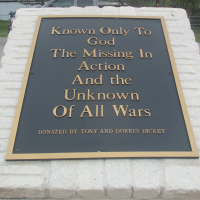
Plaque at Veterans
Memorial Park in
Rhome, Texas
(photo: Wikipedia)
The remains of thousands of American soldiers dating as far back as World War II still have not been brought home, despite the Department of Defense spending millions every year to locate and return these remains to their families.
 
Outgoing Defense Secretary Chuck Hagel promised to implement reforms to erase the backlog of “unknowns,” buried around the world, believed to be about 9,400 according to ProPublica. Some of the missing fought in Vietnam, others during the Korean War, and still others in World War II.

One unknown was Private Arthur “Bud” Kelder, who died in the Philippines 73 years ago. Kelder was buried with several other prisoners in 1942 near the Japanese prison camp in which he died. Although Kelder’s family members provided strong evidence of the location of his remains, the Joint Prisoners of War/Missing in Action Accounting Command (J-PAC) and its longtime scientific director, Tom Holland, refused to investigate the grave and have Kelder’s remains shipped home. Only after the Kelder family’s story was published did the Pentagon officially identify his remains last month. Holland was fired late last year.

J-PAC also declined to work to return home the remains of another soldier, this one from Europe. Private First Class Lawrence Gordon was killed in Normandy in 1944 and was mistakenly identified as a German soldier and buried in a German cemetery. It fell to the Germans, our former enemies, and the French to send Gordon’s remains home.

A key to identifying remains buried overseas is DNA—that of the soldiers and any relatives still alive. But with many from the World War II era in their 80s and 90s, fewer relatives are available for officials to contact and collect genetic material from.

Holland’s office was reluctant to use DNA to identify soldiers’ remains for fear of making an error, saying they must first narrow down who the person might be. “It doesn’t matter that I’ve identified 500 people correctly. If I misidentify one, that’s what going to be the focus. That’s what’s going to be on the news. That is what is going to erode the credibility. That’s what I go home with every night,” Holland told ProPublica last year.

Hagel hopes to address these problems through “sweeping reforms to address the current inefficiency” and the establishment of a new office to oversee the POW/MIA identification. In addition, “a medical examiner will lead identification efforts that will rely heavily on the latest in DNA testing and a new database will list all of the missing. The new agency will also seek assistance from other organizations and outside groups,” according to Sara Afzal at ProPublica.

The changes should improve a process that currently identifies an average of only 72 people a year, even though the Pentagon spends $100 million annually on this effort.

-Noel Brinkerhoff, Steve Straehley
To Learn More:
Pentagon Overhauls Effort to Identify its Missing (by Megan McCloskey, ProPublica)
The Military Is Leaving the Missing Behind (by Megan McCloskey, ProPublica)
Defense POW/MIA Accounting Agency (U.S. Department of Defense)


Monday, February 2, 2015

A Memorial for the Victims of the Wilhelm Gustloff sinking, Jan. 30th, 1945 - A "hate crime" of epic proportions

Only to imagine if we as Americans will be held to a gripping hatred by those whom our government terrorizes now. Haven't we already seen the early signs of such impending horrors from what we're told is "blowback."

But why would our government conceal these horrors, you ask? 

Because the Soviet communists are our friends just as they always been the allies of those who will enslave us all... same as the "moderate terrorists" are our seed friends today.  

Here's another cover-up by our rulers: Katyn Forest Massacre & Coverup by FDR & US Government *incl. video*


It should be alarming to Americans how this 'democracy of moral truth' and its controlled media would conceal these events from the people. For me, at least it shivers my bones.

2015-02-02 5:25
Remember the Wilhelm Gustloff, 1945 (Click to enlarge)

In the night of January 30th, 1945 while evacuating refugees from Eastern Germany, the Gustloff, which was designed to carry a max. 1,865 passengers, had 10,582 on board when she was torpedoed by Soviet sub S-13. An estimated 9,343 Germans, mainly civilians, including men, women, elderly, sick and wounded, and about 5,000 children, perished in the frigid Baltic Sea waters, making it the largest loss of life in a single ship sinking in maritime history.

This was an ALLIED WAR CRIME, a HATE CRIME, and a CRIME AGAINST HUMANITY!

The sinking of MV Wilhelm Gustloff was a “war crime” and indeed a “hate crime” of epic proportions, which the world media, court historians and justice officials have ignored, like so many others committed against Germans. Why? Because of blatant Anti-German propaganda. “German victims” does not fit with the standard narrative of the so-called “good war” and with the childish notion that most have been indoctrinated with of “good guys vs bad guys”. If at all mentioned or noticed, the information is quickly dismissed and forgotten as the years of mental programming overrides ones logic, human decency and compassion with a simplistic response “They were Germans. Who cares? They started the war, and whatever bad things happened to them, they had it coming!”

Thankfully, however, more and more are waking up and coming to the stark realization that they have been lied to all of their lives about virtually everything, including origins of World War II and the true agenda behind it. But for now, let’s focus on this catastrophe and the events which led up to it.

History’s Greatest Naval Disasters – The Little-Known Stories of the Wilhelm Gustloff, the General Steuben and the Goya

(an old IHR article from 1992 citing very old sources in terms of the data which is referenced, but still a good read nonetheless)

Excerpt: “Ignorance and even suppression of the facts of these marine disasters is part of the general ignorance in the United States about the great loss of life and terrible suffering endured by the German people during the Second World War, above all in the conflict’s grim final months. For the story of the unparalleled loss of life in the sinkings of these three German ships can be understood only within the context of the general situation during the final months of the war, when the advancing Soviet forces, eager to take terrible vengeance against the Germans, set in motion one of the greatest mass migrations in history.

It began in mid-October 1944, when Red Army forces first broke into German East Prussia. Spurred on by the hate filled calls to violence against Germans by Soviet Jewish propagandist Ilya Ehrenburg, Red Army troops systematically plundered and murdered Germans unfortunate enough to fall into their hands. [3]

One of the first towns taken by the Soviets was Nemmersdorf, in the Gumbinnen district of East Prussia. It was only because German forces succeeded in recapturing this town a short time later that the world was able to learn how Soviet troops had set about brutally raping females of all ages, and slaughtering the old men, women and children there. The fortunate ones were shot out of hand. Many were clubbed or hacked to death. After being raped, naked women were nailed to doors in crucifix positions. In one case, a group of refugees was crushed under Soviet tanks. [4]

German authorities lost no time in publicizing the horrifying results of the brief Soviet occupation. Journalists, including some from neutral Sweden, Switzerland and Spain, were quickly brought in to report on what had happened. Shocking newsreel footage from Nemmersdorf was shown in German motion picture theaters.

Panic-stricken civilians now desperately sought to escape falling into the hands of the advancing Soviets. As a result, during the final months of 1944 and early 1945, long columns of terrified refugees streamed into the towns and villages along the Bay of Danzig, all frantically waiting for boats that would take them to at least temporary refuge further to the west.

In light of all this, it was quickly decided in Berlin to organize a mass evacuation of civilians. As a result, between January 1945 and the capitulation on May 8, 1945, more than two million people — the great majority of them German civilians — were safely transported to the West. This second “Dunkirk,” which dwarfed many times over the British evacuation in 1940, was organized by Rear Admiral Konrad Engelhardt under the direction of Admiral Karl Dönitz, Commander-in-Chief of the German Navy.” continues here…

Documentary

The Sinking of the Wilhem Gustloff

A 45 minute film produced by “Unsolved History” does an excellent job of investigating all of the facts and even attended the scene where the Gustloff went down with dive crews. They then engaged maritime disaster experts who, with state of the art technology, produced computer simulations, and included eyewitness testimony from some of the still living survivors from that fateful night. They prove that the previous estimates of the lives lost were far too low, and they also validate other sources I’ve read (as shown in my graphics) that put the total number of passengers at about 10,500 and they put the death toll at around 9,600 (slightly higher than my other sources).

Furthermore, their deep sea divers discovered a hitherto unknown and very chilling fact: the Soviets later added further insult to their victims, and by extension to all Germans, by later returning to the wreck, salvaging everything of value, and then setting off explosives inside the wreck to cover up their crimes!

Sadly, yet predictably, the makers of this documentary film found it necessary to include the usual Anti-German war propaganda demonizing Goebbels for having told the truth about Soviet atrocities that had been committed at places like Nemmersdorf to make it seem as though these German victims of deserved the revenge that an “out of control” Germany had brought upon herself. Nothing could be further from the truth! As I have documented, Hitler did not war and he did all he could to avoid through diplomatic means. The war was ultimately forced upon us Germans, and it is high time that the full and true history be told!

The makers of this film (like most others) either portray Goebbels as a liar, or as having exaggerated the facts of the Nemmersdorf Massacre and exploiting it for political gain, when in fact, he was doing is duty and all that he could to warn his people, to save the themselves, defend themselves and their nation against the beastly Soviet Red Army / Bolshevik hordes. He was also telling the world about these war crimes!


Read the rest here: A Memorial for the Victims of the Wilhelm Gustloff sinking, Jan. 30th, 1945 – A “hate crime” of epic proportions - Justice4Germans.com


Friday, January 9, 2015

The McCain and Kerry Betrayals & Treachery to America, its Veterans and their Families *vid*

It's inconceivable how these two monsters could have ever been elected - - not once or twice, but over, and over...is there no justice to be had for the American people?


War Heroes?
 
John McCain ran in 2008 as a war hero and now he poses as an expert on military affairs.

There are just a few problems with that.


McCain is despised by fellow Vets, especially fellow POWs, not only for cooperating with the enemy, but also for blocking every effort to make sure all American POWs were returned after the war.

Interestingly enough, the other veteran who obstructed truth on the matter was JOHN KERRY, the fake candidate and Skull and Bones member who ran against Bush in 2004 and stepped aside in spite of massive and obvious electoral fraud in Ohio.

Kerry's family got a massive pay off from the Communist Vietnam government for his "service" on their behalf helping kill off POW investigations.

Monday, December 29, 2014

Hidden History The untold story of US POWs, VERY Upsetting

NO MORE WOUNDED WARRIORS FOR AMERICA - WE WANT OUR WARRIORS HOME NOW - UNWOUNDED
Notice that the US Red Cross conspires in the cover-up!


More videos like this
The untold history

It's a mystery how to the US manages to fill the ranks of its military.

Surely the disastrous economy and the endless pro-war propaganda helps.

But one of the biggest recruiting tools is the suppression of history.

The fact is that soldiers have to worry about their own government at least as much, or maybe even more, than the enemy that's shooting at them.
 

For example, there's a long history of the US government happily throwing its POWs under the bus when its convenient for the "strategists."


Wednesday, December 10, 2014

John Kerry's Rise to Secretary of State: Lies, Bullying, Betrayal

Kerry would not be a choice for role model of morality, integrity or loyalty for our youngsters.Kerry will adorn our dishonored country's Wall of Shame.

17 Dec 2012

It looks as if pathological liar and long-time hater of America John Kerry will be nominated for Secretary of State (SOS).

Where do you start when condemning such a choice? Let’s start in 1971, when Kerry, ironically speaking to the same Foreign Relations Committee which he now heads, said of America’s efforts in the Vietnam War:

Thursday, October 30, 2014

When It All Goes South - by Alabama YouTube


It'll creep up on you like a kudzu vine
Even miles above the Mason-Dixon line
'Til one day you're craving hominy grits
And scanning the jukebox for George Jones hits
Drinkin' Jack Black tryin' to kick back
'Til the condo's looking like a shotgun shack
You'll be one of us no matter where you're at

When it all goes south
(You'll be drivin' around on a John Deere tractor)
When it all goes south
(Wearing baseball caps but they won't be backwards)
Now it really don't matter what state you're in
One day the south's gonna rise again

There's a Wall Street wonder boy sittin' up north
Throwing darts like a monkey at a stock report
He's got two homes, car loans, in debt
And his third divorce ain't even final yet
Traded his MBA for a SUV on a backwoods road down in Tennessee
'Cause man, Manhattan ain't the place to be

When it all goes south
(With the live oak trees and the sweet magnolias)
When it all goes south
(Eatin' moon pies, drinking RC colas)
Now it really don't matter what state you're in
Someday the south's gonna rise again

When it all goes south
(Where the fog's as thick as Mississippi mud)
When it all goes south
(You'll be singing the blues 'cause it's in your blood)
Now it really don't matter what state you're in
One day the south's gonna rise again

When it all goes south
(You'll be drivin' around on a John Deere tractor)
When it all goes south
(Wearing baseball caps but they won't be backwards)

When it all goes south
(With the live oak trees and the sweet magnolias)
When it all goes south
(Eatin' moon pies, drinking RC colas)

Vicksburg, Birmingham, Natchez and Savannah, Panama City
Y'all sure look pretty in the sunshine
Getting' dixiefried get yourself some rebel pride

When it all goes south
(Where the fog's as thick as Mississippi mud)
When it all goes south
(You'll be singing the blues 'cause it's in your blood)
Now it really don't matter what state you're in
One day the south's gonna rise again

When it all goes south
(You'll be drivin' around on a John Deere tractor)
When it all goes south
(Wearing baseball caps but they won't be backwards)

When it all goes south
(With the live oak trees and the sweet magnolias)
When it all goes south
(Eatin' moon pies, drinking RC colas)

When it all goes south
(Where the fog's as thick as Mississippi mud)
When it all goes south
(You'll be singing the blues 'cause it's in your blood)

When it all goes south
(You'll be drivin' around on a John Deere tractor)
When it all goes south
(Wearing baseball caps but they won't be backwards)
(With the live oak trees and the sweet magnolias)
(Eatin' moon pies, drinking RC colas)

When it all goes south
(Where the fog's as thick as Mississippi mud)
When it all goes south
(You'll be singing the blues 'cause it's in your blood)

(When it all goes south)
When it all goes south
Yeah

Songwriters
CARNES, JANIS / CARNES, RICK / JARVIS, JOHN N


Read more: Alabama - When It All Goes South Lyrics | MetroLyrics

Thursday, October 23, 2014

American Prisoners of War Repeatedly, Shamefully Betrayed By Their Government - Shocking Documentary

Beyond doubt the most horrific documentary of betrayal by Government that we have ever seen. And we thought we'd seen them all, and even have tapes of the Senator Kerry committee.  This IS a MUST WATCH selection.

Declared "Secret" in the 'national interest'? Who the #*&^@ do these political & corporate criminals think they are fooling? The records are Secret only to protect themselves from public disgrace before the American people, and probably worse.

Sunday, October 12, 2014

VETERANS: The Military is Leaving Your MIA Buddies Behind

The military (and other agencies) will do (or not do) whatever they want because our corporatist Neocon/Communist congress does not fulfill its  oversight mandates for the citizens who presumably elect them.

The Military is Leaving the Missing Behind
March 6, 2014, The Contributor
Tracing his genealogy online one night, John Eakin landed on a name that evoked an old family sorrow.

Arthur “Bud” Kelder, Eakin’s cousin, had died while a POW during World War II, but his body had never been found. Bud’s parents had sent handwritten letters to the Army for years, asking to have their youngest son’s body returned to them in Illinois.

“It is our hope that his remains may be sent here, for burial at home,” pleaded one.

Six decades later, Eakin, a stubborn Texan who was himself a vet, resolved to find out exactly why Bud had never come home.

In the fall of 2009, Eakin reached out to family members and found that Bud’s older brother had kept a trove of historical documents laying out Bud’s saga: the telegram announcing he was a POW, newspaper clippings, letters sent between Bud and his parents.

Before the Japanese invaded the Philippines, Bud had worked as a dental assistant at the American hospital in Manila, a plum assignment in a tropical getaway. In late 1941, the Army private wrote to his parents about saving his paycheck to buy a custom-made sharkskin suit. It “really is a peach,” Bud wrote.

After war broke out in December 1941, Bud was among 12,000 American troops who were besieged by the Japanese for four months on the Bataan peninsula, just south of Manila.

“What I dream is there will be no more separations between us again and we’ll spend more time together,” he wrote to his parents in cursive two months later. “P.S. Mother! Don’t worry about me.”

The Americans surrendered on April 9, 1942. The Japanese made Bud a driver during the infamousfive-day, 65-mile Bataan Death March. He eventually ended up at Cabanatuan, one of the largest POW camps for American troops.

When Eakin tried to figure out what happened next, he ran into an unexpected roadblock.

The Pentagon spends about $100 million a year to find men like Bud, following the ethos of “leave no man behind.” Yet it solves surprisingly few cases, hobbled by overlapping bureaucracy and a stubborn refusal to seize the full potential of modern forensic science. Last year, the military identified just 60 service members out of the about 83,000 Americans missing from World War II, Korea and Vietnam, around 45,000 of whom are considered recoverable.

At the center of the military’s effort is a little-known agency, the Joint Prisoners of War/Missing in Action Accounting Command, or J-PAC, and its longtime scientific director, Tom Holland. He alone assesses whether the evidence J-PAC has assembled is sufficient to identify a set of remains: A body goes home only if he signs off.

Over Holland’s 19-year tenure, J-PAC has stuck with an outdated approach that relies primarily on historical and medical records even as others in the field have turned to DNA to quickly and reliably make identifications.

Though finding missing service members can be difficult — some were lost deep in Europe’s forests, others in Southeast Asia’s jungles — Holland’s approach has stymied efforts to identify MIAs even when the military already knows where they are. More than 9,400 service members are buried as “unknowns” in American cemeteries around the world. Holland's lab has rejected roughly nine out of every 10 requests to exhume such graves.

Holland’s cautious approach is animated by a fear of mistakes.

“Our credibility is only as good as our last misidentification,” he said in an interview. “It doesn't matter that I've identified 500 people correctly. If I misidentify one, that’s what going to be the focus. That’s what's going to be on the news. That is what is going to erode the credibility. That’s what I go home with every night.”

The top military official at J-PAC, Gen. Kelly McKeague, said he believed the standards for laboratory work to identify a veteran should be higher than the FBI lab’s standard for a death penalty case. With what J-PAC does, he said, there’s “a lot more at stake.”

In recent years, J-PAC and the other agencies responsible for the MIA program have come under intensifying scrutiny. In 2010, when Congress added World War II to J-PAC’s mission, it mandated at least 200 identifications overall a year by 2015 — a benchmark the agency has already said it will not meet. The problems, including those of DNA, go beyond J-PAC. Last month, Secretary of Defense Chuck Hagel ordered a review of how the military manages the effort.

Time is running out. There are 35,000 missing who experts say are findable from WWII. But the

MIA’s closest relatives are dying off — and often with them so are the chances for using DNA to finally identify their long-lost loved ones.  

Working from a home he built by hand in Helotes, just north of San Antonio, the gray-haired, lanky Eakin began his search by requesting Bud’s records from the Army.

He got back a remarkable document. Despite horrid conditions, the Americans prisoners had left a road map to find Bud and others like him: the “Cabanatuan POW Camp Death Report.”

Barely surviving on a little more than two cups of rice every day, the POWs had still managed to document the deaths of their comrades. It was a monumental task. Of the several thousand prisoners housed at the camp, only about 500 made it out.

Each day, the survivors dug a single unmarked grave to bury that day’s dead. And each day, the officers kept a meticulous ledger of the men who had died. However little that death roster meant in the prison camp, later, the POWs knew, it would be crucial to getting the fallen home.

The entry for Nov. 19, 1942, lists 14 men. Among them: Private Arthur “Bud” H. Kelder, dead at 4:35 p.m. The 26-year-old had succumbed to pellagra, a vitamin deficiency common among the starved prisoners.

Bud’s parents, unaware of his death for eight more months, kept writing him. On May 20, 1943, Bud’s father wrote, “Dear son, another week has gone and still no word from you. We hope you have a few letters on the way to us.”

Bud’s 34-page file had sat untouched by the government for nearly 60 years, a forgotten folder in a vast repository at the National Archives. Had anyone looked it over, they would have found what Eakin did: The military actually had a pretty good sense of where Bud was.

The files included not only a date for Bud's death, but also a specific grave for him. After the war, the Army had gone to the POW camp to dig up and identify the bodies of more than 2,700 men who died there. Using the Cabanatuan camp report and recollections of the survivors, the Army numbered the communal graves and matched them with the death list.Bud and 13 others had been in Grave 717.

Limited by the science of the time, the Army was able to identify and send home four men from that grave but not Bud. In the early 1950s, the remaining 10, along with more than 900 others who died at Cabanatuan, were reburied individually as unknowns in an American cemetery in Manila. White crosses marked their graves, bearing the words “Here Rests in Honored Glory A Comrade in Arms. Known but to God.”

To Eakin, it seemed obvious that Bud was among the 10 unidentified sets of remains from Grave 717 — a relatively small group of bones that the military could dig up and test against the DNA of family members. He tried to make it easier for the Pentagon by tracking down relatives of the men in the grave, so they could provide DNA for comparison. He even turned over an envelope Bud had licked.

Eakin said he thought identifying Bud would be "such a no-brainer.”

Reviewing details of the case later, Joshua Hyman, the head of the University of Wisconsin-Madison’s DNA Sequencing Facility, described it as a “piece of cake.”

But no one in the military seemed to show much interest. Every month, Eakin called the Army, asking, “When are you going to go dig up these remains?”

Bud’s fate rested with Holland and J-PAC’s lab on a joint Navy-Air Force base in Honolulu.

With his beard, slightly ruffled appearance, and a penchant for storytelling, Holland has the air of a liberal arts professor. Walking through the hallway outside his lab, he pointed proudly to displays of artifacts found with recovered remains: Tattered uniforms, faded, crinkled pictures and pineapple-shaped grenades.

Holland joined J-PAC in 1992 and has spent his entire scientific career there, becoming the lab's director in 1995. “The lab has been his life,” said Mark Leney, a former J-PAC anthropologist who worked with Holland for six years. “He has an enormous sense of ownership of it.”

Though J-PAC is a military command, the generals who rotate in and out for temporary assignments take no role in the scientific decisions, leaving them to Holland. Almost a dozen current and former staffers described Holland as someone who bridles at being challenged and fiercely protects his fiefdom.

“Expressing dissent was clearly not appreciated and frowned on,” said Leney, who now teaches at the University of Massachusetts Medical School.

Leney said he and another anthropologist wrote Holland a memo in 2002 about problems with procedures and standards at the lab. They asked for guidance and clarification. “Here is my guidance:Don’t ever write a memo like this again unless it is stapled to your resignation,” Holland wrote back.

J-PAC currently has about 500 employees, including historians and military logisticians to coordinate overseas digs, but it’s work in the lab that people are most likely to conjure. The lab has even been featured on the new “Hawaii Five-0.” (Holland had a cameo.) Holland’s longtime work at the lab recently earned him a lifetime achievement award from the American Academy of Forensic Sciences.

Swiping his badge and entering the bright, sterile lab, which is not much bigger than a classroom, Holland walked by 16 long metal tables with bones laid out, some with a complete skeletons, and others with pieces of bone that look like piles of jagged stones. Some bones were grayed out like seashells, and others were dark brown, almost burnt looking – the different colors betraying the countries in which they were found. Vietnam’s acidic ground bites at bones, leaving them pitted. One skeleton had a green-tinted sternum and ribs, a patina from oxidation of a copper belt with bullets that was strapped to the vet’s chest.

“There’s no formula that applies to every case,” Holland said.

Under Holland’s direction, J-PAC’s lab hasn’t prioritized DNA analysis, despite it being an advancement that has revolutionized forensic science. J-PAC’s method begins with historians sifting through archival material to start to narrow down who someone might be.

“It may be 100 people, 200 people, 500 people, that’s fine,” Holland said.

Then they compare bones to dental charts and other medical records. Combining that with archaeological analysis and artifacts, they try to winnow down the list to one person. DNA comes in last, only as a confirmation tool.

Scientists engaged in similar work elsewhere do the opposite. They start with DNA and let it drive the process, taking samples from bones they dig up and cross-referencing them against databases of DNA from the families of the missing to find a match.

“It’s how you get people identified these days,” said Clyde Snow, one of the world’s foremost forensic anthropologists. “It opened up a whole new world for us.”

Since the earlier 2000s, the DNA-led approach has been used in more than 30 countries to efficiently identify casualties of mass tragedies, including the United States after Sept. 11.

In post-conflict Bosnia, scientists initially used the traditional anthropological techniques that J-PAC relies on now and identified only seven out of the more than 4,000 bodies from the Srebrenica massacre, according to Ed Huffine, a forensic scientist who later designed a DNA-led process there.   

Once they turned to DNA, Huffine said, they were able to make 400 identifications per month at the peak of their efforts.

J-PAC does occasionally start from DNA when bones from many people have been mixed together – as they have done with a complicated case involving 500 co-mingled remains from the Korean War.

But Holland’s deputy at J-PAC, John Byrd, said the lab rarely needs to resort to that. While using DNA first makes sense in places like Bosnia, where authorities lacked medical records for the missing, the U.S. military keeps copious records. And even advocates of DNA agree that relying on records can make sense in some cases.

J-PAC has also faced with cases in which DNA wasn’t an option. Soldiers buried as unknowns from the Korean War were embalmed, making DNA extraction impossible. Holland’s team developed a much-admired innovation to get around that limitation, matching clavicle bones to chest radiographs taken to screen for tuberculosis.

But those cases are an exception. Typically, Holland’s lab has been able to extract DNA, including on all WWII cases it has worked on.  

“If we worked together, concentrating on DNA, we could decrease greatly the time it takes to make identifications,” said a current J-PAC anthropologist, who favors using DNA first.

Holland insists his process works. Making an identification “is an awesome burden,” Holland said, sitting in his paper-strewn office. Sticky notes act as a Rolodex, one wall displays dozens of photocopies of his hand with notes he wrote on his palm during meetings, and on a shelf in his bookcase are copies of two novels he penned – starring a fictionalized version of himself.  “At the end of the day, I carry that burden.”

“If there is a better way to do it, I’m willing to take a look at it, but at some point the government pays me to do my job,” he said in a measured cadence that conveyed both annoyance and self-restraint. “And clearly I’m biased here, but I think I do a fairly good job.”

Holland’s job has been made harder by the overall military’s failure to systematically collect and sort comparison DNA samples from family members of the missing.

Scientists in Argentina, where around 9,000 disappeared in the country’s “dirty war,” started assembling a database of such samples even before they had the technology to analyze them.

“We were collecting samples even though there was no possibility to process them, but the relatives were dying,” said Mercedes Doretti, co-founder of the Argentine Forensic Anthropology Team. Later, Argentina launched a national campaign — funded in part by the U.S. government — to collect more DNA, using famous actors and soccer teams to promote it.

There has been no such campaign in the U.S. In an era of Facebook and Twitter, J-PAC officials heralded a 2001 Pentagon letter that ran in the widely syndicated “Ask Ann Landers” column. It didn’t work. Fewer samples came in after the letter than before, an Army official said.

Huffine and other experts say using DNA effectively requires one central database and single authority overseeing it. But the Pentagon has six different agencies handling aspects of DNA testing and collection, spread out from Hawaii to Delaware. Each military branch is tasked with collecting samples from relatives of the missing from their service.

The Pentagon has relatively complete records for Vietnam and Korea but only a fraction of the needed samples from WWII. Nothing was on record for Bud or the others from Grave 717 until Eakin got involved.

The Army organizes its samples broadly by war and not by theater, major battle or event. Officials said they had no way to discern how many samples they had in hand related to the Cabanatuan unknowns, for example.

Once the military does get DNA samples, there are further delays. The Armed Forces DNA Identification Laboratory, which processes samples for J-PAC, takes 110 days on average to sequence DNA, much longer than commercial labs.

“Just waiting for DNA and trying to find a donor for DNA” from a family member — “a lot of the pauses in progress occur there,” a former J-PAC anthropologist said.

Eakin first heard of Bud as a teenager, when, looking at framed photographs on the wall, he asked about a black-and-white photo of a young man he didn’t recognize.

“That’s Bud,” his grandfather told him in a quiet voice.

“That was the only time I saw my grandpa cry,” Eakin recalled.
FINISH READING