Search Blog Posts

Showing posts with label NSA. Show all posts

Saturday, March 28, 2015

Bipartisan House Bill would Repeal Patriot Act and Ban Mass Surveillance of Americans

Anyone taking odds on this congress has neither the guts or moral fiber to go against the oligarchy that owns them...and us?

Friday, March 27, 2015
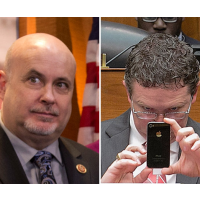
Reps. Mark Pocan
and Thomas Massie
 
An ambitious bipartisan bill that would seriously roll back the federal government’s ability to conduct surveillance operations has been introduced in the U.S. House of Representatives.
HR 1466 (pdf) (the Surveillance State Repeal Act) would do away with the Patriot Act (pdf) and ban large-scale spying programs, such as the National Security Agency’s telephone metadata collection that has generated so much controversy. It is the most far-reaching anti-surveillance legislation drafted to date.

“This isn’t just tinkering around the edges, it’s a meaningful overhaul that makes sure the meaningless surveillance of emails and cell phones are done away with,” Representative Mark Pocan (D-Wisconsin), one of the bill’s authors, told a briefing for congressional staffers, according to ThinkProgress. The coauthor of HR 1466 is Representative Thomas Massie (R-Kentucky).

The bill’s original co-sponsors are Democrats Alan Grayson of Florida, James McGovern of Massachusetts and Lloyd Doggett of Texas. Other supporters include libertarian organizations opposed to widespread government spying.

Patrick Eddington, national security and civil liberties policy analyst for the libertarian think tank CATO Institute, said: “All mass surveillance does is violate the rights and put a chilling effect on the American people.”

The legislation also would eliminate numerous surveillance permissions granted under the Foreign Intelligence Surveillance Act (pdf) amendments approved by Congress during the George W. Bush administration.

The Hill reported that the proposal is “likely to be a nonstarter for leaders in Congress, who have been worried that even much milder reforms to the nation’s spying laws would tragically handicap the nation’s ability to fight terrorists. A similar bill was introduced in 2013 but failed to gain any movement in the House.”

Congress has until June 1 to reauthorize portions of the Patriot Act that support the government’s surveillance operation. Without re-authorization of the law’s Section 215, the telephone metadata program will expire.
-Noel Brinkerhoff
To Learn More:
HR 1466 (Congress.gov) (pdf)
NSA Phone Data Collection Made No Difference to National Security (by Noel Brinkerhoff and Danny Biederman, AllGov)

Thursday, March 26, 2015

U.S. Suspected Israeli Involvement in 1960s Missing Uranium from Pennsylvania Company NUMEC- WSJ


On September 10, 1968 NUMEC receives a key coordinator of Israel's clandestine nuclear
weapons program (Avraham Hermoni) and three undercover Israeli intelligence operatives.
NUMEC tells the Atomic Energy Commission the Israeli visitors are "energy specialists."


U.S. Suspected Israeli Involvement in 1960s Missing Uranium Officials Believed Ally Used Materials Lifted From Pennsylvania Toward a Weapons Program

By John R. Emshwiller, WSJ, Updated Aug. 6, 2014 7:41 p.m. ET


Declassified documents from the 1970s provide new evidence that federal officials believed bomb-grade uranium that disappeared from a Pennsylvania nuclear facility in the 1960s was likely taken for use in a clandestine Israeli atomic-weapons program.


The documents, obtained earlier this year through public-records requests by a Washington-based nonprofit group, also indicate that senior officials wanted to keep the matter under wraps for fear it could undermine U.S. Middle East peace efforts.


Though the Central Intelligence Agency's case for the suspected theft wasn't conclusive, it was sufficiently persuasive that "I do not think that the President has plausible deniability" regarding the question, said a memo dated July 28, 1977, by a National Security Council staffer in President Jimmy Carter's administration.


A security council memo to Mr. Carter a few days later expressed more uncertainty about whether a theft had occurred, but noted that then-Secretary of State Cyrus Vance had a coming Middle East trip and discussed the need to keep attention "away from the CIA's information."


The question of whether one of America's closest allies was involved in the theft of some of its most valuable and dangerous material in pursuit of nuclear weapons has been one of the enduring mysteries of the atomic age. The suspected theft has drawn the attention of at least three presidents and other senior government officials.


The evidence suggested that "something did transpire," said Zbigniew Brzezinski, Mr. Carter's national-security adviser, in a recent interview. "But until you have conclusive evidence you don't want to make an international incident. This is a potentially very explosive, controversial issue." Besides, he added, even if a theft was proved, "What are we going to say to the Israelis, 'Give it back?' "


Israel hasn't ever said whether it has nuclear weapons. A spokeswoman for the Israeli Embassy in Washington, D.C., declined to comment for this article.


So did a spokeswoman for the Obama administration, which like past U.S. administrations has declined to say whether it believes Israel has an atomic arsenal. A CIA spokesman also declined to comment.


Mr. Carter, who said at a 2008 gathering in Britain that he believes Israel has nuclear weapons, declined through a spokeswoman to be interviewed.


His diplomatic efforts as president, which helped produce a peace treaty between Israel and Egypt in 1979, likely wouldn't have been possible "if there was some huge scandal at the time about this," said John Marcum, the staffer who wrote the July 28, 1977, memo, in a recent interview.


The theft suspicions surround events at a now-dismantled facility in Apollo, Pa., owned by a company called Nuclear Materials & Equipment Corp., or Numec. In the mid-1960s, some 200 pounds of bomb-grade uranium--enough possibly for several Hiroshima-sized bombs--couldn't be accounted for there.


An FBI investigation begun in the late 1960s, which drew interest from top Nixon administration officials, including the president, but couldn't determine what happened to the uranium, according to Federal Bureau of Investigation and other agency documents. But FBI officials did raise questions about suspected dealings between Numec's founder and president, Zalman Shapiro, and Israeli intelligence officials, according to government documents. 

Babcock & Wilcox Co. BWC -0.35%  , a nuclear-technology and energy company that acquired Numec in 1971, declined to comment.


In an interview late last year, the 93-year-old Mr. Shapiro, who has long argued the material had been lost in the production process, said that no theft took place. He said his dealings with Israel, where Numec had commercial activities, were legitimate and to his knowledge never involved intelligence officials.


Potentially crucial sections of the recently released documents--obtained by the Institute for Research: Middle Eastern Policy, an organization that has been critical of Israel--remain classified.


The latest document release underscores the need for the government to declassify the remaining information about the suspected theft, some former federal officials say.


"We know the CIA thought the material was stolen. We want to know why they thought that," said Victor Gilinsky, a former commissioner of the Nuclear Regulatory Commission.


Government records show that a federal nuclear-enrichment facility in Ohio sent shipments to Numec containing the highest percentage of U235, the explosive form of uranium, ever known to have been produced, said Roger Mattson, another former NRC official.


Did the CIA later find that such uranium had turned up in Israel, as some documentary evidence suggests? "That's not something that's declassified," said Jessica Tuchman Mathews, a national-security official in the Carter administration who wrote or received some of the recently declassified documents.


Declassified Documents:  http://www.IsraelLobby.org/numec

Read also:
 A brief history of unprosecuted Israeli foreign agent, smuggling and espionage cases.


Friday, February 27, 2015

The Feds Are Terrified

Napolitano: The NSA vs. the Fourth Amendment

What if the Government Fears Freedom?

What if the current massive spying on Americans began with an innocent secret executive order signed by President Reagan in 1986? What if Reagan contemplated that he was only authorizing American spies to spy on foreign spies unlawfully present in the U.S.?

What if Reagan knew and respected the history of the Fourth Amendment? What if the essence of that history is the colonial revulsion at the British use of general warrants? What if general warrants were issued by a secret court in London and authorized British agents in America to search wherever they wished and to seize whatever they found? What if the revulsion at this British government practice was so overwhelming that it led to the Revolutionary War against the king?

What if the whole purpose of the Fourth Amendment was to outlaw general warrants? What if the Fourth Amendment specifically guarantees the right to privacy to all in America in their persons, houses, papers and effects?

What if, in order to emphasize its condemnation of general warrants, the Fourth Amendment requires the government to obtain a warrant from a judge before invading the persons, houses, papers or effects of anyone and lays down the preconditions for the issuance of such warrants? What if those preconditions are individualized suspicion and articulated evidence of crime — called probable cause — about the specific person whose privacy the government seeks to invade?

What if these principles of constitutional fidelity, privacy and probable cause and the unlawfulness of general warrants have been regarded universally and publicly as quintessentially American values, values that set this nation apart from all others?

What if the administration of President George W. Bush was so embarrassed that 9/11 happened on its watch that it fought a useless public war in Iraq — which had nothing to do with 9/11 — and a pernicious private war against American values by unleashing American spies on innocent Americans as to whom there was no individualized probable cause so that it could create the impression it was doing something to keep America safe from another 9/11-like attack?

What if the Bush folks took Reagan’s idea of spying on foreign spies and twisted it so that they could spy on not just foreign spies, but also on foreign persons? What if they took that and leapt to spying on Americans who communicated with foreign persons?

What if they then concluded that it was easier to spy on all Americans rather than just those who communicated with foreign persons? What if they claimed in secret that all this was authorized by Reagan’s executive order and two federal statutes, their unique interpretations of which they refused to discuss in public? What if the Reagan order and the statutes authorized no such thing?

What if The New York Times caught the Bush administration in its massive violation of the Fourth Amendment, whereby it was spying on all Americans all the time without any warrants? What if the Times sat on that knowledge during, throughout and beyond the presidential election campaign of 2004? What if, when the Times revealed all this, the Bush administration agreed to stop spying? What if it didn’t stop?

What if President Obama came up with a scheme to make the spying appear legal? What if that scheme involved using secret judges in secret courts to issue general warrants? What if the Obama administration swore those judges to secrecy? What if it swore to secrecy all in the government who are involved in undermining basic American values? What if it forgot that everyone in government also swears an oath to uphold the Constitution? What if Edward Snowden violated his oath to secrecy in order to uphold his oath to the Constitution, which includes the Fourth Amendment, and spilled the beans on the government?

What if all this spying by the feds has spawned spying by the locals? What if more than 50 local police departments now have received false cell towers from the FBI, but have sworn not to tell anyone about them? What if these towers trick cellphone signals into exposing the content of cellphone conversations to the police? What if the police have done this without the knowledge of the elected representatives who are their bosses? What if they do this without any warrants? What if the Supreme Court last year outlawed police invading cellphones without warrants?

What if both Bush and Obama have argued that their first job is to keep America safe, and they will twist, torture the plain meaning of and even break laws in order to accomplish that job? What if the presidential oath is to enforce all laws faithfully, including ones the president may hate?

What if Bush and Obama have been wrong about the priority of their constitutional duties as president? What if the president’s first job is to preserve the Constitution? What if that includes the Fourth Amendment? What if the president keeps us safe but unfree?

What if invading our freedoms keeps us less safe? What if the president has failed to keep our freedoms safe? What if the government doesn’t like freedoms? What if the government is afraid we will exercise them?

Reprinted with the author’s permission.
Andrew P. Napolitano [send him mail], a former judge of the Superior Court of New Jersey, is the senior judicial analyst at Fox News Channel. Judge Napolitano has written nine books on the U.S. Constitution. The most recent is Suicide Pact: The Radical Expansion of Presidential Powers and the Lethal Threat to American Liberty. To find out more about Judge Napolitano and to read features by other Creators Syndicate writers and cartoonists, visit creators.com.

source lewrockwell

Wednesday, February 25, 2015

Snowden: Remove The Government's Ability To Interfere With Our Rights

By: Samuel Eaton Feb 24, 2015
In an ‘Ask Me Anything’ question and answer session on Reddit, Edward Snowden was asked: “What’s the best way to make NSA spying an issue in the 2016 Presidential Election? It seems like while it was a big deal in 2013, ISIS and other events have put it on the back burner for now in the media and general public. 

What are your ideas for how to bring it back to the forefront?”

Snowden replied:

This is a good question, and there are some good traditional answers here. Organizing is important. Activism is important.

At the same time, we should remember that governments don’t often reform themselves. One of the arguments in a book I read recently (Bruce Schneier, “Data and Goliath”), is that perfect enforcement of the law sounds like a good thing, but that may not always be the case. The end of crime sounds pretty compelling, right, so how can that be?

Well, when we look back on history, the progress of Western civilization and human rights is actually founded on the violation of law. America was of course born out of a violent revolution that was an outrageous treason against the crown and established order of the day. History shows that the righting of historical wrongs is often born from acts of unrepentant criminality. Slavery. The protection of persecuted Jews.

But even on less extremist topics, we can find similar examples. How about the prohibition of alcohol? Gay marriage? Marijuana?

Where would we be today if the government, enjoying powers of perfect surveillance and enforcement, had — entirely within the law — rounded up, imprisoned, and shamed all of these lawbreakers?

Ultimately, if people lose their willingness to recognize that there are times in our history when legality becomes distinct from morality, we aren’t just ceding control of our rights to government, but our agency in determining our futures.

How does this relate to politics? Well, I suspect that governments today are more concerned with the loss of their ability to control and regulate the behavior of their citizens than they are with their citizens’ discontent.

How do we make that work for us? We can devise means, through the application and sophistication of science, to remind governments that if they will not be responsible stewards of our rights, we the people will implement systems that provide for a means of not just enforcing our rights, but removing from governments the ability to interfere with those rights.

You can see the beginnings of this dynamic today in the statements of government officials complaining about the adoption of encryption by major technology providers. The idea here isn’t to fling ourselves into anarchy and do away with government, but to remind the government that there must always be a balance of power between the governing and the governed, and that as the progress of science increasingly empowers communities and individuals, there will be more and more areas of our lives where — if government insists on behaving poorly and with a callous disregard for the citizen — we can find ways to reduce or remove their powers on a new — and permanent — basis.
 Our rights are not granted by governments.
They are inherent to our nature. But it’s entirely the opposite for governments: their privileges are precisely equal to only those which we suffer them to enjoy.

We haven’t had to think about that much in the last few decades because quality of life has been increasing across almost all measures in a significant way, and that has led to a comfortable complacency. But here and there throughout history, we’ll occasionally come across these periods where governments think more about what they “can” do rather than what they “should” do, and what is lawful will become increasingly distinct from what is moral.

In such times, we’d do well to remember that at the end of the day, the law doesn’t defend us; we defend the law. And when it becomes contrary to our morals, we have both the right and the responsibility to re-balance it toward just ends.

Glenn Greenwald focused on how the issue did not break down along party lines:

The key tactic DC uses to make uncomfortable issues disappear is bipartisan consensus. When the leadership of both parties join together – as they so often do, despite the myths to the contrary – those issues disappear from mainstream public debate.

The most interesting political fact about the NSA controversy, to me, was how the divisions didn’t break down at all on partisan lines. Huge amount of the support for our reporting came from the left, but a huge amount came from the right. When the first bill to ban the NSA domestic metadata program was introduced, it was tellingly sponsored by one of the most conservative Tea Party members (Justin Amash) and one of the most liberal (John Conyers).

The problem is that the leadership of both parties, as usual, are in full agreement: they love NSA mass surveillance. So that has blocked it from receiving more debate. That NSA program was ultimately saved by the unholy trinity of Obama, Nancy Pelosi and John Boehner, who worked together to defeat the Amash/Conyers bill.

The division over this issue (like so many other big ones, such as crony capitalism that owns the country) is much more “insider v. outsider” than “Dem v. GOP”. But until there are leaders of one of the two parties willing to dissent on this issue, it will be hard to make it a big political issue.

That’s why the Dem efforts to hand Hillary Clinton the nomination without contest are so depressing. She’s the ultimate guardian of bipartisan status quo corruption, and no debate will happen if she’s the nominee against some standard Romney/Bush-type GOP candidate. Some genuine dissenting force is crucial.

Both make great points. We must remember that it is our duty to restore our rights and take away the power of the government to destroy those rights. But to do so means full spectrum cooperation.

Read the whole Snowden, Greenwald, and Poitras Reddit AMA here.

via benswann

Saturday, February 14, 2015

Why Hasn't President Reagan's un-Lawful Order been Nullified by the Republican Party?

 
Why Hasn't Ronald Reagan’s Unlawful, Un-Constitutional Executive Order #12333 for spying on Americans been Abolished, Retracted, or Nullified?

Since a Republican signed it as an unlawful executive order, why can't a Republican leadership and its Republican congress or the states nullify it? Duh.
 ~~~~~~~~~~~~~~~~~~~~~~~~~~~~~~~~~~~~~
Ronald Reagan’s Executive Order that Opened the Door for Spying on Americans


Sunday, July 20, 2014


Much attention has been paid to the USA Patriot Act and the Foreign Intelligence Surveillance Act, which grant the federal government wide latitude in collecting electronic data. But the granddaddy of spying authorizations goes back to the Reagan Administration, and even Congress doesn't know much about how it works.

Executive Order 12333 was signed by President Ronald Reagan on December 4, 1981. 

The order provides that the "United States intelligence effort shall provide the President and the National Security Council with the necessary information on which to base decisions concerning the conduct and development of foreign, defense and economic policy, and the protection of United States national interests from foreign security threats."

According to an op-ed by former State Department official John Napier Tye in The Washington Post, "Sen. Dianne Feinstein (D-California), chairman of the Senate Select Committee on Intelligence, has said that the committee has not been able to 'sufficiently' oversee activities conducted under 12333."

[" Dianne: May we be so boldly impolite as to ask why you have been authorizing a law which fellow lawmakers nor you or your committee is unable to even congressionally oversee? To many Americans that poses a threat, or even Treason  to our national security, and yet with your own indulgence. Please divulge to the American people who is the real power behind your throne." ... Ed.....CV]

The order specifically charges the National Security Agency (NSA) with "Collection of signals intelligence information for national foreign intelligence purposes in accordance with guidance from the Director of Central Intelligence" and "Processing of signals intelligence data for national foreign intelligence purposes in accordance with guidance from the Director of Central Intelligence."

As part of the order dealing with the collection of intelligence, it specifies that agencies are authorized to collect and retain "Information obtained in the course of a lawful foreign intelligence, counterintelligence, international narcotics or international terrorism investigation." That section allows information about U.S. citizens to be retained as long as the collection is incidental. This is true whether or not the citizen in question is suspected of wrongdoing.

The Review Group on Intelligence and Communications Technologies made numerous recommendations in its report on the NSA and how it deals with data. Among them was Recommendation 12, which urged that information about U.S. citizens obtained in connection with surveillance of foreign subjects be "purged upon detection" unless it has foreign intelligence value. That's apparently not being done under intelligence produced under authority of 12333.

According to a recently declassified document, "Unenciphered communications not thought to contain secret meaning may be retained for five years unless the Signals Intelligence Director determines in writing that retention for a longer period is required to respond to authorized foreign intelligence requirements."

So, what's 12333 being used for? According to the Electronic Frontier Foundation, its authority is used to cull American's electronic address books and buddy lists, to put malware on Facebook servers and to justify the recording of all of a country's telephone calls.

-Steve Straehley

To Learn More:


A Primer on Executive Order 12333: The Mass Surveillance Starlet (by Mark Jaycox, Electronic Frontier Foundation)
Source


Wednesday, February 11, 2015

Has Your State taken any Steps to Reclaim Your State Sovereign Land from the Federal Government? Why not?

1st published by CV on 11.03.2011

This method is preferred first before parading with "secessionist fervor" which is far more easily debunked by our enemies. Besides, any resolution voting secession would likely be rigged.

We first posted this alert in November 2011. You can see now how much of the western states are being assumed by the fedgov in the spreadsheet below, namely the BLM. Be courageous, do the lawful thing. You've got a lot more behind you now than we did in 1860!


Would you tolerate complete strangers squatting on your front lawn? No? Then... brush-up on your spelling of N-S-A., now add B-L-M.


States Must Reclaim their Sovereign Lands From the Federal Government ~

We put up the commentary below last November. Although we have no idea how Montanans made out with HR 1505, it's an object lesson for states and how to reclaim their sovereign property from the fedgov. 

Sunday, January 25, 2015

NSA Spying: 4th Amendment Protection

NSA and other federal agencies rely on material support, cooperation and resources from state and local governments to carry out their mass surveillance programs. By utilizing the legal doctrine of anti-commandeering (a refusal to cooperate), states can have a serious impact on the ability to carry out such surveillance or put it into practical effect.

This page tracks the status of two primary forms of state legislation. First, the 4th Amendment Protection Act, which bans all “material support or resources” (like water, electricity, personnel, and the like) to federal warrantless surveillance programs.  And also, the Electronic Data Privacy Act, which prohibits states from engaging in a narrow, but important activity that the NSA’s former chief technical director William Binney has called the “greatest threat to the Constitutional republic since the civil war.”

No legislation introduced in your state? Contact your state rep and senator, and urge them to introduce today! Find contact info here: http://openstates.org/find_your_legislator

http://openstates.org/find_your_legislator


Tuesday, January 13, 2015

How A Police SWAT Team Becomes a Charitable Corporation

Tuesday, 13 January 2015
Written by 


Government agencies have developed very clever ways to hide their acts and paperwork from their bosses, the public. Some of them do it by staying deep in the shadows, such as the CIA or the National Security Agency (NSA). 

However, a group of regional police agencies in New England, which operate Special Weapons and Tactics (SWAT) teams and are armed with machine guns, armored BearCat vehicles, and other military equipment, have done it by styling themselves as non-profit “religious, charitable, scientific, literary or educational” corporations in order to avoid disclosure of their records.
 
These agencies are called “Law Enforcement Councils” (LECs), which evoke images of fraternal cooperation between police departments. In most of the country, that is what they are: regional groups of police departments who band together — and often incorporate — for legislative lobbying, getting funding grants, sharing information, and coordinating between jurisdictions. Some of them share equipment such as traffic speed machines.
 
Only in Massachusetts have these LECs subsumed their police SWAT and other militarized operations, such as locking down the City of Boston after a bomb explosion during its marathon, under the shield of non-profit corporations in order to avoid public scrutiny.


When the American Civil Liberties Union (ACLU) tried to get the documents of one such group, the North Eastern Massachusetts Law Enforcement council (NEMLEC), which is made up of 58 police departments in northeastern Massachusetts, NEMLEC used the excuse that they were just a small non-profit charitable, religious, or educational organization and not a pubic entity, and thus were not subject to freedom of information requests. Never mind that each officer in the SWAT team is a public employee, is paid by public funds, operates publicly owned vehicles and equipment, and works on public safety missions.
 
The ACLU then sued NEMLEC to obtain their records, under the open records law in Massachusetts. However, NEMLEC has continued to oppose disclosure of the records in court, and has moved to dismiss the lawsuit. “NEMLEC can’t have it both ways,” said an attorney for the ACLU. “Either it is a public entity subject to public records laws, or what it is doing is illegal.”
 
Each member police force of a Massachusetts LEC is required to pay dues to the organization of many thousands of dollars per year. These dues are paid out of public funds. Certainly they run their policing operations by their public authority granted by the state and each city or town. In other words, they are public employees, doing their public work and getting paid by our taxes. 
 
NEMLEC’s response appears to be a recent change in the purpose of its non-profit charitable corporation status. NEMLEC was founded forty years ago in 1974, according to Massachusetts secretary of state documents. When it started, it was probably a bunch of police chiefs meeting to swap stories and give each other awards. Perhaps only recently did the group figure out that their non-profit corporation could also serve as a shield to protect their SWAT and military-like activities from disclosure to the public.
 
Why does this matter? Because these cops raid homes and kill people — sometimes the wrong people, sometimes innocent children. They use heavy armored personnel carriers, and serve “no-knock” warrants on drug houses, where they use automatic weapons and flash grenades.
 
As public employees, the records of their activities should be open to the public, and individual police departments have always had to produce them. But because the police departments have consolidated their SWAT teams under these regional “Law Enforcement Councils,” they can hide their most violent, most controversial operations under the protection of a charitable corporate veil.
 
According to a June 26, 2014 article in storyleak.com, SWAT raids have increased from 3,000 a year to over 80,000 a year in the last three decades. Media bring daily reports of drug raids on homes that were mistakenly targeted, and where police sometimes injure or kill innocent persons or pets.
 
Most of these SWAT raids, conducted by officers armed to the teeth and carrying smoke or flash grenades and battering rams, are part of the so-called “drug war.” Although law enforcement theoreticians are well aware of the ample historical evidence that prohibition does not work, we have continued to use this drug war pretext to ramp up the militarization of local police and to perpetrate a siege mentality in many urban areas.
 
We should not forget our last experiment with prohibition of liquor, some ninety years ago, which ran from 1920 to 1933. H.L. Mencken, the “sage of Baltimore,” writing during that period, reminds us what a horrible flop it was and how it ended up doing far more harm than good despite the best intentions of “dry” reformers:


Five years of Prohibition have had, at least, this one benign effect: they have completely disposed of all the favorite arguments of the Prohibitionists. None of the great boons and usufructs that were to follow the passage of the Eighteenth Amendment has come to pass. There is not less drunkenness in the Republic, but more. There is not less crime, but more. There is not less insanity, but more. The cost of government is not smaller, but vastly greater. Respect for law has not increased, but diminished.
Modern police departments have changed from a “protect and serve” model to an “us versus them” mentality and culture. In the new model, citizens have become enemies of the state, and “officer safety” is the primary concern, not the rights of the people. Officers are trained to escalate at the slightest perception of a threat, and will bring criminal charges of resisting arrest, disturbing the peace, or disorderly conduct with little provocation.
 
In that highly charged police-state atmosphere, it is critical that citizens be afforded the opportunity to see public records about police SWAT activities, regardless of whether the police style themselves a “charitable” corporation. Hopefully, the lawsuit filed by the ACLU will succeed in piercing that barrier, and the result will be more accountability by police and fealty to the constitution in their operations, because they know they are being scrutinized.

Source thenewamerican

Monday, January 12, 2015

Tennessee Republicans support NSA spying by killing off anti-NSA legislation

By: Michael Lotfi Apr 4, 2014
State Rep. Lundberg (R) kills anti-NSA bill. Top campaign donor: AT&T

NASHVILLE, April 4, 2014– A bill moving through Tennessee State House committees, which would have curtailed NSA spying from within the state, was killed Thursday by one Democrat who joined three Republicans in the House Civil Justice Committee.

Monday, January 5, 2015

US Social Surveillance Abuse Puts Civil Liberties in Jeopardy

Land Destroyer: How Many of These Secret Surveillance Programs Do you Know About? 


January 4, 2015 (Vladimir Platov -NEO) - According
to various publications in the American and foreign media, the United
States has created a global system of cyber espionage that allows the
interception and processing of personal data around the globe in
violation of fundamental human rights. Tapped phones, intercepted short
messages, supervised discussions in social networks and stolen emails –
this is the ugly reality we are living in. The NSA and other units of
the United States Intelligence Community are more than capable of
breaching any mobile operating system, be it iOS, Android or 
BlackBerry OS.


In 2011 US intelligence agencies successfully finished the development
of geo-location tracking software that allows the NSA to collect and
save more than five billion location records of mobile users around the
world on a daily basis, and then through a special program labeled
CO-TRAVELER analyze and monitor the movement of certain individuals that
could be of interest for Washington. In addition, since 2010
 information on social contacts of US citizens, their personal data,
including telephone calls, Internet logs, bank codes, insurance data is
being processed by intelligence agencies on a regular basis.


The NSA’s secret project codenamed Boundless Informant seeks to
establish control over “information space.” According to The Guardian it
has been able to collect the data on 97 billion phone calls worldwide
since March 2013.


The global electronic intelligence net Echelon (AUSCANNZUKUS or Five
Eyes), that was established by the US in cooperation with the UK back in
1947, allowed the intelligence agencies of the the Untied States, the
United Kingdom, Canada, Australia, New Zealand, Norway, Denmark,
Germany, Turkey and other countries to exchange secret information,
including the records on their respective citizens.


Yet another secret project codenamed Prism
established by the NSA and Britain’s Government Communications
Headquarters (GCHQ), allowed intelligence agencies to establish close
partnerships with major IT companies back in 2007, including Microsoft,
Yahoo, Google, Facebook, PalTalk, AOL, Skype, YouTube and Apple. Such
cooperation allows the secret services to read private e-mails and
monitor the transfer of files throughout global information space. This
allows the NSA to control sovereign leaders, business 
representatives and foreign diplomats as has been repeatedly reported on by various international media outlets.


However, Washington doesn’t seem to be satisfied with its “progress”
since it continues funding and developing new secret projects that would
not simply allow the United States to retain an effective control over
global information space, but to influence  web users worldwide to its
own advantage as well.

Thus, the Intelligence Advanced Research Projects Activity Agency
(IARPA) in recent years has started a number of research programs to
manipulate social networks.


Programs for analysis of the socio-cultural content of language
(Socio-Cultural Content in Language – SCIL Program) is implemented in
order to develop algorithms, methods and technologies that could enable
the intelligence community to supervise the activities of various
non-governmental organizations that do not agree with the social
policies of certain governments. The development of this program is
dictated by the need to recognize the content of messages transmitted
over the Internet, taking into account linguistic differences and
dialects.


IARPA in close collaboration with the National Institute of Standards and Technology is also developing a program codenamed Reynard,
which aims at studying the phenomena of social dynamics in  so-called
virtual worlds such as MMOs. This particular study is carried out in the
interest of the security agencies in order to assess the political mood
of the population and taking proactive measures once it changes.


The intelligence community is also sponsoring the development of the
Aladdin program designed for automated analysis and description of video
content (Automated Low-Level Analysis and Description of Diverse
Intelligence Video – VACE). The main goal of this program is to provide
intelligence analysts with automated search capabilities to track videos
that could be of interest for them. Videos for analytical processing
can come from different sources – television, surveillance cameras,
regular pictures, interviews or even footage shot by drones. The footage
is systematized by time and place to identify certain individuals and
determine the sequence of their actions which may be in certain semantic
relations to present-day events.


Currently, IARPA implemented a program called Babel, which aims at
developing effective speech recognition software in different languages
and dialects.


Washington and its agencies are literally spending billions of taxpayer
dollars annually under the convenient guise of the “war on terror”,
which in fact turns out to be a hidden war against its own citizens, now
deprived of basic human rights. But what makes it even worse is that
it’s pushing its satellite countries to launch an all-out offensive
against the civil liberties of Europe and beyond.


Vladimir Platov, Middle East expert, exclusively for the online magazine “New Eastern Outlook”


Land Destroyer: How Many of These Secret Surveillance Programs Do you Know About?

Friday, December 26, 2014

NSA reports detail decade's of privacy violations: BUT, Heavily Redacted to Hide the Guilty

Why can't government criminals be investigated as civilians are?  Whether a suspect admits wrongdoing or not they can be regarded as duplicitous and charged as as an accessory to a conspiracy. Where are our congressional oversight bodies; aren't they a key component in assuring the people's national security?  Start with who actually did the redacting, and go from there with hangman nooses in hand! No more IRS-style escapes from justice. We can't continue under this unlawful criminal regime, and certainly don't want an unelected citizenry to impose their justice, now do we.
Incumbent Sen. Charles Grassley (R-IA), Political Shield for Truth Obfuscation and Criminally Guilty

NSA reports detail decade's worth of privacy violations

By Jesse Byrnes - 12/26/14 11:33 AM EST 

The National Security Agency has quietly released more than a decade of reports detailing surveillance activities that potentially violated U.S. citizens' privacy rights.

Covering NSA activities from mid-2001 to 2013, the heavily-redacted reports document possible abuses, including instances of employees emailing classified information to unauthorized recipients or issuing “overly broad or poorly constructed data queries that potentially targeted” Americans.

The agency, required by executive order to submit the reports to the President’s Intelligence Oversight Board, posted the information publicly on Christmas Eve in response to a Freedom of Information Act request from the American Civil Liberties Union.

One of the released reports, from 2012, said an NSA analyst "searched her spouse’s personal telephone directory without his knowledge to obtain names and telephone numbers for targeting." The analyst was "advised to cease her activities."

In another case from 2012, information on a U.S. citizen was "disseminated to a foreign partner" before later being recalled and its deletion confirmed, according to the report.

In 2009, a U.S. Army sergeant received punishment, including a reduction in rank, after he used an NSA system "to target his wife," according to The Wall Street Journal.

Civil-liberties groups pounced on the disclosures.

The documents show “how the NSA has misused the information it collects over the past decade," said Patrick Toomey, a staff attorney with the ACLU’s National Security Project. "They show an urgent need for greater oversight by all three branches of government."
The NSA, though, said that the "vast majority" of cases "involve unintentional technical or human error."

"In the very few cases that involve the intentional misuse of a signals intelligence system, a thorough investigation is completed, the results are reported to the IOB [Intelligence Oversight Board] and the Department of Justice as required," the agency said in a statement.
"These materials show, over a sustained period of time, the depth and rigor of NSA’s commitment to compliance," it added. "By emphasizing accountability across all levels of the enterprise, and transparently reporting errors and violations to outside oversight authorities, NSA protects privacy and civil liberties while safeguarding the nation and our allies."

The report will likely heighten scrutiny on the NSA's practices following a year where lawmakers were unable to pass a bill to reform the spy agency.

In November, legislation that would have ended the NSA's phone records program failed to advance in the Senate.

Advocates for reform, including civil liberties groups and the tech industry, are vowing to press ahead in the new year.

The NSA's release was first reported by Bloomberg.
View the reports here.


http://thehill.com/policy/technology/228107-nsa-reports-detail-privacy-violations