Search Blog Posts

Showing posts with label Goldman Sachs. Show all posts

Thursday, May 7, 2015

US CORPORATE DESTROYERS URGING NEXT FASCIST FAST TRACK ATTACK 0N AMERICA

Wall Street Titans Who Crashed Global Economy in 2008 Go Big for TPP

As billionaire class and financial elites push corporate-friendly pact, new data shows empty promises and 'job-killing' reality of previous agreements
Executives from the financial institutions who received TARP funds, (L-R) Goldman Sachs Chairman and CEO Lloyd Blankfein, JPMorgan Chase & Co Chairman and CEO Jamie Dimon, The Bank of New York Mellon CEO Robert P. Kelly, Bank of America CEO Ken Lewis and State Street Corporation CEO and Chairman Ronald Logue testify before the House Financial Services Committee February 11, 2009 in Washington, DC. (Photo: Chip Somodevilla/Getty Images)

  1. [CV ...a trinational, Independent Task Force on the Future of North America has developed a roadmap to promote North American security and advance the well-being of citizens of all three countries. Read more] and more ...Ted Cruz: married to the establishment
Even as millions and millions of Americans—represented by thousands of labor, environmental, family farm, consumer, faith, Internet freedom and other advocacy organizations—continue to stand firmly in opposition to the Trans-Pacific Partnership, those backing the TPP, including President Obama and a large majority of the Republican caucus, still have two dedicated demographic groups pledging their allegiance to the cause and arguing the so-called "free trade agreement (FTA)" would be good for average workers and the economy overall: billionaires and Wall Street titans.
As Zach Carter of the Huffington Post reports:
Last week, dozens of New York City's power elite signed a letter to the state's congressional delegation, urging lawmakers to support the Trans-Pacific Partnership now in negotiations. Democrats in Congress largely oppose the TPP, and Republican leaders have said they don't have the votes needed to pass it without Democratic support.
But while Obama has struggled to win over members of his own party -- he has been publicly feuding with Sen. Elizabeth Warren (D-Mass.) -- wealthy CEOs probably aren't the ideal pitchmen to skeptical Democrats. Even if their letter hails the TPP as "a catalyst for creating new jobs in the United States" that will benefit "American workers in a broad range of industries."

Fox News mogul Rupert Murdoch signed the letter. So did Steven Schwarzman, who once compared the prospect of raising taxes on private equity magnates like himself to Hitler's invasion of Poland. John Paulson, the Republican mega-donor who made a fortune betting against the housing market with Goldman Sachs, is also a signee. So is vulture investor Wilbur Ross, who spent six figures to support GOP nominee Mitt Romney in 2012 and has backed such conservative hardliners as Sen. Tom Cotton (R-Ark.) and former Rep. Allen West (R-Fla.).

Other signatories include real estate billionaire Jerry Speyer, who recently attended a $100,000-per-person fundraiser to bolster former Florida Gov. Jeb Bush's White House hopes. The host of that event, private equity kingpin Henry Kravis, also signed.
News of the letter, which can be read in full here, came on the same day as new trade data released by the U.S. Census Bureau, covering the full first three years of the bilateral trade deal between the U.S. and South Korea, revealed that the U.S. goods trade deficit with that country has more than doubled since the agreement, first signed in 2007 and amended in 2010, was implemented.

What the new data shows, according to the advocacy group Public Citizen, is economic outcomes that are the opposite of the Obama administration’s "more exports, more jobs" promise used to push through that deal, which are the same promises the administration and those supporting TPP are now using as they attempt to persuade Congress to approve Fast Track authority and ram it through Congress without debate or amendment.

The new economic statistics, explains Public Citizen, offer a damning indictment of the promises on which such deals are sold:
U.S. goods exports to Korea have dropped 6 percent, or $2.7 billion, under the Korea FTA’s first three years, while goods imports from Korea have surged 19 percent, or $11.3 billion (comparing the deal’s third year to the year before implementation). As a result, the U.S. goods trade deficit with Korea has swelled 104 percent, or more than $14 billion. The trade deficit increase equates to the loss of more than 93,000 American jobs in the first three years of the Korea FTA, counting both exports and imports, according to the trade-jobs ratio that the Obama administration used to project gains from the deal." [...]
Record-breaking U.S. trade deficits with Korea have become the new normal under the FTA – in 35 of the 36 months since the Korea FTA took effect, the U.S. goods trade deficit with Korea has exceeded the average monthly trade deficit seen in the three years before the deal. In January 2015, the monthly U.S. goods trade deficit with Korea topped $3 billion – the highest level on record.

The administration has tried to deflect attention from the failure of its Korea FTA by claiming that its poor performance has been caused by economic stagnation in Korea. However, Korea’s economy has grown during each year of the Korea FTA, while U.S. exports to Korea have not.
Despite those figures and the collapse of the U.S. manufacturing sector in the age of neoliberal globalization, the repeated line from TPP supporters is that these deals are 'job creators.' As the letter from the billionaire elites to the New York Congressional Delegation stated, "TPP would be a catalyst for creating new  jobs in the United States, attracting more foreign investment to this country, and  benefitting American workers in a broad range  of industries."

But that's simply not what the evidence from past FTAs shows, said Lori Wallach, director of Public Citizen’s Global Trade Watch, in a statement on Tuesday.

"Who’s going to buy the argument about Fast Track and the TPP creating 'more exports, more jobs' when Obama’s only major trade deal, used as the TPP template, was sold under that very slogan and yet has done the opposite?"

And Dave Johnson, from the Campaign for America's Future, explained in a Tuesday post how none of this "just happened" by accident, but that corporate-friendly trade policies have created these 'job-killing' conditions:
Globalization is not some kind of inevitable natural process of history that has caught up with us. This was and is the result of intentional policy choices, designed to force deindustrialization, break unions, drive down wages and benefits and increase inequality as that pay differential is pocketed by a few. This is the result of the “free market, free trade” ideology that rose up in the late 70s. Free trade policy was and is designed to give a few plutocrats and their giant corporations — “the 1 percent” — increased power over governments.
 Dean Baker, in “Globalization Was Policy, Not Something That Happened,” explained, “… inequality, like the path of globalization, is not something that happened. It was and is the result of conscious policy. We won’t be able to deal with it effectively until we acknowledge this simple fact.”

In his reporting for Huffington Post, Carter makes it clear that it wasn't only billionaires who signed the letter urging for Fast Track and TPP approval. Some, he told his readers, were "merely millionaire CEOs" like Goldman Sach's Lloyd Blankfein, Kenneth Chenault of American Express, and JP Morgan's Jamie Dimon.

Tuesday, March 3, 2015

DOJ, CFTC have Begun Investigation of 10 Major Banks for Rigging Metals Fixing

Need a job? Drop gold investigation
   
Late last week, The Wall Street Journal reported that the U.S. Department of Justice and the U.S. Commodity Futures Trading Commission (CFTC) had begun investigations of 10 major banks over the process of setting prices for gold, silver, platinum and palladium in the London market.

Look for the end result to pretty much
be a cover-up of the suppression of
gold and silver prices. – Pat Heller
The banks under scrutiny are Bank of Nova Scotia, Barclays PLC, Credit Suisse Group AG, Deutsche Bank AG, Goldman Sachs Group Inc., JPMorgan Chase & Co., Societe Generale SA, Standard Bank Group Ltd., and UBS AG. After this announcement, the Swiss competition commission, WEKO, said it was looking into possible manipulation by Swiss banks in the precious metals markets.

As reported in the Journal, the Department of Justice is looking into criminal activity, while the CFTC has opened a civil investigation.

Many researchers have written about the extensive history of central banks manipulating gold prices over the decades.  In the United States, for instance, declassified government documents released so far have all confirmed that the federal government has conspired with other governments and major banks to manipulate gold prices right from the 1930s up into the 1980s.

Historically, many government monetary systems were valued in relation to gold, so it should not surprise anyone that governments would try to influence the relative prices.  In the United States, for instance, the Treasury Department’s Exchange Stabilization Fund (ESF) was established as a provision of the January 31, 1934 Gold Reserve Act.  The ESF was explicitly authorized to use its funds to stabilize the exchange value of the dollar versus gold.  Changes over the years have never revoked the authority to manipulate gold prices.  In fact, a law enacted in 1970 directed the Secretary of the Treasury, with the approval of the President, to “deal in gold, foreign exchange, and other instruments of credit and securities.”

These new investigations follow similar reviews in Europe. Last year, the British government fined Barclays Bank more than $40 million for one incident of gold price manipulation.  Also, the Swiss regulator, FINMA, said it found “serious misconduct” among precious metals traders at UBS involving a silver-fix order of one client.

If you think that the researchers and writers claiming that central banks and major private banks were manipulating the precious metals markets by suppressing prices are finally going to be proven right, think again.

I am confident that the end result of the U.S. government investigations will be, after several years in the works, some fines collected from many of these banks for specific individual incidents. Further, there will be promises that whatever wrongdoing they had done will no longer occur.  And that will be all that happens.

Why do I think this is what will be the end result of such a bombshell development? The answer is simple. Ask yourself why the DOJ and CFTC are investigating trading in the London markets but not in the New York COMEX markets. While it is true that the London market handles more volume of precious metals trading than the COMEX, the U.S. markets are more relevant to Americans.

Also ask yourself why the investigations involve eight foreign owned banks and only two U.S. companies. The foreign banks would only be within the purview of American regulators if their actions in the London markets were perpetrated from the U.S.-based offices. Why aren’t other U.S. banks being investigated?

The reason these investigations will be pretty much whitewashed is that the Department of Justice is unwilling to go after Wall Street. New York Federal Reserve Bank president William C. Dudley (who worked at Goldman Sachs 1986-2007 as the chief U.S. economist, a partner, and as a managing director) confirmed not that long ago that the DOJ has no ongoing investigations of Wall Street firms. The DOJ is not conducting such investigations despite former Federal Reserve chair Alan Greenspan’s public claim that there were massive illegal and criminal frauds committed by Wall Street firms.

The DOJ consistently stated that it will not prosecute these large institutions because the risk of damage to the economy, as they were told by outside experts.  However, could this DOJ policy could have more to do with the revolving doors where the DOJ and CFTC investigators largely have worked for the above named banks or hope to do so when the leave government employment?
After all, U.S. Attorney General Eric Holder announced two years ago that no investigation of UBS’s fixing of LIBOR interest rates would be done. Holder claimed in a news conference that the lack of prosecution was based on a decision of how such an investigation would impact global financial markets. But, was the real reason that UBS was a client of the law firm where Holder worked before his current job?
Want to add some luck to your 
collection or your pocket?

In a previous decision not to investigate HSBC, a Congressional panel asked for the identity of outside parties who advised the DOJ to drop the investigation for global financial stability reasons.  Eventually, Justice officials had to admit that they did not consult any outside parties before canceling the HSBC review.

In sum, I expect the public to be lulled into thinking that the U.S. government is really finding and reporting the truth about the manipulation of precious metals prices. However, once you realize that the DOJ and CFTC are investigating the wrong market (London instead of the New York COMEX), not all of the appropriate American-based banks that should be investigated are being pursued because the government agencies have a “policy” to avoid investigations of firms where they used to work or hope to later be employed. Don’t expect any definitive revelations about the depth and breadth of the manipulation of precious metals trading in America.

Instead, look for the end result to pretty much be a cover-up of the suppression of gold and silver prices.


Wednesday, February 18, 2015

48 suspicious banking deaths

1st pub. by CV Friday, August 22, 2014

Exclusive from...
http://www.hangthebankers.com/wp-content/uploads/2014/06/HTBbanner2-525x84.png


Our advice is if JP Morgan offers you a job: politely decline. The list of top level bankers dying under suspicious circumstances has been growing rapidly in recent months.

Whether these are genuine deaths or something more sinister one thing is for certain, banking is becoming one of the most dangerous industries to be involved in right now with an extremely high death per employee ratio.

The causes of death given for some of the bankers seems quite odd to say the least including one banker shooting himself 8 times with a nail gun and another being crushed to death by their own SUV.

With the global financial system heading towards a major crash in the near future are these people buckling under the pressure of what they see coming or are they being silenced because of what they know?

We can only assume it's a little of both.

Here's the list of top level bankers who have died recently:

DEAD (48)

July – Julian Knott, 45, JPMorgan Executive Director,Global Tier 3 Network Operations, SELF-INFLICTED GUNSHOT WOUND

June – Richard Gravino, 49, Application Team Lead, JP Morgan, SUDDEN DEATH cause unknown/pending

June – James McDonald – President & CEO of Rockefeller & Co – apparently self-inflicted, GUNSHOT WOUND

May – Thomas Schenkman, 42, Managing Director of Global Infrastructure, JP Morgan, SUDDEN DEATH, cause unknown/pending

May – Naseem Mubeen – Assistant Vice President ZBTL Bank, Islamabad, SUICIDE jumped

May – Daniel Leaf – senior manager at the Bank of Scotland/Saracen Fund Managers, FELL OFF A CLIFF

May – Nigel Sharvin – Senior Relationship Manager Ulster Bank manage portfolio of distressed businesses, ACCIDENTAL DROWNING

April – Lydia (no surname given) 52, France's Bred-Banque-Populaire, SUICIDE jumped

April – Li Jianhua, 49, Non-bank Financial Institutions Supervision Department of the regulator, HEART ATTACK

April – Benedict Philippens, Director/Manager Bank Ans-Saint-Nicolas, SHOT

April – Tanji Dewberry – Assistant Vice President, Credit Suisse, HOUSE FIRE

April – Amir Kess, co-founder and managing director Markstone Capital Group private equity fund, CYCLIST HIT BY CAR

April – Juergen Frick, Bank Frick & Co. AG, SHOT

April – Jan Peter Schmittmann – former CEO of Dutch Bank ABN Amro, (Possibly suicide, SHOT)

April – Andrew Jarzyk – Assistant Vice President, Commercial Banking at PNC Financial Services Group, MISSING/DEAD

March – Mohamed Hamwi – System Analyst at Trepp, a financial data and analytics firm, SHOT

March – Joseph Giampapa – JP Morgan lawyer, CYCLIST HIT BY MINIVAN

March – Kenneth Bellandro, former JP Morgan, SUICIDE jumped

Feb – John Ruiz – Morgan Stanley Municipal Debt Analyst, died suddenly, NO CAUSE GIVEN

Feb – Jason Alan Salais, 34, Information Technology specialist at JPMorgan, FOUND DEAD outside a Walgreens pharmacy

Feb –  Autumn Radtke, CEO of First Meta, a cyber-currency exchange firm, SUICIDE

Feb – James Stuart Jr, Former National Bank of Commerce CEO, FOUND DEAD

Feb – Edmund (Eddie) Reilly, trader at Midtown's Vertical Group, SUICIDE

Feb – Li Junjie, JP Morgan, SUICIDE

Feb – Ryan Henry Crane, SUDDEN DEATH cause unknown

Feb – Richard Talley, UNKNOWN CAUSE

Jan – Gabriel Magee, SUICIDE

Jan – William 'Bill' Broeksmit, HUNG/POSSIBLE SUICIDE

Jan – Mike Dueker, SUDDEN DEATH cause unknown

Jan – Carl Slym, SUICIDE

Jan – Tim Dickenson, SUDDEN DEATH cause unknown

Dec 2013 – Robert Wilson, a retired hedge fund founder, apparent SUICIDE leaped to his death from his 16th floor residence

Dec 2013 – Joseph M. Ambrosio, age 34, Financial Analyst for J.P. Morgan, died suddenly from Acute Respiratory Syndrome

Dec 2013 – Benjamin Idim, CAR ACCIDENT

Dec 2013 – Susan Hewitt – Deutsche Bank, DROWNING

Nov 2013 – Patrick Sheehan, CAR ACCIDENT

Nov 2013 – Michael Anthony Turner, Career Banker, CAUSE UNKOWN

Nov 2013 – Venera Minakhmetova Former Financial Analyst at Bank of America Merrill Lynch, CYCLIST HIT

Oct 2013 – Michael Burdin, SUICIDE

Oct 2013 – Ezdehar Husainat – former JP Morgan banker, killed in FREAK ACCIDENT when her SUV crushed her to death

Sept 2013 – Guy Ratovondrahona -Madagascar central bank, Sudden death - cause not confirmed

Aug 2013 – Pierre Wauthier, SUICIDE

Aug 2013 – Moritz Erhardt, SUICIDE

July 2013 Hussain Najadi CEO of merchant bank AIAK Group, SHOT

July 2013 Carsten Schloter, SUICIDE

July 2013 Sascha Schornstein – RBS in its commodity finance, MISSING

April 2013 David William Waygood, SUICIDE

Mar 2013 – David Rossi – communications director of troubled Italian bank Monte dei Paschi di Siena (MPS), SUICIDE
LETHAL BUT NON FATAL (MORE THAN ONE WAY TO SKIN A BANKER) 

Fang Fang – JP Morgan, China, DISGRACED

Nick Bagnall – Director at Bank of Tokyo-Mitsubishi, son accidentally killed himself while trying to re-enact a Tudor hanging

Robin Clark – RP Martin -Wolf of Shenfield City banker shot, SURVIVED

Kevin Bespolka – Citi Capital Advisors, Dresdner Bank, Merrill Lynch and Morgan Stanley, Seriously injured and son dead

Robert Wheeler, 49, a Deutsche Bank financial advisor, DISGRACED

Chris Latham – Bank of America, ON TRIAL, Murder for Hire

Igor Artamonov – West Siberian Bank of Sberbank, Daughter found dead (POSSIBLE SUICIDE)

Hector Sants, Barclays – resigned due to stress and exhaustion, after being told he risked more serious consequences to his health if he continued to work – a remarkable turnaround as the Church reportedly approached him two months later and was told he had made a full recovery,
POSSIBLY INTERESTING/MILDLY STRANGE

April 21st Bruce A. Schaal, 63, died suddenly Banker in Twin Lakes for 35 years

April 20th Keith Barnish 58, Died Suddenly (Still working as Senior Managing Director at Doral Financial Corporation. Previously Bear Stearns, Bank of America Senior Vice President

March 12th Jeffrey Corzine, 31, son of MF Global CEO and Chairman Jon Corzine involved in major banking crime was found dead in an apparent suicide.

Keiran Toman, 39, former banker who believed he was being stalked by a reality TV crew starved to death in a hotel room, an inquest heard today.
 

An inquest was opened after his death in July 2010 but his family asked for a second hearing as they were not informed. Police found all of Mr Toman's possessions in the room, but despite documents mentioning his family, failed to tell them he had died.

Nicholas Austin, 49, A former bank manager from Hersden died after drinking antifreeze in an effort to get high. was found in a coma by his wife Lynn at their home in Blackthorne Road on October 5. He died the same day.
—————————————————

Saturday, January 17, 2015

Rothschild may have already become the Custodian for China's Gold

We 1st published this post about a year ago, again more recently 05.11.14 - but still no mainstream financial "journalists" have dared touch it. No surprise here. Had you forgotten Hank Paulson's more 70+ trips to China when he was with Goldman Sachs setting himself to be the US Treasury Secretary?

Read December 2014 post:
ICBC: A New Global Currency & Gold Setup Is Being Conceived

Perhaps we were too quick to pass over the world gold fixing stories and manipulations recently.  Reading this banking article from the 1990s is a good lead-in for our strong suspicions that manipulations will go on as usual business in China. Then, at the appropriate time we the serfs will come to realize that Rothschild's syndicated ICBC bank is the controlling factor (custodian, central bank?) for Red China's gold.

Thursday, January 1, 2015

The Confiscation of Bank Deposits and The Derivative Debt *vid*

James Corbett interviews Ellen Brown on GRTV | WEB OF DEBT BLOG

We would urge everyone to watch the subsequent short video clip splice into this same vid. It is an incredible insight(for us anyway) that the energy market is playing in the "energy war" on Russia Gazprom, China, fracking, and South American states such as Argentina. Amazing what our government is doing to upset other countries! - after Ellen Brown finishes, just let the video run.


The Confiscation of Bank Deposits and The Derivative Debt: James Corbett interviews Ellen Brown on GRTV | WEB OF DEBT BLOG

Reuters tells us the total financial derivatives are $700 TRILLION


Thursday, December 4, 2014

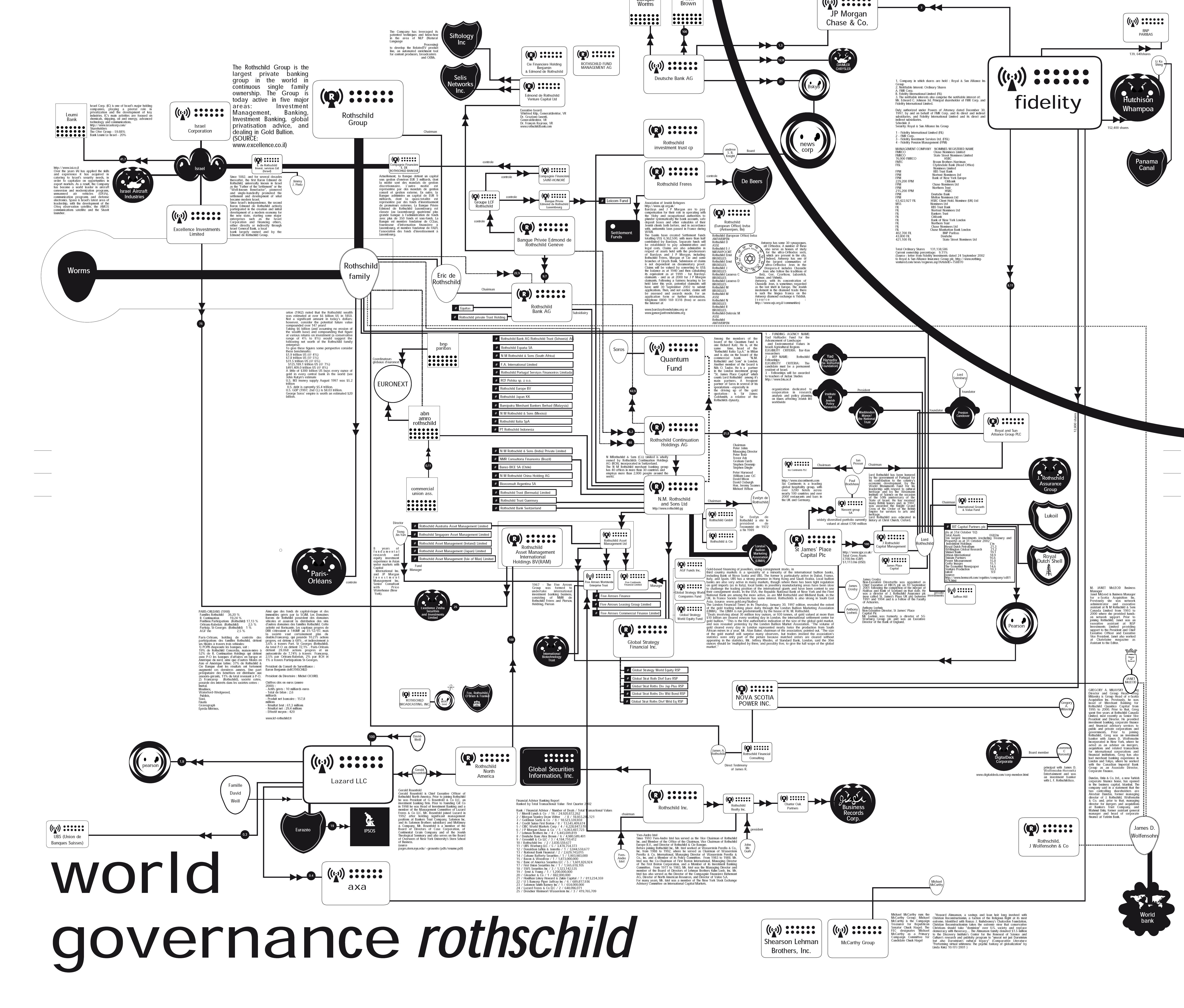
Rothschild Governance Graphic Chart - Who They Own, Who They Control

Rothschild banks are firmly embedded in the Shanghai Foreign Exchange (SHFE) which includes SILVER futures. Nate Rothschild is a board member of BUMI, his London-formed Asian financial predator.  More Rothschild-related posts on this blog

Click image to expand to a MUCH larger view!

Goldman Sachs Exits China's Largest Bank: Crisis Escalates: Some Banks Suspend Lending Activity

You don't suppose GS had inside information do you? Course not. Rothschild had a stake in ICBC as well. Did the banksters skedaddle with another booty load? What were those 70+ trips to Red China taken by Hank Paulson while with GS all about anyway (before becoming our Treasury Secretary)?
Daily Dispatches – Goldman Sachs exits ICBC investment
Goldman Sachs has sold its remaining shareholding in Industrial and Commercial Bank of China (ICBC) in a $1.1 billion block trade. This is the last of six sell-downs over the past seven years... READ BELOW

ICBC: A New Global Currency & Gold Setup Is Being Conceived

A good lead-in for Rothschild's swelling Chinese domain is this one from us posted first on March 5th: Rothschild may have already become the Custodian for China's Gold

Friends, deep down in your heart you know those ankle shackles you're wearing are not going to fall off on their own.


The Chinese Perspective On The International Gold Market


Published: 15-07-2014 17:00

ICBC: A New Global Currency Setup Is Being Conceived
At the LBMA Bullion Market Forum in Singapore on June 25, 2014, two very important speakers attended; Xu Luode, chairman of the Shanghai Gold Exchange, and Zhou Ming, General Manager of the Precious Metals Department at ICBC. Me and Torgny Persson have written about the speeches from Xu and Zhou in previous posts, in this post we will take a closer look at what Zhou said, based on what Chinese media have written about it (whereas Western media are reluctant to cover this). His statements are not entirely new as he already had revealed some objectives of ICBC's precious metals department in an interview conducted on January 7, 2014; ICBC's main goal is to become a significant player in the international gold market. Yet, he made a few remarkable statements in Singapore. First, a few segments from the article/interview published in January:  

In 2013, ICBC physical gold sales increased by more than 80% YoY, the growth rate of the entire line of business also grew more than 30% over the previous year.

For Zhou, the growth of the precious metals business is not accidental. Aside from ICBC's management in forward-thinking and advantages from being a bank, it's also because in China's internationalization process banking institutions are required to play this role.

When the precious metals department was established, ICBC chairman Jiang Jianqing said: "We have the ambition that ICBC becomes a world-class commercial bank in precious metals investment management."

Zhou: "...one day China enters the international stage, we will need more people to participate in understanding the characteristics of capital flows, so we don't have to be so passive. I drive our traders to work on scale and quantitative problems of our platform for the possibility of taking part in international transactions." 

For the future, Zhou Ming's goals are clear and simple: to continue to build the precious metals battleship, heading towards international markets. "In 2013 China became the world 's largest gold producer and consumer, there is no reason for it not to have any voice in international price fluctuations."

The following is a translation of an article in Chinese media about Zhou's speech at the LBMA Forum in Singapore June 25, 2014. Translated by Soh Tiong Hum from Terraseeds.com. 

The Chinese Perspective On The International Gold Market


2014/7/4 Source: Money Weekly

Invited by London Bullion Market Association (LBMA), Zhou Ming, General Manager of Precious Metals Department at Industrial and Commercial Bank of China (ICBC), represented the bank at the LBMA Bullion Market Forum 2014 held in Singapore. Zhou made a keynote speech where he:

  1. Expanded on China's perspective of the international gold market.
  2. Explained the structure of China's gold market to forum participants.
  3. Introduced ICBC Precious Metals Department's development and
  4. Described ICBC's status and function in the development of the Chinese gold market.
  5. Elaborated on the future direction.

Also invited to the LBMA forum were heads of Chicago Mercantile Exchange, World Gold Council, JP Morgan, HSBC, Barclays, Deutsche Bank and many other institutions.

Global precious metals market has experienced centuries of evolution and development. After World War II, the world economy was re-arranged to form a dollar-dominated international monetary system of credit. The international status of gold was replaced by the dollar and the international price of gold was pegged to the dollar. This phenomenon was referred to as 'dollar-pricing'.

Following several economic crises, US dollar's influence on the international monetary system is now on the wane. The 2007 subprime crisis in the US delivered an unprecedented blow to US Dollar hegemony. Gold, which has the best properties of money of all precious metals, in contrast became a banner of resistance to the economic crisis. Its price of $ 290 per ounce in the beginning of 2000, shot above $ 1900 per ounce in 2011.

Six years after the global financial crisis, despite a series of financial stimulus - quantitative easing that increased the size of the Federal Reserve's balance sheet to $ 4 trillion in a few years, both the current and previous head of the Federal Reserve remain defensive of QE policy. Although the Fed announced that it will start reducing the scale of QE on December 19, 2013, after which the international gold price fell below $ 1200 per ounce at one point, international analysts see China's demand and huge import as a decisive element for the reversal in the gold price. 

In 2013 a Bloomberg report said that 26 million ounces (800 metric tonnes) of gold was moved from London to Swiss refiners and then to China via Hong Kong.

When Jeremy East, Managing Director at Standard Chartered Bank, asked at the LBMA Forum In Singapore if the statement "Western gold moves East" was true, Zhou made the following statements:

  1. The world price of gold in recent decades was dollar-priced and fluctuated with the US dollar.
  2. Fed implemented QE caused the issuance of dollars that exceeds demand.
  3. International gold prices will return to rational levels after shooting high.
  4. With the status of the US dollar as the international reserve currency is shaky, a new global currency setup is being conceived.
  5. Uncertain changes will happen to gold's traditional dollar-pricing so the US dollar's influence on gold pricing needs to be re-evaluated.
  6. With the rise of Asian economies, China and India will continue to be the world's pillars of physical gold demand.
  7. Gold has not only moved from West to East but will continue to move to the East.

The factors supporting the gold price are not limited to these. Stephen Roach, senior lecturer at Yale University, formerly chairman of Morgan Stanley Asia and chief economist at Morgan Stanley agreed with Zhou in a conversation last year: "Although the US stock market continues to boom in hand with falling bond yields, US economic recovery remains fragile with a lack of recovery in US companies which causes labor unemployment levels to remain high, GDP growth to slow down and inflation to remain lower than pre-crisis levels. The international gold price is not in an environment that sustains falling prices.

Now in the second half of 2014, the gold market is an important part of the world's modern financial system and that means for China to internationalize its financial markets. When the development of China's gold market supervision and regulation policies are complete, China's commercial banks' overseas businesses will flourish and opportunities from the Shanghai FTZ can be used; the Shanghai Gold Exchange will officially launch an international board within 2014.

The international board will initially look at foreign institutional investors in the region to establish a free trade yuan-denominated spot gold trading platform and a corresponding settlement system so as to provide offshore RMB investment and circulation in a new channel. RMB cross-border trading accounts will also have a payment service.

Breakthroughs in many national policies and system developments will play an important part in the internationalization of China's financial market and its place in international gold-pricing.

End of article

Oddly enough there hasn't been any mainstream news outlet that has published anything about the speeches from Xu and Zhou, while these are very important for the international gold market. Additionally the LBMA just published the slides from the speakers at the forum in Singapore, except the ones from Xu and Zhou! Torgny Persson, who visited the forum, assured me both did use slides in their presentations. I find it strange these slides are not published. The LBMA notes on its website that in a couple of weeks it will publish the transcripts of the speeches from the Singapore forum. I'm very curious if the transcripts of Xu and Zhou will be appended.     

Koos Jansen
​via ​

Sunday, November 30, 2014

Video series by Eric deCarbonnel of Market Skeptics about the Exchange Stabilization Fund

1st posted by CV  Wednesday, December 14, 2011

After posting yesterday TheDailyBell's informative reference to deCarbonnel & his videos, I was reluctant to belabor the issue, but a well-informed subscriber  prodded me, so here we go.

From Don't Tread on Me
My Critique of “What I Have Been Afraid To Blog About: The ESF and Its History.”

This is a very interesting video series by Eric deCarbonnel of Market Skeptics about the Exchange Stabilization Fund. It is a look into the secret slush fund that operates trillions of dollars of with no oversight. It is the nexus of money and the dark world of market intervention, covert operation, drug and other illicit activities the Elite run. The real purpose of this video series is very unsettling and turns out to be a very crafty piece of propaganda.

Monday, September 29, 2014

Smoking Gun Evidence That The New York Fed Serves The Interests Of Goldman Sachs

Goldman Sachs And The New York Fed - Public DomainFor years, many people have suspected that the New York Fed is more or less controlled by the "too big to fail" banks.  

way.  As a recent Bloomberg article explained, it has become "common practice" for regulators to leave "their government jobs for much higher paying jobs at the very banks they were once meant to regulate."  If you think that there is going to be a cushy, high paying banking job for you at the end of the rainbow, you are unlikely to do anything that will mess that up.Well, now we have smoking gun evidence that this is indeed the case.  A very brave lawyer named Carmen Segarra made a series of audio recordings while she was working for the New York Fed.  The 46 hours of meetings and conversations that she recorded are being called "the Ray Rice video for the financial sector" because of the explosive content that they contain.  What these recordings reveal are regulators that are deeply afraid to do anything that may harm or embarrass Goldman Sachs.  And it is quite understandable why Segarra's colleagues at the New York Fed would feel this
To say that the culture at the New York Fed is "deferential" to big banks such as Goldman Sachs would be a massive understatement.

When Carmen Segarra was first embedded at Goldman Sachs, she was absolutely horrified by what she was seeing and hearing.  But her superiors were so obsessed with covering up for Goldman that they actually pressured her to alter the notes that she took during meetings...

The job right from the start seems to have been different from what she had imagined: In meetings, Fed employees would defer to the Goldman people; if one of the Goldman people said something revealing or even alarming, the other Fed employees in the meeting would either ignore or downplay it. For instance, in one meeting a Goldman employee expressed the view that "once clients are wealthy enough certain consumer laws don't apply to them." After that meeting, Segarra turned to a fellow Fed regulator and said how surprised she was by that statement -- to which the regulator replied, "You didn't hear that."
This sort of thing occurred often enough -- Fed regulators denying what had been said in meetings, Fed managers asking her to alter minutes of meetings after the fact -- that Segarra decided she needed to record what actually had been said.
Needless to say, someone like Segarra that did not "go along with the program" was not going to last long at the New York Fed.
 
After only seven months, she was fired...

In 2012, Goldman was rebuked by a Delaware judge for its behaviour during a corporate acquisition. Goldman had advised one energy company, El Paso Corp., as it sold itself to another energy company, Kinder Morgan, in which Goldman actually owned a $4-billion stake. Segarrra asked questions and was told by a Goldman executive that the bank did not have a conflict of interest policy. The Fed found some divisions of the bank did have a policy, though not a comprehensive one. The Fed pressured Segarra not to mention the inadequate conflict of interest policy at Goldman in her reports and, she alleges, fired her after she refused to recant.
If Segarra had not made the recordings that she did, we would have probably never heard much from her ever again.
After all, who is going to believe her over Goldman Sachs and the New York Fed?  A minority would, of course, but the general public would have probably dismissed her accusations as the bitter ramblings of an ex-employee.
 
But she did make those recordings, and they are causing chaos on Wall Street right now.
 
The following is how Michael Lewis summarized the importance of this audio...

But once you have listened to it -- as when you were faced with the newly unignorable truth of what actually happened to that NFL running back's fiancee in that elevator -- consider the following:

1. You sort of knew that the regulators were more or less controlled by the banks. Now you know.

2. The only reason you know is that one woman, Carmen Segarra, has been brave enough to fight the system. She has paid a great price to inform us all of the obvious. She has lost her job, undermined her career, and will no doubt also endure a lifetime of lawsuits and slander.
The New York Fed says that it "categorically rejects" all of the allegations made by Carmen Segarra.
 
Of course they do.
 
But what is there to deny?  The evidence is right there in the audio recordings.
 
The New York Fed has been caught red-handed serving the interests of Goldman Sachs, and no number of strongly-worded denials is going to change that.
 
Sadly, this is not likely to change any time soon.  Employees of the New York Fed are going to continue to want to get hired by the big banks, and the big banks are going to continue to hire them.  So the incestuous relationship between the New York Fed and Goldman Sachs is probably not going to change in any meaningful way despite this bad publicity.
 
What this means is that Goldman Sachs is going to continue to do pretty much whatever it wants to do, and nobody is going to stop them.
 
But someone should be doing something.
 
As I wrote about the other day, Goldman Sachs has less than a trillion dollars in total assets, but it has more than 54 trillion dollars in exposure to derivatives.
 
When the derivatives crisis strikes, some of these "too big to fail" banks are going to go down very hard.
Goldman might be one of them.
 
And when Wall Street starts collapsing, it is going to plunge the entire U.S. economy into a complete and utter nightmare.
Much of this could have been avoided if we had good rules in place and we had regulators that were honestly trying to enforce those good rules.
 
But instead, the wolves are guarding the hen house and the big banks are going absolutely wild.
 
Ultimately, this is all going to end very, very badly.

Source Economic Collapse