Search Blog Posts

Showing posts with label ACLU. Show all posts

Friday, February 27, 2015

Morton Halperin (CFR) and his ultra-radical Center for National Security Studies

1st. pub. by CV 08.12.2012

Morton Halperin and his ultra-radical Center for National Security Studies

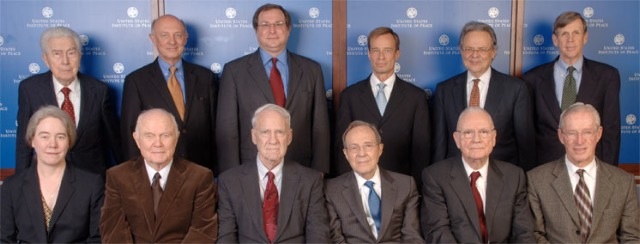
The Congressional Commission on the Strategic Posture of the United States.  Bottom Row: Ellen Williams, John Glenn, James Schlesinger, William Perry, Lee Hamilton, John Foster.  Top Row: Frederick Ikle, James Woolsey, Keith Payne, Harry Cartland, Morton Halperin, Bruce Tarter.  (Credit: USIP Photo/Steven E. Purcell)


Morton H. Halperin was born on June 13, 1933 in Brooklyn, New York, son of Lillian Neubart and Harry Halperin. He married Ina Weinstein. He is an alumnus of Columbia University(B.A., 1958) and Yale University(M.A., 1959; Ph.D., 1961). He is the author of Limited War in the Nuclear Age(1963) and China and the Bomb(1965). He is co-author of Strategy and Arms Control(1961). Morton's son, Mark, also to the far left has been Political Director of ABC News since 1997.

Morton's other son David is a gay activist and professor at the University of Michigan.  He has authored and edited a number of books about homosexuality, including: How to Do the History of Homosexuality; Saint Foucault: Towards a Gay Hagiography; The Lesbian and Gay Studies Reader; and One Hundred Years of Homosexuality and Other Essays on Greek Love.

Tuesday, January 13, 2015

How A Police SWAT Team Becomes a Charitable Corporation

Tuesday, 13 January 2015
Written by 


Government agencies have developed very clever ways to hide their acts and paperwork from their bosses, the public. Some of them do it by staying deep in the shadows, such as the CIA or the National Security Agency (NSA). 

However, a group of regional police agencies in New England, which operate Special Weapons and Tactics (SWAT) teams and are armed with machine guns, armored BearCat vehicles, and other military equipment, have done it by styling themselves as non-profit “religious, charitable, scientific, literary or educational” corporations in order to avoid disclosure of their records.
 
These agencies are called “Law Enforcement Councils” (LECs), which evoke images of fraternal cooperation between police departments. In most of the country, that is what they are: regional groups of police departments who band together — and often incorporate — for legislative lobbying, getting funding grants, sharing information, and coordinating between jurisdictions. Some of them share equipment such as traffic speed machines.
 
Only in Massachusetts have these LECs subsumed their police SWAT and other militarized operations, such as locking down the City of Boston after a bomb explosion during its marathon, under the shield of non-profit corporations in order to avoid public scrutiny.


When the American Civil Liberties Union (ACLU) tried to get the documents of one such group, the North Eastern Massachusetts Law Enforcement council (NEMLEC), which is made up of 58 police departments in northeastern Massachusetts, NEMLEC used the excuse that they were just a small non-profit charitable, religious, or educational organization and not a pubic entity, and thus were not subject to freedom of information requests. Never mind that each officer in the SWAT team is a public employee, is paid by public funds, operates publicly owned vehicles and equipment, and works on public safety missions.
 
The ACLU then sued NEMLEC to obtain their records, under the open records law in Massachusetts. However, NEMLEC has continued to oppose disclosure of the records in court, and has moved to dismiss the lawsuit. “NEMLEC can’t have it both ways,” said an attorney for the ACLU. “Either it is a public entity subject to public records laws, or what it is doing is illegal.”
 
Each member police force of a Massachusetts LEC is required to pay dues to the organization of many thousands of dollars per year. These dues are paid out of public funds. Certainly they run their policing operations by their public authority granted by the state and each city or town. In other words, they are public employees, doing their public work and getting paid by our taxes. 
 
NEMLEC’s response appears to be a recent change in the purpose of its non-profit charitable corporation status. NEMLEC was founded forty years ago in 1974, according to Massachusetts secretary of state documents. When it started, it was probably a bunch of police chiefs meeting to swap stories and give each other awards. Perhaps only recently did the group figure out that their non-profit corporation could also serve as a shield to protect their SWAT and military-like activities from disclosure to the public.
 
Why does this matter? Because these cops raid homes and kill people — sometimes the wrong people, sometimes innocent children. They use heavy armored personnel carriers, and serve “no-knock” warrants on drug houses, where they use automatic weapons and flash grenades.
 
As public employees, the records of their activities should be open to the public, and individual police departments have always had to produce them. But because the police departments have consolidated their SWAT teams under these regional “Law Enforcement Councils,” they can hide their most violent, most controversial operations under the protection of a charitable corporate veil.
 
According to a June 26, 2014 article in storyleak.com, SWAT raids have increased from 3,000 a year to over 80,000 a year in the last three decades. Media bring daily reports of drug raids on homes that were mistakenly targeted, and where police sometimes injure or kill innocent persons or pets.
 
Most of these SWAT raids, conducted by officers armed to the teeth and carrying smoke or flash grenades and battering rams, are part of the so-called “drug war.” Although law enforcement theoreticians are well aware of the ample historical evidence that prohibition does not work, we have continued to use this drug war pretext to ramp up the militarization of local police and to perpetrate a siege mentality in many urban areas.
 
We should not forget our last experiment with prohibition of liquor, some ninety years ago, which ran from 1920 to 1933. H.L. Mencken, the “sage of Baltimore,” writing during that period, reminds us what a horrible flop it was and how it ended up doing far more harm than good despite the best intentions of “dry” reformers:


Five years of Prohibition have had, at least, this one benign effect: they have completely disposed of all the favorite arguments of the Prohibitionists. None of the great boons and usufructs that were to follow the passage of the Eighteenth Amendment has come to pass. There is not less drunkenness in the Republic, but more. There is not less crime, but more. There is not less insanity, but more. The cost of government is not smaller, but vastly greater. Respect for law has not increased, but diminished.
Modern police departments have changed from a “protect and serve” model to an “us versus them” mentality and culture. In the new model, citizens have become enemies of the state, and “officer safety” is the primary concern, not the rights of the people. Officers are trained to escalate at the slightest perception of a threat, and will bring criminal charges of resisting arrest, disturbing the peace, or disorderly conduct with little provocation.
 
In that highly charged police-state atmosphere, it is critical that citizens be afforded the opportunity to see public records about police SWAT activities, regardless of whether the police style themselves a “charitable” corporation. Hopefully, the lawsuit filed by the ACLU will succeed in piercing that barrier, and the result will be more accountability by police and fealty to the constitution in their operations, because they know they are being scrutinized.

Source thenewamerican

Friday, December 26, 2014

NSA reports detail decade's of privacy violations: BUT, Heavily Redacted to Hide the Guilty

Why can't government criminals be investigated as civilians are?  Whether a suspect admits wrongdoing or not they can be regarded as duplicitous and charged as as an accessory to a conspiracy. Where are our congressional oversight bodies; aren't they a key component in assuring the people's national security?  Start with who actually did the redacting, and go from there with hangman nooses in hand! No more IRS-style escapes from justice. We can't continue under this unlawful criminal regime, and certainly don't want an unelected citizenry to impose their justice, now do we.
Incumbent Sen. Charles Grassley (R-IA), Political Shield for Truth Obfuscation and Criminally Guilty

NSA reports detail decade's worth of privacy violations

By Jesse Byrnes - 12/26/14 11:33 AM EST 

The National Security Agency has quietly released more than a decade of reports detailing surveillance activities that potentially violated U.S. citizens' privacy rights.

Covering NSA activities from mid-2001 to 2013, the heavily-redacted reports document possible abuses, including instances of employees emailing classified information to unauthorized recipients or issuing “overly broad or poorly constructed data queries that potentially targeted” Americans.

The agency, required by executive order to submit the reports to the President’s Intelligence Oversight Board, posted the information publicly on Christmas Eve in response to a Freedom of Information Act request from the American Civil Liberties Union.

One of the released reports, from 2012, said an NSA analyst "searched her spouse’s personal telephone directory without his knowledge to obtain names and telephone numbers for targeting." The analyst was "advised to cease her activities."

In another case from 2012, information on a U.S. citizen was "disseminated to a foreign partner" before later being recalled and its deletion confirmed, according to the report.

In 2009, a U.S. Army sergeant received punishment, including a reduction in rank, after he used an NSA system "to target his wife," according to The Wall Street Journal.

Civil-liberties groups pounced on the disclosures.

The documents show “how the NSA has misused the information it collects over the past decade," said Patrick Toomey, a staff attorney with the ACLU’s National Security Project. "They show an urgent need for greater oversight by all three branches of government."
The NSA, though, said that the "vast majority" of cases "involve unintentional technical or human error."

"In the very few cases that involve the intentional misuse of a signals intelligence system, a thorough investigation is completed, the results are reported to the IOB [Intelligence Oversight Board] and the Department of Justice as required," the agency said in a statement.
"These materials show, over a sustained period of time, the depth and rigor of NSA’s commitment to compliance," it added. "By emphasizing accountability across all levels of the enterprise, and transparently reporting errors and violations to outside oversight authorities, NSA protects privacy and civil liberties while safeguarding the nation and our allies."

The report will likely heighten scrutiny on the NSA's practices following a year where lawmakers were unable to pass a bill to reform the spy agency.

In November, legislation that would have ended the NSA's phone records program failed to advance in the Senate.

Advocates for reform, including civil liberties groups and the tech industry, are vowing to press ahead in the new year.

The NSA's release was first reported by Bloomberg.
View the reports here.


http://thehill.com/policy/technology/228107-nsa-reports-detail-privacy-violations

Sunday, October 12, 2014

And the Marxists Go a-Marchin': Christian Crosses on Government Cemetary Property Stir Controversy

Nullification action called for by the states to nullify unlawful political rulings by federal judges. Our society does not have to "lean that way."

It should not surprise any of you that the
American Humanist Association(AHA) qualifies as a taxpayer-subsidized "charity" under IRS guidelines. But, the evidence of their subversion is in the link above. Friends - we are subsidizing our own suicide!


Where's Darrell Issa when you need him? 


Crosses on Government Property Stir Controversy 

Friday, March 07, 2014
Bladensburg Peace Cross (photo: Google)
Secular humanists have been taking legal action against Christian crosses on public property, filing lawsuits at both ends of the country.

Sunday, September 28, 2014

High school cheerleaders defy prayer ban at football games

Whereby parents lack the spine to stand their ground for Christianity, their children lead the way. Of course, as y'all know the fedgov or its agent, the ACLU, have no sovereign or lawful authority to be in education to begin with. What state reps don't nullify, the people will.
 

ONEIDA, TENN - For many on the Oneida High School cheerleading squad, faith has always gone hand and hand with Friday night football.

“We need prayer for so many reasons especially in our community now and the troubles we face every day,” said junior Kayla King.

The Oneida Special School district has decided to do away with prayer before athletic events in an effort to avoid national legal action. The district, like dozens of others in the state of Tennessee, has received pressure from organizations like the American Civil Liberties Union and the Freedom From Religion Foundation to end prayer at public schools.

Oneida's director of school's Ann Sexton says they received a letter last fall from the ACLU reminding them it is unconstitutional to hold school sanctioned prayer at football games.

“We were advised to stop the practice,” Sexton said. Instead, they instated a moment of silence before games.

But that didn't sit well with many students and community members in Oneida.

“During the moment of silence all the cheerleaders came together and recited the Lord's Prayer,” King explained.

On Friday night's game against Watertown, the cheerleaders from both teams joined hands and recited the prayer, and they weren't alone.

“In that moment the atmosphere was kind of great because it was nothing but heads bowed, and you heard the Lord's Prayer ring over the football field,” said King.

Kevin Acres has been announcing football games for Oneida for more than a decade, and he said he's been getting lots of questions about the discontinued prayers. That's why on Friday night he explained the change.

“First off, I wanted to let everyone know on both sides of the field, this wasn't our decision or the school board, it was pressure from outside groups,” said Acres.

The ACLU isn't alone in their efforts to stop prayer at public schools. The Wisconsin-based Freedom From Religion Foundation also sent letters to every school district in Tennessee after complaints over prayers in 2011.

“As you know, the First Amendment prohibits government policies and practices 'respecting an establishment of religion, or prohibiting the free exercise thereof.' Both the First Amendment's Establishment Clause and the Free Exercise Clause operate to protect the religions liberty and freedom of conscience of all Americans. It is well settled that school faculty, coaches, administrators or invited clergy may not lead students in prayer or conduct a prayer during a school event,” read the letter from ACLU.

Acres says it's frustrating but he understands the schools the position.

“The majority of people in this area want to have prayer before a ball game, and I don't think its right for a minority out away from here dictates what we do here,” said Acres.

But Acres says in a way the student led prayer can be seen as a positive.

“Where you had one person saying a prayer over the PA, now you've got hundreds maybe a thousand people saying it together,” he said.

Because while prayer can no longer be said over the loud speaker, the Oneida cheerleaders hope to make sure it's still heard loud and clear.

“It is your option what you do in that moment of silence and this is our option,” explained King.


Thursday, June 12, 2014

US pushing local cops to stay mum on surveillance

Guess who leads the way? Yep, Florida ....again! Gradually, but ever so steadily DC is federalizing our state governments.

US pushing local police departments to keep quiet on cell-phone surveillance technology
This photo taken June 11, 2014 shows the Berkshire Manor Apartments in Tallahassee, Fla., one location where the “Stingray” surveillance device was used extensively by the Tallahassee Police Department. The Obama administration has been quietly advising local police not to disclose details about surveillance technology they are using to sweep up basic cellphone data from entire neighborhoods, The Associated Press has learned. (AP Photo/Phil Sears)

The Obama administration has been quietly advising local police not to disclose details about surveillance technology they are using to sweep up basic cellphone data from entire neighborhoods, The Associated Press has learned.

Citing security reasons, the U.S. has intervened in routine state public records cases and criminal trials regarding use of the technology. This has resulted in police departments withholding materials or heavily censoring documents in rare instances when they disclose any about the purchase and use of such powerful surveillance equipment.

Federal involvement in local open records proceedings is unusual. It comes at a time when President Barack Obama has said he welcomes a debate on government surveillance and called for more transparency about spying in the wake of disclosures about classified federal surveillance programs.

One well-known type of this surveillance equipment is known as a Stingray, an innovative way for law enforcement to track cellphones used by suspects and gather evidence. The equipment tricks cellphones into identifying their owners’ account information and transmitting data to police as if it were a phone company’s tower. That allows police to obtain cellphone information without having to ask for help from service providers, such as Verizon or AT&T, and can locate a phone without the user even making a call or sending a text message.

But without more details about how the technology works and under what circumstances it’s used, it’s unclear whether the technology might violate a person’s constitutional rights or whether it’s a good investment of taxpayer dollars.

Interviews, court records and public-records requests show the Obama administration is asking agencies to withhold common information about the equipment, such as how the technology is used and how to turn it on. That pushback has come in the form of FBI affidavits and consultation in local criminal cases.

“These extreme secrecy efforts are in relation to very controversial, local government surveillance practices using highly invasive technology,” said Nathan Freed Wessler, a staff attorney with the American Civil Liberties Union, which has fought for the release of these types of records. “If public participation means anything, people should have the facts about what the government is doing to them.”

Harris Corp., a key manufacturer of this equipment, built a secrecy element into its authorization agreement with the Federal Communications Commission in 2011. That authorization has an unusual requirement: that local law enforcement “coordinate with the FBI the acquisition and use of the equipment.” Companies like Harris need FCC authorization in order to sell wireless equipment that could interfere with radio frequencies.

A spokesman from Harris Corp. said the company will not discuss its products for the Defense Department and law enforcement agencies, although public filings showed government sales of communications systems such as the Stingray accounted for nearly one-third of its $5 billion in revenue. “As a government contractor, our solutions are regulated and their use is restricted,” spokesman Jim Burke said.

Local police agencies have been denying access to records about this surveillance equipment under state public records laws. Agencies in San Diego, Chicago and Oakland County, Michigan, for instance, declined to tell the AP what devices they purchased, how much they cost and with whom they shared information. San Diego police released a heavily censored purchasing document. Oakland officials said police-secrecy exemptions and attorney-client privilege keep their hands tied. It was unclear whether the Obama administration interfered in the AP requests.

“It’s troubling to think the FBI can just trump the state’s open records law,” said Ginger McCall, director of the open government project at the Electronic Privacy Information Center. McCall suspects the surveillance would not pass constitutional muster.

“The vast amount of information it sweeps in is totally irrelevant to the investigation,” she said.

A court case challenging the public release of information from the Tucson Police Department includes an affidavit from an FBI special agent, Bradley Morrison, who said the disclosure would “result in the FBI’s inability to protect the public from terrorism and other criminal activity because through public disclosures, this technology has been rendered essentially useless for future investigations.”

Morrison said revealing any information about the technology would violate a federal homeland security law about information-sharing and arms-control laws — legal arguments that that outside lawyers and transparency experts said are specious and don’t comport with court cases on the U.S. Freedom of Information Act.

The FBI did not answer questions about its role in states’ open records proceedings.

But a former Justice Department official said the federal government should be making this argument in federal court, not a state level where different public records laws apply.

“The federal government appears to be attempting to assert a federal interest in the information being sought, but it’s going about it the wrong way,” said Dan Metcalfe, the former director of the Justice Department’s office of information and privacy. Currently Metcalfe is the executive director of American University’s law school Collaboration on Government Secrecy project.

A criminal case in Tallahassee cites the same homeland security laws in Morrison’s affidavit, court records show, and prosecutors told the court they consulted with the FBI to keep portions of a transcript sealed. That transcript, released earlier this month, revealed that Stingrays “force” cellphones to register their location and identifying information with the police device and enables officers to track calls whenever the phone is on.

One law enforcement official familiar with the Tucson lawsuit, who spoke on condition of anonymity because the official was not authorized to speak about internal discussions, said federal lawyers told Tucson police they couldn’t hand over a PowerPoint presentation made by local officers about how to operate the Stingray device. Federal officials forwarded Morrison’s affidavit for use in the Tucson police department’s reply to the lawsuit, rather than requesting the case be moved to federal court.

In Sarasota, Florida, the U.S. Marshals Service confiscated local records on the use of the surveillance equipment, removing the documents from the reach of Florida’s expansive open-records law after the ACLU asked under Florida law to see the documents. The ACLU has asked a judge to intervene. The Marshals Service said it deputized the officer as a federal agent and therefore the records weren’t accessible under Florida law.

Tuesday, May 27, 2014

U.S. Govt Employs Illegal Immigrants…in Detention Centers Using Jailed Migrants as a Pool of Cheap Labor - NYTimes.com

Look Ma, no oversight here either!

You don't suppose these corporate prisons are paying $1 an hour, but billing the govt more, would you? Naw, that's criminally illegal.

By IAN URBINAMAY 24, 2014

Working for $1 a Day

HOUSTON — The kitchen of the detention center here was bustling as a dozen immigrants boiled beans and grilled hot dogs, preparing lunch for about 900 other detainees. 

Elsewhere, guards stood sentry and managers took head counts, but the detainees were doing most of the work — mopping bathroom stalls, folding linens, stocking commissary shelves.

As the federal government cracks down on immigrants in the country illegally and forbids businesses to hire them, it is relying on tens of thousands of those immigrants each year to provide essential labor — usually for $1 a day or less — at the detention centers where they are held when caught by the authorities.

This work program is facing increasing resistance from detainees and criticism from immigrant advocates. In April, a lawsuit accused immigration authorities in Tacoma, Wash., of putting detainees in solitary confinement after they staged a work stoppage and hunger strike. In Houston, guards pressed other immigrants to cover shifts left vacant by detainees who refused to work in the kitchen, according to immigrants interviewed here.

Detained Immigrants, Working for the U.S.

Every day, about 5,500 detained immigrants work in the nation’s immigration detention centers. Some are paid a dollar a day; others earn nothing. The locations shown are facilities that the federal government reimburses for this work. 

The federal authorities say the program is voluntary, legal and a cost-saver for taxpayers. But immigrant advocates question whether it is truly voluntary or lawful, and argue that the government and the private prison companies that run many of the detention centers are bending the rules to convert a captive population into a self-contained labor force.

Last year, at least 60,000 immigrants worked in the federal government’s nationwide patchwork of detention centers — more than worked for any other single employer in the country, according to data from United States Immigration and Customs Enforcement, known as ICE. The cheap labor, 13 cents an hour, saves the government and the private companies $40 million or more a year by allowing them to avoid paying outside contractors the $7.25 federal minimum wage. Some immigrants held at county jails work for free, or are paid with sodas or candy bars, while also providing services like meal preparation for other government institutions.

Unlike inmates convicted of crimes, who often participate in prison work programs and forfeit their rights to many wage protections, these immigrants are civil detainees placed in holding centers, most of them awaiting hearings to determine their legal status. Roughly half of the people who appear before immigration courts are ultimately permitted to stay in the United States — often because they were here legally, because they made a compelling humanitarian argument to a judge or because federal authorities decided not to pursue the case.

“I went from making $15 an hour as a chef to $1 a day in the kitchen in lockup,” said Pedro Guzmán, 34, who had worked for restaurants in California, Minnesota and North Carolina before he was picked up and held for about 19 months, mostly at Stewart Detention Center in Lumpkin, Ga. “And I was in the country legally.”

Mr. Guzmán said that he had been required to work even when he was running a fever, that guards had threatened him with solitary confinement if he was late for his 2 a.m. shift, and that his family had incurred more than $75,000 in debt from legal fees and lost income during his detention. A Guatemalan native, he was released in 2011 after the courts renewed his visa, which had mistakenly been revoked, in part because of a clerical error. He has since been granted permanent residency.

Claims of Exploitation

Officials at private prison companies declined to speak about their use of immigrant detainees, except to say that it was legal. Federal officials said the work helped with morale and discipline and cut expenses in a detention system that costs more than $2 billion a year.

“The program allows detainees to feel productive and contribute to the orderly operation of detention facilities,” said Gillian M. Christensen, a spokeswoman for the immigration agency. Detainees in the program are not officially employees, she said, and their payments are stipends, not wages. No one is forced to participate, she added, and there are usually more volunteers than jobs.

Marian Martins, 49, who was picked up by ICE officers in 2009 for overstaying her visa and sent to Etowah County Detention Center in Gadsden, Ala., said work had been her only ticket out of lockdown, where she was placed when she arrived without ever being told why.

Ms. Martins said she had worked most days cooking meals, scrubbing showers and buffing hallways. Her only compensation was extra free time outside or in a recreational room, where she could mingle with other detainees, watch television or read, she said.

“People fight for that work,” said Ms. Martins, who has no criminal history. 

“I was always nervous about being fired, because I needed the free time.”

Ms. Martins fled Liberia during the civil war there and entered the United States on a visitor visa in 1990. She stayed and raised three children, all of whom are American citizens, including two sons in the Air Force. Because of her deteriorating health, she was released from detention in August 2010 with an electronic ankle bracelet while awaiting a final determination of her legal status.

Natalie Barton, a spokeswoman for the Etowah detention center, declined to comment on Ms. Martins’s claims but said that all work done on site by detained immigrants was unpaid, and that the center complied with all local and federal rules.

The compensation rules at detention facilities are remnants of a bygone era. 

A 1950 law created the federal Voluntary Work Program and set the pay rate at a time when $1 went much further. (The equivalent would be about $9.80 today.) Congress last reviewed the rate in 1979 and opted not to raise it. It was later challenged in a lawsuit under the Fair Labor Standards Act, which sets workplace rules, but in 1990 an appellate court upheld the rate, saying that “alien detainees are not government ‘employees.’ ”

Immigrants in holding centers may be in the country illegally, but they may also be asylum seekers, permanent residents or American citizens whose documentation is questioned by the authorities. On any given day, about 5,500 detainees out of the 30,000-plus average daily population work for $1, in 55 of the roughly 250 detention facilities used by ICE. Local governments operate 21 of the programs, and private companies run the rest, agency officials said.

These detainees are typically compensated with credits toward food, toiletries and phone calls that they say are sold at inflated prices. (They can collect cash when they leave if they have not used all their credits.) “They’re making money on us while we work for them,” said Jose Moreno Olmedo, 25, a Mexican immigrant who participated in the hunger strike at the Tacoma holding center and was released on bond from the center in March. “Then they’re making even more money on us when we buy from them at the commissary.”

A Legal Gray Area
Continue reading the main story

Wednesday, February 19, 2014

ACLU on Trial

Betrayal at the Top:
The Record of the American Civil Liberties Union

by William H. McIlhany
The ACLU is widely portrayed by the mass media as an uncompromising defender of our most cherished freedoms. The impression given is of a group so dedicated to protecting the Bill of Rights that they would be willing in 1979 to lose as many as 70,000 of their members through their controversial defense of the right of Nazis to march in Skokie, Illinois.

Unquestionably the vast majority of ACLU members have been drawn to the organization by an idealistic response to this image. But on closer examination, a great disparity exists between the group's professed ideals and the work and statements of its leadership. A review of such contradictions can lead to an understanding of why this is the case.

The ACLU and The Right to Life

Since the Supreme Court's legalization of abortion in 1973, the ACLU has remained the staunchest advocate not only of the mass murder of millions of unborn children, but also of compelling those to whom abortion is morally repugnant to pay for it through public funding.

The Union endorses euthanasia or "mercy killing" through so-called "living wills" in which the right to terminate one's own life is delegated to the doctor with the protection of the state.

In spite of the Union's insistence on what it calls a woman's "right to control her own body," we find the group consistently absent from defending doctors and patients who are persecuted for choosing nutritional therapies for terminal diseases. The Union's record in defending the civil liberties of mental patients against involuntary commitment to institutions also leaves much to be desired.

But most amazingly, in spite of the group's willingness to give the government power to determine when life both begins and ends, the ACLU flatly maintains that there is no crime one can commit so horrible, either for retribution or deference, than capital punishment.

ACLU Defends the Soviet Family

It would be fair to say that the ACLU has contributed to the attempted undermining of the American family. They have been active in fighting for distribution of often dangerous methods of contraception and abortion to minors without parental approval. While avoiding defense of doctors who recommend nutrition to their patients, the ACLU has pushed for legalization of dangerous "recreational" drugs, not in the free market, but under government monopoly control. In the face of growing evidence of its relationship to child molestation, the ACLU is famous defending all kinds of pornography from the restrictions of local government, while sanctioning an even more intrusive and impossibly unenforceable "national standard" on obscenity and related matters. And, of course, there is the ACLU's unsuccessful support for that Pandora's box of federal power extensions that was called the "Equal Rights Amendment."

In so many of these issues, which include areas in which the Union has in recent years received much publicity, the ACLU claims to be defending the rights of minors as individuals against the wishes of their parents. But when 12-year-old Ukrainian Walter Polovchak in 1980 ran away from his parents in Chicago because he did not want to be forced to return to a life of slavery in the Soviet Union, the ACLU was so moved by his parents "concern," that they took the case for the boy's involuntary repatriation. 

Apparently for the ACLU, an American child should be free to do anything regardless of the consequences, but a child from behind the Iron Curtain should be refused the chance for a life of freedom.

Whose Rights?

It may seem incredible that a group like the ACLU would fear the exhibition of Nativity scenes on public property or the singing of "hark the Herald Angels Sing" in public school assembly programs as threats to the First Amendment while turning deaf ears to the pleas of a 12-year-old boy for freedom. But strange conclusions result from the group's tendency to view the concept of rights as pertaining not to all individuals and what they have the right to do, but rather to groups who use government to take away from others the things they think they deserve.

Unlike the authors of the U.S. Constitution, the ACLU views our rights as demanding the fruits of another's labor rather than the opportunity to earn them ourselves. The late Ayn Rand correctly pointed out that this really means the right to enslave others to provide what we want. The Union's leaning toward a collectivist view of rights is further illustrated by the fact that that other guide books separately detail the rights of women, gay people, teachers, students, military personnel, veterans, hospital patients, mentally retarded persons, young people, aliens, students, candidates and voters, suspects, prisoners, lawyers and clients, government employees, etc. It's almost as if our rights are defined by our job or sex, or lack of either.

ACLU Assaults our Intelligence Agencies

Had the ACLU not been around we might not have had the tragedies in Oklahoma City or the bombing at the 1996 Atlanta Olympics.

Perhaps the best known posturing against Big Brother on the part of the Union consists of its often bewilderingly contradictory positions on personal privacy vs. government surveillance and investigation.

The ACLU provided primary leadership for the Left's drive to abolish the:
  • House Committee on Un-American Activities(later House Internal Security Committee),
  • Senate Internal Security Subcommittee
  • Subversive Activities Control Board
  • Attorney General's List of Subversive Organizations
  • Internal Security Division of the Justice Department
  • domestic operations of Military Intelligence
  • and the 1977 Levi Guidelines which crippled the investigative capacity of the FBI.
The Saga of Jay Paul

In 1982 the ACLU of Southern California sued Los Angeles Police Department for alleged "abuses" committed by the Public Disorder Intelligence Division, a department which had investigated subversion and terrorism for many years.

Though initially a fishing expedition to determine what data the department possessed as well as its sources, by 1983 the focus of the attack had become PDID Detective Jay Paul, an acknowledged expert on Communist subversion and terrorism. LAPD had been under outside pressure to destroy its intelligence files and Detective Paul had stored them in his home. These files consisted of many boxes full of public record information, mostly newspaper and magazine articles going back to the 1930's. They were of historical value, possibly useful in ongoing or future investigations and were rescued by Paul from destruction. The ACLU and its liberal political allies in Los Angeles were horrified to discover the collection contained information on their own left-wing activities.

In January 1983 Jay Paul was removed from his intelligence capacity and subjected to an exhausting daily interrogation and investigation that would continue almost 18 months. It is not without significance that this action and the subsequent abolition of the PDID stopped the only advance investigation security preparation that could have helped stop terrorism at the 1984 Summer Olympics before it started.

Using this suit as a public "cause celebre", in the summer of 1983, the Union pushed mightily for a local Freedom of Information ordinance which Police Chief Darryl Gates told the LA City Council would prevent him from protecting the people of Los Angeles against terrorism at the 1984 Olympics. Fortunately enough concerned citizens packed the council chambers in opposition to this measure that only a very emasculated version of the proposal became law.

The ACLU File

One reason why some prominent leaders of the ACLU have been so opposed to public and private investigations of subversion must relate to what such an investigation would reveal about the Union itself.

The ACLU was formed out of earlier organizations in 1920 and its Executive Director and moving spirit until 1950 was Roger Baldwin. Before he died at age 97 in 1981, his ideology may have changed, but during the early years of his ACLU tenure there is no doubt where he stood.

In the "Harvard Class Book of 1935, spotlighting Baldwin's class of 1905 on its thirtieth anniversary, he was quoted as saying, "I seek the social ownership of property, the abolition of the propertied class and sole control by those who produce wealth. Communism is, of course, the goal." He gave this advice in 1917 to an associate who was forming another group:

"Do steer away from making it look like a Socialist enterprise...We want also to look like patriots in everything we do. We want to get a good lot of flags, talk a good deal about the Constitution and what our forefathers wanted to make of this country, and to show that we are really the folks that really stand for the spirit of our institutions."

It should not be surprising to note that Baldwin was active during the 1930's in quite a few of the Communist Party's United Front organizations - he was an officer of the Garland Fund, for instance - along with other ACLU leaders including Rev. Harry Ward, Rev. John Haynes Holmes, Clarence Darrow, Scott Nearing, Robert Morss Lovett, Arthur Garfield Hayes, Archibald MacLeish, and Oswald Fraenkel. ACLU leadership also included identified Communist Louis Budenz, Robert Dunn and Corliss Lamont. ACLU activists William Z. Foster and Elizabeth Gurley Flynn would later become leaders of the Communist Party, U.S.A.

Since that time, the ACLU's official left-leaning activism has only steadily increased. Some local affiliates of the Union have always led this crusade, such as the Southern California ACLU which had maintained on its Board identified Communist Party operative Frank Wilkinson. While the national ACLU has not been characterized as a Communist front by any state or federal investigation since 1938, any doubt about its becoming a 'staunch defender' of individual rights was put to rest in April 1976, when the ACLU National Board formally reinstated Communist Elizabeth Gurley Flynn "posthumously" in its ranks. 

Despite this partisanship, the ACLU and its affiliated tax-exempt foundation continue to receive substantial yearly support from the Ford, Rockefeller, Carnegie, Field, and other foundations.


Recommended reading:
The ACLU on Trial, by William H. McIlhany, (New Rochelle, New York: Arlington House, 1976)
The Tax-Exempt Foundations, by William H. McIlhany(Westport, CT: Arlington House, 1980)

LINKS:


Tuesday, February 18, 2014

Federal Court Puts an End to North Carolina’s Anti-Abortion License Plates

It's unclear under what Article of our constitution grants the federal government the authority to  rule on this state matter. As automobile and all road vehicles are registered by individual states' reserved rights, it only follows that those licensing issuances are reserved to the states.

Me thinks the ACLU should ask the fedgov how itself honors the 1st and 14th Amendments, yes? 

Nullification by North Carolina lawmakers called for in this instance.

See: 
The ACLU and The Right to Life

Saturday, February 15, 2014

DHS Obeys ACLU's Order to Stop Arresting Illegal Aliens


February 14, 2014 

Caving into the demands of a leftist civil rights group, the Department of Homeland Security (DHS) has terminated an enforcement program that apprehends illegal immigrants in California’s central valley.

Wednesday, February 12, 2014

Obama Administration Debates Whether to Kill another American Citizen with Drone Strike

Wednesday, February 12, 2014

Officials within the Obama administration are deciding whether to use drones to kill another American overseas suspected of working with al Qaeda.

Thursday, January 2, 2014

Traitorous US Judge Rules 'Constitution Exemption' Zone 100 Miles Inland

New York judges may be removed in one of three ways:

  • Judges may be admonished, censured, retired, or removed from office by the commission on judicial conduct. The commission’s disciplinary actions are subject to review by the court of appeals.

  • Judges of the court of appeals and justices of the supreme court may be removed by a two-thirds vote of both houses of the legislature. Other judges may be removed by a two-thirds vote of the senate on the recommendation of the governor.
  • Judges may be impeached by a majority vote of the assembly and removed by a two-thirds vote of the court for the trial of impeachments. The court consists of the president of the senate, the senators, and the judges of the court of appeals. Source

Traitorous US Judge Rules 'Constitution Exemption' Zone 100 Miles Inland

    January 2, 2014 By 21st Century Wire says…

    Another shameful and corrupt anti-American ruling by a judicial elite who believe themselves to be above the law…

    The dismantling of the Americans’ bill of rights continued this week – this time with the help of another anti-Constitutional judge. Many consider such rulings as ‘traitorous’, and rightfully so.
     

    The Fourth Amendment to the US Constitution was enacted to protect American citizens from a power-crazed government, yet there are still many within the judiciary like District Judge Edward Korman (photo, left) from New York, who feel that rights are merely ‘relative’ and should be rolled back in the face of nonexistent and FBI-engineered threats like al Qaeda terrorists besieging the United States.

    Judge Korman believes it’s perfectly OK for badge wearing thugs from the DHS, police or other ‘agencies’ – to search and analyze the data stored on your laptops, phones, cameras and anything else you may have on hand – for no reason, and with zero probable cause. This judge has clearly ruled in favor of a corporatized police state, with all its new bells and whistles.

    Such a ruling by a US judge would be considered unconstitutional  and an act of treason in past years, but as the Nazification of the US Federal Fascist States continues, this ruling will somehow be viewed by micromanagers and control-freaks in government jobs as “progress”.

    Judges cannot, and should not be customizing our Bill of Rights in the United States of America. We believe these people, for whatever reason, are working against the founding principles of America and will do anything within their technocratic power to disassemble the US Constitution, and thus, should be relieved of their duties in decision-making positions on the grounds that they have willfully abused their power…

    A US federal judge has reaffirmed an Obama administration policy granting officials the authority to search Americans’ laptops, citing a controversial premise that makes citizens within 100 miles of the border eligible for a police check.

    District Judge Edward Korman made his ruling in New York on Tuesday, more than three years after the American Civil Liberties Union (ACLU) filed suit. The ACLU claimed that – since Americans put so much of their lives on their computers, cell phones, and other devices – border officials should have reasonable suspicion before sifting through someone’s personal files.

    Attorneys argued that searches conducted without reasonable suspicion are a violation of the Fourth Amendment, which protects against unreasonable search and seizure.

    Not so, according to Judge Korman. In his decision Tuesday he argued that the area 100 miles inland falls under a “border exemption.”

    Laptops have only come into widespread use in the twenty-first century. Prior to that time, lawyers, photographers, and scholars managed to travel overseas and consult with clients, take photographs, and conduct scholarly research,” wrote Korman.

    No one ever suggested the possibility of a border search had a chilling effect on his or her First Amendment rights. While it is true that laptops make overseas work more convenient, the precaution plaintiffs may choose to take to ‘mitigate’ the alleged harm associated with the remote possibility of a border search are simply among the many inconveniences associated with international travel.”...

    READ MORE =>