Search Blog Posts

Showing posts with label Ron Paul. Show all posts

Wednesday, March 25, 2015

More African Americans are Abandoning State-Run Schools and opting for Homeschool

By: Joshua Cook Mar 9, 2015
According to National Home Education Research Institute, approximately 220,000 African American students are being homeschooled. Black families are one of the fastest growing home school demographic.

A 2012 report published in the Journal of Black Studies found that most black families chose to educate their children at home to avoid school-related racism.

According to The Atlantic, there is a rise in homeschooling for African American families.

“We have all heard that the American education system is not the best and is falling behind in terms of international standards,” Temple University faculty member Ama Mazama said. “But this is compounded for black children, who are treated as though they are not as intelligent and cannot perform as well, and therefore the standards for them should be lower.”

Listen to Ben Swann’s interview with Dr. Ron Paul about the homeschooling revolution and why more and more families are leaving the failed public school system and choosing homeschooling for their children.


Monday, March 9, 2015

Don't Be Fooled by the Federal Reserve's Anti-Audit Propaganda - By Ron Paul

EDITORIAL
By Ron Paul - March 09, 2015

In recent weeks, the Federal Reserve and its apologists in Congress and the media have launched numerous attacks on the Audit the Fed legislation. These attacks amount to nothing more than distortions about the effects and intent of the audit bill.

Fed apologists continue to claim that the Audit the Fed bill will somehow limit the Federal Reserve's independence. Yet neither Federal Reserve Chair Janet Yellen nor any other opponent of the audit bill has ever been able to identify any provision of the bill giving Congress power to dictate monetary policy. The only way this argument makes sense is if the simple act of increasing transparency somehow infringes on the Fed's independence.

This argument is also flawed since the Federal Reserve has never been independent from political pressure. As economists Daniel Smith and Peter Boettke put it in their paper "An Episodic History of Modern Fed Independence," the Federal Reserve "regularly accommodates debt, succumbs to political pressures, and follows bureaucratic tendencies, compromising the Fed's operational independence."

The most infamous example of a Federal Reserve chair bowing to political pressure is the way Federal Reserve Chairman Arthur Burns tailored monetary policy to accommodate President Richard Nixon's demands for low interest rates. 

Nixon and Burns were even recorded mocking the idea of Federal Reserve independence.

Nixon is not the only president to pressure a Federal Reserve chair to tailor monetary policy to the president's political needs. In the fifties, President Dwight Eisenhower pressured Fed Chairman William Martin to either resign or increase the money supply. Martin eventually gave in to Ike's wishes for cheap money. 

During the nineties, Alan Greenspan was accused by many political and financial experts – including then-Federal Reserve Board Member Alan Blinder – of tailoring Federal Reserve policies to help President Bill Clinton.

Some Federal Reserve apologists make the contradictory claim that the audit bill is not only dangerous, but it is also unnecessary since the Fed is already audited. 

It is true that the Federal Reserve is subject to some limited financial audits, but these audits only reveal the amount of assets on the Fed's balance sheets. The Audit the Fed bill will reveal what was purchased, when it was acquired, and why it was acquired.

Perhaps the real reason the Federal Reserve fears a full audit can be revealed by examining the one-time audit of the Federal Reserve's response to the financial crisis authorized by the Dodd-Frank law. This audit found that between 2007 and 2010 the Federal Reserve committed over $16 trillion – more than four times the annual budget of the United States – to foreign central banks and politically influential private companies. Can anyone doubt a full audit would show similar instances of the Fed acting to benefit the political and economic elites?

Some fed apologists are claiming that the audit bill is part of a conspiracy to end the Fed. As the author of a book called End the Fed, I find it laughable to suggest that I, and other audit supporters, are hiding our true agenda. Besides, how could an audit advance efforts to end the Fed unless the audit would prove that the American people would be better off without the Fed? And don't the people have a right to know if they are being harmed by the current monetary system?

For over a century, the Federal Reserve has operated in secrecy, to the benefit of the elites and the detriment of the people. It is time to finally bring transparency to monetary policy by auditing the Federal Reserve.

This article contributed courtesy of the ron Paul Institute for Peace and Prosperity.
Source thedailybell

Monday, March 2, 2015

Department of Homeland Security: What is it Good For? by Ron Paul

By Ron Paul - March 02, 2015

Late Friday night, Congress passed legislation funding the Department of Homeland Security for one week. This vote followed weeks of debate over efforts to attach a prohibition on funding President Obama's executive order granting amnesty to certain illegal immigrants to the Homeland Security funding bill.

Despite the heated rhetoric from both sides, no one seriously believes that Congress will allow Homeland Security funding to lapse. Most in Congress believe that, without the Department of Homeland Security, Americans would be left unprotected from terrorists and natural disasters. As with most areas of bipartisan agreement, the truth is the exact opposite of the DC consensus. 

The American people would be much better off if Congress transferred the few constitutional functions performed by Homeland Security to other parts of the government and then shut down the rest of the department.

Many Americans associate Homeland Security with the color-coded terrorist warning system and the "if you see something, say something" public relations campaign. These programs were designed to inspire public confidence in the department, but instead they inspired public ridicule.

Ironically, the best case for shutting down this department is its most well-known component -- the Transportation Security Administration (TSA). More terrorist attacks have been thwarted by airline passengers than by the TSA! The TSA may be ineffective at stopping terrorists, but it is very effective at harassing innocent Americans like Lucy Forck. Three-year-old Lucy, who uses a wheelchair, not only had to endure an intrusive screening from TSA agents, but the agents also took away her beloved stuffed animal.

When not abusing children who use wheelchairs, TSA subjects airline passengers to rules that seem designed to make air travel as unpleasant as possible. For example, TSA recently forced a Campaign for Liberty staffer to throw away a jar of Nutella she had in her carry-on luggage. I am sure all airline passengers feel safe knowing that TSA is protecting them from sandwich spreads.

Ending the TSA would return responsibility for airline security to airports and airlines. Private businesses have a greater incentive than a government bureaucracy to ensure their customers' safety. 

Those conservatives who think this is a radical idea should try to think of one area where they trust government bureaucrats to do a better job than private business owners.

Another agency within Homeland Security that the American people could do without is the Federal Emergency Management Agency (FEMA). Having spent fifteen years in Congress representing a coastal area subject to hurricanes and floods, I have seen first-hand how FEMA places adherence to bureaucratic rules ahead of aiding victims of a natural disaster. As a result, it is not uncommon for disaster victims to wait months or even years for assistance.

FEMA not only fails to provide effective relief to disaster victims, it also impedes private disaster relief efforts. FEMA even hinders disaster victims' efforts to help themselves. While in Congress, I heard stories of individuals being threatened with fines or even jail time if they returned to their property without FEMA's permission. One individual in my district was threatened with arrest if he removed a tarp that FEMA put on his house -- even though FEMA was supposed to have put it on his neighbor's house!

Ten years after the creation of the Department of Homeland Security, it is clear that this department has failed to protect our security, but has infringed on liberty. If Congress really wanted to enhance our security and our liberty it would shut down this unnecessary, unconstitutional department.

This article contributed courtesy of the Ron Paul Institute for Peace and Prosperity.

via thedailybell

Monday, January 26, 2015

Education is Too Important Not to Leave to the Marketplace

Written by Ron Paul
Sunday January 25, 2015


This week, events around the country will highlight the importance of parental control of education as part of National School Choice Week. This year’s events should attract more attention than prior years because of the growing rebellion against centralized education sparked by the federal Common Core curriculum.

The movement against Common Core has the potential to change American education. However, anti-Common Core activists must not be misled by politicians promoting “reforms” of the federal education bureaucracy, or legislation ending Common Core while leaving all other federal education programs intact. The only way to protect American children from future Common Core-like programs is to permanently padlock the Department of Education.

Federal programs providing taxpayer funds to public schools give politicians and bureaucrats

leverage to impose federal mandates on schools. So as long as federal education programs exist, school children will be used as guinea pigs for federal bureaucrats who think they are capable of creating a curriculum suitable for every child in the country.

Supporters of federal education mandates say they are necessary to hold schools “accountable.” Of course schools should be accountable, but accountable to whom?

Several studies, as well as common sense, show that greater parental control of education improves education quality. In contrast, bureaucratic control of education lowers education quality. Therefore, the key to improving education is to make schools accountable to parents, not bureaucrats.

The key to restoring parental control is giving parents control of the education dollar. If parents control the education dollar, school officials will strive to meet the parents’ demand that their children receive a quality education. If the federal government controls the education dollar, schools will bow to the demands of Congress and the Department of Education.

So if Congress was serious about improving education it would shut down the Department of Education. It would also shut down all other unconstitutional bureaucracies, end our interventionist foreign policy, and reform monetary policy so parents would have the resources to provide their children with an education that fits their children’s unique needs. Federal and state lawmakers must also repeal any laws that limit the education alternatives parents can choose for their children. The greater the options parents have and the greater the amount of control they exercise over education, the stronger the education system.

These reforms would allow more parents access to education options such as private or religious schools, and also homeschooling. It would also expand the already growing market in homeschooling curriculums. I know a great deal about the homeschooling curriculum market, as I have my own homeschooling curriculum. The Ron Paul Curriculum provides students with a rigorous program of study in history, economics, mathematics, and the physical and natural sciences. It also provides intensive writing instruction and an opportunity for students to operate their own Internet businesses. Of course, my curriculum provides students with an introduction to the ideas of liberty, including Austrian economics. However, we do not sacrifice education quality for ideological indoctrination.

It is no coincidence that as the federal role in education has increased the quality of our education system has declined. Any “reforms” to federal education programs will not fix the fundamental flaw in the centralized model of education. The only way to improve education is to shut down the Department of Education and restore control of education to those with the greatest ability and incentive to choose the type of education that best meets the needs of American children — American parents.

For information about the Ron Paul Curriculum go to ronpaulcurriculum.com.


Copyright © 2014 by RonPaul Institute. Permission to reprint in whole or in part is gladly granted, provided full credit and a live link are given.
Please donate to the Ron Paul Institute


Related

SOURCE

Wednesday, January 21, 2015

Let's Secede from the American Monetary Union

January 21, 2015 Ryan McMaken

The Swiss central bank’s recent move to de-peg the Swiss franc from the euro reminds us of the importance of choice in currency. 

By pegging the Swiss franc to the euro, the Swiss central bank was in effect subsidizing the euro by refusing to compete with it. If carried into the long term, this would have meant a de facto monetary union between the euro and the franc. Fortunately for most people however, the Swiss central bank maintained its legal independence from the euro and the peg was eventually ended, thus freeing the holders of Swiss francs from the new round of money-supply inflation that is expected from the European Central Bank.

Those who have their savings in euros are not so lucky. Those in the Eurozone who work hard to save and invest will have the value of their euros reduced to further subsidize and bail out politically-connected investors who have financed southern European governments. All the while, the government of the European Union will enrich itself and its friends through the money-creation mechanism. Such are the expected results of the expansion of government’s money monopoly in the Eurozone.

The Government’s Money Monopoly

The European monetary experiment illustrates anew for us how a monetary monopoly is an indispensable component of an effort to achieve political unity and more powerful government. As Philipp Bagus has noted, the currency known as the euro is just as much a political instrument as it is an economic one. It greatly enhances the monopoly power enjoyed by the nascent state known as the European Union without having to first achieve true de jure political union. The central bankers of a unified Europe are far more powerful than the central bankers of any one European state could ever hope to be.

Although much further down the road in this respect, the United States is subject to a monetary union similar in many ways to that of the European Union. In the eighteenth century, state currencies were abolished with the victory of the new American Constitution in 1788, and the First Bank of the United States was created shortly thereafter. At that point, the central government’s control of the money supply was far from complete, however. A true functioning monopoly over the money supply did not arrive until the twentieth century with the Federal Reserve System, which through its regulatory power was able to impose a de facto money monopoly on the United States.

Today, it is nearly impossible to conduct business in the United States without using US dollars, and the federal government, which tightly regulates the financial system, greatly discourages to the point of utter impracticality the use of privately-produced or foreign currency for daily business in the US.

Why Currency Competition Is Important

From a central planner’s perspective, the ideal monetary situation is a single global currency controlled by a single central bank. With only one currency, a government could inflate at will without threat from any competing currency save a black market trade in commodity monies, which would of course be outlawed. In other words, the less competition a central bank has from other currencies, the better.

Toward the other end of this spectrum is a global economy with at least dozens of competing currencies. Some currencies would be more stable and respectable than others, but all would be at least somewhat restrained by the knowledge that every currency, if devalued too much, will at some point be abandoned in favor of a more reliable and stable currency.

Thus, if one wishes to restrict the power of states, and to enhance personal and economic freedom, one of the most meaningful first steps must be to oppose state control over the money supply, and failing that, to weaken the state’s monopoly through competition and secession.

Baby Steps Toward Currency Freedom

Interestingly, in spite of a century of a totally centralized money supply, and a constitutional prohibition on state-issued currency, some American states still imagine themselves as having a role in the monetary system. In the wake of the 2008 financial crisis, for example, lawmakers from thirteen states suggested their home states take advantage of a loophole in the Constitution (of sorts) and make gold and silver coins legal tender in their states as a hedge against economic disaster. Utah went slightly further:
Utah became the first state to introduce its own alternative currency when Governor Gary Herbert signed a bill into law [in 2011] that recognized gold and silver coins issued by the U.S. Mint as an acceptable form of payment. Under the law, the coins — which include American Gold and Silver Eagles — are treated the same as U.S. dollars for tax purposes, eliminating capital gains taxes.

Since the face value of some U.S.-minted gold and silver coins — like the one-ounce, $50 American Gold Eagle coin — is so much less than the metal value ... the new law allows the coins to be exchanged at their market value, based on weight and fineness.
Finish reading @Mises.org

Thursday, January 1, 2015

Death Penalty for Debasing Currency: US Coinage Act of 1792

Don't kid yourself that it couldn't happen again in this century. The serfs are waking up, and they're MAD as Hell and won't take it anymore. If bankers' heads and those of their government defenders begin appearing on the ends of pikes, you'll know why!

As most of you know much of our current law was based on English case law. Hence, this was the Royal Mint's disposition of counterfeiters and forgers. The methods employed for carrying out the death penalty are appropriate even today.:


SOLOMON IDSWELL, Deception > forgery, 20th May 1795.


Reference Number: t17950520-26
Offence: Deception & forgery
Verdict: Guilty
Punishment: Death


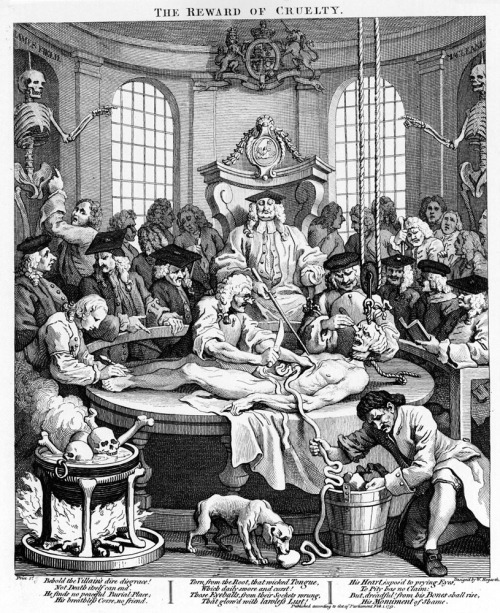
Our preferred method of punishment would be by "dissected and anatomised". Rehabilitation is not up for reconsideration. That's already been shown to be a failed remedy.Plate IV: The Reward of Cruelty by William Hogarth


Section 19 of coinage act of 1792: death penalty for debasing currency

And be it further enacted, That if any of the gold or silver coins which shall be struck or coined at the said mint shall be debased or made worse as to the proportion of the fine gold or fine silver therein contained, or shall be of less weight or value than the same out to be pursuant to the directions of this act, through the default or with the connivance of any of the officers or persons who shall be employed at the said mint, for the purpose of profit or gain, or otherwise with a fraudulent intent, and if any of the said officers or persons shall embezzle any of the metals which shall at any time be committed to their charge for the purpose of being coined, or any of the coins which shall be struck or coined at the said mint, every such officer or person who shall commit any or either of the said offenses, shall be deemed guilty of felony, and shall suffer death. section 19 of coinage act of 1792


The Federal Reserve debased our currency. Take a look at your coinage. See any gold or silver there?

The founders of this nation knew that banks left to themselves, would substitute cheap metal tokens for real money. They had seen it happen in England, and they saw the results; massive unemployment and poverty for the people.

So the Founders created a monetary system based on government-issued currency of fixed real value, for the use of the people without interest. And the United States flourished.

Then the bankers wormed their way back into the system, bought the Congress and a President, replaced the government issued public currency with currency borrowed from their banks at interest... and debased the gold and silver coinage.

By that last act, every member of the Federal Reserve system (and their enablers in Congress and the Treasury) is in violation of Section 19 of the coinage act of 1792.

Source:  section 19 of coinage act of 1792: death penalty for debasing currency

Sunday, December 21, 2014

Ron Paul Child Curriculum: The Story of Liberty, K-12 Online!


K-5 Introduction
Kindergarten Phonics
K-5th Fine Arts
K-5th Math
K-5th Memorization
K-1st Grade Social Studies
2nd-5th Grade History
2nd Grade Literature
3rd Grade Literature
4th Grade Literature
5th Grade Literature

Here, you and your children can get an education in liberty like no other. 

Here, students learn the basics of Western Civilization and Western liberty -- how it was won, how it is being lost, and how it will be restored. (Not can . . . will.)

Students also learn the basics of American history, the United States Constitution, and American geography.

They get two courses on free market economics. They get two courses on government, including a how-to course on reclaiming America, one county at a time.

Students get mathematics, either through calculus or statistics or both. 

They get the basics of science: biology, chemistry, and physics.

I invite parents to take courses and participate on forums -- to get the education they never had. Parents do not pay for the individual courses that they purchase for their children.

When completed and online, the curriculum's first six years -- instructional videos and course materials -- will be free. Some parents will decide to join the site, in order to participate in the K-5 forums, but membership is not mandatory. It is supplemental. On the K-5 timetable, click here.


Friday, November 7, 2014

Greenspan's Stunning Admission: "Gold Is Currency; No Fiat Currency, Including the Dollar, Can Match It"

Tyler Durden's picture


For some reason, the Council of Foreign Relations, where ex-Fed-Chief Alan Greenspan spoke last week, decided the following discussion should be left out of the official transcript. 

We can perhaps understand why... as Gillian Tett concludes, "comments like that will be turning you into a rock star amongst the gold bug community."
 
Greenspan (Uncut):


TETT: Do you think that gold is currently a good investment?
 
GREENSPAN: Yes... Remember what we're looking at. Gold is a currency. It is still, by all evidence, a premier currency. No fiat currency, including the dollar, can macth it.
Which is missing from the official CFR transcript...

GREENSPAN: ...remember, we had that first tapering discussion, we got a very strong market response. And then we reassured everybody to have no -- remember, tapering is still (audio gap) of an agreement that the central banks have made -- European central banks, I believe -- about allocating their gold sales which occurred when gold prices were falling down (audio gap) has been renewed this year with a statement that gold serves a very important place in monetary reserves.

And the question is, why do central banks put money into an asset which has no rate of return, but cost of storage and insurance and everything else like that, why are they doing that? If you look at the data with a very few exceptions, all of the developed countries have gold reserves. Why?

TETT: I imagine right now, it's because of a question mark hanging over the value of fiat currency, the credibility going forward.

GREENSPAN: Well, that's what I'm getting at. Every time you get some really serious questions, the 50 percent of the gold price determination begins to move.

TETT: Right.

GREENSPAN: And I think it is fascinating and -- I don't know, is Benn Steil in the audience?

TETT: Yes.

GREENSPAN: There he is, OK. Before you read my book, go read Benn's book. The reason is, you'll find it fascinating on exactly this issue, because here you have the ultimate test at the Mount Washington Hotel in 1944 of the real intellectual debate between the -- those who wanted to an international fiat currency which was embodied in John Maynard Keynes' construct of a banker, and he was there in 1944, holding forth with all of his prestige, but couldn't counter the fact that the United States dollar was convertible into gold and that was the major draw. Everyone wanted America's gold. And I think that Benn really described that in extraordinarily useful terms, as far as I can see. Anyway, thank you.

TETT: Right. Well, I'm sure with comments like that, that will be turning you into a rock star amongst the gold bug community.
*  *  *
As a reminder, here is Ben Bernanke putting people straight on Gold...
As we noted at the time,

Ron Paul asks the Bernanke if he thought gold was money. Bernanke almost swallows his tongue, stares blankly for a few seconds and then says, “no.”

Paul then asks why banks hold gold on their balance sheet?  Why not diamonds?  Bernanke says, “tradition, I suppose.” 

So let me get this straight, banks hold billions of dollars of an asset that pays no interest or dividends on their balance sheet for reasons of "tradition".  nothing to do with anything else, just tradition.  uh, yea.  That must be it.
via ZH


Monday, October 27, 2014

Once-Peaceful Canada Turns Militaristic – Blowback Follows

by Ron Paul, October 27, 2014 by Ron Paul, October 27, 2014

In 1968 the government of Canada decided to openly admit Americans seeking to avoid being drafted into the US war on Vietnam. Before, would-be immigrants were technically required to prove that they had been discharged from US military service. This move made it easier for Americans to escape President Johnson’s war machine by heading north.

Although a founding member of NATO, Canada did not join the United States in its war against Vietnam. The Canadian government did not see a conflict 7,000 miles away as vital to Canada’s national interest so Canada pursued its own foreign policy course, independent of the United States.

How the world has changed. Canada’s wise caution about military adventurism even at the height of the Cold War has given way to a Canada of the 21st century literally joined at Washington’s hip and eager to participate in any bombing mission initiated by the D.C. interventionists.

Considering Canada’s peaceful past, the interventionist Canada that has emerged at the end of the Cold War is a genuine disappointment. Who would doubt that today’s Canada would, should a draft be reinstated in the US, send each and every American resister back home to face prison and worse?

As Glenn Greenwald pointed out this past week:

Canada has spent the last 13 years proclaiming itself a nation at war. It actively participated in the invasion and occupation of Afghanistan and was an enthusiastic partner in some of the most extremist War on Terror abuses perpetrated by the U.S.

Canada has also enthusiastically joined President Obama’s latest war on Iraq and Syria, pledging to send fighter jets to participate in the bombing of ISIS (and likely many civilians in the process).

But Canada’s wars abroad came back home to Canada last week.
Though horrific, it should not be a complete surprise that Canada found itself hit by blowback last week, as two attacks on Canadian soil left two Canadian military members dead.

Greenwald again points out what few dare to say about the attacks:
Regardless of one’s views on the justifiability of Canada’s lengthy military actions, it’s not the slightest bit surprising or difficult to understand why people who identify with those on the other end of Canadian bombs and bullets would decide to attack the military responsible for that violence.

That is the danger of intervention in other people’s wars thousands of miles away. Those at the other end of foreign bombs – and their surviving family members or anyone who sympathizes with them – have great incentive to seek revenge. This feeling should not be that difficult to understand.

Seeking to understand the motivation of a criminal does not mean that the crime is justified, however. We can still condemn and be appalled by the attacks while realizing that we need to understand the causation and motivation. This is common sense in other criminal matters, but it seems to not apply to attacks such as we saw in Canada last week. Few dare to point out the obvious: Canada’s aggressive foreign policy is creating enemies abroad that are making the country more vulnerable to attack rather than safer.

Predictably, the Canadian government is using the attacks to restrict civil liberties and expand the surveillance state. Like the US PATRIOT Act, Canadian legislation that had been previously proposed to give the government more authority to spy on and aggressively interrogate its citizens has been given a shot in the arm by last week’s attacks.

Unfortunately Canada has unlearned the lesson of 1968: staying out of other people’s wars makes a country more safe; following the endless war policy of its southern neighbor opens Canada up to the ugly side of blowback.

The Ron Paul Institute for Peace & Prosperity

Read more by Ron Paul
·        National Service Is Anti-Liberty and Un-American – October 19th, 2014
·        Liberty, Not Government, Is Key to Containing Ebola – October 12th, 2014
·        The Real Status of Forces in Afghanistan and Iraq – October 5th, 2014
·        Congress Votes for More War in the Middle East – September 21st, 2014
·        Nixon’s Vindication – September 7th, 2014


Wednesday, October 1, 2014

Ron Paul Thinks There Should Be More Secessionist Movements in the U.S.

The former U.S. congressman and perennial presidential candidate tells National Journal that he's "real pleased" with American secessionist groups.

(Photo by T.J. Kirkpatrick/Getty Images)

September 30, 2014 Secessionists across the world were inspired by Scotland's energetic attempt at independence from the United Kingdom earlier this month. Ron Paul, as it turns out, joined them.

In an essay on his eponymous institution's website Sunday, the former U.S. congressman from Texas wrote that any supporters of freedom should cheer secessionism because it allows for smaller government—a constant mantra for the libertarian and perennial presidential candidate, who didn't previously realize there were more than a handful of secessionist groups in the United States.

"I was real pleased with that, and a bit surprised," Paul told National Journal. "But then, on second thought, you think, 'Why not? Why not more?' "

Fringe groups calling for states and regions to secede from the U.S., such as the Second Vermont Republic and the Alaskan Independence Party, gained more publicity in the weeks leading up to the Scottish referendum. As the outsized federal government continues to encroach on individual rights, Paul said, he thinks there will be a groundswell of these movements.

"It's something that I think is going to grow, because the failure of the federal government is going to get much worse," he said. "When the bankruptcy evolves, and maybe some of these pension funds are confiscated, and the wars never end, and bankruptcy comes forth, people [will say], 'Hey, we're getting a bad deal from this. Why don't we leave?' "

He added: "I think it's inevitable people wanting to leave will be there, and the numbers will grow."

Realistically, though, Paul said he doesn't think any of these groups could actually succeed. Despite the founders' own deep belief in secession—they gained America's independence from Europe, after all—he said the Civil War set the precedent that secession would carry "very, very bad" results.

"By our history, the heavy hand of the federal government would come down," Paul told National Journal. "They'd probably shoot 'em."

In typical fashion, Paul argued that the principle of secession was more important than what could actually happen in reality. It's the threat, he said, that's important to keep the federal government in check.

"I think what is most important is we have a concrete right to secede," Paul said. "Even if we never had any secession, or any state declare independence, we would be so much better off, because there would always be this threat. Once the threat of a state leaving was removed, it was just open-door policy for the federal government to expand itself and run roughshod out over the states because the states couldn't do much."

Given that his son, Sen. Rand Paul, R-Ky., will likely run for president in 2016 with a much better chance of winning than his father ever had, the elder Paul's willingness to share his reasonably radical views seem imprudent, if not unexpected. In an election cycle that has often equated the politics of Ron and Rand, this latest remark is sure to annoy the potential 2016-er's supporters.

For Rand's sake, it's fortunate that Ron didn't express his support for the Texas Nationalist Movement or any other secessionist groups in the U.S. Before he'd back Texan independence, he joked, "I better check out and see who's running Austin before we decide about that."

source

Sunday, September 28, 2014

WOW-MUST WATCH! ▶ Ron Paul: What US does now in Middle East will increase violence - YouTube

Great job by RT network.

Published on Sep 28, 2014
On this episode of Breaking the Set, Abby Martin speaks with former Congressman and three-time presidential candidate Ron Paul, discussing his views on the ramifications of expanding the war against ISIS into Syria, how US foreign policy has exacerbated the growth of Islamic extremism, the hypocritical partnership with Saudi Arabia, and the marginalization of alternative views outside of the two party system.


Monday, September 15, 2014

Ron Paul: Will the Swiss Vote to Get Their Gold Back?

Ron Paul

Will the Swiss Vote to Get Their Gold Back?

September 15, 2014
Editorial By Ron Paul

On November 30th, voters in Switzerland will head to the polls to vote in a referendum on gold. On the ballot is a measure to prohibit the Swiss National Bank (SNB) from further gold sales, to repatriate Swiss-owned gold to Switzerland and to mandate that gold make up at least 20 percent of the SNB's assets. Arising from popular sentiment similar to movements in the United States, Germany and the Netherlands, this referendum is an attempt to bring more oversight and accountability to the SNB, Switzerland's central bank.

The Swiss referendum is driven by an undercurrent of dissatisfaction with the conduct not only of Swiss monetary policy, but also of Swiss banking policy. Switzerland may be a small nation, but it is a nation proud of its independence and its history of standing up to tyranny. The famous legend of William Tell embodies the essence of the Swiss national character. But no tyrannical regime in history has bullied Switzerland as much as the United States government has in recent years.

The Swiss tradition of bank secrecy is legendary. The reality, however, is that Swiss bank secrecy is dead. Countries such as the United States have been unwilling to keep government spending in check, but they are running out of ways to fund that spending. Further taxation of their populations is politically difficult, massive issuance of government debt has saturated bond markets, and so the easy target is smaller countries such as Switzerland which have gained the reputation of being "tax havens." Remember that tax haven is just a term for a country that allows people to keep more of their own money than the US or EU does, and doesn't attempt to plunder either its citizens or its foreign account-holders. But the past several years have seen a concerted attempt by the US and EU to crack down on these smaller countries, using their enormous financial clout to compel them to hand over account details so that they can extract more tax revenue.

The US has used its court system to extort money from Switzerland, fining the US subsidiaries of Swiss banks for allegedly sheltering US taxpayers and allowing them to keep their accounts and earnings hidden from US tax authorities. EU countries such as Germany have even gone so far as to purchase account information stolen from Swiss banks by unscrupulous bank employees. And with the recent implementation of the Foreign Account Tax Compliance Act (FATCA), Swiss banks will now be forced to divulge to the IRS all the information they have about customers liable to pay US taxes.

On the monetary policy front, the SNB sold about 60 percent of Switzerland's gold reserves during the 2000s. The SNB has also in recent years established a currency peg, with 1.2 Swiss francs equal to one euro. The peg's effects have already manifested themselves in the form of a growing real estate bubble, as housing prices have risen dangerously. Given the action by the European Central Bank (ECB) to engage in further quantitative easing, the SNB's continuance of this dangerous and foolhardy policy means that it will continue tying its monetary policy to that of the EU and be forced to import more inflation into Switzerland.

Just like the US and the EU, Switzerland at the federal level is ruled by a group of elites who are more concerned with their own status, well-being and international reputation than with the good of the country. The gold referendum, if it is successful, will be a slap in the face to those elites. The Swiss people appreciate the work their forefathers put into building up large gold reserves, a respected currency and a strong, independent banking system. They do not want to see centuries of struggle squandered by a central bank. 

The results of the November referendum may be a bellwether, indicating just how strong popular movements can be in establishing central bank accountability and returning gold to a monetary role.

This article provided courtesy of the Ron Paul Institute for Peace and Prosperity.

via thedailybell

Sunday, September 14, 2014

Ron Paul's 'Audit the Fed' bill returns to Congress

Former Republican congressman 
Ron Paul of Texas. (Associated Press)
By Stephen Dinan - The Washington Times - Saturday, September 13, 2014

Ron Paul may not be in Congress anymore, but his “Audit the Fed” bill lives on after him.

House Republican leaders scheduled a vote on the legislation for sometime in the next week, as one of a series of pre-election bills designed to highlight lawmakers’ stances just before they go home to face voters.

Mr. Paul made the bill one of his causes, and after years of trying finally pushed it through the House in 2012 on an overwhelming 327-98 vote. But Senate Majority Leader Harry Reid, who had previously said he supported an audit of the Federal Reserve, reversed himself.

“If Harry Reid refuses to hold the vote before the Senate leaves town, you can help us make sure the American people hear about it all the way until Election Day and build so much pressure by the time Congress returns, the Senate will be forced to act in the Lame Duck,” Mr. Paul said in an email to supporters from his advocacy group, Campaign For Liberty.

Mr. Paul retired from the House after the last Congress. The current House version of the legislation is sponsored by Rep. Paul Broun, a Georgia Republican. His version cleared the House oversight committee on a voice vote in July, suggesting continued bipartisan support.

The bill would order the Government Accountability Office, which is Congress’s chief investigative arm, to review the Fed’s decision-making — particularly on monetary policy.

Congress established the Federal Reserve nearly a century ago. The system, which consists of a board of governors and 12 regional banks, act as lenders of last resort to the country’s banking system, and it is charged both with fighting inflation and with promoting economic growth and employment.

The Congressional Budget Office said the bill would cost about $5 million for the staff required to conduct the audit. The CBO also said the Federal Reserve would spend money complying with the review, which would end up costing the government about $3 million in lower revenue from the Fed over the next decade.

The previous chairman of the Federal Reserve, Ben Bernanke, had opposed an audit, saying it could lead to politicians second-guessing the secretive board’s decisions. When Mr. Paul’s bill came up for a vote in 2012, Mr. Bernanke called it a “nightmare scenario.”

Mr. Paul’s son, Sen. Rand Paul, Kentucky Republican, has a companion bill in the Senate, but that has not seen any action with Democrats controlling the chamber.

Despite Democratic leaders’ opposition, a number of rank-and-file Democrats support the legislation.

Indeed, 19 Democrats in the House are co-sponsors of Mr. Broun’s bill, while in the Senate, Sen. Mark Begich, Alaska Democrat, is a co-sponsor. Mr. Begich even bragged about his support for the legislation in a recent Senate campaign debate.

Kucinich praises Ron Paul’s ‘diligence’ in supporting Federal Reserve audit bill