An ethical person - like a politician, banker or lawyer - may know right from wrong, but unlike many of them, a moral person lives it. An Americanist first already knows that.
Bankers and their government agents will always act in their own best interests. Any residual benefit flowing down to the citizens by happenstance will just be litter.
Haven't we all on at least one occasion been puzzled how we (the people) could lose such a vote in our legislature? It had been a slam-dunk we'd thought.
Well, here's your answer, and you won't like it. Washington's corporate corruption has run down hill, and now in our backyard - - many made possible by taxpayer-subsidized IRS non-profit tax-exempt charters! How could anyone miss their own foot from a range that close!
Business interests among the top 50 donors were almost always successful, winning 96 percent of the time.
Four
out of every five dollars that the top contributing business groups
gave to ballot measure fights went to the sides trying to defeat the
proposals.
~~~~~~~~~~~~~~~~~~~~~~~~~~~~~~~~~~~~~~~~~~~~~~~~~~ Here's a California example. Some of the individual state corporate donors follow at bottom...
Feb. 5, 2015
Anthem Inc. quickly mounted its defenses when consumer advocates pushed for a 2014 ballot initiative in California that would have made it more difficult for the nation’s third largest health insurer to raise rates.
The company, based in Indianapolis, Ind., shelled out $12.8 million to back television ads and a website that warned voters the measure would “give one politician too much power,” “create more bureaucracy” and “interfere with your treatment options.”
Anthem’s money, combined with millions from other interested parties, swamped efforts by Consumer Watchdog, the advocacy group that spent four months gathering the signatures to put Proposition 45 on the ballot. Opponents of the bill together gave more than $31.5 million — dwarfing supporters’ $2.6 million.
In November, Anthem and the other big business interests won at the polls, with nearly 59 percent of the vote.
Anthem, formerly known as WellPoint, was the second-biggest donor to groups fighting over ballot measures in the nation last year, according to a Center for Public Integrity analysis. The donors gave the money to political committees that advocated for or against the propositions. The health insurer did not respond to requests for comment.
Anthem’s victory on Proposition 45 was part of a pattern that played out across the country: Business interests poured money into ballot question fights, largely to protect their own revenue, with overwhelmingly positive results.
“There’s no question that when business or corporations or entities that are affected by ballot initiatives give to the ballot initiative process, they're not doing so out of altruism," said Joe Tuman, a professor of political and legal communications at San Francisco State University. "They’re doing so out of rational self-interest."
As if the tyranny of Washington, DC wasn't too much, now we've got the states kicking us in the junk, where else, but.....Yankee-occupied FLORIDA!
March 9, 2014 by Arjun Walia
Robin Speronis lives off the grid in Florida, completely independent of the city’s water and electric system. A few weeks ago, officials ruled her off-grid home illegal.
Officials cited the International Property Maintenance Code, which mandates that homes be connected to an electricity grid and a running water source.
That’s like saying our dependency on corporations isn’t even a choice. The choice to live without most utilities has been ongoing for Robin, the self-sufficient woman has lived for more than a year and a half using solar energy, a propane camping stove and rain water.
In the end, she was found not guilty of not having a proper sewer or electrical system; but was guilty of not being hooked up to an approved water supply.
Speronis is still being hassled by the municipality of Cape Coral for not having a connection to city water, nor proper sewage. That. regardless of the fact the city capped her sewers themselves.
Is Off-Grid Really Illegal?
Robin Speronis during a news interview.
In essence yes. To live off the grid means to not have to hook up to any corporate or municipal utilities. If a municipality makes it illegal to disconnect from any given utility, they are in essence making off grid living illegal.
“It means living independently, mainly living independently of the utility companies. Providing your own power. It does not mean living in the stone age, it’s not about bush craft. It’s about generating your own power, your own water, dealing with your own waste. Probably as part of a community, not living on your own like a hermit. It’s also about being more self-reliant and being less dependent on the system. Perhaps realizing that the system isn’t really protecting us anymore and we have to look after ourselves.” – George Noory
Exploring Our Potential Beyond The Grid
Our potential as a human race is quite extraordinary, we just don’t realize it. Sustainable living is not about giving up a certain lifestyle. We can still have all the modern amenities, design and beyond. We simply need to transition from one way of seeing housing to another.
One potential issue with off the grid living is that corporations will lose their ability to control others with their utility. This could be the type of political and corporate agreements that give people like Speronis issues to begin with.
“One of the saddest lessons of history is this: If we’ve been bamboozled long enough, we tend to reject any evidence of the bamboozle. We’re no longer interested in finding out the truth. The bamboozled has captured us. It’s simply too painful to acknowledge, even to ourselves, that we’ve been taken. Once you give a charlatan power over you, you almost never get it back.” – Carl Sagan
Moving Away From Dependence
The human race does not need to be dependent on these corporations for basic needs in the manner we have now. While we continue to feed this dependency, the planet continues to suffer. In order to move forward, we must start cooperating with each other, and realize just how much potential we have to create something we can take into our own hands and do sustainably. We can’t wait for these corporations to come up with solutions as they will likely be very profit oriented.
Another Case of State Hassle
Earlier this year, Texas state brought several SWAT teams to a sustainable community and threatened to shut it down. Each one of the community members were initially handcuffed at gunpoint. It was called “The Garden of Eden Community,” and was totally self sustainable. You can read more about that here.
In the battle of controlling federal tyranny, state legislatures play a key role. The states have the responsibility of protecting its citizens from the overreaches of an unconstitutional federal government. And they have a number of tools at their disposal.
But getting the state legislature to stand up for the citizens usually requires some level of education on your part. First of all, legislators need to understand the federal government is limited in its role as spelled out in the Constitution. For instance, the responsibilities of the Congress, as originally delegated to it by the states in 1787, are housed in Article I, Section 8. According to the 10th Amendment, responsibilities outside of these limits are reserved to the states or the people.
With that simple understanding, state legislators should work toward countering Congress each time it ventures outside of its constitutional limitations. Unfortunately, states do not have a great history of standing up to the federal government. If they did, states would not be as financially dependent upon the federal government as 2012 Census data demonstrates: "State Budget Solutions found that all state governments combined received 31.6 percent of their general revenue from the federal government in 2012."
Realize that the role you play locally and in your state is much more important than any federal election will ever be. Right now, JBS members and supporters are working in each state to stop legislation antithetical to freedom. They are also educating legislators on their role and working to recruit others. If you're not involved, do so today! At the very least, start by signing up for our legislative alerts, so you can send your elected state and federal officials emails about what they should be supporting.
We have been closely monitoring states that are introducing resolutions to ask Congress to call a constitutional convention. Email alerts have been sent out to those in affected areas. Be sure to let your legislators know of your support for keeping the Constitution as written, instead of opening it up for rewrite. As history has proven, constitutional conventions cannot be controlled.
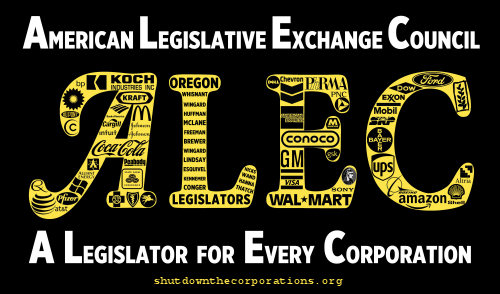
Not only should ALEC have their IRS tax-exempt charter withdrawn, but likewise for their enemies, "Common cause", for instance, as well as all other "charities..... churches, synagogues & mosques included. Are your state elected reps on the list? See ALEC's tax filing Form 990. See the corporate membership list posted by "Source Watch"., a project of the tax-exempt Center for Media & Democracy which describes its charity as "receiving substantial funds from a government unit." CMD is closely aligned with leftist Amy Goodman's DemocracyNow! , also a tax-exempt entity.
Praise the Lord for creating West Virginia even if it was a Yankee stronghold in the 19th century.
A bill introduced in the West Virginia House of Delegates this week would block unconstitutional foreign deployments of the state’s national guard troops, effectively restoring the Founders’ framework for state-federal balance on the Guard.
House Bill 2168 (HB2168), the Defend the Guard Act, was introduced by Del. Pat McGeehan (R-Hancock, 1), a former Air Force intelligence officer who did tours in Afghanistan and the Middle East, and cosponsored by ten other delegates. If passed, the bill would block the federal government from deploying West Virginia Guard troops overseas unless there is a declaration of war from Congress, as required by the Constitution.
“This bill essentially says, ‘If you don’t follow the highest law of the land, then we will withhold our Guard troops.’ The language and intent of the Constitution is so clear on this one issue,” McGeehan told the Wheeling News-Register.
Guard troops have played significant roles in all modern overseas conflicts, with over 650,000 deployed since 2001. More specifically, West Virginia National Guard troops have participated in missions in Iraq, Afghanistan, Libya, Kosovo and elsewhere.
Since none of these missions have been accompanied by a Constitutional declaration of war, the Defend the Guard Act would have prohibited the deployments. Such declarations have only happened five times in U.S. history, with the last being in World War II.
BACKGROUND
Article I, Section 8, Clauses 15 and 16 make up the “militia clauses” of the Constitution. Clause 16 authorizes Congress to “provide for organizing, arming, and disciplining, the Militia.” In the Dick Act of 1903, Congress organized the militia into today’s National Guard, limiting the part of the militia that could be called into federal service rather than the entire body of people. Thus, today’s National Guard is governed by the “militia clauses” of the Constitution, and this view is confirmed by the National Guard itself.
Clause 15 delegates to the Congress the power to provide for “calling forth the militia” in three situations only: 1) to execute the laws of the union, 2) to suppress insurrections, and 3) to repel invasions.
During state ratifying conventions, proponents of the Constitution, including James Madison and Edmund Randolph, repeatedly assured the people that this power to call forth the militia into federal service would be limited to those very specific situations, and not for general purposes, like helping victims of a disease outbreak or engaging in “kinetic military actions.”
“Defending one side or the other in a Middle East civil war doesn’t qualify as ‘repelling an invasion,’” said Mike Maharrey, national communications director for the Tenth Amendment Center. “The Founders didn’t trust presidents on war, and one way they insisted on balancing that power was by keeping a strong military force at home, in the states.”
RETURNING TO THE CONSTITUTION
It is this limited Constitutional structure that advocates of the Defend the Guard Act seek to restore. That is, use of the Guard for the three expressly-delegated purposes in the Constitution, and at other times to remain where the Guard belongs, at home, supporting and protecting their home state.
“For decades, the power of war has long been abused by this supreme executive, and unfortunately our men and women in uniform have been sent off into harm’s way over and over,” said McGeehan. “If the U.S. Congress is unwilling to reclaim its constitutional obligation, then the states themselves must act to correct the erosion of constitutional law.”
Maharrey agreed. “While getting this bill passed isn’t going to be easy, it certainly is, as Daniel Webster once noted, one of the reasons state governments even exist.”
Referenced by Maharrey was an 1814 speech on the floor of Congress where Webster urged similar actions to McGeehan’s Defend the Guard Act. He said, “The operation of measures thus unconstitutional and illegal ought to be prevented by a resort to other measures which are both constitutional and legal. It will be the solemn duty of the State governments to protect their own authority over their own militia, and to interpose between their citizens and arbitrary power. These are among the objects for which the State governments exist.”
NEXT UP
HB2168 has been assigned to the House Veterans’ Affairs Committee. It will need to pass by a majority vote before being sent to the House Judiciary Committee. Should it pass that stage, the full House will have an opportunity to consider whether to send the bill over to the state Senate.
ACTION STEPS
In West Virginia, support this bill by following all the action steps at THIS LINK
All other states, contact your state rep and senator, urging them to introduce legislation similar to HB2168. Find their contact info here.
(Reagan Ali) Most
of the nation is unaware of it, but there are two states which will
take your driver’s license away if you do not pay your student loans.
Alums in both Montana and Iowa, face laws that allow the state to revoke driver’s licenses if the individual is unable to pay back their loans.
This has obvious consequences for potential employment, as well as
childcare, creating a downward spiral of self-perpetuating poverty.
The Montana Department of Justice says that those who default on
their student loans face “indefinite suspension until student loan
association notifies Motor Vehicle Division of compliance.”
The Department of Motor Vehicles in Iowa parallels this legislation
almost identically. The law says that the State will “suspend a person’s
driver’s license upon receiving a certificate of noncompliance from the
College Student Aid Commission in regard to the person’s default on an
obligation owed to or collected by the commission.”
But the group Jobs With Justice notes that in October 2010, there were also 42 nurses in Tennessee who similarly had their licenses suspended for nothing other than falling behind on their student loans.
The irony of all of this is that taking away the ability to drive
makes student loan defaulters even more certain to fall behind on
payments.
In effect, this is little different than debtors prison, which, in a
misguided effort to deter loan default, actually perpetuates it.
New York City, New York – According to multiple reports, Judge Katherine Forrest has threatened to impose a secret jury in the case of accused Silk Road operator Ross Ulbricht, in response to jury nullification outreach that has been taking place outside the courtroom all week.
For those who don’t know, jury nullification is basically the right for any juror to not only judge the facts of the case, but to also actually judge the validity of the law itself. This means that if a jury feels that a defendant is facing an unjust charge, they actually have the right to rule in the defendant’s favor, even if they are technically guilty under the court’s standards.
However, authorities in the court system prefer that this fact is unknown by jurors, so they can continue to persecute people for nonviolent, victim-less crimes. In the case of Ross Ulbricht, Judge Forrest has went through great lengths to see that the jury will not be fully informed about their rights to judge the legitimacy of the law.
Not only has the judge dismissed a number of jurors because they were made aware of jury nullification, but she has also now threatened to impose a secret jury if activists don’t stop their jury outreach.
According to jury rights activist James Babb, “Basically, she decreed that if the independent volunteers didn’t stop informing jurors of their right to nullify unjust and misapplied laws, she would “annonymize” the jury, bussing them in from a secret location, blocking their contact from the outside world. Of course, the jurors won’t be told that they are being “protected” from a 100% factual pamphlet about their indisputable rights. Instead, they will thank the judge for protecting them from a dangerous crime boss.”
Sadly, the activists are now left with very few options to inform jurors of their full legal rights.
“After careful consideration, we have decided to postpone the pamphleting operation until the hostage is recovered safely. However, the offending judge will not be forgotten. She will become accustomed to dealing with informed jurors. We will not be intimidated. We will not abandon our mission. Forrest’s grumpiness confirms what we already knew. They are scared of the truth. They fear for their house of cards,” Babb said.
Derrick Broze was on location for The Liberty Beat and reported that “Day two of the Ross Ulbricht trial began on Wednesday morning with the prosecution continuing to question DHS agent and apparent Silk Road mole Jared Deryeghiayan. Lead prosecutor Serrin Turner presented several screenshots related to criminal activity on the Silk Road. He asked Deryeghiayan to explain each exhibit and how it related to illegal activity, including the purchase of illicit drugs and fraudulent documents.”
“While it has been demonstrated that drugs were in fact trafficked through the Silk Road, charges of conspiracy to traffic in hacking software and stolen passports have yet to be substantiated by the government. Even if the prosecution proves that drugs, fraudulent documents, and hacking software/services were in fact trafficked through Silk Road, they must still demonstrate that at the time of the alleged illegal activity, Ulbricht was acting as Dread Pirate Roberts, the Silk Road administrator,” he added.
John Vibes is an author, researcher and investigative journalist who takes a special interest in the counter culture and the drug war. In addition to his writing and activist work he is also the owner of a successful music promotion company. In 2013, he became one of the organizers of the Free Your Mind Conference, which features top caliber speakers and whistle-blowers from all over the world. You can contact him and stay connected to his work at his Facebook page. You can find his 65 chapter Book entitled “Alchemy of the Timeless Renaissance” at bookpatch.com.
It worked during slave times. Can it also save Ross Ulbricht from going to jail?
If you happen to be lurking around the Manhattan courthouse where Ross Ulbricht’s trial began on Tuesday, you may notice one of about a dozen signs urging you to Google something called “jury nullification.”
Ads near the courthouse where the Silk Road trial is taking place aimed at informing people about jury nullification.
Walk a little further, and you may just encounter activists handing out jury nullification leaflets. But if you ask them to explain what it is, they may refuse—because doing so could land them in jail.
Jury nullification is one of the oldest legal concepts in the world. It means that jury members have the right to find a defendant innocent, even if they believe he’s guilty of the crime with which he’s charged. They would do so, theoretically, if they believed the crime shouldn’t actually be labeled a crime. Some of the most famous examples came in the mid-1800s, when Northern abolitionists, sitting on juries, refused to convict slaves for fleeing their masters under the Fugitive Slave Act.
More recently, a jury in New Hampshire acquitted a man in 2012 who openly admitted that he was growing marijuana in his backyard. “He grows for his own personal religious and medicinal use,” one of the jurors said after the case. “[A]fter chewing on all of the possibilities…we all decided that the only fair thing to do was to vote with our consciences and acquit the defendant of all charges.”
Jury nullification has become a popular tactic among activists, academics and lawyers as the government’s $51 billion-per-year drug war has heated up. Many of these people believe it’s crazy that a person can get thrown in the slammer for 10 or 20 years simply for using or selling drugs.
Some of these same people believe that Ulbricht, who is accused of being the mastermind behind the drug site Silk Road, should be set free regardless of his guilt—because simply operating a website shouldn’t land you in prison. Nicholas J. Sarwark, chair of the Libertarian National Committee, the official group that manages the United States Libertarian Party, called on Tuesday for outright dismissal of the charges against Ulbricht, saying that trial “grossly oversteps the bounds of a properly limited government.”
This week, I spoke with James Babb, the activist who raised the money for the jury nullification ads—and who is personally handing out leaflets at the New York City courthouse. “I’m reminding people that you’ve got a conscience—use it, don’t just rubber-stamp the prosecution,” he says.
Babb won’t explicitly say he’s there for the Silk Road trial. He’s cagey because jury nullification activists have a history of being sent to jail for jury tampering. Perhaps the most famous case came in 2011, when an 80-year-old retired chemistry professor named Julien Heicklin was jailed for standing outside a Manhattan court where he distributed jury nullification pamphlets.
Julien Heicklin, a retired chemistry professor, handing out leaflets.
YouTube
Heicklin, whom Babb calls his personal hero, was eventually acquitted, with the judge remarking that it’s only jury tampering if someone tries “to influence a juror’s decision through a written communication ‘made in relation to a specific case pending before that juror.'”
To make sure that no jury nullification activists breaks jury tampering laws, the Fully Informed Jury Association has recently put out several guidelines. They include:
Stick to the public sidewalk in front of the courthouse.
Offer literature to everyone without regard to who they are and do not try to single out jurors in any way.
Go the extra mile to be friendly and courteous, and to avoid being perceived as belligerent, profane, harassing or a nuisance.
Anticipation has built for months around the Silk Road trial. Earlier this week, I wrote about the prosecution’s task of connecting Ross Ulbricht, a real person, with the anonymous online persona “Dread Pirate Roberts” that ran Silk Road.
The trial began Tuesday, and right off the bat, there was a surprising twist: The defense now readily admits that Ulbricht founded Silk Road, though they claim he passed off the keys to the site to someone else before it gained popularity.
And jury nullification has already gotten a mention at the Silk Road trial. The prosecution has tried to ban any evidence regarding Ulbricht’s personal political beliefs, saying it would “serve only to invite jury nullification.” The prosecutors are afraid that the jurors would become sympathetic to Ulbricht’s libertarian beliefs and view him merely as an entrepreneur who operated an e-commerce website—not a drug kingpin.
To be clear, the odds of Ulbricht being acquitted because of jury nullification are slim. He has a better chance of walking free if his defense can successfully prove that he wasn’t operating the site when most of the drug deals were going down.
Regardless, jury nullification is what Babb and his cohorts (there are about six of them in total) are fighting for, even if they walk a fine line when talking about it. Right now, they’re allowed to stand on the sidewalk and hand out their pamphlets, but if the Silk Road jurors ever walk up to them, the activists will refuse to speak to them. “Just to be on the safe side, I wouldn’t want to talk to them,” Babb says. “I’d say there’s an 800 number to call.”
As it's becoming apparent our country is being overrun, it's time for state governors to adorn a mantel of responsibility for the safety of their citizens. Order home the national guards from foreign deployment, establish operational relationships as well with their respective State Defense Force. Expel federal troops, ICE, Homeland, and nuisance agencies from state sovereign land.
Nullification is the people's tool - use it!
Afterall, if the federal government is incapable, or criminally deliberate in disrupting our society, culture, sovereignty and economics, let the people participate in their own defense!
The Georgia State Defense Force’s rich heritage dates
back to England. Under the direction of General James Edward Oglethorpe,
Sergeants of the Guard trained future colonists in militia tactics. Georgia
settlers arriving in 1733 became members of General Oglethorpe’s militia.
These militia forces later joined General George Washington to secure
American Independence.
The volunteer militia remained in continuous service throughout the 1700’s
and 1800’s. During the War Between the States Georgia responded with over
100 volunteer regiments, battalions, and batteries. This volunteer
commitment was second only in number to the State of Virginia.
During World War II, the 8,000 members of the volunteer militia force
guarded war plants, critical communications facilities, utilities,
reservoirs, and transportation facilities. Although not officially
disorganized until 1951, the Georgia State Guard began its retirement in
July 1946. The Georgia State Defense Force was re-authorized in 1973.
Today, the Georgia State Defense Force is authorized under the Official Code
of Georgia, Title 38. The Georgia Department of Defense is comprised of the
Army National Guard, the Air Guard and the State Defense Force, all of whom
serve under the direction of the Adjutant General of Georgia. Source
State Defense Force
From Wikipedia, the free encyclopedia
This article is about defense forces of individual states of the United States of America. For defense forces of states countries and nations, see military.
State defense forces: army units highlighted in red, naval units in blue, those with both in green, inactive in purple.
State defense forces (SDF) (also known as state guards, state military reserves, or state militias) in the United States are military units that operate under the sole authority of a state government; they are partially regulated by the National Guard Bureau but they are not a part of the Army National Guard of the United States.[1] State defense forces are authorized by state and federal law and are under the command of the governor of each state.
State defense forces are distinct from their state's National Guard in that they cannot become federal entities (all state National Guard personnel can be federalized under the National Defense Act of 1933 with the creation of the National Guard of the United States).[2] The federal government recognizes state defense forces under 32 U.S.C.§ 109 which provides that state defense forces as a whole may not be called, ordered, or drafted into the armed forces of the United States, thus preserving their separation from the National Guard. However, under the same law, individual members serving in the state defense force are not exempt from service in the armed forces (i.e., they are not excluded from the draft). Under 32 USC § 109(e), "A person may not become a member of a defense force . . . if he is a member of a reserve component of the armed forces."
Nearly every state has laws authorizing state defense forces, and 22 states, plus Puerto Rico, have active SDFs with different levels of activity, support, and strength. State defense forces generally operate with emergency management and homeland security missions. Most SDFs are organized as army units, but air and naval units also exist.[3][4]
Origins
From its founding until the early 1900s, the United States maintained only a minimal army and relied on state militias to supply the majority of its troops.[5] As a result of the Spanish-American War, Congress was called upon to reform and regulate the training and qualification of state militias. In 1903, with passage of the Dick Act, the predecessor to the modern-day National Guard was formed. It required the states to divide their militias into two sections. The law recommended the title "National Guard" for the first section, known as the organized militia, and "Reserve Militia" for all others.[6]
During World War I, Congress authorized the states to maintain Home Guards, which were reserve forces outside the National Guards being deployed by the Federal Government. The Secretary of War was authorized to furnish these units with rifles, ammunition, and supplies.[7]
In 1933, Congress finalized the split between the National Guard and the traditional state militias by mandating that all federally funded soldiers take a dual enlistment/commission and thus enter both the state National Guard and the newly created National Guard of the United States, a federal reserve force. In 1940, with the onset of World War II and as a result of its federalizing the National Guard, Congress amended the National Defense Act of 1916, and authorized the states to maintain "military forces other than National Guard."[8] This law authorized the War Department to train and arm the new military forces that would come to be known as State Guards. Many states took advantage of this law and maintained distinct state military forces throughout the war to defend their own territories, shorelines, and airspaces.
State nullification actions have fallen behind in these states. Additionally, state representatives have surrendered much of your sovereign land to the tyranny in Washington:
Even though self-proclaimed socialists make up only a tiny minority
of the American population, there are some states that can be safely
described as more “socialist” than others. That’s according to the financial website The Street, which
put together a list of the 10 most and least “socialist” states in the
United States – and some of the results are surprising. By “socialist,”
the website meant that a large percentage of the state’s economy is
under government control. “In order to measure the degree to which different states reflect
socialist principles, we determined state expenditures and state GDP as
the best indicators because socialist states tax and spend a higher
percentage of their GDP,” the website said. The simple formula divided the state’s expenditures by the state’s GDP. Disagree with the list? Let us know in the comments section. 1. West Virginia. Government expenditures made up
34.1 percent of the state’s gross domestic product. That means more than
three of every 10 dollars spent in West Virginia is spent by the
government. Additionally, West Virginia was No. 2 on Forbes’ list of the
10 poorest states in the US. 2. Alaska. Don’t tell Sarah Palin, but the final
frontier is heavily subsidized by government. Government spending
accounted for around 23.6 percent of the state’s gross domestic product. 3. Wyoming. So, the Cowboy State is not a bastion of
rugged individualism? Government expenditures made up 21.8 percent of
the state’s gross domestic product. The federal government owns most of
the land in sparsely populated Wyoming. New Mini Pocket Power Plus Can Charge All Your Electronics — And Jump Start Your Car! 4. Mississippi. Forbes’ choice as America’s poorest state is also the fourth-most “socialist” state in the US, according to The Street.
Government spending makes up 20 percent of the state’s economy. The
state had a poverty rate of 24 percent and an average household income
of $37,963 a year in 2013. 5. Arkansas. The nation’s eighth poorest state
ranked No. 5. Government spending makes up 18.6 percent of the state’s
gross domestic product. As in West Virginia and Mississippi, a high poverty rate of 19.7 percent makes for low incomes and a high level of welfare dependence. 6. Vermont. The state’s best-known politician is
independent US Senator Bernie Sanders, who describes himself as “a
democratic socialist.” Vermont also flirted with the idea of a single
payer health care system but dropped it because of high costs last year.
Even without that experiment, 17.9 percent of Vermont’s gross domestic
product consists of government spending. 7. New Mexico. A high percentage of government land
ownership, a high poverty rate, and large military bases make for a
large government economic presence. Around 17.2 percent of the state’s
domestic product was made up of government expenditures. New Mexico is
also the nation’s fifth poorest state, with 21.9 percent of the
population living below the poverty line in 2013. 8. Hawaii. Hawaii has a high level of government
involvement in the economy because geographic isolation limits economic
opportunity. Around 16.5 percent of the state’s gross domestic product
consisted of government spending. 9. Rhode Island. A stagnant economy and industrial
decline make for a poverty rate and a lot of welfare dependence in the
nation’s smallest state. Around 16.3 percent of Rhode Island’s gross
domestic product is comprised of government spending. 10. Wisconsin. America’s Dairyland has long had a reputation as a bastion of progressivism and high taxes. It is also the 10th most “socialist” state in the nation according to The Street,
with 16.2 percent of its GDP consisting of government spending. An
economy that is heavily dependent on agriculture and health care
accounts for the high level of government in the state. It also ranks
fourth in American in property taxes. If you were wondering about the 10 least “socialist” states, they are: