Search Blog Posts

Showing posts with label Manipulation. Show all posts

Tuesday, March 31, 2015

What’s Wrong With Silver?

Which silver?  Paper silver or real silver?


Silver prices are largely set on the COMEX futures – paper silver.  

A company can post the margin and sell short thousands of contracts with no actual metal available thereby creating artificial supply.  The reverse occurs when some company buys thousands of contracts.  It is a paper game, but unfortunately it has tremendous influence on the price of real silver.

What’s wrong with paper silver?  Paper silver has been aggressively sold and that pushes prices down – just the opposite of what occurred between 2009 and April 2011.  What is wrong with paper silver is … probably nothing.  Buyers and sellers do their thing, sometimes in fractions of a second, and they define a price for paper.

What’s wrong with physical silver?  The usual – the paper markets set the price for the physical markets and drive prices to unsustainable highs and lows.  We are currently at the low end of the cycle.

How do we know the price is low and due to turn up?  Of course we have no guarantee (my crystal ball is being repaired) but we can look at the demand and charts.  Steve St. Angelo publishes excellent analysis on physical supply and demand for silver.  Read his many articles, but a summary is:  silver supply is weak and global investment demand is strong, especially at these prices.

The silver to gold ratio shows a clear pattern for the past 44 years.  When silver prices are low so is the ratio, and when the ratio is high, look out below.  Silver moves higher faster than gold and crashes more quickly, hence the volatility in the ratio.  Examine the (smoothed) chart for the past 10 years as an example.  The ratio is now quite low and so is the price of silver.  History shows that exponentially increasing debt creates exponential increases in consumer prices, currency in circulation, and gold prices.  Debt will increase – this is as certain as tomorrow’s sunrise – and gold prices will also increase, albeit erratically.

Silver to Gold Ratio
Other analysts suggest gold and silver have not reached their final lows.  They may be correct in the short-term (not my take), but in the long-term, prices for both metals will go substantially higher.  

Examine the monthly log scale chart of silver.
Silver Monthly
Note the massive correction in prices, and the deeply oversold (monthly) condition of the RSI (Relative Strength Indicator) and the TDI.  Prices have been ready to turn up for several months.  Prices may not rally this week but they will soon.  Stacking silver is good insurance.

What could go wrong with our political and financial systems that might assist silver prices?

The US recently sent 3,000 troops and 750 tanks and other military vehicles to Latvia on the Russian border.

Russia Starts Nationwide Show of Force:”  45,000 Russian troops plus war planes and submarines are performing military drills.

Over 20 central banks have reduced interest rates in the past few months.  They are not reducing interest rates because their economies are strong.  Hint:  more QE.

Great Britain joined the Chinese backed Asian Infrastructure Investment Bank, clearly in opposition to US interests.  Germany, France and Italy did the same.  US influence is declining and Chinese and Russian military and economic influence is rising.  

How long will the dollar be the ONLY reserve currency in the world?  When those excess dollars flood back to the US, after they are no longer needed elsewhere, how much inflation will that create for the U.S.?

Economic wars and hot military wars increase debt and commodity prices.  Gold and silver will see another rally, probably one that surprises almost everyone.

Gary Christenson
The Deviant Investor

FRAUD CENTRAL: Government Corruption Big Time

Government Corruption Has Become Rampant

The Cop Is On the Take

Government corruption has become rampant:
  • Senior SEC employees spent up to 8 hours a day surfing porn sites instead of cracking down on financial crimes
  • NSA spies pass around homemade sexual videos and pictures they’ve collected from spying on the American people
  • Investigators from the Treasury’s Office of the Inspector General found that some of the regulator’s employees surfed erotic websites, hired prostitutes and accepted gifts from bank executives … instead of actually working to help the economy
  • The Minerals Management Service – the regulator charged with overseeing BP and other oil companies to ensure that oil spills don’t occur – was riddled with “a culture of substance abuse and promiscuity”, which included “sex with industry contacts
  • Agents for the Drug Enforcement Agency had sex parties with prostitutes hired by the drug cartels they were supposed to stop
  • The former chief accountant for the SEC says that Bernanke and Paulson broke the law and should be prosecuted
  • The government knew about mortgage fraud a long time ago. For example, the FBI warned of an “epidemic” of mortgage fraud in 2004. However, the FBI, DOJ and other government agencies then stood down and did nothing. See this and this. For example, the Federal Reserve turned its cheek and allowed massive fraud, and the SEC has repeatedly ignored accounting fraud. Indeed, Alan Greenspan took the position that fraud could never happen
  • Paulson and Bernanke falsely stated that the big banks receiving Tarp money were healthy, when they were not. The Treasury Secretary also falsely told Congress that the bailouts would be used to dispose of toxic assets … but then used the money for something else entirely
  • Warmongerers in the U.S. government knowingly and intentionally lied us into a war of aggression in Iraq.  The former head of the Joint Chiefs of Staff – the highest ranking military officer in the United States – said that the Iraq war was “based on a series of lies”. The same is true in Libya and other wars
  • The Bush White House worked hard to smear CIA officersbloggers and anyone else who criticized the Iraq war
The biggest companies own the D.C. politicians.  Indeed, the head of the economics department at George Mason University has pointed out that it is unfair to call politicians “prostitutes”.  They are in fact pimps … selling out the American people for a price.

Government regulators have become so corrupted and “captured” by those they regulate that Americans know that the cop is on the take.   Institutional corruption is killing people’s trust in our government and our institutions.

Indeed, America is no longer a democracy or republic … it’s officially an oligarchy.

The allowance of unlimited campaign spending allows the oligarchs to purchase politicians more directly than ever.    Moreover, there are two systems of justice in Americaone for the big banks and other fatcats, and one for everyone else.

But the private sector is no better … for example, the big banks have turned into criminal syndicates.
Liberals and conservatives tend to blame our country’s problems on different factors … but they are all connected.

The real problem is the malignant, symbiotic relationship between big corporations and big government.

Source

Friday, March 27, 2015

New York Post Expose: Stock Market Rigging Hits the Mainstream

 
STAFF NEWS & ANALYSIS

March 27, 2015
    Stock market rigging is no longer a 'conspiracy theory' ... The stock market is rigged. When I started making that claim years ago — and provided solid evidence — people scoffed. Some called it a conspiracy theory, tinfoil hats and that sort of stuff. Most people just ignored me. But that's not happening anymore. The dirty secret is out. – Justohn Crudele/New York Post

    Dominant Social Theme: The good times are back. Just look at the stock market.
    Free- Market Analysis: The stock market has moved down hard these past few days and perhaps there is more to come. The moves allowed the New York Post's John Crudele to readdress a favorite topic of his, which is market-rigging in the US and abroad.

    His most recent article seems to have made a stir, puncturing a favorite elite market meme: The market is going up because the economy is recovering.

    Crudele attributes markets' ebullience to direct interference of central banks and other interested and powerful parties. Here's more:

    Ed Yardeni, a longtime Wall Street guru who isn't one of the clowns of the bunch, said flat out last week that the market was being propped up. "These markets are all rigged, and I don't say that critically. I just say that factually," he asserted on CNBC.
    Yardeni's claim is the most basic one: that the Federal Reserve won't do anything that will upset Wall Street and, in fact, is doing all it can to help the stock market.
    But there are other recent claims that come closer to the bull's-eye, even if the archers don't quite see what they are hitting. The Wall Street Journal carried an intriguing story on March 11 about how the Bank of Japan was "aggressively purchasing stock funds." (The Journal is owned by News Corp., the parent of The Post.)
    "By directly underpinning the market, [Bank of Japan] officials have tried to encourage private investors to follow suit and put more money in stocks in the hope of stimulating the economy and increasing inflation," read the report with a Tokyo dateline.

    The reasons given for the Bank of Japan's interference, as we can see, are altruistic in some sense. Forcing averages up is going to give the average Japanese investor a sense of excitement that may encourage him or her to invest as well. The economy will improve. Prosperity will expand.

    Crudele uses the Japanese market rigging to generate other speculations on how market manipulation works in the biggest sense. It's his theory that the Bank of Japan and perhaps other central banks around the world are dipping into US stock markets.

    The idea is that the Fed might be reluctant to take such actions for fear of discovery, but that other collegial parties might be involved.
    Perhaps this sounds far-fetched, but more than a year ago, Crudele points out, it became known that the Chicago exchange that trades options and commodities had created an incentive program encouraging foreign banks, including central banks, to buy discounted equity derivatives contracts.

    Such contracts (think S&P futures) are an easy way to move markets up and down – usually up. Crudele counsels that market losses these days are usually followed by S&P futures buying. "It almost always occurs," he writes.
    US stock markets are not immune to direct manipulation, however. Crudele claims that during 2008 when the entire economy was unraveling at a rapid clip, phone logs he received show regular contact between then Treasury Secretary Hank Paulson and Wall Street banks such as Goldman Sachs. The phone calls and stock market rallies seem to have a relationship, he indicates.
    Crudele points out that companies may be able to force equities higher when they embark on stock buybacks that take shares out of the market. However, there are other kinds of possible manipulations that Crudele doesn't get into. Computerized trading is one of them.
    But the biggest manipulation of all is simply the endless stimulation that central banks have embarked upon.
    Japan, the EU, the US and China are all rapidly printing money despite various denials and equivocations. Is this coincidence or a globally coordinated buying effort that may be orchestrated by top bankers and the Bank for International Settlements itself?

    Our point for well over a year now is that this latest Wall Street Party has been orchestrated via money printing and regulatory adjustments that have had the effect of forcing averages up.

    We've been consistent, pointing out that these manipulations provided investors with a significant window of opportunity, provided they were properly hedged and practiced appropriate asset allocation.

    Is the current market downturn the end of this manipulative effort – if that is what it is? Such time related speculations are difficult to predict, indeed. But even a deep retrenchment would not necessarily end this faux bull market.
    Conclusion: 
    However, when the market finally does move down definitively, we have a feeling it will be a resounding crash. In the meantime, profits have been gathered – and maybe, just maybe, there are more to come.
    http://www.thedailybell.com/news-analysis/36192/New-York-Post-Expose-Stock-Market-Rigging-Hits-the-Mainstream/

    Monday, March 9, 2015

    Don't Be Fooled by the Federal Reserve's Anti-Audit Propaganda - By Ron Paul

    EDITORIAL
    By Ron Paul - March 09, 2015

    In recent weeks, the Federal Reserve and its apologists in Congress and the media have launched numerous attacks on the Audit the Fed legislation. These attacks amount to nothing more than distortions about the effects and intent of the audit bill.

    Fed apologists continue to claim that the Audit the Fed bill will somehow limit the Federal Reserve's independence. Yet neither Federal Reserve Chair Janet Yellen nor any other opponent of the audit bill has ever been able to identify any provision of the bill giving Congress power to dictate monetary policy. The only way this argument makes sense is if the simple act of increasing transparency somehow infringes on the Fed's independence.

    This argument is also flawed since the Federal Reserve has never been independent from political pressure. As economists Daniel Smith and Peter Boettke put it in their paper "An Episodic History of Modern Fed Independence," the Federal Reserve "regularly accommodates debt, succumbs to political pressures, and follows bureaucratic tendencies, compromising the Fed's operational independence."

    The most infamous example of a Federal Reserve chair bowing to political pressure is the way Federal Reserve Chairman Arthur Burns tailored monetary policy to accommodate President Richard Nixon's demands for low interest rates. 

    Nixon and Burns were even recorded mocking the idea of Federal Reserve independence.

    Nixon is not the only president to pressure a Federal Reserve chair to tailor monetary policy to the president's political needs. In the fifties, President Dwight Eisenhower pressured Fed Chairman William Martin to either resign or increase the money supply. Martin eventually gave in to Ike's wishes for cheap money. 

    During the nineties, Alan Greenspan was accused by many political and financial experts – including then-Federal Reserve Board Member Alan Blinder – of tailoring Federal Reserve policies to help President Bill Clinton.

    Some Federal Reserve apologists make the contradictory claim that the audit bill is not only dangerous, but it is also unnecessary since the Fed is already audited. 

    It is true that the Federal Reserve is subject to some limited financial audits, but these audits only reveal the amount of assets on the Fed's balance sheets. The Audit the Fed bill will reveal what was purchased, when it was acquired, and why it was acquired.

    Perhaps the real reason the Federal Reserve fears a full audit can be revealed by examining the one-time audit of the Federal Reserve's response to the financial crisis authorized by the Dodd-Frank law. This audit found that between 2007 and 2010 the Federal Reserve committed over $16 trillion – more than four times the annual budget of the United States – to foreign central banks and politically influential private companies. Can anyone doubt a full audit would show similar instances of the Fed acting to benefit the political and economic elites?

    Some fed apologists are claiming that the audit bill is part of a conspiracy to end the Fed. As the author of a book called End the Fed, I find it laughable to suggest that I, and other audit supporters, are hiding our true agenda. Besides, how could an audit advance efforts to end the Fed unless the audit would prove that the American people would be better off without the Fed? And don't the people have a right to know if they are being harmed by the current monetary system?

    For over a century, the Federal Reserve has operated in secrecy, to the benefit of the elites and the detriment of the people. It is time to finally bring transparency to monetary policy by auditing the Federal Reserve.

    This article contributed courtesy of the ron Paul Institute for Peace and Prosperity.
    Source thedailybell

    Tuesday, March 3, 2015

    ▶ GONE GOLD -- The Powerful Story Of Repatriation - YouTube

    Published on Mar 1, 2015
    What do Switzerland, England, Austria, Netherlands, France, Belgium, Mexico, Poland, Italy. Australia, Ecuador, Romania and the tiny country of Azerbaijan have in common? They all want to know where their gold is, and they all have burgeoning gold repatriation movements in various stages of progress. Peter Boehringer, the father of the gold repatriation movement in Germany, and founder of the website Goldseiten.de joins us to discuss the great global awakening as nations begin asking, where is our PHYSICAL gold? We want it back!
    Another Unsolved Gold Crime: Did the Banking Cartel also Steal Armenia's Gold?


    Tuesday, February 24, 2015

    Ten Banks, Including JPM, Goldman, Deutsche, Barclays, SocGen And UBS, Probed For Gold Rigging

    Submitted by Tyler Durden on 02/23/2015 22:17 -0500
    No matter how many times the big banks are caught red-handed manipulating precious metals, some failed former Deutsche Bank prop-trader (you know who you are) will take a vociferous stand based on ad hominem attacks and zero facts that no, what you see in front of you is not precious metal rigging at all but a one-off event that has nothing to do with a criminal banking syndicate hell bent on taking advantage of anyone who is naive and dumb enough to still believe in fair and efficient markets. 

    The last time this happened was in November when we learned that "UBS Settles Over Gold Rigging, Many More Banks To Follow", and sure enough many more banks did follow, because in Europe, where the stench of gold market manipulation stretches far beyond merely commercial banks, and rises through the central banks, namely the BOE and ECB, culminating with the Head of Foreign Exchange & Gold at the BIS itself, all such allegations have to be promptly settled or else the discovery that the manipulation cartel in Europe involves absolutely everybody will shock and stun the world, which heretofore was led to believe that such things as gold market (not to be confused with Libor or FX) manipulation only exist in the paranoid delusions of a few tinfoil fringe-blogging lunatics.

    However, as usually happens, someone always fails to read the memo that when it comes to gold-market manipulation one must i) find nothing at all incriminating if one is a paid spokesman for the entities doing the manipulation such as former CFTC-sellout Bart Chilton or ii) if one can't cover it, then one must settle immediately or else the chain of revelations will implication everyone.

    This time, that someone is the US Department of Justice, which as the WSJ just reported, is investigating at least 10 major banks for possible rigging of precious-metals markets. The DOJ is shockingly doing so "even though European regulators dropped a similar probe after finding no evidence of wrongdoing, according to people close to the inquiries." Of course, the reason why said probe was dropped in Europe is because it would have implicated virtually the entire trading desk at the biggest and most important European bank: Deustche Bank, as well as the biggest bank in Switzerland, UBS and UK's own Barclays, reveal a manipulation cartel rivaling even that of Libor. And once traders at the commercial banks turned sides and squealed for the prosection, well then it would be the central banks' turn next. Which is why it was imperative to bring this investigation to a quiet end.

    But not in the US.

    According to the WSJ, "prosecutors in the Justice Department’s antitrust division are scrutinizing the price-setting process for gold, silver, platinum and palladium in London, while the Commodity Futures Trading Commission has opened a civil investigation, these people said. The agencies have made initial requests for information, including a subpoena from the CFTC to HSBC Holdings PLC related to precious-metals trading, the bank said in its annual report Monday.

    HSBC also said the Justice Department sought documents related to the antitrust investigation in November. The two probes “are at an early stage,” the bank added, saying it is cooperating with U.S. regulators.

    Who is involved in this latest gold-rigging scandal? Why everyone! ... which makes it immediately obvious why the European regulator had to promptly cover up the whole affair. Under scrutiny are Bank of Nova Scotia , Barclays PLC, Credit Suisse Group AG , Deutsche Bank AG , Goldman Sachs Group Inc., J.P. Morgan Chase & Co., Société Générale SA, Standard Bank Group Ltd. and UBS AG , according to one of the people close to the investigation.

    Robert Hockett, a law professor at Cornell University, said it is “not particularly surprising” that the Justice Department is plowing ahead despite the decision by European regulators.  

    Recent scrutiny of big banks’ operations in the physical commodities markets and criticism of the Justice Department’s financial-crisis track record make it “quite understandable” that the agency would investigate allegations of precious metals price-rigging.

    Last year, the FCA fined Barclays £26 million ($40.2 million) for lax controls after one of its traders allegedly manipulated the gold fix at the expense of a client.

    Swiss regulator Finma settled last year allegations of foreign-currency manipulation with UBS. The regulator said it found “serious misconduct” among precious-metals traders at UBS, including “front running,” or trading ahead of, the silver-fix orders of one client. A spokeswoman for UBS, which said at the time that it “instituted significant cultural and compliance changes,” declined further comment.

    You mean to say that the banks that were for decades rigging Libor... and FX... and bonds... and stocks... oh, and gold, were let go with a slap on the wrist and a promise to "change their ways" and not to do it again?  Yup, that's exactly right.

    So what happens next? Well, we finally will find just how much of a banker-controlled muppet the so-called US attorney general truly is. Recall that a week ago he gave his subordinates 90 days to being cases against individuals for their role in the financial crisis.

    Well here is the perfect opportunity.  Should Holder let this latest mass criminal ring go without any incarceration, one can officially stick a fork in the US justice system, which is meant for everyone, but the rule-flouting bankers who can clearly get away with absolutely anything.

    As for the rigging in the gold market, rigging which begins with the lowliest prop-traders at Deutsche Bank and involves every single central bank and High Frequency trading outfit and is now a proven fact, we have explained over the years and thousands of times just how to end it all, so instead of wasting readers' time on this topic yet again, here are just two very simple solutions how to fix this one particular market:

    So simple, even the most corrupt US Attorney General caveman can do it.

    Source ZeroHedge

    Saturday, January 17, 2015

    Rothschild may have already become the Custodian for China's Gold

    We 1st published this post about a year ago, again more recently 05.11.14 - but still no mainstream financial "journalists" have dared touch it. No surprise here. Had you forgotten Hank Paulson's more 70+ trips to China when he was with Goldman Sachs setting himself to be the US Treasury Secretary?

    Read December 2014 post:
    ICBC: A New Global Currency & Gold Setup Is Being Conceived

    Perhaps we were too quick to pass over the world gold fixing stories and manipulations recently.  Reading this banking article from the 1990s is a good lead-in for our strong suspicions that manipulations will go on as usual business in China. Then, at the appropriate time we the serfs will come to realize that Rothschild's syndicated ICBC bank is the controlling factor (custodian, central bank?) for Red China's gold.

    Monday, January 5, 2015

    Has Appreciation of Gold Shifted?


    STAFF NEWS & ANALYSIS
    Again, Bloomberg Questions Whether Historical Shifts Have Doomed Investors' Appreciation of Gold
    January 05, 2015
      The Rise and Fall of Gold ... King Midas lusted after it. The Incas worshipped it. Shiny flakes of it set off a 19th-century rush to California and ship captains never stop looking for it at the bottom of the sea. While gold has ignited passions for centuries, for today's investors, it seems, the metal has been losing its allure. After surging sevenfold during a 12-year bull market — a run matched by only a handful of assets, including U.S. Treasuries and stamps — investors sold it wildly in 2013. Another drop last year marked the first back-to-back yearly declines in 14 years. Is the epic boom and bust in gold just another market cycle or is it a change in human appetites? – Bloomberg

      Dominant Social Theme: Have people fundamentally fallen out-of-love with the yellow metal?
      Free-Market Analysis: This is not so much an analysis of gold as one of Bloomberg's regular negative assessments of the yellow metal's future.

      Bloomberg, as a media product, supports the agenda of major Western investment banks and central banks. There is not a lot of affection among these facilities for gold-as-money or even gold as a store of value.

      Such banks do seem to value gold for their own holdings but are apt to discourage the general public from valuing gold over electronic and paper physical currencies.

      Ultimately, the Western financial establishment seems to want to create a more consolidated and global system of finance based on a basket of national currencies. Gold may or may not be part of this larger basket, but it will not be emphasized as the primary money.

      Thus, we rarely see articles in the mainstream media that celebrate gold ownership. Instead, we are apt to read this sort of article, questioning the legitimacy of gold-as-money in the modern era.

      More:

      Gold's time-honored appeal as a haven from financial storms sent it to a record $1,921.17 an ounce in 2011. Investors sought safety from the threat of faster inflation and weaker currencies as governments expanded the money supply by buying bonds to stimulate flagging economies. As economic growth returned, stock markets rallied and the metal began to tumble. Bullion plummeted 28 percent in 2013, then slid another 1.4 percent in 2014. The rout hurt holders such as billionaire John Paulson, producers like Barrick Gold and the biggest owners of gold, central banks.

      Investors sold as much from physically backed gold exchange-traded products in 2013 as they bought in the previous three years combined, and kept disposing. Interest in gold revived at times in 2014 as concern about slower global economic growth, an emerging-market sell-off and turmoil in Ukraine and the Middle East stoked demand for a protection of wealth. Gold remains down about a third from its peak, fueling the debate about the lessons of the metal's spectacular fall.

      Discarded as a monetary system when the dollar's peg to gold ended in the 1970s, gold spiked to $850 in 1980. Prices slumped in the following two decades, spurring central banks around the world to shrink their reserves. When the financial crisis sent the metal higher in 2008, central banks started buying again and are still accumulating, though at a slower pace. Investors flocked to gold-backed exchange-traded products after the first one was listed in 2003. Investors trusted an asset that governments can't produce at will. Similar arguments are cited for the surge in popularity of bitcoin, a virtual currency with limits on supply.

      More than perhaps any other investment, bullion acts as an echo chamber for anxieties about economic growth, fears of geopolitical conflict and guesses about what the globe's central bankers are thinking. Warren Buffett famously expressed his disdain for gold because it's not productive like, say, companies or farmland. He wrote in 2011 that investors in the metal are motivated by their "belief that the ranks of the fearful will grow."

      This last paragraph makes a powerful statement about the way that modern investors – especially professional investors – perceive the yellow metal. While precious metals have been "money" for thousands of years, the modern paradigm categorizes those who want to hold them as "fearful."

      The article goes on to tell us that there are "fewer reasons to own it now because central banks have engineered an economic recovery without sparking inflation, an argument bolstered by the slide in oil prices."

      Additionally, we read that the "U.S. Federal Reserve ended its bond-buying program and faster U.S. economic growth plus higher interest rates will boost the dollar, another favorite haven."

      These sorts of points sound convincing but in many ways they are questionable. Banks are holding billions, even trillions, in reserve because of central bank money printing and thus monetary inflation has already taken place. Eventually, price inflation follows monetary inflation.

      The slide in oil prices is arguably an engineered one, designed by Saudi Arabia and the US to put pressure on Russia, which derives a great deal of wealth from its sale of "black gold."

      Finally, the article tells us that the Fed has ended its bond buying program, but there are plenty of ways that central banks can continue to pressure rates and prop up bond markets. Whether the Fed will raise interest rates substantially remains to be seen. We'd argue that it won't because it can't.

      As we regularly point out, the financial establishment seems wedded to the idea of a "Wall Street Party" that is continuing to move up stock markets fast and hard. While this equity surge would seem to be an ancient one by historical standards, it shows no real signs of a let-up.

      Regulatory and monetary policy have been designed to support the current stock market surge and even the suggestion in the other article in this issue focuses on equity formation as an alternative to bank funding.

      Goldman Sachs, we learn, predicts that gold will extend its slide and head toward $1,050 an ounce. This is perfectly possible in the short term. In the long term, it is difficult to imagine that gold has lost its "luster."

      For thousands of years, gold has held its value and even with many forces arrayed against it in the modern era, it cyclically makes higher highs, as it has recently.

      One does not need to concentrate all of one's assets in gold (or silver) to appreciate that it is part of a modern portfolio that will continue to provide value. Likewise, stocks may continue to appreciate for a while longer, but the fundamental laws of finance cannot be suspended.

      Conclusion:  
      Stock market booms do not go on forever; gold's value may fluctuate but unlike certain kinds of paper assets, its value from a historical standpoint has never approached zero and – likely – for the foreseeable future never will.

      High Alert has created two special video reports that will assist readers considering gold for their portfolio. My Old Friend answers the question, "How do I get started with gold?" and Don't Lose Your Gold introduces a solution for Americans asking, "What happens when a new law or a new executive order or a bureaucratic edict tells me to undo all I've done to internationalize my finances?" 

      via thedailybell

      Monday, December 29, 2014

      13 Reasons Why the Federal Reserve Fears a Complete Audit

      Cartoon from 1912, one year before the creation of the Federal Reserve…
      I can see Ben Bernanke is sweating bullets. The Federal Reserve has been secretive and uncountable since 1913.

      Sunday, December 14, 2014

      Cronyism ensuring American taxpayers bailout the finance industry during the next crash

      …  Nostradamus like spending bill will ensure big banks never fail with your money.

      Posted by mybudget360
       
      Do you smell what is in the air?  Pine trees?  No.  Something with a more pungent smell.  There is a wonderful whiff of cronyism floating around Washington D.C.  In the latest government kabuki theater there was some interesting items being passed.  There were major protections given to banks should trillions of dollars in derivatives blow up during the next market correction.  

      While the public is enjoying a few dollars off in gasoline prices so they can spend more money they don’t have during this holiday season, the latest government/banking spending bill was passed by slim margins but puts the taxpayer on the hook for trillions of dollars of risky derivative bets.  Great timing given the energy markets are imploding so we know some hedge funds are taking it in the shorts and will likely come to D.C. hat in hand to cash in on those generous campaign donations.  Central banks have done very little to help US households because incomes simply are not keeping up in the face of inflation.  The latest bill is something to behold.

      Minority Report of finance bills

      What is so blatant about the latest bill is that it practically says that next time banks implode via derivative bets that taxpayers will be on the hook.  The last time we were told that too big to fail banks needed all the help in the world because they would take the economy down with it.  Of course the public did not want this but the spin media made it seem like the public was on board.  They never were.  Yet this was done during the actual correction.  This time, acting like Nostradamus the financial industry is basically writing in provisions to protect itself for future transgressions.  Like writing a note to your spouse that you apologize for all future mistakes and this piece of paper absolves you from all acts.

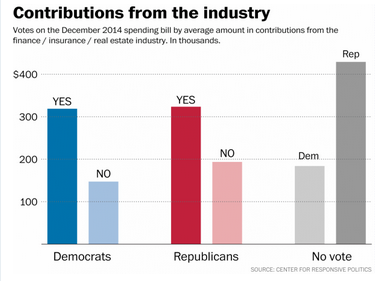
      This should be no surprise given that the FIRE industry is backing both Republicans and Democrats equally:

      “(WaPo ) on average, members of Congress who voted yes received $322,000 from those industries. Those who voted no? $162,000.”


      Those that think money in politics buys little influence are either naïve or simply are ignoring the facts.  It is clear that money is controlling our government to the point of cronyism.  And of all those previous bailouts?  How have they helped American families?


      The cost of housing, healthcare, and college tuition are soaring yet incomes are stagnant.  Of course inflation occurs because too much money (debt) is flowing into the system.  Big banks and investors ended up buying many single family homes and converting them into rentals and pushing rents up.  Prices are also up but many families never recovered after the Great Recession hit.  The stock market went up but thanks to hot money.  Spending and income are not looking so hot:


      If you look at wages/earnings minus healthcare costs we are actually in recession territory.  And since very few Americans actually own stocks, the recent mega run in the stock market has done little for regular families.

      But what is certain is that the recent spending bill that was passed is laden with future gifts to Wall Street banks when the inevitable correction hits.  Influence peddling in Washington isn’t anything new but the blatant nature of this bill is.  These are trillion dollar bets that will likely go bad and a bill was now passed to make it easier for taxpayer bailouts when things inevitably correct.  This will come from Americans that are struggling planning for their retirement and have very little in savings.  If you need any more proof that the 2014 election was a joke, look no further.  We are basically swapping jerseys on the same players here.  Get your wallets ready for the inevitable future bailouts that you will not vote on once again.  Our government should represent the voters but in this case, they represent their biggest donors.  And what the donors want isn’t necessarily what is best for American families.  In fact, it is the direct opposite in many cases.

      via mybudget360

      Saturday, December 13, 2014

      Barclays 'may have automated currency rigging'

      …fines involved, banks co-operating”.  

                                                                                              Benjamin M. Lawsky
      New York State's Supt. of Fin. Services
      But, with NY DFS Zionist attorney Benjamin Lawsky heading the "investigation" you could look at the incident as a thief having a hand in the pockets of both victim and perpetrator! How can any thief beat that: authorize, or at least overlook a thief (bankster) to steal investors' savings, then assess/transfer as "fines" winnings back into the banking cartel via the government! This could only happen under a corrupt government to which the people have forgone all vigilance or caring. We suppose it beats a stick in the eye, eh.

      At this rate of bank balance growth all your savings, stocks, and even your government checks such as Social Security, and pensions will be all taken from you with your government as the conduit for this unrealized wealth transfer. Not only that, but you'll have to pay off the indebtedness! Expect no mercy. Many folks have already withdrawn or suspended payments to these theft houses, and pulled their wealth back under their own in-your-hand supervision. How else can you fight back other than to halt your consumer patronage of government services?

      Expect no satisfying criminal incarcerations as warranted to be tenderly meted out to subordinate underlings - with a generous remuneration attached from Barclay's.


      New York's financial regulator investigates possibility of systemic foreign exchange manipulation at Barclays and Deutsche Bank

      Barclays has set aside £500m for currency rigging fines to date Photo: Bloomberg News

      By James Titcomb
      5:50PM GMT 11 Dec 2014

      Barclays and Deutsche Bank may have programmed automated trading platforms to systematically rig the currency markets, a US regulator has alleged.

      New York’s Department of Financial Services (DFS), led by Benjamin Lawsky, has uncovered evidence suggesting the banks may have developed algorithms to manipulate foreign exchange markets, according to multiple reports.

      The allegations are especially serious because Barclays and Deutsche Bank, among other banks, are being investigated by the DFS over the foreign exchange market.

      Using algorithms in trading systems is common practice at banks, but employing them as part of an effort to profit from manipulating forex rates could suggest the problem was more widespread than a select few traders.

      Neither Barclays nor Deutsche Bank were among the six banks that far paid £2.7bn to settle claims with UK, US and Swiss regulators last month.

      Related Articles
       
      30 Oct 2014
      12 Nov 2014
      09 Dec 2014

      Barclays had been widely expected to settle, but pulled out at the eleventh hour after saying it wanted to pay fines to other authorities at the same time.

      The DFS is believed to have raised concerns that the fines levied by the UK’s Financial Conduct Authority, among others, were insubstantial. The regulator already has an internal monitor at Barclays as part of its investigation into the foreign exchange market.

      Any evidence of wide-ranging currency rigging could well mean higher fines for the banks involved.

      Further penalties related to foreign exchange manipulation, from the DFS as well as the US Department of Justice, are expected to be higher than the ones imposed in November.

      Barclays and the DFS did not comment, while Deutsche Bank said it was co-operating with foreign exchange investigations.
      via Telegraph