Search Blog Posts

Showing posts with label Congress. Show all posts

Tuesday, March 31, 2015

FRAUD CENTRAL: Government Corruption Big Time

Government Corruption Has Become Rampant

The Cop Is On the Take

Government corruption has become rampant:
  • Senior SEC employees spent up to 8 hours a day surfing porn sites instead of cracking down on financial crimes
  • NSA spies pass around homemade sexual videos and pictures they’ve collected from spying on the American people
  • Investigators from the Treasury’s Office of the Inspector General found that some of the regulator’s employees surfed erotic websites, hired prostitutes and accepted gifts from bank executives … instead of actually working to help the economy
  • The Minerals Management Service – the regulator charged with overseeing BP and other oil companies to ensure that oil spills don’t occur – was riddled with “a culture of substance abuse and promiscuity”, which included “sex with industry contacts
  • Agents for the Drug Enforcement Agency had sex parties with prostitutes hired by the drug cartels they were supposed to stop
  • The former chief accountant for the SEC says that Bernanke and Paulson broke the law and should be prosecuted
  • The government knew about mortgage fraud a long time ago. For example, the FBI warned of an “epidemic” of mortgage fraud in 2004. However, the FBI, DOJ and other government agencies then stood down and did nothing. See this and this. For example, the Federal Reserve turned its cheek and allowed massive fraud, and the SEC has repeatedly ignored accounting fraud. Indeed, Alan Greenspan took the position that fraud could never happen
  • Paulson and Bernanke falsely stated that the big banks receiving Tarp money were healthy, when they were not. The Treasury Secretary also falsely told Congress that the bailouts would be used to dispose of toxic assets … but then used the money for something else entirely
  • Warmongerers in the U.S. government knowingly and intentionally lied us into a war of aggression in Iraq.  The former head of the Joint Chiefs of Staff – the highest ranking military officer in the United States – said that the Iraq war was “based on a series of lies”. The same is true in Libya and other wars
  • The Bush White House worked hard to smear CIA officersbloggers and anyone else who criticized the Iraq war
The biggest companies own the D.C. politicians.  Indeed, the head of the economics department at George Mason University has pointed out that it is unfair to call politicians “prostitutes”.  They are in fact pimps … selling out the American people for a price.

Government regulators have become so corrupted and “captured” by those they regulate that Americans know that the cop is on the take.   Institutional corruption is killing people’s trust in our government and our institutions.

Indeed, America is no longer a democracy or republic … it’s officially an oligarchy.

The allowance of unlimited campaign spending allows the oligarchs to purchase politicians more directly than ever.    Moreover, there are two systems of justice in Americaone for the big banks and other fatcats, and one for everyone else.

But the private sector is no better … for example, the big banks have turned into criminal syndicates.
Liberals and conservatives tend to blame our country’s problems on different factors … but they are all connected.

The real problem is the malignant, symbiotic relationship between big corporations and big government.

Source

Sunday, March 29, 2015

Espionage, Treason, and the Congressional Fifth Column


Congress canoodles with Israeli spies to undermine Iran deal

by , March 25, 2015
The spectacle of virtually the entire Senate GOP caucus mobilizing in support of a foreign power in order to drag us into war with Iran has certainly been instructive. Not since the Federalist party plotted with the British during the War of 1812 has an American fifth column been so open about their treason.

But isn’t the "t"-word a bit hyperbolic? After all, don’t all Americans, even the worst warmongers among us, have the right to free speech? Those members of Congress were merely expressing their opinion – right?

Not so fast:
"Soon after the U.S. and other major powers entered negotiations last year to curtail Iran’s nuclear program, senior White House officials learned Israel was spying on the closed-door talks.

"The spying operation was part of a broader campaign by Israeli Prime Minister Benjamin Netanyahu’s government to penetrate the negotiations and then help build a case against the emerging terms of the deal, current and former U.S. officials said. In addition to eavesdropping, Israel acquired information from confidential U.S. briefings, informants and diplomatic contacts in Europe, the officials said.

"The espionage didn’t upset the White House as much as Israel’s sharing of inside information with U.S. lawmakers and others to drain support from a high-stakes deal intended to limit Iran’s nuclear program, current and former officials said."

To be clear: the Israelis penetrated our communications, and used other means – including "informants" presumably inside the U.S. government – to uncover details about the emerging deal with Iran, and then passed this information on, perhaps indirectly, to their congressional fifth column, including presidential aspirants Ted Cruz, Marco Rubio, and Rand Paul, all of whom then signed on to Sen. Tom Cotton’s "open letter" to Tehran.

If this isn’t treason, then the word has no meaning.

Speaker of the House John Boehner, who plotted with Israeli ambassador Ron Dermer behind the President’s back to invite Netanyahu to address Congress, said he was "shocked" and "baffled" by the news. Not by the news they spied on us – it’s well known that the Jewish state is among the most aggressive foreign adversaries our counterintelligence agencies have to fend off – but "by the fact that there were reports in this press article that information was being passed on from the Israelis to members of Congress. I’m not aware of that at all." What’s baffling, however, is Boehner’s behavior during this Israeli incursion onto American territory: why did he suddenly decide to go full wingnut and canoodle with the Israelis to bring Bibi to American shores? And how is it the Speaker has so little knowledge of what’s going on right under his nose on Capitol Hill?

"The White House discovered the operation," reports Adam Entous of the Wall Street Journal, "when U.S. intelligence agencies spying on Israel intercepted communications among Israeli officials that carried details the U.S. believed could have come only from access to the confidential talks, officials briefed on the matter said." Those telling details then somehow found their way into conversations between the Israelis (and their American agents) and "U.S. lawmakers and others," accord to the Journal.

It’s one thing to spy, said a top U.S. official, but "it’s another thing to steal U.S. secrets and play them back to U.S. legislators to undermine U.S. diplomacy." Read More
 

Saturday, March 28, 2015

Bipartisan House Bill would Repeal Patriot Act and Ban Mass Surveillance of Americans

Anyone taking odds on this congress has neither the guts or moral fiber to go against the oligarchy that owns them...and us?

Friday, March 27, 2015
Reps. Mark Pocan
and Thomas Massie
 
An ambitious bipartisan bill that would seriously roll back the federal government’s ability to conduct surveillance operations has been introduced in the U.S. House of Representatives.
HR 1466 (pdf) (the Surveillance State Repeal Act) would do away with the Patriot Act (pdf) and ban large-scale spying programs, such as the National Security Agency’s telephone metadata collection that has generated so much controversy. It is the most far-reaching anti-surveillance legislation drafted to date.

“This isn’t just tinkering around the edges, it’s a meaningful overhaul that makes sure the meaningless surveillance of emails and cell phones are done away with,” Representative Mark Pocan (D-Wisconsin), one of the bill’s authors, told a briefing for congressional staffers, according to ThinkProgress. The coauthor of HR 1466 is Representative Thomas Massie (R-Kentucky).

The bill’s original co-sponsors are Democrats Alan Grayson of Florida, James McGovern of Massachusetts and Lloyd Doggett of Texas. Other supporters include libertarian organizations opposed to widespread government spying.

Patrick Eddington, national security and civil liberties policy analyst for the libertarian think tank CATO Institute, said: “All mass surveillance does is violate the rights and put a chilling effect on the American people.”

The legislation also would eliminate numerous surveillance permissions granted under the Foreign Intelligence Surveillance Act (pdf) amendments approved by Congress during the George W. Bush administration.

The Hill reported that the proposal is “likely to be a nonstarter for leaders in Congress, who have been worried that even much milder reforms to the nation’s spying laws would tragically handicap the nation’s ability to fight terrorists. A similar bill was introduced in 2013 but failed to gain any movement in the House.”

Congress has until June 1 to reauthorize portions of the Patriot Act that support the government’s surveillance operation. Without re-authorization of the law’s Section 215, the telephone metadata program will expire.
-Noel Brinkerhoff
To Learn More:
HR 1466 (Congress.gov) (pdf)
NSA Phone Data Collection Made No Difference to National Security (by Noel Brinkerhoff and Danny Biederman, AllGov)

Friday, March 27, 2015

Mossad Chief Secretly Met With Top U.S. Officials Including Sitting Senators


The Intel Hub
February 1, 2012

A clandestine Washington visit by Mossad Chief Tamir Pardo, in which he privately met with multiple Senators and other top officials, was revealed in testimony  during a hearing of the Senate Select Committee on Intelligence attended by CIA director David Petraeus (CFR) and Intel Chief James Clapper.

Tuesday, March 10, 2015

▶ The Problem With Voting for ‘Conservatives’ - YouTube


Published on Mar 9, 2015
JBS CEO Art Thompson's weekly news video update for March 9 - 15, 2015.

In this week's Analysis Behind the News video, JBS CEO Art Thompson demonstrates the problem with those in Congress who obey the Constitution only 80 percent of the time. He also introduces a new pamphlet focusing on how trade agreements have hurt our military readiness.


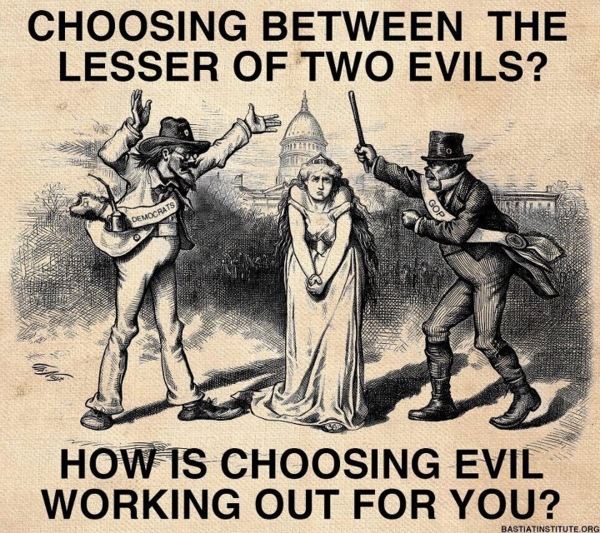
 http://www.federalobserver.com/wp-content/uploads/2012/08/Lesser2Evils.jpg

Saturday, March 7, 2015

Politicians Get Billions and Return Trillions to Corporations on "Investment"

Fixed Fortunes: Biggest corporate political interests spend billions, get trillions

Nov. 17, 2014, 9:26 a.m.

Between 2007 and 2012, 200 of America’s most politically active corporations spent a combined $5.8 billion on federal lobbying and campaign contributions. A year-long analysis by the Sunlight Foundation suggests, however, that what they gave pales compared to what those same corporations got: $4.4 trillion in federal business and support.

That figure, more than the $4.3 trillion the federal government paid the nation’s 50 million Social Security recipients over the same period, is the result of an unprecedented effort to quantify the less-examined side of the campaign finance equation: Do political donors get something in return for what they give?

Four years ago, the U.S. Supreme Court suggested the answer to that question was no. Corporate spending to influence federal elections would not “give rise to corruption or the appearance of corruption,” the majority wrote in the landmark Citizens United v. Federal Election Commission decision.

Sunlight decided to test that premise by examining influence and its potential results on federal decision makers over six years, three before the 2010 Citizens United decision and three after.

We focused on the records of 200 for-profit corporations, all of which had active political action committees and lobbyists in the 2008, 2010 and 2012 election cycles — and were among the top donors to campaign committees registered with the Federal Election Commission. Their investment in politics was enormous. There were 20,500 paying lobbying clients over the six years we examined; the 200 companies we tracked accounted for a whopping 26 percent of the total spent. On average, their PACs, employees and their family members made campaign contributions to 144 sitting members of Congress each cycle.

On average, 144 sitting members of Congress received money from the Fixed Fortune 200 each cycle. Graphic credit: The Sunlight Foundation

After examining 14 million records, including data on campaign contributions, lobbying expenditures, federal budget allocations and spending, we found that, on average, for every dollar spent on influencing politics, the nation’s most politically active corporations received $760 from the government. The $4.4 trillion total represents two-thirds of the $6.5 trillion that individual taxpayers paid into the federal treasury.

Welcome to the world of "Fixed Fortunes," a seemingly closed universe where the most persistent and savvy political players not so mysteriously have the ability to attract federal dollars regardless of who is running Washington.

Political change, permanent interests

During the six years we studied, newly elected Democratic majorities took control in the House and Senate. Two years later, the White House shifted from Republican to Democratic control, and two years after that the GOP came back to take the House. The collapse of the housing bubble in 2007 led to massive bailout efforts by the Treasury Department and the Federal Reserve Board, two massive stimulus bills and the loss of more than eight million jobs. Congress passed laws that overhauled health care insurance and financial industry regulation. Troops surged in Afghanistan and withdrew from Iraq. There were 16 separate “continuing resolutions” to fund the government, a debt ceiling standoff that caused a downgrade in the nation’s credit rating and a “super committee” to wrestle with the federal budget. As middle class Americans lost ground, the Fixed Fortune 200 got what they needed.

What they needed included loans that helped automakers and banks survive the recent recession while many homeowners went under. It included full funding and expansion of federal programs started in the 1930s that, year after year, decade after decade, help prop up prices for agribusinesses and secure trade deals for our biggest manufacturers. It included budget busting emergency measures that funneled extra dollars to everything from defense contractors to public utility companies to financial industry giants. The record suggests that the money corporations spend on political campaigns and Washington lobbying firms is not an unwise investment.

The Fixed Fortune 200 come from a wide range of industries. There are a host of familiar names among them, like Ford Motor Company, McDonald’s and Bank of America, as well as some less famous, like MacAndrews & Forbes, the Carlyle Group and Cerberus Capital Management. (For the complete list, including what they gave and what they got, click here.) There are retailers and investment banks, construction and telecommunications firms, health insurers and gun makers, entertainment conglomerates, banks and pharmaceutical manufacturers, among others.

Out of 20,500 paying lobbying clients, the Fixed Fortune 200 accounted for a whopping 26 percent of the total spent. Graphic credit: The Sunlight Foundation

Overall, the Fixed Fortune 200’s PACs, employees and their family members gave $597 million to political committees and disclosed spending $5.2 billion on lobbying. They make this enormous investment in politics in large part because their businesses are inextricably entwined with government decisions — including spending decisions.

Government as business partner

For example, the federal government issued contracts to purchase goods and services that totaled a little more that $3 trillion during the period; companies among the top 200 corporate political givers won $1 trillion of that, a third of the total. The Treasury Department managed $410 billion in loans and other assistance issued under the Troubled Asset Relief Program, created by Congress to cope with the 2008 financial crisis; of that amount, $298 million, about 73 percent, went to 16 firms among the Fixed Fortune 200. When the Federal Reserve took extraordinary measures in the wake of the 2008 financial crisis, it funneled nearly $2.8 trillion through 29 Fixed Fortune firms. The companies that participated the most in politics got huge returns.

Of the 200 corporations we examined, we could sum the financial rewards for 179. Of those, 138 received more from the federal government than they spent on politics, 102 of them received more than 10 times what they spent on politics, and 29 received 1,000 times or more from the federal government than they invested in lobbyists or contributed to political committees via their employees, their family members and their PACs.

As for the other 21 companies on our list, while we could not quantify the financial benefits that some received, we were able to identify them. Some examples:
  • Arch Coal lists the Tennessee Valley Authority (TVA), the government corporation that’s the largest public electricity producer, as one of its three biggest customers. TVA does not release data on its coal purchases.
  • Forest City Enterprises does not appear as a landlord in the Government Services Agency’s database of federal rental agreements, though its annual report notes that the U.S. government is the third-biggest customer for its pricey New York City office space.
  • Occidental Petroleum has leases on federal land to extract natural gas, but the government does not release information on how much that gas is withdrawn or how much it is worth.
  • And while the government has so far refused to release information on what retailers get the most purchases via food stamps, Wal-Mart went so far as to acknowledge in a filing with the Securities and Exchange Commission that reductions in the now $78 billion-a-year Supplemental Nutrition Assistance Program — or food stamps — could have a significant impact on the company’s earnings, which totaled $476 billion in its most recent fiscal year.
Of the 200 companies analyzed for Fixed Fortunes, 28 are in what the money in politics research organization the Center for Responsive Politics classifies as the communications and electronics sector, 21 in healthcare, 13 in defense and aerospace, 13 agribusinesses, 11 in energy and natural resources, and 7 in transportation. The biggest sector, accounting for 48 of the 200, was finance, insurance and real estate, which is consistently the largest source of campaign funds for politicians cycle after cycle. Congress and the executive branch have paid particular attention to the industry, approving hundreds of billions in aid to help it weather the financial crisis. Meanwhile, the Federal Reserve advanced trillions in credit, which the nation’s central bank hoped would trickle down through the rest of the economy.

Explore the full list of groups in the Fixed Fortune 200

See the full list of corporations — including how much each gave and what they got in return — on our Influence Explorer page

Companies with the biggest returns on their political investments include three foreign financial service and banking firms, UBS and Credit Suisse Group from Switzerland, and Deutsche Bank of Germany, all of which benefited from the Treasury Department’s taxpayer-financed rescue of American International Group. Investment banks Goldman Sachs and Morgan Stanley as well as commercial banks like JPMorgan Chase & Co., Citigroup, Wells Fargo and Bank of America also received far more from government than they put into politics: They benefited from the bailouts of the financial industry undertaken by Treasury and the Federal Reserve. Weapons manufacturers like Boeing and Lockheed Martin, both of which disclosed spending more than $10 million each year on lobbying, also made the list. So did McKesson, a pharmaceutical wholesaler that is the biggest vendor for Veterans Affairs, and the Carlyle Group, a wealth management firm started by former government insiders who invest in firms that have significant involvement with government, such as defense, telecommunications and health care.
CONTINUE READING – MUCH MORE DATA > >

GOP lawmaker reissues legislation to dissolve the ATF

Many will emit loud guffaws and snicker at this congressman for his stepping up to return a stolen liberty to Americans. Laugh if you must, but know that it is congressmen such as Rep. Sensenbrenner that are needed to restore our Constitutional liberties in a lawful and peaceful non-violent manner. Just know what a fool you are as you continue to saunter ignorantly, defeatedly, and uncaringly your stroll on the road to serfdom.
~~~~~~~~~~~~~~~~~~~~~~~~~~~~
Posted on March 6, 2015 by Sam Rolley
In apparent response to the Bureau of Alcohol, Tobacco, Firearms and Explosive (ATF) attempt to regulate popular types of rifle ammunition off the civilian market, Rep. Jim Sensenbrenner (R-Wis.) has reintroduced legislation to disband the agency.

Sensenbrenner, a senior member of the House Judiciary Committee, contends that the ATF’s functions could easily be handled by the nation’s other law enforcement agencies.

“[The ATF’s] ‘Framework’ is an affront to the Second Amendment and yet another reason why Congress should pass the ATF Elimination Act,” the lawmaker said in a statement.

Republican lawmakers and 2nd Amendment supporters throughout the nation have most recently criticized the agency for its proposal to reclassify certain types of 5.56mm/.223 caliber ammunition as armor-piercing. The ban would specifically ban the manufacture and sale of M855/SS109 “green tip” ammunition.

But Sensenbrenner has long called for the ATF’s abolition, citing a series of well-publicized ATF scandals in recent years as proof that the agency does more harm to the nation than good.

In 2010, the ATF’s notorious Fast and Furious program shot to the center of public debate after news broke that Border Patrol Agent Brian Terry was killed with a firearm the agency had allowed to “walk” into the hands of Mexican cartel members.

Then, in December 2013, the Milwaukee Journal-Sentinel issued a report detailing how ATF agents operating stings in six different cities “took advantage of the mentally ill, set up stings near churches and schools and made decisions which some claim actually increased crime in their neighborhoods” in a bid to trump up firearms charges against individuals.

A Government Accountability Office report out last summer noted the scandals and criticized ATF policy changes that caused the agency to overlap the duties of other U.S. law enforcement agencies while decreasing its original mission.

“Beginning in 2010, ATF made criminal organization investigations one of its highest priorities, similar to firearms investigations, and deemphasized alcohol and tobacco investigations that do not involve violent crime,” the GAO report noted. “ATF data show that alcohol and tobacco investigations decreased by 85 percent (from 168 to 25 investigations opened) from fiscal years 2003 through 2013. In 2012, to more effectively identify and address the most violent criminal threats.”

That report led to Sensenbrenner’s original call to dissolve the agency.

“The ATF is a largely duplicative, scandal ridden agency that lacks a clear mission. It is plagued by backlogs, funding gaps, hiring challenges and a lack of leadership. For decades it has been branded by high profile failures,” he said in September. “There is also significant overlap with other agencies. At a time when we are approaching $18 trillion in debt, waste and redundancy within our federal agencies must be addressed. Without a doubt, we can fulfill the role of the ATF more efficiently.”

Sensenbrenner’s ATF Elimination Act would place the ATF’s firearms, explosives and arson responsibilities to the FBI and alcohol and tobacco law enforcement to the Drug Enforcement Agency.

Though the most recent proposal to eliminate the ATF comes from a Republican, the agency has also come under fire from Democrats in the past.
In 1993, Rep. John Conyers (D-Mich.) introduced legislation to “transfer all functions of the Bureau of Alcohol, Tobacco, and Firearms relating to the regulation of firearms from the Department of the Treasury to the Federal Bureau of Investigation.”

Source personalliberty

Friday, March 6, 2015

Congress's Socialist Wing

As an ideological point of reference realize that the site (DTN) origin of this post is of a leftist pro-war Zionist Republican neocon bent itself.
Don't be confused what's Left and what's Right:

These people know better than you what's best for America
~~~~~~~~~~~~~~~~~~~~~~~~~~~~~~~~~~~~~~~~~~~~~~~~~~~~~~
Congressional Progressive Caucus (CPC)
Rep.  Raul Grijalva (co-chair)
1511 Longworth HOB
Washington, DC
20515

Rep.  Keith Ellison (co-chair)
1027 Longworth HOB
Washington, DC
20515

URL: Website
  • Socialist wing of the Democratic Party
  • Consists of 76 Members of Congress
  • Has close ties to the Institute for Policy Studies and the Democratic Socialists of America
  • Has ties to the Communist Party USA

                Members of the Congressional Progressive Caucus


The Congressional Progressive Caucus (CPC) was founded in 1991 by Bernie Sanders, a self-identified socialist who had recently been elected to the U.S. House of Representatives. Sanders' CPC co-founders included House members Ron Dellums, Lane Evans, Thomas Andrews, Peter DeFazio, and Maxine Waters. The Institute for Policy Studies (IPS) was also involved in CPC's founding and in Caucus activities thereafter; IPS continues to advise CPC on various matters to this day.

Another key player in establishing CPC was the Democratic Socialists of America (DSA), which has maintained a close alliance with the Caucus ever since. In 1997, DSA's political director, Chris Riddiough, organized a meeting with CPC leaders to discuss how the two groups might be able to “unite our forces on a common agenda.” Among those who participated in the meeting were Bernie Sanders, labor leader Richard Trumka, professor Noam Chomsky, feminist Patricia Ireland, Rev. Jesse Jackson, Senator Paul Wellstone, journalist William Greider, and the socialist author Barbara Ehrenreich.

Beginning in 1997, CPC worked closely with the newly launched “Progressive Challenge, a coalition of more than 100 leftist organizations that sought to unite their activities and objectives under a "multi-issue progressive agenda." To view a list of many of the major groups that co-sponsored the Progressive Challenge, click here.

On November 11, 1999, CPC drafted a vital Position Paper on economic inequality, which called for “legislative initiatives” to combat the “income and wealth disparities” that “distor[t] our democracy, destabiliz[e] the economy, and erod[e] our social and cultural fabric.” Lamenting that “two and a half decades of government policies and rules governing the economy” had been “tilted in favor of large asset owners at the expense of wage earners,” the document derided the “pro-investor bias” of America's existing “tax policy, trade policy, monetary policy, [and] government regulations.”

In 2005 CPC spelled out its political agendas in what would become its signature document, the “Progressive Promise.” Therein, the Caucus emphasizes its commitment to four major priorities: Economic Justice and Security; Civil Rights and Civil Liberties; Global Peace and Security; and Environmental Protection & Energy Independence. Under the rubric of these items fall a number of additional key CPC objectives, such as these:
  • "To uphold the right to universal access to affordable, high-quality healthcare for all."
  • "To … create new jobs in the U.S. by building more affordable housing, re-building America’s schools and physical infrastructure, cleaning up our environment, and improving homeland security."
  • "To ensure [that] working families can live above the poverty line and with dignity by raising and indexing the minimum wage."
  • "To sunset expiring provisions of the Patriot Act and bring remaining provisions into line with the U.S. Constitution."
  • "To fight corporate consolidation of the media and ensure opportunity for all voices to be heard"—essentially a plan for purging conservative voices from the airwaves by means of the "Fairness Doctrine" or adherence to the principles of “localism.”
  • "To bring U. S. troops home from Iraq as soon as possible."
  • "To encourage debt relief for poor countries" as outlined in the United Nations Millennium Project, a massive redistributive scheme calling for the governments of wealthy countries to commit 0.7% of their GNP to promoting “the economic development and welfare of developing countries.”
  • "To free ourselves and our economy from dependence upon imported oil and shift to growing reliance upon renewable energy supplies and technologies."
  • To “eliminate [the] environmental threat posed by global warming,” an objective that may be accomplished by increased emphasis on “solar, biomass, and wind power.”
  • "To promote environmental justice," a term founded on the premise that hazardous-waste landfills and pollution-emitting industries tend to be situated disproportionately near minority neighborhoods.
A 2002 report by Joelle Fishman, chair of the Communist Party USA's Political Action Committee, stated that the Progressive Caucus “provides an important lever that can be used to advance workers' issues and move the debate to the left in every Congressional District in the country.” In a 2010 CPUSA report, Party member David Bell identified Progressive Caucus members as his organization's “allies in Congress.”

As of March 2015, CPC consisted of 68 members of the House of Representatives—all of them leftist Democrats—and one U.S. Senator (Bernie Sanders, an Independent who caucuses with the Democrats).

For a comprehensive list of all 69 CPC members, click here.

For a list of noteworthy former members who left the Caucus prior to April 2011, click here.

For additional information on CPC, click here.
Source DTN

Wednesday, March 4, 2015

US Taxpayers Pay 25% of Israel's Defense Budget & List of US Politicians Who Hold Dual US/Israeli Citizenship

Keep at my fellow Americans we've got foreigners' bills to pay too!

Part I

A Reminder: U.S. Pays One Quarter of Israel's Defense Budget


Wednesday, March 04, 2015
(graphic: AllGov)
With Capitol Hill abuzz over Israeli Prime Minister Benjamin Netanyahu's appearance before Congress this week, there is no time like the present for a refresher on how much the American taxpayers spend on Israel's defense.

If it wasn't for Washington's longtime commitment to bolstering the Israel Defense Forces, Netanyahu and Israeli lawmakers would have a serious shortfall on their hands.
After all, the U.S. funds about 25% of Israel's annual spending on its military, thanks to $3 billion a year in aid.

"Since it was founded in 1948, Israel has become the largest single recipient of U.S foreign assistance — a total of $121 billion, almost all of which has been in the form of military assistance," Brandon Ward wrote at Journalist's Resource, citing a 2014 Congressional Research Service report (U.S. Foreign Aid to Israel [pdf]).

Among the items funded by the United States is Israel's Iron Dome anti-missile system. The 2015 budget allows $175.9 million for the system on top of $234 million in 2014 and $704 million in the years before that, according to the report.

The really big-ticket item is a purchase of 19 F-35 fighter planes financed with a $2.75 billion grant. The planes were supposed to have been delivered this year, but problems with the F-35 program have pushed the delivery date to 2016 or 2017.
-Noel Brinkerhoff, Steve Straehley
To Learn More:
U.S. Foreign Aid to Israel (by Jeremy M. Sharp, Congressional Research Service) (pdf)
U.S. Aid to Israel Equals $4.9 Million a Day for 64 Years (by Noel Brinkerhoff and David Wallechinsky, AllGov)

via AllGov
~~~~~~~~~~~~~~~~~~~~~~~~~~~~~~~~~~~~~~
Political Polygamy is Moral and OK for America

Part II

US Politicians Who Hold Dual US/Israeli Citizenship

August 18, 2014

"If Americans were ever polled on it—and they never are—the majority who now object to increasing aid to Israel would also likely object to quasi-governmental and governmental positions being staffed by people who—by citizenship or sheer strength of identity politics—are primarily occupied with advancing Israeli interests rather than those of the United States. It is obvious that the real reason AIPAC and its economic luminaries such as Fischer never substantiate any of the advertised benefits the U.S.-Israel "special relationship" delivers to America in return for all of the costs is simple—there simply aren't any. As greater numbers of Americans become aware that the entire "special relationship" framework is sustained by nothing more than Israel lobby campaign-finance and propaganda networks, the harder the lobby will have to work… In the very short term, Americans can only fight such undue Israel lobby influence by again—like during the drive to attack Syria—staging a mass action to demand their senators reject Stanley Fischer's nomination," Grant Smith, IRMEP

Past and Present:
1. Attorney General – Michael Mukasey
2. Head of Homeland Security – Michael Chertoff
3. Chairman Pentagon's Defense Policy Board – Richard Perle
4. Deputy Defense Secretary (Former) – Paul Wolfowitz
5. Under Secretary of Defense – Douglas Feith
6. National Security Council Advisor – Elliott Abrams
7. Vice President Dick Cheney's Chief of Staff (Former) – "Scooter" Libby
8. White House Deputy Chief of Staff – Joshua Bolten
9. Under Secretary of State for Political Affairs – Marc Grossman
10. Director of Policy Planning at the State Department – Richard Haass
11. U.S. Trade Representative (Cabinet-level Position) – Robert Zoellick
12. Pentagon's Defense Policy Board – James Schlesinger
13. UN Representative (Former) – John Bolton
14. Under Secretary for Arms Control – David Wurmser
15. Pentagon's Defense Policy Board – Eliot Cohen
16. Senior Advisor to the President – Steve Goldsmith
17. Principal Deputy Assistant Secretary – Christopher Gersten
18. Assistant Secretary of State – Lincoln Bloomfield
19. Deputy Assistant to the President – Jay Lefkowitz
20. White House Political Director – Ken Melman
21. National Security Study Group – Edward Luttwak
22. Pentagon's Defense Policy Board – Kenneth Adelman
23. Defense Intelligence Agency Analyst (Former) – Lawrence (Larry) Franklin
24. National Security Council Advisor – Robert Satloff
25. President Export-Import Bank U.S. – Mel Sembler
26. Deputy Assistant Secretary, Administration for Children and Families – Christopher Gersten
27. Assistant Secretary of Housing and Urban Development for Public Affairs – Mark Weinberger
28. White House Speechwriter – David Frum
29. White House Spokesman (Former) – Ari Fleischer
30. Pentagon's Defense Policy Board – Henry Kissinger
31. Deputy Secretary of Commerce – Samuel Bodman
32. Under Secretary of State for Management – Bonnie Cohen
33. Director of Foreign Service Institute – Ruth Davis
34. Federal Reserve Chair – Janet Yellen
35. Federal Reserve Vice-Chair – Stanley Fischer
Current (and past) Members of Senate:
  Representative Gary Ackerman (New York)
  Representative John H. Adler (New Jersey)
  Representative Shelley Berkley (Nevada)
  Representative Howard Berman (California)
  Representative Steve Cohen (Tennessee)
  Representative Susan Davis (California)
  Representative Eliot Engel (New York)
  Representative Bob Filner (California)
  Representative Barney Frank (Former) (Massachusetts)
  Representative Gabrielle Giffords (Arizona)
  Representative Jane Harman (California)
  Representative Paul Hodes (New Hampshire)
  Representative Steve Israel (New York)
  Representative Steve Kagen (Wisconsin)
  Representative Ronald Klein (Florida)
  Representative Sander Levin (Michigan)
  Representative Nita Lowey (New York)
  Representative Jerry Nadler (New York)
  Representative Jared Polis (Colorado)
  Representative Steve Rothman (New Jersey)
  Representative Jan Schakowsky (Illinois)
  Representative Adam Schiff (California)
  Representative Arlen Specter (Pennsylvania)
  Representative Allyson Schwartz (Pennsylvania)
  Representative Brad Sherman (California)
  Representative Debbie Wasserman Schultz (Florida)
  Representative Henry Waxman (California)
  Representative Anthony Weiner (New York)
  Representative John Yarmuth (Kentucky)
House of Representatives:
  Representative Gary Ackerman (New York)
  Representative John H. Adler (New Jersey)
  Representative Shelley Berkley (Nevada)
  Representative Howard Berman (California)
  Representative Steve Cohen (Tennessee)
  Representative Susan Davis (California)
  Representative Eliot Engel (New York)
  Representative Bob Filner (California)
  Representative Barney Frank (Massachusetts)
  Representative Gabrielle Giffords (Arizona)
  Representative Alan Grayson (Florida)
  Representative Jane Harman (California)
  Representative Paul Hodes (New Hampshire)
  Representative Steve Israel (New York)
  Representative Steve Kagen (Wisconsin)
  Representative Ronald Klein (Florida)
  Representative Sander Levin (Michigan)
  Representative Nita Lowey (New York)
  Representative Jerry Nadler (New York)
  Representative Jared Polis (Colorado)
  Representative Steve Rothman (New Jersey)
  Representative Jan Schakowsky (Illinois)
  Representative Adam Schiff (California)
  Representative Allyson Schwartz (Pennsylvania)
  Representative Brad Sherman (California)
  Representative Debbie Wasserman Schultz (Florida)
  Representative Henry Waxman (California)
  Representative Anthony Weiner (New York)
  Representative John Yarmuth (Kentucky)


There are no better people to run America than European American people. European peoples should be able to organize and advance their own interests just like every other group.

via american3rdposition