Search Blog Posts

Showing posts with label JP Morgan. Show all posts

Tuesday, April 28, 2015

Why in the world has JP Morgan accumulated more than 55 million ounces of physical silver?

The Real Bunker Hunt Story - What IF Today JP Morgan was Actually BUYING Physical Silver? *video*

We 1st pub. this in March of 2012

Now, what would happen today if the Hunt family were replaced by the banksters, namely JPM? The CFTC, SEC & COMEX were crooked in 1980, and aren't they even more so today?

Why couldn't the crooks actually be strategically on the long side for physical. They have the corrupted regulators in their pockets, so why not execute a similar strategy from the long side? Couldn't their large short positions be implemented to suppress the price for themselves, and acquiring it from miners directly or middle agents? Just another element that our silver gurus have been neglecting...in my view.

In fact, having driven the mining stocks down to absurd levels the conspirators could buy all the controlling equity in every gold/silver mine in the world for a few billion dollars of their taxpayer-supplied money!!

So, then, without the general public joining in the physical buying frenzy, why the repeated delivery delays of modest amounts. You might want to Google:  "physical silver bullion delivery delays"

In relation to this postulate, watch: Silver Fakewardation - *video*


Is JP Morgan Shorting Paper Metals While Acquiring Massive Physical Stockpiles?

*Updated

Manipulation explained, or pure disinformation orchestrated  to pre-emptively manage the fallout of the coming JP Morgan silver manipulation scandal?

Friday, March 6, 2015

Too Big to Fail Banks Ranked

Friday, March 06, 2015


JPMorgan Chase has earned the distinction of being the largest bank among those deemed too-big-to-fail for the sake of the U.S. financial and economic systems, according to a new government report (pdf).

The federal Office of Financial Research (OFR) ranked 12 U.S. financial institutions based on their “total exposures.”

No. 1 was JPMorgan Chase followed by Citigroup, Bank of America, Wells Fargo, Goldman Sachs and Morgan Stanley.


Among the conclusions produced in the report are findings that “the largest U.S. banks generally scored highest for all systemic risk indicators,” and that “several of the largest banks scored high in systemic importance because they dominate specific businesses, such as payments and asset custody services.”

The authors of the OFR report based their findings on data collected by the Federal Reserve System. That data was significant, they said, because it provides additional transparency that helps to quantify important aspects of the banking system.

Their evaluation was made by comparing scores on the banks’ sizes, global activity, complexity, interconnectedness, and dominance in certain areas of customer service.

To Learn More:
Systemic Importance Indicators for 33 U.S. Bank Holding Companies: An Overview of Recent Data (by Meraj Allahrakha, Paul Glasserman, and H. Peyton Young, Office of Financial Research) (pdf)

Tuesday, March 3, 2015

DOJ, CFTC have Begun Investigation of 10 Major Banks for Rigging Metals Fixing

Need a job? Drop gold investigation
   
Late last week, The Wall Street Journal reported that the U.S. Department of Justice and the U.S. Commodity Futures Trading Commission (CFTC) had begun investigations of 10 major banks over the process of setting prices for gold, silver, platinum and palladium in the London market.

Look for the end result to pretty much
be a cover-up of the suppression of
gold and silver prices. – Pat Heller
The banks under scrutiny are Bank of Nova Scotia, Barclays PLC, Credit Suisse Group AG, Deutsche Bank AG, Goldman Sachs Group Inc., JPMorgan Chase & Co., Societe Generale SA, Standard Bank Group Ltd., and UBS AG. After this announcement, the Swiss competition commission, WEKO, said it was looking into possible manipulation by Swiss banks in the precious metals markets.

As reported in the Journal, the Department of Justice is looking into criminal activity, while the CFTC has opened a civil investigation.

Many researchers have written about the extensive history of central banks manipulating gold prices over the decades.  In the United States, for instance, declassified government documents released so far have all confirmed that the federal government has conspired with other governments and major banks to manipulate gold prices right from the 1930s up into the 1980s.

Historically, many government monetary systems were valued in relation to gold, so it should not surprise anyone that governments would try to influence the relative prices.  In the United States, for instance, the Treasury Department’s Exchange Stabilization Fund (ESF) was established as a provision of the January 31, 1934 Gold Reserve Act.  The ESF was explicitly authorized to use its funds to stabilize the exchange value of the dollar versus gold.  Changes over the years have never revoked the authority to manipulate gold prices.  In fact, a law enacted in 1970 directed the Secretary of the Treasury, with the approval of the President, to “deal in gold, foreign exchange, and other instruments of credit and securities.”

These new investigations follow similar reviews in Europe. Last year, the British government fined Barclays Bank more than $40 million for one incident of gold price manipulation.  Also, the Swiss regulator, FINMA, said it found “serious misconduct” among precious metals traders at UBS involving a silver-fix order of one client.

If you think that the researchers and writers claiming that central banks and major private banks were manipulating the precious metals markets by suppressing prices are finally going to be proven right, think again.

I am confident that the end result of the U.S. government investigations will be, after several years in the works, some fines collected from many of these banks for specific individual incidents. Further, there will be promises that whatever wrongdoing they had done will no longer occur.  And that will be all that happens.

Why do I think this is what will be the end result of such a bombshell development? The answer is simple. Ask yourself why the DOJ and CFTC are investigating trading in the London markets but not in the New York COMEX markets. While it is true that the London market handles more volume of precious metals trading than the COMEX, the U.S. markets are more relevant to Americans.

Also ask yourself why the investigations involve eight foreign owned banks and only two U.S. companies. The foreign banks would only be within the purview of American regulators if their actions in the London markets were perpetrated from the U.S.-based offices. Why aren’t other U.S. banks being investigated?

The reason these investigations will be pretty much whitewashed is that the Department of Justice is unwilling to go after Wall Street. New York Federal Reserve Bank president William C. Dudley (who worked at Goldman Sachs 1986-2007 as the chief U.S. economist, a partner, and as a managing director) confirmed not that long ago that the DOJ has no ongoing investigations of Wall Street firms. The DOJ is not conducting such investigations despite former Federal Reserve chair Alan Greenspan’s public claim that there were massive illegal and criminal frauds committed by Wall Street firms.

The DOJ consistently stated that it will not prosecute these large institutions because the risk of damage to the economy, as they were told by outside experts.  However, could this DOJ policy could have more to do with the revolving doors where the DOJ and CFTC investigators largely have worked for the above named banks or hope to do so when the leave government employment?
After all, U.S. Attorney General Eric Holder announced two years ago that no investigation of UBS’s fixing of LIBOR interest rates would be done. Holder claimed in a news conference that the lack of prosecution was based on a decision of how such an investigation would impact global financial markets. But, was the real reason that UBS was a client of the law firm where Holder worked before his current job?
Want to add some luck to your 
collection or your pocket?

In a previous decision not to investigate HSBC, a Congressional panel asked for the identity of outside parties who advised the DOJ to drop the investigation for global financial stability reasons.  Eventually, Justice officials had to admit that they did not consult any outside parties before canceling the HSBC review.

In sum, I expect the public to be lulled into thinking that the U.S. government is really finding and reporting the truth about the manipulation of precious metals prices. However, once you realize that the DOJ and CFTC are investigating the wrong market (London instead of the New York COMEX), not all of the appropriate American-based banks that should be investigated are being pursued because the government agencies have a “policy” to avoid investigations of firms where they used to work or hope to later be employed. Don’t expect any definitive revelations about the depth and breadth of the manipulation of precious metals trading in America.

Instead, look for the end result to pretty much be a cover-up of the suppression of gold and silver prices.


Wednesday, February 18, 2015

48 suspicious banking deaths

1st pub. by CV Friday, August 22, 2014

Exclusive from...
http://www.hangthebankers.com/wp-content/uploads/2014/06/HTBbanner2-525x84.png


Our advice is if JP Morgan offers you a job: politely decline. The list of top level bankers dying under suspicious circumstances has been growing rapidly in recent months.

Whether these are genuine deaths or something more sinister one thing is for certain, banking is becoming one of the most dangerous industries to be involved in right now with an extremely high death per employee ratio.

The causes of death given for some of the bankers seems quite odd to say the least including one banker shooting himself 8 times with a nail gun and another being crushed to death by their own SUV.

With the global financial system heading towards a major crash in the near future are these people buckling under the pressure of what they see coming or are they being silenced because of what they know?

We can only assume it's a little of both.

Here's the list of top level bankers who have died recently:

DEAD (48)

July – Julian Knott, 45, JPMorgan Executive Director,Global Tier 3 Network Operations, SELF-INFLICTED GUNSHOT WOUND

June – Richard Gravino, 49, Application Team Lead, JP Morgan, SUDDEN DEATH cause unknown/pending

June – James McDonald – President & CEO of Rockefeller & Co – apparently self-inflicted, GUNSHOT WOUND

May – Thomas Schenkman, 42, Managing Director of Global Infrastructure, JP Morgan, SUDDEN DEATH, cause unknown/pending

May – Naseem Mubeen – Assistant Vice President ZBTL Bank, Islamabad, SUICIDE jumped

May – Daniel Leaf – senior manager at the Bank of Scotland/Saracen Fund Managers, FELL OFF A CLIFF

May – Nigel Sharvin – Senior Relationship Manager Ulster Bank manage portfolio of distressed businesses, ACCIDENTAL DROWNING

April – Lydia (no surname given) 52, France's Bred-Banque-Populaire, SUICIDE jumped

April – Li Jianhua, 49, Non-bank Financial Institutions Supervision Department of the regulator, HEART ATTACK

April – Benedict Philippens, Director/Manager Bank Ans-Saint-Nicolas, SHOT

April – Tanji Dewberry – Assistant Vice President, Credit Suisse, HOUSE FIRE

April – Amir Kess, co-founder and managing director Markstone Capital Group private equity fund, CYCLIST HIT BY CAR

April – Juergen Frick, Bank Frick & Co. AG, SHOT

April – Jan Peter Schmittmann – former CEO of Dutch Bank ABN Amro, (Possibly suicide, SHOT)

April – Andrew Jarzyk – Assistant Vice President, Commercial Banking at PNC Financial Services Group, MISSING/DEAD

March – Mohamed Hamwi – System Analyst at Trepp, a financial data and analytics firm, SHOT

March – Joseph Giampapa – JP Morgan lawyer, CYCLIST HIT BY MINIVAN

March – Kenneth Bellandro, former JP Morgan, SUICIDE jumped

Feb – John Ruiz – Morgan Stanley Municipal Debt Analyst, died suddenly, NO CAUSE GIVEN

Feb – Jason Alan Salais, 34, Information Technology specialist at JPMorgan, FOUND DEAD outside a Walgreens pharmacy

Feb –  Autumn Radtke, CEO of First Meta, a cyber-currency exchange firm, SUICIDE

Feb – James Stuart Jr, Former National Bank of Commerce CEO, FOUND DEAD

Feb – Edmund (Eddie) Reilly, trader at Midtown's Vertical Group, SUICIDE

Feb – Li Junjie, JP Morgan, SUICIDE

Feb – Ryan Henry Crane, SUDDEN DEATH cause unknown

Feb – Richard Talley, UNKNOWN CAUSE

Jan – Gabriel Magee, SUICIDE

Jan – William 'Bill' Broeksmit, HUNG/POSSIBLE SUICIDE

Jan – Mike Dueker, SUDDEN DEATH cause unknown

Jan – Carl Slym, SUICIDE

Jan – Tim Dickenson, SUDDEN DEATH cause unknown

Dec 2013 – Robert Wilson, a retired hedge fund founder, apparent SUICIDE leaped to his death from his 16th floor residence

Dec 2013 – Joseph M. Ambrosio, age 34, Financial Analyst for J.P. Morgan, died suddenly from Acute Respiratory Syndrome

Dec 2013 – Benjamin Idim, CAR ACCIDENT

Dec 2013 – Susan Hewitt – Deutsche Bank, DROWNING

Nov 2013 – Patrick Sheehan, CAR ACCIDENT

Nov 2013 – Michael Anthony Turner, Career Banker, CAUSE UNKOWN

Nov 2013 – Venera Minakhmetova Former Financial Analyst at Bank of America Merrill Lynch, CYCLIST HIT

Oct 2013 – Michael Burdin, SUICIDE

Oct 2013 – Ezdehar Husainat – former JP Morgan banker, killed in FREAK ACCIDENT when her SUV crushed her to death

Sept 2013 – Guy Ratovondrahona -Madagascar central bank, Sudden death - cause not confirmed

Aug 2013 – Pierre Wauthier, SUICIDE

Aug 2013 – Moritz Erhardt, SUICIDE

July 2013 Hussain Najadi CEO of merchant bank AIAK Group, SHOT

July 2013 Carsten Schloter, SUICIDE

July 2013 Sascha Schornstein – RBS in its commodity finance, MISSING

April 2013 David William Waygood, SUICIDE

Mar 2013 – David Rossi – communications director of troubled Italian bank Monte dei Paschi di Siena (MPS), SUICIDE
LETHAL BUT NON FATAL (MORE THAN ONE WAY TO SKIN A BANKER) 

Fang Fang – JP Morgan, China, DISGRACED

Nick Bagnall – Director at Bank of Tokyo-Mitsubishi, son accidentally killed himself while trying to re-enact a Tudor hanging

Robin Clark – RP Martin -Wolf of Shenfield City banker shot, SURVIVED

Kevin Bespolka – Citi Capital Advisors, Dresdner Bank, Merrill Lynch and Morgan Stanley, Seriously injured and son dead

Robert Wheeler, 49, a Deutsche Bank financial advisor, DISGRACED

Chris Latham – Bank of America, ON TRIAL, Murder for Hire

Igor Artamonov – West Siberian Bank of Sberbank, Daughter found dead (POSSIBLE SUICIDE)

Hector Sants, Barclays – resigned due to stress and exhaustion, after being told he risked more serious consequences to his health if he continued to work – a remarkable turnaround as the Church reportedly approached him two months later and was told he had made a full recovery,
POSSIBLY INTERESTING/MILDLY STRANGE

April 21st Bruce A. Schaal, 63, died suddenly Banker in Twin Lakes for 35 years

April 20th Keith Barnish 58, Died Suddenly (Still working as Senior Managing Director at Doral Financial Corporation. Previously Bear Stearns, Bank of America Senior Vice President

March 12th Jeffrey Corzine, 31, son of MF Global CEO and Chairman Jon Corzine involved in major banking crime was found dead in an apparent suicide.

Keiran Toman, 39, former banker who believed he was being stalked by a reality TV crew starved to death in a hotel room, an inquest heard today.
 

An inquest was opened after his death in July 2010 but his family asked for a second hearing as they were not informed. Police found all of Mr Toman's possessions in the room, but despite documents mentioning his family, failed to tell them he had died.

Nicholas Austin, 49, A former bank manager from Hersden died after drinking antifreeze in an effort to get high. was found in a coma by his wife Lynn at their home in Blackthorne Road on October 5. He died the same day.
—————————————————

Tuesday, February 10, 2015

The Plundered Gold Depository at Fort Knox

Pssst! Did you know? In hardly any other area of life so many conspiracy theories circulating in the economy. SPIEGEL ONLINE presents the key. This time: How President Nixon verscherbelte the U.S. gold reserves from Fort Knox.

Monday, February 9, 2015

Rockefeller, Morgan, and War

"It's Why We Fight"...You didn't know?


This article is excerpted from Wall Street, Banks, and American Foreign Policy, chapter 8, "Rockefeller, Morgan, and War" (1984; 2011).

During the 1930s, the Rockefellers pushed hard for war against Japan, which they saw as competing with them vigorously for oil and rubber resources in Southeast Asia and as endangering the Rockefellers' cherished dreams of a mass "China market" for petroleum products. On the other hand, the Rockefellers took a noninterventionist position in Europe, where they had close financial ties with German firms such as I.G. Farben and Co., and very few close relations with Britain and France.

Saturday, December 6, 2014

Gold Price Manipulation Goes Mainstream On German TV

1st posted by CV on May 21, 2014
 
Public TV channel 3sat, which is a cooperation between Germany, Austria and Switzerland, broadcasted a short documentary on gold price manipulation on May 9, 2014. More and more mainstream news outlets are covering the allegedly gold price manipulation, after evidence is piling up and many other market manipulations, like LIBOR, are coming out. From the Financial Times February 23, 2014:

Global gold prices may have been manipulated on 50 per cent of occasions between January 2010 and December 2013, according to analysis by Fideres, a consultancy.

The findings come amid a probe by German and UK regulators into alleged manipulation of the gold price, which is set twice a day by Deutsche Bank, HSBC, Barclays, Bank of Nova Scotia and Société Générale in a process known as the “London gold fixing”.

Fideres’ research found the gold price frequently climbs (or falls) once a twice-daily conference call between the five banks begins, peaks (or troughs) almost exactly as the call ends and then experiences a sharp reversal, a pattern it alleged may be evidence of “collusive behaviour”.

“The behaviour of the gold price is very suspicious in 50 per cent of the cases. This is not something you would expect to see if you take into account normal market factors,“ said Alberto Thomas, a partner at Fideres.

Oddly enough this article from the Financial Times was removed from their website two days after publication.

One of the most extensive researches that has been done on gold price manipulation is by Dimitri Speck in his book “The Gold Cartel”. On his website there is a chart that illustrates what Fideres’ found about the London gold fix. Dimitri Speck was, amongst others, interviewed by 3sat for the documentary.


I do not agree with everything that’s being said in the video, for example they state Chinese gold demand was 1066 tonnes in 2013, which is based upon numbers from the World Gold Council I happen to disagree with, or that it’s not necessary to invest in physical gold stored outside the banking system, though I thought it was worth sharing this clip with subtitles for the English speaking world. Germany is one of the few Western countries where there is a broad consensus about the importance of gold and sound money.

Press the captions button (lower right corner, a double "cc", white) and choose English. Translated by Behfar Bastani.


Transcript:

Presenter: Good evening and welcome to the business magazine Makro. For many people, the purchase of gold represents a safe reserve for bad times. No wonder that, at the height of the financial crisis savers were queuing up at gold dealers. Throughout history, gold has served as a promise of reliability and stability. But today there are considerable doubts as to whether that promise remains valid, because an examination of gold prices reveals machinations fit for a financial thriller.

Narrator: London, the most important gold market in the world. Whether the price of gold rises or falls is determined here. Twice a day, a handful of bankers confer on the phone to fix the daily price of the precious metal. Thus arises the most important reference value for physical gold, used by businesses ranging from jewellers to gold mines. There is no public oversight for the “Fixing”. Apparently, this lack of restraint has led to serious manipulations of the gold price, as pointed out by a current investigation which has detected strange price movements spanning a number of years.

Rosa Abrantes-Metz: The setting of the gold fixing is, in my view, problematic. It opens the door for abuse and manipulation. There is absolutely no transparency in the arrangements made during the private phone conversations of this small group of participants as they decide what the price of gold should be. 

Narrator: Experts have long complained that this system is particularly susceptible to manipulation. Only five banks participate in the London gold fix, thus far including the Deutsche Bank. In the more extreme futures markets, where bets are made on gold price developments in future months, the quantities that exchange hands are of quite different magnitudes.

Folker Hellmeyer: We have a situation where this market is dominated by three essential players, three banks, in the USA. These banks have a market share on the order of 80 percent. In other words, we are talking about an almost monopolistic structure which of course also provides the power to manipulate the market.

Narrator: And which power is apparently being abundantly used. The futures market, intended to provide predictability and stability for future prices, is controlled by the following three banks: HSBC, Citibank, and JP Morgan. Their tool: paper gold securities.

Thorsten Schulte: It is possible to simply sell scraps of paper, thereby creating fear, especially fear among those who possess gold in its physical form, and who may then arrange to sell their metal, eventually resulting in such a a wave of fear …

Narrator: The gold price has been attacked in this fashion time and again, often with massive price declines within a matter of a few minutes. Yet, there is quite a bit more to the story.

Dimitri Speck: Gold is the opponent of debt based moneys, i.e. currencies, and in particular the US Dollar. Therefore, the US Federal Reserve has an interest in a weak gold price, and the US government protects the manipulation of the gold price by the private banks.

Narrator: For years, the US Federal Reserve has served as the lender of last resort. Gold must be weak if a loss of confidence in the US Dollar is to be averted. It has been difficult to prove that this is a rigged game with a stacked deck, but if the gold market manipulations are indeed encouraged in addition to being condoned, that would explain why oversight bodies have thus far turned a blind eye to it, despite years of massive conspicuous activities in the futures markets, as with the gold fixing in London.

Presenter: Incidentally, the Deutsche Bank intends to withdraw from the gold fix. As of now, no other bank has expressed an interest
in filling that spot. Too many banks are scared to damage their good reputation in London. Gold is a speculation commodity with a high symbolic power. Its price is therefore strongly influenced by many fears and hopes. Here are a few facts about that from our Makroskop.

Narrator: 31.1 grams, the weight of one ounce of refined gold. The precious metal is regarded foremost as protection in times of crisis. Gold climbed rapidly during the financial and economic crisis. Currently gold trades for about USD $1300 per ounce. Yet the more hopes grow for an end to the international economic slowdown, the more the price of gold declines. The US government continues to hold the largest governmental gold reserves at 261.6 million ounces, over 8100 metric tonnes. The US is followed by Germany, Italy, France, and China. But the largest demand comes from the Middle Kingdom. From gold coins to gold bars, the Chinese are accumulating large quantities. In 2013 the Chinese acquired 1065.8 tonnes, moving for the first time ahead of the Indians who purchased 974.8 tonnes in 2013. Jewellery accounts for the highest portion of the demand. In China, jewellery sales have tripled since 2004. They represent about 30 percent of worldwide demand. About 400 tonnes was purchased by businesses. In particular, China’s electronic manufacturers need industrial gold for production. Meanwhile, in the mining sector, China has risen from being a small player to become the number one gold producing country. In the past tens years, Chinese gold production has more than doubled from 217 to 437 tonnes.

Presenter: Today, the course of the gold market is being set by China. What are the worldwide consequences of this? Let’s talk about that with the chief editor of the Frankfurter Börsenbrief.

Presenter: A very good evening to you, Mr. Bernhard Klinzing. These days the flow of gold seems to be from the west to the east, as we have just seen. There are considerably more buyers in Asia than in the developed western countries. What do you attribute this to?

Klinzing: The reason is that India and China, which together make up half the gold market, do not have state provided elder care, which is valued differently there. Inflation fears are another factor. “The Chinese are the Germans of Asia”, it is said, and so they sit on gold.

Presenter: We have seen that the price of gold is heavily manipulated. There are manipulators that are apparently backed
from the highest places. Do you believe that, or do you regard it as a conspiracy theory?

Klinzing: I don’t believe that based on the Deutsche Bank and the London fix, but based on what we just saw from the Americans I absolutely do see that danger, because there is a quasi “Edward Snowden”. His name is Paul Roberts and he worked at the US treasury department and he has confirmed that the Fed, together with a number of banks, are preventing gold from rising above $1400 per ounce by continually providing gold bids which put downward pressure on the price.

Presenter: Given the unsound loans that came to light in the Libor scandal or the forex markets, do you believe that this is only the tip of the iceberg in the gold trade?

Klinzing: I would say that we are only seeing a snow ball from the iceberg while a lot more is hidden at the bottom. The banks earn a hefty sum whenever they fix the gold price by as little as 1/10th of a US Dollar upwards or downwards. You can see that with Goldman Sachs who published studies predicting gold’s decline to $950 per ounce while at the same time increasing their own gold positions by 20%. That does not match up. Presenter: What are some consequences for other market participants? You stated that the banks are lining their pockets, but what are some of the consequences?

Klinzing: Yes, there is a hedge fund manager by the name of William Kaye who has said that the German gold is no longer stored in the vaults of the Fed in New York, but has already found its way to China because the Fed needed the gold in order to carry out its market manipulations. This is as yet only a suspicion, and it may even be a conspiracy theory, but the Germans were denied an opportunity to touch or take samples of their own gold in New York.

Presenter: One could hardly think up a better plot for an economic thriller. I would like to talk about investors again. Is gold a good investment for the, let’s say, small investor?

Klinzing: One should not construct a portfolio with only gold, that much should be clear. But of course gold is a very attractive portfolio addition, whereby investors can insure the value of their portfolio against currency risks. Because if the Euro rises, the value of gold falls, so you can participate only less than possible, therefore invest always in a currency protected fashion.

Presenter: How can I do that as an investor?

Klinzing: There are certificates for doing this, there is no need for an investor to store gold in their own vault or under their pillow. For that there are very good solutions on the financial markets.

Presenter: Before we wrap up, what are your thoughts on how the gold price develops further from here?

Klinzing: We can see that in China the standard of living is rising, the middle class will grow from 300 million people to 500 million by 2020, and urbanization is accelerating. This means that there will be much more demand for gold from China, as well as from India. I don’t believe that gold will break $1400 per ounce this year, but we will see a new gold rally in the next few years.

Presenter: An overview of the gold price from Bernhard Klinzing of the Frankfurter Börsenbrief. Thank you for being on the show with us tonight. Dear viewers, if you have any questions for our studio guest, please visit the Makro blog where Mr. Klinzing will be available for a little while longer after the show. On our homepage you will also find additional background material on the topic of gold. 

Thursday, December 4, 2014

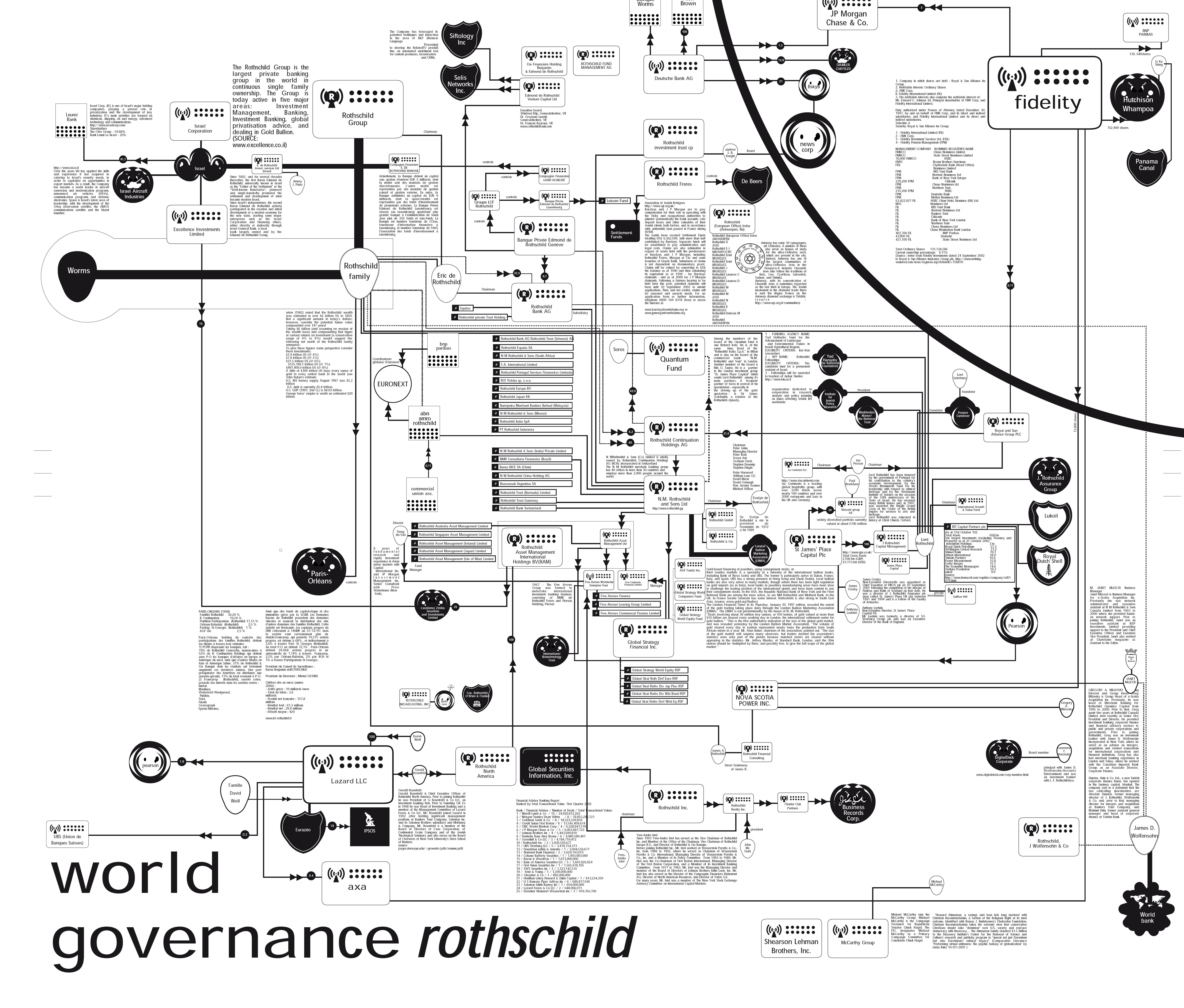
Rothschild Governance Graphic Chart - Who They Own, Who They Control

Rothschild banks are firmly embedded in the Shanghai Foreign Exchange (SHFE) which includes SILVER futures. Nate Rothschild is a board member of BUMI, his London-formed Asian financial predator.  More Rothschild-related posts on this blog

Click image to expand to a MUCH larger view!

Sunday, November 30, 2014

Video series by Eric deCarbonnel of Market Skeptics about the Exchange Stabilization Fund

1st posted by CV  Wednesday, December 14, 2011

After posting yesterday TheDailyBell's informative reference to deCarbonnel & his videos, I was reluctant to belabor the issue, but a well-informed subscriber  prodded me, so here we go.

From Don't Tread on Me
My Critique of “What I Have Been Afraid To Blog About: The ESF and Its History.”

This is a very interesting video series by Eric deCarbonnel of Market Skeptics about the Exchange Stabilization Fund. It is a look into the secret slush fund that operates trillions of dollars of with no oversight. It is the nexus of money and the dark world of market intervention, covert operation, drug and other illicit activities the Elite run. The real purpose of this video series is very unsettling and turns out to be a very crafty piece of propaganda.

Saturday, September 6, 2014

The Enemy Within that We Subsidize: IRS Tax-Exempt Foundations - Norman Dodd *Video*

It comes as no surprise to the crooks we send to represent us, but yes, the IRS and the whole pyramid of "non-profit" 'charities' is really an IRS sham unequaled by even the ones no politician dare even mention. 

In this crisis of deficits and debt, and a Government seeking to increase taxes to strengthen the socialist trend, don't you find it bizarre that foundations are permitted (even encouraged!) to continue plundering the American common folk?

Thursday, August 28, 2014

Save our Swiss gold!

This Swiss method of voting by national referendum - popular initiative - is a fundamental difference between our representative republic and theirs ("democracy" isn't in the Constitution). Think for a minute... would you entrust the American masses to have the same comprehension of our rule of law as do the Swiss? Look at what our national referendum to vote for a president brought us, and that's your answer. Every president and duplicitous congress through patient gradualism, have usurped our individual rights guaranteed by law. Obama is no worse. He just seems that way because he's been brought in to mop-up what other traitors, each one progressively "worse", accomplished before him. Just following orders. The end is nigh. That's what you're feeling. 

The Swiss should have known better than to leave their gold with a foreign custodian after WWII. Although, the American people still don't know if you don't hold it, you don't own it.

August 28, 2014 

In just three months, on November 30, the Swiss will vote in a federal referendum on the future of the country's gold reserves.

The referendum has arisen through a popular initiative called 'Save our Swiss Gold.' In Switzerland, citizens can propose changes to the Swiss constitution through a mechanism called a popular initiative, even if parliament is against the proposal.

The 'Save Our Swiss Gold' initiative is set to highlight the important issue of sovereign gold reserves and who has possession and controls them. It may lead to an important debate about each country's national patrimony and their gold reserves.

The 'Save Our Swiss Gold' initiative is proposing the following:
  • rules to prevent the Swiss National Bank (SNB) selling any more of the country's gold reserves
  • to direct that the SNB must keep a minimum of 20% of its reserves in gold, and
  • to require that all Swiss gold must be stored in Switzerland.
This would require repatriation of Swiss gold since some of the Swiss gold reserves are stored abroad.

The Swiss National Bank (SNB) are against the proposal but were forced last year, in reaction to the popular campaign, to reveal the storage locations of the Swiss gold.

In April 2013, Thomas Jordan, SNB President, confirmed that 70% of Switzerland's gold is in Switzerland, 20% is at the Bank of England, and 10% is stored with the Bank of Canada, and that this mix of holdings had been in place for more than a decade.

Since the Swiss hold a total of 1,040 tonnes of gold reserves, this would mean that there are 104 tonnes of Swiss gold at the Bank of Canada and 208 tonnes in the Bank of England. Jordan's explanation of the foreign gold storage was that it provided "adequate regional diversification and good market access".

Since the Bank of England specialises in the custody of gold on behalf of numerous foreign central banks, it's not surprising then that the SNB stores gold at the Bank of England.

What is surprising is that the SNB still holds gold at the Bank of Canada, since the Bank of Canada is a legacy custodian of other countries' gold and appears to have stopped storing other nations sovereign gold in recent years.

When the Bank of Canada was asked earlier this year as to how many foreign central banks it acts as gold custodian for, it confirmed that it currently acts as gold custodian for only four foreign central banks, but that due to confidentiality, it was unable to disclose the identity of the national account holders.

However, its known from other sources that both the Netherlands and Sweden also hold some of their gold reserves at the Bank of Canada.

The Dutch central bank, De Nederlandsche Bank, has stated previously that most of its gold reserves are held at the Federal Reserve Bank in New York, the Bank of England, and the Bank of Canada, with less than 10% stored in the bank's own headquarters in Amsterdam.

The Swedish Riksbank has also stated recently that its gold is stored in a number of foreign locations, such as the Federal Reserve, the Bank of England but also the Bank of Canada.

The identity of the 4th foreign central that stores gold at the Bank of Canada is unclear, but it may be the Bank of England or the Federal Reserve, since both banks historically held gold accounts with the Bank of Canada.

Given that Canada sold nearly all of its own substantial gold holdings a number of years ago, it seems like an anomaly that the Bank of Canada in Ottawa is still holding gold on behalf of other countries. Most countries that had held gold in Ottawa repatriated it long ago.

Citizens of Switzerland, the Netherlands and Sweden should be concerned that some of their nation's gold is in custody with a bank that is no longer a specialist in gold custody and that did not even see fit to maintain its own gold reserves. They should also be concerned about the secrecy and lack of transparency regarding their gold.

The upcoming Swiss gold referendum will be very interesting and will highlight and focus minds on why the SNB vigorously defends the need to keep some of its gold reserves in a long forgotten vault in Ottawa.

About the Author
Mark O'Byrne
Mark O'Byrne is executive director of Ireland-based GoldCore.