Search Blog Posts

Showing posts with label Retirement. Show all posts

Wednesday, March 4, 2015

The Myth of the Voluntary Military

July 29, 2011 Jeffrey A. Tucker

Ludwig von Mises summed up the essence of government in words that are particularly vivid in wartime:
Government interference always means either violent action or the threat of such action.… Government is in the last resort the employment of armed men, of policemen, gendarmes, soldiers, prison guards, and hangmen. The essential feature of government is the enforcement of its decrees by beating, killing, and imprisoning. Those who are asking for more government interference are asking ultimately for more compulsion and less freedom.

What about those who are called upon to enforce state edicts, whether just or unjust? Every society includes people who are willing to act as the coercive arm of the state, those who are willing to use violence and freely risk their lives as they administer the law. The state has no great trouble recruiting policemen and prison guards. Are there enough such people to amass a huge army of hundreds of thousands of people who are willing to risk their lives carrying out destructive foreign wars of dubious merit?

When you see the pictures of American troops fighting their way through sand storms, in a strange land with strange people, seeking to overturn a government and transform a society that posed no credible threat to the United States, being shot at by average Iraqis who are clearly motivated only by the desire to expel the invader, it is not hard to imagine that US troops are wondering how it all came to this.

The British defense secretary, Geoff Hoon, claims that the coalition armed forces are made up of "men and women who made a free choice to serve their country," whereas Iraqi forces "are motivated either by fear or by hatred." It's hard to say what motivates Iraqi forces (perhaps the desire to repel invasion?), but what he says about coalition troops is simply not true.


The men and women now fighting initially agreed to be in the employ of the military. The United States is not yet conscripting people. And yet how many of these would leave Iraq if they could? What if Donald Rumsfeld announced that anyone now fighting in Iraq is free to leave without penalty? What would become of the US armed forces now attempting to bring about unconditional surrender in Iraq?

It's an interesting question, as a pure mental experiment, because it highlights the essentially forced nature of all modern military service. To leave once the war begins would amount to what the government calls desertion. This word sounds ominous, but in fact it merely describes what everyone in a civilized society takes for granted: the right to quit.

Deuteronomy's exhortation to encourage the Israelites into battle includes an invitation to freely leave: "What man is there that is fearful and fainthearted? Let him go and return unto his house." (20:8) But there is no such right in the modern US military. If you try to leave, you face coercion, particularly if you try to leave in wartime. In this way, the military differs from the police and the ranks of prison guards, jobs from which people are free to walk away without penalty.

Punishing people for attempting to leave the military — to avoid killing and/or being killed — is not a new practice. Mises speaks of the "barbarous" practices used in the 18th century to keep soldiers from deserting their units. The more undesirable wartime conditions become, the more necessary it is for the state to force people to continue to endure them.

The scene that shocked me most in the movie Gods and Generals — and it was clearly not intended to be shocking — occurs when an assistant to Stonewall Jackson informs the general that some soldiers have been discovered in an attempt to desert the army under his command. The general orders them to be tried in a military court, and, if found guilty of attempted desertion, to be shot. They were indeed tried and shot. Thus did these men die for exercising their God-given right to walk away.

One of those shot in the film was a young man recruited by Jackson himself, the son of a friend who decided to return to the North. The scene was included to demonstrate Jackson's impartiality. This general is no respecter of persons — or (more plausibly) personhood. To me, the scene demonstrated the immorality of all modern notions of military discipline.

As the movie shows, the South believed it was fighting for the right of self-government, which required that the states be able to exercise their right to leave an increasingly despotic Union. But the military command would not allow their soldiers to secede. The Confederate generals believed that the Union must be voluntary, but the army itself must be kept together through coercion.
"The legalization of desertion might provide the very key to bringing about a more humane world."

Of course, Northern armies employed the same practice. Many Union troops believed they were fighting against slavery, which amounts to nothing more than forbidding people from exercising their right to flee their alleged owners. But the imposition of the death penalty for soldiers choosing not to fight, that is, to flee their military owners, was assumed to be a normal part of military discipline.

Both North and South claimed they were fighting in order to abolish a form of captivity — the right to self-government in one case, and the right to not be employed against one's will in the other — but the ability of the military to imprison and kill fleeing soldiers was never questioned. It is not often questioned tod

The scene parallels the opening sequence in the movie Enemy at the Gates, when Russian troops in boats are being bombed from the air by German planes. Russian troops begin to jump in the water to get away. Their Russian commander starts to unload his pistol as they leap. The viewer is rightly shocked by this incredible display of totalitarian brutality. Yet, in essence, what we are seeing is nothing more than a fast-forwarded version of the court-martial, death-penalty scene in Gods and Generals.

Both scenes underscore a reality hardly ever discussed: all modern armies are essentially totalitarian enterprises. Once you sign up for them, or are drafted, you are a slave. The penalty for becoming a fugitive is death. Even now, the enforcements against mutiny, desertion, going AWOL, or what have you, are never questioned.

This is remarkable, if you think about it. Imagine that you work for Walmart but find the job too dangerous, and try to quit. You are told that you may not, so you run away. The management catches up to you, and jails you. You refuse to go and resist. Finally, you are shot. We would all recognize that this is exploitation, an atrocity, a crime, a clear example of the disregard that this company has for human life. The public outrage would be palpable. The management, not the fleeing employees, would be jailed or possibly executed.

Murray Rothbard frames the question nicely: "In what other occupation in the country are there severe penalties, including prison and in some cases execution, for 'desertion,' i.e., for quitting the particular employment? If someone quits General Motors, is he shot at sunrise?"

The military has done a study1  of what causes people to go AWOL, concluding that the practice "tends to increase in magnitude during wartime" and when "the Army is attempting to restrict the ways that soldiers can exit service through administrative channels."

The same study profiles the deserters, as compared with nondeserters, as less educated, having a lower aptitude, more likely to be from broken homes, etc. — all the usual reasons why a person is so dishonorably disinclined to want to be killed. Finally, this study examined the effects of desertion on the individual, concluding that choosing to be disemployed from the ranks of the armed and dangerous causes "loss of self-esteem and confidence" as well as "embarrassment and even shame." Well, what else would you expect from someone who has "chosen a certain path and failed to meet the necessary requirements and/or sustain the fortitude to meet those requirements"?

Now comes the report from Diwaniya, Iraq, heavily cited by a US military spokesman, that many Iraqi soldiers were fighting at gunpoint, threatened with death by tough loyalists of President Saddam Hussein.… "The officers threatened to shoot us unless we fought," said a wounded Iraqi from his bed in the American field hospital here. "They took out their guns and pointed them and told us to fight."

It could be that the captured soldiers are only trying to win sympathy. But it would hardly be surprising if it were true. To force people to fight when they would rather not is the very essence of modern military organization. In modern practice, there is no such thing as a voluntary military. Whether you are forced into the machine or not (via conscription or via payments in tax dollars), once you are a cog, you must stay in no matter how much grinding you do or how much you are ground.

The slave-like nature of the military commitment has no expiration date. Yes, there are contracts, but the military can void them whenever it so desires. Predictably, it desires to void these contracts (through so-called stop-loss regulations) when the enlisted most want to leave: when they must kill and risk being killed. All branches of the military have implemented these stop-loss regulations because of the war on terror. This amounts to the nationalization of human beings.
 
Still, one wonders how much the ranks of the militarily employed would shrink in absence of antidesertion enforcement. If modern presidents had to recruit the way barons and lords recruited, and if they constantly faced the prospect of mass desertions, they might be more careful about getting involved in unnecessary, unjust, unwinnable wars, or going to war at all. Peace would take on new value out of necessity. When going to war, they might be more careful to curb their war aims, and match war strategies with those more limited aims.

In fact, we might discover through the study of the history of antidesertion statutes the key to the transition from the limited war and decentralized military of the medieval world to the mass murder of the modern total war. The legalization of desertion might provide the very key to bringing about a more humane world.

In the meantime, US officials would do well to stop complaining that Iraqi soldiers are being forced to serve and forced to kill. A press release from the Air Force announcing its new stop-loss rule says, "We understand the individual sacrifices that our airmen and their families will be making.… We appreciate their unwavering support and dedication to our nation."

One might even have a greater appreciation for their sacrifice (even if not their mission) if one knew that it were undertaken willingly.

This article is excerpted from It's a Jetsons World, "The Myth of the Voluntary Military" (2011).

source: Mises.org  

Monday, February 23, 2015

A New Way to Hold Gold (2015 Update)

Posted on February 23, 2015 by Chris Martenson

What if you could carry and exchange gold in the exact same manner as you do with the dollar bills in your wallet?

Last year, we introduced the precious metals community to a company called Valaurum, which has developed a technology that’s making this possible.

Here’s the write-up from last year:

Democratizing Gold

In short, a fractional gram’s worth of gold is affixed to layers of polyester, creating a note – called an “Aurum” – similar in dimension and thickness to a U.S. dollar bill. This gold (usually 1/10th or 1/20th of a gram) is commercially recoverable. So an Aurum offers similar potential as a coin or bar, in terms of providing a vehicle for storing and exchanging known, dependable increments of precious metals – just in much smaller (and more affordable) amounts than commercially available to date.

The big idea here? In a world where a 1oz coin of gold costs over $1,200, an Aurum will let you hold a few dollars’ worth of gold in a single note. If you’ve got pocket change, you can be a precious metals owner.

And you don’t have to change your behavior. You can store and transport an Aurum in your billfold along with your dollars.

Understanding the Aurum

As the saying goes, a picture’s worth a thousand words. Here’s a picture of an Aurum designed for Peak Prosperity that the Valaurum team produced for us:


You’ll see that with even just 1/20th of a gram of gold involved, it’s enough to make the Aurum appear to be “made of” gold. 

The characteristic luster, color, and shine of the 24-karat gold used is immediately apparent.

The Aurum is designed to be handled in the same manner as we do with our “paper” money. And, despite having a more ‘plastic’ feel to it (resulting from the polyester backing), it’s as flexible, lightweight, and familiar-feeling as paper currency.

The big difference, of course, is that instead of being a claim on something else, it simply is what it is: a fractional gram of gold. It can be stored, traded, or melted down – just like a coin or bar.

Here’s a brief video that gives an overview of the production process:

Implications

Being able to hold gold in this form is significant for several reasons.

First, it makes gold ownership available to all budgets. Many of the world’s households have been priced out of gold to date. This changes that completely.

Second, it enables the potential for everyday transactions should we ever return to a precious metal-backed monetary standard. It answers the challenge: How will you pay for your groceries with gold? With an Aurum, it’s now easy.

Whether Valaurum’s product emerges as the winning horse or not, the world definitely needs this type of solution (i.e., convenient fractional physical metal) to go mainstream.
I’m very excited by this new innovation in the bullion industry, and I explore the matter in depth in this podcast [14]. If you’re similarly intrigued, it’s worth the listen.

The response to last year’s podcast was tremendous. It quickly became one of the most popular in Peak Prosperity’s history. If the description above interests you, and you haven’t listened to it already, you can do so by clicking here [14].

Big News

So, what’s happened with the aurum over the past year? Has the concept caught on with precious metals investors?

We’ve invited Adam Trexler back to the program to find out. In this week’s podcast, he shares with us a number of positive updates about adoption of the aurum, demand by the bullion dealer community, and product enhancement to the gold note itself.

But most exciting is this: a (small) sovereign central bank is deep in negotiations with Valaurum to replace its existing national currency with aurum notes, creating a true precious-metals backed monetary system. As best we know, this would make it the only one in existence in the world today.

If this indeed occurs, it could be a game-changer. Changes in trust and perception always begin with a non-conformist having the courage to depart from the herd’s consensus. Even a small country rejecting fiat money in favor of a gold standard will catch the attention of others. And as the current currency wars exacerbate, as they inevitably will, more countries will increasingly look to adopt monetary regimes that work better. 

Perhaps that will be a return to gold, in this new form.

More Big News

The Peak Prosperity aurum notes we printed up last year quickly sold out. Demand was much higher than we had expected.

For those who did not have the chance to purchase any — or for those who did, and are interested in collecting each new series that gets produced — we have good news: the new 2015 Peak Prosperity aurum (1/10th gram) is now available for purchase [15]. Those interested in doing so can learn more by clicking here [15].

And for those interested in the latest on Valaurum,  click the play button below to listen to my latest interview with Adam Trexler (31m:20s)


via washingtonsblog

Saturday, February 14, 2015

Will Uncle Sam get your IRA?

Posted on February 13, 2015 by Pat Heller

I have written a number of times that I expect the U.S. government will eventually take or somehow get control of all assets in private retirement accounts, including precious metals individual retirement accounts. The basic reason for this expectation is that the U.S. government is running up tens of trillions of dollars of debts and unfunded liabilities. The trillions of dollars of private retirement account assets are just too big a target for the politicians and bureaucrats to leave alone.
Will Uncle Sam get your IRA?

An early attempt by the government to take control of such assets came soon after President Clinton took office. As now structured, income taxes are not paid on most retirement accounts until the assets are withdrawn. This event to collect income taxes usually occurs years down the road.

In the early 1990s, that concept was turned around. The proposal was to impose a 15 percent tax on all existing private retirement accounts, then tax new contributions also at the 15 percent rate.  The payoff for taxpayers was that any future withdrawals would be tax free.

A new plan was presented to the House Committee on Education and Labor in hearings on Oct. 7, 2008, by Professor Teresa Ghilarducci. This proposal was for the U.S. government to seize all private retirement assets and replace them with Guaranteed Retirement Accounts (GRAs) managed by the Social Security Administration. The only assets that would be allowed into these new Accounts would be U.S. Treasury bonds paying 3 percent interest (indexed for subsequent Consumer Price Index changes).

Further, the plan called for 5 percent of payrolls to be withheld, on top of existing Social Security and Medicare tax withholdings, for deposit into these GRAs.  The last feature of this proposal is that upon the death of the account holder, part of the remaining assets would be forfeited to the U.S. government. That was a huge change where all private retirement account assets, up to now, go to the heirs.

The one bonus to bribe Americans to go along with the nationalization of private retirement accounts was that the assets would be converted to government bonds as of their value at a designated earlier date when most paper assets such as stocks, bonds and currencies were mostly at a higher value than they were in October 2008. Given the opportunity to recoup some of the losses that retirement accounts had suffered in 2007 and 2008, this was a definite enticement.

In September 2010, the Departments of Labor and Treasury held joint hearings to advocate that, upon retirement, the assets in private retirement accounts would be converted into annuities, where the residual assets upon death would ultimately all be retained by the U.S. government.

In January 2014, during his State of the Union address, President Obama proposed the establishment of the MyRA. This is initially a voluntary program for lower-income Americans to set aside some after-tax dollars to earn income that can later be withdrawn tax-free. However, there are several limitations. First, these accounts can only own U.S. Treasury debt that pays the same interest rate as the Thrift Savings Plan’s Government Securities Investment Fund. This fund was paying less than 2 percent at the time of the President’s proposal. A second major limitation is that accounts could not exceed $15,000 in total value. Further, these accounts cannot exist longer than 30 years.

Starting two months ago, a small number of these MyRA accounts have been established.
 
Investment writer Doug Fabian has described an all-too-plausible scenario that he expects to happen before the end of President Obama’s term. He anticipates that there will be some major financial crisis in the United States, greater than the Great Recession of last decade, where investors will see the values of their stocks, bonds and other assets mostly plummet.

This could be triggered by any number of incidents. As some examples, Greece could leave the European Monetary Union, which would force many major American and foreign banks to write down tens of billions of dollars of bonds that they are now carrying at face value.  The developing fall in demand for upper-end U.S. housing could expand to all housing nationwide, leaving U.S. banks with massive bad debts that risk their survival. Or local, school district, regional, and state governments all across America could be forced into bankruptcy after the Governmental Accounting Standards Board issues their pronouncements in June requiring these entities to more fully report the extent of their tens of trillions of dollars of unfunded liabilities for employee pensions and retiree health care benefits. There are many other possible crises, but this gives you an idea of how massive a financial crisis could occur.

At the time when such a financial crisis hits, private retirement account assets will almost all drop in value – by a lot.  If, or when, this occurs, there will be a huge groundswell from people who no longer have enough wealth to retire. Mr. Fabian theorizes that this will be the perfect time for the federal government to modify MyRA accounts to accept unlimited asset transfers from existing private retirement accounts. By the federal government offering people the opportunity to get credit for the value of their assets before the financial crisis was triggered, Fabian expects that a high percentage of Americans would voluntarily be eager to turn their retirement assets into loans to the U.S. Treasury.

Such a scenario would be a power-grabbing politician’s dream. Instead of being thought of as a President who stole people’s retirement assets, the person in charge in such circumstances were be hailed as a savior. Unfortunately, I think the risk of such events coming to pass by the end of 2016 are high enough that Americans need to prepare their finances sooner rather than later.

Should any huge financial crisis come to pass, expect to see a surge in demand for precious metals, especially gold and silver. Other portable tangible assets such as rare coins and paper money will also likely experience stronger demand.  However, the increased demand for such assets will not be for placement in retirement accounts.  Instead, look for the surge in demand to be for assets that can be owned and possessed directly.

Patrick A. Heller was the American Numismatic Association 2012 Harry Forman Numismatic Dealer of the Year Award winner. He is the owner emeritus and communications officer of Liberty Coin Service in Lansing, Mich., and writes “Liberty’s Outlook,” a monthly newsletter on rare coins and precious metals subjects. Past newsletter issues can be viewed at http://www.libertycoinservice.com. Other commentaries are available at Coin Week (http://www.coinweek.com and http://www.coininfo.com). He also writes a bi-monthly column on collectibles for “The Greater Lansing Business Monthly” (http://www.lansingbusinessmonthly.com/articles/department-columns). His Numismatic Literary Guild award-winning radio show “Things You ‘Know’ That Just Aren’t So, And Important News You Need To Know” can be heard at 8:45 a.m. Wednesday and Friday mornings on 1320-AM WILS in Lansing (which streams live and becomes part of the audio and text archives posted at http://www.1320wils.com).  

via numismaticnews

Thursday, February 12, 2015

Keeping Big Pharma in Seventh Heaven is Keeping Addicts in Hell

February 11, 2015 
by Martin G. Selbrede

How the State of Massachusetts is Moving the Goalposts in Light of Dr. Kishore's Successful Treatment of Addiction to Provide Pharmaceutical Companies with a State-Funded Customer Base

This is the seventh in an ongoing series of articles about Dr. Punyamurtula S. Kishore, the Christian doctor who innovated the Massachusetts Model of addiction treatment. 

The previous six articles documented how conventional addiction therapies based on substitute narcotics (methadone and Suboxone®) leave only 2% to 5% of patients who won't relapse back into full-scale addiction after twelve months. The few who haven't relapsed will often take prescribed substitute narcotics indefinitely, creating life-long issues for them. In contrast, Dr. Kishore's sobriety-based approach is non-narcotic in orientation. His method doesn't lead to a miserable 2% to 5% success rate at the one-year mark, but an astonishing 50% to 60% success rate based on hard test data (rising from 37% in 1994 to over 50% in 2011 with a quarter-million patients having passed through his program).

...from Hippocrates Oath, solemnly kept by Dr.
Kishore - Man cannot serve two masters.
Massachusetts buried this medical miracle by incarcerating Dr. Kishore in September 2011 and withholding Medicare payments to his fifty-two treatment centers, causing their complete collapse. The consequences of the state's actions against Dr. Kishore's work permeate the previous six articles. To repeat that material, even in condensed form, would consume most of this present article. If you've not followed this series, review the earlier articles before diving into this newest article. Without the background of the earlier articles, you can fall prey to ongoing manipulation (by omission and commission) by the state and its media gatekeepers.

Moving the Goalposts

The first example of "moving the goalposts" in this series had reference to the cleverly-edited graphic used to hide the disastrous 80% recidivism rate occurring during the first month of conventional drug addiction treatments. Because the first-month results have simply been chopped off the graph, they don't come under consideration. This opens the door to redefining success. One moves the goalposts for one of two reasons: to block a competitor from succeeding, or to create the illusion of success for yourself. This tactic is a blatant example of the latter.

Moving of the goalposts in such a way can only be effective if you are ignorant of the correct location of the goalposts. If someone comes along and blows the whistle on how dislocated the goalposts are, and what constituencies are benefiting from the reality distortion field thus imposed, he becomes a threat. If the whistleblower's success rate is many times higher than the conventional success rate, this becomes a second layer of threat.


Both forms of threat to the status quo need to be quashed to maintain the blissful ignorance of the populace, to keep the goalposts at their "preferred" new location. When the media keeps the people it reputedly serves ignorant of both aspects of these moved goalposts, it becomes a key accessory to the redefinition of success. Once journalists start down that road, it becomes increasingly difficult for them to admit fault, recant, and fight against the ignorance they've been enforcing so faithfully. No one wants to admit culpability in moving the goalposts. Therefore, Dr. Kishore's clinical record is simply ignored.

There are three other major respects in which crucial goalposts have been moved during the escalating drug addiction crisis taking its massive toll upon our communities. We will examine the tactics, significance, and high price we are all paying for the moving of these goalposts that should never have been moved. We will then come to understand why Solomon's maxim remains painfully valid for us today: "Remove not the old landmark; and enter not into the fields of the fatherless" (Prov. 23:10). Click to continue reading this article.

Thursday, January 29, 2015

Comparing the inflated cost of living today from 1938 to 2015: US Dollar losing an enormous amount of purchasing power since 1938

 Posted by mybudget360
 
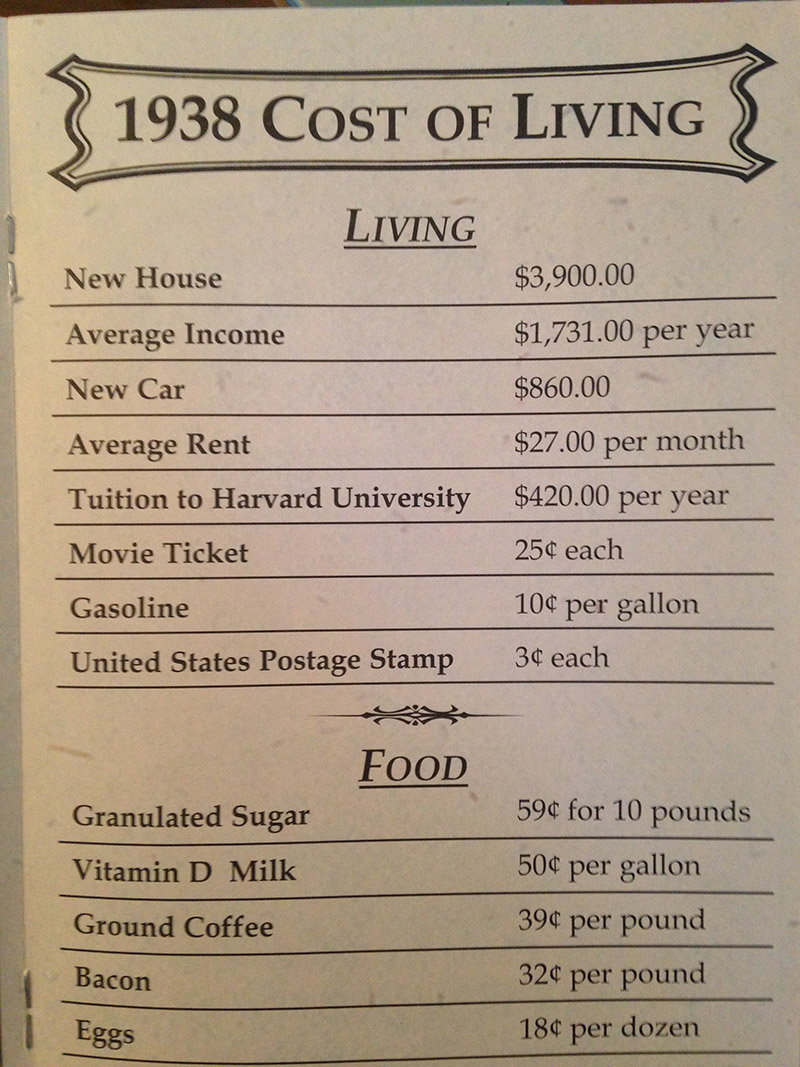
People have a hard time understanding how inflation erodes their purchasing power.  Little by little the cost of everything goes up and people simply assume this is normal in an economy.  The $2 movie ticket becomes a $8 movie ticket.  That can of tuna just got smaller but the price remains the same.  The cost of going to college went from manageable to needing large student debt merely to complete a four year degree.  Inflation is argued to be a purely monetary outcome.  You have too much money, in the form of cash or credit in today’s case, chasing fewer goods.  In our current economy, debt is the fuel accelerating inflation.  You can see this in items like housing, cars, and college where debt is the primary fuel driving prices higher.  The big problem today is that incomes are simply not rising fast enough to keep up with the rise in other expenses.  Over time, inflation has a big destructive power.  I thought it would be useful to look at the cost of typical items in 1938 and compare them to where things stand in 2015.


Comparing 1938 to 2015

Over a year ago, we looked at some old data and found this to be useful to readers.  I thought it would be helpful to update the data and see where things stand today in 2015.  Someone sent this snapshot of the cost of living in 1938.  It really is fascinating looking at inflation over a very long period of time.  In this case, we are looking at spending pre-World War II.  Most Americans probably have no sense as to what the cost of living was back then since they are mired in the fight of living paycheck to paycheck.
Take a look at the cost of living in 1938:
cost-of-living (1)
Source:  Reddit
What is important is to look at income in relation to the cost of living.   A new home was about twice the annual average income.  Today, with the median household income being $50,000 and your typical new home costing $298,000 we are definitely on the more expensive side (6 times annual income versus 2 back in 1938).  Look at the new car costs.  A new car cost about $860 or half of annual income.  Today, a regular car can cost $32,000 and most will need to finance it.  Tuition to Harvard was $420 per year and today Harvard tuition is nearly $62,000 with room and board:
harvard
Source:  Harvard website

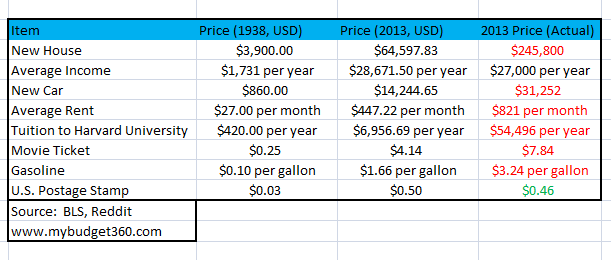
In other words, the typical family of today would need to use all their annual income to send their kid to Harvard plus go in debt while in 1938, your average family had income to send 4 kids to Harvard per year.  The most inflated of all categories is college tuition.

Looking at various costs adjusting for inflation

I put this table together and adjusted for inflation to give you a better perspective:
inflation-and-actual-prices
I wanted to update some of this data for 2015 as well:
New house:                        $298,000 (Source: Census)
Average income:              $28,000 (Social Security)
New Car:                             $32,000 (Bankrate)
Average Rent:                   $950
Tuition to Harvard:          See above
Movie ticket:                     $8
Gasoline:                             $1.99
US Postage Stamp:          $0.49
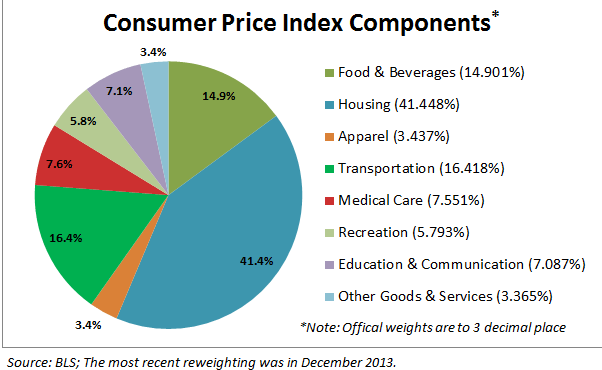
So basically every single category is up besides gasoline given the crash in oil prices in 2014.  But this is a small drop in the bucket given what consumes the biggest portion of your budget:
inflation categories

Housing, food, medical care, transportation, and education make up the biggest expenses.  Housing by far consumes the biggest portion.  And look at how fast prices have gone up since 2000:

inflation since 2000
Medical care is up over 70 percent.  Housing is up over 40 percent even with the crash in the housing market.  Basically the only items that held steady were apparel and recreation.  But look at how incomes are doing:
real household income
You wonder why you feel like you have less purchasing power?  You feel poorer because you are thanks to the slow eroding power of inflation.  The Fed would like to argue that there is no inflation but just look at housing costs, medical care, college tuition, and grocery bills and tell the regular working American family that there is no inflation.

Source

Tuesday, January 27, 2015

▶ SHOCKING Report Reveals Government STEALING Pension Funds! - YouTube


Sources:
"Is Your Pension Courting Catastrophe? - Bloomberg View"
http://www.bloombergview.com/articles...
"Detroit attorney says pension cuts actually close to 50 percent - World Socialist Web Site"
http://www.wsws.org/en/articles/2014/...
"Public service unions not entitled to $28B pension surplus, says Supreme Court | Toronto Star"
http://www.thestar.com/news/canada/20...
"Portugal raids pension funds to meet deficit targets - Telegraph"
http://www.telegraph.co.uk/finance/fi...
"Hungarian savers say government is stealing their pensions | Reuters"
http://www.reuters.com/article/2014/1...
"Russia Seized Citizens Pension Funds. Could That Happen in the U.S.? - Businessweek"
http://www.businessweek.com/articles/...
"UPDATE 2-Poland reduces public debt through pension funds overhaul | Reuters"
http://www.reuters.com/article/2013/0...
"Argentina seizes pension funds to pay debts. Who's next? – Telegraph Blogs"
http://blogs.telegraph.co.uk/finance/...
"How the West Was Lost: Fifty Years of Economic Folly - And the Stark Choices ... - Dambisa Moyo - Google Books"
https://books.google.ca/books?id=ivXM...


Monday, January 26, 2015

U.S. nursing homes' new tactic to collect debts: Seizing power of attorney from patients' relatives

If you haven't already cleared your remaining savings and other assets off the table, you probably should not rule it out until checking out this new government/corporatist fraud. Government is but the collection enforcement agent for the Corporatists.
 ~~~~~~~~~~~~~~~~~~~~~~~~~~~~~~~~~~~~~~~~~~
The New York Times | January 26, 2015 | Last Updated: Jan 26 11:16 AM ET
Piotr Redlinski/The New York Times: Dino and Lillian Palermo at the Mary Manning Walsh Nursing Home, which filed a guardianship petition asking the court to give a stranger full legal power over Lillian Palermo and complete control of her money, in New York, Oct. 31, 2014. 

NEW YORK — Lillian Palermo tried to prepare for the worst possibilities of aging. An insurance executive with a Ph.D. in psychology and a love of ballroom dancing, she arranged for her power of attorney and health care proxy to go to her husband, Dino, eight years her junior, if she became incapacitated. And in her 80s, she did.

Dino Palermo, who was the lead singer in a Midtown nightclub in the 1960s when Lillian’s elegant tango first caught his eye, now regularly rolls his wife’s wheelchair to the piano at the Catholic nursing home in Manhattan where she ended up in 2010 as dementia, falls and surgical complications took their toll. He sings her favourite songs, feeds her home-cooked Italian food, and pays a private aide to be there when he cannot.

It’s a strategic move to intimidate. Nursing homes do it just to bring money.

But one day last summer, after he disputed nursing home bills that had suddenly doubled Lillian Palermo’s copays, and complained about inexperienced employees who dropped his wife on the floor, Dino Palermo was shocked to find a six-page legal document waiting on her bed.

It was a guardianship petition filed by the nursing home, Mary Manning Walsh, asking the court to give a stranger full legal power over Lillian Palermo, now 90, and complete control of her money.

Few people are aware that a nursing home can take such a step. Guardianship cases are difficult to gain access to and poorly tracked by New York state courts; cases are often closed from public view for confidentiality.
Piotr Redlinski/The New York Times: Nursing homes are using a New York State statute created to protect the infirm as a way to get paid.

It’s so cruel. Mr. Palermo loves his wife, he’s there every single day, and they just threw him to the courts.

But the Palermo case is no aberration. Interviews with veterans of the system and a review of guardianship court data conducted by researchers at Hunter College at the request of The New York Times show the practice has become routine, underscoring the growing power nursing homes wield over residents and families amid changes in the financing of long-term care.

In a random, anonymized sample of 700 guardianship cases filed in Manhattan over a decade, Hunter College researchers found more than 12 percent were brought by nursing homes. Some of these may have been prompted by family feuds, suspected embezzlement or just the absence of relatives to help secure Medicaid coverage.

But lawyers and others versed in the guardianship process agree that nursing homes primarily use such petitions as a means of bill collection – a purpose never intended by the Legislature when it enacted the guardianship statute in 1993.

At least one judge has ruled that the tactic by nursing homes is an abuse of the law, but the petitions, even if they are ultimately unsuccessful, force families into costly legal ordeals.

The Palermo case is no different than any other nursing home bill that they had difficulty collecting. When you have families that do not co-operate and an incapacitated person, guardianship is a legitimate means to get the nursing home paid.

“It’s a strategic move to intimidate,” said Ginalisa Monterroso, who handled patient Medicaid accounts at the Mary Manning Walsh Nursing Home until 2012, and is now chief executive officer of Medicaid Advisory Group, an elder care counselling business that was representing Dino Palermo in his billing dispute. “Nursing homes do it just to bring money.”

“It’s so cruel,” she added. “Mr. Palermo loves his wife, he’s there every single day, and they just threw him to the courts.”

Brett D. Nussbaum, a lawyer who represents Mary Manning Walsh and many other nursing homes, said Dino Palermo’s devotion to his wife was irrelevant to the decision to seek a court-appointed guardian in July, when the billing dispute over his wife’s care reached a stalemate, with an outstanding balance approaching $68,000.
Nina Bernstein/The New York Times Dino and Lillian Palermo

“The Palermo case is no different than any other nursing home bill that they had difficulty collecting,” Nussbaum said, estimating that he had brought 5,000 guardianship cases himself in 21 years of practice. “When you have families that do not co-operate and an incapacitated person, guardianship is a legitimate means to get the nursing home paid.”
READ MORE

Lobbyists can make You Rich if you're a Politician

Instead of honoring your oath of office and following the rule of law, just feign 'love of country', stick to Party commandments, and the special interests will stuff your every pocket in every suit.

Sincere or Strategic, Lobbyists Give Big

by Emily Kopp on March 12, 2014 8:00 AM

It seems a lobbyist's work is never done.

You have to know policy, wrangle with legislative language, persuade important people of the rightness of your cause, market yourself to clients. And then, for many on K Street, there's another key part of the job: pulling out your checkbook. Federal lobbyists are often campaign contributors, too -- sometimes offering, sometimes responding to not-so-subtle requests.  

And the sums can be large. In fact, the 25 lobbyists who have given the most to political campaigns in the first half of the 2014 cycle have combined to give a total of $1.85 million. Whether they give strategically or out of partisan passion depends on the donor, but there's little doubt that their generosity can play a role in wedging doors open in congressional office buildings.

Or, as sixth-ranking lobbyist-donor Ben Barnes put it, "I think anyone could be sanctimonious and say they're donating for the love of their country, but how you make a living has something to do with it." Barnes, whose clients include Texas A&M University, Texas Gulf Energy and Huntsman Corp., has long been a fixture of Democratic politics in Texas, and is a top bundler for congressional campaigns. So far in this cycle, he has given out about $79,000.

Lobbyists rank 13th among all interest groups in contributions so far in the 2014 campaigns, a jump from 22nd at the end of the 2012 cycle. Individual lobbyists contributed far more than lobbying firms' PACs -- 22 times as much. 
And as in 2012, the big-giving lobbyists prefer writing their checks to candidates or committees, rather than sending them funds into a larger pool -- for instance, a super PAC. Only four lobbyists on our list contributed to super PACs. Tonio Burgos, the director of his own lobbying firm, contributed $25,000 to the liberal House Majority PAC, though even absent his super PAC donation Burgos would have earned a spot in the top 25.

Overall, super PACs have received a pitiful 2 percent of lobbyists' donations so far, a dip from their 7 percent share in 2012.

An array of clients -- unions excepted


Among our top 25 contributors, 24 work for a lobbying or law firm or for a consulting group. Their major clients include household names like General Electric, Caterpillar and Microsoft.

Fifteen of our top 25 represent firms in the insurance industry, while 14 count pharmaceutical firms among their clients. Altogether the top lobbyist-donors are associated with 65 different industries in 12 sectors. Labor is the only industry not represented by even one of the the top 25.

Together this band of lobbyists represented 481 discrete clients in 2013, about 19 clients per lobbyist.

The exception? Nicholas Calio, a former aide to President George W. Bush, who lobbies in-house at Airlines for America, a trade association that spent nearly $8.5 million lobbying in 2013.

The technology sector is well represented by this coalition. General Electric, Microsoft, Intuit Inc. and Blackberry each number four clients among the group. Seven lobbyists of our top 25 represent Blue Cross/Blue Shield, while five represent the Edison Electric Institute, a trade group of power companies.

Kenneth Kies is the top lobbyist-donor so far this time around, having given close to $140,000. Together with his wife, he's given nearly $200,000 to candidates and committees in the 2014 cycle, putting them 22nd among all donors. Kies, who years ago worked for two tax committees in Congress, is now with the lobbying firm Federal Policy Group, where his clients include the American Bankers Association, Blue Cross Blue Shield and Microsoft.

Party matters, again
There are deep partisan divisions among the top 25. Sixteen of them gave exclusively to one party or the other: Five donated solely to Republicans, 11 gave only to Democrats. Some who work at the same firm were diametrically opposed in their giving patterns: Capitol Counsel LLC's Sharon Finley funneled all of her contributions to Democrats, while 100 percent of her partner Jeffrey Walter's donations went to the GOP.

The nine who divided their donations showed strong party preferences too, though. Even the two most even-handed donors contributed $4 to one party for every $1 they gave the other. James D. Massie donated $44,000 to Democrats and $11,000 to Republicans; David E. Franasiak donated $51,000 to Republicans and $12,600 to Democrats.

In D.C., genuine friendships often overlap with relationships built on mutual favors. Add the fact that many well-paid lobbyists once worked in congressional and agency offices where they still know people and it can be especially hard to tease out the motivations behind any single donation.

"If I only donated for the good of my firm or business I wouldn't have donated to candidates that I knew had no chance. But I knew it was important for them to have a voice," one lobbyist on the list told OpenSecrets Blog. His belief that a Democratic majority is better for the country "animates my giving," he said.

Another lobbyist on the list was more pragmatic. He favors the pro-business stance of Republicans and hopes they take control of the Senate and then the White House. At the same time, "this is politics, and you have to participate in the system," he acknowledged in an interview.

Lobbyists prefer incumbents, bolster embattled Democrats
Federally registered lobbyists have spread $18 million in contributions among over 100 candidates and members of Congress so far in the 2014 cycle, with donations tilting to the right: $7.4 million has gone to Democrats, $8.35 million to Republicans. Super PACs received a very small share, only about $71,000.

About 93 percent of lobbyists' total spending has gone to incumbents, and much of it has gravitated to just a few veteran lawmakers in the leadership. While lobbyists aim for access, they love stability, not eager to have to forge new relationships every election cycle. 
Top Recipients of Lobbyist-Donors, 2014 cycle

Sen. Mitch McConnell (R-Ky.)
$281,301
Rep. John Boehner (R-Ohio)
$278,380
Sen. Mark Pryor (D-Ark.)
$221,450
Sen. Mark Udall (D-Colo.)
$204,400
Sen. John Cornyn (R-Texas)
$194,300
Sen. Mark Begich (D-Alaska)
$160,300
Sen. Jeanne Shaheen (D-N.H.)
$129,433
Sen. Kay Hagan (D-N.C.)
$123,733
Sen. Mark Warner (D-Va.)
$121,750
Sen. Susan Collins (R-Maine)
$121,486

Senate Minority Leader Mitch McConnell (R-Ky.), who faces a primary challenge, has received the most from lobbyists in the midterm cycle so far, more than $281,000. House Speaker John Boehner (R-Ohio) is a close second at $278,380.