Search Blog Posts

Showing posts with label LBMA. Show all posts

Thursday, December 4, 2014

ICBC: A New Global Currency & Gold Setup Is Being Conceived

A good lead-in for Rothschild's swelling Chinese domain is this one from us posted first on March 5th: Rothschild may have already become the Custodian for China's Gold

Friends, deep down in your heart you know those ankle shackles you're wearing are not going to fall off on their own.


The Chinese Perspective On The International Gold Market


Published: 15-07-2014 17:00
ICBC: A New Global Currency Setup Is Being Conceived
At the LBMA Bullion Market Forum in Singapore on June 25, 2014, two very important speakers attended; Xu Luode, chairman of the Shanghai Gold Exchange, and Zhou Ming, General Manager of the Precious Metals Department at ICBC. Me and Torgny Persson have written about the speeches from Xu and Zhou in previous posts, in this post we will take a closer look at what Zhou said, based on what Chinese media have written about it (whereas Western media are reluctant to cover this). His statements are not entirely new as he already had revealed some objectives of ICBC's precious metals department in an interview conducted on January 7, 2014; ICBC's main goal is to become a significant player in the international gold market. Yet, he made a few remarkable statements in Singapore. First, a few segments from the article/interview published in January:  

In 2013, ICBC physical gold sales increased by more than 80% YoY, the growth rate of the entire line of business also grew more than 30% over the previous year.

For Zhou, the growth of the precious metals business is not accidental. Aside from ICBC's management in forward-thinking and advantages from being a bank, it's also because in China's internationalization process banking institutions are required to play this role.

When the precious metals department was established, ICBC chairman Jiang Jianqing said: "We have the ambition that ICBC becomes a world-class commercial bank in precious metals investment management."

Zhou: "...one day China enters the international stage, we will need more people to participate in understanding the characteristics of capital flows, so we don't have to be so passive. I drive our traders to work on scale and quantitative problems of our platform for the possibility of taking part in international transactions.

For the future, Zhou Ming's goals are clear and simple: to continue to build the precious metals battleship, heading towards international markets. "In 2013 China became the world 's largest gold producer and consumer, there is no reason for it not to have any voice in international price fluctuations."

The following is a translation of an article in Chinese media about Zhou's speech at the LBMA Forum in Singapore June 25, 2014. Translated by Soh Tiong Hum from Terraseeds.com

The Chinese Perspective On The International Gold Market


2014/7/4 Source: Money Weekly

Invited by London Bullion Market Association (LBMA), Zhou Ming, General Manager of Precious Metals Department at Industrial and Commercial Bank of China (ICBC), represented the bank at the LBMA Bullion Market Forum 2014 held in Singapore. Zhou made a keynote speech where he:

  1. Expanded on China's perspective of the international gold market.
  2. Explained the structure of China's gold market to forum participants.
  3. Introduced ICBC Precious Metals Department's development and
  4. Described ICBC's status and function in the development of the Chinese gold market.
  5. Elaborated on the future direction.

Also invited to the LBMA forum were heads of Chicago Mercantile Exchange, World Gold Council, JP Morgan, HSBC, Barclays, Deutsche Bank and many other institutions.

Global precious metals market has experienced centuries of evolution and development. After World War II, the world economy was re-arranged to form a dollar-dominated international monetary system of credit. The international status of gold was replaced by the dollar and the international price of gold was pegged to the dollar. This phenomenon was referred to as 'dollar-pricing'.

Following several economic crises, US dollar's influence on the international monetary system is now on the wane. The 2007 subprime crisis in the US delivered an unprecedented blow to US Dollar hegemony. Gold, which has the best properties of money of all precious metals, in contrast became a banner of resistance to the economic crisis. Its price of $ 290 per ounce in the beginning of 2000, shot above $ 1900 per ounce in 2011.

Six years after the global financial crisis, despite a series of financial stimulus - quantitative easing that increased the size of the Federal Reserve's balance sheet to $ 4 trillion in a few years, both the current and previous head of the Federal Reserve remain defensive of QE policy. Although the Fed announced that it will start reducing the scale of QE on December 19, 2013, after which the international gold price fell below $ 1200 per ounce at one point, international analysts see China's demand and huge import as a decisive element for the reversal in the gold price

In 2013 a Bloomberg report said that 26 million ounces (800 metric tonnes) of gold was moved from London to Swiss refiners and then to China via Hong Kong.

When Jeremy East, Managing Director at Standard Chartered Bank, asked at the LBMA Forum In Singapore if the statement "Western gold moves East" was true, Zhou made the following statements:

  1. The world price of gold in recent decades was dollar-priced and fluctuated with the US dollar.
  2. Fed implemented QE caused the issuance of dollars that exceeds demand.
  3. International gold prices will return to rational levels after shooting high.
  4. With the status of the US dollar as the international reserve currency is shaky, a new global currency setup is being conceived.
  5. Uncertain changes will happen to gold's traditional dollar-pricing so the US dollar's influence on gold pricing needs to be re-evaluated.
  6. With the rise of Asian economies, China and India will continue to be the world's pillars of physical gold demand.
  7. Gold has not only moved from West to East but will continue to move to the East.

The factors supporting the gold price are not limited to these. Stephen Roach, senior lecturer at Yale University, formerly chairman of Morgan Stanley Asia and chief economist at Morgan Stanley agreed with Zhou in a conversation last year: "Although the US stock market continues to boom in hand with falling bond yields, US economic recovery remains fragile with a lack of recovery in US companies which causes labor unemployment levels to remain high, GDP growth to slow down and inflation to remain lower than pre-crisis levels. The international gold price is not in an environment that sustains falling prices.

Now in the second half of 2014, the gold market is an important part of the world's modern financial system and that means for China to internationalize its financial markets. When the development of China's gold market supervision and regulation policies are complete, China's commercial banks' overseas businesses will flourish and opportunities from the Shanghai FTZ can be used; the Shanghai Gold Exchange will officially launch an international board within 2014.

The international board will initially look at foreign institutional investors in the region to establish a free trade yuan-denominated spot gold trading platform and a corresponding settlement system so as to provide offshore RMB investment and circulation in a new channel. RMB cross-border trading accounts will also have a payment service.

Breakthroughs in many national policies and system developments will play an important part in the internationalization of China's financial market and its place in international gold-pricing.

End of article

Oddly enough there hasn't been any mainstream news outlet that has published anything about the speeches from Xu and Zhou, while these are very important for the international gold market. Additionally the LBMA just published the slides from the speakers at the forum in Singapore, except the ones from Xu and Zhou! Torgny Persson, who visited the forum, assured me both did use slides in their presentations. I find it strange these slides are not published. The LBMA notes on its website that in a couple of weeks it will publish the transcripts of the speeches from the Singapore forum. I'm very curious if the transcripts of Xu and Zhou will be appended.     

Koos Jansen
​via ​

Wednesday, November 12, 2014

Big Banks Busted Massively Manipulating Foreign Exchange, Precious Metals ... And Every Other Market

Citizens feverishly resurrecting Lamppost Justice
in DC and Wall Street. They warn lamppost justice
'growth' could spread to immigration, gun control,
socialist healthcare, taxes, oathbreakers, abortion,
Zionists, and numerous other un-Constitutionalist
promoters. Neighborhood klatches forming.
Any remnant of congressional oversight has long since had its tent folded. You’ll suffocate yourself if you’re holding your breath for jail justice to be applied to the banking cartel’s syndicate bosses and their government co-conspirator  ‘regulators’. Small fry junior “executives” maybe, but only enough to let you gasp for a quick breath. Do you really...really believe our government can convict itself?
 ~~~~~~~~~~~~~~~

 Big Banks Busted Massively Manipulating Foreign Exchange, Precious Metals ... And Every Other Market 


Posted on November 12, 2014 by WashingtonsBlog

Currency Markets Are Rigged

Currency markets are massively rigged. And see this and this.


Reuters notes today:

Regulators fined six major banks including Citigroup (C.N) and UBS (UBSN.VX) a total of $4.3 billion for failing to stop traders from trying to manipulate the foreign exchange market, following a year-long global investigation.

HSBC (HSBA.L), Royal Bank of Scotland (RBS.L), JP Morgan (JPM.N) and Bank of America (BAC.N) also face penalties resulting from the inquiry that has put the largely unregulated $5 trillion-a-day market on a tighter leash, accelerated the push to automate trading and ensnared the Bank of England.

In the latest scandal to hit the financial services industry, dealers shared confidential information about client orders and coordinated trades to make money from a foreign exchange benchmark used by asset managers and corporate treasurers to value their holdings. Dozens of traders have been fired or suspended.
***
Britain’s Financial Conduct Authority (FCA) fined five lenders $1.77 billion, the biggest penalty in the history of the City of London, and the U.S. Commodity Futures Trading Commission (CFTC) ordered them to pay a further $1.48 billion.
***
The U.S. Office of the Comptroller of the Currency, which regulates banks, also fined the U.S. lenders $950 million and was the only authority to penalise Bank of America.

Gold and Silver Are Manipulated

Today, Switzerland’s financial regulator (FINMA) found “serious misconduct” and a “clear attempt to manipulate precious metals benchmarks” by UBS employees in precious metals trading, particularly with silver.

Reuters reports:
Swiss regulator FINMA said on Wednesday that it found a “clear attempt” to manipulate precious metals benchmarks during its investigation into precious metals and foreign exchange trading at UBS …

Gold and silver prices have been “fixed” in daily conference calls by the powers-that-be.

Bloomberg reported last December:

It is the participating banks themselves that administer the gold and silver benchmarks.

So are prices being manipulated? Let’s take a look at the evidence. In his book “The Gold Cartel,” commodity analyst Dimitri Speck combines minute-by-minute data from most of 1993 through 2012 to show how gold prices move on an average day (see attached charts). He finds that the spot price of gold tends to drop sharply around the London evening fixing (10 a.m. New York time). A similar, if less pronounced, drop in price occurs around the London morning fixing. The same daily declines can be seen in silver prices from 1998 through 2012.

For both commodities there were, on average, no comparable price changes at any other time of the day. These patterns are consistent with manipulation in both markets.

Derivatives Are Manipulated
Continue reading

Wednesday, August 13, 2014

Shanghai Silver In Backwardation

​Koos Jansen of BullionStar
Published: 12-08-2014 22:54

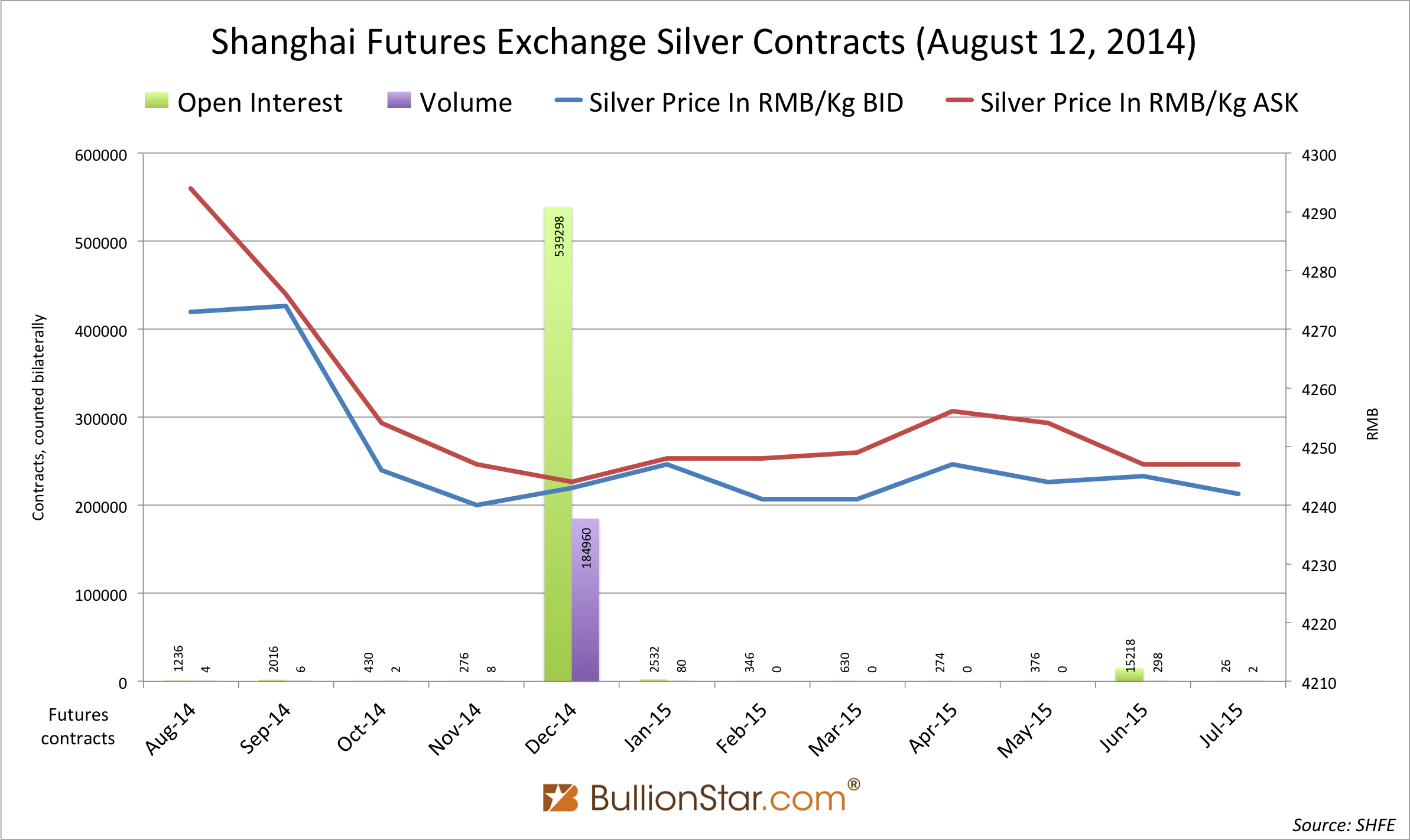
Today the front month silver contract on the Shanghai Futures Exchange (SHFE) closed at an 8 % premium over London spot. Therewithal the futures curve of silver is in backwardation; silver is scarce in Shanghai. 


Backwardation means the future price is lower than the present spot price. Normally the futures curve of precious metals is in contango, meaning the future price is higher than the spot price. 

If we look at the Ag1412 contract (silver 2014 December), the ask price closed at 4244 RMB/Kg, while the bid price of Ag1408 (silver 2014 August) was 4273 RMB/Kg. Consequentially one could, for example, sell 900 Kg of silver in August for 3,845,700 RMB (900 Kg times 4273 RMB) and buy back the same amount of silver delivered in December for 3,819,600 RMB (900 Kg times 4244 RMB). This trade would make a profit of 26,100 RMB in 4 months on 900 Kg.    

The open interest (OI) for Ag1408 is 1246 contracts. On the Shanghai Futures Exchange the OI is calculated bilaterally, so currently there are 623 long and 623 short contracts open. The contract size is 15 Kg/lot. The Last Trading Day of Ag1408 is friday August 15. If the 623 shorts/longs aren't closed before friday, these contracts will be settled and the longs take delivery of 9.345 metric tonnes (623 contracts times 15 Kg). When silver is delivered this doesn't necessarily mean the metal is taken out of the warehouse. What happens is that a warrant, a claim of ownership on silver in the warehouse, is transferred from short to long. If the long redeems the warrant and takes the silver out of the warehouse or chooses to hold the warrant and from that moment pay storage costs is up to him. Additionally, anyone can deposit silver in the warehouse and create a warrant.

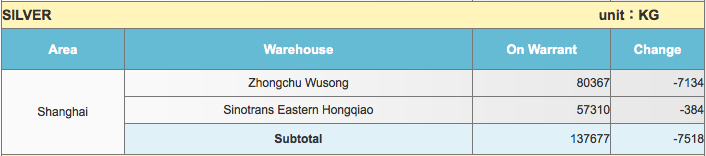
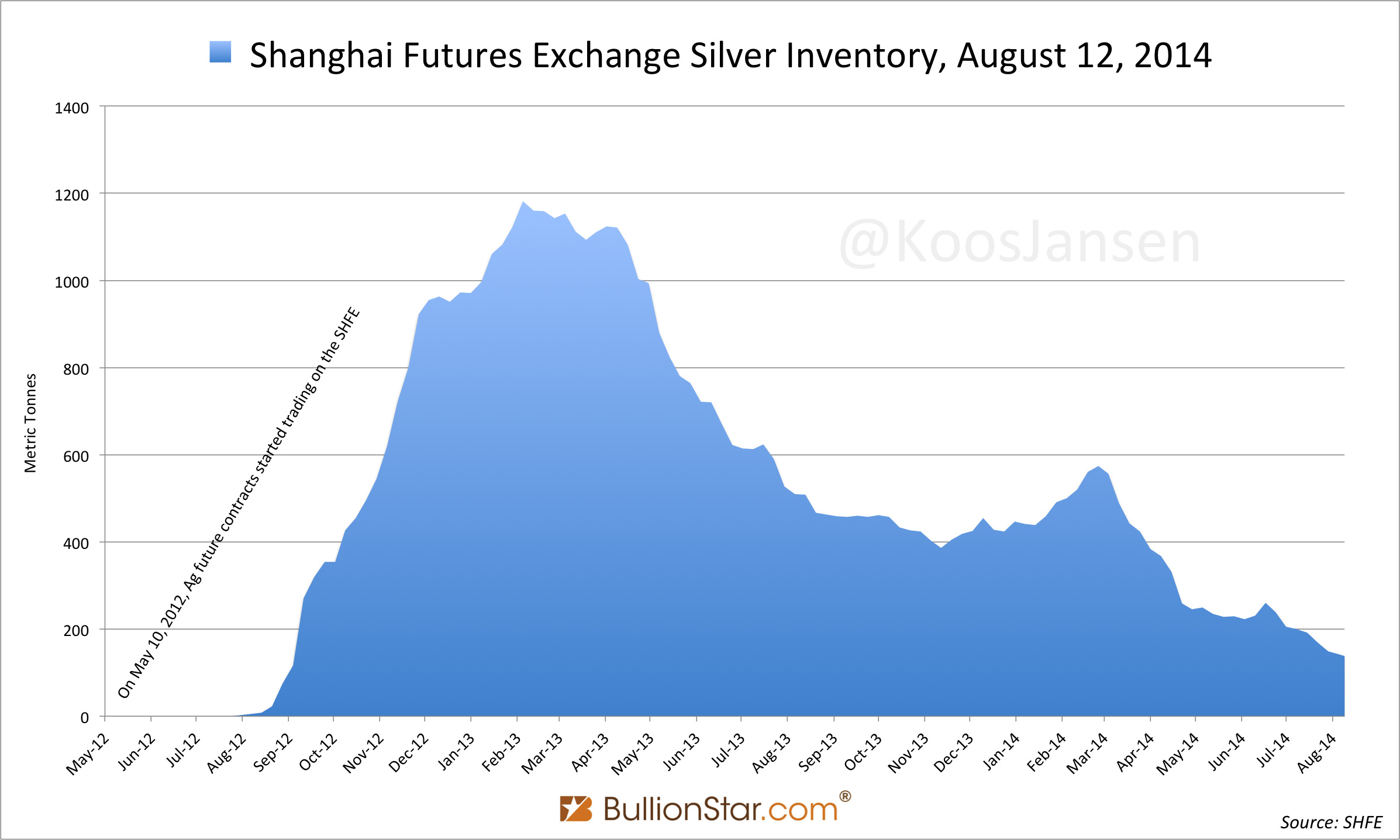
The owner of a warrant can redeem his silver any time he prefers. The SHFE today reported silver inventory (on warrant) was 137.677 tonnes, 


down 7.518 tonnes from yesterday. 


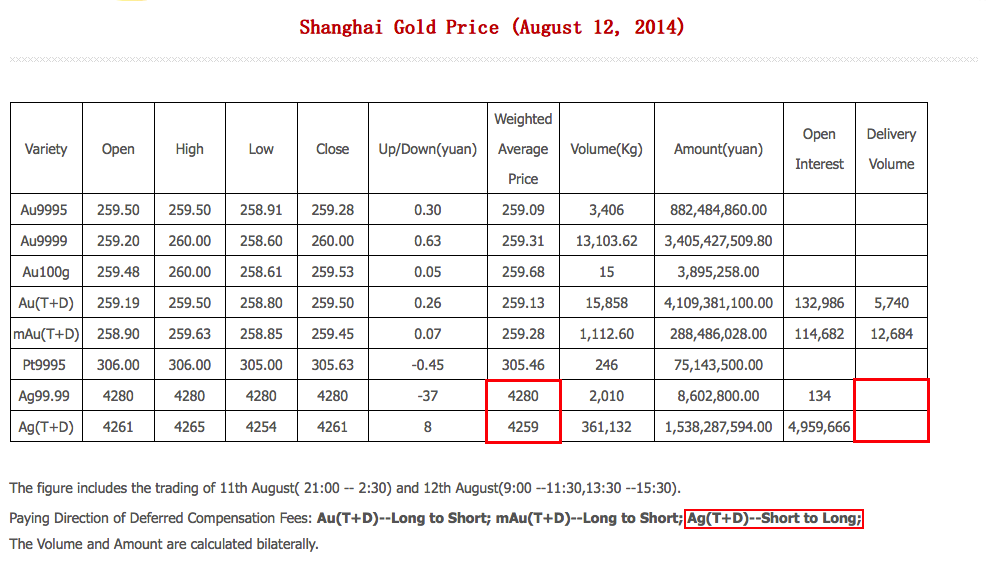
On the Shanghai Gold Exchange (SGE) we could see spot silver Ag99.99 trading at a premium over spot deferred silver Ag(T+D). The Ag(T+D) shorts chose not to deliver any metal, but instead pay the deferred compensation fee. Today Ag99.99 closed at a 7.8 % premium over London spot, Ag(T+D) at 7.3%. Note, the SGE does not close at the same time as the SHFE.  


In May and June silver also traded in backwardation on the SHFE. The trading opportunity then attracted supply that pushed the futures curve in contango and the premiums lower. The next chart lags a couple of days. 


Koos Jansen

Saturday, June 21, 2014

Fixing The Fixes: How Can Silver, And Soon Gold, Prices Be More Transparent?

Would you dare sell Boris Karloff paper
tobacco for him to smoke in his pipe?
We're just not sensing big sighs of relief from the world's metals investors that the crooks will be gone and their rigged gaming tables dismantled and tossed onto the trash heap. Leg irons will hang on the wall pegs awhile longer. The guillotine stays under its shroud.

That dust of excitement they're trying to kick up in our faces could be, you realize, just another blend of anthrax. If these same manipulators can hold tight rein on the silver fix for centuries, any reasonable person realizes the embezzlers won't surrender a good thing. 

Unless what you put in your pipe, you can smoke, it ain't real tobacco.


June. 19, 2014 6:03 AM ET  
By Stuart Burns 

It seems everyone is clamoring to provide a silver fix when the current collaborative bank-decided arrangement ceases after 117 years on August 14. According to Reuters, the front runner might be the London Metal Exchange in spite of it being mired in controversy, itself, over the warehouse debacle and resulting sky-high aluminum physical delivery premiums.


Admitting The Problem is the First Step

Recognizing the old system is broken is one thing, agreeing on what form the new system should take is entirely another. A new benchmark to set silver prices is certainly required and the London Bullion Market Association (LBMA) along with the wider silver market community is keen to see a system to allow daily prices to take shape.

The problem, at the risk of sounding like a pun, is precious little time is available. The LME has three proposals. The first is simply an alternative telephone-based arrangement, similar to the current three bank process in which HSBC, Scotia Bank and Deutsche Bank get together to negotiate a price where sellers are willing to sell and buyers are willing to buy and can be used as a reliable benchmark for contracts around the world.

The LME promises better auditing and compliance, drawing on its years of experience in market making. The second proposal is an extension of its open cry ring-based process as used for base metals, minor metals and steel billets, although the exchange acknowledges creating sufficient liquidity may be an issue as currently few of the ring dealers also have any significant exposure to precious metals.

The third and preferred option of the silver users apparently is for an electronic auction-based system. Although the LME would use its existing infrastructure in its LME Select electronic platform, it still feels this would be the most challenging to have running by August 15. Nevertheless if that is what the LBMA decide they want at a meeting planned for June 20, then the LME would work to the August date. LME Select does have the advantage that some LBMA market makers such as JPMorgan (JPM) and Societe Generale (OTC:SCGLF), are already using it as they are also involved in base metals.

None LME Solutions

The LME is not alone in offering solutions though, the LBMA will be evaluating up to 10 options at their meeting, including proposals from the Intercontinental Exchange (ICE), which has been running the LIBOR interbank interest rate benchmark service since February and the Chicago Mercantile Exchange (CME) which is proposing an electronic system and recently launched a rival physically settled aluminum contract to rival the LME's US$ 51 billion per annum market.

The prize could be not just the silver fix, but ultimately the gold fix, too, as Deutsche Bank's exit from both metals' price fixing agreements leaves the gold fix in, well, a fix. Down to four participants and under intense scrutiny over rate-fixing and transparency, a change is almost certainly in the air and a move to an electronic auction seems the most likely.

The importance of getting this right cannot be overplayed, not just for the trade but for investors. A price that enjoys everyone's unquestioning acceptance and trust is imperative to ensure continued liquidity and support.
via seeking alpha

Thursday, June 19, 2014

Bank Of England's Quarterly Report: Are We Quietly Seeing Central Banks Repatriate Their Gold?

Jun. 19, 2014 8:36 AM ET  
Summary
  • Bank of England's Quarterly Report shows that the bank held 5485 tonnes of gold for 72 central bank customers.
  • The gold holdings of the bank have dropped over 750 tonnes year-over-year with no reported central bank selling.
  • This suggests that we may be seeing large amounts of gold repatriation, which is exactly what happened when Bretton Woods broke down.
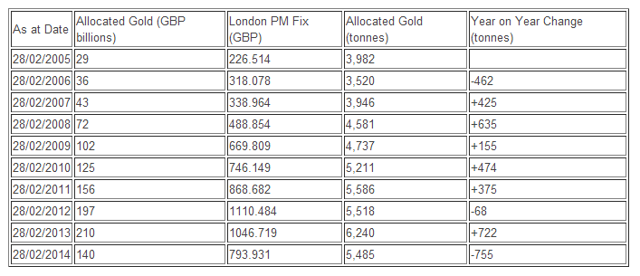
In its latest quarterly report, the Bank of England (BOE) released some very interesting information, which should interest investors that own physical gold and gold ETFs (SPDR Gold Shares (GLD)), regarding its gold custodial holdings. In this report, it stated that as of February 28th 2014, it held 5485 metric tonnes of gold (valued at 140 billion British pounds at that date) on behalf of 72 central banks. This gold was specifically held in allocated form - that is it was held claim-free for the bank's central bank customers and in a dedicated, not pooled form (i.e. specific bar numbers were owned by clients).

This can be seen in the diagram below.


We can't find historical data regarding how many central banks held gold at the Bank of England over time, but we do have some data regarding the historical change in the allocated holdings of gold.

Source: Gold Chat

This data was compiled and published by Bron Suchecki of the Perth Mint in Australia, who does a wonderful job of giving a practical look at a very opaque gold market.

The important thing to see here is the massive 755 tonne drop in allocated gold held by the Bank of England from February 2013 to February 2014. We know that central banks actually accumulated gold over 2013 and sold very little during the year, so this large drop in allocated gold reserves wasn't from central bank selling.

The other groups of entities that hold gold at the Bank of England are bullion banks who are members of the LBMA, and of that group HSBC is a member. The importance of that is HSBC is also the custodian of SPDR Gold Shares (GLD), and according to the prospectus, that in addition to the HSBC vault, GLD can keep gold at the Bank of England's vaults.

Over this same period, GLD lost about 451 tonnes of gold, so if we assume that every single tonne came from the Bank of England vaults, it still leaves around 304 tonnes of gold that left the BoE's vaults over the year - an extremely large amount considering that central banks were net buyers of gold.

Conclusion for Investors

Now, this decline in gold may be related to bullion bank selling as they liquidate allocated gold positions, but we believe we may be seeing something else going on here.

What may be going on is that central banks may be quietly repatriating gold from other central banks. That would explain why allocated gold would decline and yet there is little or no central bank selling - it is central banks removing their gold from Bank of England custodianship.

If that is the case, then the implications of this may be very large for gold investors. The accumulation of gold by central banks (as we've seen over the last few years), shows that they are seeking asset diversification, while the repatriation of gold shows that there is a lack of trust. This lack of trust is exactly what ended the previous monetary system of Bretton Woods as the French owned allocated gold that they were accumulating in the form of dollar reserves (which were convertible into gold but were in the custodianship of the US). That wasn't the problem because the system could work fine with the French accumulating even more allocated gold dollar reserves, it wasn't until Charles De Gaulle and the French lost trust in these allocated reserves and asked for their repatriation to France that the system broke.

If we're seeing a breakdown in trust between central banks regarding gold reserves (which are heavily concentrated in London and New York), then the consequences for the financial system and the gold price could be tremendous - especially since the actual physical gold is only a small fraction of total gold claims due to gold leasing, rehypothecation, and fractional reserve banking. If that small physical gold reserve base is depleted through repatriation, then the gold price should rise orders of magnitude higher, as the only way the base can support the claims upon it is with a much higher gold price.

This is simply another one of those reasons that gold ownership makes so much fundamental sense and thus we still think investors would be wise to maintain a strong exposure to gold with positions in physical gold and gold ETFs (SPDR Gold Shares GLD, PHYS, CEF). The gold miners have had a strong run recently and we would take profits in some of them, but investors should also have exposure to the leverage that they provide and may want to consider evaluating gold miners such as Goldcorp (GG), Agnico Eagle (AEM), Newmont (NEM), or even some of the explorers and silver miners such as First Majestic Silver (AG) (we're not suggesting these companies specifically - only suggesting them for further investor research).
We do not know for sure what happened to the allocated gold at the Bank of England, but if it is central bank gold repatriation (which we wouldn't hear about until well after the occurrence) then that may be moving us to the next stage in the financial crisis. With many other strong fundamentals going for it, investors should seriously consider initiating or increasing their position in gold.
via seeking alpha

Thursday, June 5, 2014

ETF Securities joins LME with silver fix plan

To say these evolving developments could provide silver's price with levitation may be an understatement. Obviously, they've run out of plunder in London. Whether the Shanghai exchange will line their purses likewise, we'll have to see.
 
Bloomberg News | June 5, 2014 10:51 AM ET
More from Bloomberg News
BloombergThe proposal made to the London Bullion Market Association would use a five-minute auction process that occurs on the London Stock Exchange and based on ETF Securities’ silver-backed fund that trades on the bourse

ETF Securities Ltd., an exchange-traded-products provider with about $19 billion of assets, proposed an alternative to the century-old London silver fixing benchmark process that’s set to end in August.

The proposal made to the London Bullion Market Association would use a five-minute auction process that occurs on the London Stock Exchange and based on ETF Securities’ silver-backed fund that trades on the bourse, said Graham Tuckwell, chairman and founder of the Jersey-based company. The company is talking to the LSE about moving the auction capability from 4:30 p.m. to noon, when the present silver fixing process is held, he said.
Related
The London Silver Market Fixing Ltd. will stop running the fixing on Aug. 14 after Deutsche Bank AG said it will withdraw from the process, leaving just two banks to conduct the ritual. The LBMA began a consultation in May seeking views for an alternative to the benchmark that’s used by miners to central banks. The London Metal Exchange got requests to provide a daily rate, CME Group Inc. has said it’s also helping to find a way to set prices and Platts said today it’s in talks with the LBMA.

“The system is already in place, it’s ready to go,” Tuckwell said today by phone from Amsterdam. “Our securities are settled in metal already. It’s a very transparent process.”

Regulatory focus on financial benchmarks is intensifying after rigging was uncovered in everything from interbank lending rates to currencies. Economists and academics have said fixings are susceptible to manipulation and lack sufficient regulation, while traders say the processes are efficient and crucial reference points for the market.

Deutsche Bank, HSBC Holdings Plc and Bank of Nova Scotia conduct the silver fixing each day at noon. The German bank said it’s withdrawing from fixings as it scales back its commodities business. It stopped taking part in gold fixings in May after failing to agree on a sale of its seat and postponed its April 29 resignation from the silver rate to Aug. 14.

During the silver fix, the three member banks declare how much metal they want to buy or sell for clients as well as their own accounts. Traders relay shifts in supply and demand to clients and take fresh orders as the price changes, before the fix is made. The first silver fixing took place in 1897.

Used as a benchmark to price holdings at, the fixing also allows participants to physically buy and sell metal. The proposal made by ETF Securities could allow the transfer of physical metal two days later, Tuckwell said.

“The only thing we need really to talk to the LSE about is asking to arrange the auction at midday, rather than at 4:30 p.m.,” he said. “They are already putting in place the possibility of having intraday auctions in all securities of about mid-September.”

The LME said May 29 it had requests from industrial and financial companies, has defined a “robust” process for a daily price and is working with the LBMA in consulting with the market. CME Group said that day it’s “working closely with the precious metals industry and LBMA to reduce market disruption by helping to find a robust transaction-based way to set the daily spot price.” An LBMA survey as part of the consolation closed May 30.

“Platts is in talks with LBMA officials, financial entities and others regarding continuity, transparency and best practices in the silver market,” Kathleen Tanzy, a spokeswoman in New York at the energy and commodities news and price publisher, said in an e-mailed statement today. “ Continuity in the provision of benchmarks, prices and assessments is critical to preserve the integrity of markets.”

Silver was fixed at $18.81 an ounce today. The metal for immediate delivery declined 2.5 percent this year, according to Bloomberg generic pricing.

“Clearly it gives us a higher profile in the market,” Tuckwell said. “It’s worth our doing.”

Friday, May 30, 2014

Gold in a fix

Could the conspirators be setting up a transfer of manipulation from London to Shanghai under another Rothschild banking syndicate? Why not, the Rothschilds had been one of the London fixing members for 200 years.


By Alasdair Macleod
Posted 30 May 2014 

Last week the UK's Financial Conduct Authority fined Barclays for rigging the gold price at a gold fix for the disadvantage of a customer and the benefit of the bank's book. This news could not come at a worse time for the London Bullion Market and the London Gold Market Fixing Limited, the company directly responsible for the twice-daily fix. It may well lead to the end of the gold fix, the silver fix already being axed in August.

The fix is a process by which the four fixing members match their orders at an agreed price. The London bullion market is over-the-counter without the formal price records of a regulated market. The fix is therefore a needed reference price, and its status and the liquidity that follows have been central to London being the world's major bullion dealing centre.

There are two problems with the fix. The first is it potentially distorts the market by delaying pre-fix business and bringing post-fix business forward. The second is that customers have to trust the fixing banks, who are also dealing for themselves into the fix. And this is what tripped up Barclays.

Outside the fix it should be reasonably clear to clients whether a bank is operating as principal or agent. During the fix roles can become opaque, and unscrupulous dealers can find ways to game the system. 

Claims that the Barclays case was an isolated instance may be true, but indications that the FCA is treating this as a one-off and not investigating other banks may be ultimately damaging to the market's reputation. Then there are the separate circumstances of Deutsche Bank's resignation of its fixing seats on both gold and silver.

Last December Deutsche Bank was instructed by the German banking regulator, BaFin, to hand over documents in connection with its enquiry into gold and silver price fixing. Four weeks later the bank announced it was resigning its seats on the gold and silver fixes. While it is premature to positively link the resignations with BaFin's enquiry, the coincidence raises the possibility that banks which have settled with regulators over accusations of fixing LIBOR may have a case to answer in precious metals as well. Interestingly, there are no buyers for Deutsche's seats, suggesting legal and compliance officers at other bullion banks also have doubts about the fixing process.

To give this topic further context it should be noted that London has seen some unusual price movements in the past. The table below shows the profits generated by shorting one ounce of gold on the morning fix and buying it back at the afternoon fix every day for the eleven years 2000-2010, covering most of the largest bull market in the LBMA's history.


This phenomenon was first drawn to public attention a few years ago by an American analyst, Adrian Douglas. In every year this short trade would have been profitable, despite a rise in the gold price from $282.05 to $1405.50 in December 2010, a rise of 400%. This extraordinary price behaviour was confined to London trading hours.

So hard statistics tell us gold has been behaving unusually in London hours for a considerable time. The LBMA is not a regulated market, but derivatives and share prices based on precious metals are, so regulators have a duty to be interested. The FCA should broaden its investigations accordingly, but whether it does or not it is hard to see how the twice-daily gold fix can survive.
via GoldMoney

Wednesday, May 14, 2014

The History Of The London Silver Market Since 1600

We must respect this silver pig's right to smoke
Submitted by Tyler Durden on 05/14/2014  - Zero Hedge
In honor of the end of the one of the most infamous price manipulation cartels in precious metal history - the London silver fix - below we present (pdf) the full history of the london silver market, from 1600 all the way until the year 2000. There is just one more event to add to the timeline: 2014 - the end of the silver fixing cartel (and its replacement with the BIS manipulation cartel?)

Friday, May 2, 2014

GoldCore Reports Half of Italy's Gold is Held in New York Fed Vault; Is Repatriation Possible?

-- Posted Friday, 2 May 2014 

[Excerpt] 
...Please note GoldCore is closed for a Bank Holiday, this Monday, May 5th, reopening May 6th....
Consensus payroll data estimates from surveyed economists indicate improving expectations for April and a possible drop in the unemployment rate. Any surprises in the U.S. payroll data today could be the catalyst to move the gold price out of its very narrow trading pattern, although given that it's the end of the trading week, the short term direction for gold may not become apparent until next week. 
[So sorry, but vid in Italiano only]


Italy May Have Over 1,000 Tonnes Of Gold At The New York Fed
Written by Ronan Manly for GoldCore


The overt and blatant manipulation of the gold and silver markets on the Comex reflects frantic desperation - but why?

From outside the usual ‘precious metals commentary community.’


Dave Kranzler | May 1, 2014 11:22 am


Perhaps the most unsettling recent event was the announcement by the CME that it was looking at putting daily price limit curbs on gold and silver futures.

Saturday, April 5, 2014

Renewed Estimates of Chinese Gold Demand & their Geopolitical Strategy


By Alasdair Macleod
Posted 04 April 2014

I have been revisiting estimates of the quantities of gold being absorbed by China, and yet again I have had to revise them upwards. 

Friday, March 28, 2014

Gold Arbitrage and Backwardation Part III (Gold as a Commodity)

A must read for goldbugs.

Submitted by Monetary Metals on 03/28/2014
by Keith Weiner
In Part I, we discussed the concept of arbitrage. We showed why defining it as a risk-free investment that earns more than the risk-free rate of interest is invalid. There is no such thing as a risk-free investment, and in any case economics must be focused on the acting man rather than theoretical constructs. We validated that arbitrage arises because the market is constantly offering incentives to the acting man in the form of spreads. Arbitrage is the act of straddling a spread. Arbitrage will tend to compress a spread. The spread will narrow, though not to zero because no one has any incentive to make it zero.

Wednesday, March 26, 2014

Bundesbank's Asche on Germany's Custodial Gold with Fed: "Some Gold Bars Melted Down to Meet LBMA Delivery Standards"!

"Complete relocation of all German gold held abroad isn’t desirable", says Asche. Is Germany folding its cards in deference to the Fed's theft of Germany's gold?

Germany's politicians controlled by international bankers could be setting up their citizens to get stiffed out of their savings.

Friday, February 28, 2014

FT's Shocking Gold-Manipulation Glitch

We did not miss this story from the FT. We do not regard the FT as an entirely truthful publisher, and skipped over it, that's all.

By Staff Report - February 28, 2014, The Daily Bell

Here Is The FT's Gold Price Manipulation Article That Was Removed ... Two days ago the FT released a clear, informative and fact-based article, titled simply enough "Gold price rigging fears put investors on alert" in which author Madison Marriage, citing a report by the Fideres consultancy, revealed that global gold prices may have been manipulated on 50 per cent of occasions between January 2010 and December 2013. – ZeroHedge

Monday, February 24, 2014

Sunday, February 9, 2014

Barclays Busted: Sells private account details up to 27,000 files leaked in worst breach of bank data EVER

  • Cache of personal and financial details stolen and sold to rogue traders
        
  • Unscrupulous dealers 'used information to pressure investors into scams'
       
  •  Bank thanked Mail on Sunday for revelation and launched investigation
       
  •  Barclays now face unlimited fines for not protecting customer information
       
  •  Former City broker blew the whistle on the files to stop problem growing

Friday, February 7, 2014

Scandal: Bank Of England Condoned Currency Manipulation by Private Banks

Popular TV crime shows like Law and Order tell us that the departments of Internal Affairs are called in to investigate crooked cops. But, these shows never tell us what happens when the IAD itself is crooked or 'on the take.'  I'd imagine it's deferred to a mayor, or some other popularly elected official for resolution and justice accountability. A public Grand Jury, I'd presume. 

Sunday, February 2, 2014

Untangling Gold at the Bank of England

By  Alasdair Macleod in  Gold reserves   Posted  30 July 2013
From 2006 the Bank of England’s Annual Report has declared the quantity of gold in its custody, including the UK’s own 310 tonnes. Prior to that date a diminishing quantity of on-balance sheet gold (sight accounts) was recorded in the audited accounts, which then disappeared. This tells us that sight accounts (where the BoE acts as banker and not custodian) were dropped. This is sensible, because the BoE is no longer directly liable to other central banks while gold prices are rising…Read article

Thursday, January 16, 2014

Metals, Currency Rigging Worse Than Libor, Bafin's Koenig Says - Bloomberg


By Karin Matussek and Oliver Suess Jan 16, 2014 7:00 PM ET 

Germany’s top financial regulator said possible manipulation of currency rates and prices for precious metals is worse than the Libor-rigging scandal, which has already led to fines of about $6 billion.