Search Blog Posts

Showing posts with label Pensions. Show all posts

Thursday, January 29, 2015

Comparing the inflated cost of living today from 1938 to 2015: US Dollar losing an enormous amount of purchasing power since 1938

 Posted by mybudget360
 
People have a hard time understanding how inflation erodes their purchasing power.  Little by little the cost of everything goes up and people simply assume this is normal in an economy.  The $2 movie ticket becomes a $8 movie ticket.  That can of tuna just got smaller but the price remains the same.  The cost of going to college went from manageable to needing large student debt merely to complete a four year degree.  Inflation is argued to be a purely monetary outcome.  You have too much money, in the form of cash or credit in today’s case, chasing fewer goods.  In our current economy, debt is the fuel accelerating inflation.  You can see this in items like housing, cars, and college where debt is the primary fuel driving prices higher.  The big problem today is that incomes are simply not rising fast enough to keep up with the rise in other expenses.  Over time, inflation has a big destructive power.  I thought it would be useful to look at the cost of typical items in 1938 and compare them to where things stand in 2015.


Comparing 1938 to 2015

Over a year ago, we looked at some old data and found this to be useful to readers.  I thought it would be helpful to update the data and see where things stand today in 2015.  Someone sent this snapshot of the cost of living in 1938.  It really is fascinating looking at inflation over a very long period of time.  In this case, we are looking at spending pre-World War II.  Most Americans probably have no sense as to what the cost of living was back then since they are mired in the fight of living paycheck to paycheck.
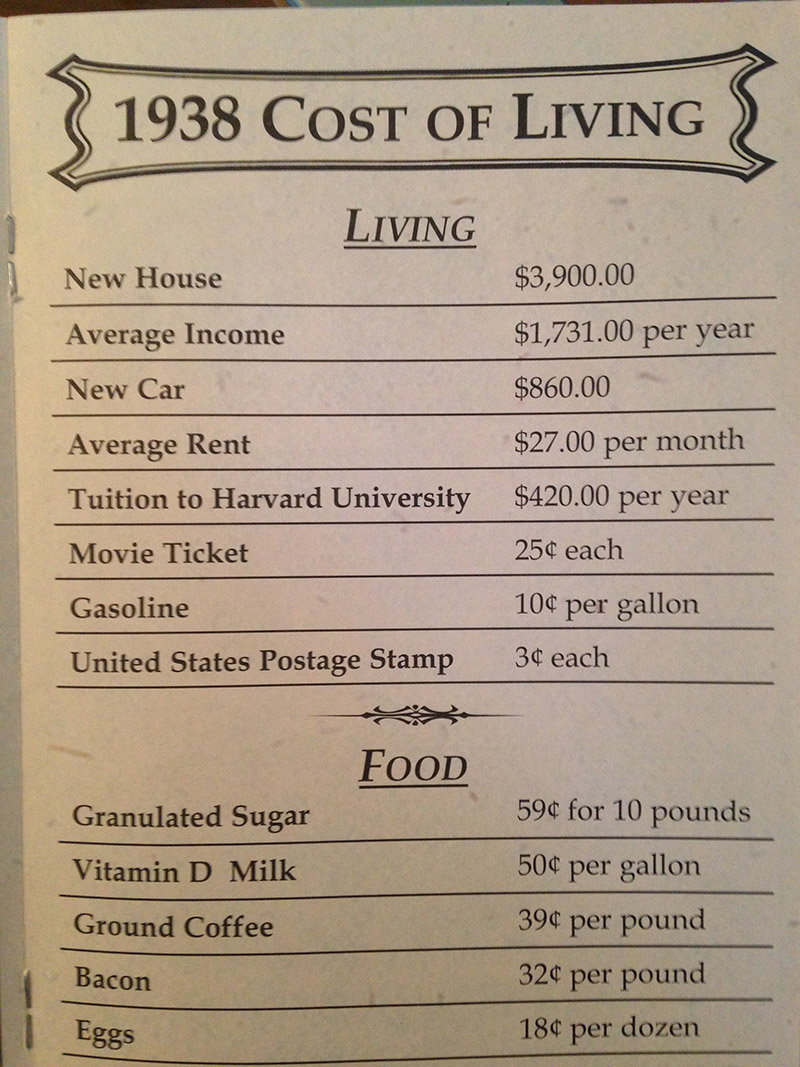
Take a look at the cost of living in 1938:
cost-of-living (1)
Source:  Reddit
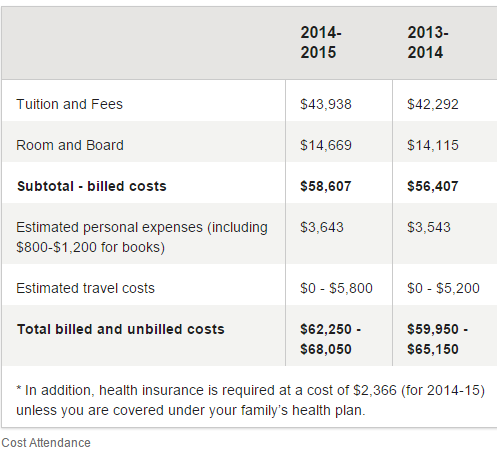
What is important is to look at income in relation to the cost of living.   A new home was about twice the annual average income.  Today, with the median household income being $50,000 and your typical new home costing $298,000 we are definitely on the more expensive side (6 times annual income versus 2 back in 1938).  Look at the new car costs.  A new car cost about $860 or half of annual income.  Today, a regular car can cost $32,000 and most will need to finance it.  Tuition to Harvard was $420 per year and today Harvard tuition is nearly $62,000 with room and board:
harvard
Source:  Harvard website

In other words, the typical family of today would need to use all their annual income to send their kid to Harvard plus go in debt while in 1938, your average family had income to send 4 kids to Harvard per year.  The most inflated of all categories is college tuition.

Looking at various costs adjusting for inflation

I put this table together and adjusted for inflation to give you a better perspective:
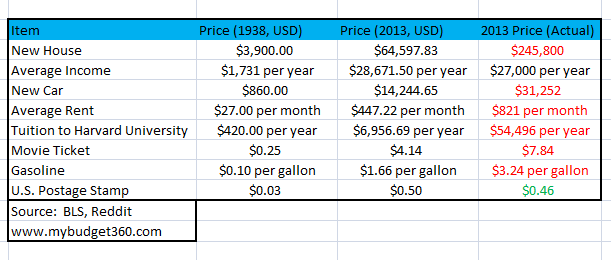
inflation-and-actual-prices
I wanted to update some of this data for 2015 as well:
New house:                        $298,000 (Source: Census)
Average income:              $28,000 (Social Security)
New Car:                             $32,000 (Bankrate)
Average Rent:                   $950
Tuition to Harvard:          See above
Movie ticket:                     $8
Gasoline:                             $1.99
US Postage Stamp:          $0.49
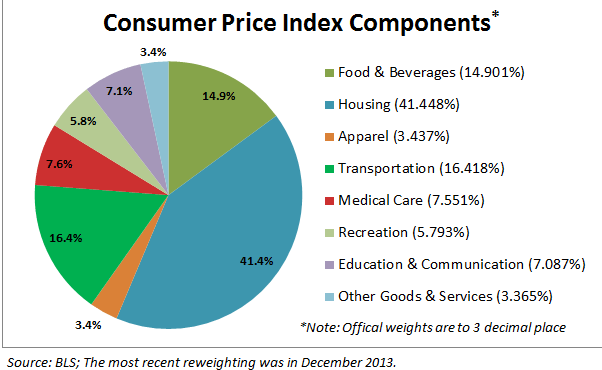
So basically every single category is up besides gasoline given the crash in oil prices in 2014.  But this is a small drop in the bucket given what consumes the biggest portion of your budget:
inflation categories

Housing, food, medical care, transportation, and education make up the biggest expenses.  Housing by far consumes the biggest portion.  And look at how fast prices have gone up since 2000:
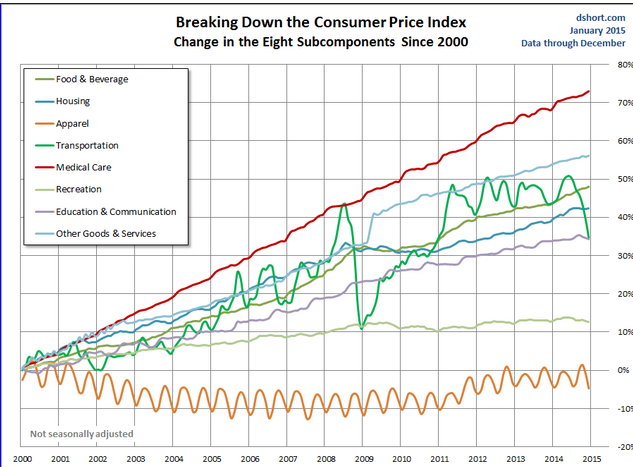
inflation since 2000
Medical care is up over 70 percent.  Housing is up over 40 percent even with the crash in the housing market.  Basically the only items that held steady were apparel and recreation.  But look at how incomes are doing:
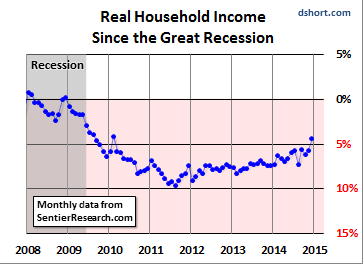
real household income
You wonder why you feel like you have less purchasing power?  You feel poorer because you are thanks to the slow eroding power of inflation.  The Fed would like to argue that there is no inflation but just look at housing costs, medical care, college tuition, and grocery bills and tell the regular working American family that there is no inflation.

Source

Tuesday, January 27, 2015

▶ SHOCKING Report Reveals Government STEALING Pension Funds! - YouTube


Sources:
"Is Your Pension Courting Catastrophe? - Bloomberg View"
http://www.bloombergview.com/articles...
"Detroit attorney says pension cuts actually close to 50 percent - World Socialist Web Site"
http://www.wsws.org/en/articles/2014/...
"Public service unions not entitled to $28B pension surplus, says Supreme Court | Toronto Star"
http://www.thestar.com/news/canada/20...
"Portugal raids pension funds to meet deficit targets - Telegraph"
http://www.telegraph.co.uk/finance/fi...
"Hungarian savers say government is stealing their pensions | Reuters"
http://www.reuters.com/article/2014/1...
"Russia Seized Citizens Pension Funds. Could That Happen in the U.S.? - Businessweek"
http://www.businessweek.com/articles/...
"UPDATE 2-Poland reduces public debt through pension funds overhaul | Reuters"
http://www.reuters.com/article/2013/0...
"Argentina seizes pension funds to pay debts. Who's next? – Telegraph Blogs"
http://blogs.telegraph.co.uk/finance/...
"How the West Was Lost: Fifty Years of Economic Folly - And the Stark Choices ... - Dambisa Moyo - Google Books"
https://books.google.ca/books?id=ivXM...


Monday, January 26, 2015

U.S. nursing homes' new tactic to collect debts: Seizing power of attorney from patients' relatives

If you haven't already cleared your remaining savings and other assets off the table, you probably should not rule it out until checking out this new government/corporatist fraud. Government is but the collection enforcement agent for the Corporatists.
 ~~~~~~~~~~~~~~~~~~~~~~~~~~~~~~~~~~~~~~~~~~
The New York Times | January 26, 2015 | Last Updated: Jan 26 11:16 AM ET
Piotr Redlinski/The New York Times: Dino and Lillian Palermo at the Mary Manning Walsh Nursing Home, which filed a guardianship petition asking the court to give a stranger full legal power over Lillian Palermo and complete control of her money, in New York, Oct. 31, 2014. 

NEW YORK — Lillian Palermo tried to prepare for the worst possibilities of aging. An insurance executive with a Ph.D. in psychology and a love of ballroom dancing, she arranged for her power of attorney and health care proxy to go to her husband, Dino, eight years her junior, if she became incapacitated. And in her 80s, she did.

Dino Palermo, who was the lead singer in a Midtown nightclub in the 1960s when Lillian’s elegant tango first caught his eye, now regularly rolls his wife’s wheelchair to the piano at the Catholic nursing home in Manhattan where she ended up in 2010 as dementia, falls and surgical complications took their toll. He sings her favourite songs, feeds her home-cooked Italian food, and pays a private aide to be there when he cannot.

It’s a strategic move to intimidate. Nursing homes do it just to bring money.

But one day last summer, after he disputed nursing home bills that had suddenly doubled Lillian Palermo’s copays, and complained about inexperienced employees who dropped his wife on the floor, Dino Palermo was shocked to find a six-page legal document waiting on her bed.

It was a guardianship petition filed by the nursing home, Mary Manning Walsh, asking the court to give a stranger full legal power over Lillian Palermo, now 90, and complete control of her money.

Few people are aware that a nursing home can take such a step. Guardianship cases are difficult to gain access to and poorly tracked by New York state courts; cases are often closed from public view for confidentiality.
Piotr Redlinski/The New York Times: Nursing homes are using a New York State statute created to protect the infirm as a way to get paid.

It’s so cruel. Mr. Palermo loves his wife, he’s there every single day, and they just threw him to the courts.

But the Palermo case is no aberration. Interviews with veterans of the system and a review of guardianship court data conducted by researchers at Hunter College at the request of The New York Times show the practice has become routine, underscoring the growing power nursing homes wield over residents and families amid changes in the financing of long-term care.

In a random, anonymized sample of 700 guardianship cases filed in Manhattan over a decade, Hunter College researchers found more than 12 percent were brought by nursing homes. Some of these may have been prompted by family feuds, suspected embezzlement or just the absence of relatives to help secure Medicaid coverage.

But lawyers and others versed in the guardianship process agree that nursing homes primarily use such petitions as a means of bill collection – a purpose never intended by the Legislature when it enacted the guardianship statute in 1993.

At least one judge has ruled that the tactic by nursing homes is an abuse of the law, but the petitions, even if they are ultimately unsuccessful, force families into costly legal ordeals.

The Palermo case is no different than any other nursing home bill that they had difficulty collecting. When you have families that do not co-operate and an incapacitated person, guardianship is a legitimate means to get the nursing home paid.

“It’s a strategic move to intimidate,” said Ginalisa Monterroso, who handled patient Medicaid accounts at the Mary Manning Walsh Nursing Home until 2012, and is now chief executive officer of Medicaid Advisory Group, an elder care counselling business that was representing Dino Palermo in his billing dispute. “Nursing homes do it just to bring money.”

“It’s so cruel,” she added. “Mr. Palermo loves his wife, he’s there every single day, and they just threw him to the courts.”

Brett D. Nussbaum, a lawyer who represents Mary Manning Walsh and many other nursing homes, said Dino Palermo’s devotion to his wife was irrelevant to the decision to seek a court-appointed guardian in July, when the billing dispute over his wife’s care reached a stalemate, with an outstanding balance approaching $68,000.
Nina Bernstein/The New York Times Dino and Lillian Palermo

“The Palermo case is no different than any other nursing home bill that they had difficulty collecting,” Nussbaum said, estimating that he had brought 5,000 guardianship cases himself in 21 years of practice. “When you have families that do not co-operate and an incapacitated person, guardianship is a legitimate means to get the nursing home paid.”
READ MORE

Lobbyists can make You Rich if you're a Politician

Instead of honoring your oath of office and following the rule of law, just feign 'love of country', stick to Party commandments, and the special interests will stuff your every pocket in every suit.

Sincere or Strategic, Lobbyists Give Big

by Emily Kopp on March 12, 2014 8:00 AM

It seems a lobbyist's work is never done.

You have to know policy, wrangle with legislative language, persuade important people of the rightness of your cause, market yourself to clients. And then, for many on K Street, there's another key part of the job: pulling out your checkbook. Federal lobbyists are often campaign contributors, too -- sometimes offering, sometimes responding to not-so-subtle requests.  

And the sums can be large. In fact, the 25 lobbyists who have given the most to political campaigns in the first half of the 2014 cycle have combined to give a total of $1.85 million. Whether they give strategically or out of partisan passion depends on the donor, but there's little doubt that their generosity can play a role in wedging doors open in congressional office buildings.

Or, as sixth-ranking lobbyist-donor Ben Barnes put it, "I think anyone could be sanctimonious and say they're donating for the love of their country, but how you make a living has something to do with it." Barnes, whose clients include Texas A&M University, Texas Gulf Energy and Huntsman Corp., has long been a fixture of Democratic politics in Texas, and is a top bundler for congressional campaigns. So far in this cycle, he has given out about $79,000.

Lobbyists rank 13th among all interest groups in contributions so far in the 2014 campaigns, a jump from 22nd at the end of the 2012 cycle. Individual lobbyists contributed far more than lobbying firms' PACs -- 22 times as much. 
And as in 2012, the big-giving lobbyists prefer writing their checks to candidates or committees, rather than sending them funds into a larger pool -- for instance, a super PAC. Only four lobbyists on our list contributed to super PACs. Tonio Burgos, the director of his own lobbying firm, contributed $25,000 to the liberal House Majority PAC, though even absent his super PAC donation Burgos would have earned a spot in the top 25.

Overall, super PACs have received a pitiful 2 percent of lobbyists' donations so far, a dip from their 7 percent share in 2012.

An array of clients -- unions excepted


Among our top 25 contributors, 24 work for a lobbying or law firm or for a consulting group. Their major clients include household names like General Electric, Caterpillar and Microsoft.

Fifteen of our top 25 represent firms in the insurance industry, while 14 count pharmaceutical firms among their clients. Altogether the top lobbyist-donors are associated with 65 different industries in 12 sectors. Labor is the only industry not represented by even one of the the top 25.

Together this band of lobbyists represented 481 discrete clients in 2013, about 19 clients per lobbyist.

The exception? Nicholas Calio, a former aide to President George W. Bush, who lobbies in-house at Airlines for America, a trade association that spent nearly $8.5 million lobbying in 2013.

The technology sector is well represented by this coalition. General Electric, Microsoft, Intuit Inc. and Blackberry each number four clients among the group. Seven lobbyists of our top 25 represent Blue Cross/Blue Shield, while five represent the Edison Electric Institute, a trade group of power companies.

Kenneth Kies is the top lobbyist-donor so far this time around, having given close to $140,000. Together with his wife, he's given nearly $200,000 to candidates and committees in the 2014 cycle, putting them 22nd among all donors. Kies, who years ago worked for two tax committees in Congress, is now with the lobbying firm Federal Policy Group, where his clients include the American Bankers Association, Blue Cross Blue Shield and Microsoft.

Party matters, again
There are deep partisan divisions among the top 25. Sixteen of them gave exclusively to one party or the other: Five donated solely to Republicans, 11 gave only to Democrats. Some who work at the same firm were diametrically opposed in their giving patterns: Capitol Counsel LLC's Sharon Finley funneled all of her contributions to Democrats, while 100 percent of her partner Jeffrey Walter's donations went to the GOP.

The nine who divided their donations showed strong party preferences too, though. Even the two most even-handed donors contributed $4 to one party for every $1 they gave the other. James D. Massie donated $44,000 to Democrats and $11,000 to Republicans; David E. Franasiak donated $51,000 to Republicans and $12,600 to Democrats.

In D.C., genuine friendships often overlap with relationships built on mutual favors. Add the fact that many well-paid lobbyists once worked in congressional and agency offices where they still know people and it can be especially hard to tease out the motivations behind any single donation.

"If I only donated for the good of my firm or business I wouldn't have donated to candidates that I knew had no chance. But I knew it was important for them to have a voice," one lobbyist on the list told OpenSecrets Blog. His belief that a Democratic majority is better for the country "animates my giving," he said.

Another lobbyist on the list was more pragmatic. He favors the pro-business stance of Republicans and hopes they take control of the Senate and then the White House. At the same time, "this is politics, and you have to participate in the system," he acknowledged in an interview.

Lobbyists prefer incumbents, bolster embattled Democrats
Federally registered lobbyists have spread $18 million in contributions among over 100 candidates and members of Congress so far in the 2014 cycle, with donations tilting to the right: $7.4 million has gone to Democrats, $8.35 million to Republicans. Super PACs received a very small share, only about $71,000.

About 93 percent of lobbyists' total spending has gone to incumbents, and much of it has gravitated to just a few veteran lawmakers in the leadership. While lobbyists aim for access, they love stability, not eager to have to forge new relationships every election cycle. 
Top Recipients of Lobbyist-Donors, 2014 cycle


Sen. Mitch McConnell (R-Ky.)
$281,301
Rep. John Boehner (R-Ohio)
$278,380
Sen. Mark Pryor (D-Ark.)
$221,450
Sen. Mark Udall (D-Colo.)
$204,400
Sen. John Cornyn (R-Texas)
$194,300
Sen. Mark Begich (D-Alaska)
$160,300
Sen. Jeanne Shaheen (D-N.H.)
$129,433
Sen. Kay Hagan (D-N.C.)
$123,733
Sen. Mark Warner (D-Va.)
$121,750
Sen. Susan Collins (R-Maine)
$121,486

Senate Minority Leader Mitch McConnell (R-Ky.), who faces a primary challenge, has received the most from lobbyists in the midterm cycle so far, more than $281,000. House Speaker John Boehner (R-Ohio) is a close second at $278,380.


Sunday, December 14, 2014

Cronyism ensuring American taxpayers bailout the finance industry during the next crash

…  Nostradamus like spending bill will ensure big banks never fail with your money.

Posted by mybudget360
 
Do you smell what is in the air?  Pine trees?  No.  Something with a more pungent smell.  There is a wonderful whiff of cronyism floating around Washington D.C.  In the latest government kabuki theater there was some interesting items being passed.  There were major protections given to banks should trillions of dollars in derivatives blow up during the next market correction.  

While the public is enjoying a few dollars off in gasoline prices so they can spend more money they don’t have during this holiday season, the latest government/banking spending bill was passed by slim margins but puts the taxpayer on the hook for trillions of dollars of risky derivative bets.  Great timing given the energy markets are imploding so we know some hedge funds are taking it in the shorts and will likely come to D.C. hat in hand to cash in on those generous campaign donations.  Central banks have done very little to help US households because incomes simply are not keeping up in the face of inflation.  The latest bill is something to behold.

Minority Report of finance bills

What is so blatant about the latest bill is that it practically says that next time banks implode via derivative bets that taxpayers will be on the hook.  The last time we were told that too big to fail banks needed all the help in the world because they would take the economy down with it.  Of course the public did not want this but the spin media made it seem like the public was on board.  They never were.  Yet this was done during the actual correction.  This time, acting like Nostradamus the financial industry is basically writing in provisions to protect itself for future transgressions.  Like writing a note to your spouse that you apologize for all future mistakes and this piece of paper absolves you from all acts.

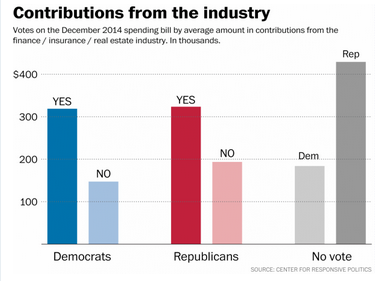
This should be no surprise given that the FIRE industry is backing both Republicans and Democrats equally:

“(WaPo ) on average, members of Congress who voted yes received $322,000 from those industries. Those who voted no? $162,000.”


Those that think money in politics buys little influence are either naïve or simply are ignoring the facts.  It is clear that money is controlling our government to the point of cronyism.  And of all those previous bailouts?  How have they helped American families?


The cost of housing, healthcare, and college tuition are soaring yet incomes are stagnant.  Of course inflation occurs because too much money (debt) is flowing into the system.  Big banks and investors ended up buying many single family homes and converting them into rentals and pushing rents up.  Prices are also up but many families never recovered after the Great Recession hit.  The stock market went up but thanks to hot money.  Spending and income are not looking so hot:


If you look at wages/earnings minus healthcare costs we are actually in recession territory.  And since very few Americans actually own stocks, the recent mega run in the stock market has done little for regular families.

But what is certain is that the recent spending bill that was passed is laden with future gifts to Wall Street banks when the inevitable correction hits.  Influence peddling in Washington isn’t anything new but the blatant nature of this bill is.  These are trillion dollar bets that will likely go bad and a bill was now passed to make it easier for taxpayer bailouts when things inevitably correct.  This will come from Americans that are struggling planning for their retirement and have very little in savings.  If you need any more proof that the 2014 election was a joke, look no further.  We are basically swapping jerseys on the same players here.  Get your wallets ready for the inevitable future bailouts that you will not vote on once again.  Our government should represent the voters but in this case, they represent their biggest donors.  And what the donors want isn’t necessarily what is best for American families.  In fact, it is the direct opposite in many cases.

via mybudget360

Sunday, December 7, 2014

Social Security has become the de facto retirement plan for millions of Americans.

...Social Security helps keep half of elderly Americans from poverty

Posted by mybudget360


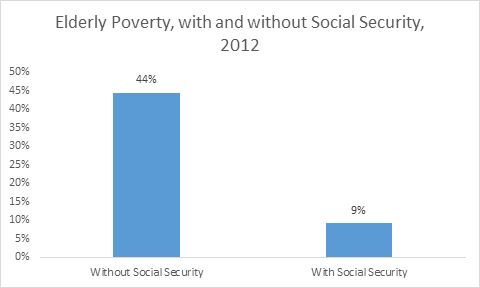
Social Security was never designed as a long-term retirement plan for millions of Americans.  Yet Social Security has become the default retirement plan for many elderly Americans.  In fact, if it were not for Social Security roughly 44 percent of elderly Americans would be in poverty.
 

This is calculated by how many Americans receive Social Security and the standard poverty income cutoff created by Census figures.  The middle class continues to struggle and falls further behind the curve. 

Since Social Security is adjusted via the CPI, it is problematic when the CPI fails to account for bigger changes in prices.  As we’ve highlighted before, inflation is here in big ways.
 

For older Americans healthcare costs are soaring and this eats deep
into their monthly budgets.  Social Security in various forms is now
being received by 64million Americans.  This is a big deal especially with so many Americans hitting retirement age in the years to come.


Social Security the last barrier from poverty for millions

It was interesting to read a report highlight that without Social
Security, roughly 44 percent of elderly Americans would be in poverty:

“[Figures show]
that were it not for Social Security benefits, over 44 percent of the elderly would be poor. With it, that share falls to 9 percent.”

While some might see this in a positive light I see this as more of a
precautionary tale.  Many Americans are too close to the financial edge and are winging it in retirement.  The data is troubling:


elderly social security


For more than one-third of retirees Social Security makes up 90 percent of their income.  And how much is the typical benefit?

social security average payment


For your typical retiree the typical monthly benefit is $1,300.  Keep
in mind that Social Security isn’t some kind of charity fund.  You pay into it when you work.  We all do.  However, with fewer younger workers and many making lower incomes combined with many older Americans retiring, the math is getting tougher to sustain here.  $1,300 a month does not go far especially when this is your primary source of retirement income.


Many Americans are now drawing on a system that was largely setup to help families for a few years to keep them from poverty.  But this now appears to be a long-term retirement system for older Americans.  Take a look at the raw numbers:

social security

64 million Americans receive some form of funds from the Social
Security Administration.  During the last decade, those claiming
disability has gone straight through the roof.  This figure requires
deeper analysis like the “not in the labor force” category of our employment.  The jump in those claiming disability simply does not go in line with population growth.  The figure held steady for a long period of time but the 2000s saw a steady increase:


[disability]

The bigger issue here is the structural changes to our economy and
many simply not finding work in the current economy.  There are some permanent changes to our economy here and many are depending on these monthly payments to stay out of poverty.  This is scary and doesn’t really speak to the quality of this recovery.  We still have 46 million Americans receiving food stamps.


It should be clear that Social Security has become the default retirement plan for millions of older Americans.  But with inflation
hitting in areas that are hard to measure via the CPI, COLA adjustments to Social Security benefits are simply not going to keep up.  


 Unfortunately many older Americans are going to fall into poverty as the years go by.


Source:
Social Security helps keep half of elderly Americans from poverty: Social Security has become the de facto retirement plan for millions of Americans.

Sunday, September 21, 2014

VIDEO: Why the US is Deeply Insolvent & Only One Unfriendly Door Out

VIDEO: Why the US is deeply insolvent


Building on the previous chapter on the US’ tremendous and exponentially-increasing debt, this chapter looks at the shocking shortfall between our nation’s assets and its liabilities.
 
In short, America is deeply insolvent. We’re just not admitting it yet.
 
Perhaps not surprisingly, official statistics leave out our unfunded liabilities when calculating the net worth of the nation. Once these liabilities are added back in, America’s net worth plunges into the negative tens to hundreds of $trillions.
 
In the last chapter we noted how our vast debts place an unfair and immoral burden on future generations, and realistically can and will never be pad off. Factoring in the unfunded liabilities just makes the situation beyond absurd.


For the best viewing experience, watch the above video in hi-definition (HD) and in expanded screen mode
 
Coming next Friday: Chapter 15: Demographics
 
For those who simply don’t want to wait until the end of the year to view the entire new series, you can indulge your binge-watching craving by enrolling to PeakProsperity.com. 

The entire full new series, all 27 chapters of it, is available — now– to our enrolled users.
 
The full suite of chapters in this new Crash Course series can be found at www.peakprosperity.com/crashcourse
And for those who have yet to view it, be sure to watch the ‘Accelerated’ Crash Course — the under-1-hour condensation of the new 4.5-hour series. It’s a great vehicle for introducing new eyes to this material.

Sunday, September 14, 2014

Wall Street Is Coming to Fleece Your Town

States must follow North Dakota's lead now, or die to become an impoverished hulk of rubble.

September 14, 2014    Source: Ellen Brown, Web of Debt blog

The Fed's bizarre new rules transfer power from the public sector, once again.
In an inscrutable move that has alarmed state treasurers, the Federal Reserve, along with the Federal Deposit Insurance Corporation and the Office of the Comptroller of the Currency, just changed the liquidity requirements for the nation’s largest banks. Municipal bonds, long considered safe liquid investments, have been eliminated from the list of high-quality liquid collateral. assets (HQLA). That means banks that are the largest holders of munis are liable to start dumping them in favor of the Treasuries and corporate bonds that do satisfy the requirement.

Muni bonds fund the nation’s critical infrastructure, and they are subject to the whims of the market: as demand goes down, interest rates must be raised to attract buyers. State and local governments could find themselves in the position of cash-strapped Eurozone states, subject to crippling interest rates. The starkest example is Greece, where rates went as high as 30% when investors feared the government’s insolvency. Sky-high interest rates, in turn, are the fast track to insolvency. Greece wound up stripped of its assets, which were privatized at fire sale prices in a futile attempt to keep up with the bills.

The first major hit to US municipal bonds occurred with the downgrade of two major monoline insurers in January 2008. The fault was with the insurers, but the taxpayers footed the bill.  The downgrade signaled a simultaneous downgrade of bonds from over 100,000 municipalities and institutions, totaling more than $500 billion. The Fed’s latest rule change could be the final nail in the municipal bond coffin, another misguided move by regulators that not only does not hit its mark but results in serious collateral damage to local governments – maybe serious enough to finally propel them into bankruptcy.

Why this unprecedented move by US regulators? It is not because municipal bonds are too risky, since corporate bonds with lower credit ratings are accepted under the new rules. Nor is it that the stricter standard is required by the Basel Committee on Banking Supervision (BCBS), the BIS-based global regulator agreed to by the G20 leaders in 2009. The Basel III Accords set by the BCBS are actually more lenient than the US rules and do not include these HQLA requirements. So what’s going on?

From the Inscrutable, Unaccountable Fed

The rule change was detailed by Pam Martens and Russ Martens in a September 4th article titled “The Fed Just Imposed Financial Austerity on the States.” They write that on September 3rd:

The Federal regulators adopted a new rule that requires the country’s largest banks – those with $250 billion or more in total assets – to hold an increased level of newly defined “high quality liquid assets” (HQLA) in order to meet a potential run on the bank during a credit crisis. In addition to U.S. Treasury securities and other instruments backed by the full faith and credit of the U.S. government (agency debt), the regulators have included some dubious instruments while shunning others with a higher safety profile.

Bizarrely, the Fed and its regulatory siblings included investment grade corporate bonds, the majority of which do not trade on an exchange, and more stunningly, stocks in the Russell 1000, as meeting the definition of high quality liquid assets, while excluding all municipal bonds – even general obligation municipal bonds from states with a far higher credit standing and safety profile than BBB-rated corporate bonds.

This, rightfully, has state treasurers in an uproar. The five largest Wall Street banks control the majority of deposits in the country. By disqualifying municipal bonds from the category of liquid assets, the biggest banks are likely to trim back their holdings in munis which could raise the cost or limit the ability for states, counties, cities and school districts to issue muni bonds to build schools, roads, bridges and other infrastructure needs. This is a particularly strange position for a Fed that is worried about subpar economic growth.
Not Sufficiently Liquid?
Continue reading

Tuesday, August 26, 2014

New Jersey Funneling Pension Fund Cash to Wall Street Investment Managers

Are others finding it just as bewildering as we do how the politicians can keep on stealing when we've learned so much with the internet? They are an in-your-face gang, for sure. Will 'enough' ever be really enough?

We have become totally per-occupied and distracted by the street police focus that we no longer recognize law enforcement where there isn't any.


Posted on August 26, 2014 by
By David Dayen, a lapsed blogger, now a freelance writer based in Los Angeles, CA. Follow him on Twitter @ddayen

David Sirota has carved out a much-needed niche lately by poking around in the unseemly deals between public pension funds and Wall Street predators, and he brings yet another scoop, this time in New Jersey:

Gov. Chris Christie's administration openly acknowledged that more New Jersey taxpayer dollars were going to land in the coffers of major financial institutions. It was 2010, and Christie had just installed a longtime private equity executive, Robert Grady, to manage the state's pension money. Grady promoted a plan to put more of those funds into riskier investments managed by Wall Street firms. Though this would entail higher fees, Grady said the strategy would "maximize returns while appropriately managing risk."

Four years later, New Jersey has secured only half the promised results. The state has sent more pension money to big-name Wall Street firms like Blackstone, Third Point, Omega Advisors, Elliott Associates and Grady's old firm, The Carlyle Group. Additionally, the amount of fees the state pays financial managers has more than tripled since Christie assumed office. New Jersey is now one of America's largest investors in hedge funds.

The "maximized returns" have yet to materialize… Had New Jersey's pension system simply matched the median rate of return, the state would have reaped roughly $3.8 billion more than it did between fiscal years 2011 and 2014, says pension consultant Chris Tobe.

The $939.8 million million in Wall Street fees from 2010-2013 are bad enough, especially for below-market returns, but the sheer riskiness of these bets, essentially letting fund managers gamble with public money, is truly nauseating. As Sirota points out, New Jersey has authorized over one-third of its pension funds to alternative investments, from hedge funds to private equity firms to venture capital funds. That is alarmingly high. Calpers, the largest pension fund in the country, has dropped their alternative investment stake to less than half that. These investments don't outperform the market, but they're great to grease the palms of the managers with fees. In this case, those managers happen to be ket backers of Chris Christie:

The above-average costs for New Jersey are a direct result of Christie administration officials moving more pension money to Wall Street firms. The management fees those firms charge are far more expensive than the fees for passive index funds and the costs associated with equities being managed by in-house pension staff. Investments with Wall Street managers comprise less than half of New Jersey's pension portfolio — but those investments' attendant fees account for 96 percent of the pension system's total overhead expenses, according to State Investment Council documents [...]

As previously reported by IBTimes, campaign finance records show that employees and others affiliated with firms managing New Jersey pension money made $167,000 worth of donations to New Jersey Republicans since 2009. Employees of those firms have also donated more than $11 million to the Republican Governors Association and the Republican National Committee.

Christie is the chairman of the RGA and both organizations spent heavily to support his 2013 reelection campaign.

This amounts to Christie funding his presidential ambitions with New Jerseyite's taxpayer money. He funnels that money to Wall Street managers, and they recycle a chunk of it back to him and his causes. As Sirota points out, the donations line up with when the firms got the contracts to manage the pension money. In one case, a contract went to the venture capital firm General Catalyst Group right after one of their partners made a $10,000 donation to the state Republican Party.

It's more than amusing seeing Orin Kramer try to justify these practices to Sirota. Kramer, the hedgie and former chair of the State Investment Council, ran the pension fund into the ground by dumping money into Lehman-related assets, leading to $115 million in losses. (We got a very fun phone call from Kramer the last time we had the temerity to mention that on this site, so keep your line open, Yves!)

The amount of back-patting and favor-making in New Jersey, done with public money, which all then justifies cutting the meager pensions of state employees, deserves a ton more scrutiny. So it's good that Sirota's been on the case.

Source nakedcapitalism

Thursday, August 14, 2014

SEC Charges Kansas With Failing to Disclose Pension Risks

This singular instance of fraud, or worse, should stand as a beacon of Morality and Integrity for the other 49 states. For them to not conceal any pension shortfalls backing state bonds from investors or the SEC is truly remarkable.

For any other states to have undertaken similar disclosure frauds to the SEC could prove to be a colossal collapse for pensioners and bond investors throughout the world, bringing down the entire US debt markets. It would place another bailout scourge upon US taxpayers far greater than 2008, a bailout demand which would bring all citizens into the street in anger.


By Martin Z. Braun - Aug 11, 2014
 

This man was never informed (innocent)
Mark Parkinson (D), governor of Kansas
2009-2011
The U.S. Securities and Exchange Commission charged Kansas with failing to disclose a "multibillion-dollar" pension liability to bond investors.

Documents for eight bond offerings in 2009 and 2010 by the state's Development Finance Authority didn't tell investors that a study had pegged Kansas's public-employee pension as the second-most underfunded in the nation. Kansas, which didn't admit or deny the findings, put in place new 

This man is vigorously working on it
Sam Brownback (R), governor of
Kansas 2011-
disclosure policies and agreed to settle the case.

"Kansas failed to adequately disclose its multibillion-dollar pension liability in bond offering documents, leaving investors with an incomplete picture of the state's finances and its ability to repay the bonds amid competing strains on the state budget," LeeAnn Ghazil Gaunt, chief of the SEC Enforcement Division's Securities and Public Pension Unit, said in a statement from Washington.

The SEC has been cracking down on faulty disclosure by states and localities that borrow in the $3.7 trillion municipal-bond market.

It settled a similar case with New Jersey in 2010, the first time the regulator targeted a state. Last year, Illinois became the second state to settle with the SEC over charges it misled investors about a growing shortfall in its employee pension funds as it sold $2.2 billion in bonds.

Around the same time as New Jersey's settlement, the SEC began questioning the disclosures in eight Kansas bond issues that raised $273 million, the SEC said. 

Growing Gap


As the Sunflower State prepared to issue $127 million of bonds in 2009, a draft actuarial report provided to Kansas's public pension found that the gap between its liabilities and assets had grown to $8.3 billion in 2008, from $5.6 billion the previous year, lowering the pension's funding level to 59 percent, the SEC said. The gap was the result of years of insufficient contributions by the state and school districts to cover the cost of benefits earned by public employees and their accumulated liabilities, the SEC said.

Only Illinois had a lower pension funding status than Kansas, according to a 2010 report by the Pew Center on the States.

Neither the finance authority nor the Kansas Department of Administration, which advised the authority of material changes to state finances, determined that additional disclosure regarding the pension fund in the bond offering statement was necessary, the SEC said. 

New Procedures


Kansas has adopted new policies and procedures to ensure it's making the appropriate disclosures about its pension liabilities, the SEC said. The state mandated closer communication and cooperation among agencies responsible for preparing bond disclosures and established a disclosure committee, the agency said.

The SEC didn't seek financial penalties or make claims of intentional misconduct, according to Jim Clark,the state's secretary of Administration.

"We remain committed to complying with all disclosure requirements," Clark said in a statement.

Kansas boosted employee contributions to the pension fund and created a new plan for employees hired after 2015, reducing projected pension debt by $500 million, Governor Sam Brownback said in the same statement.

"We have improved transparency in the reporting system and taken decisive actions to meet our existing obligations and maintain the trust of our state workers and retirees," Brownback said.

To contact the reporter on this story: Martin Z. Braun in New York at mbraun6@bloomberg.net

To contact the editors responsible for this story: Stephen Merelman at smerelman@bloomberg.net Pete Young, Mark Tannenbaum 

via Bloomberg

Thursday, June 26, 2014

The Happy Story of Boomers Retiring on Their Generational Wealth Is Wrong

Wednesday, June 25, 2014
Charles Hugh Smith
This happy story is wrong on multiple counts.

The conventional view of the Baby Boomers' retirement is a happy story:
 since we're living longer and remaining productive longer, Boomers will not be as much of a burden on Gen-X and Gen-Y as doom-and-gloomers assume.

Not only are Boomers staying productive longer, they will draw upon their vast generational wealth as they age, limiting the financial burden on younger generations.


This happy story is nicely summarized in this lengthy piece The Fear Factor: Long-held predictions of economic chaos as baby boomers grow old are based on formulas that are just plain wrong.


In this view, the only thing needed to prop up Social Security for the rest of the 21st century is a higher tax on high-income earners, in effect moving the limit on earned income exposed to Social Security taxes from about $114,000 to $217,000.


This happy story is wrong on multiple counts. Let's start with the most egregious errors:


1. It ignores the End of Work and the decline of full-time jobs


2. It ignores the Elephants in the Room, Medicare and Medicaid


3. It ignores the inconvenient reality that there is nobody to buy the Boomers' overpriced stocks, bonds and homes when they start to unload them


Put another way:
 the happy story ignores the changing nature of work and jobs, the unsustainable cost trajectory of Sickcare (a.k.a. healthcare) and the inability of Gen-X and Gen-Y to buy Boomer assets at bubble valuations. Take these factors into minimal consideration and the claim that 76 million people (out of 316 million) can retire with no negative repercussions falls completely apart.

1. The end of work and changing nature of jobs: I have covered this for many years, most recently in a program with Gordon Long: The New Nature of Work: Jobs, Occupations & Careers (25 minutes, YouTube).


Insert end of work in the custom search box on this site and you'll get 10 pages of articles published here on that topic. For example:


Global Reality: Surplus of Labor, Scarcity of Paid Work (May 7, 2012)


The reality is sobering: 57 million people draw Social Security benefits, tens of millions more draw Medicaid, Section 8 housing credits, etc., and full-time jobs number 118 million:


The Good And The Not- So-Good News About US Jobs In One Chart (Zero Hedge)


That's a ratio of roughly two workers for every retiree and considerably less than that for workers to the total number of government dependents. As the Baby Boom retires en masse, if full-time jobs don't rise as dramatically as the number of retirees, the system fails.


The happy story repeats the usual falsehood that Social Security has a Trust Fund it can draw down. This is a falsehood because the Trust Fund is fiction: when Social Security runs a deficit, the Treasury funds it by selling Treasury bonds, the same way it funds any other deficit spending. If the Treasury can't sell bonds, the phantom nature of the Trust Fund will be revealed.


2. Everyone who looks at numbers rather than fictional claims knows the intractable problem is Medicare and Medicaid. In Sickcare, there are no real limits on cost, and so every attempt to impose cost discipline fails or triggers blowback. Read more