Search Blog Posts

Showing posts with label Reconstruction. Show all posts

Tuesday, December 2, 2014

New England Unitarianism and Whiggery: Subversion of American Culture

New England Unitarianism and Whiggery:
Subversion of American Culture
orig. pub., 2005 by Bill Rummel, Charleston Voice

Although never surrendering the Confederacy, the South lost the shooting war to the northern invaders in 1865. One hundred and forty years later Iraq has lost its shooting war with these same invaders. 
"Reconstruction" in both instances has proven to be brutal and deadly for its citizens, but very rewarding for those who get the contracts to "rebuild" a country in their own image. Carpetbaggers and Scalawags of whatever nationality will always be with us. Other sovereign nations are destined to meet the same fate.

Sensible people throughout the world are asking now as they did in 1865-1877 "How can it be that America so rooted with a Christian conscience could have become so cruel, so vindictive, and so corrupt? What has brought about such an alteration to its Founding beliefs?"

The crushing import tariffs of the American antebellum period and the theft of Iraq's oil are but actions of a disintegrating culture which once had the social fabric of non-intervention that the whole world admired. Where do we begin to find the answers to the above questions? I discovered the answers to be found in our country's history in the period from 1805 to 1860. My public school, and later prep school and college, devoted so little student attention to this crucial period.

The ink had barely dried on our new Constitution before subversion began to erode our newly formed institutions. What transpired was the replacement of the moderate Calvinist David Tappan of Harvard with the election in 1805 of Unitarian Henry Ware. For several generations Arminian opinions had been slowly gaining currency in the vicinity of Boston and Harvard. The emergence of Unitarianism was a very gradual, almost an imperceptible process. The Divinity of the Calvinists was out, and the moral philosophies of the Unitarians (and Congregationalists) was in. 

They saw themselves as having the moral responsibility of others. The Age of Protestant Enlightenment was upon the land and we have never recovered. Daniel Howe in his Unitarian Conscience explains: 

"The rebellion against Calvinist theology which the Liberals of Massachusetts pioneered was gradually accepted and followed by mainstream American Protestants in general. The Unitarian denomination itself always remained small, of course, but the Harvard moralists had resigned themselves to this very early. 'Our object is not to convert men to our party, but to our principles,' they declared.....by 1857 a Unitarian could estimate, with justification, that there were ten times as many covert Liberals in other denominations as there were professed Unitarians."

Religious Affiliation of U.S. Presidents
Denomination
Number of
Presidents
Percent of
Presidents
Percent of
Current
U.S. Pop.
Ratio % of Pres.
to % of Pop.
Episcopalian
11
26.2%
1.7%
15.4
Presbyterian
9
21.0%
2.8%
5.1
Methodist
4
9.5%
8.0%
1.5
Baptist
4
9.5%
18.0%
0.5
Unitarian
4
9.5%
0.2%
47.5
Disciples of Christ
3
7.1%
0.4%
18.7
Dutch Reformed
2
4.8%
0.1%
48.0
Quaker
2
4.8%
0.7%
6.9
Catholic
1
2.4%
24.5%
0.1
Congregationalist/
United Church of Christ
1
2.4%
0.6%
4.0
Keep in mind that in the table above, the % of the U.S. population for religious groups are current figures. Religious groups have had much different proportions at various time in U.S. history.

Unitarianism was a religion of reason; it was heralded as the "Second Awakening". In an age which had little mass communication or literate congregations, oratorical Evangelical Unitarianism was the way to go. It not only inspired feeling, but moved men to action. Evangelicals today are more inspired by oratory of Unitarian fabrication than seeking and reading the truths for their own souls. 

There are scant few churches today which are devoid of the moral overtones of Unitarianism as launched two centuries ago - a mix of humanism and Puritanism in Harvard's moral philosophy. Even Bill Wilson's Alcoholics Anonymous once offered God as their salvation now serves up a "higher power" as a solution for their patron's failings.

The most successful of Unitarian endeavors on behalf of their view of education was Horace Mann, "Father of American Education".  

Catholics considered government schools not as an encroaching evil of bigger government, but as a Protestant assault on Catholicism. 

Public schooling has proven to be a fear of both. Catholic schools have proven to be a failed attempt to preserve their orthodox teachings.  Mann was also a Whig. The government school crisis upon us today is an extension of the Unitarian agenda launched over 160 years ago.

An excellent account of the Unitarians in the vanguard of abolitionism can be read in Al Benson's brief essay  "What the 'History' Books Don't Tell Us". Unitarian minister Thomas Starr King is credited with delivering California to statehood on the side of the Union. Unitarian John Pierpont's grandson was J.P. Morgan.

We've all heard of the Whigs (1834-1854). Lincoln was a Whig longer than he was a Republican. There have been three periods in our presidential history that have had two-party national parties. The Jefferson-Republicans and the Federalists, the Democrats (formerly Jeffersonian Repubs) and the Whigs, and today's Republicans and Democrats. By far, the Whigs have influenced our political, moral, and spiritual culture more than any other. Amazingly, only two Whigs were ever elected as President, William Henry Harrison and Zachary Taylor. And both died shortly after taking office!

The political agenda for the Unitarians to advance their moral philosophies upon others, notably the South ("Land of Darkness") was to get a platform advanced by Whiggery.

Howe again in The Political Culture of the American  Whigs, tells us:

"Business and professional men tended to be Whigs. Industrial workers did not vote against their employers; frequently, wage earners and others who felt they had a stake in the growth of manufacturing were also Whigs.....the Whig party was especially strong in southern New England...that hoped for government-aided economic-development projects - "internal improvements". People of New England extraction and members of the sects of New England Protestantism (Congregationalists, Unitarians, "New School" Presbyterians) also seem to have voted Whig in disproportionate numbers." 

The spoils system had taken root and rent-seekers and those seeking special privilege or patronage saw the Whigs as their opportunity to reap un-toiled dispensation.  The religious elite saw the Whigs as an opportunity to use government to advance their moral views and mold others to a template of rationalism devised in their world view. 

The South, with their Calvinist beliefs was especially singled out for Enlightenment. None were to be disappointed.

Several of their easily recognizable programs have been central banking, direct taxation, high tariffs, "internal improvements", and one failed program - temperance - were among the basic planks of the Whig political agenda.

As any casual reader can tell I am not a scholar in any loose meaning of the word, just someone trying to give you some dots with which you can connect, and even better, add your own in a comprehensible and meaningful mosaic for others to derive meaning as to their contemporary lives.

I think it a noble tribute to our ancestors to point out that political debate of the 19th century centered around whether an act of government was constitutional, or not. Much of that debate embodied a near universal belief in states rights. "They can't do that - it's a violation of the 10th Amendment!" Today it's argued whether something is 'needed', 'necessary', in the 'national interest', 'fair', or 'ethical'.

The Unitarians got it right. And we can, too. They weren't witnessing for their Unitarian sect, but were winning converts to their principles. Upon this they built a culture of rational humanistic moralism which has proven a tragedy for our country. The idea here is not to try and bring wayward souls to your Sunday services. Remember, being men, deacons and ministers can run aground, too. As you read this, your ideas and beliefs are an embryonic culture to be shared with those only you can know who may have an interest. Your minister can learn from you. Building a fabric of understanding and restoring the truth as to way things used to be is our ticket to the restoration of Americanist ideals. With an informed America it's not going to matter who's who in the political sphere. While affiliations can be a clue, it's the ideas and philosophies of others that you should be looking at. Identify those that are dispensing the moral subversions of Unitarianism - politically administered by modern day Whiggery. This is our national security.

The South has a long way to go to reach the level of understanding necessary to govern themselves; and for this reason I view secession as a foolish option. Replacing one collection of tyrants with another to rule over a dumbed-down electorate is not a world I want to live in.

Bill Rummel
-Charleston Voice


Links on Religion
·         Maryknollers: Missionaries for Marx
·         Fellowship of Reconciliation

Thursday, October 30, 2014

When It All Goes South - by Alabama YouTube


It'll creep up on you like a kudzu vine
Even miles above the Mason-Dixon line
'Til one day you're craving hominy grits
And scanning the jukebox for George Jones hits
Drinkin' Jack Black tryin' to kick back
'Til the condo's looking like a shotgun shack
You'll be one of us no matter where you're at

When it all goes south
(You'll be drivin' around on a John Deere tractor)
When it all goes south
(Wearing baseball caps but they won't be backwards)
Now it really don't matter what state you're in
One day the south's gonna rise again

There's a Wall Street wonder boy sittin' up north
Throwing darts like a monkey at a stock report
He's got two homes, car loans, in debt
And his third divorce ain't even final yet
Traded his MBA for a SUV on a backwoods road down in Tennessee
'Cause man, Manhattan ain't the place to be

When it all goes south
(With the live oak trees and the sweet magnolias)
When it all goes south
(Eatin' moon pies, drinking RC colas)
Now it really don't matter what state you're in
Someday the south's gonna rise again

When it all goes south
(Where the fog's as thick as Mississippi mud)
When it all goes south
(You'll be singing the blues 'cause it's in your blood)
Now it really don't matter what state you're in
One day the south's gonna rise again

When it all goes south
(You'll be drivin' around on a John Deere tractor)
When it all goes south
(Wearing baseball caps but they won't be backwards)

When it all goes south
(With the live oak trees and the sweet magnolias)
When it all goes south
(Eatin' moon pies, drinking RC colas)

Vicksburg, Birmingham, Natchez and Savannah, Panama City
Y'all sure look pretty in the sunshine
Getting' dixiefried get yourself some rebel pride

When it all goes south
(Where the fog's as thick as Mississippi mud)
When it all goes south
(You'll be singing the blues 'cause it's in your blood)
Now it really don't matter what state you're in
One day the south's gonna rise again

When it all goes south
(You'll be drivin' around on a John Deere tractor)
When it all goes south
(Wearing baseball caps but they won't be backwards)

When it all goes south
(With the live oak trees and the sweet magnolias)
When it all goes south
(Eatin' moon pies, drinking RC colas)

When it all goes south
(Where the fog's as thick as Mississippi mud)
When it all goes south
(You'll be singing the blues 'cause it's in your blood)

When it all goes south
(You'll be drivin' around on a John Deere tractor)
When it all goes south
(Wearing baseball caps but they won't be backwards)
(With the live oak trees and the sweet magnolias)
(Eatin' moon pies, drinking RC colas)

When it all goes south
(Where the fog's as thick as Mississippi mud)
When it all goes south
(You'll be singing the blues 'cause it's in your blood)

(When it all goes south)
When it all goes south
Yeah

Songwriters
CARNES, JANIS / CARNES, RICK / JARVIS, JOHN N


Read more: Alabama - When It All Goes South Lyrics | MetroLyrics

Saturday, October 25, 2014

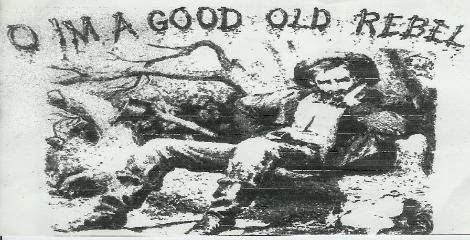
2nd South Carolina String Band - Oh, I'm a Good Ol' Rebel


Will we experience a similar contempt for our founding compacts as discouraged southern soldier veterans? The "yankee virus" as spread now throughout all states, so maybe we have superior voices this time.  

Sadly, we sense that as our lives and liberties become increasingly disparaged by government there will be millions who'll share the southern anguish of 150 years ago, and come to know what the "good ol' rebel" was trying to tell us. You're an informed audience and understand.


Remember...they only wanted to be left alone.


First published in 1914, this song expresses
the feelings of the old CSA Veterans

Oh, I'm a good old Rebel,
Now that's just what I am;
For this "fair land of Freedom"
I do not care a damn.
I'm glad I fit against it-
I only wish we'd won.
And I don't want no pardon
For anything I've done.

I hates the Constitution,
This great Republic too;
I hates the Freedmen's Buro,
In uniforms of blue.
I hates the nasty eagle,
With all his brag and fuss;
But the lyin', thievin' Yankees
I hates' em wuss and wuss.

I hates the Yankee nation
and everything they do,
I hates the Declaration
of Independence, too;
I hates the glorious Union
tis drippin' with our blood
I hates their striped banner,
I fit it all I could.

I followed Ol' Marsh Roberts
for four years, nearabout,
got wounded in three places
and starved at P'int Lookout:
I cotched the rheumatism
a'campin' in the snow;
but I killed a chance o' Yankees,
I'd like to kill some mo'.

We got three hundred thousand
Befo' they conquered us.
They died of Southern fever
And Southern steel and shot;
And I wish it was three million
Instead of what we got.

I can't take up my musket
And fight' em now no mo',
But I ain't a-goin'to love' em,
Now that is sartin sho';
And I don't want no pardon
For what I was and am;
And I won't be reconstructed,
And I do not give a damn.

<bgsound SRC="http://www.dixiescv.org/images/sounds/Oh-I'm-a-Good-Old-Rebel.wma" LOOP=FALSE AUTOSTART=TRUE HIDDEN=FALSE VOLUME="100">
The song Oh I'm a Good Old Rebel is a
WAV. file created and © by Hoyt Axton
Used with permission. All rights reserved.
 

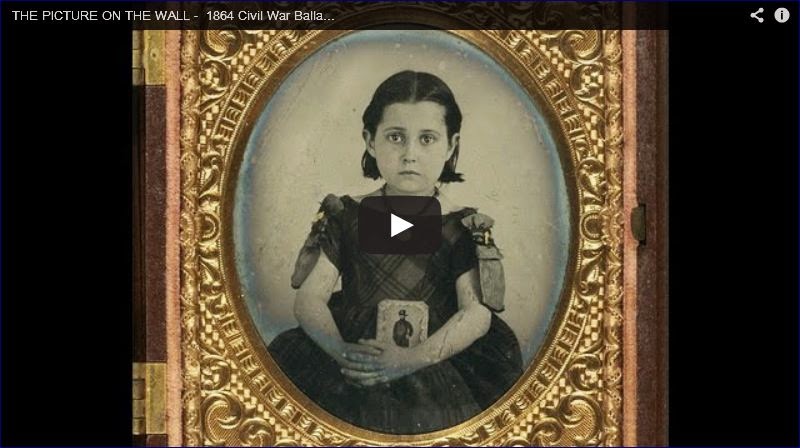
"THE PICTURE ON THE WALL" - 1864 Civil War Ballad - Tom Roush


The poignant lyrics to this song were adapted to music in 1864 by Henry Clay Work who composed songs such as "Grandfather's Clock" and "Marching Through Georgia." This ballad is practically unknown even to the most avid of Civil War music enthusiast. I felt compelled to perform it in my own attempt to portray the feelings of the families who survived the sacrifice of a beloved husband, father, or son for a cause in which they believed was right. The sentiments of this song are universal and still are true in every war from the Civil War to Afghanistan and beyond.

More ballads of the period from Tom Roush


Thursday, October 16, 2014

We have an Unlawful 14th Amendment

CAUTION: Do not use this irregularity to call for or support the Insiders call for a Constitutional Convention (CON-CON)!!
Posted on October 13, 2014 by admin in Education

There is No “Fourteenth Amendment”!

by David Lawrence, U.S. News & World Report, September 27, 1957

A MISTAKEN BELIEF—that there is a valid article in the Constitution known as the “Fourteenth Amendment”—is responsible for the Supreme Court decision of 1954 and the ensuing controversy over desegregation in the public schools of America. No such amendment was ever legally ratified by three fourths of the States of the Union as required by the Constitution itself. The so-called “Fourteenth Amendment” was dubiously proclaimed by the Secretary of State on July 20, 1868. The President shared that doubt. There were 37 States in the Union at the time, so ratification by at least 28 was necessary to make the amendment an integral part of the Constitution. Actually, only 21 States legally ratified it. So it failed of ratification.

The undisputed record, attested by official journals and the unanimous writings of historians, establishes these events as occurring in 1867 and 1868:

Outside the South, six States—New Jersey, Ohio, Kentucky, California, Delaware and Maryland—failed to ratify the proposed amendment.

In the South, ten States—Texas, Arkansas, Virginia, North Carolina, South Carolina, Georgia, Alabama, Florida, Mississippi and Louisiana —— by formal action of their legislatures, rejected it under the normal processes of civil law. A total of 16 legislatures out of 37 failed legally to ratify the “Fourteenth Amendment.”

Congress—which had deprived the Southern States of their seats in the Senate —did not lawfully pass the resolution of submission in the first instance.

The Southern States which had rejected the amendment were coerced by a federal statute passed in 1867 that took away the right to vote or hold office from all citizens who had served in the Confederate Army. Military governors were appointed and instructed to prepare the roll of voters. All this happened in spite of the presidential proclamation of amnesty previously issued by the President. New legislatures were thereupon chosen and forced to “ratify” under penalty of continued exile from the Union. In Louisiana, a General sent down from the North presided over the State legislature.

Abraham Lincoln had declared many times that the Union was “inseparable” and “indivisible.” After his death, and when the war was over, the ratification by the Southern States of the Thirteenth Amendment, abolishing slavery, had been accepted as legal. But Congress in the 1867 law imposed the specific conditions under which the Southern States would be “entitled to representation in Congress.”

Congress, in passing the 1867 law that declared the Southern States could not have their seats in either the Senate or House in the next session unless they ratified the “Fourteenth Amendment,” took an unprecedented step. No such right—to compel a State by an act of Congress to ratify a constitutional amendment—is to be found anywhere in the Constitution.

Nor has this procedure ever been sanctioned by the Supreme Court of the United States. President Andrew Johnson publicly denounced this law as unconstitutional. But it was passed over his veto.
Secretary of State Seward was on the spot in July 1868 when the various “ratifications” of a spurious nature were placed before him. 

The legislatures of Ohio and New Jersey had notified him that they rescinded their earlier action of ratification. He said in his official proclamation that he was not authorized as Secretary of State “to determine and decide doubtful questions as to the authenticity of the organization of State legislatures or as to the power of any State legislature to recall a previous act or resolution of ratification.” He added that the amendment was valid “if the resolutions of the legislatures of Ohio and New Jersey, ratifying the aforesaid amendment, are to be deemed as remaining of full force and effect, notwithstanding the subsequent resolutions of the legislatures of these States.” This was a very big “if.” It will be noted that the real issue, therefore, is not only whether the forced “ratification” by the ten Southern States was lawful, but whether the withdrawal by the legislatures of Ohio and New Jersey —two Northern States —was legal. The right of a State, by action of its legislature, to change its mind at any time before the final proclamation of ratification is issued by the Secretary of State has been confirmed in connection with other constitutional amendments.

The Oregon Legislature in October 1868 —three months after the Secretary’s proclamation was issued —passed a rescinding resolution, which argued that the “Fourteenth Amendment” had not been ratified by three fourths of the States and that the “ratifications” in the Southern States were “usurpations, unconstitutional, revolutionary and void” and that, “until such ratification is completed, any State has a right to withdraw its assent to any proposed amendment.”

What do the historians say about all this? The Encyclopedia Americana states:
“Reconstruction added humiliation to suffering . . . Eight years of crime, fraud, and corruption followed and it was State legislatures composed of Negroes, carpetbaggers and scalawags who obeyed the orders of the generals and ratified the amendment.”

W. E. Woodward, in his famous work, “A New American History?” published in 1936, says:
“To get a clear idea of the succession of events let us review [President Andrew] Johnson’s actions in respect to the ex-Confederate States.”

“In May, 1865, he issued a Proclamation of Amnesty to former rebels. Then he established provisional governments in all the Southern States. They were instructed to call Constitutional Conventions. They did. New State governments were elected. White men only had the suffrage [the Fifteenth Amendment establishing equal voting rights had not yet been passed]. Senators and Representatives were chosen, but when they appeared at the opening of Congress they were refused admission. The State governments, however, continued to function during 1866.”

“Now we are in 1867. In the early days of that year [Thaddeus] Stevens brought in, as chairman of the House Reconstruction Committee, a bill that proposed to sweep all the Southern State governments into the wastebasket. The South was to be put under military rule.”

“The bill passed. It was vetoed by Johnson and passed again over his veto. In the Senate it was amended in such fashion that any State could escape from military rule and be restored to its full rights by ratifying the Fourteenth Amendment and admitting black as well as white men to the polls.” In challenging its constitutionality, President Andrew Johnson said in his veto message:

“I submit to Congress whether this measure is not in its whole character, scope and object without precedent and without authority, in palpable conflict with the plainest provisions of the Constitution, and utterly destructive of those great principles of liberty and humanity for which our ancestors on both sides of the Atlantic have shed so much blood and expended so much treasure.”

Many historians have applauded Johnson’s words. Samuel Eliot Morison and Henry Steele Commager, known today as “liberals,” wrote in their book, “The Growth of the American Republic”:

“Johnson returned the bill with a scorching message arguing the unconstitutionality of the whole thing, and most impartial students have agreed with his reasoning.”

James Truslow Adams, another noted historian, writes in his “History of the United States”:

“The Supreme Court had decided three months earlier, in the Milligan case, . . . that military courts were unconstitutional except under such war conditions as might make the operation of civil courts impossible, but the President pointed out in vain that practically the whole of the new legislation was unconstitutional. . . . There was even talk in Congress of impeaching the Supreme Court for its decisions! The legislature had run amok and was threatening both the Executive and the Judiciary.”

Actually, President Johnson was impeached, but the move failed by one vote in the Senate.

The Supreme Court, in case after case, refused to pass on the illegal activities involved in “ratification.” It said simply that they were acts of the “political departments of the Government.” This, of course, was a convenient device of avoidance. The Court has adhered to that position ever since Reconstruction Days.

Andrew C. McLaughlin, whose “Constitutional History of the United States” is a standard work, writes:

“Can a State which is not a State and not recognized as such by Congress, perform the supreme duty of ratifying an amendment to the fundamental law? Or does a State —by congressional thinking —cease to be a State for some purposes but not for others?”

This is the tragic history of the so-called “Fourteenth Amendment”— a record that is a disgrace to free government and a “government of law.”

Isn’t the use of military force to override local government what we deplored in Hungary? It is never too late to correct injustice. The people of America should have an opportunity to pass on an amendment to the Constitution that sets forth the right of the Federal Government to control education and regulate attendance at public schools either with federal power alone or concurrently with the States.

That’s the honest way, the just way to deal with the problem of segregation or integration in the schools. Until such an amendment is adopted, the “Fourteenth Amendment” should be considered as null and void.

There is only one supreme tribunal — it is the people themselves. Their sovereign will is expressed through the procedures set forth in the Constitution itself.

via dueprocessrevisited

Tuesday, August 19, 2014

The Civil War and the Southern Belle

By
August 18, 2014 7:01 pmAugust 18, 2014 7:01 pm

Disunion follows the Civil War as it unfolded.


In the beginning of the war, Southern women wanted their men to leave — in droves, and as quickly as possible. They were the Confederate Army's most persuasive and effective recruitment officers, shaming anyone who shirked his duty to fight. A young English immigrant in Arkansas enlisted after being accosted at a recruitment meeting. "If every man did not hasten to battle, they vowed they would themselves rush out and meet the Yankee vandals," he wrote of Southern women. "In a land where women are worshipped by men, such language made them war-mad."

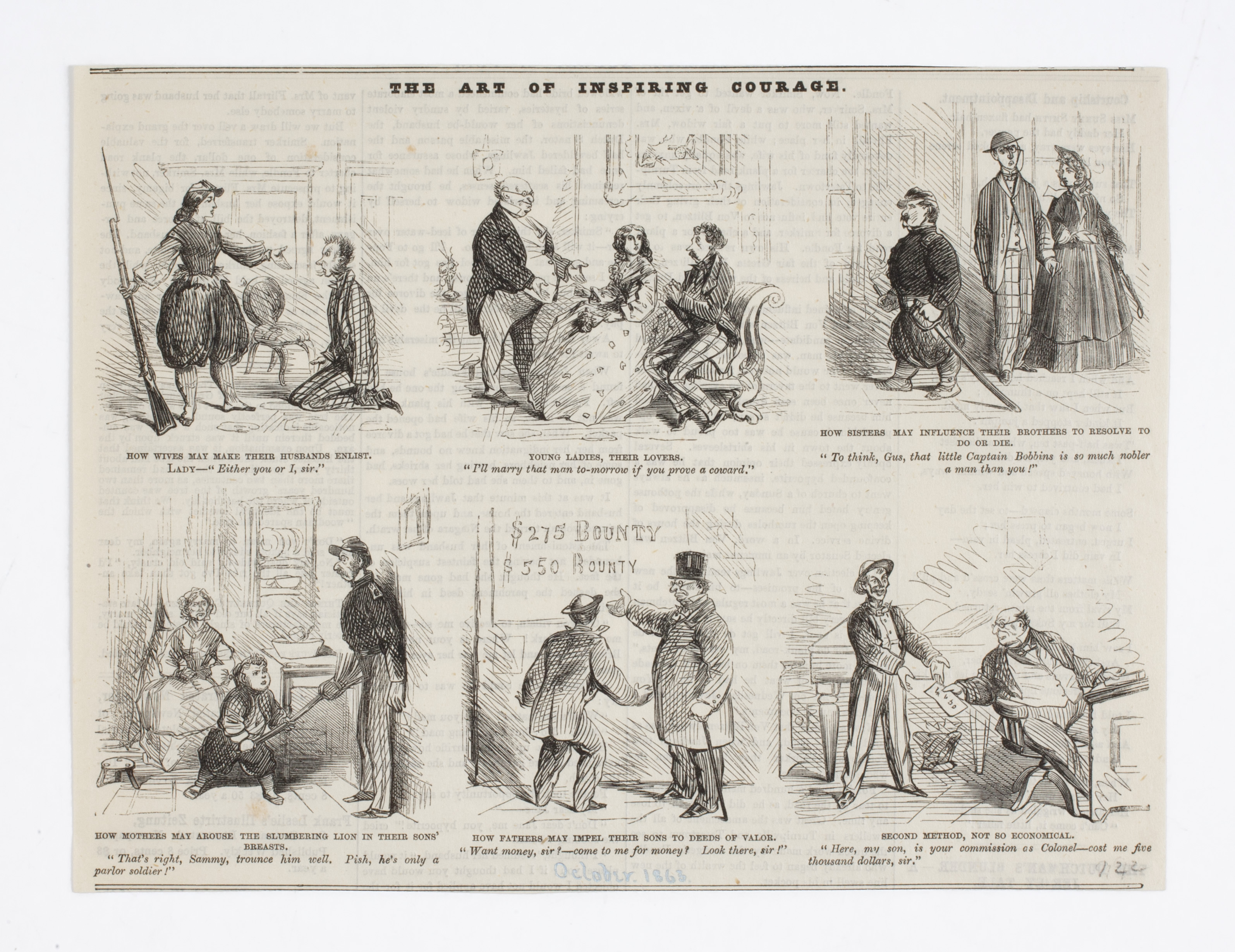
Newspapers printed gender-bending cartoons that drove the point home. In one, a musket-wielding woman dressed in trousers and a kepi looms over her cowering beau, insisting, "Either you or I, sir." One Alabama schoolgirl spoke for many of her peers when she declared, "I would not marry a coward." At balls and parties girls linked arms and sang, "I am Bound to be a Soldier's Wife or Die an Old Maid." One belle, upon hearing that her fiancé refused to enlist, sent her slave to deliver a package enclosing a note. The package contained a skirt and crinoline, and the note these terse words: "Wear these, or volunteer." He volunteered.

Photo
A Winslow Homer drawing from 1865 showing a captain, who lost an arm, with his newly independent wife.Credit Brooklyn Museum


In the sudden absence of husbands, fathers, brothers and beaus, white Southern women discovered a newfound freedom — one that simultaneously granted them more power in relationships and increased their likelihood of heartbreak. Gone were the traditions of antebellum courtships, where family connections and wealth were paramount and a closed circle of friends and neighbors scrutinized potential mates, a process that could last for years. The war's disruptions forced elite Southern parents to loosen rules regarding chaperoning and coquetry, which one prominent lecturer called "an artful mixture of hypocrisy, fraud, treachery and falsehood" that risked tarnishing a girl's reputation. 

The girls themselves relinquished the anticipation, instilled since birth, that they would one day assume their positions as wives, mothers and slave mistresses, that their lives would be steeped in every privilege and comfort. The war ultimately challenged not only long-held traditions of courtship and marriage, but the expectation that one might wed at all.
At least in cities where the Confederate Army established a base of operations, young women were overwhelmed by the number of prospective suitors. Thousands of men flocked to the Confederate capital of Richmond, prepared to work in one of the government departments or to train for duty in the Army. The Central Fair Grounds just west of the city were transformed into "Camp Lee," where the new recruits set up tents and conducted military drills. "Between eight and ten thousand men went down Main St. this afternoon," wrote a 16-year-old Richmond diarist. "It was very tantalizing to me to hear the drum and the cheering and to be able to see nothing but their bayonets and the tops of their heads. It is wicked in me to wish that I had gone out so that I might see them, and not to wish that I had gone to church, but I love the soldiers so much, that I forget almost everything else when I get to thinking about them."

Troops marching through the capital blew kisses to the Richmond belles, who returned the attention with unprecedented abandon, waving handkerchiefs and tossing pocket Bibles and pincushions. In the antebellum years, new acquaintances required a formal letter of introduction, but the war allowed for association with complete strangers, men whose names they didn't even know. The women took unchaperoned trips to Confederate campgrounds, going on horseback rides and picnics, allowing uniformed men to serenade them and plant lingering kisses on their hands — all activities once restricted to engaged couples. Even their style of banter changed, turning aggressive and overtly political, a rebellion against their old identities as genteel Southern ladies. "I confess myself a rebel, body and soul," declared a Louisiana girl, adding, "Confess? I glory in it!" Union soldiers occupying Southern towns complained of "she-rebels" who spat at them and emptied the contents of chamber pots on their heads.

The relaxed wartime atmosphere led to increased physical intimacy, although in letters and diaries Southern women admitted only to flirting. Casual relationships, and even casual engagements — "slight, silly love affairs," as one woman called them — flourished. Both women and men kept engagements secret, sometimes specifying that each was still free to see others. "Neither of us is to consider this engagement binding," wrote a Georgia belle to her betrothed, a Confederate lieutenant. "If another is loved, no sense of honor will prevent our immediately letting the other know of it — so you are still at liberty to fall in love with whom you please, without considering me at all in the way." One Georgia cavalryman predicted, "If we Stay heare much longer in about 9 months from now thare will be more little Gorgians [sic] a Squalling through this contry then you can Shake a Stick at." Such liaisons could endanger elite women's reputations and, in some cases, their lives. One Richmond woman, who became pregnant after an affair with a married Confederate officer, died as a result of complications from a self-induced abortion.

Southern women in rural areas grappled with entirely different concerns: the dearth of suitable men — or any men at all. By the summer of 1863, in New Bern, N. C., only 20 of the 250 white people remaining in town were men. The war was on its way to claiming one in five white Southern men of military age (leaving behind more than 70,000 widows), a situation that prompted frantic letters to the editor. "Having made up my mind not to be an old maid," an 18-year-old Virginian wrote to the editor of the Southern Literary Messenger, "and having only a moderate fortune and less beauty, I fear I shall find it rather difficult to accomplish my wishes" (nevertheless she hopefully listed her skills, which included making brandy peaches and "throw[ing] socks in a corner").

Widowed women in their 30s faced stiff competition for available men in their age group, and suffered constant reminders of their grim odds. The editor of the Petersburg (Va.) Daily Register took pity on older eligible women during the social season of 1864, helpfully warning them against using rouge. "Bachelors are a shy game," he pointed out, "and when convinced of one deception imagine many more." As if strategizing over how to thwart younger rivals wasn't taxing enough, the widows were also national laughingstocks — punch lines to the endless "old maid" jokes that became a staple of American humor. If you were alive during the Civil War, chances are you heard the one about the schoolboy who threw a stone at a dog; he missed the pooch, but hit seven old maids.

As time passed and casualties mounted, some women grew resigned to the idea of life without a husband, while others compromised on acceptable partners. "One looks at a man so differently when you think he may be killed tomorrow," one South Carolina woman mused. "Men whom up to this time I had thought dull and commonplace … seemed charming." One in 13 soldiers returned home missing limbs, and the press, pulpit and politicians reminded Southern women that it was their patriotic duty to marry disabled veterans. The "limping soldier," argued the president of the Confederacy, Jefferson Davis, should be treated as aristocracy after the war: "To the young ladies I would say when choosing between an empty sleeve and the man who had remained at home and grown rich, always take the empty sleeve." 

There was, of course, a third option that some women took: the unspeakable faux pas of marrying a Yankee. A Nashville girl wrote her brother in the Confederate Army that the local belles were "dropping off into the arms of the ruthless invader." One, a girl who carried a stiletto and threatened to emulate Charlotte Corday should the enemy invade her city, had "gone the way of all flesh and married an officer with that detestable eagle on his shoulder."

Toward the end of the war, many Southern women who were widowed or had never married sustained themselves with female friendships (or "Boston marriages," as they came to be called in the North). They proudly proclaimed their independence, asserting that they preferred the freedom of single life to the entanglements of marriage — a risky "lottery," in the words of a Louisiana diarist, that subjected women to the "despotism of one man." While they certainly mourned the deaths of male suitors — as they did the deaths of male relatives — they no longer considered spinsterhood a tragedy. "Clara … thinks we'll all be old maids yet," wrote a South Carolinian, recording a friend's predictions. She added, "I don't doubt it, neither do I care very much."

By 1865, all Southern women — the happily and regrettably single, the perpetually engaged, the wives and widows — had tired of the war. The Confederacy was shrinking, and the morale of its remaining men shrinking with it. The Northern press ran a widely reprinted cartoon called "sowing" and "reaping," chiding Southern women for "hounding their men on to Rebellion" and then complaining about its effects. The Union blockade had sent the cost of goods and food skyrocketing. They were starving; they feared the terrors of Yankee occupation; they had exhausted both their patriotism and their patience. "Oh my dear husband how shall I live without you?" wrote one Mississippi woman. "When will this cruel war end?" It was time, at last, for the surviving husbands, fathers, brothers and beaus to lay down their arms and come home.

Karen Abbott's forthcoming book, "Liar, Temptress, Soldier, Spy: Four Women Undercover in the Civil War," will be published in September. Her website is www.karenabbott.net.

SOURCES: Catherine Clinton, "Southern Families at War: Loyalty and Conflict in the Civil War South"; Lisa Tendrich Frank, "Women in the American Civil War"; Giselle Roberts, "The Confederate Belle"; Anya Jabour, "Scarlett's Sisters: Young Women in the Old South"; David Andrew Silkenat, "Suicide, Divorce, and Debt in Civil War era North Carolina" (dissertation); Lacy K. Ford, "A Companion to the Civil War and Reconstruction"; Mary Elizabeth Massey, "Women in the Civil War"; Richard F. Selcer, "Civil War America, 1850-1875"; A. Wilson Greene, "Civil War Petersburg: Confederate City in the Crucible of War"; William C. David and Russ A. Pritchard, "Fighting Men of the Civil War"; Stephen W. Berry, "All That Makes a Man: Love and Ambition in the Civil War South" and "Weirding the War: Stories from the Civil War's Ragged Edges"; Amy Murrell Taylor, "The Divided Family in Civil War America"; J. David Hacker, Libra Hilde, and James Holland Jones, "The Effect of the Civil War on Southern Marriage Patterns."


Saturday, August 16, 2014

Defending Southern Heritage? Sober Up!!

Thursday, May 26, 2005
by Clyde Wilson
Clyde Wilson, Founder of the SCLOS
Many good people have been working in recent years to preserve public acknowledgment and celebration of our Confederate history. Our fights have been largely defensive reactions to the innumerable strokes of our enemies, and most of them have been defeats. Our enemies control most of the 'respectable' political, religious, educational, business and media institutions of American society, including nearly all 'Southern' institutions.

We have lost in part because many defenders of our symbols have not understood the nature of the battle.

Southerners are a conservative people. They prefer the traditional to the abstract and are slow to adopt new theories (one of the several characteristics that distinguish them from other inhabitants of the United States). This is a good and healthy virtue, but like all virtues it can, if we are not careful, become a self-defeating rigidity. 
 
The conservative philosopher Russell Kirk contrasted mere stand-patter conservatism of the dull-witted or poor in spirit who reject anything new with the true conservatism of an Edmund Burke or a John C. Calhoun who perceived that it was necessary to change in order to conserve because new conditions had created new threats to our patrimony.

Unfortunately, too many spokesmen in the fight for Southern heritage are stand-patters, i.e., dinosaurs on their way to extinction. They are trying to live in a world that they grew up in but which does not exist any more. The world that they grew up in accepted Southerners and Southern heritage as a positive part of America. That world began disappearing a half century ago and is almost gone.

After Reconstruction, which all sensible Northerners came to realize had been a grievous mistake, most Americans, North and South, took the Road to Reunion. Southerners had to agree that they were glad that the Union had been saved and a stronger America had emerged. (They were already genuinely glad of the end of slavery.) For the most part they did this with sincerity and enthusiasm (they had to if they had any hopes of personal success). Southerners became good and loyal members of the new America. They have lived up to that pledge every generation since, in fact have been the most loyal of all Americans and done more than their fair share in every war.

As their part of the bargain, Northerners acknowledged that Southerners had been brave and honourable in their war for independence, and their heroes, like Lee and Jackson, would be celebrated as AMERICAN heroes. (There were always a few old Yankees around who wanted to exterminate the rebels, and indeed there still are, but they were a minority.)

This is why The Birth of a Nation creation of D.W. Griffith, son of a Confederate soldier, could be regarded as a national epic at the beginning of the twentieth century. Will Rogers, another son of a Confederate soldier, was a national institution and he and Shirley Temple and many others portrayed very sympathetic Southern characters in the films of the 1920s and 1930s.

Gone With the Wind, book and movie, was an all-time best-seller
"Bless her heart..."
in the North as well as the South. Every major male non-Southern Hollywood star in the 1950s and 1960s portrayed a heroic Confederate: Erroll Flynn, John Wayne, Clark Gable, Allan Ladd, Charlton Heston, Richard Harris, Montgomery Clift, Henry Fonda, Ronald Reagan, and Richard Widmark, to name just a few. In all his best movies, John Wayne is a Confederate: Red River, The Searchers, and True Grit, the last two based on Southern novels.

Confederate flags were seen among American fighting men, in real life and film, during World War II, Korea, and Vietnam. Douglas Southall Freeman's R.E. Lee and Lee's Lieutenants were celebrated as accounts of AMERICAN military valour. When President Roosevelt inaugurated the first completed dam of the TVA, he did so on a platform that flew US and Confederate flags.

THAT WORLD DOES NOT EXIST ANY MORE! DEFENDERS OF SOUTHERN HERITAGE SHOULD STOP ACTING LIKE IT DOES. The people who want to do away with Confederate symbols are not people who will come around when you argue a little historical interpretation with them, or when you point out (as you know to be true) that your forebears were not fighting for slavery, or prove that you are a loyal American whose heart contains no hate and violence.

They do not care! They have no heritage of their own and do not know what a heritage is. They believe in their own self-interest and fashionable abstractions. We do not and will not in the foreseeable future live in a world where Southern heritage will be publicly honoured except by us. We live in a regime where Confederate symbols are scheduled for complete obliteration. At present, we can expect no help from our own institutions, the politics of Southern states being dominated primarily by Big Business. (A phone call from the president of NationsBank or the publisher of a big newspaper carries more weight with any politician than 20,000 Confederates at a rally, or any number of personal visits from earnest citizens. This is a fact.)

The Compromise is broken. Why this happened would take several books to explain. Northern society has periodically gone through fits of fanaticism which have focused upon us. When was the last time you thought about telling people in New York or Seattle what to do? Never, because it is not a part of our national character as Southerners. But hundreds of thousands of Northerners are thinking about you and about their right to suppress your evil ways. In their fantasy world, which is the only culture of any significance they have, YOU are the evil obstacle to making the world perfect. They have always been that way.

It has nothing to do with you. It is their problem. It has nothing to do with the South except that the South lies convenient for their aggressions. They cover up their emptiness, hatred, hypocricy, and insignificance by identifying you as the Enemy. This is the way Puritans behave when they lose their religion. Our forefathers saw this clearly. It was that kind of society and people that they fought to be free of !

Many of our official defenders have not figured out that the Compromise no longer exists. In a recent legislative election in South Carolina, the leftwing candidate brought out a bevy of veterans and SCV members to publicly condemn the conservative candidate because the conservative candidate was a Southern activist who allegedly would not repeat the Pledge of Allegiance.

It was as if the conservative candidate was one of the spoiled Yankee children who promoted treason in time of war in the 1960s. These good people are too blind to figure out that those 60s traitors are now in power in America and are the ones who are hellbent on using their power to destroy every last vestige of our Southern heritage and identity!

This unfortunately represents the attitude of too many flag defenders. One despairs at such blindness. The compatriots I am talking about, however, can be educated. I have seen it done. Democrats and Republicans both, of the ruling establishment, are relying on this kind of stupid 'patriotism' to kill off challenges to their power. Southern heritage is the first casualty of that power.

WAKE UP! It is not 1945 any more, or even 1975. You can either honour your Southern heritage and preserve your Southern identity, or you can give unthinking obedience to the America of today. You cannot do both without engaging in self-defeating contradiction.

HERE ARE A FEW SUGGESTIONS:

*Don't compromise. Compromise is only a defeat and a springboard for another attack. Don't think that being a good sport will make the other side good sports. Who follows an uncertain trumpet? You will probably lose. But a loss on principle preserves a rallying point. John C. Calhoun says: a defeat on principle is not an overthrow, while a victory by compromise is a defeat.

*Be worthy of your ancestors. Don't be a goody goody 'American' humbly begging to be allowed to keep a shred of your heritage. You are a member of a great people under attack who have been betrayed by their leaders. It is needed to defend the Southern people here and now and not just the noble Confederate soldier.

*Think like a Southerner. Lay claim to all your heritage! We cannot
You would be hard-pressed to find any patriot who's worked any harder to preserve southern heritage than H.K. Edgarton
defend only our Confederate forebears, as important as that is. They are but a part of Southern history. Lay claim to all of Southern history and culture, from Captain John Smith and Pocahontas to Dale Earnhardt. To concentrate on Confederate history alone is to concede to the enemy that the Confederacy can be segregated off as an evil episode of slavery and treason. It also plays into the North's everlasting tendency to claim anything Southern that is good, as 'American,' that is, non-Southern. George Washington is just as Southern as Robert E. Lee. Thomas Jefferson is just as Southern as Jefferson Davis. Andrew Jackson is just as Southern as Bedford Forrest. Alvin York, and Audie Murphy, and the Alamo are just as Southern as Stonewall Jackson.

Avoid argument with the enemy and concentrate on educating yourself and members of our people, especially the young, not forgetting the many Yankees of good will. In Heritage-Haters you are dealing with people who send their children to private schools while busing yours and still think they are morally superior to you because they are in favour of busing and you are not. They are not interested in debate or evidence. Remember, they are not attacking your great-grandfather's war: they are attacking you! And, as we learned in the flag fight in South Carolina, this goes double for the academic 'experts' in the war era, who are even less interested in evidence and perspective than the ordinary flag hater.

*Don't be discouraged. So beautiful and powerful is our heritage that it has taken them decades to cut away as much as they have. It will take some time and hard work to recover lost ground.

*If you have to argue, turn the tables. There is little profit in talking about slavery in today's climate. If you must discuss slavery call it 'domestic servitude,' which is what it was. Most importantly, point out that, sure, the South did not want outside interference with its domestic servitude, but the North was NOT fighting to end slavery! The significant factor is the North's motives! They are the ones who invaded us, violating the fundamental American principle of the consent of the governed. Most people who think they are aggrieved about slavery neither know nor care anything about history. They are really aggrieved about the segregation that marked more recent times.

If you must debate don't make indefensible statements that will be laughed out of court, like 'the war was not about slavery', 'most Southerners did not own slaves', and an exaggerated count of black soldiers in the Confederacy. Yes, the war was partly about slavery, though not on their side and not as centrally and in the way that they claim. By counting families, or households, approximately one-fourth of Southerners were owners of domestic servants, almost all of them of a few people (1-4) who lived and worked closely with the family. Yes, there were a great many black Confederates who helped sustain the armies and the home front, but not as enrolled soldiers.

*My standpatter compatriots, if you want to be a good American as defined by the ruling institutions today, forget about your Southern heritage. But most Southerners care for family, place, Christian social order, courage, loyalty, honour—all things besieged in America today. That is, after all, why we love our heritage.

*Stop supporting federal government wars out of unthinking loyalty. For a long time the US armed forces had a chilvalric Southern flavour. They now combine all the worst aspects of bureacracy, imperialism, graft, affirmative action, and Political Correctness, in an atmosphere of moral depravity.

*Cure yourself of Republican party thinking. What further proof is needed that the South and Southerners have nothing to expect from the Republican 'conservatives' except payoffs to individuals to betray their people? As the Rev Robert Lewis Dabney pointed out long ago, the Northern 'conservatives,' in the entire course of American history have never conserved anything. George W., though raised in Texas, suppressed innocuous Confederate plaques. McCain, though a descendant of Confederates, branded our flag as a hate symbol to be suppressed. The Republican governor of New York banished the Georgia flag. Shortly after their candidate was elected President, the Wall Street Journal and National Review published pieces ridiculing Southern conservatives. The message was clear: Give us your votes and shut up.

The worst thing that can happen to the South is to be turned into an appendage of the bland, principleless elements represented by the Republican party. Think like a Southerner, not like a knee-jerk 'conservative.' If Jesse Jackson causes a ruckus in Decatur, Illinois, applaud him. You can be sure that if he was making trouble in your town, Decatur, Illinois, would be cheering him on. They just don't want him to bother them.

Dr Clyde Wilson is a published author, a professor at the University of South Carolina, and one of the founding members of the League of the South.