Search Blog Posts

Showing posts with label ECB. Show all posts

Tuesday, February 24, 2015

Ten Banks, Including JPM, Goldman, Deutsche, Barclays, SocGen And UBS, Probed For Gold Rigging

Submitted by Tyler Durden on 02/23/2015 22:17 -0500
No matter how many times the big banks are caught red-handed manipulating precious metals, some failed former Deutsche Bank prop-trader (you know who you are) will take a vociferous stand based on ad hominem attacks and zero facts that no, what you see in front of you is not precious metal rigging at all but a one-off event that has nothing to do with a criminal banking syndicate hell bent on taking advantage of anyone who is naive and dumb enough to still believe in fair and efficient markets. 

The last time this happened was in November when we learned that "UBS Settles Over Gold Rigging, Many More Banks To Follow", and sure enough many more banks did follow, because in Europe, where the stench of gold market manipulation stretches far beyond merely commercial banks, and rises through the central banks, namely the BOE and ECB, culminating with the Head of Foreign Exchange & Gold at the BIS itself, all such allegations have to be promptly settled or else the discovery that the manipulation cartel in Europe involves absolutely everybody will shock and stun the world, which heretofore was led to believe that such things as gold market (not to be confused with Libor or FX) manipulation only exist in the paranoid delusions of a few tinfoil fringe-blogging lunatics.

However, as usually happens, someone always fails to read the memo that when it comes to gold-market manipulation one must i) find nothing at all incriminating if one is a paid spokesman for the entities doing the manipulation such as former CFTC-sellout Bart Chilton or ii) if one can't cover it, then one must settle immediately or else the chain of revelations will implication everyone.

This time, that someone is the US Department of Justice, which as the WSJ just reported, is investigating at least 10 major banks for possible rigging of precious-metals markets. The DOJ is shockingly doing so "even though European regulators dropped a similar probe after finding no evidence of wrongdoing, according to people close to the inquiries." Of course, the reason why said probe was dropped in Europe is because it would have implicated virtually the entire trading desk at the biggest and most important European bank: Deustche Bank, as well as the biggest bank in Switzerland, UBS and UK's own Barclays, reveal a manipulation cartel rivaling even that of Libor. And once traders at the commercial banks turned sides and squealed for the prosection, well then it would be the central banks' turn next. Which is why it was imperative to bring this investigation to a quiet end.

But not in the US.

According to the WSJ, "prosecutors in the Justice Department’s antitrust division are scrutinizing the price-setting process for gold, silver, platinum and palladium in London, while the Commodity Futures Trading Commission has opened a civil investigation, these people said. The agencies have made initial requests for information, including a subpoena from the CFTC to HSBC Holdings PLC related to precious-metals trading, the bank said in its annual report Monday.

HSBC also said the Justice Department sought documents related to the antitrust investigation in November. The two probes “are at an early stage,” the bank added, saying it is cooperating with U.S. regulators.

Who is involved in this latest gold-rigging scandal? Why everyone! ... which makes it immediately obvious why the European regulator had to promptly cover up the whole affair. Under scrutiny are Bank of Nova Scotia , Barclays PLC, Credit Suisse Group AG , Deutsche Bank AG , Goldman Sachs Group Inc., J.P. Morgan Chase & Co., Société Générale SA, Standard Bank Group Ltd. and UBS AG , according to one of the people close to the investigation.

Robert Hockett, a law professor at Cornell University, said it is “not particularly surprising” that the Justice Department is plowing ahead despite the decision by European regulators.  

Recent scrutiny of big banks’ operations in the physical commodities markets and criticism of the Justice Department’s financial-crisis track record make it “quite understandable” that the agency would investigate allegations of precious metals price-rigging.

Last year, the FCA fined Barclays £26 million ($40.2 million) for lax controls after one of its traders allegedly manipulated the gold fix at the expense of a client.

Swiss regulator Finma settled last year allegations of foreign-currency manipulation with UBS. The regulator said it found “serious misconduct” among precious-metals traders at UBS, including “front running,” or trading ahead of, the silver-fix orders of one client. A spokeswoman for UBS, which said at the time that it “instituted significant cultural and compliance changes,” declined further comment.

You mean to say that the banks that were for decades rigging Libor... and FX... and bonds... and stocks... oh, and gold, were let go with a slap on the wrist and a promise to "change their ways" and not to do it again?  Yup, that's exactly right.

So what happens next? Well, we finally will find just how much of a banker-controlled muppet the so-called US attorney general truly is. Recall that a week ago he gave his subordinates 90 days to being cases against individuals for their role in the financial crisis.

Well here is the perfect opportunity.  Should Holder let this latest mass criminal ring go without any incarceration, one can officially stick a fork in the US justice system, which is meant for everyone, but the rule-flouting bankers who can clearly get away with absolutely anything.

As for the rigging in the gold market, rigging which begins with the lowliest prop-traders at Deutsche Bank and involves every single central bank and High Frequency trading outfit and is now a proven fact, we have explained over the years and thousands of times just how to end it all, so instead of wasting readers' time on this topic yet again, here are just two very simple solutions how to fix this one particular market:

So simple, even the most corrupt US Attorney General caveman can do it.

Source ZeroHedge

Friday, February 6, 2015

Is Russia Planning a Gold-Based Currency?

February 6, 2015

The “perfect-storm” of geopolitical instability, diplomatic isolation, severe currency depreciation, and economic decline now confronting Russia has profoundly damaged Moscow's international standing, and possibly for the long-term. Yet, it is precisely such conditions that may push the country’s leadership into taking the radical step that will secure its world-player status once and for all: the adoption of a gold-exchange standard.

Though a far-fetched idea at first glance, many factors suggest that remonetization in gold may be a logical next step for Moscow.

First, for years Moscow has been expressing its unwillingness to remain at the monetary mercy of the US and its NATO allies and this view has been most vehemently expressed by President Putin’s long-time economic advisor, Sergei Glazyev. Russia is prepared to play strategic hardball with the West on the issue: the governor of Russia’s central bank took the unusual step last November of presenting to the international media details of the bank’s zealous gold-buying spree. The announcement, in sharp contrast to that institution’s more taciturn traditions, underscores Moscow’s outspoken dismay with dollar hegemony; its timing suggests coordination with the top rungs of government to present gold as a possible currency-war weapon.

Second, despite international pressure, Russia has been very wary of the sell-off policies that led the UK, France, Spain, and Italy to unload gold over the past decade during unsuccessful attempts to prop up their respective ailing economies — in particular, of then-Prime Minister Gordon Brown’s sell-off of 400 metric tons of the country's reserves at stunningly low prices. Moscow’s surprise decision upon the onset of the ruble’s swift decline in early December 2014 to not tap into the country’s gold reserves, now the world's sixth largest, highlights the ambitiousness of Russia’s stance on the gold issue. By the end of December, Russia added another 20.73 tons, according to the IMF in late January, capping a nine-month buying spree.

Third, while the Russian economy is structurally weak, enough of the country's monetary fundamentals are sound, such that the timing of a move to gold, geopolitically and domestically, may be ideal. Russia is not a debtor nation. At this writing in January, Russia’s debt to GDP ratio is low and most of its external debt is private. Physical gold accounts for 10 percent of Russia’s foreign currency reserves. The budget deficit, as of a November 2014 projection, is likely to be around $10 billion, much less than 1 percent of GDP. The poverty rate fell from 35 percent in 2001 to 10 percent in 2010, while the middle class was projected in 2013 to reach 86 percent of the population by 2020.

Collapsing oil prices serve only to intensify the monetary attractiveness of gold.
Given that oil exports, along with the rest of the energy sector, account for 45 percent of GDP, the depreciation of the ruble will continue; newly unstable fiscal conditions have devastated banks, and higher inflation looms, expected to reach 10 percent by the end of 2015. As Russia remains (for the foreseeable future) mainly a resource-based economy, only a move to gold, arguably, can make the currency stronger, even if it does limit Russia’s available currency.

In buying as much gold as it has, the country is, in part, ensuring that it will have enough money in circulation in the event of such fundamental transformation. In terms of re-establishing post-oil shock international prestige, a move to gold will allow the country to be seen as a more reliable and trustworthy trading partner.

The repercussions of Russia on a gold-exchange standard would be immense. Above all, it would mean the first major schism in the world's monetary order. China would quite likely follow suit. It could mean the threat of a severe inflation in the United States should rafts of unwanted dollars make their way back across the Atlantic — the Fed's ultimate nightmare. Above all, the country will avoid the extreme debt leverages which would not have happened had Western capitals remained on gold.

“A gold standard would be politically appealing, transforming the ruble to a formidable currency and reducing outflows significantly,” writes Dr. Enrico Colombatto, economics professor at the University of Turin, Italy.

He notes that the only major drawback would be that the imposed discipline of a gold standard would deprive authorities of discretionary political power. The other threat would be that of a new generation of Russian central bankers becoming too heavily influenced by the monetary mindset of the European Central Bank (ECB) and the Fed.

As Alisdair MacLeod, a two-decade veteran of off-shore banking consulting based in the UK, recently wrote, Russia (and China) will “hold all the aces” by moving away from any possible currency wars of the future into the physical gold market. In his article, he adds that there is currently a low appetite for physical gold in Western capital markets and longer-term foreign holders of rubles would be unlikely to exchange them for gold, preferring to sell them for other fiat currencies.

Mr. Macleod cites John Butler, CIO at Atom Capital in London, who sees great potential in a gold-exchange standard for Russia. With the establishment of a sound gold-exchange rate, he argues, the Central Bank of Russia would no longer be confined to buying and selling gold to maintain the rate of exchange. The bank could freely manage the liquidity of the ruble and be able to issue coupon-bearing bonds to the Russian public, allowing it a yield linked to gold rates. As the ruble stabilizes, the rate of the cost of living would drop; savings would grow, spurred on by long term stability and lower taxes.

Foreign exchange also would be favorable, Mr. Butler maintains. Owing to the Ukraine crises and commodities crises, rubles have been dumped for dollar/euro currencies. Upon the announcement of a gold-exchange, demand for the ruble would increase. London and New York markets would in turn be countered by provisions restricting gold-to-ruble exchanges of imports and exports.

The geopolitics of gold also figure into Russia’s increasingly close relations with China, a country that also has made clear its preference for gold over the dollar. (Russia recently edged out China as the world's top buyer of the metal.) In the aftermath of the $400 billion, 30-year deal signed between Russian gas giant Gazprom and the China National Petroleum Company in November 2014, China turned its focus to the internationalization of its own gold market. On January 15, 2015, the Shanghai Gold Exchange, the largest physical gold exchange worldwide, and the World Gold Council, concluded a strategic cooperation deal to expand the Chinese gold market through the new Shanghai Free Trade Zone.

This is not the first time the gold standard has been seen as the ultimate cure for Russia’s economic problems. In September 1998, the noted economist Jude Wanninski predicted in a far-sighted essay for The Wall Street Journal that only a gold ruble would get the the country out of its then-debt crises. It was upon taking office about two years later, in May 2000, that President Putin embarked upon the country’s massive gold-buying campaign. At the time, it took twenty-eight barrels of crude just to buy an ounce of gold. The gold-backed ruble policy of those years was adopted to successfully pay down the country's external debt.

As a pro-gold stance is, essentially, anti-dollar, speculation about how the US would react raises the question of whether an all-out currency war would follow. The West would have to keep Russia regionally and militarily marginalized, not to mention kept within the confines of the Fed, the ECB, and the Bank of England (BOE).
Nor is that prospect too far-fetched. As Dutch author Willem Middelkoop has written in his 2014 book The Big Reset: War on Gold and the Financial Endgame,
A system reset is imminent. Even before 2020 the world's financial system will need to find a different anchor. ... In a desperate attempt to maintain this dollar system, the United States waged a secret war on gold since the 1960s. China and Russia have pierced through the American smokescreen around gold and the dollar and are no longer willing to continue lending to the United States. Both countries have been accumulating enormous amounts of gold, positioning themselves for the next phase of the global financial system.

via Mises.org

Sunday, January 25, 2015

ECB to launch €1.1 trillion of quantitative easing

On one of these ECB monetary leaps of fiat faith the ECB will not have a bungee cord for its sovereign members. Maybe this time off the cliff is that monetary jump. Watch out below. Take a selfie for posterity. This will raise the curtain for the next planned "rescue"Act; entrance stage left: NAU and the Amero. Insurance policies with no "free look" period.

~~~~~~~~~~~~~~~~~~~~~~~~~~~~~~~~~~~~

ECB to launch €1.1 trillion of quantitative easing


By buying eurozone governments’ bonds using electronically created money – so-called quantitative easing– the ECB hopes to shore up confidence, boost inflation, and drive down the value of the euro on foreign exchanges, helping to boost exports and kickstart growth.


Mario-Draghi
European Central Bank President and ex-Goldman Sachs Managing Director Mario Draghi.

Mario Draghi, president of the European Central Bank, has announced that he will pump €1.1tn at a rate of €60bn a month into financial markets until September 2016, in an attempt to prevent the fragile eurozone economy from grinding to a halt.

In a keenly anticipated announcement at the ECB’s headquarters in Frankfurt, Draghi said the operation would continue, “until we see a sustained adjustment in the path of inflation”.

By buying eurozone governments’ bonds using electronically created money – so-called quantitative easing– the ECB hopes to shore up confidence, boost inflation, and drive down the value of the euro on foreign exchanges, helping to boost exports and kickstart growth.

The €60bn a month figure includes the purchases of private sector assets that the ECB had already begun to try to unlock credit markets.

Draghi said the decision on the ECB’s governing council was made with “so large a majority that no vote was necessary”.

The launch of QE is likely to infuriate Berlin, which views it as akin to a bailout for free-spending governments such as Greece. However, with average prices already falling across the eurozone, the ECB wants to avoid the threat of a deflationary spiral, in which consumers and businesses slash spending while they wait for prices to fall further, dragging the economy into a slump.

“While the sharp fall in oil prices over recent months remains the dominant factor driving current headline inflation, the potential for second-round effects on wage and price-setting has increased and could adversely affect medium-term price developments,” Draghi said.

In a concession to the Germans, Draghi promised that national central banks would bear most of the risk of their governments defaulting, with just 20% of the new bond-purchases subject to “risk-sharing”. In an aside that will be heard loud and clear in Athens, Draghi also warned that, “some additional eligibility criteria will be applied in the case of countries under an EU/IMF adjustment programme”. That could allow the ECB to exclude Greek bonds from QE if, for example, a future Syriza government ditched the austerity programme imposed by its creditors.
Syriza supporters in Athens greeted the exit polls with jubilation
 Draghi has promised to do “whatever it takes” to safeguard the single currency, and has repeatedly signalled in recent months that with eurozone inflation slipping well below the ECB’s 2% target, he felt more action was necessary. However, he stressed that QE alone would not repair the eurozone economy, and reforms by member-country governments would also be necessary.

“What monetary policy can do is to create the basis for growth, but for growth to pick up you need investment, for investment you need confidence, and for confidence you need structural reforms”. He urged governments urgently implement reforms, saying, “the more they do, the more effective our monetary policy will be.”

The ECB had already announced, in a statement earlier on Thursday, that it would leave its main interest rate unchanged at 0.05%.

Source: theGuardian

Thursday, December 4, 2014

▶ What Happened to Ukraine's Gold? - YouTube


Published on Mar 14, 2014

Why bankers want control of Ukraine, part 2 and how bankers are fooling Ukrainians into enslaving themselves for future generations.
We discuss the bailout of EU banks disguised as a "bailout" of Ukranian people, the close alliances between Rothschild banking organizations like the IMF and the new neo-Nazi regime, and the disappearance of Ukraine's 42.3 tonnes of gold.

Articles referenced in the above video below:

Putin's media Q&A session about the Ukrainian crisis:
http://www.informationclearinghouse.i...

Who's who in Ukraine's new neo-Nazi, fascist government
http://www.globalresearch.ca/whos-who...

US to provide Ukraine with $1-b loan guarantees
http://www.chinadaily.com.cn/world/20...

in which the ORIGINAL $1B IMF loan QUICKLY MORPHED INTO $15B debt enslavement of Ukranians

EU to provide Ukraine with $15B aid package
http://www.foxnews.com/world/2014/03/...

Oddly enough the Western media reported the EU to lend Ukraine $15B though it is undeniably the IMF's desire to loan Ukraine $15B which exposes the fact that the EU is controlled by Western bankers
IMF mission in Ukraine to discuss $15b loan
http://edition.presstv.ir/detail.fa/2...

Was The Price Of Ukraine's "Liberation" The Handover Of Its Gold To The Fed?
http://www.globalresearch.ca/was-the-...

Ukraine PM: Yanukovych clan stole $70bn
http://euobserver.com/tickers/123302


Sunday, November 23, 2014

Will you be one of those Americans on the list to be given advance notice of the US "Confiscation Day"?

1st. published by CV in April 2013

List of 132 Names Released of Cyprus Elites and Companies Who Emptied Bank Deposits Ahead Of "Confiscation Day" for Commoners

ADDENDUM: Cyprus President's Family Transferred Tens Of Millions To London Days Before Deposit Haircuts 


From: SigmaLive / First Issue Date: April 01, 2013 10:30
 
Four pages with the names of some 132 companies and individuals who withdrew the bulk of their deposits in euros, dollars and rubles kept in local banks reveals a publication of the first issue.

Sunday, May 25, 2014

Former Bundesbank Vice-President Recommends Gold, Says Current Economic System is "Pure Fiction"

Saturday, May 24, 2014 11:43 PM 
Mike "Mish" Shedlock
Anyone who is thinking clearly knows the economic system fostered by central banks is totally and completely out of control.

Repetitive rounds of QE, competitive currency debasement, interest rates at zero, and sponsorship of the internet bubble followed by the housing bubble, followed by the current stock market bubble is proof enough.

So, what I am about to report is really nothing but common sense, except for the fact that it comes from an unusual place, where one does not normally hear such discussions.

Jürgen Stark, former vice president of the Bundesbank, and also former chief economist of the ECB (unofficial title) says "The System is Out of Control". Via translation from Libre Mercado, here are a few snips. 

ECB chief Jürgen Stark
Stark, until recently one of the big hawks central bank of Germany for his fierce defense of monetary orthodoxy, resigned in late 2011 for his outright rejection to the purchase of government bonds by the ECB launched the president of the institution Jean Claude Trichet. Since then, Stark has used his rare, but valuable public appearances to warn of the risks associated with the current policy of central banks to the crisis.

In a conference organized by the Ludwig von Mises Institute in Germany, recommended to protect the attendees directly against a probable collapse of the global monetary system. Stark spoke openly.

Stark noted that central banks, including the ECB, "have completely lost all ability to control and perspective on the economic situation."

The monetary system was saved in 2011 through concerted action by major central banks worldwide. But, according to Stark, the whole system is "pure fiction". The monetary authorities have been groping since 2008 to avoid a second Lehman Brothers, but if happen, "the system will not survive," he warned.

The problem is the monetary model itself. That is, the printing of paper currency without real backing and the multiplier by which the commercial banks can expand credit-uncontrolled without prior savings. Stark recommended allocating part of this fictional savings to investment in traditional "safe havens" such as gold or silver.

Also, in another lecture delivered last week in Paris, Stark noted that the fragile recovery in Europe is not due to the absence of monetary and fiscal stimuli (low rates, debt purchase, etc..) and (more government spending) but the slow deleveraging and lack of structural reforms.

Far from helping, the loose monetary policy of the ECB is hampering the recovery, as advanced free market on multiple occasions. The key to growth, create jobs and end the crisis on solid foundations, as Stark, is to increase competitiveness. And to do so, "we must continue gaining flexibility. Progress has been made, but still not enough. The situation has improved, but the crisis is not over."

"the probability of default, as is reflected in the markets are too low," he added. The expert was critical of the downside risks caused by the fall in spreads and insurance against default (CDS), as attributes, especially the artificial ECB action.

"Capital appreciation has grown stronger euro. But the crisis markets are distorted. We should not be too happy with what happened," he mused.
System is Pure Fiction

Stark is preaching to the choir, but it is appreciated. One does not normally hear such statements from central bankers or even ex-central bankers.

That said, his statements would carry more weight if he was still with the Bundesbank. I wish Stark never left.

Supposedly Stark Left for Personal Reasons but it's easy to discern he was fed up with being the only member of the ECB with a clue.

You can only beat your head against the wall so many times before you lose all sense of hope and finally your mind.

Mike "Mish" Shedlock
http://globaleconomicanalysis.blogspot.com

Monday, May 19, 2014

Gold "Important" And No Plan To Sell Significant Quantity Of - ECB

Published in Market Update  Precious Metals  on 19 May 2014
By Mark O’Byrne

Today’s AM fix was USD 1,301.00, EUR 948.67 and GBP 773.85 per ounce.
Friday’s AM fix was USD 1,293.75, EUR 943.17 and GBP 769.72 per ounce.

Gold fell $2.50 or 0.19% Friday to $1,293.10/oz. Silver slipped $0.12 or 0.62% to $19.36/oz. Gold and silver both finished up for the week at 0.34% and 1.10% respectively.

Gold moved higher today in euros, pounds and dollars after the ECB and 21 other central banks announced a new gold agreement. The new agreement was expected but the timing was unexpected as the last agreement was not due to expire until September 27.
Gold in Euros - 5 Minutes, 1 Day (Thomson Reuters)

The crisis in Ukraine and risk of increased tensions between Russia and the west continues to provide support for gold. A further deterioration in relations seems likely and should push gold higher.

Also supporting gold is the likelihood that the incoming government in India will relax import restrictions and duties, in the world’s second largest buyer.

Over the weekend, incoming Indian leader Modi told thousands of supporters that he represents a break from past governments after winning the nation’s biggest electoral mandate in 30 years. Last week,  Reserve Bank of India Governor Raghuram Rajan said that the new Indian finance minister will decide on easing gold import curbs.
Gold in Euros - Monthy, 1999 to May 19, 2014 (Thomson Reuters)
Gold “Important” And ECB No Plan To Sell Significant Quantity Of Gold 
The ECB, the Swiss National Bank (SNB) and the Riksbank of Sweden announced a new gold agreement this morning. They announced they have no plans to sell significant quantities of gold and reaffirmed the importance of gold bullion as a monetary reserve.

Twenty one central banks including the ECB, the central banks of the  euro area (Austria, Belgium, Cyprus, Estonia, Finland, France, Germany, Greece, Ireland, Italy, Latvia, Luxembourg, Malta, the Netherlands, Portugal, Slovakia, Slovenia, Spain), the SNB and the Riksbank announced the fourth gold agreement between the central banks for the next 5 years.

In a joint statement, the central banks confirmed their intentions with regard to their gold holdings and the participants in the gold agreement made the following declaration:
- Gold remains an important element of global monetary reserves.
- The participants in the gold agreement will continue to coordinate their gold transactions so as to avoid market disturbances.
- The participants currently have no plans to sell any substantial quantities of gold.
The press release from the SNB can be read here.

The agreement, which applies as of 27 September 2014, following the expiry of the current agreement, will be reviewed in five years’ time. The first gold agreement was concluded in 1999 in order to coordinate planned gold sales by the different central banks. The agreement was extended in 2004 and 2009.
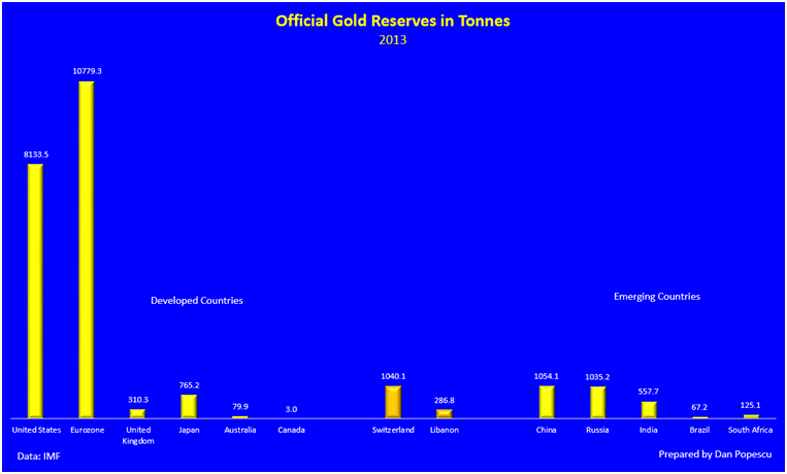
Official Gold Reserves in Tonnes – Developed Countries vs Emerging Countries

The timing of the announcement was unexpected as the current agreement does not expire until September.

It is understandable that the central banks value their gold as “important element of global monetary reserves,” given the still lingering economic problems in Greece, Italy, Spain, Portugal, Ireland and Cyprus and continuing ultra loose monetary policies in the Eurozone - with the possibility of negative interest rates.

Thus, European central banks are likely to continue to be reluctant to sell their substantial gold reserves which total of 10,779.3 tonnes or 8,972.6 tonnes ( EU G6).

There is also the fact that while Eurozone banks balance sheets have recovered somewhat, many are far from robust and remain vulnerable. Should there be a ‘Black Swan’ event or economies slow down again, central banks may require their gold reserves in order to maintain confidence in the single currency and other fiat currencies.

It is believed that there is little appetite for a new gold agreement among the rest of the world and among the emerging market central banks such as China. 

Most of the central banks that were signatories to the Washington Agreement, clearly do not want to sell their gold reserves.

The World Gold Council released data showing that global official gold reserves totalled 31,890.7 tons as of February, 2014. Of this total figure, the euro area held a total of 10,779.3 tons making it the largest holder of gold reserves in the world with 36.6% of the total global gold reserves.

The second largest holder of gold reserves is the U.S. with 8,133.5 tonnes. 
China's central bank gold reserves data has remained at 1,054 tons since the beginning of 2009. No change has occurred in 4 and a half years, despite most market participants believing that China is quietly accumulating gold reserves. 

China is likely to announce a sharp increase in their reserves to over 3,000 or 4,000 tonnes in the coming months.

The previous European gold agreement, agreed in August 2009, committed the central banks to sell no more than 400 tonnes per year and no more than 2,000 tonnes in the five-year period.

Sales under the current pact have only totalled around 200 tonnes, 10 times less than was permissible. The global and Eurozone debt crisis created a new found awareness of gold as a safe haven monetary asset.

This reluctance to sell gold is likely to continue. Indeed, many central banks are already under pressure to repatriate their gold reserves from the UK and the U.S.
 Official Gold Reserves as a Percentage of Total Foreign Currency Reserves

Gold reserves and the price of gold are closely watched on financial and foreign exchange markets - as a barometer of inflation expectations, of systemic risk and of confidence in fiat currencies.

The central banks at the time of the first agreement, the Washington agreement, affirmed that gold remained an important part of the global monetary system, setting the basis for a long and upward trend for the gold price.

The initial statement does not mention the sales ceiling for the pact and some market participants are surprised they did not reaffirm the sales ceiling. The European Central Bank has told Reuters that there is indeed no formal ceiling included in the new CBGA.

There was no mention of gold leasing and the use of futures and options by central banks in the agreement. There was in 1999 and 2004 but not in 2009 and again now.

The Bank of England did not sign the agreement. The Bank of England signed the first Washington Agreement in 1999 but opted out in 2004 and 2009.

The opt out may be because the UK gold reserves are now insubstantial. By signing the agreement, the BOE might again draw attention to Gordon Brown's controversial gold sales.
source goldcore

Tuesday, April 29, 2014

Europe and Deflation Paranoia - Frank Hollenbeck

Mises Daily: Tuesday, April 29, 2014 by Frank Hollenbeck

There is a current incessant flow of articles warning us of the certain economic calamity if deflation is allowed to show its nose for even the briefest period of time. 

Friday, December 20, 2013

Government's Plan to Raid Public Pensions 'Illegal,' says Court

Victory for retired pensioners and workers in Portugal as austerity proposal shot down
- Jon Queally, staff writer
Retired people protest in Lisbon over plans to cut pensions. (Photo: AP)The pattern of seizing workers' retirements by slashing pension benefits or raiding the funds in order to reduce budget deficits has been seen across Europe and in the U.S.

Tuesday, December 10, 2013

Currency War Means Currency Suicide - Patrick Barron

Mises Daily: Tuesday, December 10, 2013 by Patrick Barron
 
What the media calls a “currency war,” whereby nations engage in competitive currency devaluations in order to increase exports, is really “currency suicide.” 

Tuesday, April 30, 2013

Monied Oligarchs escape as Cyprus crisis hits middle class

April 29, 2013 Angelica Azadyants, special to RBTH

Russian shopkeepers, small businesses and middle-class expats are among the victims of the island’s financial meltdown.

Oligarchs escape as Cyprus crisis hits middle class
Feeling the squeeze: Many in Cyprus took to the streets to protest as banks 
closed for two weeks and investors took a ‘haircut’ on their savings. Source: 
Getty Images
Although Russian savers of all descriptions, from private individuals and small businesses to corporations and institutions, have suffered in the Cypriot financial crisis, the effect is seen most starkly among the thousands of Russians actually living on the Mediterranean island.

Wednesday, April 24, 2013

The Real Face of the European Union - Traitors Within Your Gates - YouTube

Individual liberties and sovereignties can only be reclaimed by driving out your collaborative puppet politicians from your country's leadership. America's day to do the same will come and be too late for the masses here. There is no one left to come to your aid this time. Our enemies could never quell the patriot groups rebelling all at once. This was seen in the Greek resistance of WWII.

Saturday, April 13, 2013

Was Cyprus Attack Also an Attack on Gold?

Friday, April 12, 2013
By Staff Report


Are We About to See a Global Gold Selling Spree? ... Heavily indebted euro zone nations such as Italy and Portugal could come under pressure to put their bullion reserves to work as a result of plans for Cyprus to sell gold to meet its financing needs. 

Tuesday, April 9, 2013

Winner Takes All: The Super-priority Status of Derivatives

Cyprus-style confiscation of depositor funds has been called the “new normal.”  Bail-in policies are appearing in multiple countries directing failing TBTF banks to convert the funds of “unsecured creditors” into capital; and those creditors, it turns out, include ordinary depositors. Even “secured” creditors, including state and local governments, may be at risk.  Derivatives have “super-priority” status in bankruptcy, and Dodd Frank precludes further taxpayer bailouts. In a big derivatives bust, there may be no collateral left for the creditors who are next in line. 

Wednesday, April 3, 2013

BREAKING: ING internet banking in chaos after 'mysterious' withdrawals - NOS Nieuws

Wednesday 03 April 2013

Financial services group is grappling with a major internet banking breakdown which has led to thousands of people unable to use their direct debit cards.

In some cases, people have ‘lost’ thousands of euros from their accounts because of the fault while others have thousands of euros too much, Nos television reported.

Sunday, March 31, 2013

Some Euro Nations Still Honor Pre-Euro Currency

By Richard Giedroyc, World Coin News
October 03, 2012

This article was originally printed in World Coin News.


Germany’s former mark currency may have caught the attention of The Wall Street Journal and other publications recently, but what about the status of the former currencies of the other European Union currency union member nations?

Saturday, March 30, 2013

Cypriot Politicians’ Loans Written Off

Who says Indebtedness doesn't pay! (Don't try this at home.)

By Margarita Papantoniou on March 29, 2013

tromaktikoWith banks confiscating up to 80 percent of uninsured deposits over 100,000 euros ($130,000) and the country facing a deep economic crisis, Cyprus has forgiven loans to politicians and companies while others are generally being required to pay in full, media reports said, setting off fury on the island country.

Tuesday, March 26, 2013

Oh, Oh ... Chypre bail-out: les épargnants sera attaqué pour sauver l'euro dans les crises futures, a déclaré le chef zone euro

Les comptes d'épargne en Espagne, en Italie et d'autres pays européens sera attaqué si nécessaire pour préserver la monnaie unique européenne en soutenant des banques en faillite, un responsable de la zone euro a annoncé haut.


La nouvelle politique sera d'alarme des centaines de milliers d'expatriés britanniques qui vivent et ont transféré leur épargne, le produit des ventes de maisons et d'autres biens sur des comptes bancaires dans la zone euro des pays comme la France, l'Espagne et l'Italie.

L'euro est tombé sur les marchés mondiaux après Jeroen Dijsselbloem, le président néerlandais de la zone euro, a déclaré au FT et Reuters que les lourdes pertes infligées aux déposants de Chypre serait le modèle pour les futures crises bancaires à travers l'Europe.

«S'il ya un risque dans une banque, notre première question devrait être" Bon, qu'est ce que tu en banque va faire à ce sujet? Que pouvez-vous faire pour vous recapitaliser? ", At-il dit.

"Si la banque ne peut pas le faire, alors nous allons discuter avec les actionnaires et les obligataires, nous allons leur demander de contribuer à la recapitalisation de la banque, et le cas échéant les titulaires de dépôts non assurés."

Amerrissage une politique à trois ans de la protection des détenteurs d'obligations seniors et les déposants grandes, plus de 100.000 €, dans les banques, M. Dijsselbloem fait valoir que l'absence de contagion du marché entourant Chypre a montré que les investisseurs privés pourraient maintenant être frappé pour payer des dettes bancaires douteuses.
"Si nous voulons avoir une bonne santé, un secteur financier sain, le seul moyen est de dire:« Regardez, là où vous prenez des risques, vous devez traiter avec eux, et si vous ne pouvez pas traiter avec eux, alors vous ne devriez 't les ont pris en charge, »at-il dit.

"Les conséquences peuvent être que c'est la fin de l'histoire, et c'est une approche que je pense, maintenant que nous sommes sortis de la chaleur de la crise, nous devons prendre."

L'annonce est très importante, car elle marque la mise en sommeil des fonds de l'euro € 700 milliards de renflouement, le Mécanisme européen de stabilité (MES), l'Espagne et l'Irlande veut être utilisés pour recapitaliser leurs banques en difficulté.

"Nous devons viser à une situation où nous n'aurons jamais besoin même d'envisager la recapitalisation directe", at-il dit.

«Si nous avons encore plus d'instruments en matière de bail-in et jusqu'où nous pouvons aller en liberté sous caution-in, la nécessité d'une récapitulation directe deviendra de plus en plus petit."

La zone euro a été prévu de mettre en l'ESM comme un «grand bazooka" à la mi-2014 qui pourrait aider à sauver les banques et éviter les turbulences financières dans des pays comme l'Espagne ou l'Italie, un développement qui a été retardée par la résistance allemande.

Commentaires de M. Dijesselbloem l'alarme se déclenchera pays comme l'Irlande et l'Espagne qui avait été l'espoir d'accéder à la gestion écologiquement rationnelle afin de restructurer les banques sans tuer leur secteur financier en infligeant de lourdes pertes aux investisseurs.

«Je pense que l'approche doit être, nous allons traiter avec les banques au sein des banques d'abord, avant de regarder l'argent public ou de tout autre instrument venant du côté public», at-il dit.
"Les banques devraient en principe être en mesure de se sauver, ou du moins restructurer ou recapitaliser eux-mêmes autant que possible."

Dans une note publiée lundi suite à l'accord de renflouement Chypre, Barclays a averti que «la décision de renflouer la dette bancaire senior et grands déposants auront probablement un impact sur les prix sur instruments de capitaux propres et de crédit de ces banques de la zone euro qui sont perçus comme les plus faibles» .

M. Dijsselbloem reconnu qu '«il est toujours nervosité", mais a affirmé que toute la nervosité sur les marchés financiers provoquées par la nouvelle approche serait une bonne chose car cela augmenterait le coût de l'emprunt pour les banques malsaines, un argument peu de chances de gagner ami à Madrid ou Rome .

«Si je financer une banque et je sais pas si la banque va avoir des ennuis, je vais être frappé et je vais perdre de l'argent, je vais mettre un prix sur cela," at-il dit.

"Je pense que c'est un bon principe économique. Et avoir de l'argent pas cher, car le risque sera assumé par le gouvernement, et je serai toujours récupérer mon argent, ne conduit pas à de bonnes décisions dans le secteur financier."

Hier soir, le ministre néerlandais des Finances a essayé de ramer à partir de ses observations en insistant sur le fait que "Chypre est un cas particulier".

«Programmes d'ajustement macro-économiques sont faits sur mesure pour la situation du pays concerné et pas de modèles ou des modèles utilisés", at-il dit.

Le président chypriote Nicos Anastasiades a admis l'accord de renflouement zone euro, il a frappé lundi à Bruxelles a été douloureux mais a déclaré Chypre pourrait maintenant prendre un nouveau départ après avoir parcouru un "souffle" de l'effondrement. Il a également dit qu'il y aurait une enquête criminelle sur la crise.

Les banques à Chypre restera fermée jusqu'à jeudi, la banque centrale du pays a annoncé. Il avait dit plus tôt que les banques rouvrir aujourd'hui après un arrêt d'une semaine, à l'exception de Laiki et de la Banque de Chypre.

Télégraphe

Oh, Oh...Cyprus bail-out: savers will be raided to save euro in future crises, says eurozone chief

Savings accounts in Spain, Italy and other European countries will be raided if needed to preserve Europe's single currency by propping up failing banks, a senior eurozone official has announced.


The new policy will alarm hundreds of thousands of British expatriates who live and have transferred their savings, proceeds from house sales and other assets to eurozone bank accounts in countries such as France, Spain and Italy.

Shocking ~ Bankers Just Set Horrifying Precedent - *Video*