Search Blog Posts

Showing posts with label Central/South America. Show all posts

Saturday, April 4, 2015

Remove US military bases from Latin America - UNASUR chief

Published time: April 01, 2015 07:26

US soldiers walk after landing at the Muniz Air National Guard Base in San Juan, Puerto Rico (Reuters / Alvin Baez-Hernandez)

Latin American countries should discuss removing all US military bases from their soil, a top official of integration organization UNASUR suggested. The issue may be discussed next month at the upcoming Summit of the Americas in Panama.
 
The Summit of the Americas on April 10 and 11 is to be attended by regional leaders, with 31 nations already confirming attendance. UNASUR Secretary-General Ernesto Samper suggested that the summit would be a good place to “reassess relations between the US and South America.”
 
“A good point on the new agenda of relations [in Latin America] would be the elimination of US military bases,” the former Columbian president told the news agency EFE. 

He added that the bases were “a leftover from the days of the Cold War and other clashes.”
 
READ MORE: 5mn Venezuelans sign petition against US aggression & interference
 
Samper also blasted Washington’s habit of taking unilateral steps to pursue its goals in Latin America. The latest example is the US declaration of Venezuela as a threat to its national security, he said.
 
“In a globalized world like the present one, you can't ask for global rules for the economy and maintain unilateral rules for politics. No country has the right to judge the conduct of another and even less to impose sanctions and penalties on their own,” he stressed.

Secretary General of the Union of South American Nations (UNASUR) Ernesto Samper (Reuters / Carlos Garcia Rawlins)

The Panama meeting has already been declared historic as it will be the first one attended by Cuba since 1962, when it was expelled from the Organization of American States (OAS), the event’s organizing body. In 2014, the US and Canada blocked the proposal to readmit Cuba, which drew criticism from UNASUR and a boycott of last year’s summit of the Americas by Ecuador and Nicaragua. 

This year Cuban President Raul Castro will have an opportunity to meet his US counterpart Barack Obama, marking progress in the restoration of US-Cuban relations after decades of alienation.

Samper said that the Cuban-US rapprochement should not overshadow Washington’s conflict with Caracas, which is also sending a delegation to the Panama summit, the continued operation of the prison at Guantanamo Bay, US militarization of the continent and other issues.

The Union of South American Nations (UNASUR) is a regional integration organization that includes 12 members and two observer nations. It was formally founded in 2004 and became fully functional in 2011, when its Constitutive Treaty entered into force following ratification by member states. UNASUR is headed by a president chosen from heads of member states, but the secretary-general performs the bulk of the organizational work.  Source

Tuesday, January 6, 2015

The Search for El Dorado – Lost City of Gold


6 January, 2015 - 00:57 mrreese

For hundreds of years, treasure hunters and historians alike have searchedfor El Dorado, the lost city of gold. The idea of a city filled withgold and other riches has a natural appeal, drawing the attention of individuals from all over the world in hopes of discovering the ultimate treasure, and an ancient wonder. In spite of numerous expeditions around all of Latin America, the city of gold remains a legend, with no physical evidence to substantiate its existence.

The origins of El Dorado come from legendary tales of the Muisca
tribe. Following two migrations – one in 1270 BC and one between 800 and 500 BC, the Muisca tribe occupied the Cundinamarca and Boyacá areas ofColombia. According to legend, as written in Juan Rodriguez Freyle’s “El Carnero,” the Muisca practiced a ritual for every newly appointed king that involved gold dust and other precious treasures.


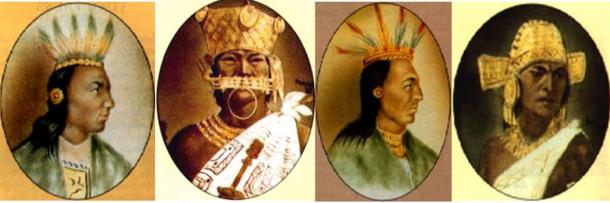
Portraits of rulers of Muisca
Portraits of rulers of Muisca (Wikimedia Commons)

When a new leader was appointed, many rituals would take place before
he took his role as king. During one of these rituals, the new king
would be brought to Lake Guatavita, where he would be stripped naked,
and covered in gold dust. He would be placed upon a highly decorated
raft, along with his attendants, and piles of gold and precious stones.
The raft would be sent out to the center of the lake, where the king
would wash the gold dust from his body, as his attendants would throw
the pieces of gold and precious stones into the lake. This ritual was
intended as a sacrifice to the Muisca's god. To the Muisca, “El Dorado”
was not a city, but the king at the center of this ritual, also called
“the Gilded One.” While El Dorado is meant to refer to the Gilded One,
the name has now become synonymous with the lost city of gold, and any
other place where one can quickly obtain wealth.


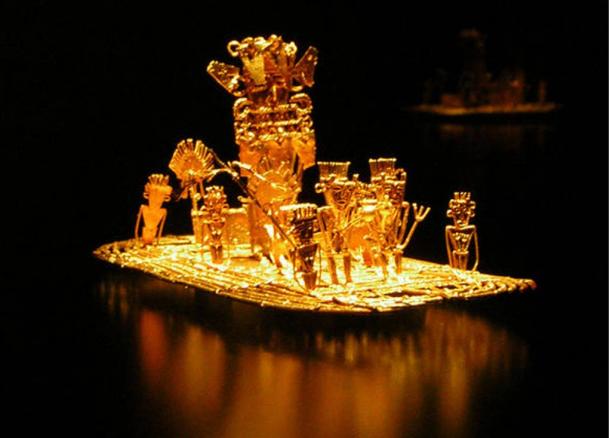
Muisca raft, representation of the initiation of the new Zipa in the lake of Guatavita
Muisca raft, representation of the initiation of
the new Zipa in the lake of Guatavita, possible source of the legend of
El Dorado. It was found in a cave in Pasca, Colombia in 1856, together
with many other gold objects. Dated between 1200 and 1500 BC. (
Wikimedia Commons)

In 1545, Conquistadores Lázaro Fonte and Hernán Perez de Quesada
attempted to drain Lake Guatavita. As they did so, they found gold along
its shores, fueling their suspicion that the lake contained a treasure
of riches. They worked for three months, with workers forming a bucket
chain, but they were unable to drain the lake sufficiently to reach any
treasures deep within the lake. In 1580, another attempt to drain the
lake was made by business entrepreneur Antonio de Sepúlveda. Once again,
various pieces of gold were found along the shores, but the treasure at
the depths of the lake remained concealed. Other searches were
conducted on Lake Guatavita, with estimates that the lake could contain
up to $300 million in gold, with no luck in finding the treasures. All
searches came to a halt when the Colombian government declared the lake a
protected area in 1965.


Guatavita Volcanic Lagoon, Cundinamarca, Colombia, the sacred lake and center of the rites of the Muiscas
Guatavita Volcanic Lagoon, Cundinamarca, Colombia,
the sacred lake and center of the rites of the Muiscas. Source:
BigStockPhoto.

Nonetheless, the search for El Dorado continues, even without the
ability to search Lake Guatavita. The legends of the Muisca tribe, the
Gilded One and their ritualistic sacrifice of treasures have transformed
over time into today’s tale of El Dorado, lost city of gold. To many
individuals, El Dorado is a real city, and the desire to discover this
city is great. Whether led by greed, a desire for fame, or a desire to
unravel the mysteries of an ancient legend, these individuals have gone
on conquests in hopes of finding El Dorado. As the legends have shifted
and transformed, so has the location of El Dorado. Searches for the city
are not restricted to Colombia, or Lake Guatavita, where the Muisca
tribe practiced their rituals, but span all areas of Latin America.
Expeditions to find El Dorado have been conducted far and wide.


Gold artifacts from the Muisca tribe of Colombia
Gold artifacts from the Muisca tribe of Colombia (public domain)

England’s Sir Walter Raleigh made two attempts to find El Dorado. In
1595, it was rumored that El Dorado could be found at Lake Parime in the
highlands of Guyana. Raleigh set sail, in hopes of discovering the lost
city, establishing an English presence in the Southern Hemisphere, and
creating an English settlement in the lad of Guyana. His desire to find
El Dorado remained strong, although he only discovered bits and pieces
of gold along the way. In 1617, Raleigh returned to South America with
his son, in hopes of finding El Dorado. His son was killed in conflict
with the Spaniards, and Raleigh did not find El Dorado on his second,
disastrous expedition. Upon his return to England, he was executed for
disobeying King James’ orders to avoid conflict with the Spanish.


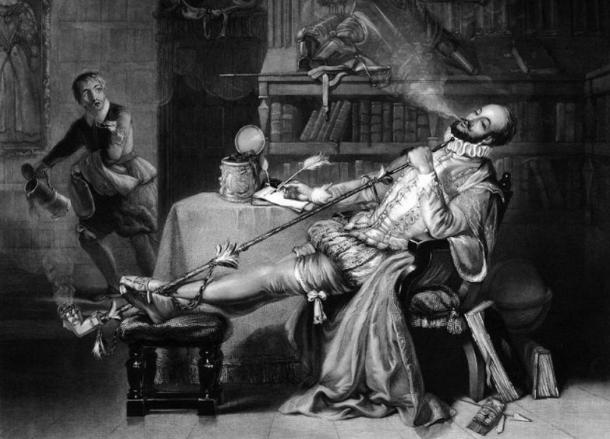
Sir Walter Raleigh went on two expeditions to find El Dorado
Sir Walter Raleigh went on two expeditions to find
El Dorado. ‘Raleigh's First Pipe in England’ by Frederick William
Fairholt, 1859. (public domain)

Several expeditions to find El Dorado have been attempted since
Raleigh’s time, but none have been successful. Monks Acana and Fritz,
Don Manuel Centurion - Governor of San Thome del Angostura, and
entrepreneurs Nicholas Rodriguez and Antonio Santos, have all led
expeditions in hopes of finding the lost city. All have failed to find
the El Dorado, and the expeditions have led to the loss of hundreds of
lives – from those killed during the attempts to drain Lake Guatavita,
to those who perished while searching the landscape of Latin America.
The most recent attempt to find El Dorado occurred in 2000. The
Monastery of Santo Domingo was searching for underground Incan tunnels,
when they found a large tunnel beneath the Monastery, but no gold. Then
in 2001, Italian archaeologist Mario Polia discovered a document from
the 1600s that contained descriptions of a city that could potentially
be El Dorado. Within the area, located in Paratoari in Peru, tools and
evidence of manmade structures have been recovered, but El Dorado
remains a mystery.

Although the costly search for El Dorado has yet to yield any
evidence of an actual city of gold, the topic remains one of interest to
this day. Searches for El Dorado have spanned hundreds of years and
vast areas of Latin America, while costing a great deal of money, and
hundreds of lives. To some, it has become clear that the costs and risks
of continuing to search for El Dorado are not worth it, while others
remain determined to find the lost city of gold. Perhaps someday the
city of El Dorado will be discovered, and the riches rumored to be
contained within will be found, but for now, it remains a mystery
whether El Dorado is a real gold-filled ancient city, or simply a
legend.

Featured image: Golden vitives figures (known as tunjos),
Muisca-Chibcha culture — pre-columbian culture in the territory of
modern Colombia; Gold Museum, Bogotá, Colombia (
Wikimedia Commons)


Sources:

The Legend of El Dorado – Historic Mysteries. Available from: http://www.historicmysteries.com/legend-of-el-dorado/

El Dorado Legend Snared Sir Walter Raleigh – National Geographic. Available from: http://science.nationalgeographic.com/science/archaeology/el-dorado/

El Dorado – Wikipedia. Available from: http://en.wikipedia.org/wiki/El_Dorado

El Dorado – Myths Encyclopedia. Available from: http://www.mythencyclopedia.com/Dr-Fi/El-Dorado.html

By M R Reese


Saturday, December 27, 2014

Trusting NPR for your "truthful news"? - Surprise! It's a government propaganda generator

Your Tax Dollars at Work: IPS and National Public Radio

The Institute for Policy Studies' (IPS) annual report points out that Institute fellows’ commentaries ‘‘are heard regularly over National Public Radio [NPR] and through local radio interviews and broadcasts.‘‘ NPR has a regular nationwide audience of about nine million.
 
NPR’s liberal-left bias in its news reporting has been derived in part from the politics of Frank Mankiewicz, NPR president until he left in April 1983 Mankiewicz has been a fairly regular Washington School faculty member and consultant for IPS.
 
According to FBI records Mankiewicz was scheduled to meet with Teofilo Acosta, a top—ranking Cuban DGI officer, Orlando Letelier and Kirby Jones at his home in Washington on June 7, 1975. 

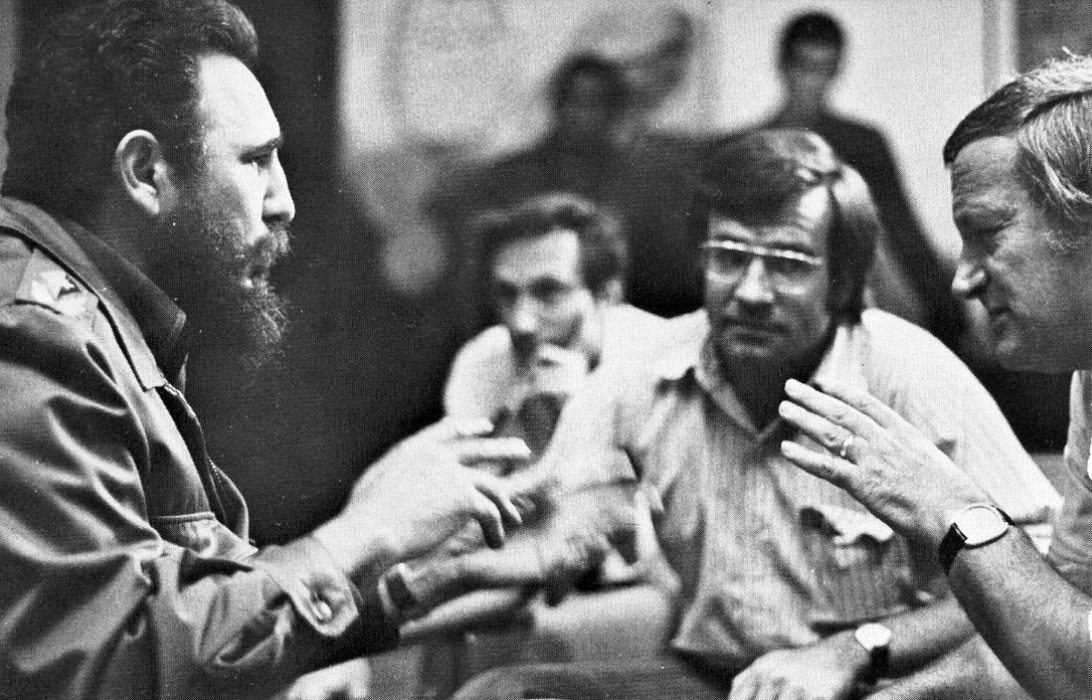
In 1974 and 1975 Mankiewicz traveled to Cuba three times with IPS fellow Saul Landau and Kirk Jones to produce a documentary on Fidel Castro. Like l.andau, Mankiewicz found Castro captivating. In the preface of his book, With Fidel, co-authored with Jones, Mankiewicz writes:
Fidel Castro, Saul Landau, Peace Corps officials Frank Mankiewicz and Kirby Jones, 1974


  • "Comparing notes later, it seemed clear we had been with one of the most charming and entertaining men either of us had ever met. Whether one agrees with him or not, Castro is personally overpowering. U.S. political writers would call it a simple case of charisma, but it is more than that. 
  • Political leaders often can be and are charismatic in a public sense, but rather normal in more private moments. Such is not the case with Fidel Castro. He remains one of the few truly electric personalities in a world in which his peers seem dull and pedestrian. "


In April 1983 Mankiewicz resigned from NPR amidst charges of gross financial mismanagement— a $7.8 million shortfall, 26 percent of its annual operating budget. But NPR retains its ties with IPS through fellows like Richard Barnet, Ariel Dorfman, Roger Wilkins, Michael Klare, Peter Kornbluh, and Barbara Ehrenreich who offer commentaries or are quoted over NPR. Over the years a number of NPR reporters and employees have also participated in IPS activities. 

Jim Angle, editor of ‘‘All Things Considered,’’ chaired a workshop, ‘‘Public Opinion and the Media," at a Riverside Church Conference on Central America in October 1983. Angle said he didn’t mix his politics with his professional work, but the main topics discussed in his workshop were ‘‘advocacy reporting" and how media activists could use events "like the human rights certification process of El Salvador’’ to influence public opinion.
 
Michele Magar, and assistant producer at NPR, chaired the IPS Washington School’s six-week class on foreign reporting in spring 1984—a class that brought in three reporters from the Washington Post and one from the New York Times. The IPS syllabus called for Magar to be joined by coworker Deborah Amos, a news producer at NPR, for the final session. The IPS agenda billed the class as one that would "examine the role of foreign journalism in our perceptions of the world, and in the formation of foreign policy." Topics discussed included the ‘‘Impact of Foreign Reporting: Implications Here and Abroad,’’ ‘‘Neutrality vs. Advocacy," "The Politics of Foreign Reporting." "Falling out of Favor with the U.S. Embassy: What Are the Costs?’’
 
On U.S. intervention in Grenada, NPR’s polls found that the American public disapproved of our action by a margin of about three to two. This conflicted with all respected public opinion polls, which found no less than 65 percent of the public in favor.
 
After the release of the bipartisan Kissinger Commission Report on Central America in January 1984, NPR got on the bandwagon to discredit its findings. The commission specifically warned of the increasing Soviet and Cuban involvement in the Western Hemisphere, the escalating conflict in Nicaragua and El Salvador, and the general instability in Central America should the United States sit back and do nothing. The week of February 20, 1984—the same week the report was released and distributed to Congress the "Morning Edition" news program promoted a new IPS publication, Changing Course: Blueprint for Peace in Central America and the Caribbean. On February 23 NPR aired a lengthy interview with Richard Barnet, who criticized the Kissinger Commission findings while promoting his institute’s alternative study.
 
NPR sympathy for the Marxist guerrillas in El Salvador continued despite the enthusiasm for democracy demonstrated by the large voter turnouts in the 1982 and 1984 Salvadoran elections. NPR prefers to despair by focusing on ‘‘right-wing death squads.’’ Two days after the Salvadoran election of March 1984, the news anchor for ‘‘Morning Edition,’’ Bob Edwards, said that ‘‘it is likely that the elections will make little difference to the future of El Salvador."
 
The numerous connections with IPS aside, NPR’s failure to uphold rigorous standards of objectivity in news coverage and to comply with the FCC’s guidelines on fairness amid equal access is not in keeping with its responsibility to the American public, particularly since the American taxpayers foot 95 percent of NPR’s budget, which is over $25 million annually.
 
Pages 133-135 Covert Cadre, S. Steven Powell

Saturday, November 29, 2014

About Lincoln and His Republicans You Might Not Know

Little attention is given to the punishing protective tariffs imposed by the Republican congress on the South to eliminate the import of foreign manufactured goods. As industrial production of the ante-bellum period was largely in Pennsylvania and purchased by the southern agrarian states, the additional penalties were passed along to the South. Today, we call a government "law" such as this a "wealth transfer scheme", or more accurately Corporatism or Fascism.


As it is, reading the below certainly screams out to be identified as a repeat of Washington's policies to interfere in America's cultural, race, and economic mix. Even the coloreds of today now recognize it as a scheme to import foreigners to take their jobs. 


Union members can see it as a hammer to break unions, replacing any strikers with immigrant scabs (union leaderships cannot be counted on to 'interfere' to protect their current members).  Organized workers: Look to whom your union dues are politically supporting - Republican or Democrat is inconsequential. Tell us how tolerant communist governments are of labor unions - - only in the establishment of total government, then jettisoned and banished under death. While your union job may have been exported from the US, was it re-incarnated in Red China?


Corporatist dinner menu - we're still on it

Only communist or fascist you say? Bone-up on the Versailles Treaty after WWI prompting German workers in the Ruhr Valley to strike because Germany could not pay the horrendous reparations to the allied victors.


Indeed, we do not learn from history because human nature does not change.


The 'Great Emancipator' and the Issue of Race

Abraham Lincoln's Program of Black Resettlement


By Robert Morgan

Many Americans think of Abraham Lincoln, above all, as the president who freed the slaves. Immortalized as the "Great Emancipator," he is widely regarded as a champion of black freedom who supported social equality of the races, and who fought the American Civil War (1861-1865) to free the slaves.

While it is true that Lincoln regarded slavery as an evil and harmful institution, it is also true, as this paper will show, that he shared the conviction of most Americans of his time, and of many prominent statesmen before and after him, that blacks could not be assimilated into white society. He rejected the notion of social equality of the races, and held to the view that blacks should be resettled abroad. As President, he supported projects to remove blacks from the United States.

Early Experiences


In 1837, at the age of 28, the self-educated Lincoln was admitted to practice law in Illinois. In at least one case, which received considerable attention at the time, he represented a slave-owner. Robert Matson, Lincoln's client, each year brought a crew of slaves from his plantation in Kentucky to a farm he owned in Illinois for seasonal work. State law permitted this, provided that the slaves did not remain in Illinois continuously for a year. In 1847, Matson brought to the farm his favorite mulatto slave, Jane Bryant (wife of his free, black overseer there), and her four children. A dispute developed between Jane Bryant and Matson's white housekeeper, who threatened to have Jane and her children returned to slavery in the South. With the help of local abolitionists, the Bryants fled. They were apprehended, and, in an affidavit sworn out before a justice of the peace, Matson claimed them as his property. Lacking the required certificates of freedom, Bryant and the children were confined to local county jail as the case was argued in court. Lincoln lost the case, and Bryant and her children were declared free. They were later resettled in Liberia.1

In 1842 Lincoln married Mary Todd, who came from one of Kentucky's most prominent slave-holding families.2 While serving as an elected representative in the Illinois legislature, he persuaded his fellow Whigs to support Zachary Taylor, a slave owner, in his successful 1848 bid for the Presidency.3 Lincoln was also a strong supporter of the Illinois law that forbid marriage between whites and blacks.4

"If all earthly power were given me," said Lincoln in a speech delivered in Peoria, Illinois, on October 16, 1854, "I should not know what to do, as to the existing institution [of slavery]. My first impulse would be to free all the slaves, and send them to Liberia, to their own native land." After acknowledging that this plan's "sudden execution is impossible," he asked whether freed blacks should be made "politically and socially our equals?" "My own feelings will not admit of this," he said, "and [even] if mine would, we well know that those of the great mass of white people will not ... We can not, then, make them equals."5

One of Lincoln's most representative public statements on the question of racial relations was given in a speech at Springfield, Illinois, on June 26, 1857.6 In this address, he explained why he opposed the Kansas-Nebraska Act, which would have admitted Kansas into the Union as a slave state:

There is a natural disgust in the minds of nearly all white people to the idea of indiscriminate amalgamation of the white and black races ... A separation of the races is the only perfect preventive of amalgamation, but as an immediate separation is impossible, the next best thing is to keep them apart where they are not already together. If white and black people never get together in Kansas, they will never mix blood in Kansas ...

Racial separation, Lincoln went on to say, "must be effected by colonization" of the country's blacks to a foreign land. "The enterprise is a difficult one," he acknowledged,

but "where there is a will there is a way," and what colonization needs most is a hearty will. Will springs from the two elements of moral sense and self-interest. Let us be brought to believe it is morally right, and, at the same time, favorable to, or, at least, not against, our interest, to transfer the African to his native clime, and we shall find a way to do it, however great the task may be.

To affirm the humanity of blacks, Lincoln continued, was more likely to strengthen public sentiment on behalf of colonization than the Democrats' efforts to "crush all sympathy for him, and cultivate and excite hatred and disgust against him ..." Resettlement ("colonization") would not succeed, Lincoln seemed to argue, unless accompanied by humanitarian concern for blacks, and some respect for their rights and abilities. By apparently denying the black person's humanity, supporters of slavery were laying the groundwork for "the indefinite outspreading of his bondage." The Republican program of restricting slavery to where it presently existed, he said, had the long-range benefit of denying to slave holders an opportunity to sell their surplus bondsmen at high prices in new slave territories, and thus encouraged them to support a process of gradual emancipation involving resettlement of the excess outside of the country.

Earlier Resettlement Plans


The view that America's apparently intractable racial problem should be solved by removing blacks from this country and resettling them elsewhere -- "colonization" or "repatriation" -- was not a new one. As early as 1714 a New Jersey man proposed sending blacks to Africa. In 1777 a Virginia legislature committee, headed by future President Thomas Jefferson (himself a major slave owner), proposed a plan of gradual emancipation and resettlement of the state's slaves. In 1815, an enterprising free black from Massachusetts named Paul Cuffe transported, at his own expense, 38 free blacks to West Africa. His undertaking showed that at least some free blacks were eager to resettle in a country of their own, and suggested what might be possible with public and even government support.7

In December 1816, a group of distinguished Americans met in Washington, DC, to establish an organization to promote the cause of black resettlement. The "American Colonization Society" soon won backing from some of the young nation's most prominent citizens. Henry Clay, Francis Scott Key, John Randolph, Thomas Jefferson, James Madison, James Monroe, Bushrod Washington, Charles Carroll, Millard Fillmore, John Marshall, Roger B. Taney, Andrew Jackson, Daniel Webster, Stephen A. Douglas, and Abraham Lincoln were members. Clay presided at the group's first meeting.8

Measures to resettle blacks in Africa were soon undertaken. Society member Charles Fenton Mercer played an important role in getting Congress to pass the Anti-Slave Trading Act of March 1819, which appropriated $100,000 to transport blacks to Africa. In enforcing the Act, Mercer suggested to President James Monroe that if blacks were simply returned to the coast of Africa and released, they would probably be re-enslaved, and possibly some returned to the United States. Accordingly, and in cooperation with the Society, Monroe sent agents to acquire territory on Africa's West coast -- a step that led to the founding of the country now known as Liberia. Its capital city was named Monrovia in honor of the American President.9

With crucial Society backing, black settlers began arriving from the United States in 1822. While only free blacks were at first brought over, after 1827, slaves were freed expressly for the purpose of transporting them to Liberia. In 1847, black settlers declared Liberia an independent republic, with an American-style flag and constitution.10

By 1832 the legislatures of more than a dozen states (at that time there were only 24), had given official approval to the Society, including at least three slave-holding states.11 Indiana's legislature, for example, passed the following joint resolution on January 16, 1850:12

Be it resolved by the General Assembly of the State of Indiana: That our Senators and Representatives in Congress be, and they are hereby requested, in the name of the State of Indiana, to call for a change of national policy on the subject of the African Slave Trade, and that they require a settlement of the coast of Africa with colored men from the United States, and procure such changes in our relations with England as will permit us to transport colored men from this country to Africa, with whom to effect said settlement.

In January 1858, Missouri Congressman Francis P. Blair, Jr., introduced a resolution in the House of Representatives to set up a committee

to inquire into the expediency of providing for the acquisition of territory either in the Central or South American states, to be colonized with colored persons from the United States who are now free, or who may hereafter become free, and who may be willing to settle in such territory as a dependency of the United States, with ample guarantees of their personal and political rights.

Blair, quoting Thomas Jefferson, stated that blacks could never be accepted as the equals of whites, and, consequently, urged support for a dual policy of emancipation and deportation, similar to Spain's expulsion of the Moors. Blair went on to argue that the territory acquired for the purpose would also serve as a bulwark against any further encroachment by England in the Central and South American regions.13

Lincoln's Support for Resettlement


Lincoln's ideological mentor was Henry Clay, the eminent American scholar, diplomat, and statesman. Because of his skill in the US Senate and House of Representatives, Clay won national acclaim as the "Great Compromiser" and the "Great Pacificator." A slave owner who had humane regard for blacks, he was prominent in the campaign to resettle free blacks outside of the United States, and served as president of the American Colonization Society. Lincoln joined Clay's embryonic Whig party during the 1830s. In an address given in 1858, Lincoln described Clay as "my beau ideal of a statesman, the man for whom I fought all of my humble life."14

The depth of Lincoln's devotion to Clay and his ideals was expressed in a moving eulogy delivered in July 1852 in Springfield, Illinois. After praising Clay's lifelong devotion to the cause of black resettlement, Lincoln quoted approvingly from a speech given by Clay in 1827: "There is a moral fitness in the idea of returning to Africa her children," adding that if Africa offered no refuge, blacks could be sent to another tropical land. Lincoln concluded:15

If as the friends of colonization hope, the present and coming generations of our countrymen shall by any means succeed in freeing our land from the dangerous presence of slavery, and, at the same time, in restoring a captive people to their long-lost fatherland, with bright prospects for the future, and this too, so gradually, that neither races nor individuals shall have suffered by the change, it will indeed be a glorious consummation.

In January 1855, Lincoln addressed a meeting of the Illinois branch of the Colonization Society. The surviving outline of his speech suggests that it consisted largely of a well-informed and sympathetic account of the history of the resettlement campaign.16

In supporting "colonization" of the blacks, a plan that might be regarded as a "final solution" to the nation's race question, Lincoln was upholding the views of some of America's most respected figures.

Sunday, September 14, 2014

Citi, Deutsche Bank, Bank Of America Were Channels For Sending Drug Money To Colombia, Court Filing Shows

By Angelo Young@angeloyoung_
on September 14 2014 12:53 PM
Colombian police shows guns, watches and jewels seized in the house where Erikson Vargas, a.k.a. Sebastian, alleged drug gang leader of 'La Oficina de Envigado' was captured early this week, near Medellin on August 9, 2012. A year earlier, a sting operation in East Boston exposed a global narcotics ring and started a four-year investigation into how global drug money flowed through major banks and back to 'La Oficina,' where it was used, among other things, to buy these watches and guns. Raul Arboleda/AFP/Getty Images

U.S.-based accounts at Citigroup Inc. (NYSE:C), Deutsche Bank AG (ETR:DBK) and Bank of America Corp. (NYSE:BAC) were used to channel tens of millions of dollars’ worth of global drug money that was sent to shady Colombian currency brokerages, an affidavit from an undercover Massachusetts detective obtained recently by 100Reporters says. The revelation comes as the U.S. Justice Department has been laying down record penalties against some of the world’s largest financial institutions for trade-sanction and money laundering violations.

Representatives at the banks declined to comment to International Business Times. 

The affidavit by Jaime X. Cepero was filed in August 2013 as part of a four-year investigation by federal authorities in the wake of a 2011 Boston-area sting operation that exposed a global narcotics ring, netting $200 million and 20 suspects. The investigation led to the extradition of 12 suspects from Colombia and 15 guilty pleas. Cepero had been detailed to a U.S. Drug Enforcement Administration task force that oversaw the operation. The affidavit was submitted as evidence last year as part of an investigation by the Internal Revenue Service. In some instances, he said, the banks had reported suspicious activity to the U.S. Treasury Department as required by law, but not in all instances.
The DEA offers this flowchart explaining how drug money makes it from the street back to the pockets of the Colombian traffickers. DEA

The document not only identifies the three banks by name but also offers a glimpse into the action-movie-like efforts narcotics traffickers used to channel global proceeds from the sale of cocaine and heroin through the United States. Couriers would sometimes stash heat-sealed bundles of currency in secret compartments of parked cars in suburban U.S. parking lots. Similar cash transfers took place on busy streets in major U.S. cities, including New York, Los Angeles, Houston and Orlando, Florida. The affidavit says one transfer took place in Rome where the cash was covered in visible cocaine residue.

The money would then be deposited, in some cases by undercover anti-narcotics agents as part of the sting operation, into accounts held by Colombian brokerage houses at the three banks in Boston and New York. These front companies would then transfer the cash to local shell companies in Colombia in the local currency to be retrieved by the operative of La Oficina de Envigado, the drug cartel that emerged from the ashes of the Medellín Cartel, which collapsed in the early 1990s.

The Treasury Department issued a warning in 2006 that Mexican and Colombian exchange houses were at high-risk of being front organizations for money laundering operations. Like banks, these brokerage houses are often used to handle money transfer operations from expats sending money home. Banks have been subjected to record fines in recent years for allegedly laundering drug money and violating trade sanctions. Last year HSBC Holdings PLC (LON:HSBA) was slapped with a $1.9 billion fine for enabling drug cartels to launder billions of dollars. In June, BNP Paribas SA (EPA:BNP) agreed to pay $8.9 billion for transferring funds out of Sudan and other countries under U.S. trade sanctions.

In many cases banks are allowed to pay fines without admitting guilt, and individuals inside these banks rarely go to prison for enabling drug cartels and despots to move money around. 

View article

Tuesday, September 9, 2014

▶ How Crack Funded a CIA War: Gary Webb Interview on the Contras and Ronald Reagan (1996) - YouTube


Published on Sep 25, 2013
Facing increasing public scrutiny from the fallout after Webb's "Dark Alliance" series, the CIA conducted its own internal investigations. Investigative journalist Robert Parry credits Webb for being responsible for the following government investigations into the Reagan-Bush administration's conduct of the Contra war:

Wednesday, July 16, 2014

Maryknollers: Missionairies for Marx

Published by Charleston Voice, 2.18.2012

Maryknoll/Orbis Books Profiled


Maryknoll is dedicated to the spread of Liberation Theology throughout the United States and the Third World.

Founded in 1911 as the Catholic Foreign Mission Society of America, Maryknoll had the formal approval of both the American Bishops and the Vatican. For some fifty years, all seemed well. Missions were founded in one country after another, and the society eventually established its presence in all continents.

In 1912 a companion congregation of nuns, the Maryknoll Sisters of St. Dominic, was formed and eventually approved by the Holy See. 

Their purpose was similar to that of the Maryknoll fathers: the bringing of the gospel of Jesus Christ to those in need of salvation.
 
Then the words of Father Miguel D'Esccoto
Brockman: "The terrorist, murderer and
genocidal U.S. empire, you call the United
States, as a follower of Christ I call it: terrorist,
murderer and genocidal imperialism. Because,
well, I have to be deep, every fiber of my
being, anti-imperialist and anti-capitalist".
Read more
Then Maryknoll embraced Liberation Theology and the promotion of political activities(revolution) in one of the most remarkable changes in a religious organization in the United States. Under the influence of Miguel D’Escoto and others, Maryknoll adopted Liberation Theology as its primary form of ideological expression. 

In 1970, D’Escoto founded Orbis Books, Maryknoll’s publishing house. He is also responsible for the change in orientation of Maryknoll Magazine from a traditional missionary publication to an instrument of political indoctrination that is distributed to about one million readers worldwide.
 
(pictured with Chicago's Rahm Emanuel) The Chicago Sun-Times reported Feb. 4 that d’Escoto Inc. and other companies with close ties to UNO were paid millions of dollars to help build schools under a $98 million grant approved in 2009 by lawmakers in Springfield and Gov. Pat Quinn. Miguel d’Escoto’s son,  Federico “Fred” d’Escoto, also works for d’Escoto Inc. (read more)
The results of these changes were devastating. From more than 800 priests in 1969,Maryknoll is down to less than 700 today. The nuns have been similarly reduced from more than 1,400 in the 1960s to less than 900 today. Whereas there were 330 major and 447 minor seminarians in 1960, there are less than 25 today. Maryknoll’s five seminaries have all been closed, reportedly, over the teaching of Marxism instead of Christian theology.
 
Orbis Books publishes dozens of books every year. Although some titles appear innocuous, Orbis is the main vehicle for the production of liberationist material in the United States.

According to Orbis, the list of cities requiring liberation does not include Moscow,Havana, Beijing, Hanoi, or Prague.

The complete Orbis catalogue of over 200 titles maintained this distinction. The majority of titles are concentrated on Latin America, a few on Africa, Asia, and elsewhere, none on communist lands, even though such countries were once the target of intensive missionary effort.
 
The current spirit that prevails within the Maryknoll organization is well captured in the recognition given to Miguel D’Escoto. Although defrocked by the Vatican, D’Escoto remains in good standing within Maryknoll. 


Monday, July 14, 2014

▶ Immigration for Change - YouTube


Published on Jul 14, 2014


JBS CEO Art Thompson's weekly news video update for July 14 - 20, 2014.

In this week's analysis behind the news video, JBS CEO Art Thompson discusses how the recent surge of immigration across our southern border has been planned to change American society; how The Communist Manifesto talks about changing society in order to effect a revolution in a government; how immigration has long been understood to be a catalyst that is capable of bringing about such a change; how most people don't realize how immigration can bring about this revolutionary change; how it has been a long-standing Democratic and Republican goal to have unimpeded migration throughout North America and ultimately throughout the Americas; and how this change in American society would enable revolutionary changes in our system of government.

Sunday, July 6, 2014

ACORN for Illegal Aliens – the Internal Taxpayer-Funded Courtesy US Transfer Agents for Illegals

ACORN! Remember them from the earlier Obama days? Here


ACORN for Illegal Aliens – Meet the Southwest Key Programs

By: Terresa Monroe-Hamilton NoisyRoom.net


Are you curious who has been facilitating the transport of illegal alien children throughout the country? Look no more… meet La Raza connected Southwest Key Programs. This organization is the pipeline for the children into US refugee camps and homes across the nation. They provide immigrant youth shelters. It is a well-oiled machine that was set up to educate and reintegrate youth into American society. They also provide training for jobs. And baby, they are hiring.

Southwest Key Programs is funded by government and state programs. Here is an overview of what they do:

Southwest Key Programs is a national nonprofit organization providing transformative education, innovative safe shelters and alternatives to incarceration for over 200,000 youth and their families annually, while creating opportunities for their families to become self-sufficient. The inspiring youth and parents we work with are seeking the American dream: equality, education, and a higher quality of life. At Southwest Key, we simply open the doors to opportunity so they can achieve these dreams.
Southwest Key Programs ranks 5th among the Top Hispanic Nonprofits in America, employing a creative and diverse staff of over 2,200 employees. Because of Southwest Key's work, thousands of youth have been diverted from prisons, jails, and institutions, enabling them to stay at home with their families and out of trouble. Southwest Key has reunified thousands of immigrant children with their families and provided these unaccompanied minors with 24-hour care and education. Southwest Key is one of only three nonprofits in Austin to be accredited by the Council on Accreditation, the nation's leading human service accrediting body.
From the start, a cornerstone of all of our programs has been culturally-relevant education. Since 1999 we have refined our model by operating leading alternative schools throughout Texas, preventing hundreds of youth from dropping out of school by providing them with individualized education in a therapeutic setting. In 2009, East Austin College Prep opened at Southwest Key's El Centro de Familia campus.

Over $8 million went into building their facility for this. This business was founded in 1987 and was made-to-order for Obama's manufactured chaos on the border. Fast facts on Southwest Key Programs:

  • Founded: 1987
  • Legal Status: Nonprofit, charitable 501(c)(3) Social Service, Education and Community Development Organization
  • Staff: Over 2,200 nationwide
  • Programs: Southwest Key operates 68 juvenile justice and family programs, safe shelters for immigrant children, schools, and community building initiatives
  • Number Served: Over 200,000 kids and their families annually
  • Headquarters: Austin, Texas
  • Locations: Texas, California, New York, Georgia, Arizona, Wisconsin
  • FY 20013-14 Budget: $150 million
  • Funding: Grants and contracts by U.S. federal, state, and local government, foundations, and corporations; special events; private contributions
  • Social Enterprises: Southwest Key Enterprises, Southwest Key Cafe del Sol, Southwest Key Maintenance, Southwest Key Green Energy & Construction, Southwest Key Workforce Development, The Blooming Florist, Southwest Key Youth, Family, & Transportation LLC

Their specialty is reunifying illegal minors with their families. They are the underground railroad for the American invasion from the South. They are nationalistic in their connections and leadership. Heavily connected to the La Raza Roundtable, don't be fooled by the charitable facade. This is a radical breeding ground. They are militant, Latino community organizers.

Here are their Board of Directors:

  • Victor Garza
    Board Chair, July 2004 to Present
    Retired Veterans Services
    Chair, La Raza Roundtable
    Resident of Fresno, California
  • Orlando Martinez
    Board Vice Chair, March 2007 to Present
    Founder and Senior Partner of Martinez Tjaden, LLP
    Former Commissioner of the Georgia Department of Juvenile Justice
    Former Director of Colorado's Department of Youth Service
    Resident of Atlanta, Georgia
  • Anselmo Villarreal
    Board Treasurer, February 2012 to Present
    CEO, La Casa de Esperanza
    Resident of Milwaukee, Wisconsin
  • Rosa Santis
    Board Secretary, February 2011 to Present
    President and CEO, Pedro SS Services, Inc. in East Austin
    Resident of Austin, Texas
  • David Marshall, Jr.
    Board Member, March 2014 to Present
    Management Consultant, ICF International
    National Board Member, Princeton Prize in Race Relations
    Former President of the LBJ School of Public Affairs Alumni Association
    Former Admission Officer and Coordinator of Multicultural Recruitment, Princeton University
    Resident of Washington, DC
  • Elizabeth S. Gonzales, CLTC
    Board Member, April 2011 to Present
    New York Life, Insurance Agent, New York Life Insurance Co
    Resident of Austin, Texas

The Leadership of Southwest Key Programs:

  • Dr. Juan Sanchez
    El Presidente/CEO and Founder
    Founded Southwest Key in 1987
  • Joella L. Brooks
    Chief Operations Officer
    Joined the Southwest Key Familia in 1990
  • Melody Chung
    Chief Financial Officer
    Joined the Southwest Key Familia in 1998
  • Roque Barros
    VP or Community Impact
    Joined the Southwest Key Familia in 2013
  • Veronica Delgado-Savage
    Vice President, Youth Justice Programs
    Joined the Southwest Key Familia in 1996
  • Alexia Rodriguez
    Vice President, Immigrant Youth Services/Legal Counsel
    Joined the Southwest Key Familia in 2003
  • Rachel Luna
    General Counsel
    Joined the Southwest Key Familia in 2006
  • Jennifer Nelson
    Vice President, Community Engagement
    Joined the Southwest Key Familia in 2000
  • Dr. Joe Gonzales
    Superintendent, East Austin College Prep
    Joined the Familia in 2011

They are connected to the Office of Refugee Resettlement:

About Unaccompanied Children's Services
"Following the Office of Refugee Resettlement (ORR) mission, which is founded on the belief that new arriving populations have inherent capabilities when given opportunities, ORR/ Division of Children Services/Unaccompanied Alien Children program provides unaccompanied alien children (UAC) with a safe and appropriate environment as well as client-focused highest quality of care to maximize the UAC's opportunities for success both while in care, and upon discharge from the program to sponsors in the U.S. or return to home country, to assist them in becoming integrated members of our GLOBAL SOCIETY."

It is to laugh. If their intent was the highest quality of care and safety, they have failed already and spectacularly. Their real goal is the GLOBAL SOCIETY.

As an aside, here is a map where illegal alien children are currently being housed. Thank you Weasel Zippers. I would imagine that Southwest Key Programs will transport children from these facilities to put them either with their families that are here legally or illegally, or house them in homes until their family is brought over. We are talking 10′s of millions being brought in and this organization will not only facilitate an invasion force, they will get wealthy doing it from government and state funds. I understand that Texas alone has given them over $150,000 in state monies.

For example, they are creating jobs for housing illegal immigrants. In Tucson alone there are 200 openings for jobs to assist with the sheltering of illegal immigrant children. This organization is taking old nursing homes and other buildings and converting them to house thousands of children. They make no mention of medical care or gangs – just shelter, safety and culture – their culture, not America's.

There is massive push back on this as well. In Escondido, CA, the residents rejected these shelters wholeheartedly. As Daniel Greenfield of Sultan Knish rightly states, "This is what revolution looks like."

 
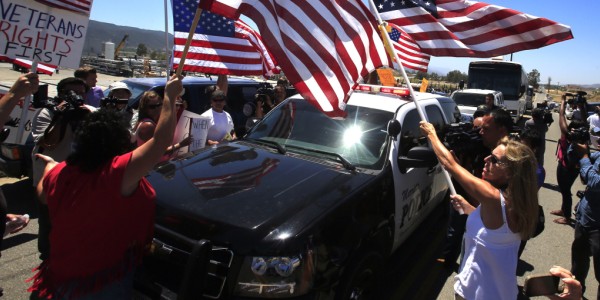
Protesters in Murrieta, California, blocking and turning away buses of illegal immigrants

Murrieta, CA is not just pushing back, they're telling the feds to shove it:

A crowd of 200 to 300 people in downtown Murrieta surrounded three Homeland Security buses carrying illegal alien detainees waving large American flags and holding signs that opposed higher taxes and "new illegals" — waited in the hot sun all day for the three charter buses to arrive.
Waving Americans flags and protest signs, the crowd refused to give way when the buses arrived with some 140 detainees from Texas, which has seen a flood of Central American illegal aliens cross the border.
Protesters chanted "USA!" "Impeach Obama!" and "Deport, Deport!"

They turned buses back and they will be the first of many communities to do so. There are militias from California and Texas joining forces to turn illegals back. There has been talk of calling the National Guard out to the border in Arizona and Texas. The border is in meltdown.

Sultan Knish also asks: "Are the Anti-Illegal Amnesty Protests the New Tea Party?"

The Murrieta protest strongly reminded me of what the Tea Party used to do when it came to ObamaCare. A small number of ordinary people used social media to get the word out and organize protests.
The media denounced them. The politicians denounced them. But in the end they helped turned the tide of public opinion.
The situation is similar to, but also worse than ObamaCare, because there is no establishment opposition at all. The only real opposition is coming from ordinary people who are fed up.

Sultan Knish absolutely nails it – we are fed up.

Obama is also fundraising with a racist Mexican Director who actively promoted the murder of opponents of illegal immigration. Nifty, huh? But Obama couldn't be bothered to actually go to the US/Mexican border. He would never sully himself with the masses. He has Communist minions for that, don't ya know.

So, while Southwest Key Programs claims to be 'for the children,' remember what is really going on here. The redistribution of wealth, the invasion and eradication of America's borders and the destruction of our Republic. It's community organizing from hell and is spurring a revolt. Remember, it's not fascism when they do it. Southwest Key Programs is ACORN for illegal aliens and they are the handmaidens of Obama's 'transformation' of America.


 Video Reveals Thousands of Illegal Immigrants Arriving At Border, Getting Free Bus Tickets Into US

Monday, June 16, 2014

Former Border Patrol Agents: Illegal Immigration Crisis "Contrived"

There are no congressional oversight committees effectively worthy of the definition. Long overdue for our border states to reclaim their sovereign land from the unlawful occupation by the Feds. 

Political sanctimonious, semantically ambiguous verbal palliatives are too little, too late. Furthermore, they would be dishonest.
 
Recall your national guards from wherever they are, utilize state law enforcement agencies, deputize needed property owners, and secure our borders!


Friday, 13 June 2014 19:50
Written by  Warren Mass
 
Thousands of illegal immigrants are flooding across the border into Texas and other border states every day, but two things distinguish this wave from earlier illegal immigration waves. 

First, Hondurans, Salvadorans, and Guatemalans now make up about 75 percent of illegals caught in South Texas, whereas previously most people who crossed the border illegally originated in Mexico. 

Second, large numbers of these illegal migrants are unaccompanied children. A Reuters article on May 29 cited Obama administration estimates that 60,000 children unaccompanied by parents or relatives will pour into the United States this year, up from about 6,000 in 2011.

The situation was deemed so urgent by the Obama administration on June 2, that the White House issued a presidential memorandum directing the secretary of Homeland Security to establish an interagency “Unified Coordination Group.” The group is to be created, stated President Obama, in “Response to the Influx of Unaccompanied Alien Children Across the Southwest Border.”

A June 12 report in The New York Post noted that in fiscal year 2009, border patrol agents apprehended 3,304 children from Honduras, El Salvador and Guatemala, but that number is close to 50,000 this year and is expected to continue increase dramatically. 

California Rep. Darrell Issa, chairman of the House Oversight Committee, expressed concern on Fox News Radio that the mass migration of children trying to cross our border could result in fatalities.

“This flood is going to mean children dying trying to get in,” said Issa. 

“And more important, children coming here with the anticipation that somehow they’re going to be granted citizenship and then they will bring the rest of their family … that’s a false narrative.”

The Washington Post reported on June 12 that the sharp increase in the number of illegal migrants coming over the border over the past three months — especially in the number of children traveling without their parents — has overwhelmed the Border Patrol’s detention centers in South Texas, prompting officials to ship the children to converted warehouses and military bases as far away as California. The Post noted that during the past eight months, Customs and Border Protection has detained 47,000 unaccompanied minors, most of them in the Rio Grande Valley area of South Texas. This is an increase of 92 percent from the same period during the previous fiscal year.

“We’re fighting a losing battle right now,” said Chris Cabrera, the Border Patrol’s union representative in McAllen, Texas, as quoted in the Post. “We don’t have anywhere to hold them.”

The report noted that many of the migrants — especially women and children — are not trying to sneak into the country but are crossing the border in plain sight of Border Patrol agents. While illegal aliens from Mexico can fairly quickly be processed and sent back across the border, the situation for illegals from Central America is more complicated. The government must first clear their return with consular officials from their native country, then charter planes to fly them home. If the aliens request asylum in the United States, on the grounds that they fear persecution in their home countries, they must establish that their fears are credible.

Whether or not asylum is ultimately granted, the claim serves as a delaying tactic, often allowing the alien to remain in the United States long enough to blend in among the large numbers of “undocumented aliens."
Read more TNA

Thursday, June 12, 2014

Crisis Leaves 'Vast Swaths' of Border Unprotected, Cartels 'in Control'


by Brandon Darby 11 Jun 2014, 8:52 AM PDT

HOUSTON, Texas--The massive influx of adults and minors crossing into the U.S. from Mexico, Guatemala, Honduras, and El Salvador has brought the Customs and Border Protection agency (CPB) past its capacity to provide security at the U.S./Mexico border, according to the National Border Patrol Council (NBPC).

In an interview with Breitbart Texas, NBPC Vice President Shawn Moran revealed that the Mexican cartels control the flow of illegal immigrants across Mexico through the monopoly on coyotes, otherwise known as human smugglers. “Mexican cartels are exploiting this crisis to get their shipments through. They know our schedules, our shifts, our manpower, and how we react to these situations,” said Vice President Moran.

“The cartels control the flow of people from south of our border. The coyotes are mostly at the employ of the cartels. They rent the smuggling routes that are protected by the cartel enterprises. We are being completely reactive and chasing the cartel activity.

"Today they are using the RGV sector [Rio Grande Valley], but they could begin using another sector instead at any moment.” Moran was referring to the mass re-assignment of Border Patrol agents to Texas from western states like Arizona.

The fact that the CPB has taken so much time to reorganize federal assets to handle the crisis along the Texas border with Mexico indicates an inability to preempt the Mexican cartels and be ready for their next move, according to Vice President Moran. He stated, “The CPB is unable to quickly react to the changing trends in illegal immigration and drug smuggling.”

He said the Border Patrol agents were exhausted and overwhelmed, but still doing their best to keep Americans safe and enforce our laws. He stated, “Even though our pay has been cut and we are working in horrible conditions, Border Patrol agents are doing their best in a phenomenally difficult situation. We are trying to balance providing enough personnel to handle the influx in the holding facilities while still trying to keep enough agents on the line.”

“Since the CPB started reducing the hours agents can work, we have seen an overall increase in smuggling and illegal alien crossing,” he said. “The CBP is controlling the number of hours agents can work and we are desperately trying to keep enough agents in the field and still handle the processing of the illegal aliens we catch, but we are leaving vast swaths of the border unprotected.” He added, “The cartels know our limitations and our weak points and they are taking full advantage of them.”

Source Breitbart