Search Blog Posts

Showing posts with label BOE. Show all posts

Tuesday, March 31, 2015

Putin Is About To Nationalise Rothschild Central Bank

A big stretch maybe, but a fascinating prospect...we'll see. Whose side will you be on?

His effort to stabilise the declining Ruble.

Posted by: Neon Nettle  |@Neon Nettle
 on 18th March 2015 @ 10.26am


putin is to nationalise the rothschild controlled central bank of russia in an effort to stabilise the declining ruble  © press
Putin is to nationalise the Rothschild controlled Central Bank of Russia in an effort to stabilise the declining Ruble.
Putin is to nationalise the Rothschild controlled Central Bank of Russia in an effort to stabilise the declining Ruble. 
Euro-med.dk reports:
Under the Constitution, the CBR belongs to a foreign State – the City of London – and is taking orders from London and Washington. This bank can only print money corresponding to its cash in foreign currency, which is not sufficient for Putin´s purposes. The CBR even has to buy (worthless) US bonds for the dollars paid for Russian oil – whereby the dollars return to the FED!
Moreover, Putin is under pressure from the West, which wants to overthrow and replace him with Western-minded oligarchs. Thus, the US ambassador to Moscow, Tefft, is said to have made it very clear: “We will displace Putin from office and install our people as leader of the government (he even mentioned the person by name) and appoint ministers”. -

Therefore, Putin now needs a strong army to prevent Russia’s submission to the US.

Fyodorov said in an interview: A split in the Russian elite took place two months ago, as part of the elite decided to stay with Putin.

Putin then made his decision, which defines the events to follow. Furthermore, the logic of 1) a state of emergency or 2) geopolitical war entered into force, while we are under pressure.


What this means is, a. Americans now cannot diminish their pressure, while b. we just enjoy the pressure, because it forces us technologically into national liberation: For many years, we could not obtain de-offshoring, but American pressure has performed this in one day.

Putin must now mercilessly clean the 5th column – in “Our Central Bank, the Ministry of Finance, the Ministry of Economy.
 

But above all, Putin sees the West as the big speculator against the ruble.

To put the plan straightforward: 1. A split in the government, 2. Identification of the fifth column in government, in business, in the media, 3. purge 4. a parallel active position on the Ukraine, because Ukraine and Russia is the same – like Putin said. With these words he defined his position and strategy for Russia.

Nationalization of the Central Bank of Russia would be the first signal and mean the final breach with Rothschild´s City of London / the British Empire / the “British (banksters) Crown” and its tool, the United States. Their Relationship has been tense since Putin´s seizure of the Rothschild/Chodorkowsky’s Yukos shares. 

Therefore, Putin hesitates with the nationalization. He also still needs authorization to enforce his plan as a strong man. For this he needs a “great necessity” which is supposedly imminent because of US aggression.
via NeonNettle
 

Wednesday, February 25, 2015

Lowest Interest Rates in History - EVER

We truly live at a momentous time. Play your cards right (whatever those cards may be) and you'll provide for your foreseeable generations to come.
~~~~~~~~~~~~~~~~~~~~~~~~~~~~~~~~~~~~~~~  

by John Rubino on February 24, 2015

Business Insider’s Myles Udland just posted a chart, drawn from research by the Bank of England, showing interest rates for the past 3,000 years. And for all those who’ve been feeling like today’s “new normal” is actually profoundly abnormal, here’s your proof. It turns out that interest rates, both long and short-term, are lower than they’ve ever been. Not lower than in this cycle, or post-war or in the past century, but ever, going back to the earliest days of markets.

Interest rates 3000 years
And they’re still falling in most of the world. 

Central banks are cutting rates on a daily basis (Turkey was today’s announcement), in some cases to less than zero. Something like $2 trillion of sovereign and corporate debt now trades with negative yields.
 
Virtually the only major entity considering raising rates is the US, and the incongruity of this threat has traders balking. See Bloomberg’s Traders still don’t believe the Fed is ready to raise rates .
 
If this is indeed uncharted territory and we’re going further in before we’re done, what are the implications for markets and, well, everything? A couple of thoughts:
 
The insurance industry, pension funds and money market funds all depend on positive yields to operate. A life insurance company, for instance, can keep premiums low because it can invest that cash for years before having to pay out on the policy. What happens if the bonds it buys start yielding nothing (or less than nothing)? What about a money market fund that can no longer find investment grade corporate paper yielding much more than zero? Pension funds, meanwhile, have generally promised 7%-8% returns to their members, but now have to get all of those profits from the equity and real estate sides of their portfolios.
 
For any of these entities to stay in business they now have to act like hedge funds, taking on extra risk, rolling the dice and hoping that the good years outweigh the bad ones. In other words, these formerly safest-of-the-safe investment vehicles become just as risky as the typical eTrade account.
 
Then there’s the impact of negative rates on the market’s price signaling mechanism for the rest of us. Interest rates are the price of money, and as such they tell investors, entrepreneurs and consumers what to do. Low interest rates generally say “buy, build, consume, take risks” while high rates say “save, sell, conserve, wait.” 

But zero or negative rates? Are they just an extreme version of low rates or is there a qualitative difference? Everyone has a theory about this but in the absence of historical precedent, we’ll have to wait and see.
 
Anyhow, the coming negative interest rate world will provide plenty of thrills, chills and blog post material. For now it’s enough to note that we’ve never, through depressions, world wars, bubbles and famines, seen anything like today’s economy.

via dollarcollapse 

Tuesday, February 24, 2015

Ten Banks, Including JPM, Goldman, Deutsche, Barclays, SocGen And UBS, Probed For Gold Rigging

Submitted by Tyler Durden on 02/23/2015 22:17 -0500
No matter how many times the big banks are caught red-handed manipulating precious metals, some failed former Deutsche Bank prop-trader (you know who you are) will take a vociferous stand based on ad hominem attacks and zero facts that no, what you see in front of you is not precious metal rigging at all but a one-off event that has nothing to do with a criminal banking syndicate hell bent on taking advantage of anyone who is naive and dumb enough to still believe in fair and efficient markets. 

The last time this happened was in November when we learned that "UBS Settles Over Gold Rigging, Many More Banks To Follow", and sure enough many more banks did follow, because in Europe, where the stench of gold market manipulation stretches far beyond merely commercial banks, and rises through the central banks, namely the BOE and ECB, culminating with the Head of Foreign Exchange & Gold at the BIS itself, all such allegations have to be promptly settled or else the discovery that the manipulation cartel in Europe involves absolutely everybody will shock and stun the world, which heretofore was led to believe that such things as gold market (not to be confused with Libor or FX) manipulation only exist in the paranoid delusions of a few tinfoil fringe-blogging lunatics.

However, as usually happens, someone always fails to read the memo that when it comes to gold-market manipulation one must i) find nothing at all incriminating if one is a paid spokesman for the entities doing the manipulation such as former CFTC-sellout Bart Chilton or ii) if one can't cover it, then one must settle immediately or else the chain of revelations will implication everyone.

This time, that someone is the US Department of Justice, which as the WSJ just reported, is investigating at least 10 major banks for possible rigging of precious-metals markets. The DOJ is shockingly doing so "even though European regulators dropped a similar probe after finding no evidence of wrongdoing, according to people close to the inquiries." Of course, the reason why said probe was dropped in Europe is because it would have implicated virtually the entire trading desk at the biggest and most important European bank: Deustche Bank, as well as the biggest bank in Switzerland, UBS and UK's own Barclays, reveal a manipulation cartel rivaling even that of Libor. And once traders at the commercial banks turned sides and squealed for the prosection, well then it would be the central banks' turn next. Which is why it was imperative to bring this investigation to a quiet end.

But not in the US.

According to the WSJ, "prosecutors in the Justice Department’s antitrust division are scrutinizing the price-setting process for gold, silver, platinum and palladium in London, while the Commodity Futures Trading Commission has opened a civil investigation, these people said. The agencies have made initial requests for information, including a subpoena from the CFTC to HSBC Holdings PLC related to precious-metals trading, the bank said in its annual report Monday.

HSBC also said the Justice Department sought documents related to the antitrust investigation in November. The two probes “are at an early stage,” the bank added, saying it is cooperating with U.S. regulators.

Who is involved in this latest gold-rigging scandal? Why everyone! ... which makes it immediately obvious why the European regulator had to promptly cover up the whole affair. Under scrutiny are Bank of Nova Scotia , Barclays PLC, Credit Suisse Group AG , Deutsche Bank AG , Goldman Sachs Group Inc., J.P. Morgan Chase & Co., Société Générale SA, Standard Bank Group Ltd. and UBS AG , according to one of the people close to the investigation.

Robert Hockett, a law professor at Cornell University, said it is “not particularly surprising” that the Justice Department is plowing ahead despite the decision by European regulators.  

Recent scrutiny of big banks’ operations in the physical commodities markets and criticism of the Justice Department’s financial-crisis track record make it “quite understandable” that the agency would investigate allegations of precious metals price-rigging.

Last year, the FCA fined Barclays £26 million ($40.2 million) for lax controls after one of its traders allegedly manipulated the gold fix at the expense of a client.

Swiss regulator Finma settled last year allegations of foreign-currency manipulation with UBS. The regulator said it found “serious misconduct” among precious-metals traders at UBS, including “front running,” or trading ahead of, the silver-fix orders of one client. A spokeswoman for UBS, which said at the time that it “instituted significant cultural and compliance changes,” declined further comment.

You mean to say that the banks that were for decades rigging Libor... and FX... and bonds... and stocks... oh, and gold, were let go with a slap on the wrist and a promise to "change their ways" and not to do it again?  Yup, that's exactly right.

So what happens next? Well, we finally will find just how much of a banker-controlled muppet the so-called US attorney general truly is. Recall that a week ago he gave his subordinates 90 days to being cases against individuals for their role in the financial crisis.

Well here is the perfect opportunity.  Should Holder let this latest mass criminal ring go without any incarceration, one can officially stick a fork in the US justice system, which is meant for everyone, but the rule-flouting bankers who can clearly get away with absolutely anything.

As for the rigging in the gold market, rigging which begins with the lowliest prop-traders at Deutsche Bank and involves every single central bank and High Frequency trading outfit and is now a proven fact, we have explained over the years and thousands of times just how to end it all, so instead of wasting readers' time on this topic yet again, here are just two very simple solutions how to fix this one particular market:

So simple, even the most corrupt US Attorney General caveman can do it.

Source ZeroHedge

Thursday, August 28, 2014

Save our Swiss gold!

This Swiss method of voting by national referendum - popular initiative - is a fundamental difference between our representative republic and theirs ("democracy" isn't in the Constitution). Think for a minute... would you entrust the American masses to have the same comprehension of our rule of law as do the Swiss? Look at what our national referendum to vote for a president brought us, and that's your answer. Every president and duplicitous congress through patient gradualism, have usurped our individual rights guaranteed by law. Obama is no worse. He just seems that way because he's been brought in to mop-up what other traitors, each one progressively "worse", accomplished before him. Just following orders. The end is nigh. That's what you're feeling. 

The Swiss should have known better than to leave their gold with a foreign custodian after WWII. Although, the American people still don't know if you don't hold it, you don't own it.

August 28, 2014 

In just three months, on November 30, the Swiss will vote in a federal referendum on the future of the country's gold reserves.

The referendum has arisen through a popular initiative called 'Save our Swiss Gold.' In Switzerland, citizens can propose changes to the Swiss constitution through a mechanism called a popular initiative, even if parliament is against the proposal.

The 'Save Our Swiss Gold' initiative is set to highlight the important issue of sovereign gold reserves and who has possession and controls them. It may lead to an important debate about each country's national patrimony and their gold reserves.

The 'Save Our Swiss Gold' initiative is proposing the following:
  • rules to prevent the Swiss National Bank (SNB) selling any more of the country's gold reserves
  • to direct that the SNB must keep a minimum of 20% of its reserves in gold, and
  • to require that all Swiss gold must be stored in Switzerland.
This would require repatriation of Swiss gold since some of the Swiss gold reserves are stored abroad.

The Swiss National Bank (SNB) are against the proposal but were forced last year, in reaction to the popular campaign, to reveal the storage locations of the Swiss gold.

In April 2013, Thomas Jordan, SNB President, confirmed that 70% of Switzerland's gold is in Switzerland, 20% is at the Bank of England, and 10% is stored with the Bank of Canada, and that this mix of holdings had been in place for more than a decade.

Since the Swiss hold a total of 1,040 tonnes of gold reserves, this would mean that there are 104 tonnes of Swiss gold at the Bank of Canada and 208 tonnes in the Bank of England. Jordan's explanation of the foreign gold storage was that it provided "adequate regional diversification and good market access".

Since the Bank of England specialises in the custody of gold on behalf of numerous foreign central banks, it's not surprising then that the SNB stores gold at the Bank of England.

What is surprising is that the SNB still holds gold at the Bank of Canada, since the Bank of Canada is a legacy custodian of other countries' gold and appears to have stopped storing other nations sovereign gold in recent years.

When the Bank of Canada was asked earlier this year as to how many foreign central banks it acts as gold custodian for, it confirmed that it currently acts as gold custodian for only four foreign central banks, but that due to confidentiality, it was unable to disclose the identity of the national account holders.

However, its known from other sources that both the Netherlands and Sweden also hold some of their gold reserves at the Bank of Canada.

The Dutch central bank, De Nederlandsche Bank, has stated previously that most of its gold reserves are held at the Federal Reserve Bank in New York, the Bank of England, and the Bank of Canada, with less than 10% stored in the bank's own headquarters in Amsterdam.

The Swedish Riksbank has also stated recently that its gold is stored in a number of foreign locations, such as the Federal Reserve, the Bank of England but also the Bank of Canada.

The identity of the 4th foreign central that stores gold at the Bank of Canada is unclear, but it may be the Bank of England or the Federal Reserve, since both banks historically held gold accounts with the Bank of Canada.

Given that Canada sold nearly all of its own substantial gold holdings a number of years ago, it seems like an anomaly that the Bank of Canada in Ottawa is still holding gold on behalf of other countries. Most countries that had held gold in Ottawa repatriated it long ago.

Citizens of Switzerland, the Netherlands and Sweden should be concerned that some of their nation's gold is in custody with a bank that is no longer a specialist in gold custody and that did not even see fit to maintain its own gold reserves. They should also be concerned about the secrecy and lack of transparency regarding their gold.

The upcoming Swiss gold referendum will be very interesting and will highlight and focus minds on why the SNB vigorously defends the need to keep some of its gold reserves in a long forgotten vault in Ottawa.

About the Author
Mark O'Byrne
Mark O'Byrne is executive director of Ireland-based GoldCore.

Tuesday, July 15, 2014

Reserve Bank of Australia Releases Gold Bar Details

​(includes US Treasury gold bar custodial gold bars link attachment)
Our states' constitutional obligations are going onto 160 years in delaying, obfuscation, fright and cowardly, accepting bribes, immoral by putting their own welfare before the voters by not re-instating sound, redeemable money for their citizens. Taxes ("revenues") by any other name is still EXTORTION.

Reserve Bank of Australia Releases Gold Bar Details


Tuesday, July 15, 2014


A few months ago I wrote about an FOI request that I had applied for with the Reserve Bank of Australia (RBA):

BoE Tells RBA: Don't Release Gold Bar Details (FOI)


It had been rejected based on the Bank of England (BoE) claiming the information was confidential, the RBA used this response to suggest that release of the information would cause damage to the international relations of the Commonwealth.

I lodged an appeal with the OAIC (as recommended by Peter Timmins of Open and Shut) and it was successful (mostly, as explained further down).

The argument for review of the decision was as follows:

My request for a list identifying the gold bars that form Australia's 80 tonnes gold reserves was denied on the basis that it would divulge information shared in confidence between a foreign government (or authority of) and Government of the Commonwealth (or authority of), however the custody arrangement of Australia's Gold between the Reserve Bank of Australia (RBA) and the Bank of England (BoE) is purely a commercial relationship, rather than a governmental relationship. Furthermore the RBA has revealed to multiple individuals via general enquiry that "at 30 June 2011, 99.9% of the gold is held in the United Kingdom, at the Bank of England", which is inconsistent with the exemption claim that correspondence between the RBA and the BoE regarding their commercial custody arrangement is confidential. Given that the RBA has openly revealed the location of the gold, further to the total physical amount, there is no reason to expect that revealing the physical properties of the bars would in any way risk the security of the asset.

Releasing the document/s requested is in the matter of the public interest. How can the BoE restrict the ability of the RBA to comply with a valid FOI request regarding a matter of public interest in the stewardship by the RBA of the Australian public's gold?

The US Government has published a bar list of deep storage gold reserves in the matter of transparency and public interest and I think it's a reasonable expectation that Australia follows this lead in order to allay any fears of the public, proving that the gold is there and physically accounted for.

The review process took some time, it was around 7 weeks from initial contact with the OAIC to this point.

I'm pleased to inform readers that upon reconsideration (the RBA contacted the BoE again in relation to the request), details of the bars have been released (minus the serial number). The FOI Officer provided this reasoning on retaining confidentiality of the serial number:

We are in a position to release to you melter/assayer, gross weight, assay and fine weight information relating to the bars in the inventory.  The only information we will withhold from release are the individual bar numbers, as this information remains confidential (in the opinion of both the Bank of England and the Reserve Bank of Australia). The Bank of England (as our custodian) use their own numbering system to uniquely identify each bar and have reaffirmed to us that these numbers should not be disclosed to third parties as the information is confidential.

The Bank is of the view that withholding of the bar details is required, to ensure that our obligations to the Bank of England (in terms of confidentiality of their information) are maintained.  This also accords with the burdens placed on the Bank in terms of section 33(a)(iii), which exempts information the disclosure of which would, or could reasonably be expected to, cause damage to the international relations of the Bank.  Section 33(b) also exempts 'any' information exchanged in confidence between the Bank of England and the Reserve Bank of Australia.

You can access the file which contains the records below:


Further to the bar list, Warren from Screwtape Files (who has constructed a Bullion Bars Database, the largest known public repository of historical bar lists on the internet) provided the following information showing the refiner breakdown compared with a much larger data set he has compiled from various sources:

... If a refiner is not listed in the RBA document, then it's not shown in the other columns.
(i.e. you'll note the GLD comparison will not add up to 100%, neither does the 'Universe'.)

Explanation of the other columns:

PercentageUniverse = every single gold bar we have on record (247,477)
PercentageGLDHistorical = every gold bar ever seen across 700+ GLD bar lists (157,593)
PercentageGLDCurrent = every single gold bar currently in GLD (approx 64,000 in this sample).

Basically what you can see is that the BoE composition is somewhat different.
I haven't yet checked for any direct matches for weight, fineness + refiner, but a few random checks on the Royal Mint bars were negative, it's my guess the only matches to ETF data would be coincidental (i.e. expected from statistics).
* NULL means there are no matches

Click Table To Enlarge

While it's not a complete record of each bars attributes (lacking serial number), it does confirm that Australia's Gold reserves are held in allocated form as identifiable bars (which to the best of my knowledge wasn't already publicly known). The below is a description from the IMF on allocated vs unallocated Gold (from a central bank reserve asset perspective):

Allocated gold

4. Allocated gold is gold deposited under a safe-keeping or custody arrangement. It is "a specific and uniquely numbered physical piece of gold, which remains in the ownership of the individual or institution placing it for safe custody with a bank" (paragraph 15 of Philip Turnbull, BOPTEG issues paper # 27A). The owner of allocated gold keeps legal ownership over the allocated gold even if it is deposited with a custodial facility provider. In the economic system, it remains an asset without a counterpart liability.

Unallocated gold

5. Unallocated gold represents a claim on a fixed quantity of gold. "Account providers hold title to a reserve base of physical (allocated) gold and issue claims to account holders denominated in unallocated gold. The account holder does not hold title to physical gold but instead holds an unsecured claim against the account provider, in effect a deposit with the account provider" (paragraph 13 of Chris Wright and Stuart Brown, issues paper for the fourth AEG meeting). The account holder does not have legal ownership of the physical gold but is an unsecured depositor. The account holder is a creditor to the account provider, and so in the economic system this asset has a counterpart liability. Unallocated gold targets the professional gold market.

6. In many cases, similar to deposits, an account holder of unallocated gold account deposits its physical gold to its account provided by, for instance, a bullion bank. Then, the account holder undertakes gold transactions (outright purchase/sale, gold swaps, and gold deposits) via the account. But specific gold bars are not ascribed to the holder unless the holder takes delivery of the gold. The bullion bank can use the deposited physical gold for its own trading purpose and so does not necessarily have 100 percent backing in physical gold for the unallocated gold accounts.

A positive result from the OAIC review which I will be closing (despite the lack of serial number). Unfortunately the process for such a review will become more difficult in the near future due to the government announcing that the OAIC will be abolished. Peter Timmins wrote about the issue when first announced in the budget:

The changes wipe the review model adopted in the reform package of 2010, and it's back to where things used to be and we know they didn't work properly then. Not to mention the gaps: in effect no one has the leadership function so essential to the culture change talked about for 30 years but still a long, long way off and going in the wrong direction under this government; and no mention also of the what happens regarding the role the OAIC played in moving towards a government wide information policy. The AAT cannot provide inexpensive FOI review - the flagfall is $816, refundable but for $100 if the applicant meets with some success.

Not likely to have been an amount I would have risked for the information that was provided to me in this case. With the OAIC being wound up at the end of this year, I would encourage you to get any FOI requests lodged soon if you want the opportunity to have any rejections reviewed by the OAIC given the lengthy process it took for my results.


Thursday, June 19, 2014

Bank Of England's Quarterly Report: Are We Quietly Seeing Central Banks Repatriate Their Gold?

Jun. 19, 2014 8:36 AM ET  
Summary
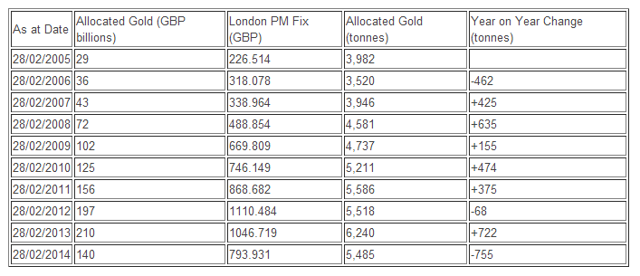
  • Bank of England's Quarterly Report shows that the bank held 5485 tonnes of gold for 72 central bank customers.
  • The gold holdings of the bank have dropped over 750 tonnes year-over-year with no reported central bank selling.
  • This suggests that we may be seeing large amounts of gold repatriation, which is exactly what happened when Bretton Woods broke down.
In its latest quarterly report, the Bank of England (BOE) released some very interesting information, which should interest investors that own physical gold and gold ETFs (SPDR Gold Shares (GLD)), regarding its gold custodial holdings. In this report, it stated that as of February 28th 2014, it held 5485 metric tonnes of gold (valued at 140 billion British pounds at that date) on behalf of 72 central banks. This gold was specifically held in allocated form - that is it was held claim-free for the bank's central bank customers and in a dedicated, not pooled form (i.e. specific bar numbers were owned by clients).

This can be seen in the diagram below.


We can't find historical data regarding how many central banks held gold at the Bank of England over time, but we do have some data regarding the historical change in the allocated holdings of gold.

Source: Gold Chat

This data was compiled and published by Bron Suchecki of the Perth Mint in Australia, who does a wonderful job of giving a practical look at a very opaque gold market.

The important thing to see here is the massive 755 tonne drop in allocated gold held by the Bank of England from February 2013 to February 2014. We know that central banks actually accumulated gold over 2013 and sold very little during the year, so this large drop in allocated gold reserves wasn't from central bank selling.

The other groups of entities that hold gold at the Bank of England are bullion banks who are members of the LBMA, and of that group HSBC is a member. The importance of that is HSBC is also the custodian of SPDR Gold Shares (GLD), and according to the prospectus, that in addition to the HSBC vault, GLD can keep gold at the Bank of England's vaults.

Over this same period, GLD lost about 451 tonnes of gold, so if we assume that every single tonne came from the Bank of England vaults, it still leaves around 304 tonnes of gold that left the BoE's vaults over the year - an extremely large amount considering that central banks were net buyers of gold.

Conclusion for Investors

Now, this decline in gold may be related to bullion bank selling as they liquidate allocated gold positions, but we believe we may be seeing something else going on here.

What may be going on is that central banks may be quietly repatriating gold from other central banks. That would explain why allocated gold would decline and yet there is little or no central bank selling - it is central banks removing their gold from Bank of England custodianship.

If that is the case, then the implications of this may be very large for gold investors. The accumulation of gold by central banks (as we've seen over the last few years), shows that they are seeking asset diversification, while the repatriation of gold shows that there is a lack of trust. This lack of trust is exactly what ended the previous monetary system of Bretton Woods as the French owned allocated gold that they were accumulating in the form of dollar reserves (which were convertible into gold but were in the custodianship of the US). That wasn't the problem because the system could work fine with the French accumulating even more allocated gold dollar reserves, it wasn't until Charles De Gaulle and the French lost trust in these allocated reserves and asked for their repatriation to France that the system broke.

If we're seeing a breakdown in trust between central banks regarding gold reserves (which are heavily concentrated in London and New York), then the consequences for the financial system and the gold price could be tremendous - especially since the actual physical gold is only a small fraction of total gold claims due to gold leasing, rehypothecation, and fractional reserve banking. If that small physical gold reserve base is depleted through repatriation, then the gold price should rise orders of magnitude higher, as the only way the base can support the claims upon it is with a much higher gold price.

This is simply another one of those reasons that gold ownership makes so much fundamental sense and thus we still think investors would be wise to maintain a strong exposure to gold with positions in physical gold and gold ETFs (SPDR Gold Shares GLD, PHYS, CEF). The gold miners have had a strong run recently and we would take profits in some of them, but investors should also have exposure to the leverage that they provide and may want to consider evaluating gold miners such as Goldcorp (GG), Agnico Eagle (AEM), Newmont (NEM), or even some of the explorers and silver miners such as First Majestic Silver (AG) (we're not suggesting these companies specifically - only suggesting them for further investor research).
We do not know for sure what happened to the allocated gold at the Bank of England, but if it is central bank gold repatriation (which we wouldn't hear about until well after the occurrence) then that may be moving us to the next stage in the financial crisis. With many other strong fundamentals going for it, investors should seriously consider initiating or increasing their position in gold.
via seeking alpha

Monday, May 26, 2014

First Germany, Now Austria Demands An Audit Of Its Offshore Held Gold

Submitted by Tyler Durden on 05/26/2014
First it was Germany, now another AAA-rated European country is starting to get concerned about its hard assets.

Overnight Bloomberg reported that following in Bundesbank's footsteps, Austria will audit its gold reserves located in the UK, which represent 80% of its total gold holdings. This gold reserve reviews held at Bank of England in London will be first conducted by external auditors, Christian Gutleder, a spokesman for the Austrian central bank, says via telephone.

As a reminder, Austria held 80% of its roughly 280 tons of gold in U.K., according to last annual report.

Gutleder explained that the Central bank has checked its reserves regularly in the past, adding that gold reserves haven’t changed since 2007. Which begs the question: why check them now then? 

According to the official explanation that review comes after euro-skeptic Freedom Party demanded more transparency, repatriation of reserves. Perhaps it is time to rename the Euroskeptic party into the "we doubt our gold is where you say it is" skeptics. A better explanation was provided by the Austrian Trend magazine, which said that "the measure is seen as a consequence of growing public pressure. There is a rising disbelief among Austrians about the existence of the gold."

Joking aside, with Euroskeptics across Europe ascendent, we wonder which central European nation will be the first to uncover that its gold is no longer where it is supposed to be (that most certainly includes the Banque de France).
Some more color from Goldreporter.de:

Austria is planning to send auditors to the Bank of England in order to verify the existence of Austria's gold reserves stored in british vaults.

The Austrian accountability office will sent a delegation to London in order to check on Austrias gold reserves stored in vaults at the Bank of England. This is reported by Austrian magazine Trend. The measure is seen as a consequence of growing public pressure. There is a rising disbelief among Austrians about the existence of the gold.
“I acknowledge the request. Any grocery store is obliged to do inventory once a year. It is the only way of getting rid of these unreasonable allegations”, Ewald Nowotny, Governor of the National Bank of Austria tells Trend.

Austria officially owns 280 tonnes of gold of which 17 percent are kept in vaults inside the country. Around 150 tonnes are estimated to be stored in London.

In recent years doubts about the existence and the quality of Germany's monetary gold stored at the New York Fed and the Bank of England were raised by a rising number of skeptics. In January the Bundesbank eventually announced plans to repatriate most of Gemany's gold reserves until 2020.

So first Germany (which at this rate may repatriate its gold held in New York, London and Paris some time in the year 3000, now Austria... Who's next to confirm that all those doubts about infinite re-hypothecation of physical gold with countless beneficiaries of paper receivables will be the next conspiracy theory to become conspiracy fact, after last week's surprising announcement that Barclays (the first of many) had manipulated paper gold prices on at least one occasions in the past decade.

via ZH

Friday, May 23, 2014

Barclays Fined For Manipulating Price Of Gold For A Decade; Sending "Bursts" Of Sell Orders

Submitted by Tyler Durden on 05/23/2014 06:56 -0400

It was almost inevitable: a week after we wrote "From Rothschild To Koch Industries: Meet The People Who "Fix" The Price Of Gold" and days after "Barclays' Head Of Gold Trading, And Gold "Fixer", Is Leaving The Bank", earlier today the UK Financial Conduct Authority finally formalized what most in the "tin-foil" hat community had known for years, when it announced that it fined Barclays £26 million for manipulating "the setting of the price of gold in order to avoid paying out on a client order." Furthermore, the FCA confirmed that those inexplicable gold raids which come as if out of nowhere, and slam gold with a vicious force so strong sometime they halt the entire market, had a very specific source: Barclays, whose trader Daniel James Plunkett, born 1976, "sent out a burst of orders aimed at moving the price of the yellow metal."

This took place for a decade. As the FT reports:

The FCA said Barclays had failed to "adequately manage conflicts of interest between itself and its customers as well as systems and controls failings, in relation to the gold fixing" between 2004 and 2013.

Some further details on Plunkett's preferred means of manipulating the gold price.

The FCA said Mr Plunkett had manipulated the market by placing, withdrawing and re-placing a large sell order for between 40,000 oz and 60,000 oz of gold bars.

He did this in an attempt to pull off a "mini puke", which the FCA took to mean a sharp fall in the price of gold. As a result, the bank was not obliged to make a $3.9m payment to the customer under an option contract.

Which is precisely what we have shown many times here for example in "Vicious Gold Slamdown Breaks Gold Market For 20 Seconds", when a sell order so aggressive comes in it not only takes out the entire bid stack with an intent not for "best execution" but solely to reprice the market lower. Recall from September:

There was a time when, if selling a sizable amount of a security, one tried to get the best execution price and not alert the buyers comprising the bid stack that there is (substantial) volume for sale. Of course, there was and always has been a time when one tried to manipulate prices by slamming the bid until it was fully taken out, usually just before close of trading, an illegal practice known as "banging the close." It appears that when it comes to gold, the former is long gone history, and the latter is perfectly legal. As the two charts below from Nanex demonstrate, overnight just before 3 am Eastern, a block of just 2000 GC gold futures contracts slammed the price of gold, on no news as usual, sending it lower by $10/oz. However, that is not new: such slamdowns happen every day in the gold market, and the CFTC constantly turns a blind eye. What was different about last night's slam however, is that this time whoever was doing the forced, manipulation selling, just happened to also break the market. Indeed: following the hit, the entire gold market was NASDARKed for 20 seconds after a circuit breaker halted trading!


To summarize: a humble block of 2000 gold futs (GC) taking out the bid stack, and slamming the price of gold, managed to halt the gold market: one of the largest "asset" markets in the world in terms of total notional, for 20 seconds.

And Mr. Plunkett in action:

To be sure Barclays was truly sorry, and pinky swears that having been caught manipulating the gold market for ten years it will never do it again:

The news is also a fresh blow to Barclays' chief executive Antony Jenkins as he tries to overhaul the culture of the London-based lender. Mr Jenkins took over 18 months ago after his predecessor, Bob Diamond, stepped down amid the Libor scandal.

Analysts said the fine reflected badly on the industry – as well as the hard-charging, revenue-focused business model that Barclays had previously been operating.

Mr Jenkins said in a statement on Friday: "We very much regret the situation that led to this settlement . . . These situations strengthen our resolve to improve." The bank discovered the misconduct after the client complained. It then reported the incident to the regulator, for which it received a 30 per cent discount on its fine for co-operation.

Ian Gordon, analyst at Investec, said that in pure financial terms, the fine was "utterly inconsequential, both in a group context, and in relation to the quantum of other conduct costs". He was referring specifically to the bank's provisions for the mis-selling of payment protection insurance and interest rate hedging products.

So a wrist slap, we get that. One wouldn't expect more - after all the banks run the show.  And yet, one wonders: is this just a case of "Fab Tourre-ing" the scandal, and redirecting all attention to just one (preferably junior) person? To be sure, this one trader made handsome profits from gold manipulation...

Mr Plunkett boosted his trading book by $1.8m at the expense of a customer, who was later compensated. He has now been banned from "performing any function in relation to any regulated activity" and fined £95,600. At the time, Barclays was one of five banks that set the price of the precious metal twice a day. Tracey McDermott, the FCA's director of enforcement and financial crime, said: "A firm's lack of controls and a trader's disregard for a customer's interests have allowed the financial services industry's reputation to be sullied again."

... but is this just an attempt by the FCA to pass this off as the proverbial "only cockroach", especially when as we reported earlier this week, none other than Barclays head of trading Marc Booker quietly left dodge?

The speculation is further heightened when one considers that Plunkett had left Barclays nearly two years ago in October 2012! According to his FCA record:

Prior to Barclays Plunkett worked as a lowly junior trader at Dresdner and RBC - and this is the a manipulation mastermind? Further, considering the FCA found failures at Barclays starting in 2004 and Plunkett only joined in 2006, can the FCA please disclose who else was the frontman for gold manipulation at Barclays in the 2004-2006 period? READ MORE…

Monday, May 19, 2014

Gold "Important" And No Plan To Sell Significant Quantity Of - ECB

Published in Market Update  Precious Metals  on 19 May 2014
By Mark O’Byrne

Today’s AM fix was USD 1,301.00, EUR 948.67 and GBP 773.85 per ounce.
Friday’s AM fix was USD 1,293.75, EUR 943.17 and GBP 769.72 per ounce.

Gold fell $2.50 or 0.19% Friday to $1,293.10/oz. Silver slipped $0.12 or 0.62% to $19.36/oz. Gold and silver both finished up for the week at 0.34% and 1.10% respectively.

Gold moved higher today in euros, pounds and dollars after the ECB and 21 other central banks announced a new gold agreement. The new agreement was expected but the timing was unexpected as the last agreement was not due to expire until September 27.
Gold in Euros - 5 Minutes, 1 Day (Thomson Reuters)

The crisis in Ukraine and risk of increased tensions between Russia and the west continues to provide support for gold. A further deterioration in relations seems likely and should push gold higher.

Also supporting gold is the likelihood that the incoming government in India will relax import restrictions and duties, in the world’s second largest buyer.

Over the weekend, incoming Indian leader Modi told thousands of supporters that he represents a break from past governments after winning the nation’s biggest electoral mandate in 30 years. Last week,  Reserve Bank of India Governor Raghuram Rajan said that the new Indian finance minister will decide on easing gold import curbs.
Gold in Euros - Monthy, 1999 to May 19, 2014 (Thomson Reuters)
Gold “Important” And ECB No Plan To Sell Significant Quantity Of Gold 
The ECB, the Swiss National Bank (SNB) and the Riksbank of Sweden announced a new gold agreement this morning. They announced they have no plans to sell significant quantities of gold and reaffirmed the importance of gold bullion as a monetary reserve.

Twenty one central banks including the ECB, the central banks of the  euro area (Austria, Belgium, Cyprus, Estonia, Finland, France, Germany, Greece, Ireland, Italy, Latvia, Luxembourg, Malta, the Netherlands, Portugal, Slovakia, Slovenia, Spain), the SNB and the Riksbank announced the fourth gold agreement between the central banks for the next 5 years.

In a joint statement, the central banks confirmed their intentions with regard to their gold holdings and the participants in the gold agreement made the following declaration:
- Gold remains an important element of global monetary reserves.
- The participants in the gold agreement will continue to coordinate their gold transactions so as to avoid market disturbances.
- The participants currently have no plans to sell any substantial quantities of gold.
The press release from the SNB can be read here.

The agreement, which applies as of 27 September 2014, following the expiry of the current agreement, will be reviewed in five years’ time. The first gold agreement was concluded in 1999 in order to coordinate planned gold sales by the different central banks. The agreement was extended in 2004 and 2009.
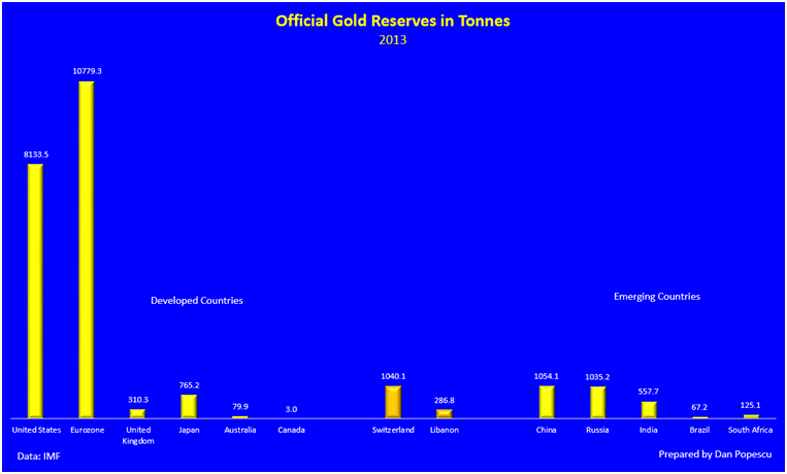
Official Gold Reserves in Tonnes – Developed Countries vs Emerging Countries

The timing of the announcement was unexpected as the current agreement does not expire until September.

It is understandable that the central banks value their gold as “important element of global monetary reserves,” given the still lingering economic problems in Greece, Italy, Spain, Portugal, Ireland and Cyprus and continuing ultra loose monetary policies in the Eurozone - with the possibility of negative interest rates.

Thus, European central banks are likely to continue to be reluctant to sell their substantial gold reserves which total of 10,779.3 tonnes or 8,972.6 tonnes ( EU G6).

There is also the fact that while Eurozone banks balance sheets have recovered somewhat, many are far from robust and remain vulnerable. Should there be a ‘Black Swan’ event or economies slow down again, central banks may require their gold reserves in order to maintain confidence in the single currency and other fiat currencies.

It is believed that there is little appetite for a new gold agreement among the rest of the world and among the emerging market central banks such as China. 

Most of the central banks that were signatories to the Washington Agreement, clearly do not want to sell their gold reserves.

The World Gold Council released data showing that global official gold reserves totalled 31,890.7 tons as of February, 2014. Of this total figure, the euro area held a total of 10,779.3 tons making it the largest holder of gold reserves in the world with 36.6% of the total global gold reserves.

The second largest holder of gold reserves is the U.S. with 8,133.5 tonnes. 
China's central bank gold reserves data has remained at 1,054 tons since the beginning of 2009. No change has occurred in 4 and a half years, despite most market participants believing that China is quietly accumulating gold reserves. 

China is likely to announce a sharp increase in their reserves to over 3,000 or 4,000 tonnes in the coming months.

The previous European gold agreement, agreed in August 2009, committed the central banks to sell no more than 400 tonnes per year and no more than 2,000 tonnes in the five-year period.

Sales under the current pact have only totalled around 200 tonnes, 10 times less than was permissible. The global and Eurozone debt crisis created a new found awareness of gold as a safe haven monetary asset.

This reluctance to sell gold is likely to continue. Indeed, many central banks are already under pressure to repatriate their gold reserves from the UK and the U.S.
 Official Gold Reserves as a Percentage of Total Foreign Currency Reserves

Gold reserves and the price of gold are closely watched on financial and foreign exchange markets - as a barometer of inflation expectations, of systemic risk and of confidence in fiat currencies.

The central banks at the time of the first agreement, the Washington agreement, affirmed that gold remained an important part of the global monetary system, setting the basis for a long and upward trend for the gold price.

The initial statement does not mention the sales ceiling for the pact and some market participants are surprised they did not reaffirm the sales ceiling. The European Central Bank has told Reuters that there is indeed no formal ceiling included in the new CBGA.

There was no mention of gold leasing and the use of futures and options by central banks in the agreement. There was in 1999 and 2004 but not in 2009 and again now.

The Bank of England did not sign the agreement. The Bank of England signed the first Washington Agreement in 1999 but opted out in 2004 and 2009.

The opt out may be because the UK gold reserves are now insubstantial. By signing the agreement, the BOE might again draw attention to Gordon Brown's controversial gold sales.
source goldcore