Search Blog Posts

Showing posts with label Republican. Show all posts

Thursday, May 7, 2015

All B-Cruz: married into the TPP/NAU establishment

Not a US citizen? No problem, it doesn't matter anymore! ¿No un ciudadano estadounidense? ¡No hay problema, no importa más!

If you consider yourself a Cruzer supporter watch where you step. If you think the "tea party" is your safe haven, you'll be disappointed when you find out it's just another appendage for GOP neocon leadership propaganda. 

The mouse trap is baited, don't lunge for the cheese. Promise us all you'll jump off a bridge after you support whom you thought was the 'lesser of two evils', when in fact there is no lesser! The Cruzer and an opponent  worship at other alters than you or me.


Good Fellas Blankfein, Goldman CEO and
Head Abortion Meister Buffett
During his CPAC speech this weekend, Senator Ted Cruz took shots at previous Republican presidential candidates Dole, McCain, and Romney, for lacking a “clear distinction” from big-government democrats. Well, I think Mr. Cruz has got some ‘splaining to do. It seems he’s just as married—literally—to the establishment as any of them.

A report from the ever-busy infowars.com reveals that Cruz’s wife, Heidi, has some rather behemoth credentials:

Cruz’s insider connection is a family affair. His wife, Heidi, is a Goldman Sachs vice president in Houston, Texas, according to her LinkedIn profile. She also served as an economic advisor for the Bush administration. In 2011, a Cruz campaign spokesman portrayed Heidi as “an expert on North American trade,” in other words she is savvy when it comes to globalist transnational trade deals like NAFTA, the single most destructive government move against the American worker in history.

She was also a term member of the Council on Foreign Relations (see her bio at Claremont McKenna College), a position that expired prior to her husband’s attack on the globalist organization.

The details come from a page listing Clermont-McKenna College’s Board of Advisors, on which Mrs. Cruz apparently served. In addition to being one of only three of W’s economic advisors,

She also served in the Administration as the economic director for the Western Hemisphere at the National Security Council at the White House, advising the President and then-National Security Advisor Condoleezza Rice. She also is a former director at the U.S. Treasury Department and was special policy assistant to Ambassador Robert B. Zoellick, then Chief U.S. international trade negotiator.

It also reveals that before Goldman Sachs, she worked for another tentacle of the vampire squid, JPMorgan, “focusing on international structured finance.”


None of this says “Tea Party,” “small government,” “sound money,” and contrary to Cruz’s latest pitch, it also does not much support “standing on principle”—unless that “principle” is fiat money, TARP bailouts, financing wars, revolving doors, etc.

Now perhaps Mrs. Cruz’s career is not representative of the Senator’s views. Or, if it is, perhaps the Senator has changed views in recent years. He did later blast the CFR, but that seems to have come only after his wife’s Term ended, and only when trying to present himself as a Tea Party candidate.

But Cruz has wasted no time showing us to his views. Only a day after falling a distant second behind Ran Paul (Paul 31%, Cruz only 11%) in the CPAC straw poll, Cruz took a swipe, albeit a weak one, at Paul. Breitbart.com reports that despite being a “big fan” of Rand Paul, Cruz stated, “I don’t agree with him on foreign policy.”

There’s no doubt Paul is not an imperialist or a warmonger, but he has certainly deviated from his father’s uncompromising non-interventionism. When Fox News Sunday asked about his foreign policy, Paul answered,


I see my foreign policy in the same line as what came out of, probably, the first George Bush. Henry Kissinger wrote something in the Washington Post two days ago [here] which I agree with. I see it coming out of the mainstream of the Republican position.

I opposed with real fervor the involvement of us in Syria, and that became the dominant position in the country—both Republican and Democrat. There’s not one Republican who’s saying we should put military troops in Crimea, in the Ukraine. So I think I’m right in the middle of that position.

And I think that those who would try to argue that somehow I’m different than the mainstream Republican opinion are people who want to take advantage for their own personal political gain. I’m a great believer in Ronald Reagan. I’m a great believer in a strong national defense. . . .

It’s perhaps not surprising then that in his sideswipe at Paul, Cruz didn’t really give any real specifics, just vague sentimental references:

U.S. leadership is critical in the world. I agree we should be reluctant to deploy military force aboard, but there’s a vital role, just as Ronald Reagan did. When Ronald Reagan called the Soviet Union an Evil Empire, when he stood in front of the Brandenburg Gate and said ‘Tear down this wall.’ Those words changed the course of history. The United States has a responsibility to defend our values.

Of course, Paul seems to share all of these platitudes: who doesn’t believe in “defending our values”? Who doesn’t believe in “U.S. leadership”? So as criticisms these fall flat.

The real questions are things like, “Do we need 800 international military bases to accomplish this?” “Do we need to maintain military bases in 63 countries?” “Do we need standing armies of 255,000 soldiers in foreign countries?” “Can anyone who believes in fiscal responsibility and small government seriously maintain $680+ billions each year in ‘defense’ spending?” And this is all not even considering the biblical doctrines regard the military and war (Paul has hinted at some. Cruz has not, as far as I know).

Since Paul shares the views Cruz mentioned, it seems that Cruz is either uniformed (unlikely), dishonest (harsh), or is engaging in careless political volleys.

Consider the results of CPAC, the latter seems most likely.
In fairness, Cruz was asked about Paul by an interviewer, so he had no choice but answer. But his answer is vague grandstanding on things Paul agrees with.

So, if we are to believe that Cruz’s answer distinguishes him from Paul somehow, then he must have very different definitions of “U.S. leadership” and “defending our values” than those articulated by Paul. For Cruz, these must be euphemisms for “imperialism” and “interventionism.”

If Cruz’s familial associations—Goldman Sachs, JPMorgan, W, CFR— are any indication, then I think we know the answer. I suspect there is, therefore, some truth in Infowar.com’s conclusion:

Like the domestication of the Tea Party and the expulsion of its more purist liberty-minded activists, the Cruz the warrior pitted against the establishment motif is another slick subversion directed at the political elite’s most puissant opposition – the real Tea Party and a threatening number of patriot activists gnawing at the edges of the political establishment.

If Cruz gets more prominent for the 2016 primary, I suspect there will be an attempt to scrub these associations.
UPDATE: Paul fires back:

Many forget today that Reagan’s decision to meet with Mikhail Gorbachev was harshly criticized by the Republican hawks of his time, some of whom would even call Reagan an appeaser. In the Middle East, Reagan strategically pulled back our forces after the tragedy in Lebanon in 1983 that killed 241 Marines, realizing the cost of American lives was too great for the mission.

Without a clearly defined mission, exit strategy or acceptable rationale for risking soldiers lives, Reagan possessed the leadership to reassess and readjust.

Today, we forget that some of the Republican hawks of his time criticized Reagan harshly for this too, again, calling him an appeaser. . . .

How many leaders were as great as Reagan, willing to admit their mistakes, learn from them and put their country before their own reputation and legacy?

Today’s Republicans should concentrate on establishing their own identities and agendas, as opposed to simply latching onto Ronald Reagan’s legacy—or worse, misrepresenting it.
Source AmericanVision

Sunday, March 29, 2015

Espionage, Treason, and the Congressional Fifth Column


Congress canoodles with Israeli spies to undermine Iran deal

by , March 25, 2015
The spectacle of virtually the entire Senate GOP caucus mobilizing in support of a foreign power in order to drag us into war with Iran has certainly been instructive. Not since the Federalist party plotted with the British during the War of 1812 has an American fifth column been so open about their treason.

But isn’t the "t"-word a bit hyperbolic? After all, don’t all Americans, even the worst warmongers among us, have the right to free speech? Those members of Congress were merely expressing their opinion – right?

Not so fast:
"Soon after the U.S. and other major powers entered negotiations last year to curtail Iran’s nuclear program, senior White House officials learned Israel was spying on the closed-door talks.

"The spying operation was part of a broader campaign by Israeli Prime Minister Benjamin Netanyahu’s government to penetrate the negotiations and then help build a case against the emerging terms of the deal, current and former U.S. officials said. In addition to eavesdropping, Israel acquired information from confidential U.S. briefings, informants and diplomatic contacts in Europe, the officials said.

"The espionage didn’t upset the White House as much as Israel’s sharing of inside information with U.S. lawmakers and others to drain support from a high-stakes deal intended to limit Iran’s nuclear program, current and former officials said."

To be clear: the Israelis penetrated our communications, and used other means – including "informants" presumably inside the U.S. government – to uncover details about the emerging deal with Iran, and then passed this information on, perhaps indirectly, to their congressional fifth column, including presidential aspirants Ted Cruz, Marco Rubio, and Rand Paul, all of whom then signed on to Sen. Tom Cotton’s "open letter" to Tehran.

If this isn’t treason, then the word has no meaning.

Speaker of the House John Boehner, who plotted with Israeli ambassador Ron Dermer behind the President’s back to invite Netanyahu to address Congress, said he was "shocked" and "baffled" by the news. Not by the news they spied on us – it’s well known that the Jewish state is among the most aggressive foreign adversaries our counterintelligence agencies have to fend off – but "by the fact that there were reports in this press article that information was being passed on from the Israelis to members of Congress. I’m not aware of that at all." What’s baffling, however, is Boehner’s behavior during this Israeli incursion onto American territory: why did he suddenly decide to go full wingnut and canoodle with the Israelis to bring Bibi to American shores? And how is it the Speaker has so little knowledge of what’s going on right under his nose on Capitol Hill?

"The White House discovered the operation," reports Adam Entous of the Wall Street Journal, "when U.S. intelligence agencies spying on Israel intercepted communications among Israeli officials that carried details the U.S. believed could have come only from access to the confidential talks, officials briefed on the matter said." Those telling details then somehow found their way into conversations between the Israelis (and their American agents) and "U.S. lawmakers and others," accord to the Journal.

It’s one thing to spy, said a top U.S. official, but "it’s another thing to steal U.S. secrets and play them back to U.S. legislators to undermine U.S. diplomacy." Read More
 

Wednesday, March 25, 2015

Washington's Al Qaeda Ally Now Leading ISIS in Libya

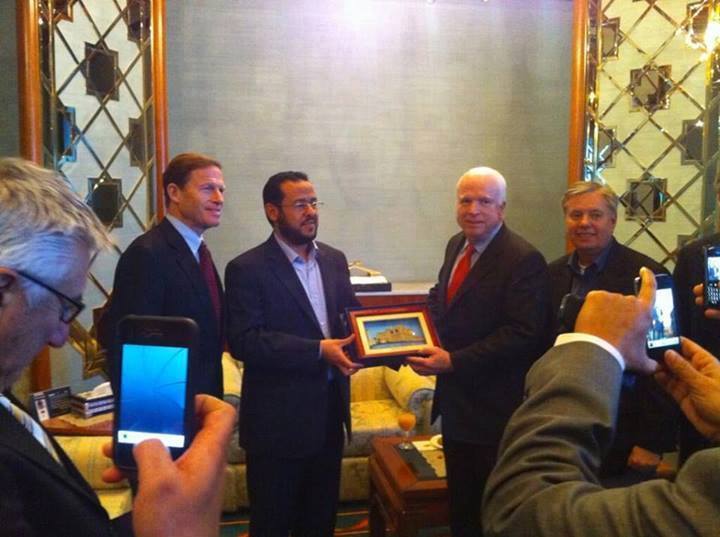
 Republican senators McCain & Graham heroes to some, traitors to most. While they will not be punished by congress which acts unlawfully itself, this pair must be removed by the voters of those respective states. 

Additionally, state governors for years have condoned the respective national guard regiments to be deployed in the undeclared overseas wars upon many nations - and lives. Those unlawful acts should be nullified by governors immediately.

March 9, 2015 (Eric Draitser - NEO) - The revelations that US ally Abdelhakim Belhadj is now leading ISIS in Libya should come as no surprise to those who have followed US policy in that country, and throughout the region. It illustrates for the umpteenth time that Washington has provided aid and comfort to precisely those forces it claims to be fighting around the world.

According to recent reports, Abdelhakim Belhadj has now firmly ensconced himself as the organizational commander of the ISIS presence inside Libya. The information comes from an unnamed US intelligence official who has confirmed that Belhadj is supporting and coordinating the efforts of the ISIS training centers in eastern Libya around the city of Derna, an area long known as a hotbed of jihadi militancy.

While it may not seem to be a major story – Al Qaeda terrorist turns ISIS commander – the reality is that since 2011 the US and its NATO allies have held up Belhadj as a “freedom fighter.” They portrayed him as a man who courageously led his fellow freedom-lovers against the “tyrannical despot” Gaddafi whose security forces at one time captured and imprisoned many members of the Libyan Islamic Fighting Group (LIFG), including Belhadj.

Belhadj served the US cause in Libya so well that he can be seen receiving accolades from Sen. John McCain who referred to Belhadj and his followers as heroes. He was initially rewarded after the fall of Gaddafi with the post of military commander of Tripoli, though he was forced to give way to a more politically palatable “transitional government” which has since evaporated in that chaotic, war-ravaged country.

Belhadj’s history of terrorist activity includes such “achievements” as collaboration with Al Qaeda in Afghanistan and Iraq, and of course his convenient servitude to the US-NATO sponsored rampage across Libya that, among other things, caused mass killings of black Libyans and anyone suspected of being part of the Green Resistance (those loyal to the Libyan Arab Jamahiriya led by Gaddafi). Although the corporate media tried to make a martyr of Belhadj for his alleged torture via the CIA rendition program, the inescapable fact is that wherever he goes he leaves a violent and bloody wake.

While much of this information is known, what is of paramount importance is placing this news in a proper political context, one that illustrates clearly the fact that the US has been, and continues to be, the major patron of extremist militants from Libya to Syria and beyond, and that all talk of “moderate rebels” is merely rhetoric designed to fool an unthinking public.

The Enemy of My Enemy is My Friend…Until He Isn’t

There is ample documented evidence of Belhadj’s association with Al Qaeda and his terrorist exploits the world over. Variousreports have highlighted his experiences fighting in Afghanistan and elsewhere, and he himself has boasted of killing US troops in Iraq. However, it was in Libya in 2011 where Belhadj became the face of the “rebels” seeking to topple Gaddafi and the legal government of Libya.

As the New York Times reported:
The Libyan Islamic Fighting Group was formed in 1995 with the goal of ousting Colonel Qaddafi. Driven into the mountains or exile by Libyan security forces, the group’s members were among the first to join the fight against Qaddafi security forces… Officially the fighting group does not exist any longer, but the former members are fighting largely under the leadership of Abu Abdullah Sadik [aka Abdelhakim Belhadj].
So, not only was Belhadj a participant in the US-NATO war on Libya, he was one of its most powerful leaders, heading a battle-hardened jihadist faction that constituted the leading edge of the war against Gaddafi. Nowhere was this more clearly demonstrated than when the Libyan Islamic Fighting Group (LIFG) took the lead in the attack on Gaddafi’s compound at Bab al-Aziziya. In this regard, LIFG was provided intelligence, and likely also tactical support, from US intelligence and the US military.

This new information about Belhadj’s association with the suddenly globally relevant ISIS certainly bolsters the argument that this writer, among many others, has made since 2011 – that the US-NATO war on Libya was waged by terrorist groups overtly and tacitly supported by US intelligence and the US military. Moreover, it dovetails with other information that has surfaced in recent years, information that shines a light on how the US exploited for its own geopolitical purposes one of the most active terrorist hotbeds anywhere in the world.

According to the recent reports, Belhadj is directly involved with supporting the ISIS training centers in Derna. Of course Derna should be well known to anyone who has followed Libya since 2011, because that city, along with Tobruk and Benghazi, were the centers of anti-Gaddafi terrorist recruitment in the early days of the “uprising” all through the fateful year of 2011. But Derna was known long before that as a locus of militant extremism. FINISH READING

Tuesday, March 10, 2015

▶ The Problem With Voting for ‘Conservatives’ - YouTube


Published on Mar 9, 2015
JBS CEO Art Thompson's weekly news video update for March 9 - 15, 2015.

In this week's Analysis Behind the News video, JBS CEO Art Thompson demonstrates the problem with those in Congress who obey the Constitution only 80 percent of the time. He also introduces a new pamphlet focusing on how trade agreements have hurt our military readiness.


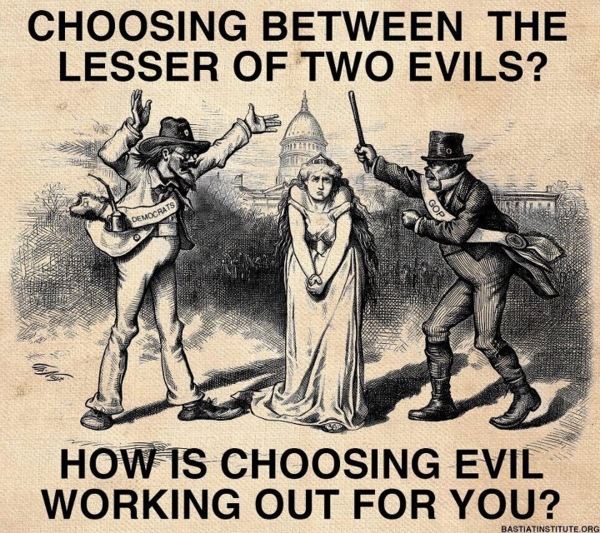
 http://www.federalobserver.com/wp-content/uploads/2012/08/Lesser2Evils.jpg

Friday, March 6, 2015

Congress's Socialist Wing

As an ideological point of reference realize that the site (DTN) origin of this post is of a leftist pro-war Zionist Republican neocon bent itself.
Don't be confused what's Left and what's Right:

These people know better than you what's best for America
~~~~~~~~~~~~~~~~~~~~~~~~~~~~~~~~~~~~~~~~~~~~~~~~~~~~~~
Congressional Progressive Caucus (CPC)
Rep.  Raul Grijalva (co-chair)
1511 Longworth HOB
Washington, DC
20515

Rep.  Keith Ellison (co-chair)
1027 Longworth HOB
Washington, DC
20515

URL: Website
  • Socialist wing of the Democratic Party
  • Consists of 76 Members of Congress
  • Has close ties to the Institute for Policy Studies and the Democratic Socialists of America
  • Has ties to the Communist Party USA

                Members of the Congressional Progressive Caucus


The Congressional Progressive Caucus (CPC) was founded in 1991 by Bernie Sanders, a self-identified socialist who had recently been elected to the U.S. House of Representatives. Sanders' CPC co-founders included House members Ron Dellums, Lane Evans, Thomas Andrews, Peter DeFazio, and Maxine Waters. The Institute for Policy Studies (IPS) was also involved in CPC's founding and in Caucus activities thereafter; IPS continues to advise CPC on various matters to this day.

Another key player in establishing CPC was the Democratic Socialists of America (DSA), which has maintained a close alliance with the Caucus ever since. In 1997, DSA's political director, Chris Riddiough, organized a meeting with CPC leaders to discuss how the two groups might be able to “unite our forces on a common agenda.” Among those who participated in the meeting were Bernie Sanders, labor leader Richard Trumka, professor Noam Chomsky, feminist Patricia Ireland, Rev. Jesse Jackson, Senator Paul Wellstone, journalist William Greider, and the socialist author Barbara Ehrenreich.

Beginning in 1997, CPC worked closely with the newly launched “Progressive Challenge, a coalition of more than 100 leftist organizations that sought to unite their activities and objectives under a "multi-issue progressive agenda." To view a list of many of the major groups that co-sponsored the Progressive Challenge, click here.

On November 11, 1999, CPC drafted a vital Position Paper on economic inequality, which called for “legislative initiatives” to combat the “income and wealth disparities” that “distor[t] our democracy, destabiliz[e] the economy, and erod[e] our social and cultural fabric.” Lamenting that “two and a half decades of government policies and rules governing the economy” had been “tilted in favor of large asset owners at the expense of wage earners,” the document derided the “pro-investor bias” of America's existing “tax policy, trade policy, monetary policy, [and] government regulations.”

In 2005 CPC spelled out its political agendas in what would become its signature document, the “Progressive Promise.” Therein, the Caucus emphasizes its commitment to four major priorities: Economic Justice and Security; Civil Rights and Civil Liberties; Global Peace and Security; and Environmental Protection & Energy Independence. Under the rubric of these items fall a number of additional key CPC objectives, such as these:
  • "To uphold the right to universal access to affordable, high-quality healthcare for all."
  • "To … create new jobs in the U.S. by building more affordable housing, re-building America’s schools and physical infrastructure, cleaning up our environment, and improving homeland security."
  • "To ensure [that] working families can live above the poverty line and with dignity by raising and indexing the minimum wage."
  • "To sunset expiring provisions of the Patriot Act and bring remaining provisions into line with the U.S. Constitution."
  • "To fight corporate consolidation of the media and ensure opportunity for all voices to be heard"—essentially a plan for purging conservative voices from the airwaves by means of the "Fairness Doctrine" or adherence to the principles of “localism.”
  • "To bring U. S. troops home from Iraq as soon as possible."
  • "To encourage debt relief for poor countries" as outlined in the United Nations Millennium Project, a massive redistributive scheme calling for the governments of wealthy countries to commit 0.7% of their GNP to promoting “the economic development and welfare of developing countries.”
  • "To free ourselves and our economy from dependence upon imported oil and shift to growing reliance upon renewable energy supplies and technologies."
  • To “eliminate [the] environmental threat posed by global warming,” an objective that may be accomplished by increased emphasis on “solar, biomass, and wind power.”
  • "To promote environmental justice," a term founded on the premise that hazardous-waste landfills and pollution-emitting industries tend to be situated disproportionately near minority neighborhoods.
A 2002 report by Joelle Fishman, chair of the Communist Party USA's Political Action Committee, stated that the Progressive Caucus “provides an important lever that can be used to advance workers' issues and move the debate to the left in every Congressional District in the country.” In a 2010 CPUSA report, Party member David Bell identified Progressive Caucus members as his organization's “allies in Congress.”

As of March 2015, CPC consisted of 68 members of the House of Representatives—all of them leftist Democrats—and one U.S. Senator (Bernie Sanders, an Independent who caucuses with the Democrats).

For a comprehensive list of all 69 CPC members, click here.

For a list of noteworthy former members who left the Caucus prior to April 2011, click here.

For additional information on CPC, click here.
Source DTN

Neocon Nuland Lies about Ukraine before Congress

It starts with her claim the US-backed violent overthrow of the Ukrainian government last year was the work of "peaceful protesters"

Daniel McAdams
03.06.2015 
Neocons espouse the concept
of 'the noble lie'

This article originally appeared at RT


Victoria Nuland’s anti-Russian rhetoric comes from the neocon camp of US politics, seeking to stir the Ukraine crisis, thrilled by the prospect of defense industry expansion and more arms sales, Daniel McAdams of the Ron Paul Peace Institute told RT.

RT: World leaders and international monitors agree the situation in Ukraine is generally improving. Why are we still witnessing aggressive rhetoric from some US officials?

Daniel McAdams: Because the US does not want peace to break out. The US is determined to see its project through. But unfortunately like all of its regime change projects this one is failing miserably. Victoria Nuland completely disregards the role of the US in starting the conflict in Ukraine. She completely glosses over the fact that the army supported by Kiev has been bombarding Eastern Ukraine, as if these independent fighters in the east are killing themselves and their own people. Victoria Nuland was an aid to Dick Cheney; she is firmly ensconced in the neocon camp. The neocons believe very strongly in lying, the noble lie… They lied us into the war in Iraq; they are lying now about Ukraine. Lying is what the neocons do.

RT: Nuland listed a lot of hostile actions by Russia without providing any reliable proof. Do you think she can she be challenged on these topics?

DM: Maybe she is right but the US hasn't provided one piece of proof, except for Ambassador Geoffrey Pyatt’s Rorschach tests he passes off as a satellite photo. Maybe they are true but we have to present some evidence because we’ve seen now the neocons have lied us into the war. This is much more serious than the attack on small Iraq. This has the potential for a global nuclear war. So I think they should be held to a higher level of scrutiny. Thus far they have not provided any. We do know however that the US is providing military aid. As the matter of fact this week hundreds of American troops are arriving in Ukraine. Why is that not an escalation? Why is it only an escalation when the opponents of the US government are involved?

RT: How probable is that the Western nations ship lethal aid to Ukraine?

DM: It is interesting because Victoria Nuland this week spent some time with Andriy Parubiy, one of the founders of the fascist party in Ukraine and I believe one of the founders of the Joseph Goebbels Institute. She met with him this week and had a photo taken with him. He came back to Ukraine and assured his comrades that the US will provide additional, non-lethal weapons - whatever that means - and felt pretty strongly that they would provide lethal weapons. The Chairman of the Joint Chiefs of Staff, General Martin Dempsey has been urging the US government to provide lethal weapons as has the new US defense secretary [Ashton Carter], both of whom come from the military industrial complex which is thrilled by prospect of a lot more arms to be sold.

RT: Nuland has said the State Department is in talks with EU leaders for another round of sanctions on Russia. Do you think the EU will agree?

DM: I think they will be pressured into agreeing. It is interesting that Nuland said that the new Rada, the new Ukrainian parliament, in this first four months has been a hive of activity. I was just watching some videos from the fights in the Ukrainian parliament. So that was one bit of unintentional humor probably in her speech. It looks like a fight club over there.


via Russia-insider

Friday, February 27, 2015

FCC Net "Neutrality" Passes by a Narrow Margin

So much for sworn oaths, beyond some obtuse frothy babble expect nary a Republican statesman to stand up for the peoples' liberty.
 
Net Neutrality: Beginning of the End of the Internet?

Written by  C. Mitchell Shaw

The FCC voted yesterday to begin regulating the Internet as a public utility under a plan known as Net Neutrality. Let that sink in. The federal government will regulate the Internet in the same way the agency already regulates the telephone and cable television industries — and it calls that "neutral." Having been denied the ability to regulate the Internet in the past because of a lack of authority, the FCC has now simply reclassified the Internet under Title II, and — voilà! — they have the authority to regulate it.

One problem with this action is that the Internet does not belong in the same category as telephones and televisions. It is "other": It has its own category. 

The Internet is the most innovative, pervasive, free, and open form of communication man has ever known. Access to it is more available now than ever before, and an increasing number of people are using it as the primary method for their communications. When used properly, the Internet allows private, anonymous communication in a way that is unrivaled. But beyond that, it is also a marketplace, a research network, an alternative news source, and much, much more. And the Internet is all these things because it grew up largely unhindered by government regulation (read: interference).

With the three-to-two vote of unelected bureaucrats unaccountable to the people, that is changing. It is as sure as can be that Net Neutrality will change the Internet. As the Internet is bogged down in regulation by an agency that has no constitutional authority even to exist, let alone to regulate the Internet, the innovation that birthed and nursed the Net to youthful maturity will be replaced by concerns about compliance with regulations. Instead of answering to the concerns of consumers — as is done in a free market — ISPs (Internet Service Providers — through which a company such as Netflix provides services to Internet users) will begin focusing their attention on lobbying the FCC. The result will be an Internet that has lost its youthful energy and is mired in rules that aren't even known yet.

The reason the rules aren't yet known is that FCC Chairman Wheeler decided to keep them secret. He has hinted at the powers the new rules grant to the FCC, though, and they are frightening. In an op-ed piece for Wired on February 4, Wheeler wrote, "My proposal includes a general conduct rule that can be used to stop new and novel threats to the Internet. This means the action we take will be strong enough and flexible enough not only to deal with the realities of today, but also to establish ground rules for the as yet unimagined."

What constitutes "new and novel threats to the Internet" is left to be defined later.

Perhaps as disturbing as the secrecy of the plan is the underhanded method by which it was promoted, using — ironically — the Internet itself. In the "comments" section of many online articles, activists and bots (programs that post while appearing to be real people) posted emotional and factually erroneous appeals for regulation to "save the Internet." One example is this comment that appeared verbatim in the comments section of several stories under several different usernames:

Cable companies need to be regulated. They're working together to prevent having to provide better service or lower prices. The internet in the US is extremely slow and over priced.

My cable/internet costs me $150/month (from Time Warner). Contrast with my other expenses:
- Gym ($11/month from Planet Fitness)
- Mobile Phone ($21/month from TMobile)
- Car insurance ($25/month from Insurance Panda)
- Groceries ($90/month for me)

Yes, that's correct, my gym, cellphone, car insurance, and food COMBINED cost less than my TWC bill.

This will be a win for consumers by increasing competition and expanding infrastructure. Prices drop and speed increases. Profits drop. Aww.

In many comment platforms, visitors to the site can click on a username to see other comments posted by a commenter. Several of the usernames that posted the comment above have no other comments logged. It appears those usernames were created specifically for the purpose of posting that comment.

The purported reasons for the FCC stepping up its regulation of the Internet is that ISPs were "giving preferential treatment" to some services and "discriminating" against others and "creating paid fast lanes on the Internet." It sounds evil. It screams for relief that only Big Government can provide. 

Granted, some ISPs were slowing traffic to sites that provide streaming services for watching movies or downloading large files, while at the same time allowing faster connections to other sites. Also granted, most ISPs were providing faster services for consumers who pay more. But is that wrong? Does it require relief in the form of regulation?

These types of things are normal in a free market. Bandwidth is expensive to maintain, and ISPs must make decisions that are in their best interests as businesses. If some consumers are using a very large amount of the available bandwidth to download large files and stream movies and music, it means that either everything on that connection will slow down for everyone using it, or the ISP will have to increase the bandwidth, and pay for it. The choices are limited. The ISPs can "choke" the speeds to connections to those services that use the most bandwidth; they can charge extra to consumers who desire faster connections; they can raise rates across the board; or they can do a combination of the three.

Following the logic of the arguments in favor of Net Neutrality, a restaurant should charge the same price for an eight-ounce steak as for a 16-ounce steak. 

Just because Customer B has a bigger appetite than Customer A doesn't mean B should pay more, goes the Net Neutrality reasoning. In a free market (one that answers to the realities of cost and profits), the restaurant would have no choice but to offer only a 12-ounce steak and charge the same price as it had for the 16-ounce steak. And that is where these new regulations begin to harm consumers. We will see fewer choices and higher prices as the ISPs focus on lobbying their regulators and passing the costs along to their customers.

Many people live in areas where the demand for high speed Internet is low and have had to suffer with slow connection speeds. They have sat in Starbucks and public libraries and used their Internet connection when they needed a faster connection. Many currently pay about $100 per month for high speed Internet and home security from Comcast because they live in areas where demand is higher. These are their choices. There is no one-size-fits-all approach, and as Big Government tries to force one, those who advocated for this are going to figure that out.

Thankfully, it is far from over. The courts can rule against Net Neutrality. Some in Congress are already talking about a bill to set it aside. A future FCC commission could reverse it.

It is a dire situation to be at the mercy of big government where something this important is concerned. It is time, as The New American's Joe Wolverton has observed, to force "the federal beast back inside its constitutional cage."

via thenewamerican

Wednesday, February 25, 2015

Snowden: Remove The Government's Ability To Interfere With Our Rights

By: Samuel Eaton Feb 24, 2015
In an ‘Ask Me Anything’ question and answer session on Reddit, Edward Snowden was asked: “What’s the best way to make NSA spying an issue in the 2016 Presidential Election? It seems like while it was a big deal in 2013, ISIS and other events have put it on the back burner for now in the media and general public. 

What are your ideas for how to bring it back to the forefront?”

Snowden replied:

This is a good question, and there are some good traditional answers here. Organizing is important. Activism is important.

At the same time, we should remember that governments don’t often reform themselves. One of the arguments in a book I read recently (Bruce Schneier, “Data and Goliath”), is that perfect enforcement of the law sounds like a good thing, but that may not always be the case. The end of crime sounds pretty compelling, right, so how can that be?

Well, when we look back on history, the progress of Western civilization and human rights is actually founded on the violation of law. America was of course born out of a violent revolution that was an outrageous treason against the crown and established order of the day. History shows that the righting of historical wrongs is often born from acts of unrepentant criminality. Slavery. The protection of persecuted Jews.

But even on less extremist topics, we can find similar examples. How about the prohibition of alcohol? Gay marriage? Marijuana?

Where would we be today if the government, enjoying powers of perfect surveillance and enforcement, had — entirely within the law — rounded up, imprisoned, and shamed all of these lawbreakers?

Ultimately, if people lose their willingness to recognize that there are times in our history when legality becomes distinct from morality, we aren’t just ceding control of our rights to government, but our agency in determining our futures.

How does this relate to politics? Well, I suspect that governments today are more concerned with the loss of their ability to control and regulate the behavior of their citizens than they are with their citizens’ discontent.

How do we make that work for us? We can devise means, through the application and sophistication of science, to remind governments that if they will not be responsible stewards of our rights, we the people will implement systems that provide for a means of not just enforcing our rights, but removing from governments the ability to interfere with those rights.

You can see the beginnings of this dynamic today in the statements of government officials complaining about the adoption of encryption by major technology providers. The idea here isn’t to fling ourselves into anarchy and do away with government, but to remind the government that there must always be a balance of power between the governing and the governed, and that as the progress of science increasingly empowers communities and individuals, there will be more and more areas of our lives where — if government insists on behaving poorly and with a callous disregard for the citizen — we can find ways to reduce or remove their powers on a new — and permanent — basis.
 Our rights are not granted by governments.
They are inherent to our nature. But it’s entirely the opposite for governments: their privileges are precisely equal to only those which we suffer them to enjoy.

We haven’t had to think about that much in the last few decades because quality of life has been increasing across almost all measures in a significant way, and that has led to a comfortable complacency. But here and there throughout history, we’ll occasionally come across these periods where governments think more about what they “can” do rather than what they “should” do, and what is lawful will become increasingly distinct from what is moral.

In such times, we’d do well to remember that at the end of the day, the law doesn’t defend us; we defend the law. And when it becomes contrary to our morals, we have both the right and the responsibility to re-balance it toward just ends.

Glenn Greenwald focused on how the issue did not break down along party lines:

The key tactic DC uses to make uncomfortable issues disappear is bipartisan consensus. When the leadership of both parties join together – as they so often do, despite the myths to the contrary – those issues disappear from mainstream public debate.

The most interesting political fact about the NSA controversy, to me, was how the divisions didn’t break down at all on partisan lines. Huge amount of the support for our reporting came from the left, but a huge amount came from the right. When the first bill to ban the NSA domestic metadata program was introduced, it was tellingly sponsored by one of the most conservative Tea Party members (Justin Amash) and one of the most liberal (John Conyers).

The problem is that the leadership of both parties, as usual, are in full agreement: they love NSA mass surveillance. So that has blocked it from receiving more debate. That NSA program was ultimately saved by the unholy trinity of Obama, Nancy Pelosi and John Boehner, who worked together to defeat the Amash/Conyers bill.

The division over this issue (like so many other big ones, such as crony capitalism that owns the country) is much more “insider v. outsider” than “Dem v. GOP”. But until there are leaders of one of the two parties willing to dissent on this issue, it will be hard to make it a big political issue.

That’s why the Dem efforts to hand Hillary Clinton the nomination without contest are so depressing. She’s the ultimate guardian of bipartisan status quo corruption, and no debate will happen if she’s the nominee against some standard Romney/Bush-type GOP candidate. Some genuine dissenting force is crucial.

Both make great points. We must remember that it is our duty to restore our rights and take away the power of the government to destroy those rights. But to do so means full spectrum cooperation.

Read the whole Snowden, Greenwald, and Poitras Reddit AMA here.

via benswann