Search Blog Posts

Showing posts with label libertarian. Show all posts

Saturday, March 28, 2015

Bipartisan House Bill would Repeal Patriot Act and Ban Mass Surveillance of Americans

Anyone taking odds on this congress has neither the guts or moral fiber to go against the oligarchy that owns them...and us?

Friday, March 27, 2015
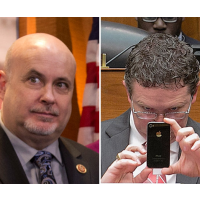
Reps. Mark Pocan
and Thomas Massie
 
An ambitious bipartisan bill that would seriously roll back the federal government’s ability to conduct surveillance operations has been introduced in the U.S. House of Representatives.
HR 1466 (pdf) (the Surveillance State Repeal Act) would do away with the Patriot Act (pdf) and ban large-scale spying programs, such as the National Security Agency’s telephone metadata collection that has generated so much controversy. It is the most far-reaching anti-surveillance legislation drafted to date.

“This isn’t just tinkering around the edges, it’s a meaningful overhaul that makes sure the meaningless surveillance of emails and cell phones are done away with,” Representative Mark Pocan (D-Wisconsin), one of the bill’s authors, told a briefing for congressional staffers, according to ThinkProgress. The coauthor of HR 1466 is Representative Thomas Massie (R-Kentucky).

The bill’s original co-sponsors are Democrats Alan Grayson of Florida, James McGovern of Massachusetts and Lloyd Doggett of Texas. Other supporters include libertarian organizations opposed to widespread government spying.

Patrick Eddington, national security and civil liberties policy analyst for the libertarian think tank CATO Institute, said: “All mass surveillance does is violate the rights and put a chilling effect on the American people.”

The legislation also would eliminate numerous surveillance permissions granted under the Foreign Intelligence Surveillance Act (pdf) amendments approved by Congress during the George W. Bush administration.

The Hill reported that the proposal is “likely to be a nonstarter for leaders in Congress, who have been worried that even much milder reforms to the nation’s spying laws would tragically handicap the nation’s ability to fight terrorists. A similar bill was introduced in 2013 but failed to gain any movement in the House.”

Congress has until June 1 to reauthorize portions of the Patriot Act that support the government’s surveillance operation. Without re-authorization of the law’s Section 215, the telephone metadata program will expire.
-Noel Brinkerhoff
To Learn More:
HR 1466 (Congress.gov) (pdf)
NSA Phone Data Collection Made No Difference to National Security (by Noel Brinkerhoff and Danny Biederman, AllGov)

Sunday, March 8, 2015

A Look at the Folly of a Constitutional Convention

This woman has a solid grip on understanding the dangers in foisting a Constitution convention (Con-Con) on us. She is good.
 

Published on Mar 7, 2015
An informative lecture by Publius Huldah, a lawyer and strict constructionist of the Constitution.


Thursday, March 5, 2015

Rights, Morality and the State - Wendy McElroy


EDITORIAL
Rights, Morality and the State

By Wendy McElroy - March 05, 2015

"Negative rights" have been a defining force in the rise and ongoing health of human freedom. A key reason for the drastic decline in human freedom has been the current popularity of "positive rights," including a popularity within some libertarian circles. The competing theories are mutually exclusive. To understand why requires an appreciation of the role that class distinctions and the universalizability of rights have played in the freedoms so many of us took for granted until they began to vanish.

Negative rights claim that individuals have jurisdiction over their own bodies and property, which no one can properly violate. In turn, individuals have the duty to similarly respect the bodies and property of others. Freedom of speech and conscience are common examples. Positive rights claim that some individuals have an enforceable claim upon the bodies or property of others, upon the actions or goods of others. Health care and education are common examples.

Negative rights are universalizable; an individual, simply by being human, possesses the same claim to right(s) as every other individual, and to the same degree. There is no qualification other than being part of the species; in the most literal sense, negative rights are human ones.

Positive rights cannot be universalized because they establish class distinctions in order to assign positive rights to some that must be provided by others. People are divided into classes according to shared characteristics, such as race or income level. 

Those who share the characteristic for inclusion into a class also share whatever privileges or disadvantages are attached to that class. Simply being human is no longer sufficient to qualify for the same 'rights' enjoyed by everyone else. A secondary characteristic is required; thus, positive rights destroy the basis of human rights by not being applied equally to all. They become 'special' rights.

Negative rights minimize conflict within society because their exercise by one person in no way prevents the equal exercise by another person or penalizes him. If 'A' exercises his freedom of conscience, it does not prevent 'B' from exercising the same right to the same degree. 'A' being a Catholic does not interfere with a 'B's atheism or penalize him. The only way 'B' can be penalized is if 'A' claims a positive right to any act or good from 'B', such as a restriction of free speech on religion or tax-support for the Catholic Church. For reasons of his own, 'B' may decide to speak discreetly or donate to the church. But the only way to create a positive legal obligation between the two is through a contract or another vehicle that expresses the consent. It is a win-win situation that promotes cooperation.

Positive rights embed conflict into society through class distinctions. If a class of people has an enforceable claim on the services and goods of others in society, then the 'others' are forced to provide them at their own cost and to their own impoverishment. 

If the positive right is health care for those with low incomes, for example, a doctor cannot legally decline a patient and the medical service must be 'free'; that is, the service will not be paid for by the recipient but by others, usually through a form of tax. The doctor and taxpayer no longer have a full claim on the peaceful use of their own bodies and property but are required to share the claim with anyone who holds the positive right to health care. This creates a lose-win situation by which some benefit by controlling others.

Negative rights – that is, human rights – expand only when positive rights – that is, special rights – crumble. Consider the universal human right of a person to own the property created by his own hands and with his own material. First, the person must be able to own property, such as land. In the past, states or kings restricted land ownership to classes such as nobles or the clergy. When class 'rights' began to crumble over the centuries, the right of land ownership opened up to other categories such as white males, all males, women. The closer a society came to making a right universal to all humans and not merely members of a group, the freer and more prosperous that society became.

Today, political correctness is destroying human rights by replacing them with positive rights that are created through class distinctions. Political correctness seeks social justice by forcibly redistributing the power, wealth and opportunities from those who are seen to be privileged (white males, the wealthy) to those who are not (minorities, women, the poor). More accurately, it seeks special privileges at the expense of human rights.

The forced redistribution is achieved through a partnership between two mutually-supportive types of class-privilege holders: those who claim a static class privilege; and, those who acquire a dynamic one. A static class privilege comes by virtue of birth or some other unchanging situation: race, genitalia, bloodline. A dynamic class privilege comes from joining an institution such as the American Federation of Teachers or the government. Both types claim special 'rights' under law. They reach out in tandem to acquire these special 'rights' by snatching them from individuals who are at the bottom of the class hierarchy and so unprivileged. With each privilege claimed, human rights are more narrowly defined.

Ironically, the politically-correct claim to be expanding human rights. Cynically, the institutions that support PC goals use terms like "equality" to justify the imposition of a class system.

Political correctness has been wildly successful because it wore a mask of benevolence. It appealed to the best moral sentiments within man: compassion, justice, goodwill. But that's what these responses are – moral sentiments, as Adam Smith would call them. What PC beneficiaries have actually done is to collapse the absolutely necessary wall between politics and morality, between what one has the duty to do and what one should do.

Smith maintained that a non-aggressive person deserved no praise because he merely fulfilled his social duty to respect individual rights; enforcement of this duty was the bailiwick of law and politics. To Smith, the praiseworthy man was one who actively aided others through acts of generosity, empathy, respect and the like; these acts were the bailiwick of morality. Both categories of action were essential to society and they had the mutually supportive effect of creating cooperation and prosperity. But using the law to impose morality only made enemies of the two categories with people's acts and goods being compelled rather than respected. Indeed, a legally imposed morality is not morality at all, but its death knell, because such acts must be voluntary.

Political correctness is the exact opposite of what is purports to be. It does not establish human rights; it destroys them. It does not express morality; it converts morality into a mockery of itself. Universal negative rights are human rights. Maintaining a wall between rights and morality is the only way either can be expressed. Collapsing that wall destroys both.

Source thedailybell

Friday, February 27, 2015

The Feds Are Terrified

Napolitano: The NSA vs. the Fourth Amendment

What if the Government Fears Freedom?

What if the current massive spying on Americans began with an innocent secret executive order signed by President Reagan in 1986? What if Reagan contemplated that he was only authorizing American spies to spy on foreign spies unlawfully present in the U.S.?

What if Reagan knew and respected the history of the Fourth Amendment? What if the essence of that history is the colonial revulsion at the British use of general warrants? What if general warrants were issued by a secret court in London and authorized British agents in America to search wherever they wished and to seize whatever they found? What if the revulsion at this British government practice was so overwhelming that it led to the Revolutionary War against the king?

What if the whole purpose of the Fourth Amendment was to outlaw general warrants? What if the Fourth Amendment specifically guarantees the right to privacy to all in America in their persons, houses, papers and effects?

What if, in order to emphasize its condemnation of general warrants, the Fourth Amendment requires the government to obtain a warrant from a judge before invading the persons, houses, papers or effects of anyone and lays down the preconditions for the issuance of such warrants? What if those preconditions are individualized suspicion and articulated evidence of crime — called probable cause — about the specific person whose privacy the government seeks to invade?

What if these principles of constitutional fidelity, privacy and probable cause and the unlawfulness of general warrants have been regarded universally and publicly as quintessentially American values, values that set this nation apart from all others?

What if the administration of President George W. Bush was so embarrassed that 9/11 happened on its watch that it fought a useless public war in Iraq — which had nothing to do with 9/11 — and a pernicious private war against American values by unleashing American spies on innocent Americans as to whom there was no individualized probable cause so that it could create the impression it was doing something to keep America safe from another 9/11-like attack?

What if the Bush folks took Reagan’s idea of spying on foreign spies and twisted it so that they could spy on not just foreign spies, but also on foreign persons? What if they took that and leapt to spying on Americans who communicated with foreign persons?

What if they then concluded that it was easier to spy on all Americans rather than just those who communicated with foreign persons? What if they claimed in secret that all this was authorized by Reagan’s executive order and two federal statutes, their unique interpretations of which they refused to discuss in public? What if the Reagan order and the statutes authorized no such thing?

What if The New York Times caught the Bush administration in its massive violation of the Fourth Amendment, whereby it was spying on all Americans all the time without any warrants? What if the Times sat on that knowledge during, throughout and beyond the presidential election campaign of 2004? What if, when the Times revealed all this, the Bush administration agreed to stop spying? What if it didn’t stop?

What if President Obama came up with a scheme to make the spying appear legal? What if that scheme involved using secret judges in secret courts to issue general warrants? What if the Obama administration swore those judges to secrecy? What if it swore to secrecy all in the government who are involved in undermining basic American values? What if it forgot that everyone in government also swears an oath to uphold the Constitution? What if Edward Snowden violated his oath to secrecy in order to uphold his oath to the Constitution, which includes the Fourth Amendment, and spilled the beans on the government?

What if all this spying by the feds has spawned spying by the locals? What if more than 50 local police departments now have received false cell towers from the FBI, but have sworn not to tell anyone about them? What if these towers trick cellphone signals into exposing the content of cellphone conversations to the police? What if the police have done this without the knowledge of the elected representatives who are their bosses? What if they do this without any warrants? What if the Supreme Court last year outlawed police invading cellphones without warrants?

What if both Bush and Obama have argued that their first job is to keep America safe, and they will twist, torture the plain meaning of and even break laws in order to accomplish that job? What if the presidential oath is to enforce all laws faithfully, including ones the president may hate?

What if Bush and Obama have been wrong about the priority of their constitutional duties as president? What if the president’s first job is to preserve the Constitution? What if that includes the Fourth Amendment? What if the president keeps us safe but unfree?

What if invading our freedoms keeps us less safe? What if the president has failed to keep our freedoms safe? What if the government doesn’t like freedoms? What if the government is afraid we will exercise them?

Reprinted with the author’s permission.
Andrew P. Napolitano [send him mail], a former judge of the Superior Court of New Jersey, is the senior judicial analyst at Fox News Channel. Judge Napolitano has written nine books on the U.S. Constitution. The most recent is Suicide Pact: The Radical Expansion of Presidential Powers and the Lethal Threat to American Liberty. To find out more about Judge Napolitano and to read features by other Creators Syndicate writers and cartoonists, visit creators.com.

source lewrockwell

Thursday, February 26, 2015

A Warning to Libertarians: Please Do Not End Up Like Ross Ulbricht

Monday, February 23, 2015


By Robert Wenzel

The trial of Ross Ulbricht, admitted founder of Silk Road, is over. He has been convicted on all the charges brought by the government. It is a terrible tragedy.

An anonymous commenter to the post, where the Ulbricht family expressed shock at how unfair the trial was, explained best what happens when the government has you in their crosshairs;

Having been through a federal criminal trial myself, this description sounds like standard operating procedure. While I feel badly for the mother, she does express an astonishing naivete of the system and process. A federal trial is not designed to find out the truth, or to have a discussion about the law. It is designed to get a perfunctory rubber stamp from the jury on an outcome that has already been decided.

And the appeal process is designed to rubber stamp what was determined in the district court. I hope for her sake she does not put much hope in the appeal. It's highly unlikely to be reversed.
Ubricht faces somewhere between 20 years to a life sentence. To be sure, from a libertarian perspective, there does not appear to be much that Ulbricht is guilty of. He simply provided a market for individuals willing to exchange, certainly not a violation of the libertarian non-aggression principle. (The government was allowed by the judge to bring up supposed murder-for-hire plots by Ulbricht, but never charged Ulbricht with the plots. Sounds sketchy to me.) BUT, despite the libertarian perspective, he is going to spend a a very, very long time in prison.

This is part of the reason, I find it remarkable that some libertarians are cheering on further efforts in the murky dark internet. Coin Report notes (my bold):

[I]n March of 2014, GRAMS was created.

GRAMS is the Google of the darknet. It is a cross-marketplace search engine hosted on TOR that aggregates listings from major DNMs and lists them in an easy to read, Google-like fashion. Filters sort listings by country, market, price range, and quantity. GRAMS search algorithms are constantly being updated to include more DNMs and listings. This has allowed the casual observer to discover the darknet without the hassle of creating multiple accounts. GRAMS has become so successful that it recently started selling sponsored listings, similar to Google AdSense.

Since the original Silk Road was shut down, the DNM landscape has changed dramatically. It has become more de-centralized. Yet, thanks to sites like GRAMS and the Subreddit r/darknetmarkets, it is still accessible to many people.

The Ross Ulbricht trial marks a turning point for the darknet. Originally created to combat a problem, DNMs have now become a rallying point for the adherents of Libertarian ideology. Ulbricht himself described the Silk Road as an “economic experiment.” Many see him as a martyr and have supported him through it all, from patronizing the Silk Road via contraband purchases to donating over $339,000 via Bitcoin toward his legal defense fund. His downfall was an inspiration to push further, to continue the economic experiment, for the betterment of humanity (hopefully).
A few points need to be made here. First, Silk Road 2.0 has been shut down. It was infiltrated by the government from the start. There are claims that  there are new bitcoin mixing technologies that make bitcoins completely anonymous in use. But how can we know that it is not the government that has set up these mixing exchanges, or infiltrated them after they have been set up? And keep in mind, the buying and selling of drugs on the dark net still requires physical delivery. How do we know the government isn't capturing the physical addresses where the drugs are delivered? How can we know that the government isn't running a major sting to catch sellers?

As long as a commodity needs physical delivery, there is no protection from the government, even if it is done via the dark net--and that supposes the government isn't watching on the dark net in the first place, before physical delivery.

There are just so many things that can go wrong operating in the dark net, with very heavy downside, it makes no sense for a libertarian, qua libertarian, to get involved, especially by running such an operation.

Just becasue libertarians are in favor of free exchange, where does it say they have to run  underground markets?

As Murray Rothbard put it, when discussing libertarian/agorist theory and the underground promoted by Samuel Konkin (my bold):

If the black market should develop, then the successful entrepreneurs are not going to be agoric theoreticians...but successful entrepreneurs period. What do they need with Konkin and his group?  I suggest, nothing at all.  There is a hint in the NLM that libertarians would a priori make better entrepreneurs than anyone else because they are more trustworthy and more rational, but this piece of nonsense was exploded by hard experience a long time ago.   Neither do the budding black marketeers need Mr. Konkin and his colleagues to cheer them on and free them of guilt.  Again, experience has shown that they do fine on their own, and that urging them on to black market activities is like exhorting ducks to swim...

As much as I love the market, I refuse to believe that when I engage in a regular market transaction (e.g., buying a sandwich) or a black market activity (e.g., driving at 60 miles per hour) I advance one iota nearer the libertarian revolution.  The black market is not going to be the path to liberty, and libertarian theoreticians and activists have no function in that market...

Historically, classical liberal political parties have accomplished far more for human liberty than any black markets. 
In other words, if you want to advance liberty, it makes little sense to be operating a black market web site just as it makes little sense to be selling drugs from a street corner to advance liberty. And from a practical perspective, if the government snares you while running a black market site, you are going to pay dearly.

Advancing liberty is not about selling hooch or weed, though there is no reason to condemn those who enter into these noble professions. If you want to advance liberty, you do so by writing, speaking and reading about liberty. This requires that very little be done beyond libertarian study and actual libertarian activities, even at the early stages of developing such a career. Roy Childs, a powerful libertarian speaker, who made an impact with short essays and book reviews. was a janitor before he was recognized and found work as libertarian.

As much as I disagree with a lot of Stefan Molyneux's commentary, you have to give the man credit for launching his first podcasts by recording them while he was in his car driving to work at his then-day job!

I have often thought that the ideal job for an aspiring young libertarian theoretician or essayist is as a grave yard shift security guard . Get a job at the front desk of a building on the overnight shift, where few are going to bother you--and you can read and read and read. Absorb all you can about libertariansim, and, when you are ready, start writing, creating videos or whatever.

Leave the drug dealing to drug dealers, There's this thing called the division of labor and there is no path where drug dealers and libertarians have to pass, anymore than libertarians have to cross paths with fire eaters and sword swallowers, though I doubt many fire eaters and sword swallowers are paying much in terms of taxes, something that libertarians can appreciate, as much as they can appreciate the efforts of drug dealers, without getting into the business.  .

Indeed, just because street hookers must operate on the black market doesn't mean we should be encouraging libertarian women to become hookers, even if they would only accept bitcoins.

 Robert Wenzel is Editor & Publisher at EconomicPolicyJournal.com and at Target Liberty. He is also author of The Fed Flunks: My Speech at the New York Federal Reserve Bank. Follow him on twitter:@wenzeleconomics

via targetliberty

Tuesday, February 10, 2015

The Morality of Capitalism: Liberty, Honesty and Humility


By Richard Ebeling - February 10, 2015

In American culture there is one persistent villain portrayed as the enemy of humanity, the perpetrator of deception, and the agent for social corruption and human harm: the businessman.

Whether in news commentaries or on the movie screen, the businessman is presented as a heartless, greedy manipulator so concerned with squeezing the last possible dollar out of anything he does, that he is willing to destroy the planet, kill his competitors, poison little children, and sell his own mother "down the river" if it will serve his material and financial purposes.

The only thing that saves us from the end of the world at the hands of these criminal private enterprisers is either some righteous individual who refuses to "take it any more" or the virtuous hand of a government agent dedicated to protecting mankind from those who, clearly, care nothing for the common good of humanity.

Critics of Capitalism Want to Abolish or Regulate It

This imagery of the businessman's way of gaining profits has been extended by many intellectuals, academics, and public policy pundits into a general criticism and, indeed, condemnation of capitalism.

What can be praiseworthy, ethical or just in a social and economic system that fosters people to focus only on their self-centered personal interest in the pursuit of material gain with little or no thought to the betterment and improvement of mankind?

The conclusion that many of these critics have reached over the years and decades is that the entire capitalist system must be done away with and replaced with an alternative social and economic system such as socialism; or, at a minimum, business enterprise has to be placed under the detailed supervision and regulatory hand of government bureaucrats presumed to be concerned with and devoted to the general welfare of the country as a whole instead of individual private interest.

I beg to differ from this interpretation of businessmen and the free enterprise system in general. Instead, I would argue that a truly free enterprise, competitive capitalism is the most moral and humanely beneficial way for people to live together that has ever been stumbled upon by mankind.

Capitalism's Premise: Individual Rights and Liberty

There are basically two way human beings can interact and associate with each other: through the threat or use of force or by mutual agreement and voluntary consent.

When have you ever walked into a shoe store looked around and, maybe, tried on a pair of shoes, but when you decided to leave without buying anything a gruff and intimidating character with a club or a gun said, "The boss says you ain't leaving without buying something"? I doubt it any of us have had any such experience.

Why? Because the philosophical and moral premise underlying transactions in the marketplace is that each participant has the right to say, "Yes" or "No" to an offer and an exchange.

Why does every person have this implied right to "Yes" or "No" without attempted physical intimidation or use of force to make him act against his will? This is due to the fact that the foundational American principle is that every one of us has an inviolable individual right to their life, liberty, and honestly acquired property.

Virtually every other philosophical and political system throughout human history has been based on some version of the opposite. That is, that you do not own yourself; your life and property are at the disposal of the primitive tribe or the medieval king, or the social, national, or racial group or "democratic" community to which you've been designated as belonging.

That is the premise of all forms of political and economic collectivism. You work for the group, you obey the group, and you live and die for the group. The political authority claiming to speak and act for the group presumes to have the right to compel your acquiescence and obedience to the asserted needs and desires of that collective group.

Only liberal, free market capitalism as it developed in parts of the Western world, and especially in the United States, broke free of this age-old collectivist conception of the relationship between the individual and others in society.

The modern ideas of individual liberty and free enterprise that began to develop and be argued for about 350 years ago transformed the way men lived and earned a living, and the ethical premises underlying human association in society.

A new morality emerged under which human relationships became based on mutual consent and voluntary agreement. Men could attempt to persuade each other to associate and trade, but they could not be compelled and plundered so one person could get what he wanted from another without their consent.

For Americans, it is heralded as the fundamental principle under which our country was based: It is held to be a self-evident truth that all men are created equal and endowed with certain unalienable rights among which are their individual rights to life, liberty and the pursuit of happiness.

Capitalism Fosters Honesty and Good Manners

As a consequence of this principle of liberty, in the marketplace of the free society individuals learn and practice the etiquette and manners of respect, politeness, honesty and tolerance. This naturally follows from the fact that if violence is ethically and legally abolished, or at least minimized, in all human relationships, then the only way any of us can get others to do things we would like them to do for us is through reason, argument, and persuasion.

The reason why the shoe salesman is motivated to act with courtesy and deference toward us when we are in his store is precisely because he cannot force on us to buy a pair of the shoes he wants to sell. We can walk down the mall corridor and buy those shoes from another seller interested in winning our business, or we can just go home without buying anything that day.

The clichés of "serve with a smile," or "the customer is always right," in fact are inescapable resulting manifestations of the voluntarist principle at the basis of all market transactions.

No businessman is likely to keep his market share or even stay in business in the long run if he earns a reputation for rudeness, deception and dishonesty in his dealings with either other businesses or his consumer customers.

The famous Scottish economist of the 18th century, Adam Smith, long ago explained that the motivation for respectful, polite, honest and deferential behavior on the part of any businessman is his own self-interest. If he doe not, he may not long remain in business, as every private enterpriser knows who had learned to appreciate the importance of gaining and maintaining his brand-name and personal reputation in the eyes of all those with whom he has dealings.

Such polite, courteous, honest and deferential behavior may start out as the self-interested conscious and intentional attempt to merely succeed in the market pursuit of profits, when voluntary and free market dealings and transactions become the common and everyday way in which people associate.

But, over time, such rules of "good behavior" become habituated, a part of the routine of regular day-in and day-out interactions, until, finally, they are transformed into the customs and traditions expected in any and all human encounters, whether in the marketplace or not.

Thus, the practice of self-interested good manners and respectful tolerance fostered first in commercial buying and selling become embedded and reinforced as the general societal rules and ways of civilized and "polite society." And, thus, capitalist conduct makes its contribution to a more cultured and humane civilization.

Capitalism Creates a Spirit of Humility, Not Political Arrogance

Monday, February 9, 2015

NM Sheriff Stands Against IRS & Federal Marshals - Cancels Land Sale

It’s good news and its happening now  – County sheriffs throughout the land are beginning to stir by standing up against the IRS and the corporations for the Constitutional rights of their citizens - - let’s appreciate them as they do their duty and apply the Rule of Law.

Let’s get behind our deputy sheriffs all over. While you’re at it ask your state government politicians why they haven’t reclaimed your sovereign state lands from the federal government. It’s yours, why let the fedgov & corporations live off it?
~~~~~~~~~~~~~~~~~~~~~~~~~~~~~~~~~~~~~~~~~~~

Tim Brown , 02.09.2015

Constitutional Sheriffs are becoming more vocal and demonstrating why they are a valuable asset to freedom and their communities. The latest sheriff to take a constitutional stand is Eddy County, New Mexico's Scott London, the first sheriff in twenty-five to stand up to the IRS against a tyrannical attempt to sell a citizen in his county's land without due process.

Priscilla Jones provides the background information for the sheriff's actions:

Approximately ten days before Christmas, U.S. Marshals broke in the door of Carter's rental property with their guns drawn. The tenant was a young mother with a new baby—home alone while her husband was at work. Sheriff London was called to the property to intervene. He advised the Marshals that Carter's case was in appeal and he deserved due process. They threatened to arrest London, but he stood his ground and they backed off....

The Taxation & Revenue Department ordered Carter to cease "engaging in business in New Mexico" until his arbitrary tax debt was paid. Carter appealed this injunction on the grounds that it was both unconstitutional and vague, as it deprived him of his right to make a living and also prohibited him from, "carrying on or causing to be carried on any activity with the purpose of direct or indirect benefit."

Kent Carter's property was in the sights of the corrupt Internal Revenue Service and the Department of the Treasury has slated a sale of the properties in question for the 19th of February. When Sheriff London found out about it, he issued the following certified letter on February 4. 

Sheriff London cites Section 18 of the New Mexico Constitution and the Fifth Amendment of the US Constitution as the basis for his stand against the federal tyrants.

"Thus I am notifying you that under compulsion to my oath to the Constitution of the United States of America and the Constitution of the State of New Mexico, I shall not allow the sales of these three properties on 19 February 2015," he wrote.

Sheriff Mack, founder of the Constitutional Sheriffs and Peace Officers Association praised London's actions.

"Many officers have stood up over the years for the rights of citizens being victimized by the federal government," Mack said. "But Sheriff London is the first one to stand up to the IRS since the early 1990s." Mack said, "His actions show courage and humility. London is setting a good example for the rest of our sheriffs."

KrisAnne Hall documents why sheriffs like London are so important to the people in her excellent article on what is taking place in New Mexico.

"Short of physical resistance, due process and community oversight (a jury of your peers) was intended to be some of the greatest protections against government threat against property," Hall wrote.  "So important was to be the protection of due process, that it is placed multiple times in our Bill of Rights."

"For example, the 5th Amendment in the Bill of Rights declares that '…nor shall be deprived of life, liberty, or property without due process of law;'  The 7th Amendment also declares, 'In suits at common law, where the value in controversy shall exceed twenty dollars, the right to trial by jury, shall be preserved…'" she adds. 

"Both of those Amendments express the due process protections guaranteed to the people.  Sheriff London accurately states in his letter to the IRS that Mr. Carter has NOT exhausted his right to due process.  Yet, the IRS under the auspices of Judge Brack and the US District court, are attempting to deprive Mr. Carter of his property with full knowledge that Mr. Carter's right to due process is still engaged."

Currently, 100% of the Carter's Social Security benefits have been seized every month by the IRS. Under the law, Carter claims that the IRS can take no more than 15% of his Social Security benefits, but they've not only taken 100% of them, they've even deprived him of $2800.00 via his bank account.

Carter said the IRS is "worse than the mafia" and called them a "lie."

"Why should they be able to take anything?" he asked.

One court document, according to Jones indicates that Carter owed $145,000, which Carter maintains has no basis and was "pulled out of thin air" by an assessing agent. However, now the IRS claims that he owes upwards of $890,000! Carter says that number "doubled with the stroke of a pen."

"The IRS fabricates evidence against citizens by pulling numbers out of a hat and adding fees," said Sheriff Mack. "They wear people down emotionally and financially until they can't take it anymore. No citizen should ever have to fight the IRS for decades in order to keep his land."

Ms. Hall also provided updated information on Carter's motion. She wrote on February 7:

I have spoken to Kent Carter.  He filed a Motion to Stay the judges decision and was DENIED with NO explanation.  If I were to make a professional guess as to why the court denied it, it would be because he filed the Motion outside the "allowed" time frame.  That is no excuse for the court to not make that explanation, but there you have it.  I also spoke to Sheriff London. 

He received a call yesterday from the acting Under Secretary of the Department of Treasury, Matthew Rutherford.  Mr. Rutherford claims this case has been decided by the appellate court already in favor of the IRS.  If he is correct that is a record pace decision.  
Sheriff London told Mr. Rutherford that he had better present proof of that before he will ever consider allowing the sales to take place.  Apparently Mr. Rutherford was not at all happy about that.  This could get very interesting!

Perhaps it is not only Sheriff London that needs to take a physical stand at the properties of Mr. Carter, but also the people of New Mexico, just as Americans did for Cliven Bundy and his ranch.

As our forefather Benjamin Franklin once wisely said, "We must all hang together, or assuredly we shall all hang separately."

Sunday, February 1, 2015

Republican Scott Walker is More of the Same: Pro-War, Neoconservative, Corporatist...anti-American

It should come as no jolt that Walker swings with the neoconservative and Zionist wing of the Republican Party. Any candidate who's never had his own boots on the ground as a veteran has little hesitation to send others off to die for himself. No, Gov. Walker is not of the Americanist cloth. 
Gov. Scott Walker says he has the utmost gratitude and respect for the women and men who wear the uniform in service of our country. However, the governor's record on issues that affect veterans tells a different story.

~~~~~~~~~~~~~~~~~~~~~~~~~~
Scott Walker seeks to deflate the GOP’s libertarian streak

posted at 3:31 pm on February 1, 2015 by Noah Rothman

One of the major takeaways from the Des Moines Register poll of the GOP primary electorate that found Wisconsin Gov. Scott Walker surging ahead of the pack in the Hawkeye State is his apparent appeal to both the Republican Party’s conservative and moderate wings.

“A majority think he’s got the right balance between conservative and moderate,” said Ann Selzer, president of the respected firm that conducted this poll.

“Caucus-goers deciding on the basis of a candidate’s values put him in second place, and he’s in first place with those who say electability is more important.”

It is a safe bet to assume that any candidate who can appeal to both of these elements of the GOP coalition is on track to win the party’s nomination. In the process of appealing to these groups, however, Walker is alienating the GOP’s rising libertarian wing.

On both the foreign affairs front and in regard to domestic policy, Walker is far from the ideal candidate to capture the support of younger voter who does not identify as Republican but is nevertheless increasingly suspicious of the government’s ability to effect positive change at home and abroad.

In an appearance on ABC’s This Week on Sunday, Walker, buoyed by his performance in the latest DMR poll, adopted a hawkish position on ISIS that even many of the GOP’s stalwart interventionists are hesitant to adopt: A willingness to use American combat troops to destroy the Islamic State in Iraq and Syria.

“I think we need to have an aggressive strategy anywhere around the world,” Walker said. “I think anywhere and everywhere, we have to go beyond just aggressive air strikes,” said Walker. “We have to look at other surgical methods. And ultimately we have to be prepared to put boots on the ground if that’s what it takes.”
“Boots on the ground in Syria? U.S. boots on the ground in Syria?”
“No, I don’t think that is an immediate plan, but I think anywhere in the world–”
“But you wouldn’t rule it out?”
“I wouldn’t rule anything out. I think when you have the lives of Americans at stake and our freedom loving allies anywhere in the world, we have to be prepared to do things that don’t allow those measures, those attacks, those abuses to come to our shores,” said Walker.
Not ruling “anything out” when it comes to combat troops in Iraq and Syria is expressly ruling that option in. America’s indigenous partners on the ground in Iraq are either too weak (the Iraqi Security Forces) or underequipped and ill-trained (the Kurdish Peshmerga) to be relied upon to liberate the massive, ethnically diverse portions of Iraq currently suffering under ISIS occupation.

In Syria, the “moderate rebels” who the administration would deploy against ISIS but would also decline to attack Bashar al-Assad’s forces do not exist. The vetting and training of relatively pro-Western rebel groups is a process that will stretch well into a prospective Walker presidency, and he has now signaled that he would likely abandon that convoluted course entirely.

The prospect of sending American troops back to Iraq and into an entirely new theater of operations in Syria will not only make Democrats in the United States nervous but will turn off the GOP’s ascendant libertarian faction.

On the domestic policy front, too, Walker has embraced some approaches that make those who are most concerned about government overreach apprehensive. Some on the right have come to suspect that Walker’s commitment to shrinking local government might not extend well beyond curtailing the power of public sector unions to influence policy.

In November, Walker backed a proposal to impose blanket drug testing on welfare beneficiaries in the Badger State – a proposal that sounded at the time to be almost certainly unconstitutional. Several court rulings have set the precedent that holds that “suspicionless” drug tests cannot be imposed on state residents merely because they intend to take advantage of existing government programs.

What’s more, as Reason’s Nick Gillespie observed, a program of mandatory drug testing is generally ineffective and a waste of tax dollars.
If a recent program in Missouri is any indication, Wisconsin will be collecting urine by the bucketful to catch very few bad actors (and that assumes smoking dope, say, should be a reason to pull somebody’s benefits). Last year, Missouri started testing suspected drug users (note: suspected, meaning there was at least some hypothetical reason to think a person was using drugs). The state ended up spending $500,000 to test 636 people, of which 20 were found to be using. So around 3 percent of suspects tested positive and each test cost around $786. Before courts ruled Florida’s drug-testing regime illegal, the Sunshine State spent $115,000 on piss tests and ended up coughing up $600,000 in reimbursements to applicants who had been denied benefits.
In Walker’s most recent State of the State address, he expanded on the details of his plan to drug test welfare recipients but failed, as the Milwaukee Journal-Sentinel reported, to outline how that program would be funded.
[T]he governor offered no details on how the state would cover the costs of that or the testing or whether he expected it to cost the state money overall, as a similar program did in Florida, or save tax dollars. The budget, he said in a statement, would also drop to four years from five the limit on how long a recipient could be in the Wisconsin Works, or W-2, program, the replacement in this state for traditional welfare.

Opponents like Shilling say that no state tests for drugs in the successor to the food stamps program known in Wisconsin as FoodShare. They say if implemented over potential federal objections, the proposal could cost Wisconsin employers a credit on their federal taxes as well as cause a loss in federal money for FoodShare.
Republicans who contend that Walker’s plan on this front is not designed to appeal to fiscal but social conservatives have a lot of ammunition available to them in order to support that claim. The only group of Republicans who can be expected to enthusiastically back this legally and financially dubious proposal are just the kind of Republicans who deliver caucus victories to GOP candidates in states like Iowa.

None of this is to say that Walker’s viability as a presidential candidate is in any way diminished. His formidability has been demonstrated in his three statewide victories in only four years, and in a purple state, no less. Many will agree with Walker’s policy preferences on both of these issues, but they do create a space for libertarian figure to oppose both him and the direction that he would take the party he seeks to lead. Enter Sen. Rand Paul…
via hotair.com

Wednesday, January 28, 2015

Know Your Enemy: How Federal Programs are Carried Out

There are two main ways that most major federal programs are put into effect. Understanding this will help determine the best way to stop them.

PROCESS 1

Some new way to violate your rights comes on the scene. The feds start giving the tools to effectuate this idea – either through grant money to buy specific things, or giveaways of specific equipment – to the states. The states start using them – widely. Eventually, the feds tap into the program, essentially making it a national program.  
This is done via “information sharing” that was expanded after 9-11, or Memoranda of understanding (MOUs), which are essentially partnerships with state funds attached to them. These agreements are not necessarily legally binding, but usually offer some privacy between state, private enterprises (contractors), and federal partnerships. Much of this kind of information usually remains hidden from the general public.

Examples: Parallel Construction, using NSA data without warrant in regular criminal investigations on a state and local level. Pentagon’s 1033 program of giving military equipment to local police, turning them into an army. This equipment is often used to help in Process 2 – direct enforcement.  Drones, where the DHS is giving mass amounts of grant money to the states to put surveillance systems in the sky. Automated License Plate Readers (ALPRs),  where the Wall Street Journal broke the story that the DEA has been working with local law enforcement to track people through their license plates for over 7 years. The ACLU obtained numerous documents revealing how local and state agencies build license plate reader systems using federal grant money. In other words, they buy the local agencies the equipment, which in essence makes a national system for the feds to tap in to.

PROCESS 2

The feds pass a new law or program violating your rights.  The states handle either handle the front-line enforcement, or they provide significant resources to the operation of the program. This is pretty straightforward, the local agencies are, again, doing the bulk of the heavy lifting.

Examples: The EPA has just over 200 enforcement agents for the entire country. Most enforcement is done by state agencies. Federal drug prohibition is primarily effectuated by state prohibition, and the same goes for federal gun control.  In other areas, states operate critical infrastructure for the feds, such as exchanges or medicaid expansion for the Affordable Care Act – or water and power NSA spying facilities.

WHAT THIS TEACHES US

The fact of the matter is this – the feds simply don’t have the manpower or resources to do what they’ve been doing. It’s the states that have been doing most of it for them.

Understanding this – the #1 most effective way to stop federal programs is to simply withdraw participation or support for them on a state level.

This is exactly what Hans-Hermann Hoppe recommended in his speech What Must Be done.  In it, he said:

“Without local enforcement, by compliant local authorities, the will of the central government is not much more than hot air.”

This mirrors the advice of James Madison in Federalist #46, which prominently recommended, among other things, a “refusal to cooperate with officers of the Union.”

The short message is this: Refuse to comply, Nullify!

I discussed this in more detail, along with some current applications of it in the states, on the Tom Woods show today.

Thursday, January 15, 2015

"Jury Nullification" And Why It Matters In The Silk Road Trial

It worked during slave times. Can it also save Ross Ulbricht from going to jail? 

If you happen to be lurking around the Manhattan courthouse where Ross Ulbricht’s trial began on Tuesday, you may notice one of about a dozen signs urging you to Google something called “jury nullification.”
 Ads near the courthouse where the Silk Road trial is taking place aimed at informing people about jury nullification.

Walk a little further, and you may just encounter activists handing out jury nullification leaflets. But if you ask them to explain what it is, they may refuse—because doing so could land them in jail.

Jury nullification is one of the oldest legal concepts in the world. It means that jury members have the right to find a defendant innocent, even if they believe he’s guilty of the crime with which he’s charged. They would do so, theoretically, if they believed the crime shouldn’t actually be labeled a crime. Some of the most famous examples came in the mid-1800s, when Northern abolitionists, sitting on juries, refused to convict slaves for fleeing their masters under the Fugitive Slave Act.

More recently, a jury in New Hampshire acquitted a man in 2012 who openly admitted that he was growing marijuana in his backyard. “He grows for his own personal religious and medicinal use,” one of the jurors said after the case. “[A]fter chewing on all of the possibilities…we all decided that the only fair thing to do was to vote with our consciences and acquit the defendant of all charges.”

Jury nullification has become a popular tactic among activists, academics and lawyers as the government’s $51 billion-per-year drug war has heated up. Many of these people believe it’s crazy that a person can get thrown in the slammer for 10 or 20 years simply for using or selling drugs.

Some of these same people believe that Ulbricht, who is accused of being the mastermind behind the drug site Silk Road, should be set free regardless of his guilt—because simply operating a website shouldn’t land you in prison. Nicholas J. Sarwark, chair of the Libertarian National Committee, the official group that manages the United States Libertarian Party, called on Tuesday for outright dismissal of the charges against Ulbricht, saying that trial “grossly oversteps the bounds of a properly limited government.”

This week, I spoke with James Babb, the activist who raised the money for the jury nullification ads—and who is personally handing out leaflets at the New York City courthouse. “I’m reminding people that you’ve got a conscience—use it, don’t just rubber-stamp the prosecution,” he says.

Babb won’t explicitly say he’s there for the Silk Road trial. He’s cagey because jury nullification activists have a history of being sent to jail for jury tampering. Perhaps the most famous case came in 2011, when an 80-year-old retired chemistry professor named Julien Heicklin was jailed for standing outside a Manhattan court where he distributed jury nullification pamphlets.
Julien Heicklin, a retired chemistry professor, handing out leaflets.
YouTube

Heicklin, whom Babb calls his personal hero, was eventually acquitted, with the judge remarking that it’s only jury tampering if someone tries “to influence a juror’s decision through a written communication ‘made in relation to a specific case pending before that juror.'”

To make sure that no jury nullification activists breaks jury tampering laws, the Fully Informed Jury Association has recently put out several guidelines. They include:
  • Stick to the public sidewalk in front of the courthouse.
  • Offer literature to everyone without regard to who they are and do not try to single out jurors in any way.
  • Go the extra mile to be friendly and courteous, and to avoid being perceived as belligerent, profane, harassing or a nuisance.
Anticipation has built for months around the Silk Road trial. Earlier this week, I wrote about the prosecution’s task of connecting Ross Ulbricht, a real person, with the anonymous online persona “Dread Pirate Roberts” that ran Silk Road.

The trial began Tuesday, and right off the bat, there was a surprising twist: The defense now readily admits that Ulbricht founded Silk Road, though they claim he passed off the keys to the site to someone else before it gained popularity.

And jury nullification has already gotten a mention at the Silk Road trial. The prosecution has tried to ban any evidence regarding Ulbricht’s personal political beliefs, saying it would “serve only to invite jury nullification.” The prosecutors are afraid that the jurors would become sympathetic to Ulbricht’s libertarian beliefs and view him merely as an entrepreneur who operated an e-commerce website—not a drug kingpin.

To be clear, the odds of Ulbricht being acquitted because of jury nullification are slim. He has a better chance of walking free if his defense can successfully prove that he wasn’t operating the site when most of the drug deals were going down.

Regardless, jury nullification is what Babb and his cohorts (there are about six of them in total) are fighting for, even if they walk a fine line when talking about it. Right now, they’re allowed to stand on the sidewalk and hand out their pamphlets, but if the Silk Road jurors ever walk up to them, the activists will refuse to speak to them. “Just to be on the safe side, I wouldn’t want to talk to them,” Babb says. “I’d say there’s an 800 number to call.”

Source vocative.com