Search Blog Posts

Showing posts with label War for Southern Independence. Show all posts

Friday, January 23, 2015

The Real Lincoln, from the Testimony of his Contemporaries (1904)

CHAPTER II


Was Lincoln a Christian? 

The real Lincoln : from the testimony of his contemporaries
- - pages 25-29

ALMOST all the Christians of Springfield, his home, opposed him for President. He was an infidel, and when he went to church, he went to mock and came away to mimic. He wrote and talked against religion in the most shocking words. He never denied the charge, publicly urged, that he was an infidel. His wife and closest friends attest all this. He became reticent about his religious views when he entered political life, and thereafter indulged freely in pious phrases in his published documents and passionate expressions of piety began to abound in his speeches; but he never denied or flinched from his religious opinions and never changed them.

As to Lincoln's attitude towards religion. Dr. Holland, in his Abraham Lincoln, says (p. 286) that twenty out of the twenty-three ministers of the different denominations of Christians, and a very large majority of the prominent members of the churches in his home, Springfield, Illinois, opposed him for President. He says (page 241) : . . . . "Men who knew him throughout all his professional and political life" have said "that, so far from being a religious man, or a Christian, the less said about that the better." He says of Lincoln's first recorded religious utterance, used in closing his farewell address to Springfield, that it " was regarded by many as an evidence both of his weakness and of his hypocrisy, .... and was tossed about as a joke — 'old Abe's last.' "

Hapgood's Lincoln (page 291, et seq,) records that the pious words with which the Emancipation Proclamation closes were added at the suggestion of Secretary Chase, and so does Usher (Reminiscences of Lincoln, ikc, p. 91), and so does Rhodes; and Rhodes shows him "an infidel, if not an atheist," and adda, "When Lincohi entered political life he became reticent upon his religious opinions." {History of the United States, Vol. IV., p. 213, et seq.). 


Of his words that savor of religion, Lamon says (Life of Lincoln, page 503) : " If he did not believe in it, the masses of 'the plain people' did, and no one was ever more anxious to do what was of good report among men." Lamon further says (page 497) that after Mr. Lincoln "appreciated .... the violence and extent of the religious prejudices which freedom of discussion from his standpoint would be sure to rouse against him," and "the immense and augmenting power of the churches," .... (page 502), "he indulged freely in indefinite expressions about 'Divine Providence,' 'the justice of God,' the 'favor of the Most High,' in his published documents, but he nowhere ever professed the slightest faith in Jesus as the Son of God and the Savior- of men." (Page 501, et seq.)

" He never told any one that he accepted Jesus as the Christ, or performed one of the acts which necessarily followed upon such a conviction." .... " When he went to church at all, he went to mock, and came away to mimic." (Page 487.) Leland says (Abraham Lincoln, Vol. IL, p. 55, et seq.): . . . "It is certain that after the unpopularity of free-thinkers had forced itself upon his mind, the most fervidly passionate expressions of piety began to abound in his speeches." Lamon tells in detail (Life of Lincoln, p. 157, et seq.) of the writing and the burning of a "little book," written by Lincoln with the purpose to disprove the truth of the Bible and the divinity of Christ, and tells how it was burned without his consent by his friend Hill, lest it should ruin his political career before a Christian people. He says that Hill's son called the book "infamous," and that " the book was burnt, but he never denied or regretted its composition; on the contrary, he made it the subject of free and frequent conversations with his friends at Springfield, and stated with much particularity and precision the origin, arguments, and object of the work.''
 

Rhodes (History of the United States, Vol. IV., p. 213) tells the same story, with confirmation in another place (Vol. ni., p. 368, in note).

Herndon describes the "essay" or "book" as "an argument against Christianity, striving to prove that the Bible was not inspired, 'and therefore not God's revelation, and that Jesus Christ was not the Son of God." Herndon says that Lincoln intended to have the "essay" published, and further quotes one of Lincoln's associates of that day, who says that Lincoln " would come into the clerk's office where I and some young men were writing, .... and would bring a Bible with him; would read a chapter and argue against it."

A letter of Herndon (Lamon's Lincoln, p. 492, et seq,) says of Lincoln's contest with the Rev. Peter Cartwright for Congress in 1848 (page 404) : " In that contest he was accused of being an infidel, if not an atheist; he never denied the charge; would not; 'would die first," because he knew it could be and would be proved." And Lamon further says (page 499): "The following extract from a letter from Mr. Herndon was extensively published throughout the United State about the time of its date, Hemdon'a Lincoln, Vol. III., p. 39, et seq., and 439, et seq., and Lamon's Lincoln, p. 492.

February 18, 1870, and met with no contradiction from any responsible source; 'When Lincoln was a candidate for oiu- Legislature, he was accused of being an infidel; of having said that Jesus Christ was an illegitimate child. He never denied the opinions or flinched from his religious views.' "

On pages 487 to 514 Lamon's Lincoln copies numerous letter from Lin(«ln's intimate associates, one from David Davis,' a Justice of the Supreme Court, and one from Lincoln's wife, that fully confirm the above as to his attitude of hostility to religion. Lamon copies {Life of Lincoln, p. 495) another letter of Hemdon, as follows: " When Mr, Lincoln left this city" — Springfield, Illinois — "for Washington, I know that he had undergone no change in his religious opinions or views." And Lamon gives (page 480) a letter of Nicolay, his senior private secretary throughout his Administration, which states that he perceived no change in Lincoln's attitude toward religion after his entrance on the presidency. The Cosmopolitan, of March, 1901, says that Nicolay probably was closer to the martyred President than any other man; .... that he knew Lincoln as President and as man more intimately than any other man." ....


(29)

Wednesday, December 31, 2014

America's Obscured History of its Police State Roots

12/31/2014

The (Yankee/Marxist) Secret Police

by Al Benson Jr.

The New York Tribune reported, on September 6, 1861, that: "Eight hundred names are now entered on the books of the secret police in New York City, of persons suspected of treason, and many arrests will be made."

"Secret Police" in New York City in 1861? It almost sounds like the trailer for an old movie about how the KGB operated/operates in Moscow. Truly, there is nothing new under the sun. That which has been will be. But it almost seems as if the Lincoln administration was giving us kind of a sneak preview of what was to come. Of course, present day "historians" would not quite see it that way. At least they wouldn't admit to it.

Even modern, politically correct (cultural Marxist) "historians" although they agree with and try to whitewash the great socialist emancipator, are forced to concede that his administration was quite ruthless. Those in Lincoln's cabinet  were willing to go along with Lincoln's Jacobin mindset, and after his death, they were more than willing to exceed it.

Mark Neely Jr., in his book The Fate of Liberty--Abraham Lincoln and Civil Liberties wrote of Secretary of State William Seward in the same vein. When a political prisoner from Kentucky was arrested, a friend of his came to Washington to plead for his release. Neely wrote: "...the Secretary of State readily admitted that no charges were on file against the prisoner. When asked whether he intended to keep citizens imprisoned against whom no charges had been made, Seward apparently answered: 'I don't care a d--n whether they are guilty or innocent. I saved Maryland by similar arrests, and so I mean to hold Kentucky'." In other words, to "preserve" the Union you destroy all of its supposed constitutional guarantees of protection against intrusive government.  It almost reminds one of a mad doctor trying to kill his patient in order to save his life. "The operation was a smashing success--the patient died!"

Fascinating story of how Lewis Thornton Powell, CSA paid Steward his due.

The willingness to kill something in order to "save" it is quite consistent with the Yankee/Marxist mindset.  Even their own records bear this out. Neely stated that: "Just after the Civil War  The American Annual Cyclopedia and Register of Important Events of the Year 1865 stated that the total number of military arrests in the North had been thirty-eight thousand." Neely's book even had s small section on torture employed by the North, (pages 109-112). So for you who think that the American government's torturing of prisoners is a new thing with the advent of Iraq and all the rest, think again. American torture of prisoners is not new. It is at least as old as the War of Northern Aggression.

If readers haven't figured out by now what all this has to do with today, then there is little that I can explain to them. We have experienced runaway big government intrusion into our lives for almost as long as most of us have been alive. We have a "voluntary" income tax that would have made Lincoln drool with anticipation. Since we were all born after 1860, none of us has ever had the opportunity to live under the system that was envisioned for us by great men like Patrick Henry. Indeed, those in his own day, thanks to the ratification of the Constitution, never had a chance to live under it. We do, however, live under increasing degrees of state socialism--euphemistically labeled as "democracy."

Did the Lincoln administration during the War, and Thaddeus Stevens and his radical abolitionist cohorts after the War, like Robespierre and other French revolutionaries, labor to "reconstruct" American society in such a way as to conform it to some form of socialism? You get three guesses--and the first two don't count!


PoP's Southern Thangs

Thursday, October 30, 2014

When It All Goes South - by Alabama YouTube


It'll creep up on you like a kudzu vine
Even miles above the Mason-Dixon line
'Til one day you're craving hominy grits
And scanning the jukebox for George Jones hits
Drinkin' Jack Black tryin' to kick back
'Til the condo's looking like a shotgun shack
You'll be one of us no matter where you're at

When it all goes south
(You'll be drivin' around on a John Deere tractor)
When it all goes south
(Wearing baseball caps but they won't be backwards)
Now it really don't matter what state you're in
One day the south's gonna rise again

There's a Wall Street wonder boy sittin' up north
Throwing darts like a monkey at a stock report
He's got two homes, car loans, in debt
And his third divorce ain't even final yet
Traded his MBA for a SUV on a backwoods road down in Tennessee
'Cause man, Manhattan ain't the place to be

When it all goes south
(With the live oak trees and the sweet magnolias)
When it all goes south
(Eatin' moon pies, drinking RC colas)
Now it really don't matter what state you're in
Someday the south's gonna rise again

When it all goes south
(Where the fog's as thick as Mississippi mud)
When it all goes south
(You'll be singing the blues 'cause it's in your blood)
Now it really don't matter what state you're in
One day the south's gonna rise again

When it all goes south
(You'll be drivin' around on a John Deere tractor)
When it all goes south
(Wearing baseball caps but they won't be backwards)

When it all goes south
(With the live oak trees and the sweet magnolias)
When it all goes south
(Eatin' moon pies, drinking RC colas)

Vicksburg, Birmingham, Natchez and Savannah, Panama City
Y'all sure look pretty in the sunshine
Getting' dixiefried get yourself some rebel pride

When it all goes south
(Where the fog's as thick as Mississippi mud)
When it all goes south
(You'll be singing the blues 'cause it's in your blood)
Now it really don't matter what state you're in
One day the south's gonna rise again

When it all goes south
(You'll be drivin' around on a John Deere tractor)
When it all goes south
(Wearing baseball caps but they won't be backwards)

When it all goes south
(With the live oak trees and the sweet magnolias)
When it all goes south
(Eatin' moon pies, drinking RC colas)

When it all goes south
(Where the fog's as thick as Mississippi mud)
When it all goes south
(You'll be singing the blues 'cause it's in your blood)

When it all goes south
(You'll be drivin' around on a John Deere tractor)
When it all goes south
(Wearing baseball caps but they won't be backwards)
(With the live oak trees and the sweet magnolias)
(Eatin' moon pies, drinking RC colas)

When it all goes south
(Where the fog's as thick as Mississippi mud)
When it all goes south
(You'll be singing the blues 'cause it's in your blood)

(When it all goes south)
When it all goes south
Yeah

Songwriters
CARNES, JANIS / CARNES, RICK / JARVIS, JOHN N


Read more: Alabama - When It All Goes South Lyrics | MetroLyrics

Saturday, October 25, 2014

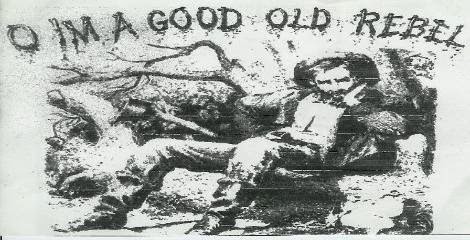
2nd South Carolina String Band - Oh, I'm a Good Ol' Rebel


Will we experience a similar contempt for our founding compacts as discouraged southern soldier veterans? The "yankee virus" as spread now throughout all states, so maybe we have superior voices this time.  

Sadly, we sense that as our lives and liberties become increasingly disparaged by government there will be millions who'll share the southern anguish of 150 years ago, and come to know what the "good ol' rebel" was trying to tell us. You're an informed audience and understand.


Remember...they only wanted to be left alone.


First published in 1914, this song expresses
the feelings of the old CSA Veterans

Oh, I'm a good old Rebel,
Now that's just what I am;
For this "fair land of Freedom"
I do not care a damn.
I'm glad I fit against it-
I only wish we'd won.
And I don't want no pardon
For anything I've done.

I hates the Constitution,
This great Republic too;
I hates the Freedmen's Buro,
In uniforms of blue.
I hates the nasty eagle,
With all his brag and fuss;
But the lyin', thievin' Yankees
I hates' em wuss and wuss.

I hates the Yankee nation
and everything they do,
I hates the Declaration
of Independence, too;
I hates the glorious Union
tis drippin' with our blood
I hates their striped banner,
I fit it all I could.

I followed Ol' Marsh Roberts
for four years, nearabout,
got wounded in three places
and starved at P'int Lookout:
I cotched the rheumatism
a'campin' in the snow;
but I killed a chance o' Yankees,
I'd like to kill some mo'.

We got three hundred thousand
Befo' they conquered us.
They died of Southern fever
And Southern steel and shot;
And I wish it was three million
Instead of what we got.

I can't take up my musket
And fight' em now no mo',
But I ain't a-goin'to love' em,
Now that is sartin sho';
And I don't want no pardon
For what I was and am;
And I won't be reconstructed,
And I do not give a damn.

<bgsound SRC="http://www.dixiescv.org/images/sounds/Oh-I'm-a-Good-Old-Rebel.wma" LOOP=FALSE AUTOSTART=TRUE HIDDEN=FALSE VOLUME="100">
The song Oh I'm a Good Old Rebel is a
WAV. file created and © by Hoyt Axton
Used with permission. All rights reserved.
 

Thursday, October 23, 2014

Cicero's Prognosis


THE HONORABLE MILLARD F. CALDWELL
Justice - Supreme Court
Tallahassee, Florida


Presented at the 22nd Annual Meeting of the Association of American Physicians and Surgeons, Inc.

October 7-9, 1965, Columbus, Ohio
Reprinted March, 1996

The Roman Republic, the foremost power of its day, had reached its zenith. Its leadership had attained unbounded wealth and unstinted power. The rulers were intolerant of restraint, indifferent to the demands of the middle class, and contemptuous of the Constitution which was designed to curb their ambitions. The time was some 70 years before the birth of Christ.

Young Marcus Tullius Cicero, then a student of law under old Scaevola, the eminent lawyer of his day, was just about to suffer his first great disillusionment with grasping government. Rome, by force of arms, guile and trickery, dominated the world. Its citizens had grown slick and fat, careless of their rights, and had fallen prey to the ruthless politicians who craved more and ever more power and riches.

Young Cicero's first client was a substantial man of business - a man of integrity who trusted his government and his fellow man. But he was a rich man and, because powerful men of government coveted his wealth, he was the victim of bureaucratic chicanery. Young Cicero, retained to plead his cause, submitted documentary proof of his client's innocence to the Judges, confident that justice would prevail.

But for some reason, his case was not going well. He consulted with his great friend and mentor, Scaevola, telling him what course he had followed, and asked why he had failed. Scaevola was disgusted - he slammed the table and, leaning toward Cicero, shouted, "Imbecile! Of what use are records presented to tribunes, consuls, or senators if the government is determined to rob and destroy a man who had displeased them, or who possesses what they want? Have I truly wasted all these years on such an idiot as this Marcus Tullius Cicero!"

Does that have the familiar ring of 1965 and the current raids of government on your substance and your rights?

Nevertheless, Cicero, before the august Senate, pleaded his client's defense against confiscatory taxation, saying "we are taxed in our bread and our wine, in our incomes and our investments, on our land and on our property, not only for base creatures who do not deserve the name of man, but for foreign nations, for complacent nations who will bow to us and accept our largesse and promise us to assist in the keeping of the peace - these mendicant nations who will destroy us when we show a moment of weakness or our treasury is bare. We are taxed to maintain legions on their soil, in the name of law and order and the Pax Romana, a document which will fall into dust when it pleases our allies and our vassals. We keep them in precarious balance only with our gold. Is the heart-blood of our nation worth these? Shall one Italian be sacrificed for Britain, for Gaul, for Egypt, for India, even for Greece, and a score of other nations? Were they bound to us with ties of love, they would not ask our gold. They would ask only our laws. They take our very flesh, and they hate and despise us. And who shall say we are worthy of more?"

Does that sound like 1965 and the billions we are pouring out to such as Nasser and Tito and their ilk?

Cicero did not save his client. But he did live to argue the cause of honest government and to talk with Sulla, the Dictator, about integrity and fair dealing. Sulla had little faith in the people. He believed them too deeply interested in their own welfare to concern themselves, too timid to stand up for their rights. He told Cicero the middle class, the lawyers, the physicians, the bankers, and the merchants would make no sacrifices. He said none of your lawyers will challenge the lawmakers and cry to them, "This is unconstitutional, an affront to a free people, and it must not pass!" 

He asked "Will one of these, your own, lift his eyes from his ledgers long enough to scan the Twelve Tables of Roman Law, and then expose those who violate them and help to remove them from power, even if it costs their lives? These fat men. Will six of them in this city, disregarding personal safety, rise up from their offices and stand in the Forum, and tell the people the inevitable fate of Rome unless they return to virtue and thrift and drive from the Senate the evil men who have corrupted them for the power they have to bestow?"
Does that sound like 1965 and our indifference to government? Does it remind you of our preoccupation with our personal affairs and our unwillingness to "rock the boat?"

Rome continued to decay. The ambitious were fattening upon its bones. The liberties of the people were lifted one by one in the name of emergencies or traded in on benefits. Catiline, brilliant, uninhibited, and evil, was pressing his suit for leadership and, in his course, curtailing the rights of all those who disagreed.

Cicero, in his Second Oration before the Senate, had this to say: "Too long have we said to ourselves 'intolerance of another's politics is barbarous and not to be countenanced in a civilized country. Are we not free? Shall a man be denied his right to speak under the law which established that right?' I tell you that freedom does not mean the freedom to exploit law in order to destroy it! It is not freedom which permits the Trojan Horse to be wheeled within the gates * * *. 
He who is not for Rome and Roman Law and Roman liberty is against Rome. He who espouses tyranny and oppression and the old dead despotisms is against Rome. He who plots against established authority and incites the populace to violence is against Rome. He cannot ride two horses at the same time. We cannot be for lawful ordinances and for an alien conspiracy at one and the same moment."

Does that sound like 1965 and its government-sponsored demonstrations?

Cicero continued: "Though liberty is established by law, we must be vigilant, for liberty to enslave us is always present under that very liberty. Our Constitution speaks of the 'general welfare of the people.' Under that phrase all sorts of excesses can be employed by lusting tyrants to make us bondsmen."

Does that sound like 1965 and usurpation by the Supreme Court in the name of "the general welfare?"

As the years went by Cicero continued his struggle, he became Consul and, for a time, stopped waste and thievery. But the people again grew careless, weary of well doing, and the avaricious and the corrupt politicians moved in and sought to banish Cicero. Once again he appeared before the Senate, but this time to plead his own cause. 

He said "The Senate, in truth, has no right to censure me for anything, for I did but my duty and exposed traitors and treason against the State. If that is a crime, then I am indeed a criminal."

Crassus, Caesar and Pompey were present. He turned and looked at them, but their faces were shut against him. His smile was sad as he said to them, "You have succeeded against me. Be it as you will. I will depart * * *." He then told the Senate: "For this day's work, lords, you have encouraged treason and opened the prison doors to free the traitors. A nation can survive its fools, and even the ambitious. But it cannot survive treason from within. An enemy at the gates is less formidable, for he is known and he carries his banners openly against the city. But the traitor moves among those within the gates freely, his sly whispers rustling through all the alleys, heard in the very halls of government itself. For the traitor appears no traitor; he speaks in the accents familiar to his victims, and he wears their face and their garments, and he appeals to the baseness that lies deep in the hearts of all men. He rots the soul of a nation; he works secretly and unknown in the night to undermine the pillars of a city; he infects the body politic so that it can no longer resist. A murderer is less to be feared. The traitor is the carrier of the plague. You have unbarred the gates of Rome to him."

Does that sound like 1965 and the subversives in high places who have been exposed and those who are not yet exposed?

Cicero was exiled from Rome but not from his conscience. He continued to plead the cause of honest government. But the people he pleaded for were not concerned. His friends, the lawyers, the doctors, and the businessmen told him: "We do not meddle in politics. 

Rome is prosperous and at peace. We have our villas in Caprae, our racing vessels, our houses, our servants, our pretty mistresses, and our comfort and treasures. We implore you, Cicero, do not disturb us with your lamentations of disaster. Rome is on the march to the mighty society, for all Romans."

Does that sound like 1965 and some of the people you know and meet in your day-to-day walks of life?

Cicero was in despair. He began to write his book De Legibus but Atticus, his publisher, asked, "But who will read it? Romans care nothing for law any longer, their bellies are too full."

And then, later, Brutus, the long-time sycophant of the ambitious Caesar, came to his senses and went to Cicero with his plea that something be done to save the nation. He confessed his error, he said he had believed in Caesar, he had believed he would restore the public, but that he has betrayed his trust.

Cicero's bitter reply was "Do not blame Caesar, blame the people of Rome who have so enthusiastically acclaimed and adored him and rejoiced in their loss of freedom and danced in his path and gave him triumphal processions and laughed delightedly at his licentiousness and thought it very superior of him to acquire vast amounts of gold illicitly. Blame the people who hail him when he speaks in the Forum of the 'new, wonderful good society' which shall now be Rome's, interpreted to mean 'more money, more ease, more security, more living fatly at the expense of the industrious.' Julius was always an ambitious villain, but he is only one man."

Does that talk of a "wonderful good society" remind you of 1965 and its "Great Society"?

I am not sure just where this country is going nor what life in America will be like five, ten, or fifty years from now. But it's clear that the old ideas of obedience to law, public thrift and common honesty, the old laws of supply and demand, and the old concepts of local self-government and individual responsibility have been discarded.

And it staggers the imagination to contemplate the changes which have occurred in the last thirty years. Our manner of government and our way of life are, for the United States, new and novel, with little in common with what has gone before. Our forefathers would be astounded by the insidious encroachments of centralized government in our everyday life.

Government is in the business of housing the people, in prescribing the hours we can work, with whom we must work, the salaries we are paid and the tax to be withheld from that salary, the schools our children can go to and with whom they must sit and play, the highways we can drive on, how and where our food is grown and processed. The government concerns itself with the products you buy, the conditions under which they are manufactured, the manner in which they are advertised; the kind, the shape, and the size of the package in which they are offered; and how they are labeled. It Is meddling with your health, your general welfare, your old age and your retirement, your security after retirement, your savings and the banks in which you place your savings; the conduct of your city, its police department and its department of health; the conduct of the affairs of your state, its law enforcement, its elections, the composition of its legislature; and every other facet of your life, private and public.

But the people of this country may like all this - to say the least, they have asked for it. They have elected the public officials who brought it about and they sit around with their tin cups waiting for more. If that's what a majority of the people of this nation want, those of us who disagree can't complain. The majority has the right to change our form of government if it wishes.

But one unfortunate aspect is that, once the die is finally cast, it will be too late to change our minds; it's altogether unlikely we could then ever reestablish the kind of government, the kind of independence and individuality our forefathers conceived and anticipated for posterity. We will have come too far and given up too much.

For that reason it is important that we give some thought to what is happening and reach some conclusions about what we'd like our future to be. We must count the cost of all the politically inspired humanitarian claptrap and be sure we're willing to pay the price in freedom, liberty, and independence.

The cause of sound government is not without a feeble hope. There is an overriding suspicion and uneasiness. The taxpayers complain of the complexities and the inequities fostered by internal revenue; the farmers complain of regimentation; the lawyers complain of the federal judiciary and its whimsical construction of the Constitution; the police deplore the judicial pampering of the criminals; citizens gener- ally are alarmed by the government stirring up of the caldrons of racial hate; students of government seeking the truth are handicapped by managed news and the dominance of news media by the extreme liberals; many are apprehensive of the coddling of communists in high office and their people generally resent America's subordination to the United Nations and the waste of multiple billions on red satellites.

Well, we ask, in the light of the precarious situation what can we do? The first thing to decide is whether we want to live in a constitutional Republic or under a socialistic despotism. Theoretically, I suppose the vast majority would say they prefer constitutional government, but, as a matter of truth, that same majority is unwilling to jeopardize the spurious but temporary prosperity linked to current socialistic practice. Indeed, it may be we are irrevocably committed - too many of us have sold the future for the hope of free medical care, free college education, social equality, and security against poverty.

But, if you are concerned, I suggest you assess the responsibility for what's happening in government. If you are honest with yourselves you will admit we cannot blame the weak Congress or the bureaucrats, the tax gatherers or the judges or the communists - the responsibility must rest upon our own shoulders.

And while it's obvious that our conduct of public affairs under both political parties has long been lacking in the forthrightness and courage so essential to our independence, we cannot take the easy way out and charge the nation's ills to the ADA, the Bobby Bakers, or the Supreme Court. To put it simply, you and I and the people generally have been negligent in attention to our public business.

In good conscience, we cannot say the federal encroachments upon our rights and the rights of the states have come with any surprise. 

We have been warned and warned again. Two thousand years ago Cicero told us what to expect, when our ancestors were considering the adoption of the Federal Constitution for the new Republic. Patrick Henry, distrusting a central government, with true and unerring foresight, told the people to "be extremely cautious, watchful, jealous of your liberty. Instead of securing your rights, you may lose them forever." He said, "there will be no checks, no real balances in this government," and looking ahead to 1965, he said "this government will * * * destroy the state governments and swallow the liberties of the people."

George Mason was fearful of centralization and thought there was a very real danger of losing all the Revolution had gained. He said that a consolidated government "is totally subversive of every principle which has hitherto governed us."

William Grayson was suspicious of the proposed Supreme Court. He said, "this court has more power than any court under heaven..." George Mason said the creation of the court would result in the destruction of state governments because, in the absence of restraint, the court "will be the judges of how far their law will operate."

Benjamin Franklin, after the Constitution was adopted, anticipating a people negligent in safeguarding their rights, said he thought our government would be well administered for a few years but that it "can only end in despotism."

At the conclusion of his two terms as President and in the light of his experience, George Washington thought the people of the future should be warned of the dangers inherent in an unrestrained Supreme Court - he said; "If * * * the distribution * * * of the constitutional powers be in any particular wrong, let it be corrected by an amendment in the way which the Constitution designates. But let there be no change by usurpation: for though this, in one instance, may be the instrument of good, it is the customary weapon by which free governments are destroyed."

Thomas Jefferson foresaw the evils of judicial encroachment when, in effect, he said the Court, under its philosophy, made the Constitution a mere thing of wax to be twisted into any form they pleased; that to consider the Judges the ultimate arbiter of the Constitution would place us under the despotism of an oligarchy.

Some years later Lord Macauley, the English historian, after a careful study of our government and our Constitution warned the American people "Your Constitution is all sail and no anchor. Either Caesar or Napoleon will seize the reins of government with a strong hand, or your Republic will be as fearfully plundered and laid waste by the barbarians in the twentieth century as the Roman Empire was in the fifth - with this difference, that the Huns and Vandals who ravaged the Roman Empire came from without, and your Huns and Vandals will have been engendered within your own country by your own institutions." It is reasonable to assume he thought the Supreme Court was one of the institutions which would destroy us from within.

Abraham Lincoln thought it necessary to tell the people: "If the policy of the government upon vital questions affecting the whole people is to be irrevocably fixed by the decisions of the Supreme Court, the people will have ceased to be their own rulers, having...practically resigned their government into the hands of that eminent tribunal."
Robert Moses had this to say the other day: "We are living in a second American Revolution, as critical as the first one which established our nation * * * the Supreme Court now legislates and executes * * * It now by-passes the state courts and delegates to lower federal courts authority to tell the states what to do and how to do it * * * the states are reduced to peonage * * * until we change our Constitution, any five judges out of nine - distinguished men no doubt but political accidents not chosen by the people - are ruling the country and determining its future."

No, we cannot have been surprised by what has happened because, from our earliest days, we have been on notice it would happen. We, very simply, have refused to heed the warnings or to acknowledge that our freedoms can be preserved by vigilant action and not otherwise. We have refused to acknowledge that bad government and bad public officials are but the reflection of ourselves as we have cast our votes - that the elected official is nothing more nor less than the instrumentality through which we express our will.

The whole trouble is that, in our civic stupor, we have forgotten that major policies, whether the gift of our substance to the communists or the regimentation of industry, agriculture, business, and the professions, require either the approval or acquiescence of the citizens of this country. What has been done, both that which has contributed to our stability and that which has endangered our future, has been with our consent. But I should tell you that the time is growing short. We must make a choice between the form of government conceived by those who captured our freedoms from Great Britain in the Revolution and this new form of government, a centralization, advocated and practiced by the left-dealers. Whether this nation is to be governed by the rule of law, under the Constitution, or the rule of man, unfettered by any restraint, constitutes the most vital problem of our time.

It is no longer of first importance whether we collectivize the professions or bankrupt the nation in abolishing poverty or in supporting our enemies abroad - the vital question, the question, in the face of which all others fade to insignificance, is whether we save the Constitution of the United States and the Republican form of government established by it.

If we can succeed in that respect and retain the right to elect the Congress and the President, all of us, the timid and the brave, the generous and the greedy, the conservatives, the liberals, and the middle gender moderates, can live with wisdom and folly, frugality and waste, the ADA socialists, and the crafty politicians. But, and never forget it, we cannot exist as a free people nor our nation as a Republic without a Constitution, observed in fact and not in the breach.

Whether the nation moves even further to the left as a socialistic despotism or is re-established as a Republic depends entirely upon the will of the majority. The answer does not hang upon whether you are liberal or conservative, a Democrat or a Republican - the answer, the sole answer, is whether you believe in and are resolute in trying to save the Constitution - as it was written and intended - upon whether you are determined to elect public officials who believe in that Constitution and are willing to boot them out of office without ceremony if they falter in their conviction.

You must face the fact that we have spent thirty years setting up the machinery to destroy that Constitution, and it will take dogged determination and constant, unwavering purpose to save it. You will have to reckon with the human inclination to avoid unpleasant facts. We are reluctant to admit our conversion to socialism or that the Supreme Court has usurped the rights of the Congress to legislate.

But we must admit that many people, many splinter groups, approve one or the other of the encroachments by the Supreme Court upon the rights of the majority. The Negroes are happy in the belief that the Brown decision established superior rights for them over the majority; the criminals are happy with the Mallory and Escobedo decisions because of the great advantage gained over the law enforcement officers and society in general; the communists thoroughly approve the Schware, Konigsberg and the Slochower cases which insure their right to infiltrate the legal profession and the schools. The labor unions like the decisions which gave to them enormous advantages. The urban politicians like the reapportionment decisions which insure their control of the state houses and the Congress.

Some of the changes made in the Constitution by judicial fiat were useful. Some, I would actively support In the political arena, but, as George Washington advised us, they should come in the manner prescribed by the Constitution and not through the unconstitutional usurpation by a court not subject to the vote of the people.

But you must remember that, by coddling particular self-interest groups, one after the other, the "rule by man" forces have built a strong following - a following which is active, vocal and organized.
The devotees of the "rule by man" theory include the moderates, the ADAers, most of labor, practically all of the minorities, many ministers, and many of the business and professional world. But I do not believe the tin-cup crowd constitutes a majority of the people of this country.

The simple majority, and I emphasize the word simple, composed of decent, ordinary businessmen, doctors, farmers, mechanics, preachers, and just people, does not realize how it has been duped. The honest fellow has always been an easy mark - the easiest to rob.

The simple majority is slow to anger. They are not given to sit-downs and sit-ins, to placards and to violence and to hate. But neither is that majority watchful of its own rights and the freedoms it inherited from brave ancestors. The majority is slow to express its opinion - slow to write the Congressmen or the President or the Supreme Court or the newspaper; it is, because of its supinely acquiescent attitude, slow to stand up and be counted.

If you, per chance, are among those who would rather be governed by constitutional law than by the whims of men unfettered by restraint, I suggest that the war will have to be fought on a wide front. You can't win with brush fights in special area. You must join and coordinate your efforts with the professions, with business and industry, with agriculture and all facets of American society concerned with the preser- vation of personal liberty. The centralizers can lick the isolated groups, but they could not defeat a sustained drive by the consolidated believers in constitutional government.
As a conservative, you should scrutinize every political candidate, at whatever level, and support the man who believes in our traditional form of government. You should examine every major governmental proposal and express your convictions at the ballot box and by letter, telegram, and in person. You should devote the same degree of thought and attention to your public business as you give to your personal affairs.

If you are a liberal, you should insist upon a Republican form of government. You should oppose every invalid executive order and shout from the housetops against the Supreme Court of the United States every time it arrogates to itself the power to write new law and to rewrite the Federal Constitution. You should remember that the historic method of stamping out liberalism is to undermine constitutional government and substitute the rule of man. You should remember that in Russia and Germany, in Italy and Red China, the liberals were promised more liberality and more freedoms - that the promisors promised fast action by fiat. They said, as our Supreme Court now says, let's do these good things now - let's not wait for the slow processes of the law.

If you are an ADA left-winger, you should insist upon utopia under the law, not by executive order. You should insist upon the right to live in Mr. Gotrock's house on the beach, the right to a free college education for your children, your right as a Protestant to join the Knights of Columbus - but you should never give Big Brother the power to confer those rights by ukase. Why? Because when the President or the Supreme Court usurps the power to give you something to which, under the law, you are not entitled, the President or the Court can, with equal ease, usurp the power to take from you that to which you are entitled.

If you are one of the American minorities and unhappy with your race, you should exert every effort to improve your position; you can aspire to the social organizations of the other races and endeavor to pull down distinction and level off all differences. But, being knowledgeable in history, you should do all these things under constitutional law. You ought never urge the illegal use of the army in your behalf because, when you have lost your popularity as a cause and are no longer needed at the ballot box, the President can use that same army illegally against you. You should remember vividly, how, in other countries, where constitutional government was abolished, minorities were cooked in the gas ovens or deep frozen in Siberia.

And if I were a left-wing newspaperman wedded to socialism, hating wealth and the wealthy, I would do my writing behind America's constitutional guaranty of free speech. I would emulate the feist dog and bark mightily, but from behind the strong fence of constitutional protection. I would remember only too well how freedom of the press and freedom of those who write for the press have been curtailed in those countries where man has risen above the law. Each morning I would remind myself to remind all my left-wing doctor, preacher, teacher, and racist friends that only under a constitutional form of government, where the rights of the individuals are protected, can we live and breathe and preach and write our thoughts; that under centralized power our only free choice will be to write and preach and teach as Big Brother tells us or to go dig salt in the mines.

But what would you do if your aim is for a dictatorship or a communistic takeover? How would you go about weakening the fiber of the country? You would know that, given a fair choice between a representative Republic and a dictatorship, the vast majority of the people in this country would vote against centralization.

No, your road to successful takeover would involve beguiling the people with handouts, creating false sense of security and, step by step, the dishing out of benefits with one hand and the lifting of liberties with the other. You would encourage the issuance of invalid executive orders, all in the name of humanity to please large segments of the voters. You would persuade the judiciary to ignore constitutional restraint and, in the beginning at least, issue invalid decisions in favor of the so-called downtrodden of our population and, of course, contemporarily, you would have the do-gooders demonstrate and create strife and, in every way possible, debunk and belittle the principles upon which the country grew and prospered and became the first nation of the earth. This prescription, faithfully followed, is likely of success under all conditions and, absent intelligent opposition, can be guaranteed.

These are not just theoretical abstractions - that's the way it's been done throughout history, beginning with Greece and Rome, on down through Russia, Hitler's Germany, Mussolini's Italy, and Peron's Argentina.

But there's a great difference in the composition of nationalities. 

Three or four hundred years ago the English, pushed to the wall by the power-spawned rule of the Star Chamber courts, pushed back and recaptured their rights. The Russian people, in sheep-like docility, have submitted. The melting pot of America seems content and complacent. Its sycophantic Congress, reflecting public acquiescence, is grovelling at the feet of the President. Its Democratic party has been captured, and its Republican party is without policy or guidance. 

We appear to be drunk on benefits and slogans, rushing lightheartedly along to self-destruction.

But perhaps all this is in keeping with natural law. The children of Hamlin followed the Pied Piper to ruin, the people of Germany and Italy followed Hitler and Mussolini, the lemmings of Norway rush to the sea to drown, and the grunions of the West Coast rush from the sea to flop on the beach and die. The Roman Republic was destroyed when the urban leaders pampered its populace with free handouts...Perhaps Benjamin Franklin knew what he was talking about when he told the young nation, after it had adopted its Constitution, in substance, that they had gained a free and independent nation but did not have the common sense to keep it. 


Pamphlet No. 1047, March 1996
via aapsonline

Thursday, October 16, 2014

We have an Unlawful 14th Amendment

CAUTION: Do not use this irregularity to call for or support the Insiders call for a Constitutional Convention (CON-CON)!!
Posted on October 13, 2014 by admin in Education

There is No “Fourteenth Amendment”!

by David Lawrence, U.S. News & World Report, September 27, 1957

A MISTAKEN BELIEF—that there is a valid article in the Constitution known as the “Fourteenth Amendment”—is responsible for the Supreme Court decision of 1954 and the ensuing controversy over desegregation in the public schools of America. No such amendment was ever legally ratified by three fourths of the States of the Union as required by the Constitution itself. The so-called “Fourteenth Amendment” was dubiously proclaimed by the Secretary of State on July 20, 1868. The President shared that doubt. There were 37 States in the Union at the time, so ratification by at least 28 was necessary to make the amendment an integral part of the Constitution. Actually, only 21 States legally ratified it. So it failed of ratification.

The undisputed record, attested by official journals and the unanimous writings of historians, establishes these events as occurring in 1867 and 1868:

Outside the South, six States—New Jersey, Ohio, Kentucky, California, Delaware and Maryland—failed to ratify the proposed amendment.

In the South, ten States—Texas, Arkansas, Virginia, North Carolina, South Carolina, Georgia, Alabama, Florida, Mississippi and Louisiana —— by formal action of their legislatures, rejected it under the normal processes of civil law. A total of 16 legislatures out of 37 failed legally to ratify the “Fourteenth Amendment.”

Congress—which had deprived the Southern States of their seats in the Senate —did not lawfully pass the resolution of submission in the first instance.

The Southern States which had rejected the amendment were coerced by a federal statute passed in 1867 that took away the right to vote or hold office from all citizens who had served in the Confederate Army. Military governors were appointed and instructed to prepare the roll of voters. All this happened in spite of the presidential proclamation of amnesty previously issued by the President. New legislatures were thereupon chosen and forced to “ratify” under penalty of continued exile from the Union. In Louisiana, a General sent down from the North presided over the State legislature.

Abraham Lincoln had declared many times that the Union was “inseparable” and “indivisible.” After his death, and when the war was over, the ratification by the Southern States of the Thirteenth Amendment, abolishing slavery, had been accepted as legal. But Congress in the 1867 law imposed the specific conditions under which the Southern States would be “entitled to representation in Congress.”

Congress, in passing the 1867 law that declared the Southern States could not have their seats in either the Senate or House in the next session unless they ratified the “Fourteenth Amendment,” took an unprecedented step. No such right—to compel a State by an act of Congress to ratify a constitutional amendment—is to be found anywhere in the Constitution.

Nor has this procedure ever been sanctioned by the Supreme Court of the United States. President Andrew Johnson publicly denounced this law as unconstitutional. But it was passed over his veto.
Secretary of State Seward was on the spot in July 1868 when the various “ratifications” of a spurious nature were placed before him. 

The legislatures of Ohio and New Jersey had notified him that they rescinded their earlier action of ratification. He said in his official proclamation that he was not authorized as Secretary of State “to determine and decide doubtful questions as to the authenticity of the organization of State legislatures or as to the power of any State legislature to recall a previous act or resolution of ratification.” He added that the amendment was valid “if the resolutions of the legislatures of Ohio and New Jersey, ratifying the aforesaid amendment, are to be deemed as remaining of full force and effect, notwithstanding the subsequent resolutions of the legislatures of these States.” This was a very big “if.” It will be noted that the real issue, therefore, is not only whether the forced “ratification” by the ten Southern States was lawful, but whether the withdrawal by the legislatures of Ohio and New Jersey —two Northern States —was legal. The right of a State, by action of its legislature, to change its mind at any time before the final proclamation of ratification is issued by the Secretary of State has been confirmed in connection with other constitutional amendments.

The Oregon Legislature in October 1868 —three months after the Secretary’s proclamation was issued —passed a rescinding resolution, which argued that the “Fourteenth Amendment” had not been ratified by three fourths of the States and that the “ratifications” in the Southern States were “usurpations, unconstitutional, revolutionary and void” and that, “until such ratification is completed, any State has a right to withdraw its assent to any proposed amendment.”

What do the historians say about all this? The Encyclopedia Americana states:
“Reconstruction added humiliation to suffering . . . Eight years of crime, fraud, and corruption followed and it was State legislatures composed of Negroes, carpetbaggers and scalawags who obeyed the orders of the generals and ratified the amendment.”

W. E. Woodward, in his famous work, “A New American History?” published in 1936, says:
“To get a clear idea of the succession of events let us review [President Andrew] Johnson’s actions in respect to the ex-Confederate States.”

“In May, 1865, he issued a Proclamation of Amnesty to former rebels. Then he established provisional governments in all the Southern States. They were instructed to call Constitutional Conventions. They did. New State governments were elected. White men only had the suffrage [the Fifteenth Amendment establishing equal voting rights had not yet been passed]. Senators and Representatives were chosen, but when they appeared at the opening of Congress they were refused admission. The State governments, however, continued to function during 1866.”

“Now we are in 1867. In the early days of that year [Thaddeus] Stevens brought in, as chairman of the House Reconstruction Committee, a bill that proposed to sweep all the Southern State governments into the wastebasket. The South was to be put under military rule.”

“The bill passed. It was vetoed by Johnson and passed again over his veto. In the Senate it was amended in such fashion that any State could escape from military rule and be restored to its full rights by ratifying the Fourteenth Amendment and admitting black as well as white men to the polls.” In challenging its constitutionality, President Andrew Johnson said in his veto message:

“I submit to Congress whether this measure is not in its whole character, scope and object without precedent and without authority, in palpable conflict with the plainest provisions of the Constitution, and utterly destructive of those great principles of liberty and humanity for which our ancestors on both sides of the Atlantic have shed so much blood and expended so much treasure.”

Many historians have applauded Johnson’s words. Samuel Eliot Morison and Henry Steele Commager, known today as “liberals,” wrote in their book, “The Growth of the American Republic”:

“Johnson returned the bill with a scorching message arguing the unconstitutionality of the whole thing, and most impartial students have agreed with his reasoning.”

James Truslow Adams, another noted historian, writes in his “History of the United States”:

“The Supreme Court had decided three months earlier, in the Milligan case, . . . that military courts were unconstitutional except under such war conditions as might make the operation of civil courts impossible, but the President pointed out in vain that practically the whole of the new legislation was unconstitutional. . . . There was even talk in Congress of impeaching the Supreme Court for its decisions! The legislature had run amok and was threatening both the Executive and the Judiciary.”

Actually, President Johnson was impeached, but the move failed by one vote in the Senate.

The Supreme Court, in case after case, refused to pass on the illegal activities involved in “ratification.” It said simply that they were acts of the “political departments of the Government.” This, of course, was a convenient device of avoidance. The Court has adhered to that position ever since Reconstruction Days.

Andrew C. McLaughlin, whose “Constitutional History of the United States” is a standard work, writes:

“Can a State which is not a State and not recognized as such by Congress, perform the supreme duty of ratifying an amendment to the fundamental law? Or does a State —by congressional thinking —cease to be a State for some purposes but not for others?”

This is the tragic history of the so-called “Fourteenth Amendment”— a record that is a disgrace to free government and a “government of law.”

Isn’t the use of military force to override local government what we deplored in Hungary? It is never too late to correct injustice. The people of America should have an opportunity to pass on an amendment to the Constitution that sets forth the right of the Federal Government to control education and regulate attendance at public schools either with federal power alone or concurrently with the States.

That’s the honest way, the just way to deal with the problem of segregation or integration in the schools. Until such an amendment is adopted, the “Fourteenth Amendment” should be considered as null and void.

There is only one supreme tribunal — it is the people themselves. Their sovereign will is expressed through the procedures set forth in the Constitution itself.

via dueprocessrevisited

Tuesday, October 7, 2014

Secession–Not Just a Southern Thang and Not Just Secular–Part Two

For those whom never learned in their government school, the Confederacy never surrendered. You're only told of Lee's troops laying down their arms at Appomattox. But, the CSA is alive to this day!
by Al Benson Jr.

Just before, and during, the War of Northern Aggression, the sentiment in favor of secession came from other areas of the country and not just from below Mason-Dixon.

In Douglas County, Illinois a meeting was held which announced that: “We regard the Emancipation Proclamation…as the entering wedge which will ultimately divide the middle and northwestern states from our mischiefmaking, puritanical, fanatical New England brethren…” Culturally, this has happened, even though Lincoln’s “mystical Union” has been held together with bayonets.

In Brown County, Indiana, a gathering was convened that put forth this sentiment: “…Our interests and inclinations will demand of us a withdrawal from political association in a common government with the New England states, who have contributed so much to every innovation upon the Constitution to our present calamity of civil war, and whose tariff legislation must ever prove oppressive to our agricultural and commercial pursuits.” Mind you, such secession sentiments are coming forth from Indiana and Illinois.

Other sources have cited secession sentiment in even the Middle Atlantic states–New York, New Jersey, Pennsylvania, Delaware and Maryland. Author William C. Wright has written that: “The secession movement was prominent in the five Middle Atlantic states. Within these five states were three types of secessionists; first, those who wanted to join the Confederacy; second, those who wished to form a central confederacy, that is, to join with the other border states and divide the United States into three separate nations; third, those who preferred to let the South go in peace rather than to use force to save the Union.”

Wright noted that Pennsylvania was the most pro-Union of these states, while New Jersey had strong economic and social ties with the South. New York was divided between the up-state region which supported the Union and the Hudson Valley and New York City areas that had ties to the South. 

New York City Mayor Fernando Wood had even made the proposition that New York City be made into a “free city.” 

Wright has duly noted that: “Together, the advocates of secession weakened the Lincoln administration’s ability to react to the Confederacy. At the same time, they offered the South hope of Northern support if war broke out.” In view of this, one might be led to wonder if this situation was the real reason for Lincoln’s actions in regard to Fort Sumter. I might also question why almost none of this type of material is ever presented in our “history” books, if such they can seriously be called. But that would be little more than a rhetorical exercise because I already know why.

The majority of people today, North and South, largely due to the abolitionist propaganda presented in our “history” books (whoever said history books had to teach real history?) and the rampant apostasy in the country as a whole, have viewed secession and the War of Northern Aggression in a strictly secular light. Many who have studied history will readily admit to the political and economic causes of the War, though some continue to persist it was all about slavery. However, most will not touch the theological reasons for secession.

However, there were many in the South that viewed secession in the same light that they viewed the biblical separation spoken of in Second Corinthians 6:14-18. They looked at an increasingly apostate and “progressive” North, while, in the main, most Southerners clung to orthodox Christianity. Informed Southerners watched much of the Northern clergy, no doubt influenced by the taint of Unitarianism, seek to deify man and to exalt the goodness of his human nature and his “free will.” It was the same sort of thing they did with abolitionist/terrorist John Brown in 1859 where Northern Unitarians claimed that Brown’s gallows was equal to Christ’s cross.

The late Professor M. E. Bradford, writing in the Southern Partisan magazine for the fourth quarter of 1991, noted that: “…Professor Bell Wiley observes, the Southern churches had always warned their communicants against ‘extreme confidence in human endeavor.’ The ordinary Southerner of 1860 did not approach the world as did those who had voted for Mr. Lincoln. They were…’as dubious of human ability in social and political matters as in the matter of salvation.’ The belief of the sovereignty of God and dependence of man was the whole of their thinking.”

In regard to Southern clergymen, Professor Bradford wrote: “Because most Southern clergymen were, during the years of sectional conflict within their denominations, convinced that apostasy and infidelity had become the dominant religions of the North.” You know something? They were right! Bradford observed that: “As the War approached, these (Southern) clergymen more and more tended to view the sectional controversy as a dispute between those who acknowledged the authority of the Scripture and those who set their own moral sense above it–in other words, between Christians and infidels.”

Thus we have another, seldom acknowledged, yet perhaps the most important dimension to the secession question–the spiritual and theological dimension. The majority probably have no interest in dealing with this aspect of the question. 

The “history” they’ve been taught tells them not to, but the spiritual dimension was and is here and needs to be dealt with. As someone with a Christian worldview, I believe all truth is educational and all things, ultimately, reflect someone’s theology. Everything eventually comes down to this–choose who you will serve, the Trinitarian God of the Scriptures or the World System. It has to be one or the other. 

Many Southern secessionists held to this view. For them, although political issues were prominent as were economic ones, their ultimate view of secession was a theological view. They viewed the doctrine of biblical separation and secession as one. In our apostate day, such a conclusion merits our serious consideration.

Read PART ONE:  Secession–Not Just Southern and Not Just Secular


Bibliography
A Constitutional View of the Late War Between the States
by Alexander H. Stephens (volume one)
Krause Reprint Company, New York, 1970

Democracy in America
by Alexis de Tocqueville (volume one)
Vintage Books, New York, July, 1990

The Hidden Civil War
by Wood Gray
Viking Press, New York, 1942

The Secession Movement in the Middle Atlantic States
by William C. Wright
Associated University Presses, Inc. Cranberry, New Jersey, copyright 1973

A Theological and Political View of the Doctrine of Secession
by Al Benson Jr.
The Copperhead Chronicle, Sterlington, Louisiana, copyright 1995, reprinted 2009
(booklet 30 pages)

Wednesday, October 1, 2014

Ron Paul Thinks There Should Be More Secessionist Movements in the U.S.

The former U.S. congressman and perennial presidential candidate tells National Journal that he's "real pleased" with American secessionist groups.

(Photo by T.J. Kirkpatrick/Getty Images)

September 30, 2014 Secessionists across the world were inspired by Scotland's energetic attempt at independence from the United Kingdom earlier this month. Ron Paul, as it turns out, joined them.

In an essay on his eponymous institution's website Sunday, the former U.S. congressman from Texas wrote that any supporters of freedom should cheer secessionism because it allows for smaller government—a constant mantra for the libertarian and perennial presidential candidate, who didn't previously realize there were more than a handful of secessionist groups in the United States.

"I was real pleased with that, and a bit surprised," Paul told National Journal. "But then, on second thought, you think, 'Why not? Why not more?' "

Fringe groups calling for states and regions to secede from the U.S., such as the Second Vermont Republic and the Alaskan Independence Party, gained more publicity in the weeks leading up to the Scottish referendum. As the outsized federal government continues to encroach on individual rights, Paul said, he thinks there will be a groundswell of these movements.

"It's something that I think is going to grow, because the failure of the federal government is going to get much worse," he said. "When the bankruptcy evolves, and maybe some of these pension funds are confiscated, and the wars never end, and bankruptcy comes forth, people [will say], 'Hey, we're getting a bad deal from this. Why don't we leave?' "

He added: "I think it's inevitable people wanting to leave will be there, and the numbers will grow."

Realistically, though, Paul said he doesn't think any of these groups could actually succeed. Despite the founders' own deep belief in secession—they gained America's independence from Europe, after all—he said the Civil War set the precedent that secession would carry "very, very bad" results.

"By our history, the heavy hand of the federal government would come down," Paul told National Journal. "They'd probably shoot 'em."

In typical fashion, Paul argued that the principle of secession was more important than what could actually happen in reality. It's the threat, he said, that's important to keep the federal government in check.

"I think what is most important is we have a concrete right to secede," Paul said. "Even if we never had any secession, or any state declare independence, we would be so much better off, because there would always be this threat. Once the threat of a state leaving was removed, it was just open-door policy for the federal government to expand itself and run roughshod out over the states because the states couldn't do much."

Given that his son, Sen. Rand Paul, R-Ky., will likely run for president in 2016 with a much better chance of winning than his father ever had, the elder Paul's willingness to share his reasonably radical views seem imprudent, if not unexpected. In an election cycle that has often equated the politics of Ron and Rand, this latest remark is sure to annoy the potential 2016-er's supporters.

For Rand's sake, it's fortunate that Ron didn't express his support for the Texas Nationalist Movement or any other secessionist groups in the U.S. Before he'd back Texan independence, he joked, "I better check out and see who's running Austin before we decide about that."

source