Search Blog Posts

Showing posts with label Energy. Show all posts

Thursday, December 25, 2014

Grandmaster Putin’s Trap

Thu, Dec 25, 2014
By Dmitry KALINICHENKO (Russia)

Grandmaster Putin’s TrapAccusations of the West towards Putin are traditionally based on the fact that he worked in the KGB. And therefore he is a cruel and immoral person. Putin is blamed for everything. But nobody ever accused Putin of the lack of intelligence.

Any accusations against this man only emphasize his ability for quick analytical thinking and making clear and balanced political and economic decisions.

Often Western media compares this ability with the ability of a grandmaster, conducting a public chess simul. Recent developments in US economy and the West in general allow us to conclude that in this part of the assessment of Putin’s personality Western media are absolutely right.

Despite numerous success reports in the style of Fox News and CNN, today, Western economy, led by the United States is in Putin’s trap, the way out of which no one in the West can see or find. And the more the West is trying to escape from this trap, the more stuck it becomes.

What is the truly tragic predicament of the West and the United States, in which they find themselves? And why all the Western media and leading Western economists are silent about this, as a well guarded military secret? Let’s try to understand the essence of current economic events, in the context of the economy, setting aside the factors of morality, ethics and geopolitics.

Development of crude oil prices.
After realizing its failure in Ukraine, the West, led by the US set out to destroy Russian economy by lowering oil prices, and accordingly gas prices as the main budget sources of export revenue in Russia and the main sources of replenishment of Russian gold reserves. It should be noted that the main failure of the West in Ukraine is not military or political. But in the actual refusal of Putin to fund the Western project of Ukraine at the expense of the budget of Russian Federation. What makes this Western project not viable in the near and inevitable future.

Last time under president Reagan, such actions of the West’s lowering of oil prices led to ‘success’ and the collapse of USSR. But history does not repeat itself all the time. This time things are different for the West. Putin’s response to the West resembles both chess and judo, when the strength used by the enemy is used against him, but with minimal costs to the strength and resources of the defender. Putin’s real policies are not public. 

Therefore, Putin’s policy largely has always focused not so much on effect, but on efficiency.
Very few people understand what Putin is doing at the moment. And almost no one understands what he will do in the future.

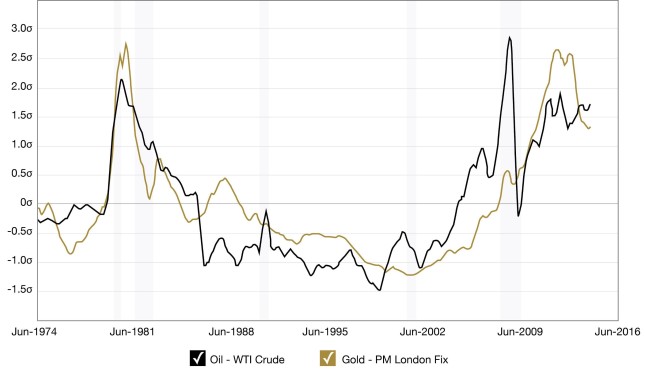
No matter how strange it may seem, but right now, Putin is selling Russian oil and gas only for physical gold.

Putin is not shouting about it all over the world. And of course, he still accepts US dollars as an intermediate means of payment. But he immediately exchanges all these dollars obtained from the sale of oil and gas for physical gold!

To understand this, it is enough to look at the dynamics of growth of gold reserves of Russia and to compare this data with foreign exchange earnings of the Russia coming from the sale of oil and gas over the same period.

goldMoreover, in the third quarter the purchases by Russia of physical gold are at all-time high record levels. In the third quarter of this year, Russia had purchased an incredible amount of gold in the amount of 55 tons. It’s more than all the central banks of all countries of the world combined (according to official data)!

In total, the central banks of all countries of the world have purchased 93 tons of the precious metal in the third quarter of 2014. It was the 15th consecutive quarter of net purchases of gold by Central banks. Of the 93 tonnes of gold purchases by central banks around the world during this period, the staggering volume of purchases – of 55 tons – belongs to Russia.

Not so long ago, British scientists have successfully come to the same conclusion, as was published in the Conclusion of the U.S. Geological survey a few years ago. Namely: Europe will not be able to survive without energy supply from Russia. Translated from English to any other language in the world it means: “The world will not be able to survive if oil and gas from Russia is subtracted from the global balance of energy supply”.

Continue reading


Thursday, November 6, 2014

Has Washington Just Shot Itself in the Oily Foot?

06.11.2014 Author: William Engdahl

6573338By now even the New York Times is openly talking about the secret Obama Administration strategy of trying to bankrupt Russia by using its oil-bloated Bedouin bosom buddy, Saudi Arabia, to collapse the world price of oil. However, it’s beginning to look like the neo-conservative Russia-haters and Cold war wanna-be hawks around Barack Obama may have just shot themselves in their oily foot. As I referred to it in an earlier article, their oil price strategy is basically stupid. Stupid, as all consequences have not been taken into account. Take now the impact on US oil production as prices plummet.

The collapse in US oil prices since September may very soon collapse the US shale oil bubble and tear away the illusion that the United States will surpass Saudi Arabia and Russia as the world’s largest oil producer. That illusion, fostered by faked resource estimates issued by the US Department of Energy, has been a lynchpin of Obama geopolitical strategy.

Now the financial Ponzi scheme behind the increase of US domestic oil output the past several years is about to evaporate in a cloud of fictitious smoke. The basic economics of shale oil production are being ravaged by the 23% oil price drop since John Kerry and Saudi King Abdullah had their secret meeting near the Red Sea in early September to agree on the Saudi oil price war against Russia.

Wall Street bank analysts at Goldman Sachs just issued a 2015 forecast that US oil prices, measured by a benchmark called WTI (West Texas Intermediate) will fall to $70 a barrel. In September 2013, WTI was more than $106 a barrel. That translates into a sharp 34% price collapse in just a few months. Why is that critical to the US shale production? Because, unlike conventional crude oil deposits, shale oil or tight oil as industry calls it, depleted dramatically faster.

A comprehensive new analysis just issued by David Hughes, a Canadian oil geo-scientist with thirty years’ experience with the Geological Survey of Canada, using data from existing US shale oil production that has now become public for the first time (the shale oil story is very recent), shows dramatic rates of oil volume decline from US shale oil wells:
The three year average well decline rates for the seven shale oil basins measured for the report range from an astounding 60-percent to 91-percent. That means over those three years, the amount of oil coming out of the wells decreases by that percentage. This translates to 43-percent to 64-percent of their estimated ultimate recovery dug out during the first three years of the well’s existence. Four of the seven shale gas basins are already in terminal decline in terms of their well productivity: the Haynesville Shale, Fayetteville Shale, Woodford Shale and Barnett Shale.
A decrease in oil daily of between 60% and 91% for these best possible shale oil regions means the oil companies must drill deeper to even stay still with oil production, let alone increase total oil volume. That means the drillers must spend more money to drill deeper, a lot more. According to Hughes, the Obama administration Department of Energy has uncritically taken rosy forecast numbers given them by the companies that boost the US shale oil myth. His calculations show future US shale oil output only 10% that estimated for 2040 by the Energy Department.

Hughes describes the current deadly dilemma of the shale oil companies as a “drilling treadmill.” They must drill more and more wells just to keep production levels flat. The oil companies have already gone after the most promising shale oil areas, so-called “sweet spots,” to maximize their production. Now as production begins to decline terminally, they must start drilling in spaces with less rich oil and gas returns. He adds, “if the future of U.S. oil and natural gas production depends on resources in the country’s deep shale deposits…we are in for a big disappointment.”

Oil price collapse
What Hughes describes was the state of shale oil before the start of the Kerry-Abdullah Saudi oil price war. Now US WTI oil prices have dropped a catastrophic 25% in six weeks, and still falling. Other large oil producers like Russia and Iran are in turn flooding the world market with their oil to increase revenue for their state budgets, adding to a global oil supply glut. That in turn pressures prices more.

The shale oil and gas bonanza of the past five years in the USA has been built on a foundation of zero Federal Reserve interest rates and huge speculative investment by hungry Wall Street firms and funds. Because of the ultra-rapid oil well depletion, when market oil prices collapse, the entire economics of lending to the shale oil drillers collapses as well. Money suddenly vanishes and debt-strapped oil companies begin real problems.

According to Philip Verleger, former head of President Carter’s Office of Energy Policy and now an energy consultant, in North Dakota’s Bakken shale, one of the most important new shale oil regions, oil at $70 a barrel could cut production 28 percent to 800,000 barrels a day by February from 1.1 million barrels a day in July. “The cash flow will go down as the prices go down, the amount of money advanced to these people to continue the drilling will dry up entirely, so you’ll see a marked slowdown in drilling,” said Verleger.

Myths, Lies and Oil Wars
The end of the shale oil bubble would deal a devastating blow to the US oil geopolitics. Today an estimated 55% of US oil production and all the production increase of the past several years comes from fracking for shale oil. With financing cut off because of economic risk amid falling oil prices, shale oil drillers will be forced to halt new drilling that is needed merely to maintain a steady oil output.

The aggressive US foreign policy in the Middle East—its war against Syria’s al-Assad regime, its hardball oil sanctions against Iran, its sanctions against Russian oil projects, its cynical toleration of ISIS in Iraqi oil regions, its refusal to intervene to stabilize the Libyan oil economy but instead to tolerate dis-order are all premised on a cocky view in Washington that the USA is once again the King of Oil in the world and can afford to play high-risk oil geopolitics. The official government agency responsible for advising the CIA, Department of Defense, State Department and White House on energy, the US Department of Energy, has issued projections of US shale oil growth based on myths and lies. That has led the Obama White House to launch oil wars based on those same myths and lies about the rosy prospects of shale oil.

This oily arrogance was epitomized in a speech by then Obama National Security Adviser Tom Donilon. In an April 2013 speech at Columbia University, Donilon, then Obama’s national security adviser, publicly expressed this: “America’s new energy posture allows us to engage from a position of greater strength. Increasing US energy supplies acts as a cushion that helps reduce our vulnerability to global supply disruptions and price shocks. It also affords us a stronger hand in pursuing and implementing our international security goals.”

The next three or so months in the US shale oil domain will be strategic.

F. William Engdahl is strategic risk consultant and lecturer, he holds a degree in politics from Princeton University and is a best-selling author on oil and geopolitics, exclusively for the online magazine “New Eastern Outlook”
First appeared:
http://journal-neo.org/2014/11/06/has-washington-just-shot-itself-in-the-oily-foot/


Tuesday, August 12, 2014

OBAMA'S IRAQ AND THE THREAT TO WORLD OIL

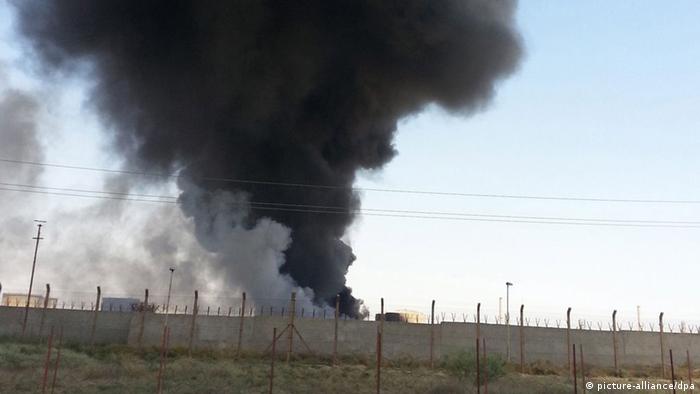
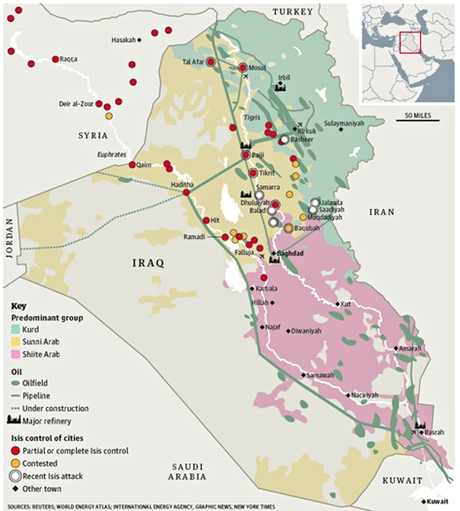
ISIS militants are selling oil from their conquered territories, further fueling tensions in the region. This has caused uncertainty on the world market, but could also lead to a drop in global oil prices.Source: ISIS, oil and war

Submitted by Andrew McKillop, 12Aug2014

Oil and Humanitarian War

Portraying American intervention in Iraq as a purely humanitarian effort, president Obama is following the same script he read in March 2011 for Libya, when he justified American intervention as an effort to prevent a civilian massacre in Benghazi. In 2011 he addressed the American nation and said the US was acting militarily, without “boots on the ground”, as a response to “brutal repression and a looming humanitarian crisis.”

Obama was much too polite to mention oil at the time, and again today when it concerns Iraq. Libya in 2011 was the world’s sixteenth-largest world producer and was supplying about 19.5% of all European oil imports at the time, but since 2012 the oil production of Libya is much lower and very erratic.

Toppling the regime of Muammar Qaddafi was seen by Obama's advisors and Secretary of State Hillary Clinton as easier than toppling Saddam Hussein of Iraq. But as in Iraq in 2003, US strategists claimed that they would open a gateway to more and further oil supplies from Libya.

Iraq today supplies almost exactly twice as much oil to world importers as Libya did in 2011 - but no longer does. Depending on he state of sectarian fighting in Libya, oil exports by Libya can be practically zero. Now that Obama has moved “on and up” to Iraq he has seriously raised the stakes. Taking Iraq out of the world oil export “supply loop” would almost certainly cause enough supply shortage that oil prices would “bounce” out of their current downward trend below the “magic three-digit” price in US dollars per barrel, of $100.

Is this the real US strategy?

When Libya fell apart and descended into chaos, and its oil production plunged from 2012, this did nothing to bounce oil prices upwards. This was because of ultra-basic reasons of supply and demand – world oil markets were more than amply supplied and the loss of Libya had no impact. Doubling the stakes in Iraq, however, can achieve the goal of a $150-per-barrel “sticker price”, if very high-priced oil, which will be very bad for the global economy, is the real goal.
 
Libya Times Two or Times Five?

ISIS to date has captured around $1.25 billion worth of American supplied military equipment according to Turkish media including 'Daily Sabah', most spectacularly in June when the IA-Iraqi Army threw off their uniforms and ran on the approach of ISIS to Mosul. ISIS was far fewer in numbers (below 10,000) and far less equipped than the IA around Mosul at that time but this is certainly not the case today.

Although ISIS has a probably low number of captured Middle Eastern versions of US M1 Abrams tanks, built in Egypt, it has larger numbers of Russian T-55s and T-72s captured in Syria, and at least 350 – 1500  US Bradleys, Humvees and other armored cars, a few military helicopters, some Manpads anti-aircraft missiles, at least 50 - 100 field howitzers, multiple rocket launchers and large numbers of anti-tank RPGs. It also has very large stocks of ammunition and other military supplies including night fighting equipment. ISIS also probably obtained a large part of the estimated $425 million of deposits held in Mosul banks when it took the city in June, and may be able to use this to buy weapons.

No reliable estimate exists of actual field numbers of ISIS fighters today, but they are growing. Controlling the Mosul and Haditha dams supplying Mosul and a string of cities to Baghdad in the south, and numerous electric power plants and water-sewage infrastructures it can paralyze Iraq when it wants. Under a worst case scenario, ISIS kamikaze “scorched earth tactics” can also enable it to paralyze oil production, refining and transport infrastructures across a swath of northern Iraq.

Outside the US and inside the Middle East warnings of this threat have multiplied for several months but Obama and his administration “didn't want to know”. We therefore have to ask if his administration wants a run-up of world oil prices as in 2008, which helped create or trigger the 2008 financial crisis which endures today?

Why High Oil Prices

We can list several supposedly-perverse reasons. Both Goldman Sachs and the so-called energy market maker banks including JP Morgan, Barclays and Societe Generale have tirelessly worked to push oil market prices – upward – since the brief crash of oil prices in 2009 when prices fell, for a short while, to about $40 per barrel. The energy market maker banks and the major brokers like Goldman Sachs have abandoned the coal, natural gas and most recently electric power markets, following major regulatory investigations and large penalties on their price-rigging. This has led Deutsche Bank to abandon all energy and commodities market activity. 

The oil market is however still under their control. 

World oil and gas spending on exploration and production, and its financing benefits directly from high oil prices. This spending was running at around $640 billion in 2013 according to estimates from Citigroup, Barclays and Morgan Stanley. Major loans for this activity are directly dependent on oil prices staying high.

Continuously high oil prices are forecast by the International Energy Agency as certain for at least the next 20 years, to 2035.

High oil prices are the cornerstone of the so-called “low carbon strategies” to beat global warming and develop alternate and renewable energy supplies, using state subsidies. High oil prices are also a major support factor for maintaining, or increasing inflation which is judged necessary or vital by central bank chiefs including Janet Yellen and Mario Draghi. High oil prices therefore provide another rationale for “print and forget” quantitative easing.

The near-automatic increase in daily traded oil prices when equity markets rise is another proof of the vital role for high oil prices in financial asset expansion, albeit totally fictitious.

Sabotaging Iraq's oil supply to the world after the “non-performance” of allowing or encouraging Libya to descend into chaos, is therefore logical. Geopolitically however, regional Middle Eastern states facing serious economic difficulties as “blowback” from the G7 Group's enduring economic crisis will be active also in Iraq, not only in humanitarian-designated military action.

The Obama administration may or may not want high oil prices, but its actions to date only lead to that conclusion.