Search Blog Posts

Showing posts with label Military. Show all posts

Wednesday, May 6, 2015

DEATH STALKS US SAILORS JUST BENEATH THEIR UNWARY CREWS


Despite Numbers, Experts Question Combat Effectiveness

WASHINGTON — The Russian Navy's submarine force is on a roll.
Four different kinds of submarines are under construction and more are coming. The country expects to lay down five new nuclear submarines in 2015.

The Navy is accepting Borey-class nuclear-powered ballistic missile submarines, Yasen-class nuclear attack submarines, and Kilo- and Lada-class diesel electric attack submarines. Six Kilos are being built for Vietnam and more are offered for export.
This rate of construction is beginning to look more like Cold War days rather than the lethargic shipbuilding rates prevalent since the 1990s.

By comparison, the US only recently returned to building two nuclear attack submarines per year, and industry is gearing up to begin construction of a new class of ballistic submarines in 2021 — a three-subs-per-year construction rate not seen since the Reagan era.

Combine the revived Russian submarine construction rate with President Vladimir Putin's aggressive stances of the past year, along with the steady drumbeat of Chinese naval expansion, and the question might be asked — is a submarine race going on?

"I know a lot of folks like the term arms race, but I think it's more complicated than that," said Thomas Mahnken, a former US defense official and now a professor at the Naval War College. "There's definitely competition going on — with the US, other NATO navies, China — but there's also modernization going on. An increasing portion of what Russia is doing is replacing aging systems or systems that already have been retired."

"I would be skeptical," cautioned Norman Friedman, a longtime naval analyst and author. "There's a history in that country of laying down things that don't get finished for a long time. No question they'll lay down the subs, but actually building them after that is a more interesting question."

The Russians frequently issue proclamations that they intend to increase naval construction, including statements about building a fleet of aircraft carriers. But ship construction remains modest, and the Navy remains largely a collection of Cold War relics. Yet Russia has a long tradition of building tough and innovative submarines.

"The Russians have put their money where their mouth is with regard to submarine construction and development," said Bryan Clark, a former US Navy submariner and strategist, now an analyst with the Center for Strategic and Budgetary Assessments. "They see that as a way to generate an asymmetric advantage over US forces. If they can develop a really high-end submarine force like they did in the Cold War, it would create a problem for US naval planners and strategists thinking through how to deal with a potential Russian threat — one that could emerge without a lot of warning."

Construction Delays

The most lethal new subs are those of the Yuri Dolgoruky class, also known as the Project 955 Borey class. Construction of the Dolgoruky has been a protracted affair — the ship was laid down at the Sevmash military shipyard in Severodvinsk in 1996 but not launched until 2007. Sea trials began in 2009, but development of the ship's primary weapon, the Bulava intercontinental ballistic missile (ICBM), itself has been fraught with problems. It was only in 2014 that the submarine submerged with a full load of 16 ICBMs, according to Russian media.

A second Borey, the Alexander Nevsky, was laid down in March 2004 and began sea trials in 2011. Like the Dolgoruky, the ship and its missiles have experienced numerous problems, and trials continued at least through 2013. Vladimir Monomakh, the third Borey, was commissioned last December after eight years of construction and trials.

Three more Boreys are under construction, and Russian Navy chief Adm. Viktor Chirkov said in December two more would be laid down in 2015, for a total of eight, all expected to be in service by 2020.

The design of the Dolgorukys uses many features of earlier submarines. In fact, the first units used pieces and components built for earlier submarines that were either scrapped or never finished. Russian media reports indicate the Vladimir Monomakh used significant hull components of the decommissioned Akula-class attack submarine Ak Bars.

"I get the feeling for all the big talk from the Russians about building a new fleet, they're probably having trouble getting stuff," Friedman said. "For the first subs, they used pieces from earlier subs."

The Dolgoruky carried out an operational test firing of a Bulava in October, the Itar-Tass news agency reported — the third successful test launch since a September 2013 failure — and two more will take place in 2015.

Meanwhile, construction of Yasen-class Project 885M nuclear attack submarines is picking up. The first unit, Severodvinsk, was commissioned at the end of 2013 after a 20-year construction period, during which the submarine underwent significant re-design. A second unit, laid down in 2009 at Sevmash, could be delivered this year.

Two more Yasens were laid down in 2014. Itar-Tass reported on Dec. 26 that Mikhail Budnichenko, head of Sevmash, said three Project 885 Yasen-class subs would be laid down this year along with two Boreys.

Non-nuclear submarine construction also continues. Along with several Kilo-class subs being built for the Russian Navy and export, at least one more Lada-class diesel-electric submarine is to begin construction this year.

Numbers vs. Effectiveness

But can Russia sustain this prodigious submarine construction effort?

"The naval production we're likely to see this year is an artifact of decisions made some time ago when oil prices were fairly high and before a number of Western countries imposed sanctions on Russia," Mahnken said. "Whatever the Russians do this year, I think it'll be very hard for them to sustain naval production going forward."

Added Friedman: "Putin doesn't have that much money. And with the drop in oil prices, they have very bad problems."

With the post-1990 decline in shipbuilding, Friedman said, the shipyards have lost much of their submarine-building expertise.
"A lot of people quit the yards" when construction all but ended, he said. "If they lost a lot of their smarter people, there's a difficulty in recreating what they had. Coming back 15 years later and trying to recreate it is kind of dubious."

Clark agreed.

"Their industrial base is weakened from two decades of not being used," he said. "You've got a significant reduction in the number of skilled engineers, the aging out of people who otherwise would be part of the Russian design base.

"While Russian engineering and technology development is top-notch, they don't necessarily have the people to be able to do all the legwork necessary to take an idea into a reality. That's why you see things like submarines taking 10 or more years to construct, because they just don't have the design and construction base to support high-rate production."

But are the new submarines cause for worry?

The Yasen attack subs "are probably what you could get in 1989, plus improved combat systems," Friedman said. "They got access to microprocessors and things like that. But they're not going to the insertion of new technology, because they're not that flexible. But I would guess the combat systems have improved substantially."

Clark sees no cause for alarm in the pace of Russian submarine construction.

"They don't have very many submarines today, and they certainly don't have very many frontline submarines that would be anywhere close to US submarines," he said. "The best submarines the Russians are producing are perhaps equivalent to some of the older US submarines currently in use. It would take a while for the Russians to build up enough of those to where they create a potential problem for the US.

"The main concern," Clark added, "is that even a small number of very good submarines can be problematic from an intelligence-gathering and surprise strike kind of perspective. But they're not able to cause a debilitating effect to a fleet."
E-mail ccavas@defensenews.com

Tuesday, April 28, 2015

Members of U.S. Military have no Recourse if they Suffer from Poor Medical Treatment


Tuesday, April 28, 2015
Military patient being moved between Walter Reed and National Naval medical centers (photo: Pablo Mercad, Walter Reed)
 
Serving one’s country not only means putting yourself in harm’s way before a foreign enemy, it also means putting your health in the hands of a military health system that has no real accountability for making fatal mistakes.

In the civilian world, a patient who is misdiagnosed and harmed by such a mistake can sue their doctor for malpractice. But this recourse does not exist with the military’s health providers, who can miss a serious medical problem with an individual and not worry about being taken to court, or even have their mistake shared with other patients.

About 1.3 million active-duty service members have to use the military’s healthcare system for care. For those who experience poor treatment, they are “virtually powerless to hold accountable the health care system that treats them,” according to Sharon LaFraniere at The New York Times.

“They are captives of the military medical system, unable, without specific approval, to get care elsewhere if they fear theirs is substandard or dangerous,” LaFraniere wrote. “Yet if they are harmed or die, they or their survivors have no legal right to challenge their care, and seek answers, by filing malpractice suits.”

Up until 18 months ago, most military personnel couldn’t even file complaints about poor medical treatment. But even though that avenue is now open, the complaints are mostly just filed away and don’t see the light of day, nor are they shared with the public because “investigations at military hospitals and clinics are confidential.”

Part of the reason for that, according to LaFraniere, is to prevent the 2 million or so civilian relatives of those service members from seeing the results, since they are not barred from filing malpractice suits. Even the military personnel themselves are not informed of the results of any inquiry that may have been undertaken in response to their complaints.

Cheryl Garner, a retired military intelligence officer told the Times: “There is just no transparency. You can’t sue. You have no insight into the process. As active duty, we just don’t have much recourse.”

Compounding the problem is the fact that the hospitals themselves don’t follow regulations. “Military hospitals often fail to conduct safety investigations that the Defense Department mandates when patients suffer serious harm or die,” wrote LaFraniere.

Potential whistleblowers are also dissuaded for calling attention to matters they see as being detrimental to patients. Medical workers who do speak out about problems with patient care often suffer reprisals.

In a project that has helped to reduce patient injuries, some military medical officials are adopting a program called I-PASS, which is a system of training and communication tools to improve transfer of patients between medical providers. About 80% of serious medical mistakes that are detrimental to patient health and wellbeing occur as a result of miscommunication between caregivers during the handoff of patients from one health care facility to another, according to The Joint Commission, a non-profit group of more than 20,500 U.S. health care organizations. Nine civilian hospitals have already partnered with military medical officials to implement the program. To date there has been a reported 30% reduction in patient injuries caused by medical errors as a result of the employment of I-PASS, according to a study performed by Walter Reed National Military Medical Center and the Uniformed Services University of Health Sciences, both of which helped develop the program.

-Danny Biederman, Noel Brinkerhoff
To Learn More:
Service Members Are Left in Dark on Health Errors (by Sharon LaFraniere, New York Times)

Saturday, April 4, 2015

Remove US military bases from Latin America - UNASUR chief

Published time: April 01, 2015 07:26

US soldiers walk after landing at the Muniz Air National Guard Base in San Juan, Puerto Rico (Reuters / Alvin Baez-Hernandez)

Latin American countries should discuss removing all US military bases from their soil, a top official of integration organization UNASUR suggested. The issue may be discussed next month at the upcoming Summit of the Americas in Panama.
 
The Summit of the Americas on April 10 and 11 is to be attended by regional leaders, with 31 nations already confirming attendance. UNASUR Secretary-General Ernesto Samper suggested that the summit would be a good place to “reassess relations between the US and South America.”
 
“A good point on the new agenda of relations [in Latin America] would be the elimination of US military bases,” the former Columbian president told the news agency EFE. 

He added that the bases were “a leftover from the days of the Cold War and other clashes.”
 
READ MORE: 5mn Venezuelans sign petition against US aggression & interference
 
Samper also blasted Washington’s habit of taking unilateral steps to pursue its goals in Latin America. The latest example is the US declaration of Venezuela as a threat to its national security, he said.
 
“In a globalized world like the present one, you can't ask for global rules for the economy and maintain unilateral rules for politics. No country has the right to judge the conduct of another and even less to impose sanctions and penalties on their own,” he stressed.

Secretary General of the Union of South American Nations (UNASUR) Ernesto Samper (Reuters / Carlos Garcia Rawlins)

The Panama meeting has already been declared historic as it will be the first one attended by Cuba since 1962, when it was expelled from the Organization of American States (OAS), the event’s organizing body. In 2014, the US and Canada blocked the proposal to readmit Cuba, which drew criticism from UNASUR and a boycott of last year’s summit of the Americas by Ecuador and Nicaragua. 

This year Cuban President Raul Castro will have an opportunity to meet his US counterpart Barack Obama, marking progress in the restoration of US-Cuban relations after decades of alienation.

Samper said that the Cuban-US rapprochement should not overshadow Washington’s conflict with Caracas, which is also sending a delegation to the Panama summit, the continued operation of the prison at Guantanamo Bay, US militarization of the continent and other issues.

The Union of South American Nations (UNASUR) is a regional integration organization that includes 12 members and two observer nations. It was formally founded in 2004 and became fully functional in 2011, when its Constitutive Treaty entered into force following ratification by member states. UNASUR is headed by a president chosen from heads of member states, but the secretary-general performs the bulk of the organizational work.  Source

Do Heroes Go to Heaven?


Over the past decade or so I have witnessed some disturbing trends at church. One would have thought that our Lord Jesus Christ had, himself, worn a government-issued uniform, given how much reverence, gratitude, and appreciation we are led to collectively express for these folks during Mass. At first, it was a weekly prayer “for the troops,” which is fine. There is no human being, alive or dead, who doesn’t need prayers.

However, we never prayed for the innocent civilians in the countries Americans had invaded, who were killed, maimed, and tortured in far greater numbers than Americans.

We never prayed for the loved ones they left behind, the widows, the orphans.

We never prayed for the refugees.

We never prayed for our enemies.

The secular state holidays have become occasion for military remembrance and honorary tribute. On Memorial Day and Veterans Day, the church bulletin includes a message of thanks to veterans for protecting Americans’ freedom, which sends the message to churchgoers that American “wars” abroad have something to do with the Bill of Rights here at home, and the wars are therefore necessary and just (a dubious notion at best). At some point, militarism began to invade Christmas with camouflaged Christmas ornaments and patriotic displays upstaging the Eucharist.

In the last year, the Catholic Church has expanded its prayers to allow more folks in uniforms to get in on the prayer action. In addition to (or in lieu of) praying for military servicemen and women, Catholic Churches are now offering weekly prayers on Sundays for all “first responders.” One wonders how this became a national “thing.” (I have heard it in several states). It seems to mesh nicely with the overall message in the mass media that we are all on the brink of ruin all the time, threatened by an inexhaustible number of enemies and looming crises, and should live in fear and trembling awaiting the next crash, attack, disaster, or pandemic; thus we owe an infinite debt of gratitude to those who offer us safety, order, and protection in such a precarious and nefarious world. (Hm. Who benefits when we have a nation of nervous Nellie’s?)

Things seem to have reached a new threshold with American Sniper. We now have American priests coming right out and saying things in the media like: “Chris Kyle was an American hero.”

The primary concern of the Church is the salvation of souls. 

Christians are concerned with holiness, not heroism. Whether Chris Kyle was an American hero is a secular idea and a moot point, and a strange pronouncement for a priest to make, unless that priest is willing to ask the questions that naturally follow: Does heroism lead to holiness? Do heroes go to heaven? Before you write me an email vilifying me as a “liberal” who “hates” soldiers for asking these questions, let me say: I do not know if “heroes” go to heaven. Nobody knows. Only God can judge the human heart. What I’m saying is: it is dangerous to pretend that they automatically do. It’s also dangerous to pretend that the question I am asking is, itself, a moot point.

When churches and religious leaders constantly adore, praise and worship those who wear uniforms, carry guns, and embody secular ideas of heroism, it leads to misunderstanding and moral confusion among the faithful. People begin to equate this image of heroism with holiness, especially children. If you don’t believe me, all you have to do is take a look at www.nogreaterloveart.com, where uniformed government agents are depicted with angels’ wings, angels of course being spiritual beings who are known for their ability to guard and protect. All you have to do is look at the “Soldier’s Stairway to Heaven,” very popular on Pinterest, or license plates and t-shirts that quote John 15:13 and hold up the service of the soldier as being second only to the “service” of Jesus

There is an idea that if you have fought in a war, you have “served your time in hell”; soldiers therefore go straight to heaven. But is such an idea spiritually and theologically acceptable? Does God offer bypasses?

Heroism and holiness have many things in common: They both require strength, courage, devotion, fortitude, self-sacrifice. But all of those qualities could be attributed to people fighting for ISIS just as well, even faith. According to the Catechism of the Catholic Church: “The way of perfection passes by way of the Cross. There is no holiness without renunciation and spiritual battle.”  There is no holiness without renunciation; that does not mean that every act of renunciation leads to holiness. The way of perfection requires hardship; not all hardship helps us on our way to perfection. In short, not all suffering is redemptive. Finish reading article

THE WAR PRAYER - Mark Twain *vid*


Uploaded on Apr 13, 2011 
Featured at Animation Film Screening at OSA Archivum in Budapest, Hungary to commemorate UN Human Rights Day, December 9, 2010. 
From OSA Program: The War Prayer (Markos Kounalakis, USA, 2006, 14 min) Based on Mark Twain's piece "The War Prayer," a short story written in the heat of the Philippine-American war of 1899-1902 offering a poignant reflection on the double-edged moral sword implicit to war. 

Followed by discussion with Markos Kounalakis, a Senior Fellow at the Center for Media and Communication Studies at the Central European University in Budapest, Hungary and President and Publisher Emeritus of the Washington Monthly. Moderator -- Oksana Sarkisova, Film Historian, OSA Archivum. 

From Wikipedia Notes: "The War Prayer," a short story or prose poem by Mark Twain, is a scathing indictment of war, and particularly of blind patriotic and religious fervor as motivations for war. The structure of the work is simple, but effective: an unnamed country goes to war, and patriotic citizens attend a church service for soldiers who have been called up. The people call upon their God to grant them victory and protect their troops. Suddenly, an "aged stranger" appears and announces that he is God's messenger. 

He explains to them that he is there to speak aloud the second part of their prayer for victory, the part which they have implicitly wished for but have not spoken aloud themselves: the prayer for the suffering and destruction of their enemies. What follows is a grisly depiction of hardships inflicted on war-torn nations by their conquerors. 

Friday, April 3, 2015

US Militarism Far Bigger Threat to American Liberty Than Russia


(Jacob G. Hornberger)  George Washington pointed out, “Overgrown military establishments, which under any form of government, are inauspicious to liberty, and which are to be regarded as particularly hostile to Republican Liberty.

Wise words by the father of our country, but ones, unfortunately, rejected by modern-day Americans, who love and idolize the enormously overgrown military establishment that now characterizes our federal governmental system.

Eastern Europeans are getting a gander at America’s overgrown military establishment. Yesterday, the New York Times reported that a huge contingent of U.S. military forces is winding its way through Eastern Europe as some sort of good-will tour and also to serve as a message to Russia that the United States is ready to go to war to protect Eastern Europe from Russia’s aggressive designs.

Never mind that it is America’s overgrown military establishment that gave rise to Russia’s so-called aggressive designs. Ever since the end of the Cold War, NATO has been absorbing Eastern European countries with the ultimate aim of absorbing Ukraine, which would enable the U.S. military to place bases and missiles on Russia’s borders.

There was never a possibility that Russia was going to let that happen, any more than the U.S. national-security establishment would permit North Korea to place military bases and missiles on Mexico’s side of the Rio Grande. In the eyes of those who believe that America’s overgrown military establishment can do no wrong, that makes Russia the aggressor in the crisis.

But let’s face it: These people are ingenious at producing crises and then playing the innocent. The fact is that NATO should have been dissolved at the end of the Cold War. It wasn’t dissolved for one big reason: in order to produce endless crises with Russia so that Americans would feel the need to keep their overgrown, Cold War-era, military establishment in existence.

Moreover, under what authority is America’s overgrown military establishment telling Eastern Europeans that the United States will come to their defense in a war against Russia? I thought that under the U.S. Constitution it is the responsibility of Congress to decide when America goes to war. The U.S. military march through Eastern Europe is just another sign of how the national-security branch of the federal government — the most powerful branch — calls its own shots when it comes to foreign policy.

Moreover, it’s a sign of the times when America’s overgrown military establishment is our country’s good-will ambassador. It used to be that the American private sector served that purpose. Not so anymore. Now, it’s U.S. generals and other military personnel who serve that purpose, as they parade through Eastern Europe showing off their tanks and other military equipment, just like the Soviets did in their May Day parades. Continue reading
 

Obama Told This Admiral Not To Give Out Bibles, His Response Is Glorious


Obama’s agenda to keep the Bible out of the hands of our Military is in full swing. If there is only one speech you have to see that takes him down, THIS IS IT!!!

The Government is telling soldiers that if a person is in need, or even contemplating suicide to send them to a Chaplain and do nothing else.

But what if the opportunity to save a life is here and now, in the moment?

This Rear Admiral says that no matter what he is told by the Government he will share the Bible when and where it is needed.

This man of true Faith is what we need right now in this country to lead us back to greatness. He took a stand against those who wish that the Bible didn’t exist and not back down from a fight!

Wednesday, April 1, 2015

How Long Would the US Navy Survive in a Shooting War?

US Navy is a huge force but largely based around aircraft carrier groups that modern weaponry may have made obsolete
Military 7 hours ago | 2200 32
 
Carriers today may be sunk from air, land or sea America sees itself as a ruler of the world’s oceans. After all, the country — which spends 10 times more on its military forces than the following nine countries — has by far the biggest naval force. And as since the Vietnam War they have dealt only with militarily inferior opponents, they are extremely self-confident in their belief that they can defeat everything and everyone. It is not surprising that some young Americans even wear T-shirts with the logo: “United States Navy: The Sea is Ours.”

Perhaps we need to meet this pride and arrogance with some understanding in view of the numerical superiority of the U.S. Navy. In total, it currently has 10 operational aircraft carriers (two in reserve), while Russia and China have only one each.

Aircraft carriers are the great pride of the U.S. Navy and are also perfect to underline visually the claim of the ruler of the seas. They are therefore well liked by U.S. presidents as stages for delivering speeches when the time comes to tell the people that this unique nation has once again won a heroic victory.

What thrilling moments these were (at least for Americans) when George W. Bush landed in a fighter jet on the USS Abraham Lincoln (no, not as a pilot) and then, with the words “mission accomplished” and “a job well done,” proclaimed the end of the Iraq war to the people. As we know, the destruction of Iraq was carried out by the Americans under the label of Operation Iraqi Freedom. We may still ask ourselves what it had to do with freedom, but that’s a different story.

In addition to their suitability as impressive orator stages, the aircraft carriers also fulfill, of course, a military purpose. They can be considered as small floating airports, which ship up to 100 fighter jets to the scene of the action. Since they are equipped with the best weapons, radar, and defense systems, until now they have experienced almost no threat, especially since in the past the U.S. Navy parked them preferably off the coasts of defenseless desert states.

But what would it look like if the power of the U.S. Navy met its peer? The title of this article already implies the answer: not so good, and it could be that the patriotic U.S. Navy fans would hide their T-shirts quickly in the closet.

Back in the 70s, Admiral Rickover, the “father of nuclear navy,” had to answer the question before the U.S. Senate: “How long would our aircraft carriers survive in a battle against the Russian Navy?” His response caused disillusionment: “Two or three days before they sink, maybe a week if they stay in the harbor.”

The reason for the greatly reduced lifetime of the aircraft carrier in a battle against the Russians is a deadly danger below the water: modern submarines — especially Russian ones — are so powerful and difficult to locate that they can send large battleships and aircraft carriers to the bottom of the sea in the blink of an eye. The weakness of the U.S. Navy, therefore, is their vulnerability when they compete with an enemy that — using the language of the Americans — dominates the seas below the water surface. Of course, the U.S. military analysts are aware of this weakness, so one wonders why the U.S. Navy still adheres to the doctrine “the bigger the better” and continues to rely on an armada of aircraft carriers and large battleships.

Colonel Douglas McGregor, a decorated combat veteran, author of four books, a PhD and military analyst, gives the answer: “Strategically, it makes no sense, but the construction of large ships, of course, creates a lot of jobs.”

So the threat of Russian submarines, torpedoes and anti-ship missiles is well known by the Americans — a fact which Roger Thompson’s book, Lessons Not Learned: The U.S. Navy’s Status Quo Culture, also points out. A brief excerpt:
As Howard Bloom and Dianne Star Petryk-Bloom advised in 2003, both the Russians and Chinese now have the deadly SS-N-22 Sunburn missile at their disposal. This massive long-range missile, equipped with nuclear or conventional warheads, is extremely difficult to detect or destroy. According to Jane’s Information Group, it is more than capable of destroying any U.S. aircraft carrier. More to the point, Timperlake (a Naval Academy graduate) and Triplett warned that the Sunburn missile is designed to do one thing: kill American aircraft carriers and Aegis-class cruisers.

The SS-N-22 missile skims the surface of the water at two-and-a-half times the speed of sound until just before impact, when it lifts up and then heads straight down into the target’s deck. Its two-hundred-kiloton nuclear warhead has almost twenty times the explosive power of the atomic bombs dropped on Hiroshima. The U.S. Navy has no defence against this missile system. As retired Admiral Eric McVadon put it: “It’s enough to make the U.S. 7th (Pacific) Fleet sink twice.”
In addition to this concept-related, almost inevitable weakness of large warships, there is another reason for the vulnerability of the U.S. Navy and the U.S. armed forces in general: their arrogance and the associated underestimation of their opponents. Anyone who underestimates his enemy grows imprudent and holds bad cards in the event of a surprise attack. This happened in 2000, when the American aircraft carrier USS Kitty Hawk was caught by the Russians on the wrong foot.

Here are some excerpts from Jon Dougherty’s article, “Russian Navy takes Flyover by Surprise” (World Net Daily):
A pair of Russian warplanes that made at least three high-speed passes over a U.S. aircraft carrier stationed in the Sea of Japan in October constituted a much more serious threat than the Pentagon has admitted and were easily in a position to destroy the ship if the planes had had hostile intentions, say Navy personnel.
According to reports, a Russian air force Su-24 “Fencer” accompanied by a Su-27 “Flanker” made unopposed passes over the USS Kitty Hawk on Oct. 9, as the carrier was being refueled.
Russian fighters and reconnaissance planes made a second attempt to get close to the carrier on Nov. 9 — a repeat performance for which the Pentagon, as well as eyewitnesses aboard ship, said the carrier was prepared. But it was the first incident in October that caused alarm.
Pentagon spokesman Kenneth Bacon said during a regularly scheduled press briefing Nov. 30 that the Russian fighters were detected on radar well in advance of their high-speed passes. Naval officers aboard ship who spoke of the incident on the condition of anonymity agreed.
However, at the time the carrier’s combat information center alerted the ship’s commander, Capt. Allen G. Myers, that the Russian fighters were inbound, none of the carrier’s fighters were airborne. The ship carries 85 aircraft, according to Navy figures, and has a crew of over 5,500. 
Witnesses said Myers immediately ordered the launch of alert fighters, but the ship’s scheduled fighter squadron was on “Alert-30” status — a minimum launch time of 30 minutes where pilots are “in the ready room” but are not sitting in cockpits waiting to be launched.
Bacon told reporters only that there “may have been a slight delay” in getting the interceptors in the air, explaining that because the Kitty Hawk was taking on fuel, it was not sailing fast enough to launch its aircraft.
One naval officer onboard the ship said, “40 minutes after the CO [commanding officer] called away the alerts,” the Russian planes “made a 500-knot, 200-foot pass directly over the tower” of the carrier.
Before the Kitty Hawk could get a single plane airborne, the Russian fighters made two more passes. Worse, witnesses said, the first plane off the deck was an EA-6B Prowler — a plane used primarily for electronic jamming of an enemy’s radar and air defenses, not a fighter capable of intercepting another warplane.
The EA-6B “ended up in a one-versus-one with a Flanker just in front of the ship,” one witness said. “The Flanker was all over his a.... He was screaming for help when finally an F/A-18 Hornet from our sister squadron got off the deck and made the intercept. It was too late.”
Naval personnel noted that “the entire crew watched overhead as the Russians made a mockery of our feeble attempt of intercepting them.”
The Clinton administration downplayed the incident .... The BBC, however, said that it was evident by the photographs taken by the Russian jets that there was “panic aboard” when the planes made their over-flights.
Our American readers will now perhaps argue that this humiliating incident happened 15 years ago and such a thing is no longer possible nowadays. But most readers of Russia Insider remember the events of April 2014 when the ultra-modern destroyer USS Donald Cook was paralyzed by a single SU-24.

For those readers who unfortunately missed the story, here it is: At the beginning of April last year the Americans sent the USS Donald Cook into the Black Sea, with the permission of Turkey, to protest against the Russian annexation of Crimea and to demonstrate their military strength. The destroyer was equipped with the most advanced Aegis Combat System, a naval weapons systems which ensures the detection, tracking and destruction of multiple targets at the same time. In addition, the USS Donald Cook is equipped with four large radars, whose power is comparable to that of several stations. For protection, it carries more than 50 anti-aircraft missiles of various types.

According to the “Montreux Convention,” non-Black Sea state warships are permitted to stay in the Black Sea for no longer than 21 days. The Americans, of course, ignored this rule, and Russia responded by sending an SU-24. The Sukhoi was unarmed but equipped with the latest electronic warfare device, called Khibiny.

When the SU-24 approached the destroyer, all radar and control systems, information transfers, etc., of the USS Donald Cook were suddenly paralyzed by Khibiny. In other words, the seemingly superior Aegis system was completely off — like when you turn off your TV with the remote control.

Subsequently, the Sukhoi simulated 12 missile attacks at low altitude on the virtually blind and deaf USS Donald Cook, and we can imagine that the two SU-24 aircraft pilots had a lot of fun. 

Unfortunately, at this time there was neither John McCain nor NATO Commander Phillip Breedlove on board the ship — they would certainly have received some long-lasting impressions from this demonstration.

After this incident, the USS Donald Cook chose to immediately and at full speed move towards a port in Romania, where 27 shocked crew members asked for dismissal from the service.

This story shows us that Americans still overestimate the capabilities of their armed forces and do not realize (or do not want to admit) that Russia’s military technology is in many areas superior and has an advantage that cannot be offset quickly.

So, as long as a single Russian fighter jet can turn off a complete U.S. warship with the latest warning and fire control systems by just pushing a button, the answer to the question “How long would the U.S. Navy survive?” today is the same as in the old Cold War days. Source

Why is the US military making fake social media accounts?

Swaying public opinion 


More videos like this
 

An insidious practice

The US military has been given software which can create fake online social media personas.

These accounts are used to “create false consensus in online conversations, crowd out unwelcome opinions and other commentaries or reports that do not correspond with its own objective”.

They may not be controlling the internet directly, but such covert manipulation of online conversations is just as destructive, and worlds more deceitful.


Friday, March 27, 2015

US military officers resort to lying and deception at all levels, finds damning official report

  • Shock 52-page report finds dishonesty at all levels in the U.S. Army 
  • Warns officers have become 'ethically numb' and urges quick action 
  • Says leaders 'espouse lofty values' but slog 'through mire of dishonesty' 
  • Finds personnel expect requested information to be 'questionable' 
  • But notes staff are 'happy to go along with the illusion all is well'  
Published: 08:55 EST, 20 February 2015

A damning official report claims dishonesty within the U.S. military is so endemic that everyone assumes they are being lied to at all times.

The shock report calls on officials to 'urgently confront the corrupting influence of dishonesty' within the army, warning officers have become 'ethically numb'.

The situation has become so bad, the executive summary concludes it has 'allowed leaders to espouse lofty professional values while slogging through the mire of dishonesty and deceit'. 
Dishonesty: The report claims dishonesty is endemic in the army on all levels, discovering personnel expect to not be told the truth at certain points, and accusing officers of becoming 'ethically numb' (Stock picture)

The report's executive summary also claims 'much of the deception and dishonesty... is actually encouraged and sanctioned by the military institution'.

Report authors Leonard Wong and Stephen J. Gerras say it is often justified one of three ways: 'mission accomplishment', 'supporting the troops' or that the task or reporting requirement is unreasonable or 'dumb'.

They go onto note lying and 'adjusting the truth' is so common, military personnel who order a report do not trust its content.

The report authors, who interviewed staff at all levels in the army in order to compile the 53-page document, state: 'It appears that a peculiar situation where those requesting the information, and those supplying it know that the information is questionable.'

However, they add, personnel are 'happy to go along with the illusion all is well'.  
Concerns: Former U.S. Defense Secretary Chuck Hagel sent a memo to military leaders before he stepped down from his post asking to deal with 'unethical or morally questionable behaviour'

The report, created for the Strategic Studies Institute and U.S. Army War College Press, say comes just a week after departing Secretary of Defense Chuck Hagel's final words of advice to senior military staff were to sort out 'unethical behaviour'.

According to CNN, Hagel wrote: 'The vast majority of our senior leaders are men and women who have earned the special trust and confidence afforded them by the American people.

'However, when senior leaders forfeit this trust through unprofessional, unethical or morally questionable behavior, their actions have an enormously negative effect on the profession.' 

via dailymail

Mossad Chief Secretly Met With Top U.S. Officials Including Sitting Senators


The Intel Hub
February 1, 2012

A clandestine Washington visit by Mossad Chief Tamir Pardo, in which he privately met with multiple Senators and other top officials, was revealed in testimony  during a hearing of the Senate Select Committee on Intelligence attended by CIA director David Petraeus (CFR) and Intel Chief James Clapper.

Thursday, March 5, 2015

Being a CFR Member Makes Gen. Petraeus: Too Big to Jail

MORE ON THE PETRAEUS CRIMES AND COVERUP BELOW-

Exclusive: While lesser Americans face years in jail for leaking secrets – even to inform fellow citizens of government abuses – retired Gen. David Petraeus gets a misdemeanor wrist-slap for exposing covert officers and lying about it, says ex-CIA analyst Ray McGovern, who was jailed just for trying to ask Petraeus a question.
By Ray McGovern

The leniency shown former CIA Director (and retired General) David Petraeus by the Justice Department in sparing him prison time for the serious crimes that he has committed puts him in the same preferential, immune-from-incarceration category as those running the financial institutions of Wall Street, where, incidentally, Petraeus now makes millions. By contrast, “lesser” folks – and particularly the brave men and women who disclose government crimes – get to serve time, even decades, in jail.

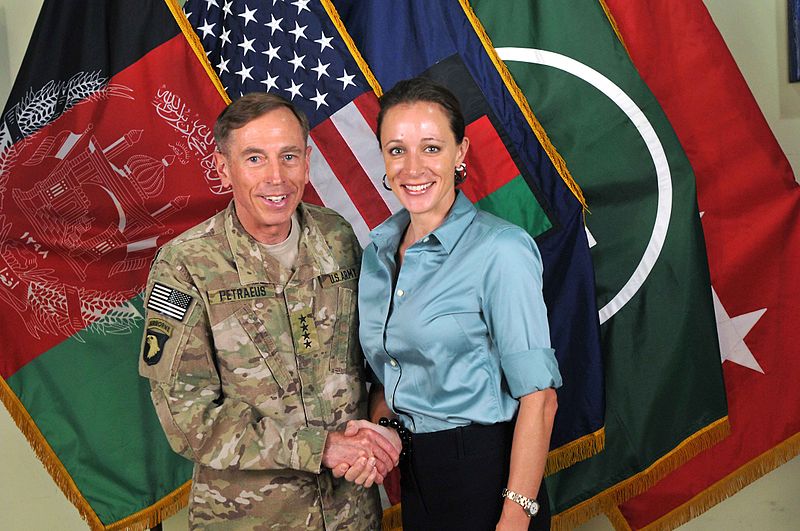
Gen. David Petraeus in a photo with his
biographer/mistress Paula Broadwell.
(U.S. government photo)
Petraeus is now a partner at KKR, a firm specializing in large leveraged buyouts, and his hand-slap guilty plea to a misdemeanor for mishandling government secrets should not interfere from his continued service at the firm. KKR’s founders originally worked at Bear Stearns, the institution that failed in early 2008 at the beginning of the meltdown of the investment banking industry later that year.
 
Despite manifestly corrupt practices like those of subprime mortgage lenders, none of those responsible went to jail after the 2008-09 financial collapse which cost millions of Americans their jobs and homes. The bailed-out banks were judged “too big to fail” and the bankers “too big to jail.”

Two years ago, in a highly revealing slip of the tongue, Attorney General Eric Holder explained to Congress that it can “become difficult” to prosecute major financial institutions because they are so large that a criminal charge could pose a threat to the economy – or perhaps what he meant was an even bigger threat to the economy.

Holder tried to walk back his unintended slip into honesty a year later, claiming, “There is no such thing as ‘too big to jail.’” And this bromide was dutifully echoed by Holder’s likely successor, Loretta Lynch, at her confirmation hearing in late January.
Words, though, are cheap. The proof is in the pudding. It remains true that not one of the crooked bankers or investment advisers who inflicted untold misery on ordinary people, gambling away much of their life savings, has been jailed. Not one.

And now Petraeus, who gave his biographer/mistress access to some of the nation’s most sensitive secrets and then lied about it to the FBI, has also been shown to be too big to jail. Perhaps Holder decided it would be a gentlemanly thing to do on his way out of office – to take this awkward issue off Lynch’s initial to-do list and spare her the embarrassment of demonstrating once again that equality under the law has become a mirage; that not only big banks, but also big shots like Petraeus – who was Official Washington’s most beloved general before becoming CIA director – are, in fact, too big to jail.

It strikes me, in a way, as fitting that even on his way out the door, Eric Holder would not miss the opportunity to demonstrate his propensity for giving hypocrisy a bad name.

A Slap on Wrist for Serious Crimes

The Justice Department let David Petraeus cop a plea after requiring him to admit that he had shared with his biographer/mistress eight black notebooks containing highly classified information and then lied about it to FBI investigators. Serious crimes? The following quotes are excerpted from “U.S. v. David Howell Petraeus: Factual Basis in support of the Plea Agreement” offered by the U.S. District Court for the Western District of North Carolina, Charlotte Division:

“17. During his tenure as Commander of ISAF in Afghanistan, defendant DAVID HOWELL PETRAEUS maintained bound, five-by-eight-inch notebooks that contained his daily schedule and classified and unclassified notes he took during official meetings, conferences, and briefings. … A total of eight such books (hereinafter the “Black Books”) encompassed the period of defendant DAVID HOWELL PETRAEUS’S ISAF [Afghanistan] command and collectively contained classified information regarding the identities of covert officers, war strategy, intelligence capabilities and mechanisms, diplomatic discussions, quotes and deliberative discussions from high-level National Security Council meetings, and defendant DAVID HOWELL PETRAEUS’s discussions with the President of the United States of America. [emphasis added]

“18. The Black Books contained national defense information, including Top Secret//SCI and code word information.”

Despite the sensitivity of the notebooks and existing law and regulations, Petraeus did not surrender them to proper custody when he returned to the U.S. after being nominated to become the Director of the CIA. According to the Court’s “Factual Basis,” Petraeus’s biographer/mistress recorded a conversation of Aug. 4, 2011, in which she asks about the “Black Books.” The Court statement continues:

“ [Petraeus] ‘Umm, well, they’re really – I mean they are highly classified, some of them.  … I mean there’s code word stuff in there.’ … On or about August 27, 2011, defendant DAVID HOWELL PETRAEUS sent an email to his biographer in which he agreed to provide the Black Books to his biographer. … On or about August 28, 2011, defendant DAVID HOWEL PETRAEUS delivered the Black Books to a private residence in Washington, D.C. where his biographer was staying. … On or about September 1, 2011, defendant DAVID HOWELL PETRAEUS retrieved the Black Books from the D.C. private residence and returned them to his own Arlington, Virginia home.” [emphasis added]

I would think it a safe guess that Petraeus’s timing can be attributed to his awareness that his privacy and freedom of movement was about to be greatly diminished, once his CIA personal security detail started keeping close track of him from his first day on the job as CIA Director, Sept. 6, 2011.

“32. On or about October 26, 2012, defendant DAVID HOWELL PETRAEUS was interviewed by two FBI special agents. … [He] was advised that the special agents were conducting a criminal investigation. … PETRAEUS stated that (a) he had never provided any classified information to his biographer, and (b) he had never facilitated the provision of classified information to his biographer. These statements were false. Defendant DAVID HOWELL PETRAEUS then and there knew that he previously shared the Black Books with his biographer.” [emphasis added]

Lying to the FBI? No problem. As “Expose Facts” blogger Marcy Wheeler immediately commented: “For lying to the FBI – a crime that others go to prison for for months and years – Petraeus will just get a two point enhancement on his sentencing guidelines. The Department of Justice basically completely wiped out the crime of covering up his crime of leaking some of the country’s most sensitive secrets to his mistress.” [emphasis added]

Talk about “prosecutorial discretion” or, in this case, indiscretion – giving Petraeus a fine and probation but no felony conviction or prison time for what he did! Lesser lights are not so fortunate. Just ask Chelsea (formerly Bradley) Manning who is serving a 35-year prison sentence for disclosing information to the public about U.S. war crimes and other abuses. Or Edward Snowden, who is stuck in Russia facing a U.S. indictment on espionage charges for informing the people about pervasive and unconstitutional U.S. government surveillance of common citizens.

Or former CIA officer John Kiriakou who was sent to prison for inadvertently revealing the name of one Agency official cognizant of CIA torture. Here’s what Neil MacBride, U.S. Attorney for the Eastern District of Virginia, said then: “The government has a vital interest in protecting the identities of those involved in covert operations. Leaks of highly sensitive, closely held and classified information compromise national security and can put individual lives in danger.”

When, on Oct. 23, 2012, Kiriakou acquiesced to a plea deal requiring two-and-a-half years in federal prison, then CIA Director Petraeus sent a sanctimonious Memorandum to Agency employees applauding Kiriakou’s conviction and noting, “It marks an important victory for our agency …  there are indeed consequences for those who believe they are above the laws that protect our fellow officers and enable American intelligence agencies to operate with the requisite degree of secrecy.” [emphasis added]

Consequences for Kiriakou but not, as we now know, for Petraeus.

If you feel no discomfort at this selective application of the law, you might wish to scroll or page back to the “Factual Basis” for Petraeus’s Plea Agreement and be reminded that it was just three days after his lecture to CIA employees about the sanctity of protecting the identity of covert agents that Petraeus lied to FBI investigators – on Oct. 26, 2012 – about his sharing such details with his mistress.

Why Did Petraeus Do It?

Old soldiers like Petraeus (indeed, most aging but still ambitious men) have been known to end up doing self-destructive things by letting themselves be flattered by the attentions of younger women. This may offer a partial explanation – human weakness even in a self-styled larger-than-life super-Mensch. But I see the motivation as mostly vainglory. (The two are not mutually exclusive, of course.)

Looking back at Petraeus’s record of overweening ambition, it seems likely he was motivated first and foremost by a desire to ensure that his biographer would be able to extract from the notebooks some juicy morsels he may not have remembered to tell her about. This might enhance his profile as Warrior-Scholar-“King David,” the image that he has assiduously cultivated and promoted, with the help of an adulating neocon-dominated media.

Petraeus’s presidential ambitions have been an open secret. And with his copping a plea to a misdemeanor, his “rehabilitation” seems to have already begun. He has told friends that he would like to serve again in government and they immediately relayed that bright hope to the media.

Sen. John McCain was quick to call the whole matter “closed.” A strong supporter of Petraeus, McCain added this fulsome praise: “At a time of grave security challenges around the world, I hope that General Petraeus will continue to provide his outstanding service and leadership to our nation, as he has throughout his distinguished career.”

And Michael O’Hanlon, Brookings’ neocon military specialist who rarely gets anything right, spoke true to form to the New York Times: “The broader nation needs his advice, and I think it’s been evident that people still want to hear from him. … People are forgiving and I know he made a mistake. But he’s also a national hero and a national treasure.”

The “mainstream media” is trapped in its undeserved adulation for Petraeus’s “heroism.” It is virtually impossible, for example, for them to acknowledge that his ballyhooed, official-handout-based “success” in training and equipping tens of thousands of crack Iraqi troops was given the lie when those same troops ran away (the officers took helicopters) and left their weapons behind at the first sight of ISIL fighters a year ago.

Equally sham were media claims of the “success” for the “surges” of 30,000 troops sent into Iraq (2007) and 33,000 into Afghanistan (2009). Each “surge” squandered the lives of about 1,000 U.S. troops for nothing – yes, nothing – except in the case of Iraq buying time for President George W. Bush and Vice President Dick Cheney to get out of town without a clear-cut defeat hanging around their necks.

Many of the supposed successes of Petraeus’s Iraqi “surge” also predated the “surge,” including a high-tech program for killing top militants such as Al-Qaeda-in-Iraq leader Abu Musab al-Zarqawi and the formation of the so-called Sunni Awakening, both occurring in 2006 under the previous field commanders. And, Bush’s principal goal of the “surge” – to create political space for a fuller Sunni-Shiite reconciliation – was never accomplished. [See Consortiumnews.com’s “The Surge Myth’s Deadly Result.”]

And last, it is important to note that David Petraeus does not have a corner on the above-the-law attitudes and behavior of previous directors of the CIA. The kid-gloves treatment he has been accorded, however, will increase chances that future directors will feel they can misbehave seriously and suffer no serious personal consequence.
The virtual immunity enjoyed by the well connected – even when they lie to the FBI or tell whoppers in sworn testimony to Congress (as Director of National Intelligence James Clapper has done) – feeds the propensity to prioritize one’s own personal ambition and to delegate a back seat to legitimate national security concerns – even basic things like giving required protection to properly classified information, including the identity of covert officers.

One might call this all-too-common syndrome Self-Aggrandizing Dismissiveness (SAD). Sadly, Petraeus is merely the latest exemplar of the SAD syndrome. The unbridled ambitions of some of his predecessors at CIA – the arrogant John Deutch, for example – have been equally noxious and destructive. But we’ll leave that for the next chapter.

Full Disclosure: Petraeus has not yet answered McGovern’s letter of Feb. 3 regarding why McGovern was barred from a public speaking event by Petraeus in New York City on Oct. 30, 2014, and then was roughly arrested by police and jailed for the night. McGovern wonders if Petraeus failed to respond because he was pre-occupied working out his Plea Agreement.

Ray McGovern worked for a total of 27 years in all four of CIA’s main directorates. He served under seven Presidents and nine CIA Directors, and is co-founder of Veteran Intelligence Professionals for Sanity (VIPS). He now works for Tell the Word, a publishing arm of the ecumenical Church of the Saviour in inner-city Washington.
source consortiumnews

PETRAEUS  FILES

Nov 21, 2012 ... Petraeus Affair: Shirtless FBI Pic Appears to Be Playful - ABC News. 


Sep 9, 2013 ... Another special forces veteran, retired Colonel James Coffman, worked with Steele and reported directly to General David Petraeus, who had ...
Nov 11, 2012 ... “What I do know is that an integral part of that firewall involved having information on Petraeus that would potentially damage his career, legacy ...


Nov 29, 2012 ... Petraeus is seeking to better the CIA's ability to create online identities for undercover spies. Currently, each internet user has a digital footprint ...


Oct 6, 2014 ... GEN David Petraeus - Director CIA (Aug. 2011) Resigned 11/9/12 Admitted Adulterer present Commander of U.S. and Coalition forces in ...

Sep 11, 2012 ... Could Theft of $500M Fuel in Afghanistan be another Thread to be Unraveled on Petraeus' Watch? Posted by Charleston Voice ...

Feb 1, 2012 ... Feinstein then indicated that she had met Mossad chief Pardo earlier in the week in Washington, with Petraeus adding that he too met Pardo ...