|


|
||
| |||
Showing posts with label Government Fraud. Show all posts
Showing posts with label Government Fraud. Show all posts
Tuesday, May 5, 2015
The Bill & Hillary Slush Fund


Sunday, May 3, 2015
Mystery of the Knights Templars
29 April, 2015 - 04:23
Bryan Hilliard
Protectors or Treasure Hunters on a Secret Mission?
The
Knights Templars were a secret society whose true purpose remains a
mystery or is at least vigorously debated among scholars and historians
to this day. The Templars left behind many clues of their actions which
have been passed down through generations, hidden in ancient
manuscripts and discovered by archeologists in the modern era. Their
story is one that has captured the fascination and curiosity of people
throughout the ages – were they sent to the holy land in Jerusalem to
protect Christians on pilgrimages, or were they sent there on secret
missions by higher authorities in order to unearth lost artifacts and
buried treasure under temples and sacred holy sites?
On Friday October 13, 1307, all the Knights Templars in France were arrested by agents of King Philip and he ordered any still residing in the country to be thrown into prison where they were tortured until confessing to accusations of heresy, homosexuality, and dishonest business activities. They were charged with capital offenses and their properties seized. More than likely, many of the confessions were meaningless but following these admissions, a Papal command was issued by Pope Clement V to all Christian sovereigns in 1312 which ordered that all Knights Templars be disbanded. The order of the Templar Knights went underground and their movements have been shrouded in mystery ever since. Friday the 13th is linked with this historical event.
But of all the mysteries surrounding the Knights Templars, the most puzzling one concerns their time spent in Jerusalem. The Templars literally disappeared there for nine years and what they did in their time there remains mostly unknown. There were nine middle aged monks who were hardly in a position to protect travelers coming in and out of Jerusalem. There also doesn’t seem to be a written account of any pilgrims being guarded by the Templars. In 1867 a clue came to light when a British archaeological team excavated under the site of the temple mount in Jerusalem. There, they uncovered tunnels extending vertically from a mosque for some twenty five meters which fanned out horizontally under the dome of King Solomon’s temple. Templars spurs and various pieces of armaments were found as proof that the tunnels had been used by them. A prevailing theory is that the Knights Templars were digging under the Temple for treasure left there by the Jews after the invasions by the Romans in 70 AD. Other theories suggest the knights were guarding the Holy Grail and in possession of major treasures. The biblical temple of Solomon once housed the Ark of the Covenant and Ten Commandments. There are early masonic writings in the 1800’s citing documents which allegedly link the Templars with the arc of the covenant and treasure buried in the Temple of Solomon. Regardless of which theory is the right one, when they emerged again in Europe they were more wealthy, powerful and influential than ever.
Featured image: Image of the Templar Knights ( brother-servant, brother and brother-knight priest). Ukraine, 1870. (Wikimedia Commons).
By Bryan Hilliard
2.) Timbers, Alex. "Knights Templar." Knights Templar. N.p., n.d. Web. 3 Dec. 2013. <http://morrischia.com/david/portfolio/boozy/research/knights_20templar.html>.
3.) The Templar code. Dir. Marcy Marzuki. Perf. Various. A & E Television Networks :, 2009. DVD.
4.) The Bible's buried secrets. Dir. Gary Glassman. Perf. Various. WGBH Boston Video, 2009. DVD.
5.) The Knights Templar. Dir. Steven R. Talley. Perf. various. A & E Television Networks :, 2005. DVD.
6.) Ralls, Karen. Knights Templar encyclopedia: the essential guide to the people, places, events, and symbols of the Order of the Temple. Franklin Lakes, NJ: New Page Books, 2007. Print.
7.) "Templarhistory.com » Blog Archive » Philip IV – 1268 – 1314." Templarhistory.com » Blog Archive » Philip IV – 1268 – 1314. N.p., n.d. Web. 3 Dec. 2013. <http://blog.templarhistory.com/2010/03/philip-iv-1268-1314/>.
8.) "Who Were the Knights Templar?." History.com. A&E Television Networks, 26 July 2011. Web. 1 Dec. 2013. <http://www.history.com/news/who-were-the-knights-templar>.
9.) The Templar code. Dir. Marcy Marzuki. Perf. Various. A & E Television Networks :, 2009. DVD.
10.) "World Of The Wicked." World Of The Wicked. N.p., n.d. Web. 3 Dec. 2013. <http://2012data.webs.com/knightsofthetemplar.htm>.
11.) Hammer, Josh ua. "Smithsonian.com." Smithsonian magazine. N.p., n.d. Web. 3 Dec. 2013. <http://www.smithsonianmag.com/history-archaeology/What-is-Beneath-the-Temple-Mount.html>.
12.) Ralls, Karen. Knights Templar encyclopedia: the essential guide to the people, places, events, and symbols of the Order of the Temple. Franklin Lakes, NJ: New Page Books, 2007. Print.
13.) The Templar code. Dir. Marcy Marzuki. Perf. Various. A & E Television Networks :, 2009. DVD.
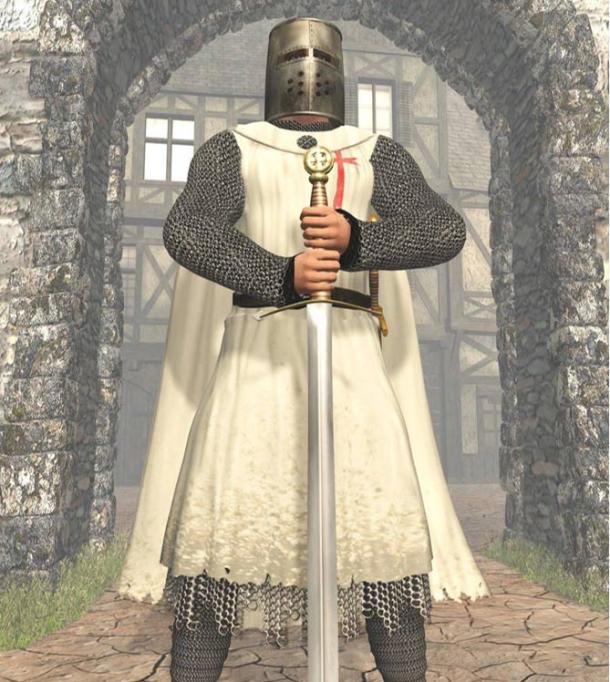
Artist’s impression of a Templar Knight (Wikimedia Commons)
The Knights Templars were members of a religious military order of
Christian knighthood founded around 1118-1119 in Jerusalem by the French
knight Hugh des Payens. For nearly two centuries this organization was
the most powerful order in the medieval world. They were the first
standing army in Europe since the fall of the Roman Empire and by the
time they reached their pinnacle of power in 1300, it is said they
numbered in the tens of thousands. In the beginning, there were a total
of nine founding knights who made up the organization and were all
related to one another through blood or marriage. As both monks and
soldiers, they were a paradox without precedent since there had never
been praying priests who took up arms who also took vows of poverty,
obedience and celibacy. Knights Templars did not surrender unless they
were outnumbered three to one and believed that since they were fighting
for God they would be immediately sent up to heaven upon falling in
battle.
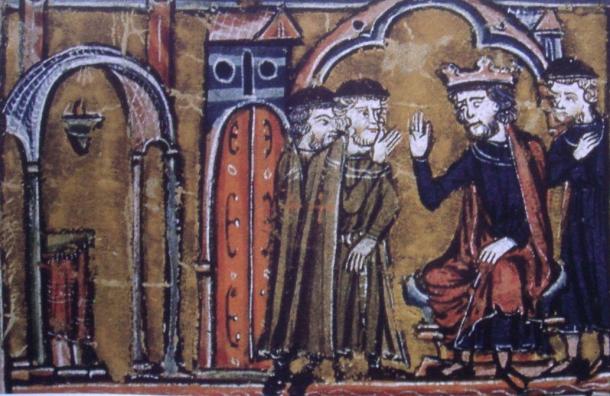
BaldwinII ceeding the location of the Temple of
Solomon to Hugues de Payns and Gaudefroy de Saint-Homer. The fourth
person is Warmund, Patriarch of Jerusalem. (Wikimedia Commons).
Today in Europe, there are hundreds of former templar sites scattered
across the continent showing how influential they were centuries ago.
At their peak, there were approximately 15,000 Templars houses with a
network stretching from England to Egypt with the center of power
situated in the then heart of the medieval world, France. Conventional
history says the Knights Templar’s purpose was to protect travelers
traveling along the coast of the Mediterranean to Jerusalem. In the
middle ages, pilgrimages were made by westerners who had been guaranteed
their safety in the city and templars protected them through the passes
and mountains. In addition to protection of the pilgrims, Templars
also defended the Christian kingdom of Jerusalem and other holy sites as
part of their duty.- The intriguing carvings of the impressive Rosslyn Chapel.
- Walking the Camino de Santiago - Retracing the footsteps of our ancestors.
Crusades and Escort Service
For two hundred years, the Crusades were fought in the name of God and were considered to be a clash of civilizations. Enemies were formed between the Christian west and Muslim east, which have endured to this day. In 1065, Jerusalem was taken by the Turks and the Christians were treated badly enough to where, throughout Christendom, people were stirred to fight and recapture the city. Another reason for the Crusades stems from the Church‘s desire to block any Islamic incursion into Christian lands. On November 27th 1095, Pope Urban II gave a speech in which he exhorted Christians to rise up against Muslims in the Holy Land. At this point in time, Muslims controlled Spain and parts of Eastern Europe. Thousands responded to the call and took up the sword but only around 1,000 ever made it to Jerusalem. The western Christians united with the Byzantines in the east and in 1099, the Crusaders, led by Godfrey of Bouillon, captured Jerusalem back from the Turks after a five week siege. When the holy sites were in Christian hands, Westerners began traveling to the area in record numbers. Outside the city walls, life was dangerous and there became a need for an escort service which is when the first Knights Templars came forward.
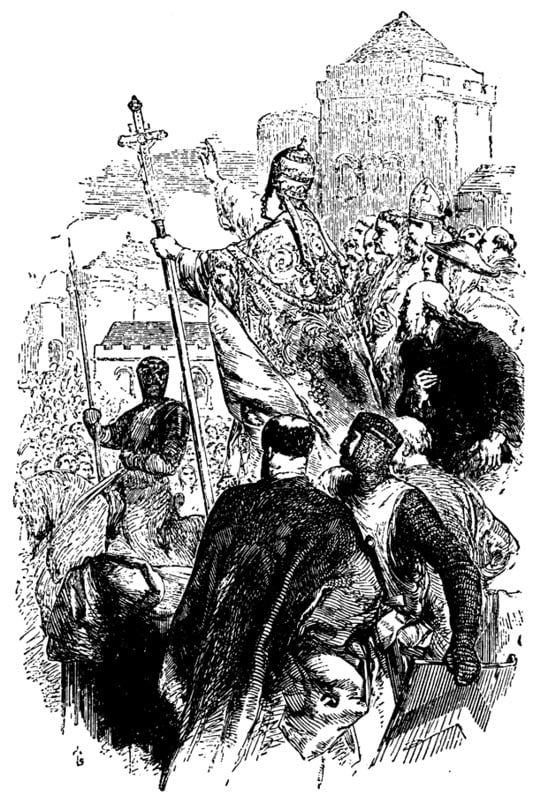
Pope Urbanus ll preaching the First Crusade. (Wikimedia Commons).
Banking Back Home
During the third crusade, the Christians were decimated at the battle of Hattin. It was the single worst military disaster in the holy land and one of the worst defeats for Christianity. The Templars were all put to the sword by their Muslim conquerors who would go on to take the city of Jerusalem a few months later. Subsequent crusades by later generations would come to be known as failures. When they returned home after the first crusades in 1128, the Templars were rich and influential and answered to no one but the pope. They also did not have to pay taxes and were allowed to cross through the borders of European countries unrestricted. From 1150 on, they stopped guarding the road to Jerusalem. Instead they devised a system which allowed pilgrims to travel without cash and valuables that might otherwise make them targets. The Templars entered into the banking business and the Temples (local lodges) were established throughout Europe, drawing deposits of massive wealth. The services the templars offered became the model for today’s banking system, money transfers, pension plans and traveler’s checks. Their wealth made them the prominent bankers of their age and the first western multi-national corporation. The most controversial service the Templars offered was the issuance of high profile loans. Princes and commoners alike banked with the Templars, and many states became indebted to them. The church, adamantly against usury at this time, looked the other way.
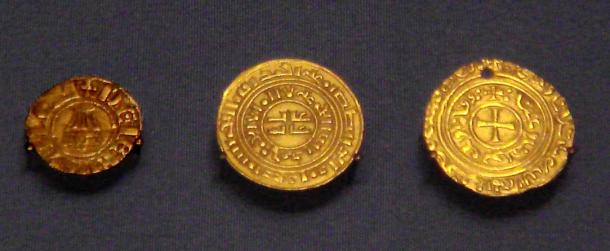
Crusader coins of the kingdom of Jerusalem, Denier in European style with Holy Sepulchre. British Museum, 2007. (Wikimedia Commons).
Decline of the Templars
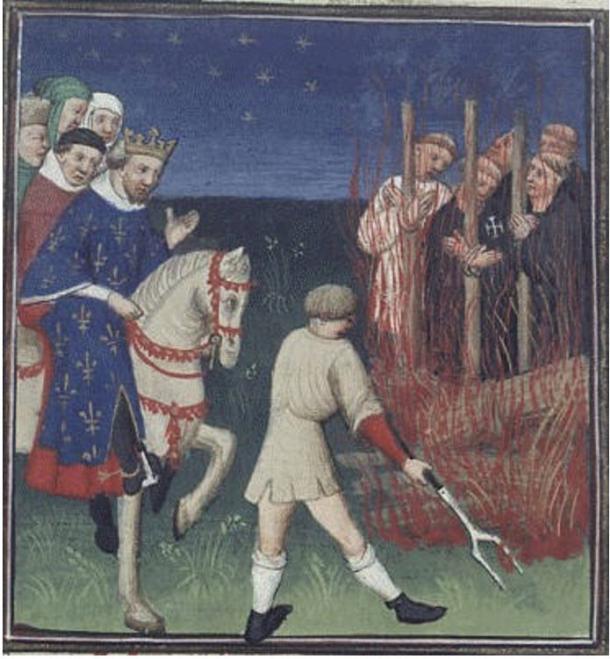
With the fall of the Holy Land to the Muslims in 1187, the Templar order lost its founding purpose and became a target for unhappy debtors. With the failure of the crusades and subsequent closures of the passage to the holy land, there no longer became a reason for the Knights Templars to exist. Imagine a standing army roaming Europe that answered to no one and with no battle to fight. This attracted attention and due to the wealth and political power the Templars had, they were seen as a threat to the power structure. During the early 14th century, the order experienced a sudden decline. In 1302, King Philip IV of France came into conflict with the pope. Needing cash for his wars, he waged a vicious and skillful campaign aimed at suppressing the Templars, gaining their wealth while simultaneously, striking a blow against the papacy.On Friday October 13, 1307, all the Knights Templars in France were arrested by agents of King Philip and he ordered any still residing in the country to be thrown into prison where they were tortured until confessing to accusations of heresy, homosexuality, and dishonest business activities. They were charged with capital offenses and their properties seized. More than likely, many of the confessions were meaningless but following these admissions, a Papal command was issued by Pope Clement V to all Christian sovereigns in 1312 which ordered that all Knights Templars be disbanded. The order of the Templar Knights went underground and their movements have been shrouded in mystery ever since. Friday the 13th is linked with this historical event.
Execution of the Templars in the presence of Philip ‘the Fair’. Bedford Master 1415-1420, France. (Wikimedia Commons).
Conspiracy
After Clement’s edict in 1312, the Templars virtually vanished from the pages of history. Of the hundreds, possibly thousands of Templars who were not arrested, there is little record of what happened to them. There is documentation that their large fleet of ships vanished and it’s possible that they fled to Scotland since the country was something a Templar stronghold at the time. They might have gone to Switzerland or hidden in the Alps which bordered southern France (its endless mountain range would have been a perfect hiding spot for treasure). Some survivors of the Templar order can be traced and they simply changed their name becoming the Knights of Christ in Portugal for example.But of all the mysteries surrounding the Knights Templars, the most puzzling one concerns their time spent in Jerusalem. The Templars literally disappeared there for nine years and what they did in their time there remains mostly unknown. There were nine middle aged monks who were hardly in a position to protect travelers coming in and out of Jerusalem. There also doesn’t seem to be a written account of any pilgrims being guarded by the Templars. In 1867 a clue came to light when a British archaeological team excavated under the site of the temple mount in Jerusalem. There, they uncovered tunnels extending vertically from a mosque for some twenty five meters which fanned out horizontally under the dome of King Solomon’s temple. Templars spurs and various pieces of armaments were found as proof that the tunnels had been used by them. A prevailing theory is that the Knights Templars were digging under the Temple for treasure left there by the Jews after the invasions by the Romans in 70 AD. Other theories suggest the knights were guarding the Holy Grail and in possession of major treasures. The biblical temple of Solomon once housed the Ark of the Covenant and Ten Commandments. There are early masonic writings in the 1800’s citing documents which allegedly link the Templars with the arc of the covenant and treasure buried in the Temple of Solomon. Regardless of which theory is the right one, when they emerged again in Europe they were more wealthy, powerful and influential than ever.
Featured image: Image of the Templar Knights ( brother-servant, brother and brother-knight priest). Ukraine, 1870. (Wikimedia Commons).

By Bryan Hilliard
References:
1.) Wasserman, James. "Secret Societies: The Knight Templars and the Assassins." Secret Societies: The Knight Templars and the Assassins. N.p., 8 Dec. 2006. Web. 3 Dec. 2013. <http://jameswassermanbooks.com/templar-lecture.html>.2.) Timbers, Alex. "Knights Templar." Knights Templar. N.p., n.d. Web. 3 Dec. 2013. <http://morrischia.com/david/portfolio/boozy/research/knights_20templar.html>.
3.) The Templar code. Dir. Marcy Marzuki. Perf. Various. A & E Television Networks :, 2009. DVD.
4.) The Bible's buried secrets. Dir. Gary Glassman. Perf. Various. WGBH Boston Video, 2009. DVD.
5.) The Knights Templar. Dir. Steven R. Talley. Perf. various. A & E Television Networks :, 2005. DVD.
6.) Ralls, Karen. Knights Templar encyclopedia: the essential guide to the people, places, events, and symbols of the Order of the Temple. Franklin Lakes, NJ: New Page Books, 2007. Print.
7.) "Templarhistory.com » Blog Archive » Philip IV – 1268 – 1314." Templarhistory.com » Blog Archive » Philip IV – 1268 – 1314. N.p., n.d. Web. 3 Dec. 2013. <http://blog.templarhistory.com/2010/03/philip-iv-1268-1314/>.
8.) "Who Were the Knights Templar?." History.com. A&E Television Networks, 26 July 2011. Web. 1 Dec. 2013. <http://www.history.com/news/who-were-the-knights-templar>.
9.) The Templar code. Dir. Marcy Marzuki. Perf. Various. A & E Television Networks :, 2009. DVD.
10.) "World Of The Wicked." World Of The Wicked. N.p., n.d. Web. 3 Dec. 2013. <http://2012data.webs.com/knightsofthetemplar.htm>.
11.) Hammer, Josh ua. "Smithsonian.com." Smithsonian magazine. N.p., n.d. Web. 3 Dec. 2013. <http://www.smithsonianmag.com/history-archaeology/What-is-Beneath-the-Temple-Mount.html>.
12.) Ralls, Karen. Knights Templar encyclopedia: the essential guide to the people, places, events, and symbols of the Order of the Temple. Franklin Lakes, NJ: New Page Books, 2007. Print.
13.) The Templar code. Dir. Marcy Marzuki. Perf. Various. A & E Television Networks :, 2009. DVD.
Labels:
Bilderberg
,
CFR
,
Conspiracy
,
CorporatistCabals
,
Federal Reserve
,
Government Fraud
,
Trilateral Commission


Tuesday, April 28, 2015
Members of U.S. Military have no Recourse if they Suffer from Poor Medical Treatment
Tuesday, April 28, 2015
 |
| Military patient being moved between Walter Reed and National Naval medical centers (photo: Pablo Mercad, Walter Reed) |
Serving one’s country not only means putting yourself in harm’s way
before a foreign enemy, it also means putting your health in the hands
of a military health system that has no real accountability for making
fatal mistakes.
In the civilian world, a patient who is misdiagnosed and harmed by such a mistake can sue their doctor for malpractice. But this recourse does not exist with the military’s health providers, who can miss a serious medical problem with an individual and not worry about being taken to court, or even have their mistake shared with other patients.
About 1.3 million active-duty service members have to use the military’s healthcare system for care. For those who experience poor treatment, they are “virtually powerless to hold accountable the health care system that treats them,” according to Sharon LaFraniere at The New York Times.
“They are captives of the military medical system, unable, without specific approval, to get care elsewhere if they fear theirs is substandard or dangerous,” LaFraniere wrote. “Yet if they are harmed or die, they or their survivors have no legal right to challenge their care, and seek answers, by filing malpractice suits.”
Up until 18 months ago, most military personnel couldn’t even file complaints about poor medical treatment. But even though that avenue is now open, the complaints are mostly just filed away and don’t see the light of day, nor are they shared with the public because “investigations at military hospitals and clinics are confidential.”
Part of the reason for that, according to LaFraniere, is to prevent the 2 million or so civilian relatives of those service members from seeing the results, since they are not barred from filing malpractice suits. Even the military personnel themselves are not informed of the results of any inquiry that may have been undertaken in response to their complaints.
Cheryl Garner, a retired military intelligence officer told the Times: “There is just no transparency. You can’t sue. You have no insight into the process. As active duty, we just don’t have much recourse.”
Compounding the problem is the fact that the hospitals themselves don’t follow regulations. “Military hospitals often fail to conduct safety investigations that the Defense Department mandates when patients suffer serious harm or die,” wrote LaFraniere.
Potential whistleblowers are also dissuaded for calling attention to matters they see as being detrimental to patients. Medical workers who do speak out about problems with patient care often suffer reprisals.
In a project that has helped to reduce patient injuries, some military medical officials are adopting a program called I-PASS, which is a system of training and communication tools to improve transfer of patients between medical providers. About 80% of serious medical mistakes that are detrimental to patient health and wellbeing occur as a result of miscommunication between caregivers during the handoff of patients from one health care facility to another, according to The Joint Commission, a non-profit group of more than 20,500 U.S. health care organizations. Nine civilian hospitals have already partnered with military medical officials to implement the program. To date there has been a reported 30% reduction in patient injuries caused by medical errors as a result of the employment of I-PASS, according to a study performed by Walter Reed National Military Medical Center and the Uniformed Services University of Health Sciences, both of which helped develop the program.
In the civilian world, a patient who is misdiagnosed and harmed by such a mistake can sue their doctor for malpractice. But this recourse does not exist with the military’s health providers, who can miss a serious medical problem with an individual and not worry about being taken to court, or even have their mistake shared with other patients.
About 1.3 million active-duty service members have to use the military’s healthcare system for care. For those who experience poor treatment, they are “virtually powerless to hold accountable the health care system that treats them,” according to Sharon LaFraniere at The New York Times.
“They are captives of the military medical system, unable, without specific approval, to get care elsewhere if they fear theirs is substandard or dangerous,” LaFraniere wrote. “Yet if they are harmed or die, they or their survivors have no legal right to challenge their care, and seek answers, by filing malpractice suits.”
Up until 18 months ago, most military personnel couldn’t even file complaints about poor medical treatment. But even though that avenue is now open, the complaints are mostly just filed away and don’t see the light of day, nor are they shared with the public because “investigations at military hospitals and clinics are confidential.”
Part of the reason for that, according to LaFraniere, is to prevent the 2 million or so civilian relatives of those service members from seeing the results, since they are not barred from filing malpractice suits. Even the military personnel themselves are not informed of the results of any inquiry that may have been undertaken in response to their complaints.
Cheryl Garner, a retired military intelligence officer told the Times: “There is just no transparency. You can’t sue. You have no insight into the process. As active duty, we just don’t have much recourse.”
Compounding the problem is the fact that the hospitals themselves don’t follow regulations. “Military hospitals often fail to conduct safety investigations that the Defense Department mandates when patients suffer serious harm or die,” wrote LaFraniere.
Potential whistleblowers are also dissuaded for calling attention to matters they see as being detrimental to patients. Medical workers who do speak out about problems with patient care often suffer reprisals.
In a project that has helped to reduce patient injuries, some military medical officials are adopting a program called I-PASS, which is a system of training and communication tools to improve transfer of patients between medical providers. About 80% of serious medical mistakes that are detrimental to patient health and wellbeing occur as a result of miscommunication between caregivers during the handoff of patients from one health care facility to another, according to The Joint Commission, a non-profit group of more than 20,500 U.S. health care organizations. Nine civilian hospitals have already partnered with military medical officials to implement the program. To date there has been a reported 30% reduction in patient injuries caused by medical errors as a result of the employment of I-PASS, according to a study performed by Walter Reed National Military Medical Center and the Uniformed Services University of Health Sciences, both of which helped develop the program.
-Danny Biederman, Noel Brinkerhoff
To Learn More:
Service Members Are Left in Dark on Health Errors (by Sharon LaFraniere, New York Times)
Sunday, March 8, 2015
▶ Fiat money inflation in France (1789) - Part 2: John Law - Video
embedded captions can be removed/added with tiny "cc" at bottom.
PART I for a preliminary historical perspective can be viewed here
Uploaded on Jun 15, 2011
Max
Keiser, of maxkeiser.com, James Turk, Director of The GoldMoney
Foundation and Pierre Jovanovic, jovanovic.com, tell the story of the
introduction of Fiat Money to France.In this episode we look at the use of Fiat Money during the French Revolution and how monetary mismanagement made an already delicate situation even worse, destroying the nation's economy and encouraging political radicalism.
We start with the debates over the issuance of paper money, explaining that the previous experience of John Law made French statesmen like Necker very cautious about fiat currency. The debates over the first issue of assignats were hard fought and lasted a long time, with the first issue of assignats approved by just a handful of votes and with all manner of guarantees to insure that it was "backed" by land and other forms of collateral.
The first issue of assignats had some very positive short term effects, stimulating commerce as paper wealth spread. However, the government took only a few months to spend the money raised and very soon cries were raised for more. This time a new issue was approved by a large majority. We look at how this paper money inflation started to drive prices higher, encouraging the creation of more paper in increasing amounts as the government and its clients became addicted to newly-created money. Rising prices were blamed on all manner of scapegoats in order to divert attention from the real cause: money printing.
As the situation worsened, the worst rose to the top, with Clavière becoming Minister of Finance with the promise to increase printing. Gresham's law started to act in full force, driving good money out of circulation with such force that silver, gold and even copper disappeared from the market. Attempts to put ceilings on prices through the "Law of the Maximum" and to prop up the value of assignats failed, and only succeeded in criminalising most commerce with increasingly harsh penalties -- eventually including death -- for those that sold above established prices or refused to accept payment in worthless government paper. Even the guillotine was not enough backing to ensure the assignat's survival.
Eventually food riots brought down the revolutionary government, and after several interim reactionary governments culminated with Napoleon's military rule. Napoleon brought back the gold standard, which survived until the first World War.

Friday, March 6, 2015
Too Big to Fail Banks Ranked
Friday, March 06, 2015

JPMorgan Chase has earned the distinction of being the largest bank among those deemed too-big-to-fail for the sake of the U.S. financial and economic systems, according to a new government report (pdf).
The federal Office of Financial Research (OFR) ranked 12 U.S. financial institutions based on their “total exposures.”
No. 1 was JPMorgan Chase followed by Citigroup, Bank of America, Wells Fargo, Goldman Sachs and Morgan Stanley.
The remaining six banks were U.S. Bancorp, PNC Financial Services, Bank of New York Mellon, HSBC N.A. Holdings, State Street and Capital One.
Among the conclusions produced in the report are findings that “the largest U.S. banks generally scored highest for all systemic risk indicators,” and that “several of the largest banks scored high in systemic importance because they dominate specific businesses, such as payments and asset custody services.”
The authors of the OFR report based their findings on data collected by the Federal Reserve System. That data was significant, they said, because it provides additional transparency that helps to quantify important aspects of the banking system.
Their evaluation was made by comparing scores on the banks’ sizes, global activity, complexity, interconnectedness, and dominance in certain areas of customer service.
To Learn More:
Systemic Importance Indicators for 33 U.S. Bank Holding Companies: An Overview of Recent Data (by Meraj Allahrakha, Paul Glasserman, and H. Peyton Young, Office of Financial Research) (pdf)
15,559 Sign Petition Opposing Merger to Create New “Too-Big-to-Fail” Bank (by Ken Broder, AllGov California)
Bailout Helped Banks “Too Big to Fail” Get Bigger (by Noel Brinkerhoff, AllGov)
Thursday, March 5, 2015
Being a CFR Member Makes Gen. Petraeus: Too Big to Jail
MORE ON THE PETRAEUS CRIMES AND COVERUP BELOW-
Exclusive: While lesser Americans face years in jail for leaking secrets – even to inform fellow citizens of government abuses – retired Gen. David Petraeus gets a misdemeanor wrist-slap for exposing covert officers and lying about it, says ex-CIA analyst Ray McGovern, who was jailed just for trying to ask Petraeus a question.
Exclusive: While lesser Americans face years in jail for leaking secrets – even to inform fellow citizens of government abuses – retired Gen. David Petraeus gets a misdemeanor wrist-slap for exposing covert officers and lying about it, says ex-CIA analyst Ray McGovern, who was jailed just for trying to ask Petraeus a question.
By Ray McGovern
The leniency shown former CIA Director (and retired General) David Petraeus by the Justice Department in sparing him prison time for the serious crimes that he has committed puts him in the same preferential, immune-from-incarceration category as those running the financial institutions of Wall Street, where, incidentally, Petraeus now makes millions. By contrast, “lesser” folks – and particularly the brave men and women who disclose government crimes – get to serve time, even decades, in jail.
 |
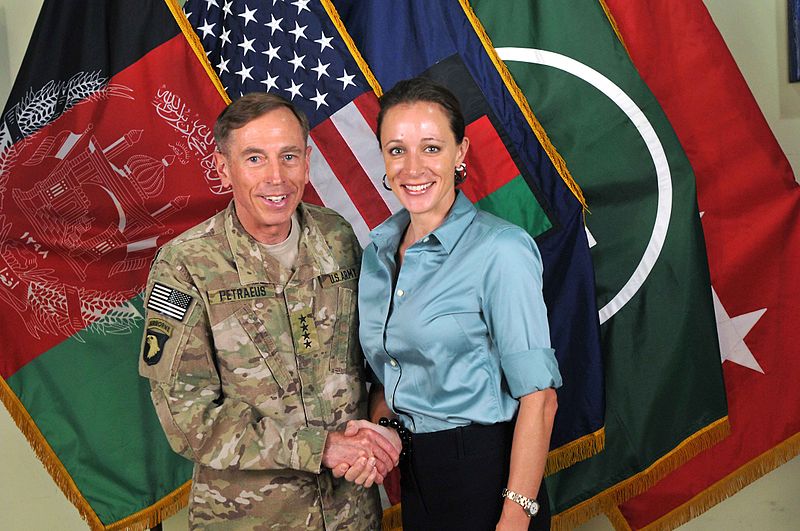
| Gen. David Petraeus in a photo with his
biographer/mistress Paula Broadwell.
(U.S. government photo) |
Despite manifestly corrupt practices like those of subprime mortgage lenders, none of those responsible went to jail after the 2008-09 financial collapse which cost millions of Americans their jobs and homes. The bailed-out banks were judged “too big to fail” and the bankers “too big to jail.”
Two years ago, in a highly revealing slip of the tongue, Attorney General Eric Holder explained to Congress that it can “become difficult” to prosecute major financial institutions because they are so large that a criminal charge could pose a threat to the economy – or perhaps what he meant was an even bigger threat to the economy.
Holder tried to walk back his unintended slip into honesty a year later, claiming, “There is no such thing as ‘too big to jail.’” And this bromide was dutifully echoed by Holder’s likely successor, Loretta Lynch, at her confirmation hearing in late January.
Words, though, are cheap. The proof is in the pudding. It remains true that not one of the crooked bankers or investment advisers who inflicted untold misery on ordinary people, gambling away much of their life savings, has been jailed. Not one.
And now Petraeus, who gave his biographer/mistress access to some of the nation’s most sensitive secrets and then lied about it to the FBI, has also been shown to be too big to jail. Perhaps Holder decided it would be a gentlemanly thing to do on his way out of office – to take this awkward issue off Lynch’s initial to-do list and spare her the embarrassment of demonstrating once again that equality under the law has become a mirage; that not only big banks, but also big shots like Petraeus – who was Official Washington’s most beloved general before becoming CIA director – are, in fact, too big to jail.
It strikes me, in a way, as fitting that even on his way out the door, Eric Holder would not miss the opportunity to demonstrate his propensity for giving hypocrisy a bad name.
A Slap on Wrist for Serious Crimes
The Justice Department let David Petraeus cop a plea after requiring him to admit that he had shared with his biographer/mistress eight black notebooks containing highly classified information and then lied about it to FBI investigators. Serious crimes? The following quotes are excerpted from “U.S. v. David Howell Petraeus: Factual Basis in support of the Plea Agreement” offered by the U.S. District Court for the Western District of North Carolina, Charlotte Division:
“17. During his tenure as Commander of ISAF in Afghanistan, defendant DAVID HOWELL PETRAEUS maintained bound, five-by-eight-inch notebooks that contained his daily schedule and classified and unclassified notes he took during official meetings, conferences, and briefings. … A total of eight such books (hereinafter the “Black Books”) encompassed the period of defendant DAVID HOWELL PETRAEUS’S ISAF [Afghanistan] command and collectively contained classified information regarding the identities of covert officers, war strategy, intelligence capabilities and mechanisms, diplomatic discussions, quotes and deliberative discussions from high-level National Security Council meetings, and defendant DAVID HOWELL PETRAEUS’s discussions with the President of the United States of America. [emphasis added]
“18. The Black Books contained national defense information, including Top Secret//SCI and code word information.”
Despite the sensitivity of the notebooks and existing law and regulations, Petraeus did not surrender them to proper custody when he returned to the U.S. after being nominated to become the Director of the CIA. According to the Court’s “Factual Basis,” Petraeus’s biographer/mistress recorded a conversation of Aug. 4, 2011, in which she asks about the “Black Books.” The Court statement continues:
“ [Petraeus] ‘Umm, well, they’re really – I mean they are highly classified, some of them. … I mean there’s code word stuff in there.’ … On or about August 27, 2011, defendant DAVID HOWELL PETRAEUS sent an email to his biographer in which he agreed to provide the Black Books to his biographer. … On or about August 28, 2011, defendant DAVID HOWEL PETRAEUS delivered the Black Books to a private residence in Washington, D.C. where his biographer was staying. … On or about September 1, 2011, defendant DAVID HOWELL PETRAEUS retrieved the Black Books from the D.C. private residence and returned them to his own Arlington, Virginia home.” [emphasis added]
I would think it a safe guess that Petraeus’s timing can be attributed to his awareness that his privacy and freedom of movement was about to be greatly diminished, once his CIA personal security detail started keeping close track of him from his first day on the job as CIA Director, Sept. 6, 2011.
“32. On or about October 26, 2012, defendant DAVID HOWELL PETRAEUS was interviewed by two FBI special agents. … [He] was advised that the special agents were conducting a criminal investigation. … PETRAEUS stated that (a) he had never provided any classified information to his biographer, and (b) he had never facilitated the provision of classified information to his biographer. These statements were false. Defendant DAVID HOWELL PETRAEUS then and there knew that he previously shared the Black Books with his biographer.” [emphasis added]
Lying to the FBI? No problem. As “Expose Facts” blogger Marcy Wheeler immediately commented: “For lying to the FBI – a crime that others go to prison for for months and years – Petraeus will just get a two point enhancement on his sentencing guidelines. The Department of Justice basically completely wiped out the crime of covering up his crime of leaking some of the country’s most sensitive secrets to his mistress.” [emphasis added]
Talk about “prosecutorial discretion” or, in this case, indiscretion – giving Petraeus a fine and probation but no felony conviction or prison time for what he did! Lesser lights are not so fortunate. Just ask Chelsea (formerly Bradley) Manning who is serving a 35-year prison sentence for disclosing information to the public about U.S. war crimes and other abuses. Or Edward Snowden, who is stuck in Russia facing a U.S. indictment on espionage charges for informing the people about pervasive and unconstitutional U.S. government surveillance of common citizens.
Or former CIA officer John Kiriakou who was sent to prison for inadvertently revealing the name of one Agency official cognizant of CIA torture. Here’s what Neil MacBride, U.S. Attorney for the Eastern District of Virginia, said then: “The government has a vital interest in protecting the identities of those involved in covert operations. Leaks of highly sensitive, closely held and classified information compromise national security and can put individual lives in danger.”
When, on Oct. 23, 2012, Kiriakou acquiesced to a plea deal requiring two-and-a-half years in federal prison, then CIA Director Petraeus sent a sanctimonious Memorandum to Agency employees applauding Kiriakou’s conviction and noting, “It marks an important victory for our agency … there are indeed consequences for those who believe they are above the laws that protect our fellow officers and enable American intelligence agencies to operate with the requisite degree of secrecy.” [emphasis added]
Consequences for Kiriakou but not, as we now know, for Petraeus.
If you feel no discomfort at this selective application of the law, you might wish to scroll or page back to the “Factual Basis” for Petraeus’s Plea Agreement and be reminded that it was just three days after his lecture to CIA employees about the sanctity of protecting the identity of covert agents that Petraeus lied to FBI investigators – on Oct. 26, 2012 – about his sharing such details with his mistress.
Why Did Petraeus Do It?
Old soldiers like Petraeus (indeed, most aging but still ambitious men) have been known to end up doing self-destructive things by letting themselves be flattered by the attentions of younger women. This may offer a partial explanation – human weakness even in a self-styled larger-than-life super-Mensch. But I see the motivation as mostly vainglory. (The two are not mutually exclusive, of course.)
Looking back at Petraeus’s record of overweening ambition, it seems likely he was motivated first and foremost by a desire to ensure that his biographer would be able to extract from the notebooks some juicy morsels he may not have remembered to tell her about. This might enhance his profile as Warrior-Scholar-“King David,” the image that he has assiduously cultivated and promoted, with the help of an adulating neocon-dominated media.
Petraeus’s presidential ambitions have been an open secret. And with his copping a plea to a misdemeanor, his “rehabilitation” seems to have already begun. He has told friends that he would like to serve again in government and they immediately relayed that bright hope to the media.
Sen. John McCain was quick to call the whole matter “closed.” A strong supporter of Petraeus, McCain added this fulsome praise: “At a time of grave security challenges around the world, I hope that General Petraeus will continue to provide his outstanding service and leadership to our nation, as he has throughout his distinguished career.”
And Michael O’Hanlon, Brookings’ neocon military specialist who rarely gets anything right, spoke true to form to the New York Times: “The broader nation needs his advice, and I think it’s been evident that people still want to hear from him. … People are forgiving and I know he made a mistake. But he’s also a national hero and a national treasure.”
The “mainstream media” is trapped in its undeserved adulation for Petraeus’s “heroism.” It is virtually impossible, for example, for them to acknowledge that his ballyhooed, official-handout-based “success” in training and equipping tens of thousands of crack Iraqi troops was given the lie when those same troops ran away (the officers took helicopters) and left their weapons behind at the first sight of ISIL fighters a year ago.
Equally sham were media claims of the “success” for the “surges” of 30,000 troops sent into Iraq (2007) and 33,000 into Afghanistan (2009). Each “surge” squandered the lives of about 1,000 U.S. troops for nothing – yes, nothing – except in the case of Iraq buying time for President George W. Bush and Vice President Dick Cheney to get out of town without a clear-cut defeat hanging around their necks.
Many of the supposed successes of Petraeus’s Iraqi “surge” also predated the “surge,” including a high-tech program for killing top militants such as Al-Qaeda-in-Iraq leader Abu Musab al-Zarqawi and the formation of the so-called Sunni Awakening, both occurring in 2006 under the previous field commanders. And, Bush’s principal goal of the “surge” – to create political space for a fuller Sunni-Shiite reconciliation – was never accomplished. [See Consortiumnews.com’s “The Surge Myth’s Deadly Result.”]
And last, it is important to note that David Petraeus does not have a corner on the above-the-law attitudes and behavior of previous directors of the CIA. The kid-gloves treatment he has been accorded, however, will increase chances that future directors will feel they can misbehave seriously and suffer no serious personal consequence.
The virtual immunity enjoyed by the well connected – even when they lie to the FBI or tell whoppers in sworn testimony to Congress (as Director of National Intelligence James Clapper has done) – feeds the propensity to prioritize one’s own personal ambition and to delegate a back seat to legitimate national security concerns – even basic things like giving required protection to properly classified information, including the identity of covert officers.
One might call this all-too-common syndrome Self-Aggrandizing Dismissiveness (SAD). Sadly, Petraeus is merely the latest exemplar of the SAD syndrome. The unbridled ambitions of some of his predecessors at CIA – the arrogant John Deutch, for example – have been equally noxious and destructive. But we’ll leave that for the next chapter.
Full Disclosure: Petraeus has not yet answered McGovern’s letter of Feb. 3 regarding why McGovern was barred from a public speaking event by Petraeus in New York City on Oct. 30, 2014, and then was roughly arrested by police and jailed for the night. McGovern wonders if Petraeus failed to respond because he was pre-occupied working out his Plea Agreement.
Ray McGovern worked for a total of 27 years in all four of CIA’s main directorates. He served under seven Presidents and nine CIA Directors, and is co-founder of Veteran Intelligence Professionals for Sanity (VIPS). He now works for Tell the Word, a publishing arm of the ecumenical Church of the Saviour in inner-city Washington.
PETRAEUS FILES
Nov 21, 2012 ... Petraeus Affair: Shirtless FBI Pic Appears to Be Playful - ABC News.
|
Sep 9, 2013 ... Another special forces veteran, retired Colonel James Coffman, worked with
Steele and reported directly to General David Petraeus, who had ...
|
Nov 11, 2012 ... “What I do know is that an integral part of that firewall involved having information
on Petraeus that would potentially damage his career, legacy ...
|
Nov 29, 2012 ... Petraeus is seeking to better the CIA's ability to create online identities for
undercover spies. Currently, each internet user has a digital footprint ...
|
Oct 6, 2014 ... GEN David Petraeus - Director CIA (Aug. 2011) Resigned 11/9/12 Admitted
Adulterer present Commander of U.S. and Coalition forces in ...
|
Sep 11, 2012 ... Could Theft of $500M Fuel in Afghanistan be another Thread to be Unraveled on
Petraeus' Watch? Posted by Charleston Voice ...
|
Feb 1, 2012 ... Feinstein then indicated that she had met Mossad chief Pardo earlier in the week
in Washington, with Petraeus adding that he too met Pardo ...
|
Tuesday, March 3, 2015
▶ GONE GOLD -- The Powerful Story Of Repatriation - YouTube
Published on Mar 1, 2015
What do Switzerland, England, Austria, Netherlands, France, Belgium, Mexico, Poland, Italy. Australia, Ecuador, Romania and the tiny country of Azerbaijan have in common? They all want to know where their gold is, and they all have burgeoning gold repatriation movements in various stages of progress. Peter Boehringer, the father of the gold repatriation movement in Germany, and founder of the website Goldseiten.de joins us to discuss the great global awakening as nations begin asking, where is our PHYSICAL gold? We want it back!


Labels:
banksters
,
Central banks
,
Crime
,
Federal Reserve
,
Germany's Gold Reserves
,
Gold
,
Government Fraud
,
Manipulation
DOJ, CFTC have Begun Investigation of 10 Major Banks for Rigging Metals Fixing
Need a job? Drop gold investigation
Posted on March 2, 2015 by Pat Heller
Late last week, The Wall Street Journal reported that the U.S. Department of Justice and the U.S. Commodity Futures Trading Commission (CFTC) had begun investigations of 10 major banks over the process of setting prices for gold, silver, platinum and palladium in the London market.

 |
| Look for the end result to pretty much be a cover-up of the suppression of gold and silver prices. – Pat Heller |
The banks under scrutiny are Bank of Nova Scotia, Barclays PLC, Credit Suisse Group AG, Deutsche Bank AG, Goldman Sachs Group Inc., JPMorgan Chase & Co., Societe Generale SA, Standard Bank Group Ltd., and UBS AG. After this announcement, the Swiss competition commission, WEKO, said it was looking into possible manipulation by Swiss banks in the precious metals markets.
As reported in the Journal, the Department of Justice is looking into criminal activity, while the CFTC has opened a civil investigation.
Many researchers have written about the extensive history of central banks manipulating gold prices over the decades. In the United States, for instance, declassified government documents released so far have all confirmed that the federal government has conspired with other governments and major banks to manipulate gold prices right from the 1930s up into the 1980s.
Historically, many government monetary systems were valued in relation to gold, so it should not surprise anyone that governments would try to influence the relative prices. In the United States, for instance, the Treasury Department’s Exchange Stabilization Fund (ESF) was established as a provision of the January 31, 1934 Gold Reserve Act. The ESF was explicitly authorized to use its funds to stabilize the exchange value of the dollar versus gold. Changes over the years have never revoked the authority to manipulate gold prices. In fact, a law enacted in 1970 directed the Secretary of the Treasury, with the approval of the President, to “deal in gold, foreign exchange, and other instruments of credit and securities.”
These new investigations follow similar reviews in Europe. Last year, the British government fined Barclays Bank more than $40 million for one incident of gold price manipulation. Also, the Swiss regulator, FINMA, said it found “serious misconduct” among precious metals traders at UBS involving a silver-fix order of one client.
If you think that the researchers and writers claiming that central banks and major private banks were manipulating the precious metals markets by suppressing prices are finally going to be proven right, think again.
I am confident that the end result of the U.S. government investigations will be, after several years in the works, some fines collected from many of these banks for specific individual incidents. Further, there will be promises that whatever wrongdoing they had done will no longer occur. And that will be all that happens.
Why do I think this is what will be the end result of such a bombshell development? The answer is simple. Ask yourself why the DOJ and CFTC are investigating trading in the London markets but not in the New York COMEX markets. While it is true that the London market handles more volume of precious metals trading than the COMEX, the U.S. markets are more relevant to Americans.
Also ask yourself why the investigations involve eight foreign owned banks and only two U.S. companies. The foreign banks would only be within the purview of American regulators if their actions in the London markets were perpetrated from the U.S.-based offices. Why aren’t other U.S. banks being investigated?
The reason these investigations will be pretty much whitewashed is that the Department of Justice is unwilling to go after Wall Street. New York Federal Reserve Bank president William C. Dudley (who worked at Goldman Sachs 1986-2007 as the chief U.S. economist, a partner, and as a managing director) confirmed not that long ago that the DOJ has no ongoing investigations of Wall Street firms. The DOJ is not conducting such investigations despite former Federal Reserve chair Alan Greenspan’s public claim that there were massive illegal and criminal frauds committed by Wall Street firms.
The DOJ consistently stated that it will not prosecute these large institutions because the risk of damage to the economy, as they were told by outside experts. However, could this DOJ policy could have more to do with the revolving doors where the DOJ and CFTC investigators largely have worked for the above named banks or hope to do so when the leave government employment?
After all, U.S. Attorney General Eric Holder announced two years ago that no investigation of UBS’s fixing of LIBOR interest rates would be done. Holder claimed in a news conference that the lack of prosecution was based on a decision of how such an investigation would impact global financial markets. But, was the real reason that UBS was a client of the law firm where Holder worked before his current job?
 |
| Want to add some luck to your collection or your pocket? |

In a previous decision not to investigate HSBC, a Congressional panel asked for the identity of outside parties who advised the DOJ to drop the investigation for global financial stability reasons. Eventually, Justice officials had to admit that they did not consult any outside parties before canceling the HSBC review.
In sum, I expect the public to be lulled into thinking that the U.S. government is really finding and reporting the truth about the manipulation of precious metals prices. However, once you realize that the DOJ and CFTC are investigating the wrong market (London instead of the New York COMEX), not all of the appropriate American-based banks that should be investigated are being pursued because the government agencies have a “policy” to avoid investigations of firms where they used to work or hope to later be employed. Don’t expect any definitive revelations about the depth and breadth of the manipulation of precious metals trading in America.
Instead, look for the end result to pretty much be a cover-up of the suppression of gold and silver prices.
via numismaticnews
Labels:
Barclays
,
CFTC
,
Coins
,
COMEX
,
DOJ
,
Germany's Gold Reserves
,
Gold and Silver
,
Goldman Sachs
,
Government Fraud
,
JP Morgan
Subscribe to:
Comments
(
Atom
)