Search Blog Posts

Showing posts with label France. Show all posts

Sunday, March 29, 2015

Will America's Revolution be another French Terror? - *7min. vid*

Let's hope not. For one thing France is today, and in a shorter time, more socialist than we are. Our Constitution for individuals' liberties is superior, yet "we the people" send people to represent us who denigrate it, and tolerate its decay and abuse. Second, while violence may be thought of as an alternative, today we have the UN which could summon world troops to our soil expeditiously to crush us. Ron Paul has pointed us in the right direction, but will we snore on, and look to the problem of Government for the solution?

Would you deny that America is well on its way to creating her very own "committee of public safety"?


              Oh ye of the Third Estate, take heed!

What About the French Revolution?

Friday, November 18, 2011 – by Staff Report
from The Daily Bell

We are increasingly believers in "directed history" – history that's coordinated by a power elite intent on creating one-world government. We've written a good deal about the directed history we're seeing as regards Occupy Wall Street. We think that the movement has been set up to be divisive and ultimately to reinforce the power of the state. Out of chaos ... order.


That's probably the reason the movement has no agenda. The people at the top who are manipulating the movement know what they want to achieve and are doing so in order to trigger increased social discord. The ultimate aim, perhaps, is to enhance world government. We've explained the parallelism here: VIDEO: Parallels Between Early 20th Century and Present Are Scary.

But there are even more parallels. The Tea Party movement in America was organic to begin with. It was a bit like the American Revolution. But having observed the American Revolution, the power elite of the day (from what we can tell) fomented the French Revolution.

That's how long the modern conspiracy to set up world government has been going on, in our view – about 300 years, maybe since the founding of the Illuminati. The American Revolution, manipulated as it may have been, ultimately was in a sense anti-government and focused on individual freedom.
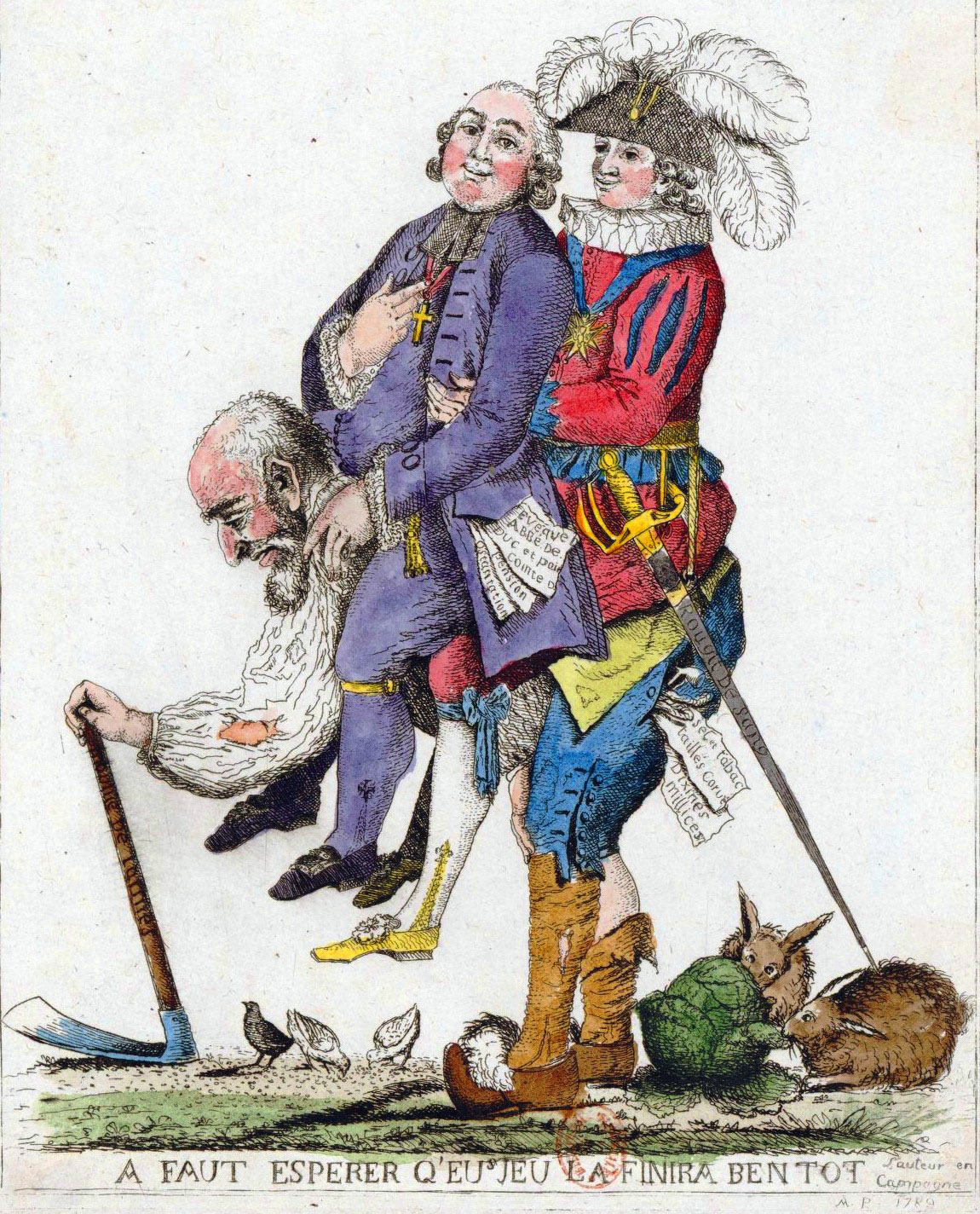
English: The Third Estate carrying the
Clergy and the Nobility on its back
Français : Le Tiers-État portant le
Clergé et la Noblesse sur son dos.

The French Revolution was set up deliberately to be "pro-government" – or pro-force at any rate. It was designed to defuse classical liberalism and freedom by proposing that government in the hands of an expert technocracy could "perfect" society and humankind.

Post revolution, between 1789 and September 1791, the French National Assembly reformed the ancient regime. They accomplished this with six basic statements, according to the website Modern European Intellectual History. Here are three of six. We've substituted the word "bankster" for "clergy" and "monarch" ...

•the abolition of special privileges of BANKSTERS through the legalization of equality (August 4, 1789)

•they subordinated BANKSTERS to the State. In November 1789, the National Assembly confiscated all BANKSTER property. And in early 1790, they passed the civil constitution, which reduced the power of the BANKSTERS who were now selected and paid by the State

•in September 1791, the National Assembly drew up a constitution, something it had been trying to do since June 1789. The constitution of 1791 specified such liberal ideas as limited BANKSTERS and full equality before the law

"Populist" movements like the French Revolution rarely end well because they are expressions mostly of anger and envy. They are not rational. They eat their own. That's what happened then as the movement began with the idea of overthrowing the regime and ended up by trying to "perfect" society using the power of the state.

Here is a Wikipedia summary:

http://en.wikipedia.org/wiki/French_revolution

The French Revolution (1789–1799), sometimes distinguished as the 'Great French Revolution' (La Grande Révolution), was a period of radical social and political upheaval in France and Europe. The absolute monarchy that had ruled France for centuries collapsed in three years. French society underwent an epic transformation as feudal, aristocratic and religious privileges evaporated under a sustained assault from radical left-wing political groups, masses on the streets, and peasants in the countryside. Old ideas about tradition and hierarchy - of monarchy, aristocracy and religious authority - were abruptly overthrown by new Enlightenment principles of equality,citizenship and inalienable rights.

The French Revolution began in 1789 with the convocation of the Estates-General in May. The first year of the Revolution saw members of the Third Estate proclaiming the Tennis Court Oath in June, the assault on the Bastille in July, the passage of the Declaration of the Rights of Man and of the Citizen in August, and an epic march on Versailles that forced the royal court back to Paris in October. The next few years were dominated by tensions between various liberal assemblies and a right-wing monarchy intent on thwarting major reforms.

A republic was proclaimed in September 1792 and King Louis XVI was executed the next year. External threats also played a dominant role in the development of the Revolution. The French Revolutionary Wars started in 1792 and ultimately featured spectacular French victories that facilitated the conquest of the Italian Peninsula, the Low Countries and most territories west of the Rhine – achievements that had defied previous French governments for centuries.

Internally, popular sentiments radicalized the Revolution significantly, culminating in the rise of Maximilien Robespierre and the Jacobins and virtual dictatorship by the Committee of Public Safety during the Reign of Terror from 1793 until 1794 during which between 16,000 and 40,000 people were killed. After the fall of the Jacobins and the execution of Robespierre, the Directory assumed control of the French state in 1795 and held power until 1799, when it was replaced by the Consulate under Napoleon Bonaparte.

After the Napoleonic Wars and ensuing rise and fall of Napoleon's First French Empire, a restoration of absolutist monarchy was followed by two further successful smaller revolutions (1830 and 1848). This meant the 19th century and process of modern France taking shape saw France again successively governed by a similar cycle of constitutional monarchy (1830-48), fragile republic (Second Republic) (1848-1852), and empire (Second Empire) (1852-1870). The modern era has unfolded in the shadow of the French Revolution. The growth of republics and liberal democracies, the spread of secularism, the development of modern ideologies and the invention of total war all mark their birth during the Revolution.

Below is a short video narrative of the French Revolution. It is simple and direct and written apparently by a high school student. We recommend it for the blunt arc of its narrative, even if it contains some factual flaws. Young people, not being so sophisticated their elders, sometimes see more clearly ...

(Video from byustudent2012's YouTube user channel.)

source: TheDailyBell

Thursday, March 26, 2015

The Great Fear and the Great Faith

1st pub by CV 10.29.12


By Rev. R.J. Rushdoony

Otto J. Scott, in Robespierre, The Voice of Virtue, calls attention to all important phenomenon of the French Revolution, The Great Fear.

Sunday, March 8, 2015

▶ Fiat money inflation in France (1789) - Part 2: John Law - Video

embedded captions can be removed/added with tiny "cc" at bottom.


 PART I for a preliminary historical perspective can be viewed here

Uploaded on Jun 15, 2011
Max Keiser, of maxkeiser.com, James Turk, Director of The GoldMoney Foundation and Pierre Jovanovic, jovanovic.com, tell the story of the introduction of Fiat Money to France.

In this episode we look at the use of Fiat Money during the French Revolution and how monetary mismanagement made an already delicate situation even worse, destroying the nation's economy and encouraging political radicalism.

We start with the debates over the issuance of paper money, explaining that the previous experience of John Law made French statesmen like Necker very cautious about fiat currency. The debates over the first issue of assignats were hard fought and lasted a long time, with the first issue of assignats approved by just a handful of votes and with all manner of guarantees to insure that it was "backed" by land and other forms of collateral.

The first issue of assignats had some very positive short term effects, stimulating commerce as paper wealth spread. However, the government took only a few months to spend the money raised and very soon cries were raised for more. This time a new issue was approved by a large majority. We look at how this paper money inflation started to drive prices higher, encouraging the creation of more paper in increasing amounts as the government and its clients became addicted to newly-created money. Rising prices were blamed on all manner of scapegoats in order to divert attention from the real cause: money printing.

As the situation worsened, the worst rose to the top, with Clavière becoming Minister of Finance with the promise to increase printing. Gresham's law started to act in full force, driving good money out of circulation with such force that silver, gold and even copper disappeared from the market. Attempts to put ceilings on prices through the "Law of the Maximum" and to prop up the value of assignats failed, and only succeeded in criminalising most commerce with increasingly harsh penalties -- eventually including death -- for those that sold above established prices or refused to accept payment in worthless government paper. Even the guillotine was not enough backing to ensure the assignat's survival.

Eventually food riots brought down the revolutionary government, and after several interim reactionary governments culminated with Napoleon's military rule. Napoleon brought back the gold standard, which survived until the first World War.


Friday, January 16, 2015

We Can't Pretend Forever Gold Is Worth $42.22

Posted on 10 Jan 2015 by Koos Jansen
 
The lawful owner of the 8,134 tonnes of official gold holdings of the United States is the US Treasury. The Federal Reserve handed over the official gold reserves to the Treasury in 1934 and in return received gold certificates – which, by the way, are not redeemable for gold, only for dollars, but that’s not the point now. The point is these gold certificates are still valued on the Fed’s balance sheet at $42.22 an ounce.

The free market price of gold is currently about $1,200. The reason the US capped the value of gold on their books at $42.22 in the seventies is because they wanted to phase out gold from the international monetary system to increase the power of King Dollar; denying the true value of the yellow metal supported this ambition. And so the Fed pretends until this day gold is worth $42.22, all in an effort to make us believe in the strength of the dollar. 

However, the US can’t pretend forever the price of gold is $42.22.
George Pompidou to Henry Kissinger, May 18, 1973:

I would therefore like to discuss the monetary question and also the question of gold—not the role of gold because we could debate that in vain and we know that we are not in agreement; but there is the question of the price of gold and we can no longer continue to go on pretending that an ounce of gold will always be worth thirty-eight dollars when it is now worth one hundred and six dollars.

On August 15, 1971, the President of the United States Richard Nixon announced the convertibility of US dollars for gold would be temporarily suspended. In particular France was not amused by the fact the US broke its promise; which was that the US dollar was as good as gold. 

After the anchor in the international monetary system was removed in ‘71 a diplomatic battle ensued about the value of currencies (and gold). The US wanted to cap the value of gold, while Europe wanted to revalue gold. This period is very interesting because I suspect it gave birth to the euro.
…I would like for you to talk to Schultz first. Burns has this idea that we have to move quickly with Europe. 
The French are key, they won’t make a deal unless we raise the price of gold. It is my view that we can’t. I don’t want you to say that to him but just remember that Arthur [Burns] is pushing for cutting a deal with the French.  
Schultz and I feel that would be a mistake. We have to keep free.
…The first thing to do is talk to George [Schultz] a little. I would like to get it where you, George, Connolly and I — would make this decision. I want to put Burns, McCracken and Peterson off.

I will resume publishing diplomatic documents from this era to find out exactly how the rest of the world (the Arabs, China, Japan, Russia and Europe) reacted and what measures were taken when the US broke its promise. If we figure out what happened in the past we have a better perspective on the future – so we can know more accurate when the US is forced to accept  the true value of gold.

Previously I’ve posted:
 Below a conversation between the President of France George Pompidou and United States National Security Advisor Henry Kissinger. Paris, May 18, 1973, 11 a.m.

Read more

Thursday, December 4, 2014

The House of Rothschild (1934 full length historical biography movie)

Boris Karloff like you've never seen him! I read Corti's book by the same name decades ago, and have it in my bookcase behind me. (You might have to drag the button bar at bottom to the left to start watching from the beginning. Odd, but...)

Published on Mar 3, 2013


The story of the rise of the Rothschild financial empire founded by Mayer Rothschild and continued by his five sons. From humble beginnings the business grows and helps to finance the war against Napoleon, but it's not always easy, especially because of the prejudices against Jews.


Thursday, November 6, 2014

Report,Whistleblowers: Libya: A Muslim nation destroyed for Israel and greed

We have a copy of an agreement between the would-be-rebels and the Mossad. The agreement states that Israel will provide arms and training to the rebels until they take-over the country and in return for that Israel will get to put a military base in the Green Mountain of Libya,” said Jo Anne and her husband James Moriarty, the whistle-blowers, who worked in Libya during 2007-2011.

Head of the CRIF (the French AIPAC), and
leading Zionist operator against. Dieudonné.
In November 2011, French Jewish “philosopher” and a close friend of former French president Nicolas Sarkozy, Bernard-Henri Levy, admitted at the first conference of the French Jewish Lobby CRIF that Qaddafi had to be removed because he became a threat to Israel.

“What I have done all these months, I did as a Jew. And like all the Jews of the world, I was worried. Despite legitimate anxiety is an uprising to be welcomed with favor, we were dealing with one of the worst enemy of Israel,” said Levy.

Last month, Dr. Franklin Lamb was allowed to interview Saif al-Islam Qaddafi, formerly heir-apparent to his father, Libyan leader Col. Moammar Qaddafi in Libyan jail. Dr. Lamb says that the main purpose of his meeting was to find out the fate of Iranian-born Lebanese Shia cleric and politician, Imam Musa Sadr, who disappeared while on visit to Libya in 1978. Dr. Lamb claims that after talking to several Libyan professionals, he came to the conclusion that Saif al-Islam could be the only person in Libya who could muster a popular public support in order to defeat the US-NATO armed and funded Islamist militia groups fighting each other for power and oil money.

The rampant regional, ideological and tribal conflicts are worse than the rule of the dictator,” said Salah Mahmud al-Akuri, a doctor in Benghazi. “Some Libyans are looking back to the old regime.”

In July 2011, Saif al-Islam was quoted as saying: “It isn’t just Libya’s black gold (oil) that the West wants, but Libya’s “blue gold” – that Nubian Sandstone Aquifer System, the only fresh water source of its kind that remains in North Africa and the Middle East, a region now experiencing a permanent drought. As famine sets in (famine has already begun in East Africa) that Libyan aquifer will become as valuable as gold. Two French water firms, the largest in the world (Veolia and Suez S.A.) want to own that aquifer, since they will make countless billions in profit from food grown from the water. Many books have been written about the escalating global water wars. Every IMF or World Bank loan is issued on the condition that the victim nation sells its water supplies to private investors. The human race can survive without oil if necessary, but not without water.”

Turkey, Qatar and Saudi Arabia are arming and funding US-NATO’s former allies (Islamists) to establish their influence in the ‘future Libya’ while the Zionist-controlled vultures are watching the on-going bloodshed of Muslim people on the sideline.

Muslims must learn the truth, sooner the better that Western invasions of their countries have nothing to do with bringing democracy or liberating women, but the agenda is totally opposite. The purpose of these “humanitarian interventions” is to installed regimes which are subservient to Zionist interests. The US, France, Britain, Canada and Italy has played major part in these “Zionist wars” in Afghanistan, Iraq, Libya, Somalia, Sudan, Lebanon, Yemen, etc., which have made life for ordinary citizen a living hell. In April 2011, American Jewish scholar, Noam Chomsky, admitted that United States is against democratic governments in the Middle East because they turn out to be anti-Israel.

Thursday, May 1, 2014

Friday, April 25, 2014

The Big, Bad Market: A French Psychosis? - Louis Rouanet

Mises Daily: Friday, April 25, 2014 by

There is a cliché according to which the French are genetically against classical liberalism and free-market economics. However, that wasn't always the case. 

Wednesday, February 26, 2014

The High Price of Delaying the Default - Thorsten Polleit

Mises Daily: Wednesday, February 26, 2014 by Thorsten Polleit
 
Credit is a wonderful tool that can help advance the division of labor, thereby increasing productivity and prosperity. 

Tuesday, February 4, 2014

Paris denies French press reports of US commandos operating in southern Libya


By Libya Herald staff.
Tripoli, 2 February 2014:

The Foreign Ministry in Paris has vigorously denied that any French military source had stated that US commandos were operating covertly in southern Libya.  It said that a report of the secret operations, carried in Saturday’s edition of the daily Le Figaro, which cited a military source in France, was completely untrue.

Monday, December 2, 2013

Friday, October 25, 2013

Report: US, Israel's Mossad may have hacked French president

Friday, October 25, 2013 5:46 PM Source alalam

French President Francois Hollande (L) greets Israeli Prime Minister Benjamin Netanyahu (R) upon his arrival at the Elysee Palace, 31 October 2012.

France believed the United States attempted to hack into its president's communications network, a leaked US intelligence document published on Friday suggests.

US agents denied having anything to do with a May 2012 cyber attack on the Elysee Palace, the official residence of French presidents, and appeared to hint at the possible involvement of Mossad, Israel's intelligence agency, a classified internal note from the US National Security Agency suggests.

Extracts from the document, the latest to emerge from the NSA via former contractor Edward Snowden, were published by Le Monde newspaper alongside an article jointly authored by Glenn Greenwald, the US journalist who has been principally responsible for a still-unraveling scandal over large-scale US snooping on individuals and political leaders all over the world.

The document is a briefing note prepared in April this year for NSA officials who were due to meet two senior figures from France's external intelligence agency, the DGSE. The French agents had travelled to Washington to demand explanations over their discovery in May 2012 of attempts to compromise the Elysee's communications systems.

The note says that the branch of the NSA which handles cyber attacks, Tailored Access Operations (TAO), had confirmed that it had not carried out the attack and says that most of its closest allies (Australia, Britain, Canada and New Zealand) had also denied involvement.

It goes on to note: "TAO intentionally did not ask either Mossad or (Israel's cyber intelligence unit) ISNU whether they were involved as France is not an approved target for joint discussions."

Le Monde interpreted this sentence as being an ironic reference to a strong likelihood that Mossad had been behind the attack.

The cyber attacks on the Elysee took place in the final weeks of Nicolas Sarkozy's term, between the two rounds of the presidential election which he ended up losing to Francois Hollande.

The attacks had been previously reported by French media, who have described them as an attempt to insert monitoring devices into the system but it remains unclear whether the presidential networks were compromised for any time.

There was no immediate response from the Elysee on Friday when asked for comment.

NJF/NJF