Search Blog Posts

Showing posts with label US Dollar Crisis. Show all posts

Friday, February 6, 2015

Is Russia Planning a Gold-Based Currency?

February 6, 2015

The “perfect-storm” of geopolitical instability, diplomatic isolation, severe currency depreciation, and economic decline now confronting Russia has profoundly damaged Moscow's international standing, and possibly for the long-term. Yet, it is precisely such conditions that may push the country’s leadership into taking the radical step that will secure its world-player status once and for all: the adoption of a gold-exchange standard.

Though a far-fetched idea at first glance, many factors suggest that remonetization in gold may be a logical next step for Moscow.

First, for years Moscow has been expressing its unwillingness to remain at the monetary mercy of the US and its NATO allies and this view has been most vehemently expressed by President Putin’s long-time economic advisor, Sergei Glazyev. Russia is prepared to play strategic hardball with the West on the issue: the governor of Russia’s central bank took the unusual step last November of presenting to the international media details of the bank’s zealous gold-buying spree. The announcement, in sharp contrast to that institution’s more taciturn traditions, underscores Moscow’s outspoken dismay with dollar hegemony; its timing suggests coordination with the top rungs of government to present gold as a possible currency-war weapon.

Second, despite international pressure, Russia has been very wary of the sell-off policies that led the UK, France, Spain, and Italy to unload gold over the past decade during unsuccessful attempts to prop up their respective ailing economies — in particular, of then-Prime Minister Gordon Brown’s sell-off of 400 metric tons of the country's reserves at stunningly low prices. Moscow’s surprise decision upon the onset of the ruble’s swift decline in early December 2014 to not tap into the country’s gold reserves, now the world's sixth largest, highlights the ambitiousness of Russia’s stance on the gold issue. By the end of December, Russia added another 20.73 tons, according to the IMF in late January, capping a nine-month buying spree.

Third, while the Russian economy is structurally weak, enough of the country's monetary fundamentals are sound, such that the timing of a move to gold, geopolitically and domestically, may be ideal. Russia is not a debtor nation. At this writing in January, Russia’s debt to GDP ratio is low and most of its external debt is private. Physical gold accounts for 10 percent of Russia’s foreign currency reserves. The budget deficit, as of a November 2014 projection, is likely to be around $10 billion, much less than 1 percent of GDP. The poverty rate fell from 35 percent in 2001 to 10 percent in 2010, while the middle class was projected in 2013 to reach 86 percent of the population by 2020.

Collapsing oil prices serve only to intensify the monetary attractiveness of gold.
Given that oil exports, along with the rest of the energy sector, account for 45 percent of GDP, the depreciation of the ruble will continue; newly unstable fiscal conditions have devastated banks, and higher inflation looms, expected to reach 10 percent by the end of 2015. As Russia remains (for the foreseeable future) mainly a resource-based economy, only a move to gold, arguably, can make the currency stronger, even if it does limit Russia’s available currency.

In buying as much gold as it has, the country is, in part, ensuring that it will have enough money in circulation in the event of such fundamental transformation. In terms of re-establishing post-oil shock international prestige, a move to gold will allow the country to be seen as a more reliable and trustworthy trading partner.

The repercussions of Russia on a gold-exchange standard would be immense. Above all, it would mean the first major schism in the world's monetary order. China would quite likely follow suit. It could mean the threat of a severe inflation in the United States should rafts of unwanted dollars make their way back across the Atlantic — the Fed's ultimate nightmare. Above all, the country will avoid the extreme debt leverages which would not have happened had Western capitals remained on gold.

“A gold standard would be politically appealing, transforming the ruble to a formidable currency and reducing outflows significantly,” writes Dr. Enrico Colombatto, economics professor at the University of Turin, Italy.

He notes that the only major drawback would be that the imposed discipline of a gold standard would deprive authorities of discretionary political power. The other threat would be that of a new generation of Russian central bankers becoming too heavily influenced by the monetary mindset of the European Central Bank (ECB) and the Fed.

As Alisdair MacLeod, a two-decade veteran of off-shore banking consulting based in the UK, recently wrote, Russia (and China) will “hold all the aces” by moving away from any possible currency wars of the future into the physical gold market. In his article, he adds that there is currently a low appetite for physical gold in Western capital markets and longer-term foreign holders of rubles would be unlikely to exchange them for gold, preferring to sell them for other fiat currencies.

Mr. Macleod cites John Butler, CIO at Atom Capital in London, who sees great potential in a gold-exchange standard for Russia. With the establishment of a sound gold-exchange rate, he argues, the Central Bank of Russia would no longer be confined to buying and selling gold to maintain the rate of exchange. The bank could freely manage the liquidity of the ruble and be able to issue coupon-bearing bonds to the Russian public, allowing it a yield linked to gold rates. As the ruble stabilizes, the rate of the cost of living would drop; savings would grow, spurred on by long term stability and lower taxes.

Foreign exchange also would be favorable, Mr. Butler maintains. Owing to the Ukraine crises and commodities crises, rubles have been dumped for dollar/euro currencies. Upon the announcement of a gold-exchange, demand for the ruble would increase. London and New York markets would in turn be countered by provisions restricting gold-to-ruble exchanges of imports and exports.

The geopolitics of gold also figure into Russia’s increasingly close relations with China, a country that also has made clear its preference for gold over the dollar. (Russia recently edged out China as the world's top buyer of the metal.) In the aftermath of the $400 billion, 30-year deal signed between Russian gas giant Gazprom and the China National Petroleum Company in November 2014, China turned its focus to the internationalization of its own gold market. On January 15, 2015, the Shanghai Gold Exchange, the largest physical gold exchange worldwide, and the World Gold Council, concluded a strategic cooperation deal to expand the Chinese gold market through the new Shanghai Free Trade Zone.

This is not the first time the gold standard has been seen as the ultimate cure for Russia’s economic problems. In September 1998, the noted economist Jude Wanninski predicted in a far-sighted essay for The Wall Street Journal that only a gold ruble would get the the country out of its then-debt crises. It was upon taking office about two years later, in May 2000, that President Putin embarked upon the country’s massive gold-buying campaign. At the time, it took twenty-eight barrels of crude just to buy an ounce of gold. The gold-backed ruble policy of those years was adopted to successfully pay down the country's external debt.

As a pro-gold stance is, essentially, anti-dollar, speculation about how the US would react raises the question of whether an all-out currency war would follow. The West would have to keep Russia regionally and militarily marginalized, not to mention kept within the confines of the Fed, the ECB, and the Bank of England (BOE).
Nor is that prospect too far-fetched. As Dutch author Willem Middelkoop has written in his 2014 book The Big Reset: War on Gold and the Financial Endgame,
A system reset is imminent. Even before 2020 the world's financial system will need to find a different anchor. ... In a desperate attempt to maintain this dollar system, the United States waged a secret war on gold since the 1960s. China and Russia have pierced through the American smokescreen around gold and the dollar and are no longer willing to continue lending to the United States. Both countries have been accumulating enormous amounts of gold, positioning themselves for the next phase of the global financial system.

via Mises.org

Thursday, January 29, 2015

Comparing the inflated cost of living today from 1938 to 2015: US Dollar losing an enormous amount of purchasing power since 1938

 Posted by mybudget360
 
People have a hard time understanding how inflation erodes their purchasing power.  Little by little the cost of everything goes up and people simply assume this is normal in an economy.  The $2 movie ticket becomes a $8 movie ticket.  That can of tuna just got smaller but the price remains the same.  The cost of going to college went from manageable to needing large student debt merely to complete a four year degree.  Inflation is argued to be a purely monetary outcome.  You have too much money, in the form of cash or credit in today’s case, chasing fewer goods.  In our current economy, debt is the fuel accelerating inflation.  You can see this in items like housing, cars, and college where debt is the primary fuel driving prices higher.  The big problem today is that incomes are simply not rising fast enough to keep up with the rise in other expenses.  Over time, inflation has a big destructive power.  I thought it would be useful to look at the cost of typical items in 1938 and compare them to where things stand in 2015.


Comparing 1938 to 2015

Over a year ago, we looked at some old data and found this to be useful to readers.  I thought it would be helpful to update the data and see where things stand today in 2015.  Someone sent this snapshot of the cost of living in 1938.  It really is fascinating looking at inflation over a very long period of time.  In this case, we are looking at spending pre-World War II.  Most Americans probably have no sense as to what the cost of living was back then since they are mired in the fight of living paycheck to paycheck.
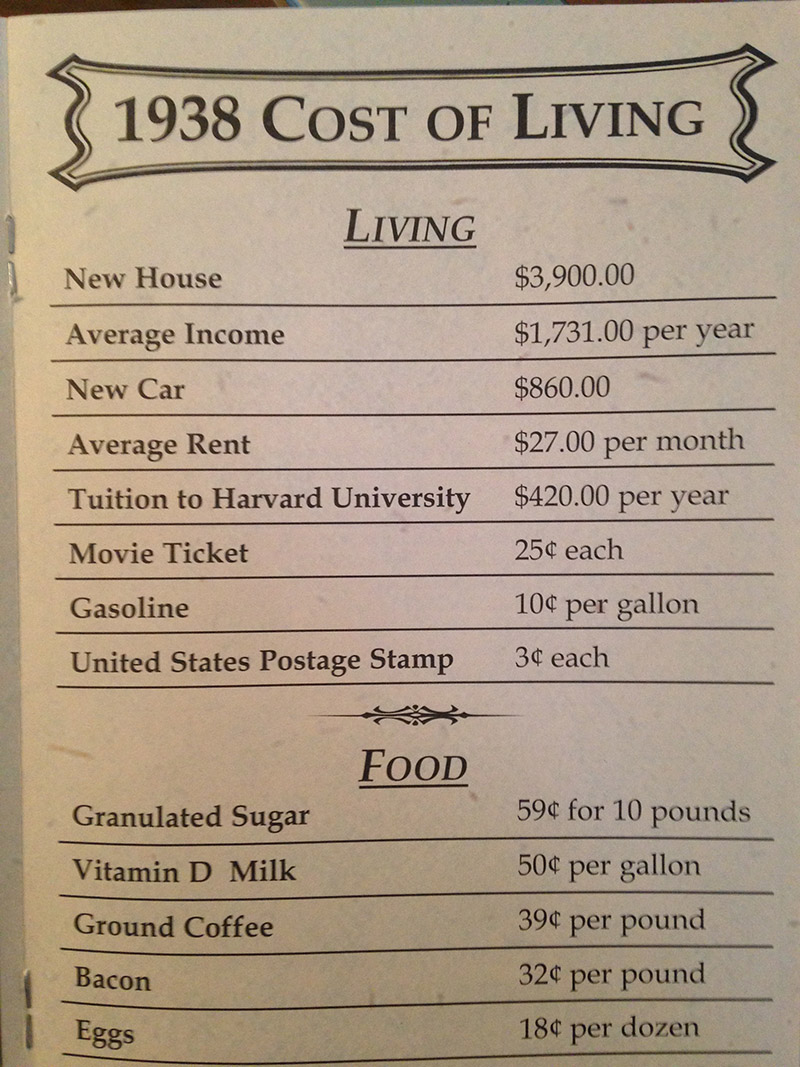
Take a look at the cost of living in 1938:
cost-of-living (1)
Source:  Reddit
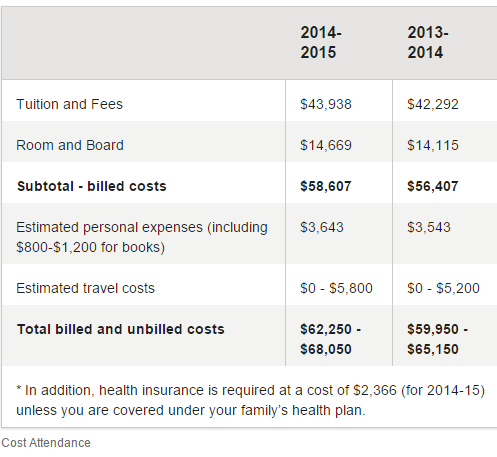
What is important is to look at income in relation to the cost of living.   A new home was about twice the annual average income.  Today, with the median household income being $50,000 and your typical new home costing $298,000 we are definitely on the more expensive side (6 times annual income versus 2 back in 1938).  Look at the new car costs.  A new car cost about $860 or half of annual income.  Today, a regular car can cost $32,000 and most will need to finance it.  Tuition to Harvard was $420 per year and today Harvard tuition is nearly $62,000 with room and board:
harvard
Source:  Harvard website

In other words, the typical family of today would need to use all their annual income to send their kid to Harvard plus go in debt while in 1938, your average family had income to send 4 kids to Harvard per year.  The most inflated of all categories is college tuition.

Looking at various costs adjusting for inflation

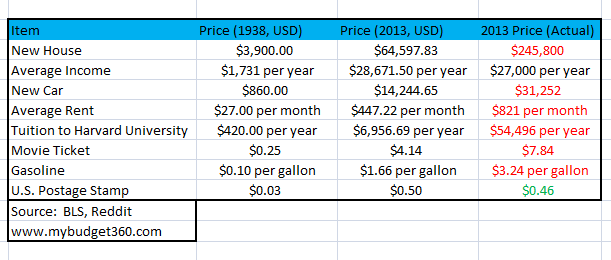
I put this table together and adjusted for inflation to give you a better perspective:
inflation-and-actual-prices
I wanted to update some of this data for 2015 as well:
New house:                        $298,000 (Source: Census)
Average income:              $28,000 (Social Security)
New Car:                             $32,000 (Bankrate)
Average Rent:                   $950
Tuition to Harvard:          See above
Movie ticket:                     $8
Gasoline:                             $1.99
US Postage Stamp:          $0.49
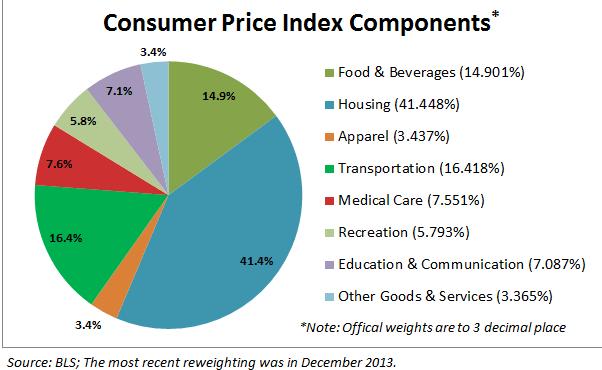
So basically every single category is up besides gasoline given the crash in oil prices in 2014.  But this is a small drop in the bucket given what consumes the biggest portion of your budget:
inflation categories

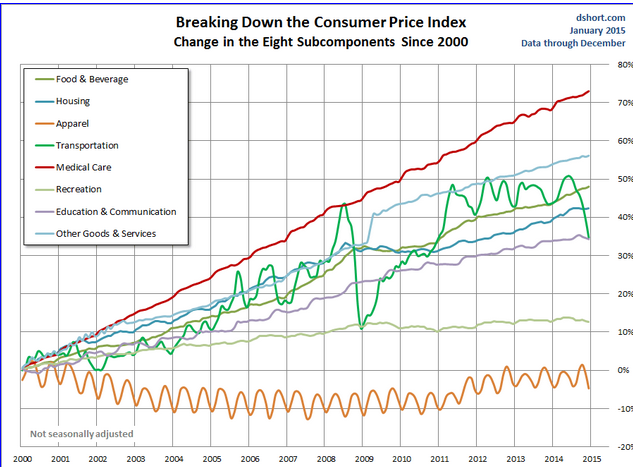
Housing, food, medical care, transportation, and education make up the biggest expenses.  Housing by far consumes the biggest portion.  And look at how fast prices have gone up since 2000:

inflation since 2000
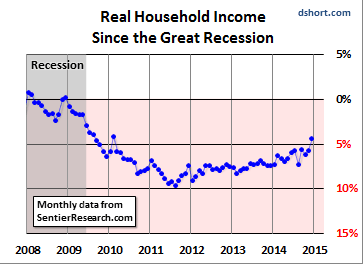
Medical care is up over 70 percent.  Housing is up over 40 percent even with the crash in the housing market.  Basically the only items that held steady were apparel and recreation.  But look at how incomes are doing:
real household income
You wonder why you feel like you have less purchasing power?  You feel poorer because you are thanks to the slow eroding power of inflation.  The Fed would like to argue that there is no inflation but just look at housing costs, medical care, college tuition, and grocery bills and tell the regular working American family that there is no inflation.

Source

Saturday, December 13, 2014

▶ World Currency US Dollar About To Collapse/NWO, Mark, & US WW3 With Russia & China Around The Corner - YouTube


Published on Nov 1, 2014

World Currency US Dollar About To Collapse/NWO, Mark Of The Beast, & US WW3 With Russia & China Around The Corner/Government Lies & Deception. God Bless & Jesus Saves. Accept Jesus As Your Lord & Saviour Today. Romans 10:9 That if thou shalt confess with thy mouth the Lord Jesus, and shalt believe in thine heart that God hath raised him from the dead, thou shalt be saved. America In Bible Prophecy Revelation 14:8-13, 16:17-20, 17, & 18, Isaiah 13, 14, 18, 47, & 48, Jeremiah 50 & 51, Habakkuk 1 & 2. Ephesians 5:11-16 And have no fellowship with the unfruitful works of darkness, but rather reprove them. 

For it is a shame even to speak of those things which are done of them in secret. But all things that are reproved are made manifest by the light: for whatsoever doth make manifest is light. Wherefore he saith, Awake thou that sleepest, and arise from the dead, and Christ shall give thee light. See then that ye walk circumspectly, not as fools, but as wise, Redeeming the time, because the days are evil.


https://www.youtube.com/watch?v=qguq3Uix0lk#t=295

Thursday, December 4, 2014

ICBC: A New Global Currency & Gold Setup Is Being Conceived

A good lead-in for Rothschild's swelling Chinese domain is this one from us posted first on March 5th: Rothschild may have already become the Custodian for China's Gold

Friends, deep down in your heart you know those ankle shackles you're wearing are not going to fall off on their own.


The Chinese Perspective On The International Gold Market


Published: 15-07-2014 17:00

ICBC: A New Global Currency Setup Is Being Conceived
At the LBMA Bullion Market Forum in Singapore on June 25, 2014, two very important speakers attended; Xu Luode, chairman of the Shanghai Gold Exchange, and Zhou Ming, General Manager of the Precious Metals Department at ICBC. Me and Torgny Persson have written about the speeches from Xu and Zhou in previous posts, in this post we will take a closer look at what Zhou said, based on what Chinese media have written about it (whereas Western media are reluctant to cover this). His statements are not entirely new as he already had revealed some objectives of ICBC's precious metals department in an interview conducted on January 7, 2014; ICBC's main goal is to become a significant player in the international gold market. Yet, he made a few remarkable statements in Singapore. First, a few segments from the article/interview published in January:  

In 2013, ICBC physical gold sales increased by more than 80% YoY, the growth rate of the entire line of business also grew more than 30% over the previous year.

For Zhou, the growth of the precious metals business is not accidental. Aside from ICBC's management in forward-thinking and advantages from being a bank, it's also because in China's internationalization process banking institutions are required to play this role.

When the precious metals department was established, ICBC chairman Jiang Jianqing said: "We have the ambition that ICBC becomes a world-class commercial bank in precious metals investment management."

Zhou: "...one day China enters the international stage, we will need more people to participate in understanding the characteristics of capital flows, so we don't have to be so passive. I drive our traders to work on scale and quantitative problems of our platform for the possibility of taking part in international transactions." 

For the future, Zhou Ming's goals are clear and simple: to continue to build the precious metals battleship, heading towards international markets. "In 2013 China became the world 's largest gold producer and consumer, there is no reason for it not to have any voice in international price fluctuations."

The following is a translation of an article in Chinese media about Zhou's speech at the LBMA Forum in Singapore June 25, 2014. Translated by Soh Tiong Hum from Terraseeds.com. 

The Chinese Perspective On The International Gold Market


2014/7/4 Source: Money Weekly

Invited by London Bullion Market Association (LBMA), Zhou Ming, General Manager of Precious Metals Department at Industrial and Commercial Bank of China (ICBC), represented the bank at the LBMA Bullion Market Forum 2014 held in Singapore. Zhou made a keynote speech where he:

  1. Expanded on China's perspective of the international gold market.
  2. Explained the structure of China's gold market to forum participants.
  3. Introduced ICBC Precious Metals Department's development and
  4. Described ICBC's status and function in the development of the Chinese gold market.
  5. Elaborated on the future direction.

Also invited to the LBMA forum were heads of Chicago Mercantile Exchange, World Gold Council, JP Morgan, HSBC, Barclays, Deutsche Bank and many other institutions.

Global precious metals market has experienced centuries of evolution and development. After World War II, the world economy was re-arranged to form a dollar-dominated international monetary system of credit. The international status of gold was replaced by the dollar and the international price of gold was pegged to the dollar. This phenomenon was referred to as 'dollar-pricing'.

Following several economic crises, US dollar's influence on the international monetary system is now on the wane. The 2007 subprime crisis in the US delivered an unprecedented blow to US Dollar hegemony. Gold, which has the best properties of money of all precious metals, in contrast became a banner of resistance to the economic crisis. Its price of $ 290 per ounce in the beginning of 2000, shot above $ 1900 per ounce in 2011.

Six years after the global financial crisis, despite a series of financial stimulus - quantitative easing that increased the size of the Federal Reserve's balance sheet to $ 4 trillion in a few years, both the current and previous head of the Federal Reserve remain defensive of QE policy. Although the Fed announced that it will start reducing the scale of QE on December 19, 2013, after which the international gold price fell below $ 1200 per ounce at one point, international analysts see China's demand and huge import as a decisive element for the reversal in the gold price. 

In 2013 a Bloomberg report said that 26 million ounces (800 metric tonnes) of gold was moved from London to Swiss refiners and then to China via Hong Kong.

When Jeremy East, Managing Director at Standard Chartered Bank, asked at the LBMA Forum In Singapore if the statement "Western gold moves East" was true, Zhou made the following statements:

  1. The world price of gold in recent decades was dollar-priced and fluctuated with the US dollar.
  2. Fed implemented QE caused the issuance of dollars that exceeds demand.
  3. International gold prices will return to rational levels after shooting high.
  4. With the status of the US dollar as the international reserve currency is shaky, a new global currency setup is being conceived.
  5. Uncertain changes will happen to gold's traditional dollar-pricing so the US dollar's influence on gold pricing needs to be re-evaluated.
  6. With the rise of Asian economies, China and India will continue to be the world's pillars of physical gold demand.
  7. Gold has not only moved from West to East but will continue to move to the East.

The factors supporting the gold price are not limited to these. Stephen Roach, senior lecturer at Yale University, formerly chairman of Morgan Stanley Asia and chief economist at Morgan Stanley agreed with Zhou in a conversation last year: "Although the US stock market continues to boom in hand with falling bond yields, US economic recovery remains fragile with a lack of recovery in US companies which causes labor unemployment levels to remain high, GDP growth to slow down and inflation to remain lower than pre-crisis levels. The international gold price is not in an environment that sustains falling prices.

Now in the second half of 2014, the gold market is an important part of the world's modern financial system and that means for China to internationalize its financial markets. When the development of China's gold market supervision and regulation policies are complete, China's commercial banks' overseas businesses will flourish and opportunities from the Shanghai FTZ can be used; the Shanghai Gold Exchange will officially launch an international board within 2014.

The international board will initially look at foreign institutional investors in the region to establish a free trade yuan-denominated spot gold trading platform and a corresponding settlement system so as to provide offshore RMB investment and circulation in a new channel. RMB cross-border trading accounts will also have a payment service.

Breakthroughs in many national policies and system developments will play an important part in the internationalization of China's financial market and its place in international gold-pricing.

End of article

Oddly enough there hasn't been any mainstream news outlet that has published anything about the speeches from Xu and Zhou, while these are very important for the international gold market. Additionally the LBMA just published the slides from the speakers at the forum in Singapore, except the ones from Xu and Zhou! Torgny Persson, who visited the forum, assured me both did use slides in their presentations. I find it strange these slides are not published. The LBMA notes on its website that in a couple of weeks it will publish the transcripts of the speeches from the Singapore forum. I'm very curious if the transcripts of Xu and Zhou will be appended.     

Koos Jansen
​via ​

Wednesday, November 12, 2014

Which Cities/States Will Be the First to Default When the Economy Rolls Over?


Tuesday, November 11, 2014


What happens to local governments when the economy rolls over?

Though we're constantly reassured the "recovery" that's stumbled for five years has years of strong growth ahead, history suggests the "recovery" is due to roll over.
 Few recoveries last longer than 5 or 6 years, and the business cycle is graying fast: subprime auto loans are not exactly the foundation of "strong growth."
So what might push the economy over the cliff? The strong U.S. dollar is crimping overseas sales and profits, the global economy is already recessionary, mortgage applications have dried up, auto sales are being driven by subprime loans, and the valuation bubbles in stocks and real estate are due for a breather, if not an outright reversal. Retail sales are flat, and with all these headwinds, growing profits by 10% to 20% a year becomes impossible for the vast majority of enterprises.

So what happens to local governments when the economy rolls over? Tax revenues decline.

The consensus is that local governments are sitting pretty: sales and property values have risen smartly, pushing tax revenues higher, and the cost of borrowing money via tax-free municipal bonds has fallen. Nice, but these are all functions of expansion and rising tax rates.

The uneven nature of the "recovery" has left some cities and states more vulnerable to a downturn than others.Let's catalog the various risk factors that might become consequential as the global and U.S. economies weaken.

1. Those dependent on foreign tourism. The weak dollar made America a bargain destination for the past decade. As the dollar strengthens and other currencies lose purchasing power, America is no longer a bargain--especially as job cuts decimate the number of people who can blow a few thousand dollars on overseas vacations to the U.S.

2. Auto manufacturing-dependent locales. Vehicle sales have been strong, and the cheerleaders claim sales will keep rising for years to come. Really? With what money? As soon as layoffs hit the marginal workforce and the subprime auto loan bubble implodes, vehicle sales will follow suit.

3. Cities and states that depend heavily on capital gains taxes. Once the current housing and stock bubbles deflate--or simply stop expanding--tax revenues from the enormous capital gains reaped in the past five years will wither.

4. Locales dependent on high income taxes. Given that most of the job growth of the past five years has occurred in low-wage sectors, adding jobs hasn't boosted income taxes much. High income-tax states have jacked up rates on high-income earners, but there is no law of nature that says high-income jobs will survive a global downturn.

Rather, enterprises desperate to tighten operating costs will want to jettison high-cost employees first.

5. Local governments with enormous debt burdens. With interest rates low, municipalities and states went to the bond market over the past few years for "free money." Once tax revenues plummet, the interest on all that "free money" will take a larger percentage of tax revenues, heightening the cost of new bond debt as buyers start adding in the risk of eventual default.

6. Locales with high fixed costs. These include high healthcare costs for homeless, elderly, government employees, etc., interest on all those bonds, government employee pensions, etc. The fixed costs only increase every year, regardless of tax revenues. Every local government with high fixed costs is in a tightening fiscal vice once tax revenues plummet.

7. Local governments with generous employee benefits and pensions. Once the stock market rolls over, the big capital gains that have funded public pension plans dry up, and the annual contribution has to be paid out of declining tax revenues.

Should interest rates actually rise, pension fund bond portfolios would plummet in value, too.

8. Local governments dominated by self-serving entrenched interests. That is, all of them: sclerotic, self-serving, entrenched interests resolutely refuse to accept any cuts in their swag. As tax revenues fall off a cliff, government managers will face a dilemma: they can't cut costs because the self-serving interests have made that politically impossible, and they can't borrow money for operating expenses.

That leaves defaulting on debt as the only choice left. And since that's the only choice left, that's what they'll do.

The vice will close on some cities and states sooner than others, but it will eventually squeeze every city and state with declining revenues and rising fixed costs into default.


New video program with Gordon T. Long:


watch on YouTube

via oftwominds

Friday, November 7, 2014

Greenspan's Stunning Admission: "Gold Is Currency; No Fiat Currency, Including the Dollar, Can Match It"

Tyler Durden's picture


For some reason, the Council of Foreign Relations, where ex-Fed-Chief Alan Greenspan spoke last week, decided the following discussion should be left out of the official transcript. 

We can perhaps understand why... as Gillian Tett concludes, "comments like that will be turning you into a rock star amongst the gold bug community."
 
Greenspan (Uncut):


TETT: Do you think that gold is currently a good investment?
 
GREENSPAN: Yes... Remember what we're looking at. Gold is a currency. It is still, by all evidence, a premier currency. No fiat currency, including the dollar, can macth it.
Which is missing from the official CFR transcript...

GREENSPAN: ...remember, we had that first tapering discussion, we got a very strong market response. And then we reassured everybody to have no -- remember, tapering is still (audio gap) of an agreement that the central banks have made -- European central banks, I believe -- about allocating their gold sales which occurred when gold prices were falling down (audio gap) has been renewed this year with a statement that gold serves a very important place in monetary reserves.

And the question is, why do central banks put money into an asset which has no rate of return, but cost of storage and insurance and everything else like that, why are they doing that? If you look at the data with a very few exceptions, all of the developed countries have gold reserves. Why?

TETT: I imagine right now, it's because of a question mark hanging over the value of fiat currency, the credibility going forward.

GREENSPAN: Well, that's what I'm getting at. Every time you get some really serious questions, the 50 percent of the gold price determination begins to move.

TETT: Right.

GREENSPAN: And I think it is fascinating and -- I don't know, is Benn Steil in the audience?

TETT: Yes.

GREENSPAN: There he is, OK. Before you read my book, go read Benn's book. The reason is, you'll find it fascinating on exactly this issue, because here you have the ultimate test at the Mount Washington Hotel in 1944 of the real intellectual debate between the -- those who wanted to an international fiat currency which was embodied in John Maynard Keynes' construct of a banker, and he was there in 1944, holding forth with all of his prestige, but couldn't counter the fact that the United States dollar was convertible into gold and that was the major draw. Everyone wanted America's gold. And I think that Benn really described that in extraordinarily useful terms, as far as I can see. Anyway, thank you.

TETT: Right. Well, I'm sure with comments like that, that will be turning you into a rock star amongst the gold bug community.
*  *  *
As a reminder, here is Ben Bernanke putting people straight on Gold...
As we noted at the time,

Ron Paul asks the Bernanke if he thought gold was money. Bernanke almost swallows his tongue, stares blankly for a few seconds and then says, “no.”

Paul then asks why banks hold gold on their balance sheet?  Why not diamonds?  Bernanke says, “tradition, I suppose.” 

So let me get this straight, banks hold billions of dollars of an asset that pays no interest or dividends on their balance sheet for reasons of "tradition".  nothing to do with anything else, just tradition.  uh, yea.  That must be it.
via ZH


Thursday, November 6, 2014

Has Washington Just Shot Itself in the Oily Foot?

06.11.2014 Author: William Engdahl

6573338By now even the New York Times is openly talking about the secret Obama Administration strategy of trying to bankrupt Russia by using its oil-bloated Bedouin bosom buddy, Saudi Arabia, to collapse the world price of oil. However, it’s beginning to look like the neo-conservative Russia-haters and Cold war wanna-be hawks around Barack Obama may have just shot themselves in their oily foot. As I referred to it in an earlier article, their oil price strategy is basically stupid. Stupid, as all consequences have not been taken into account. Take now the impact on US oil production as prices plummet.

The collapse in US oil prices since September may very soon collapse the US shale oil bubble and tear away the illusion that the United States will surpass Saudi Arabia and Russia as the world’s largest oil producer. That illusion, fostered by faked resource estimates issued by the US Department of Energy, has been a lynchpin of Obama geopolitical strategy.

Now the financial Ponzi scheme behind the increase of US domestic oil output the past several years is about to evaporate in a cloud of fictitious smoke. The basic economics of shale oil production are being ravaged by the 23% oil price drop since John Kerry and Saudi King Abdullah had their secret meeting near the Red Sea in early September to agree on the Saudi oil price war against Russia.

Wall Street bank analysts at Goldman Sachs just issued a 2015 forecast that US oil prices, measured by a benchmark called WTI (West Texas Intermediate) will fall to $70 a barrel. In September 2013, WTI was more than $106 a barrel. That translates into a sharp 34% price collapse in just a few months. Why is that critical to the US shale production? Because, unlike conventional crude oil deposits, shale oil or tight oil as industry calls it, depleted dramatically faster.

A comprehensive new analysis just issued by David Hughes, a Canadian oil geo-scientist with thirty years’ experience with the Geological Survey of Canada, using data from existing US shale oil production that has now become public for the first time (the shale oil story is very recent), shows dramatic rates of oil volume decline from US shale oil wells:
The three year average well decline rates for the seven shale oil basins measured for the report range from an astounding 60-percent to 91-percent. That means over those three years, the amount of oil coming out of the wells decreases by that percentage. This translates to 43-percent to 64-percent of their estimated ultimate recovery dug out during the first three years of the well’s existence. Four of the seven shale gas basins are already in terminal decline in terms of their well productivity: the Haynesville Shale, Fayetteville Shale, Woodford Shale and Barnett Shale.
A decrease in oil daily of between 60% and 91% for these best possible shale oil regions means the oil companies must drill deeper to even stay still with oil production, let alone increase total oil volume. That means the drillers must spend more money to drill deeper, a lot more. According to Hughes, the Obama administration Department of Energy has uncritically taken rosy forecast numbers given them by the companies that boost the US shale oil myth. His calculations show future US shale oil output only 10% that estimated for 2040 by the Energy Department.

Hughes describes the current deadly dilemma of the shale oil companies as a “drilling treadmill.” They must drill more and more wells just to keep production levels flat. The oil companies have already gone after the most promising shale oil areas, so-called “sweet spots,” to maximize their production. Now as production begins to decline terminally, they must start drilling in spaces with less rich oil and gas returns. He adds, “if the future of U.S. oil and natural gas production depends on resources in the country’s deep shale deposits…we are in for a big disappointment.”

Oil price collapse
What Hughes describes was the state of shale oil before the start of the Kerry-Abdullah Saudi oil price war. Now US WTI oil prices have dropped a catastrophic 25% in six weeks, and still falling. Other large oil producers like Russia and Iran are in turn flooding the world market with their oil to increase revenue for their state budgets, adding to a global oil supply glut. That in turn pressures prices more.

The shale oil and gas bonanza of the past five years in the USA has been built on a foundation of zero Federal Reserve interest rates and huge speculative investment by hungry Wall Street firms and funds. Because of the ultra-rapid oil well depletion, when market oil prices collapse, the entire economics of lending to the shale oil drillers collapses as well. Money suddenly vanishes and debt-strapped oil companies begin real problems.

According to Philip Verleger, former head of President Carter’s Office of Energy Policy and now an energy consultant, in North Dakota’s Bakken shale, one of the most important new shale oil regions, oil at $70 a barrel could cut production 28 percent to 800,000 barrels a day by February from 1.1 million barrels a day in July. “The cash flow will go down as the prices go down, the amount of money advanced to these people to continue the drilling will dry up entirely, so you’ll see a marked slowdown in drilling,” said Verleger.

Myths, Lies and Oil Wars
The end of the shale oil bubble would deal a devastating blow to the US oil geopolitics. Today an estimated 55% of US oil production and all the production increase of the past several years comes from fracking for shale oil. With financing cut off because of economic risk amid falling oil prices, shale oil drillers will be forced to halt new drilling that is needed merely to maintain a steady oil output.

The aggressive US foreign policy in the Middle East—its war against Syria’s al-Assad regime, its hardball oil sanctions against Iran, its sanctions against Russian oil projects, its cynical toleration of ISIS in Iraqi oil regions, its refusal to intervene to stabilize the Libyan oil economy but instead to tolerate dis-order are all premised on a cocky view in Washington that the USA is once again the King of Oil in the world and can afford to play high-risk oil geopolitics. The official government agency responsible for advising the CIA, Department of Defense, State Department and White House on energy, the US Department of Energy, has issued projections of US shale oil growth based on myths and lies. That has led the Obama White House to launch oil wars based on those same myths and lies about the rosy prospects of shale oil.

This oily arrogance was epitomized in a speech by then Obama National Security Adviser Tom Donilon. In an April 2013 speech at Columbia University, Donilon, then Obama’s national security adviser, publicly expressed this: “America’s new energy posture allows us to engage from a position of greater strength. Increasing US energy supplies acts as a cushion that helps reduce our vulnerability to global supply disruptions and price shocks. It also affords us a stronger hand in pursuing and implementing our international security goals.”

The next three or so months in the US shale oil domain will be strategic.

F. William Engdahl is strategic risk consultant and lecturer, he holds a degree in politics from Princeton University and is a best-selling author on oil and geopolitics, exclusively for the online magazine “New Eastern Outlook”
First appeared:
http://journal-neo.org/2014/11/06/has-washington-just-shot-itself-in-the-oily-foot/


Tuesday, November 4, 2014

What Does Societal Collapse and Martial Law Look Like?

Nov, 2014 by

preppers
According to a survey conducted by the Adelphi University Center for Health Innovation, 55 percent of Americans believe that the government will come to their rescue when the proverbial poop hits the fan because your big brother really cares. Literally, every alternative media outlet could show conclusive proof that an EMP was going to wipe out the power grid. We could conclusively prove that nuclear bombs were going off in 39 American cities in the most horrific false flag attack in world history and it would not make any difference to 55% of all Americans because of their cognitive dissonance.

The United States is staring at an economic collapse in the face with its $17 trillion dollar deficit, $238 trillion dollars of unfunded mandates (e.g. social security, Medicare, etc.) and a one quadrillion dollar derivatives debt in which the governments of the world are being forced to assume in the form of the “bailouts”. Even if Obama and his bankster puppet masters never had any intention of executing a false flag event in order to put this country into martial law in order to fully complete the coup d’état that is already underway, a crash is coming. The banks are going to collapse, the people will riot, there will be food shortages, whether they be planned or unplanned. I do, however, believe that food will undoubtedly be used to control the unruly masses, despite the DHS and their new found friends in the Chinese and Russian personnel which are on our soil.

Are you prepared? At the bottom of this article, I will visually demonstrate to the reader with real time examples of human behavior in groups, how each of us are going to be in very grave danger when the collapse comes. But first, let’s analyze America’s present level of individual and collective preparedness.

How Prepared Is America?

The Adelphi University research center tells us that 53% of all Americans do not have a three day supply of nonperishable food and water in their homes. FEMA and DHS are not about serving the needs of the American people; These agencies are about preserving the status quo of the powers that be. But don’t try and tell that to 55% of the citizens of this country.

Most Likely Causes of a Societal Breakdown

As the TV show by the same name, there are literally a 1,000 ways to die. The following six events represent some of the most likely events which would mortally wound our society.

1. False flag attack as a result of a chemical and biological attack
2. False flag attack as a result of a series of nuclear explosions
3. World War III
4. EMP attack
5. Economic collapse
6. Military coup resulting in civil war

America’s Level of Preparedness

A brief summation of the Adelphi study reveals the following:
  • 44 percent don’t have first-aid kits
  • 48 percent lack emergency supplies
  • 53 percent do not have a minimum three-day supply of nonperishable food and water at home
  • 55 percent believe local authorities will come to their rescue if disaster strikes
This means that 56% of those with first-aid kits, 52% of those with emergency supplies, and 47% of those who have more than three days worth of water, will be victimized by those who have not properly planned. Please allow me to put this into a real number for you. Over 130 million teenagers and adults will be in the streets seeking to obtain life-sustaining resources in a very short time following the disaster event. 

This is a train wreck starting to happen.

Time Frame for Societal Breakdown

Finish reading

Friday, October 31, 2014

Patrick Barron: The End of the US Dollar Imperium, Part 2


Published on Oct 31, 2014


Jeff Deist and Patrick Barron continue their discussion on monetary imperialism. They delve deeper into US dollar supremacy, and how it might end with a whimper instead of a bang; how the Bundesbank is a potential savior for the world monetary order, while the IMF is a paper tiger; how elites will have an increasingly hard time denying gold a role in the global monetary system, and how America’s fiat dollar corrupts cultures as well as economies.

Tuesday, October 7, 2014

Dollar Going Supernova then Black-Rob Kirby

4th


By Greg Hunter’s USAWatchdog.com (Early Sunday Release)


Derivative and gold expert Rob Kirby says the U.S. looks a lot like the run up to the fall of Rome more than 1,500 years ago.  Kirby explains, “The parallels with what we are experiencing today are so clear and so much like what was happening in Rome as Rome was falling.  Diversions were the way of the day, anything to divert people’s attention from the undermining of the empire.  It was largely a financial debasement.  Rome fell when they debased the currency.  That’s the major factor behind the fall of the Roman Empire.  It was the debasement of the currency, and we are seeing the same thing today.  What’s at the heart of all these issues?  What’s at the heart of all the trouble in the world right now?  The world’s reserve currency has been debased to the point that it is going to go supernova.  

This is the whole illusion behind the strength of the dollar.  The dollar isn’t getting stronger, just like stars aren’t going to have longevity when they go supernova.  They get brighter and you might think the star is getting more viable when, in reality, the notion of it getting really bright before it goes supernova is exactly the opposite of the illusion of it getting brighter.  It’s what happens just before it goes black and dies.”

When will the powers that be pull the plug?  Kirby says, “They won’t willingly pull the plug.  What they are looking to do is create a diversion where they can pose themselves as the savior.  People refer to it as problem, reaction, solution.  They create a false flag to create a diversion of the underlying real problem, which is the debasement of the currency, and then they pose as the saviors or the Johnny-on-the-spot with the solution to the false flag that has been manufactured. Through this process, people tend to lose their civil liberties and their freedoms and their ability to be an opposition of any kind.”

On gold and silver prices, Kirby knows the prices are heading up despite the recent knock down in prices for both metals.  Why is he so bullish?  Kirby says, “The reason I say this is because I know people that are in the business of procuring (physical gold and silver) massive amounts with mega money behind them in the physical market, and I know these people are still accumulating everything they can lay their hands on.  

They can’t lay their hands on enough (metal) to satiate the resources they have to work in that area.  Their ability to acquire physical metal is becoming harder and harder and harder as time goes on.  This is in spite of paper prices being knocked down.  It is in spite of business networks in the mainstream media . . . erroneously report that people want less physical bullion, and that’s why the price is going down.  That is a lie.  The reality is people who are in the market for physical metal can’t get enough.  It is being misreported, and we are being sold a bill of goods by our mainstream media.   The mainstream media is in bed with the ruling elites.  At the end of the day, physical metal will trump the paper.”

When does the paper manipulation in the gold and silver markets end?  Kirby says, “I still think we see major dislocations before the end of the year.  I believe people who have contracted for physical metal are going to be denied their deliveries before the end of the year.  I think this will go very public, and it’s going to lay bare the abject fraud that has been occurring with the smash down in the paper price (of gold and silver.)  The disconnect between the paper price and the lack of physical metal is going to manifest itself in a big way before the end of the year.”  Kirby goes on to say that when gold and silver bullion contracts go unfilled with physical metal, the jilted buyers will go public in a big way, and Kirby predicts, “That’s how it ends, and I think it comes this year. . . . I do think the fuse is that short now.”

Join Greg Hunter as he goes One-on-One with Rob Kirby of KirbyAnalytics.com. 
(There is much, much more in the video interview.)
After the Interview: 
Kirby says, “Something is going to break and crash the financial system, cause WWIII or both.”  Kirby says he can think of at least 10 things that could be the trigger for this calamity.
Kirby has lots of free information on KirbyAnalytics.com.  Kirby also has a newsletter subscription service that delivers detailed analysis every two weeks for a fee of $145 a year.  If you would like to sign up, please click here.

Monday, October 6, 2014

This one chart shows exactly how undervalued gold is right now...


gold-bars-vault
October 6, 2014
London, England


[Editor’s Note: Tim Price, Director of Investment at PFP Wealth Management in the UK and frequent Sovereign Man contributor, is filling in for Simon today.]

For the benefit of anyone living under a rock these past weeks, Bill Gross, the so-called “Bond King” and manager of the world’s largest bond fund (PIMCO), jumped ship before he could be shoved overboard.

PIMCO’s owners, Allianz, must surely regret having allowed so much power to be centralized in the form of one single ‘star’ manager.

In a messy transfer in which nobody came out of well, Janus Capital announced that Bill Gross would be joining to run a start- up bond fund, before he had even announced his resignation from PIMCO (but then again Janus was a two-faced god).

This was deliriously tacky behavior from within a normally staid backwater of the financial markets.

Some financial media reported this as a ‘David vs Goliath’ story; in reality it is anything but.

The story can be more accurately summarized as ‘Bond fund manager leaves gigantic asset gatherer for other gigantic asset gatherer’ (Janus Capital’s $178 billion in client capital being hardly small potatoes).

This writer recalls the giddy marketing of a particularly new economy-oriented growth vehicle called the ‘Janus Twenty’ fund in the UK back in 2000.

Between March 2000 and September 2001, that particular growth vehicle lost 63% of its value. Faddish opportunism is clearly still alive and well.

We discussed this last week, highlighting this seeming anomaly that even as there has never been so much debt in the history of the world, it has also never been so expensive.
This puts the integrity of markets clearly at risk. And we have long sought alternatives that offer much lower credit and counterparty risk.

The time-honored alternative has been gold.

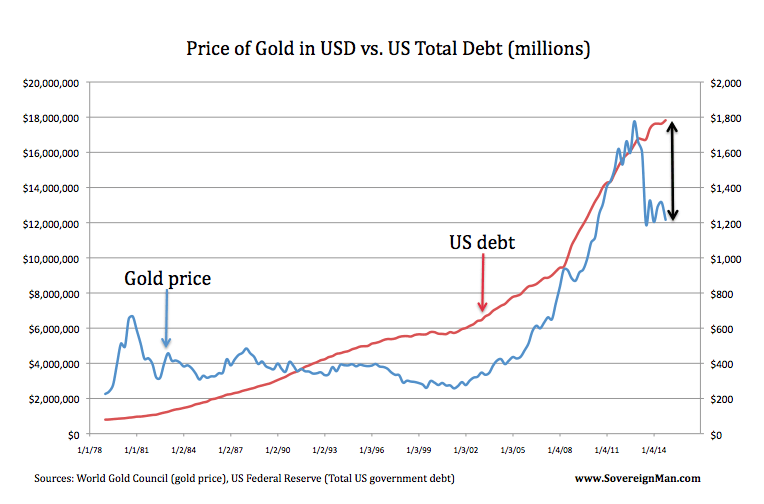
In fact, as the chart below shows, gold has tracked the expansion in US debt pretty handily (editor’s note: the correlation between the two is a strong +0.86).
chart1 This one chart shows exactly how undervalued gold is right now…
You can see in 2011, the rise in the gold price became overextended relative to the rise in US debt. Then it decoupled and went in the opposite direction.

This is a similar trend to what occurred in the early 1980s. And if one expects that relationship to resume (we do), then gold looks anomalously cheap relative to the rising level of US debt.

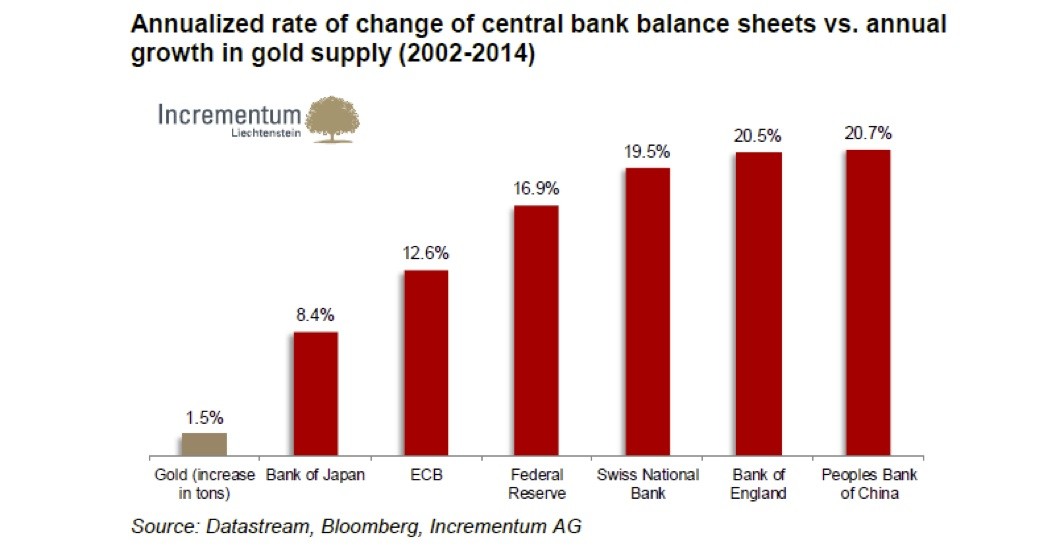
A second rationale for holding gold takes into account the balance sheet expansion of central banks:
chart2 This one chart shows exactly how undervalued gold is right now…
If one accepts that gold is not merely an industrial commodity but an alternative form of money, then it clearly makes sense to favor a money whose supply is growing at 1.5% per annum over monies whose supply is growing up to 20% per annum.

A third rationale for owning gold is best summed in perhaps the most damning statement to capture our modern financial tragedy.

“We all know what to do, we just don’t know how to get re-elected after we’ve done it.”

This is from Jean-Claude Juncker, former Prime Minister of Luxembourg and current President-Elect of the European Commission.

It’s clear there is a vacuum where bold political action should reside. Elected leaders continue to kick the can down the road and ignore dangers to the system.

And in this vacuum, central bankers have stepped in to fill the void via bond yields that are below the rate of inflation.
They say that to a man with a hammer, everything looks like a nail.

To a central banker facing the prospect of outright deflation, the answer to everything is the printing of ex nihilo money and the manipulation of financial asset prices.

This makes it incredibly difficult to shake off the suspicion that navigating the bond markets over the coming months will require almost supernatural powers in second-guessing both central banks and one’s peers.

For what it’s worth this is a game we won’t even bother playing.

Our pursuit of the rational alternative – proper forms of money and compelling deep value in equity markets – continues. More to follow on this.

[Editor’s note: Stay tuned this week for more information about Tim’s new monthly investment service, Price Value International.]
imageOur goal is simple: To help you achieve personal liberty and financial prosperity no matter what happens.

If you liked this post, please click the box below. You can Download our Free 17 page Report The 6 Pillars of Self Reliance.
About the author: Simon Black is an international investor, entrepreneur, permanent traveler, free man, and founder of Sovereign Man. His free daily e-letter and crash course is about using the experiences from his life and travels to help you achieve more freedom.