Search Blog Posts

Showing posts with label Archaeology. Show all posts

Saturday, March 7, 2015

Jawbone found in Ethiopia set to rewrite history, push back origins of humans


6 March, 2015 - 22:17 lizleafloor
 
An extraordinary fossil find in the desert of Ethiopia is pushing back the dawn of humankind by approximately half a million years, and rewriting what we know about the evolutionary branching that eventually led to modern humans.

A fossilized lower jaw, with five small teeth, is reportedly connecting the dots between primitive ancestors and modern humans. The specimen is the bone of one of the very first humans – it represents the oldest known human genus Homo - and comes from a time when humans split from the more ape-like ancestors, Australopithecus, identified by the best known fossil skeleton “Lucy”, according to CBC News.
‘The Hidden Treasures of Ethiopa’ exhibit at Houston Museum of Natural Science featuring a model of “Lucy”, Australopithecus Afarensis. Jason Kuffer/Flickr

The find is more than 400,000 years older than the oldest fossils belonging to the early humans who eventually gave rise to Homo sapiens, our modern species.

The jawbone was found close to where Lucy was discovered in 1974. The specimen of Australopithecus afarensis, dubbed Lucy, is from 3.2 million years ago. The species walked upright, but only stood a meter tall and had a small brain. This contrasts with the species Homo,characterized by an upright, bipedal posture, sophisticated tool-making abilities and a relatively large braincase”, reports BBC News. The Ethiopian jawbone seems to share traits similar to both species, and may be a transitional fossil, filling in an evolutionary gap.
The Ledi-Geraru jawbone. Credit: William Kimbel/Arizona State University

Graduate student of Arizona State University in the U.S., Chalachew Seyoum pulled the 2.8 million-year-old jawbone from the earth at the Ledi-Geraru research area in Ethiopia in 2013. “The moment I found it, I realized that it was important, as this is the time period represented by few (human) fossils in Eastern Africa,” he tells BBC News.
Researchers examine soil at the Ledi-Geraru site in Ethiopia, where Homo jawbone, known as LD 350-1, was discovered. Credit: Brian Villmoare

Side view of Australopithecus afarensis (“Lucy”), replica. Wikimedia Commons

Paleoanthropologist Brian Villmoare of University of Nevada, and colleagues published a study in the journal Science on the research into the jawbone. 

Villmoare says, “In spite of a lot of searching, fossils on the Homo lineage older than two million years ago are very rare. To have a glimpse of the very earliest phase of our lineage’s evolution is particularly exciting.”
MORE
Field work is being done in the Ledi-Geraru site to see if more fossils can be recovered. More information could help determine if the jaw belongs to a known early species of Homo, or an entirely new species, and researchers are putting off definitively naming it for the time being.

Recent examinations of fossilized human teeth in China and a prehistoric jawbone from Taiwan have been raising questions about the established theories on the history of modern humans, suggesting there may be many species yet uncategorized.

The rare Ethiopian find may help scientists answer vital questions about what prompted the transition from primitive to modern humans. The Science study suggests that environmental changes may have caused a shift in the lives and diet of ancient ancestors. Fossilized plant and animal analysis indicates that lush forest transitioned to dry grassland, and early humans may have adapted according to the new survival needs. However, scientists wait on a larger sample of hominid fossils in order to prove this conclusively.
A mix of hominid (genus Homo) depictions; (from right to left) H. habilis, H. ergaster, H. erectus; H. antecessor - male, female, H. heidelbergensis; H. neanderthalensis - girl, male, H. sapiens sapiens. Public Domain

Prof Fred Spoor of University College London and the Max Planck Institute for Evolutionary Anthropology in Leipzig tells BBC News, “By discovering a new fossil and re-analysing an old one we have truly contributed to our knowledge of our own evolutionary period, stretching over a million years that had been shrouded in mystery.”

Featured Image: The 2.8 million-year-old fossilized jawbone with small teeth which may be a transitional fossil between primitive and modern man. Credit: Brian Villmoare

Wednesday, February 11, 2015

Archaeological study explores drug-taking and altered states in prehistory

11 February, 2015 - 00:27 Mark Miller
 
Neanderthals on speed 60,000 years ago; Paleolithic art inspired by psilocybin or Amanita muscaria mushroom trips; and alcohol-fueled religious worship all over the world down through the ages – these are just some of the drug-taking behaviors reported in a new research paper which looked at decades of archaeological evidence to see how prevalent the use of psychoactive substances and other reality-bending practices was in prehistory. The paper also explores the link between religion and hallucinogens, stimulants, alcoholic beverages and other substances.

Elisa Guerra-Doce, an archaeologist at the University of Valladolid in Spain, says that altered states of consciousness were very nearly ubiquitous in societies throughout prehistory and history. An anthropologist who studied 488 human societies published a paper in 1973 that said 437 or 90 percent of them reportedly incorporated altered states of consciousness (ASC) into their fundamental belief systems.
Cohoba, a hallucinogen made of ground tree seeds, was used by Taino shamans. Users put cohoba powder on a carved pedestal and inhaled through the nose via an inhaler like this piece, from between 1000 and 1500 A.D. This carved stone shows a shaman or behique in a trance. (Walters Art Museum photo/Wikimedia Commons)

Guerra-Doce looked at four types of archaeological evidence to do her study of altered states among prehistoric societies:
  • Fossils of burned, waterlogged or desiccated leaves, seeds, fruits or wood of psychoactive plants
  • Psychoactive alkaloids in skeletal remains and artifacts
  • Residues of alcoholic beverages
  • Depictions of drinking scenes or mood-altering plants inspired by inspired by altered states of consciousness
She found chemical residue from and parts of many psychoactive plant in levels of dwellings from various eras and in artifacts and human remains from thousands of years ago. People used alcoholic beverages nearly everywhere for thousands of years, mildly stimulating betel leaves in Asia as far back as 13,000 B.C., hallucinogens derived from the San Pedro cactus in the Andes as far back as 10,600 years, hallucinogenic mescal beans in Texas and northern Mexico 11,000 years ago, and peyote from between 9,000 and 5,600 years ago.

MORE
The Greek god of wine, Dionysus, crosses the sea in his dolphin boat with grape vines above the sail in a bowl from 530 B.C. by Exsekias. (Carole Raddato photo/Wikimedia Commons)

People also apparently got high on opium as the poppy was domesticated in the western Mediterranean 8,000 years ago; the mildly stimulating (among other benefits) coca leaves for tea and chewing in South America from at least 6,000 B.C.; cannabis (marijuana) in central Asia 7,000 years ago and hallucinogenic nightshade all over the world as long ago as 5,000 years. There were tobacco in the New World 4,000 years ago, hallucinogenic yopo snuff from the New World more than 4,000 years ago, and hallucinogenic mushrooms from various places and times around the world.
Peyote plant (Frank Vincentz photo/Wikimedia Commons)
Guerra-Doce states in her report:

Ethnographic studies have long been exploring the place of fermented beverages (beer, fruit wines, rice wine, mead, koumiss, pulque, chicha, among many others) and psychoactive plants, not only hallucinogenic but also narcotic and stimulant (peyote cactus, morning glories seeds, sacred mushrooms, ayahuasca or yaje brew, cohoba, Virola snuffs, coca, tobacco, mescal beans, San Pedro cactus, iboga, betel, kat, pituri, cannabis, nightshade plants, opium poppy, and ephedra, just to offer a few examples) within traditional societies in every corner of the planet, above all in the Americas.

Published in Time and Mind: The Journal of Archaeology, Consciousness and Culture, Guerra-Doce’s article is titled 'Psychoactive Substances in Prehistoric Times: Examining the Archaeological Evidence' (PDF link). While the article focuses on entheogens, or plants and alcoholic beverages that 'generate the divine within,' it also refers to other practices that people used to alter their reality, including auditory stimulation, exposure to extreme temperatures, food restrictions, breathing techniques, extreme physical exercise, or meditation.

Featured image: Ancient relief carving depicting drug use (Michael Bradley)

Source: We found the Comments interesting also: ancient-origins

Tuesday, January 6, 2015

The Search for El Dorado – Lost City of Gold


6 January, 2015 - 00:57 mrreese

For hundreds of years, treasure hunters and historians alike have searchedfor El Dorado, the lost city of gold. The idea of a city filled withgold and other riches has a natural appeal, drawing the attention of individuals from all over the world in hopes of discovering the ultimate treasure, and an ancient wonder. In spite of numerous expeditions around all of Latin America, the city of gold remains a legend, with no physical evidence to substantiate its existence.

The origins of El Dorado come from legendary tales of the Muisca
tribe. Following two migrations – one in 1270 BC and one between 800 and 500 BC, the Muisca tribe occupied the Cundinamarca and Boyacá areas ofColombia. According to legend, as written in Juan Rodriguez Freyle’s “El Carnero,” the Muisca practiced a ritual for every newly appointed king that involved gold dust and other precious treasures.


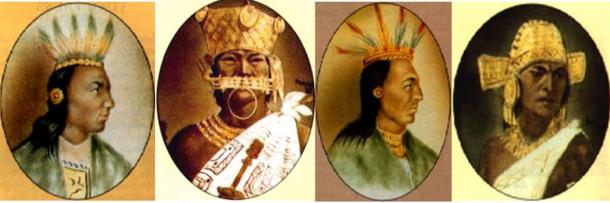
Portraits of rulers of Muisca
Portraits of rulers of Muisca (Wikimedia Commons)

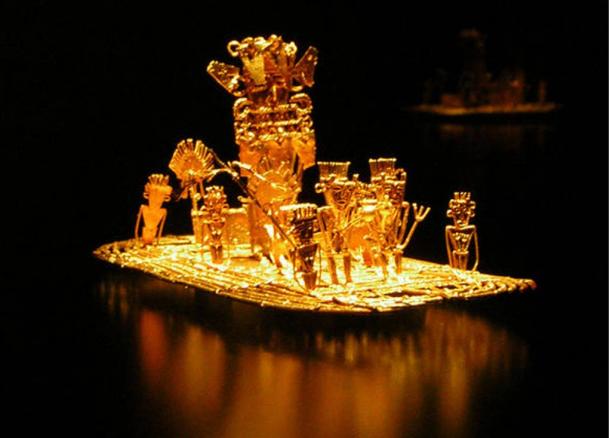
When a new leader was appointed, many rituals would take place before
he took his role as king. During one of these rituals, the new king
would be brought to Lake Guatavita, where he would be stripped naked,
and covered in gold dust. He would be placed upon a highly decorated
raft, along with his attendants, and piles of gold and precious stones.
The raft would be sent out to the center of the lake, where the king
would wash the gold dust from his body, as his attendants would throw
the pieces of gold and precious stones into the lake. This ritual was
intended as a sacrifice to the Muisca's god. To the Muisca, “El Dorado”
was not a city, but the king at the center of this ritual, also called
“the Gilded One.” While El Dorado is meant to refer to the Gilded One,
the name has now become synonymous with the lost city of gold, and any
other place where one can quickly obtain wealth.


Muisca raft, representation of the initiation of the new Zipa in the lake of Guatavita
Muisca raft, representation of the initiation of
the new Zipa in the lake of Guatavita, possible source of the legend of
El Dorado. It was found in a cave in Pasca, Colombia in 1856, together
with many other gold objects. Dated between 1200 and 1500 BC. (
Wikimedia Commons)

In 1545, Conquistadores Lázaro Fonte and Hernán Perez de Quesada
attempted to drain Lake Guatavita. As they did so, they found gold along
its shores, fueling their suspicion that the lake contained a treasure
of riches. They worked for three months, with workers forming a bucket
chain, but they were unable to drain the lake sufficiently to reach any
treasures deep within the lake. In 1580, another attempt to drain the
lake was made by business entrepreneur Antonio de Sepúlveda. Once again,
various pieces of gold were found along the shores, but the treasure at
the depths of the lake remained concealed. Other searches were
conducted on Lake Guatavita, with estimates that the lake could contain
up to $300 million in gold, with no luck in finding the treasures. All
searches came to a halt when the Colombian government declared the lake a
protected area in 1965.


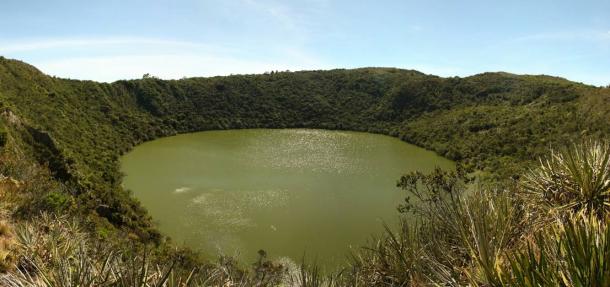
Guatavita Volcanic Lagoon, Cundinamarca, Colombia, the sacred lake and center of the rites of the Muiscas
Guatavita Volcanic Lagoon, Cundinamarca, Colombia,
the sacred lake and center of the rites of the Muiscas. Source:
BigStockPhoto.

Nonetheless, the search for El Dorado continues, even without the
ability to search Lake Guatavita. The legends of the Muisca tribe, the
Gilded One and their ritualistic sacrifice of treasures have transformed
over time into today’s tale of El Dorado, lost city of gold. To many
individuals, El Dorado is a real city, and the desire to discover this
city is great. Whether led by greed, a desire for fame, or a desire to
unravel the mysteries of an ancient legend, these individuals have gone
on conquests in hopes of finding El Dorado. As the legends have shifted
and transformed, so has the location of El Dorado. Searches for the city
are not restricted to Colombia, or Lake Guatavita, where the Muisca
tribe practiced their rituals, but span all areas of Latin America.
Expeditions to find El Dorado have been conducted far and wide.


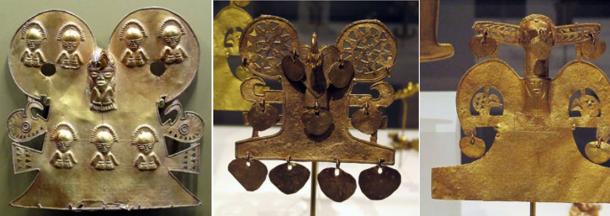
Gold artifacts from the Muisca tribe of Colombia
Gold artifacts from the Muisca tribe of Colombia (public domain)

England’s Sir Walter Raleigh made two attempts to find El Dorado. In
1595, it was rumored that El Dorado could be found at Lake Parime in the
highlands of Guyana. Raleigh set sail, in hopes of discovering the lost
city, establishing an English presence in the Southern Hemisphere, and
creating an English settlement in the lad of Guyana. His desire to find
El Dorado remained strong, although he only discovered bits and pieces
of gold along the way. In 1617, Raleigh returned to South America with
his son, in hopes of finding El Dorado. His son was killed in conflict
with the Spaniards, and Raleigh did not find El Dorado on his second,
disastrous expedition. Upon his return to England, he was executed for
disobeying King James’ orders to avoid conflict with the Spanish.


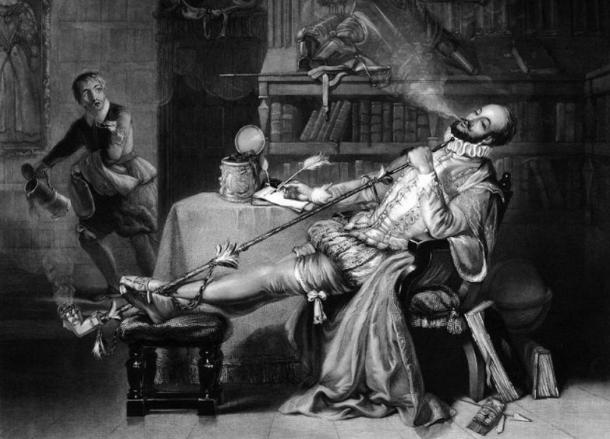
Sir Walter Raleigh went on two expeditions to find El Dorado
Sir Walter Raleigh went on two expeditions to find
El Dorado. ‘Raleigh's First Pipe in England’ by Frederick William
Fairholt, 1859. (public domain)

Several expeditions to find El Dorado have been attempted since
Raleigh’s time, but none have been successful. Monks Acana and Fritz,
Don Manuel Centurion - Governor of San Thome del Angostura, and
entrepreneurs Nicholas Rodriguez and Antonio Santos, have all led
expeditions in hopes of finding the lost city. All have failed to find
the El Dorado, and the expeditions have led to the loss of hundreds of
lives – from those killed during the attempts to drain Lake Guatavita,
to those who perished while searching the landscape of Latin America.
The most recent attempt to find El Dorado occurred in 2000. The
Monastery of Santo Domingo was searching for underground Incan tunnels,
when they found a large tunnel beneath the Monastery, but no gold. Then
in 2001, Italian archaeologist Mario Polia discovered a document from
the 1600s that contained descriptions of a city that could potentially
be El Dorado. Within the area, located in Paratoari in Peru, tools and
evidence of manmade structures have been recovered, but El Dorado
remains a mystery.

Although the costly search for El Dorado has yet to yield any
evidence of an actual city of gold, the topic remains one of interest to
this day. Searches for El Dorado have spanned hundreds of years and
vast areas of Latin America, while costing a great deal of money, and
hundreds of lives. To some, it has become clear that the costs and risks
of continuing to search for El Dorado are not worth it, while others
remain determined to find the lost city of gold. Perhaps someday the
city of El Dorado will be discovered, and the riches rumored to be
contained within will be found, but for now, it remains a mystery
whether El Dorado is a real gold-filled ancient city, or simply a
legend.

Featured image: Golden vitives figures (known as tunjos),
Muisca-Chibcha culture — pre-columbian culture in the territory of
modern Colombia; Gold Museum, Bogotá, Colombia (
Wikimedia Commons)


Sources:

The Legend of El Dorado – Historic Mysteries. Available from: http://www.historicmysteries.com/legend-of-el-dorado/

El Dorado Legend Snared Sir Walter Raleigh – National Geographic. Available from: http://science.nationalgeographic.com/science/archaeology/el-dorado/

El Dorado – Wikipedia. Available from: http://en.wikipedia.org/wiki/El_Dorado

El Dorado – Myths Encyclopedia. Available from: http://www.mythencyclopedia.com/Dr-Fi/El-Dorado.html

By M R Reese


Sunday, October 12, 2014

VETERANS: The Military is Leaving Your MIA Buddies Behind

The military (and other agencies) will do (or not do) whatever they want because our corporatist Neocon/Communist congress does not fulfill its  oversight mandates for the citizens who presumably elect them.

The Military is Leaving the Missing Behind
March 6, 2014, The Contributor
Tracing his genealogy online one night, John Eakin landed on a name that evoked an old family sorrow.

Arthur “Bud” Kelder, Eakin’s cousin, had died while a POW during World War II, but his body had never been found. Bud’s parents had sent handwritten letters to the Army for years, asking to have their youngest son’s body returned to them in Illinois.

“It is our hope that his remains may be sent here, for burial at home,” pleaded one.

Six decades later, Eakin, a stubborn Texan who was himself a vet, resolved to find out exactly why Bud had never come home.

In the fall of 2009, Eakin reached out to family members and found that Bud’s older brother had kept a trove of historical documents laying out Bud’s saga: the telegram announcing he was a POW, newspaper clippings, letters sent between Bud and his parents.

Before the Japanese invaded the Philippines, Bud had worked as a dental assistant at the American hospital in Manila, a plum assignment in a tropical getaway. In late 1941, the Army private wrote to his parents about saving his paycheck to buy a custom-made sharkskin suit. It “really is a peach,” Bud wrote.

After war broke out in December 1941, Bud was among 12,000 American troops who were besieged by the Japanese for four months on the Bataan peninsula, just south of Manila.

“What I dream is there will be no more separations between us again and we’ll spend more time together,” he wrote to his parents in cursive two months later. “P.S. Mother! Don’t worry about me.”

The Americans surrendered on April 9, 1942. The Japanese made Bud a driver during the infamousfive-day, 65-mile Bataan Death March. He eventually ended up at Cabanatuan, one of the largest POW camps for American troops.

When Eakin tried to figure out what happened next, he ran into an unexpected roadblock.

The Pentagon spends about $100 million a year to find men like Bud, following the ethos of “leave no man behind.” Yet it solves surprisingly few cases, hobbled by overlapping bureaucracy and a stubborn refusal to seize the full potential of modern forensic science. Last year, the military identified just 60 service members out of the about 83,000 Americans missing from World War II, Korea and Vietnam, around 45,000 of whom are considered recoverable.

At the center of the military’s effort is a little-known agency, the Joint Prisoners of War/Missing in Action Accounting Command, or J-PAC, and its longtime scientific director, Tom Holland. He alone assesses whether the evidence J-PAC has assembled is sufficient to identify a set of remains: A body goes home only if he signs off.

Over Holland’s 19-year tenure, J-PAC has stuck with an outdated approach that relies primarily on historical and medical records even as others in the field have turned to DNA to quickly and reliably make identifications.

Though finding missing service members can be difficult — some were lost deep in Europe’s forests, others in Southeast Asia’s jungles — Holland’s approach has stymied efforts to identify MIAs even when the military already knows where they are. More than 9,400 service members are buried as “unknowns” in American cemeteries around the world. Holland's lab has rejected roughly nine out of every 10 requests to exhume such graves.

Holland’s cautious approach is animated by a fear of mistakes.

“Our credibility is only as good as our last misidentification,” he said in an interview. “It doesn't matter that I've identified 500 people correctly. If I misidentify one, that’s what going to be the focus. That’s what's going to be on the news. That is what is going to erode the credibility. That’s what I go home with every night.”

The top military official at J-PAC, Gen. Kelly McKeague, said he believed the standards for laboratory work to identify a veteran should be higher than the FBI lab’s standard for a death penalty case. With what J-PAC does, he said, there’s “a lot more at stake.”

In recent years, J-PAC and the other agencies responsible for the MIA program have come under intensifying scrutiny. In 2010, when Congress added World War II to J-PAC’s mission, it mandated at least 200 identifications overall a year by 2015 — a benchmark the agency has already said it will not meet. The problems, including those of DNA, go beyond J-PAC. Last month, Secretary of Defense Chuck Hagel ordered a review of how the military manages the effort.

Time is running out. There are 35,000 missing who experts say are findable from WWII. But the

MIA’s closest relatives are dying off — and often with them so are the chances for using DNA to finally identify their long-lost loved ones.  

Working from a home he built by hand in Helotes, just north of San Antonio, the gray-haired, lanky Eakin began his search by requesting Bud’s records from the Army.

He got back a remarkable document. Despite horrid conditions, the Americans prisoners had left a road map to find Bud and others like him: the “Cabanatuan POW Camp Death Report.”

Barely surviving on a little more than two cups of rice every day, the POWs had still managed to document the deaths of their comrades. It was a monumental task. Of the several thousand prisoners housed at the camp, only about 500 made it out.

Each day, the survivors dug a single unmarked grave to bury that day’s dead. And each day, the officers kept a meticulous ledger of the men who had died. However little that death roster meant in the prison camp, later, the POWs knew, it would be crucial to getting the fallen home.

The entry for Nov. 19, 1942, lists 14 men. Among them: Private Arthur “Bud” H. Kelder, dead at 4:35 p.m. The 26-year-old had succumbed to pellagra, a vitamin deficiency common among the starved prisoners.

Bud’s parents, unaware of his death for eight more months, kept writing him. On May 20, 1943, Bud’s father wrote, “Dear son, another week has gone and still no word from you. We hope you have a few letters on the way to us.”

Bud’s 34-page file had sat untouched by the government for nearly 60 years, a forgotten folder in a vast repository at the National Archives. Had anyone looked it over, they would have found what Eakin did: The military actually had a pretty good sense of where Bud was.

The files included not only a date for Bud's death, but also a specific grave for him. After the war, the Army had gone to the POW camp to dig up and identify the bodies of more than 2,700 men who died there. Using the Cabanatuan camp report and recollections of the survivors, the Army numbered the communal graves and matched them with the death list.Bud and 13 others had been in Grave 717.

Limited by the science of the time, the Army was able to identify and send home four men from that grave but not Bud. In the early 1950s, the remaining 10, along with more than 900 others who died at Cabanatuan, were reburied individually as unknowns in an American cemetery in Manila. White crosses marked their graves, bearing the words “Here Rests in Honored Glory A Comrade in Arms. Known but to God.”

To Eakin, it seemed obvious that Bud was among the 10 unidentified sets of remains from Grave 717 — a relatively small group of bones that the military could dig up and test against the DNA of family members. He tried to make it easier for the Pentagon by tracking down relatives of the men in the grave, so they could provide DNA for comparison. He even turned over an envelope Bud had licked.

Eakin said he thought identifying Bud would be "such a no-brainer.”

Reviewing details of the case later, Joshua Hyman, the head of the University of Wisconsin-Madison’s DNA Sequencing Facility, described it as a “piece of cake.”

But no one in the military seemed to show much interest. Every month, Eakin called the Army, asking, “When are you going to go dig up these remains?”

Bud’s fate rested with Holland and J-PAC’s lab on a joint Navy-Air Force base in Honolulu.

With his beard, slightly ruffled appearance, and a penchant for storytelling, Holland has the air of a liberal arts professor. Walking through the hallway outside his lab, he pointed proudly to displays of artifacts found with recovered remains: Tattered uniforms, faded, crinkled pictures and pineapple-shaped grenades.

Holland joined J-PAC in 1992 and has spent his entire scientific career there, becoming the lab's director in 1995. “The lab has been his life,” said Mark Leney, a former J-PAC anthropologist who worked with Holland for six years. “He has an enormous sense of ownership of it.”

Though J-PAC is a military command, the generals who rotate in and out for temporary assignments take no role in the scientific decisions, leaving them to Holland. Almost a dozen current and former staffers described Holland as someone who bridles at being challenged and fiercely protects his fiefdom.

“Expressing dissent was clearly not appreciated and frowned on,” said Leney, who now teaches at the University of Massachusetts Medical School.

Leney said he and another anthropologist wrote Holland a memo in 2002 about problems with procedures and standards at the lab. They asked for guidance and clarification. “Here is my guidance:Don’t ever write a memo like this again unless it is stapled to your resignation,” Holland wrote back.

J-PAC currently has about 500 employees, including historians and military logisticians to coordinate overseas digs, but it’s work in the lab that people are most likely to conjure. The lab has even been featured on the new “Hawaii Five-0.” (Holland had a cameo.) Holland’s longtime work at the lab recently earned him a lifetime achievement award from the American Academy of Forensic Sciences.

Swiping his badge and entering the bright, sterile lab, which is not much bigger than a classroom, Holland walked by 16 long metal tables with bones laid out, some with a complete skeletons, and others with pieces of bone that look like piles of jagged stones. Some bones were grayed out like seashells, and others were dark brown, almost burnt looking – the different colors betraying the countries in which they were found. Vietnam’s acidic ground bites at bones, leaving them pitted. One skeleton had a green-tinted sternum and ribs, a patina from oxidation of a copper belt with bullets that was strapped to the vet’s chest.

“There’s no formula that applies to every case,” Holland said.

Under Holland’s direction, J-PAC’s lab hasn’t prioritized DNA analysis, despite it being an advancement that has revolutionized forensic science. J-PAC’s method begins with historians sifting through archival material to start to narrow down who someone might be.

“It may be 100 people, 200 people, 500 people, that’s fine,” Holland said.

Then they compare bones to dental charts and other medical records. Combining that with archaeological analysis and artifacts, they try to winnow down the list to one person. DNA comes in last, only as a confirmation tool.

Scientists engaged in similar work elsewhere do the opposite. They start with DNA and let it drive the process, taking samples from bones they dig up and cross-referencing them against databases of DNA from the families of the missing to find a match.

“It’s how you get people identified these days,” said Clyde Snow, one of the world’s foremost forensic anthropologists. “It opened up a whole new world for us.”

Since the earlier 2000s, the DNA-led approach has been used in more than 30 countries to efficiently identify casualties of mass tragedies, including the United States after Sept. 11.

In post-conflict Bosnia, scientists initially used the traditional anthropological techniques that J-PAC relies on now and identified only seven out of the more than 4,000 bodies from the Srebrenica massacre, according to Ed Huffine, a forensic scientist who later designed a DNA-led process there.   

Once they turned to DNA, Huffine said, they were able to make 400 identifications per month at the peak of their efforts.

J-PAC does occasionally start from DNA when bones from many people have been mixed together – as they have done with a complicated case involving 500 co-mingled remains from the Korean War.

But Holland’s deputy at J-PAC, John Byrd, said the lab rarely needs to resort to that. While using DNA first makes sense in places like Bosnia, where authorities lacked medical records for the missing, the U.S. military keeps copious records. And even advocates of DNA agree that relying on records can make sense in some cases.

J-PAC has also faced with cases in which DNA wasn’t an option. Soldiers buried as unknowns from the Korean War were embalmed, making DNA extraction impossible. Holland’s team developed a much-admired innovation to get around that limitation, matching clavicle bones to chest radiographs taken to screen for tuberculosis.

But those cases are an exception. Typically, Holland’s lab has been able to extract DNA, including on all WWII cases it has worked on.  

“If we worked together, concentrating on DNA, we could decrease greatly the time it takes to make identifications,” said a current J-PAC anthropologist, who favors using DNA first.

Holland insists his process works. Making an identification “is an awesome burden,” Holland said, sitting in his paper-strewn office. Sticky notes act as a Rolodex, one wall displays dozens of photocopies of his hand with notes he wrote on his palm during meetings, and on a shelf in his bookcase are copies of two novels he penned – starring a fictionalized version of himself.  “At the end of the day, I carry that burden.”

“If there is a better way to do it, I’m willing to take a look at it, but at some point the government pays me to do my job,” he said in a measured cadence that conveyed both annoyance and self-restraint. “And clearly I’m biased here, but I think I do a fairly good job.”

Holland’s job has been made harder by the overall military’s failure to systematically collect and sort comparison DNA samples from family members of the missing.

Scientists in Argentina, where around 9,000 disappeared in the country’s “dirty war,” started assembling a database of such samples even before they had the technology to analyze them.

“We were collecting samples even though there was no possibility to process them, but the relatives were dying,” said Mercedes Doretti, co-founder of the Argentine Forensic Anthropology Team. Later, Argentina launched a national campaign — funded in part by the U.S. government — to collect more DNA, using famous actors and soccer teams to promote it.

There has been no such campaign in the U.S. In an era of Facebook and Twitter, J-PAC officials heralded a 2001 Pentagon letter that ran in the widely syndicated “Ask Ann Landers” column. It didn’t work. Fewer samples came in after the letter than before, an Army official said.

Huffine and other experts say using DNA effectively requires one central database and single authority overseeing it. But the Pentagon has six different agencies handling aspects of DNA testing and collection, spread out from Hawaii to Delaware. Each military branch is tasked with collecting samples from relatives of the missing from their service.

The Pentagon has relatively complete records for Vietnam and Korea but only a fraction of the needed samples from WWII. Nothing was on record for Bud or the others from Grave 717 until Eakin got involved.

The Army organizes its samples broadly by war and not by theater, major battle or event. Officials said they had no way to discern how many samples they had in hand related to the Cabanatuan unknowns, for example.

Once the military does get DNA samples, there are further delays. The Armed Forces DNA Identification Laboratory, which processes samples for J-PAC, takes 110 days on average to sequence DNA, much longer than commercial labs.

“Just waiting for DNA and trying to find a donor for DNA” from a family member — “a lot of the pauses in progress occur there,” a former J-PAC anthropologist said.

Eakin first heard of Bud as a teenager, when, looking at framed photographs on the wall, he asked about a black-and-white photo of a young man he didn’t recognize.

“That’s Bud,” his grandfather told him in a quiet voice.

“That was the only time I saw my grandpa cry,” Eakin recalled.
FINISH READING

Friday, June 27, 2014

The Flor de la Mar: A Treasure Ship Still Awaiting Discovery

The ship was called the Flor de la Mar: Flower of the Sea.

Built in 1502, weighing 400 tons, and made for traveling from Portugal to India and back, it was twice the size of other ships that had gone on the run.

This type of vessel was called a ‘carraca’ or ‘nao’ by the Spanish, ‘caraque’ or ‘nef’ in French, and ‘carrack’ in English. In the Flor’s homeland of Portugal, the ship was known as a “nau”.

The Flor was part of an era of exploration, colonization, and exploitation. Three masts and six sails, square-rigged on the foremast and mainmast and lateen-rigged on the mizzenmast, drove the tall, rounded hull through thousands of miles of ocean waters.

Ships of this type opened the riches of distant countries far away to European conquerors. Famous relatives to the Flor de la Mar include Columbus’ Santa Maria, Vasco de Gama’s São Gabriel, and Magellan’s Victoria.

Largest Naval Treasure Ever Lost


The Flor was something of a prototype for what would become the typical 16th Century India nau.

The ship’s experience with difficulties maneuvering also led to the institutionalization of the “outer route.” Captains of heavily loaded big ships were ordered to sail east of Madagascar rather than navigating the fast Mozambique Channel.

The Flor’s service life had been exceptionally long for a ship on the India run. Built for only three or four years of work, she lasted from 1502-1511.

However, her design made her dangerously unseaworthy when fully loaded, and her service in various campaigns had necessitated many repairs.

Eventually, these issues would play a part in the Flor sailing into history with what some claim is the largest naval treasure ever lost. 

Alfonso de Albuquerque

treasure ship 
In command of the Flor was Alfonso de Albuquerque. He was known (depending on your perspective) as The Great, The Terrible, The Portuguese Mars, The Caesar of the East, and The Lion of the Sea.

Alfonso was a Portuguese fidalgo, or nobleman, whose titles included Duke of Goa and Governor of Portuguese India.

His successes in conquest were many. Included in these, he had put the King of Cochin in power, built a fort in Cochin (now known as Kochi, in western India), and established the foundation for Portugal’s empire in the East.

He had commanded a squadron of ships that sailed against the island of Ormuz in 1507: one of the chief centers of commerce in the East. He had brought Goa under Portuguese authority in 1510 and captured Malacca-one of the richest cities in the world at the time- in 1511. His successful strategy of trying to close all Indian Ocean naval passages imposed Portuguese power in a significant portion of Asia.


The Ship’s Treasure


buried treasureIt seems Alonso did not believe in the expression, “Don’t put all your eggs in one basket.” Most of his riches were placed in one ship: an enormous treasure filled the hold of the Flor de la Mar.

As you might recall, the Flor’s design meant that it was dangerous and hard to maneuver when filled to capacity as well as having been repaired numerous times.

Despite the ship’s unsafe condition, Albuquerque used it for its large capacity to transport his display of Malaccan treasures. There was also an impressive tribute from the Kingdom of Siam (Thailand) to the king of Portugal and all of Alfonso de Albuquerque’s own fortune.

It was the largest treasure ever assembled by the Portuguese navy, and included 60 tons of gold from the house of the Sultan of Malacca. Supposedly, 200 gem chests were filled with diamonds, rubies and emeralds.

Accompanied by four other ships, the Flor set sail for Portugal in November, 1511. 

Empire’s Labor Lost


treasure shipPerhaps in a stroke of irony, after taking Malacca’s riches, a violent storm blew up in the Straits of Malacca. The Flor de la Mar was shipwrecked on the reefs near the Straits, just northeast of Sumatra.

The ship broke in two, and many were lost at sea. In addition, the treasure disappeared in the violent waves of the storm.

Alonso, however, was saved. He jumped into a lifeboat with five of his officers.

Following successes in other efforts, his detractors in the Portuguese court moved against him. They inspired King Manuel to replace Albuquerque with a personal enemy, Lopo Soares de Albergaria.

Alonso de Albuquerque received news of this while at sea, and it was too much for him to bear. He died aboard ship on December 15, 1515.

The Treasure Hunt


As you might expect, treasure seekers have searched for this exceptionally rich prize ever since the first gem-filled chest got wet.

One treasure hunter, Robert Marx, has reportedly spent somewhere around $20 million trying to find the Flor de la Mar. According to Marx’s statements, “…it’s the richest vessel ever lost at sea, with its hold loaded with 200 coffers of precious stones, diamonds from the small half-inch size to the size of a man’s fist.”

As far as we know, nobody’s found it yet.

References & Image Credits:
(1) Causamerita
(2) Aquiziam
(3) Wikipedia
(4) Wikimedia.org
(5) Afonso_de_Albuquerque
(6) Antique Map
(7) Sabotage Times
(8) TreasureNet
(9) Wikipedia

 
*****

Mark Dorr grew up the son of a treasure hunter. His experiences and education led to working internationally in a variety of unique and amazing situations. MarkDorr has 50 post(s) at Top Secret Writers