 |
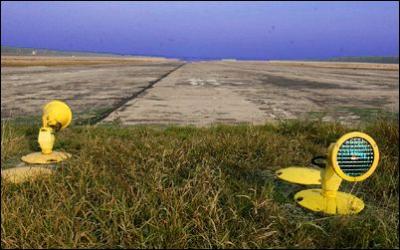
| "Keep it as tight as possible": Airstrip @ Szczytno-Szymany Airport Only the Polish prime minister and top Polish intelligence brass were told of the plan, in which agents of the United States quietly shuttled detainees from other holding facilities around the globe for stopovers and short-term interrogation in Poland between late 2002 and 2004. According to a confidential British intelligence memo, Prime Minister Tony Blair told Poland's then-Prime Minister Leszek Miller to keep the information secret, even from his own government. “Miller was asked to keep it as tight as possible,” the memo said.[source] |
On the grounds of the Polish intelligence-training academy and nicknamed "Markus Wolf" for the former East German spy chief, it's the focal point for a top-secret probe that Polish prosecutors have launched into how their government tolerated rampant violations of international and Polish law.
If former officials are brought to trial, or if the stacks of classified files in the prosecutors' offices are made public, the result will be revelations about an American anti-terrorism operation whose details U.S. officials are fighting to keep secret.
Already the prosecutor has charged Zbigniew Siemiatkowski, Poland's former interior minister and intelligence chief, with unlawful detention and corporal punishment for allowing the CIA to operate at Stare Kiejkuty from December 2002 to September 2003.
And the prosecutor's office has given victim status in the case to two men the U.S. is holding indefinitely at Guantanamo: Abd al-Rahim al-Nashiri, a Saudi charged with masterminding the bombing of the USS Cole in Yemen in 2000, and Abu Zubaydah, whom the Bush administration once described as the third-ranking leader of al-Qaida but who may have been only a safe house minder. Al-Nashiri faces a possible death sentence; Abu Zubaydah, who's been held for 10 years, hasn't been charged.
Their status as victims comes from claims that they were kidnapped by U.S. authorities, brought to Poland illegally, tortured, then spirited from Poland to other detention centers without the legally required extradition proceedings.
The villa cannot be seen from the main road or spotted on Google Earth maps. At the request of Polish authorities, its location has been blurred, the Polish newspaper Gazeta Wyborcza reported.
That's what some parts of the Polish government would like to have happen to everything that took place here.
State prosecutors, on the other hand, seem motivated to bring the case to court. The Polish investigation is now in its fifth year, has twice been reassigned to new prosecutors and will run at least until mid-February, it was announced last week. It is, to date, the only criminal prosecution in the world related to the CIA's so-called "black sites." The Obama administration has declined to investigate what happened at any of the sites, which included facilities in Thailand, Romania and Lithuania.
The prosecution is slow-going, but serious, according to Mikolaj Pietrzak, the Polish legal counsel for Guantanamo detainee Nashiri. The two prosecutors, Katarzyna Plonczyk and Janusz Sliwa, specialize in organized crime and counterterrorism and are "very capable, very competent," said Pietrzak, who's a former senior staffer of the Helsinki Foundation for Human Rights. His costs are borne by the Open Society Institute Justice Initiative, a U.S. foundation [a George Soros project...CV]
"The prosecutor is working very robustly. It is a very broad and thorough investigation - which doesn't mean it's effective," he said in an interview in Warsaw. "Everything ... could have been done much, much quicker."
The prosecution has interviewed 62 witnesses and compiled 20 volumes of material, the Helsinki Foundation said.
Pietrzak has yet to see all the documents that have been collected in al-Nashiri's case. He's been allowed to see unclassified files in Krakow, but he's had only fleeting access to the classified documents - under a previous prosecutor. But what he's seen convinces him that his client was terribly mistreated in the villa.
"My analysis of those papers has removed any shred of doubt as to the accuracy of statements made in our application" for victim status, he said.
Some of what took place here is already known. According to declassified U.S. documents, al-Nashiri was threatened with a mock execution by power drill and handgun early in his seven-month stay at Stare Kiejkuty. Abu Zubaydah was waterboarded and subjected to other so-called "enhanced interrogation techniques."
Other prisoners were very likely held here and treated in a way that Polish law prohibits.
Khalid Sheikh Mohammed, the accused architect of the Sept. 11, 2001, terrorist attacks, was waterboarded 183 times in March 2003, declassified Bush-era documents have revealed.
That treatment came at a time he was probably in Poland, said Irmina Pacho, of the Helsinki Foundation's "strategic litigation" program. But Mohammed is representing himself at Guantanamo, so there's no way lawyers can plead for him here.
It's difficult to gauge the likelihood that all facts will be made public. The Polish political elite are clearly ambivalent about prosecuting former officials, and the U.S. government has stonewalled all known requests for assistance, Polish lawyers say. At Guantanamo, the U.S. government has insisted that information about al-Nashiri's treatment be kept secret. His Pentagon defense attorneys and a group of American news organizations are challenging the idea that al-Nashiri's treatment must be considered "classified" and kept secret. The military commission judge will consider the issue at Guantanamo next week during hearings in the 9/11 case.
Poland's president, Bronislaw Komorowski, called in May 2011 for a "thorough investigation" rather than excuses about "loyalty to an ally." But four months later he refused to release his predecessor, Aleksander Kwasniewski, from his pledge to secrecy on state security matters when the prosecutor wanted to question him.
Kwasniewski, who in 2008 denied that there was ever a secret CIA prison in Poland, opposes the prosecution. In an interview with McClatchy Newspapers, he said that if anyone were to be prosecuted, it should be Americans, not Poles.
"Calling to account someone in Poland" for cooperating with the U.S. is "inappropriate," he said.
Leszek Miller, the left-of-center prime minister at the time the CIA center was operating, has refused to comment on the secret prison. But Donald Tusk, the right-of-center current prime minister, talks tough.
"This is not the 19th century, and this is not some Bantu-stan," he said in late March, after Siemiatkowski was indicted. "This case has to be resolved. Let there be no doubt about that either in Poland or on the other side of the ocean."
For Tusk, the moment of truth is nigh. Last month, the European Court of Human Rights ordered Poland to explain by Sept. 5 why al-Nashiri and Abu Zubaydah have been given victim status and to provide the court with all agreements that pertain to the setting up of what the court called "a secret CIA prison" on Polish territory.
Still, there's much that's unknown about what happened in the Markus Wolf villa: the role of outside contractors in the prison's day-to-day operations, the discussions between intelligence agencies that led to the establishment of the prison and what the Poles received in return, if anything, for allowing the black site to operate.
Evidence emerges in bits and pieces, in newspaper reports, in cryptic utterances from the state prosecutor and in the revelations of Jozef Pinior, a member of the Polish Senate and the European Parliament, who's the one senior politician who's consistently championed the case. In June, he said he'd seen an order to build an iron cage and deliver it to the villa.
His newest anecdote about the CIA prison centered on a note he'd seen from Polish intelligence officials to CIA personnel at the intelligence compound. It urged them not to throw any more kielbasa or Polish sausage in the trash, lest people think that Muslims are being held at the Stare Kiejkuty villa. "It is a clear message for people in the village that people are being held there."
Journalist Adam Krzykowski, who in 2009 discovered many of the flight records and a computer hard disk that had eluded previous investigators, estimates that six to eight suspects, at most 11, were detained at Stare Kiejkuty. Altogether, there were seven special CIA flights to Szymany, an airport about 15 miles away, according to the flight records Krzykowski turned up, with the first arriving from Bangkok on Dec. 5, 2002, with seven passengers, and the last one out in September 2003 with five passengers.
Ironically, it was an official visit to Poland by President George W. Bush in June 2003 that led to the closing of the villa. Bush's thanks for Poland's cooperation in the war on terrorism were "so profuse" that the Polish president, Kwasniewski, realized "something was not right," Gazeta Wyborcza reported in June 2011. He ordered an investigation, and on learning that the CIA was flying suspects into Poland for interrogation, ordered the interrogation center closed.
Where the prosecution goes from here isn't clear. Pietrzak, al-Nashiri's Polish attorney, thinks the Tusk government wants to string out the process. "If they charge someone there will be an eruption," he said.
But others think that however long it takes, the Polish investigation won't go away.
"For better or worse, there have been too many leaks about what is going on inside that prosecution," said Crofton Black, a senior investigator at the British prisoner advocacy group Reprieve. "Even if it weren't very difficult to walk away at this stage, so many documents have been sent to or seen by the prosecutor, so much is in the public domain. The cat's out of the bag now."
Carol Rosenberg of The Miami Herald and McClatchy Newspapers special correspondent Barbara Dziedzic contributed to this report.
SOURCE Poland Shedding Light on Secret CIA Prison

